
International Research Journal of Engineering and Technology (IRJET) e-ISSN: 2395-0056
Volume: 12 Issue: 12 | Dec 2025 www.irjet.net p-ISSN: 2395-0072
International Research Journal of Engineering and Technology (IRJET) e-ISSN: 2395-0056
Volume: 12 Issue: 12 | Dec 2025 www.irjet.net p-ISSN: 2395-0072
Bhuvaneshwari K V¹, Amshu G Movva², Dhruva M³, Nithin K J⁴, Keerti M S⁵
¹Associate Professor, Dept. of Information Science and Engineering, Bapuji Institute of Engineering and Technology, Davanagere, Karnataka, India.
²Dept. of Information Science and Engineering, Bapuji Institute of Engineering and Technology, Davanagere, Karnataka, India.
³Dept. of Information Science and Engineering, Bapuji Institute of Engineering and Technology, Davanagere, Karnataka, India.
⁴Dept. of Information Science and Engineering, Bapuji Institute of Engineering and Technology, Davanagere, Karnataka, India.
⁵Dept. of Information Science and Engineering, Bapuji Institute of Engineering and Technology, Davanagere, Karnataka, India.
Abstract - Pneumonia is a serious respiratoryinfection that affects the lungs and is a leading cause of death worldwide, particularly among children and the elderly. Early and accurate detection of pneumonia is essential to initiate timely treatment and reduce mortalityrates. Conventional diagnostic methods, such as manual interpretation of chest X-rayimages, are often time-consuming and subject to variability in human judgment, especially in areas with limited access to expert radiologists. This projectaimstodevelop an automated system for pneumonia detection using deep learning techniques. We leverage advanced Convolutional Neural Network (CNN) architectures ResNet50 and DenseNet121 to classify chest Xray images into normal and pneumonia-affected categories. A well-curated dataset consisting of labeled X-rayimages isused for training and testing the models. The system undergoes preprocessing steps to enhance image quality and standardize input data, followed by model training and evaluation using performance metrics such as accuracy, precision, recall, and F1-score. By applying deep learning techniques to medical diagnostics, the proposed system significantly enhances the accuracy and speed of pneumonia detection from chest X-rays. It serves as a dependable and efficient tool that can support healthcare professionalsin making timely decisions. Moreover, this solution is especially valuable in rural or resourceconstrained settings where access to trained radiologists is limited, thus helping to bridge the gap in medical imaging diagnostics
Key Words: PneumoniaDetection,DeepNeuralNetwork, ResNet50, DenseNet121, U-Net, Medical Imaging, Deep Learning
Pneumoniaisoneofthemostcriticalrespiratorydiseases affecting millions of individuals globally, especially in developingcountrieswithlimitedhealthcareinfrastructure. The rapid diagnosis of pneumonia is essential to prevent severe health complications and reduce mortality rates. Recent advances in artificial intelligence (AI) and deep learning(DL)haveopenednewpossibilitiesforautomating the diagnosis of diseases through medical imaging. Leveraging these technologies can significantly improve earlydetection,diagnosticaccuracy,andpatientoutcomes, particularlyinresource-limitedhealthcaresettings.
Thisresearchfocusesondevelopinga deeplearning–based computer-aided diagnostic (CAD) system capable of detectingandclassifyingpneumoniafromchestX-ray(CXR) images.Byemployingconvolutionalneuralnetworks(CNNs) andthesystemaimstonotonlyidentifypneumoniacases but also localize infected regions for improved clinical interpretability.
Pneumonia is an acute respiratory infection affecting alveoli,thesmallairsacsinthelungs.Itremainsoneofthe leading causes of morbidity and mortality worldwide, especiallyamongchildrenunderfiveandelderlypopulations. According to the World Health Organization (WHO), pneumoniaaccountedfor2.5milliondeathsgloballyin2019, including 672,000childrenunder the age of five [1]. Early diagnosis playsa crucial role inreducing fatality rates,yet accuratedetectionremainsamajorchallengeindeveloping regionslikeIndia.
International Research Journal of Engineering and Technology (IRJET) e-ISSN: 2395-0056
Volume: 12 Issue: 12 | Dec 2025 www.irjet.net p-ISSN: 2395-0072
Traditional diagnostic methods rely on radiologists to manuallyinterpretchestX-ray(CXR)images,aprocessthat istime-consumingandpronetosubjectivevariability.The shortage of skilled radiologists, particularly in rural healthcare systems, further delays diagnosis. Hence, an automated and efficient computer-aided diagnostic (CAD) systemisurgentlyneededtoassistcliniciansintimelyand accuratepneumoniadetection.
1.3
Existing deep learning-based systems have shown potential but still face challenges such as limited explainability, dependency on large, labeled datasets, and lackofregionallocalizationofinfection.Mostmodelsclassify imagesasnormalorpneumonia-positivewithoutindicating where the infection is located, which reduces clinical interpretability and adoption. Therefore, integrating deep learningmodelswithexplainable visualizationtechniques can help improve the trust and usability of AI-driven diagnostictoolsinclinicalpractice.
1.4 Problem Statement
Despite advancements in AI-assisted medical imaging, thereisstillalackofaccessibleandinterpretablediagnostic systems that can automatically detect pneumonia and visually highlight infected regions. The problem lies in designing a deep learning–based model that not only achieveshighclassificationaccuracybutalsoprovidesvisual explanationsforitspredictions,makingitareliableaidfor medicalprofessionals.
1.5 Objectives
Theprimaryobjectivesofthisresearchare:
• Todevelopadeeplearning–basedmodelcapableof classifying chest X-ray images into normal and pneumoniacategories.
• To compare model performance across architecturessuchas ResNet50, DenseNet121and CNN-based classifiers
• Toevaluatemodelaccuracy,sensitivity,specificity, andvisualizationeffectiveness.
• Tobuildanexplainable,efficient,andscalableCAD framework suitable for real-world clinical deployment.
The proposed model can be implemented in hospitals, rural clinics, and telemedicine platforms to support
radiologists in diagnosing pneumonia efficiently. Beyond pneumonia detection, the framework can be adapted for othermedicalimagingtaskssuchastuberculosisorCOVID19detection.The project’sscopealsoincludesintegrating explainabilitytobridgethegapbetweenAIpredictionsand clinical trust, paving the way for AI-assisted diagnostic decision-making.
Theapplicationsoftheproposedsysteminclude:
• ClinicalDecisionSupport: Assistingradiologistsin preliminarypneumoniascreening.
• Rural Healthcare: Providing AI-based diagnosis whereradiologistsareunavailable.
• Telemedicine: Integrating with remote consultationplatformsforreal-timeimageanalysis.
• Research: Enablingfurtherstudiesonlungdisease classificationandexplainableAIinhealthcare.
• Education: Assisting medical students in understandingpneumoniapatternsinX-rayimages.
The project leverages two prominent deep convolutional neural network architectures known for their efficacy in imageanalysis:ResNet50andDenseNet121.
ResNet and Residual Learning: The ResNet (Residual Network)architecture,specificallythe50-layervariant,was developedtotacklethecriticalissueofmodeldegradation andthevanishinggradientproblemencounteredintraining verydeepnetworks.1ResNetachievesthisthroughtheuseof identity shortcut connections, which allow the input of a layer to be added directly to the output of that layer, effectivelyenablingthenetworktolearnresidualfunctions ratherthanthecomplexunderlyingmappingdirectly.This mechanismallowsforthesuccessfultrainingofsignificantly deepernetworks,leadingtoeffectivelearningofdeeperand moreabstractfeaturerepresentations.
DenseNetandDense Connectivity: DenseNet121employs a radically different mechanism characterized by dense connectivity. In this architecture, each layer is directly connected to every subsequent layer in a feed-forward manner.Thisdesignensuresmaximuminformationflowand
International Research Journal of Engineering and Technology (IRJET) e-ISSN: 2395-0056
Volume: 12 Issue: 12 | Dec 2025 www.irjet.net p-ISSN: 2395-0072
high feature reuse throughout the network.1 The dense connectivity reduces the necessity for the model to learn redundantfeature maps, resultingina more compact and parameter-efficient network structure while maintaining highperformance.4 For medical images,particularlythose containing subtle pathological markers like pneumonia infiltrates,DenseNet’sefficiencyinfeaturereuseisadistinct advantage.Subtlepathologicalfeatures,suchasearly-stage opacities, are preserved and propagated efficiently from shallowlayerstothedeepestclassificationlayers,suggesting apotentialtheoreticalsuperiorityoverResNetincomplex texturalrecognitiontasks.
PriorstudieshaveestablishedCNNsasthedominantmethod in CXR analysis, achieving high classification benchmarks. ModelslikeDenseNet201,forinstance,haveachievedhigh accuracies,withreportedvaluesupto99.40%inmulti-class classificationtasksonextensive,robustdatasets. TheRoleofSegmentation:Despitethesehighclassification scores,theprofessionalconsensusconfirmsthenecessityof integratingsegmentation.Studiesindicatethatincorporating a deep learning segmentation model, such as the U-Net architecture, substantially improves the performance of subsequent classification models. This improvement is achieved because segmentation generates high-quality RegionsofInterest(ROIs),whichareexclusivelylimitedto the boundaries of the lung tissue, effectively excluding background noise and artifacts, such as heart shadows or ribs.Byfocusingtheclassificationmodelexclusivelyonthe diagnosticallyrelevantlungparenchyma,thesegmentation step drastically increases the signal-to-noise ratio for the classifier.
Contextualizing the Architectural Choice: The field is progressively moving toward complex, hybrid models. Current state-of-the-art systems often employ two-step processes, such as utilizing U-Net for preliminary segmentation followed by classification using Vision Transformers (ViT). These modern hybrid architectures havedemonstratedsuperiorreliability,achievinghighrecall metrics (e.g., 0.9443) on challenging imbalanced datasets. ThepresentworkutilizesResNetandDenseNetwithinthe same established U-Net framework. This confirms the project’sawarenessoftheleadingarchitecturaltrendsand positionsthestudyasacrucialstepfordemonstratingthe feasibilityandcomparativeperformanceofhighperformance CNNswithinaclinicallyrequiredhybridcontext.
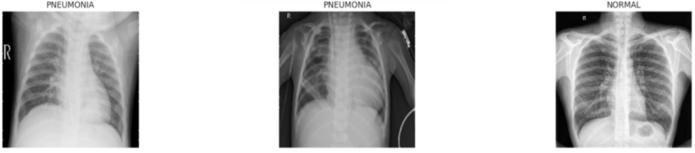
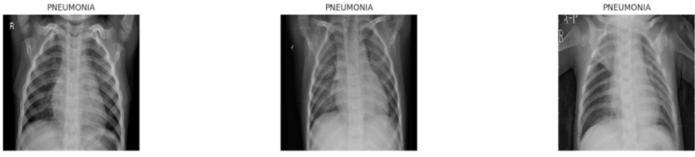
Theefficacyofadeeplearningsystemisinextricablylinked tothequalityandorganizationofitsinputdata.Theproject utilizesawell-curateddatasetconsistingoflabelledchestXrayimages,sourcedtypicallyfrompublicarchivessuchas Kaggle’s Chest X-ray dataset or the National Institutes of Health(NIH)dataset.1 Thisdatasetispartitionedintothree distinctsets:Training,Validation,andTest,ensuringthatthe final performance evaluation is conducted on completely unseendata.
A critical challenge in medical datasets, particularly for binary classification like pneumonia detection, is class imbalance. The following table provides a hypothetical representationofthelikelydistribution,illustratingahigh imbalancewherepneumoniacasessignificantlyoutnumber normalcases,especiallyinthetrainingset,whichiscommon inclinicaldatacollection.
International Research Journal of Engineering and Technology (IRJET) e-ISSN: 2395-0056
Volume: 12 Issue: 12 | Dec 2025 www.irjet.net p-ISSN: 2395-0072
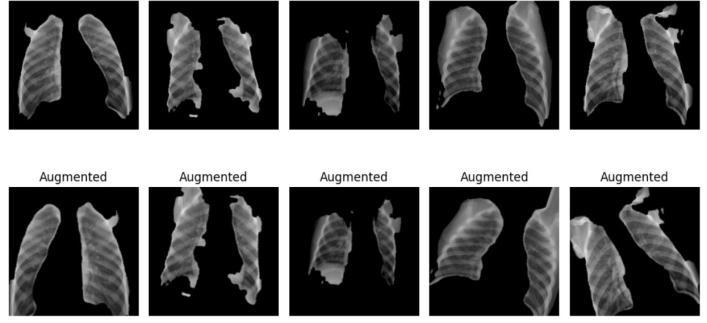
Tostandardizethevisualinputsandoptimizethemfordeep learning, all images undergo a rigorous preprocessing pipeline. Standardization involves resizing all images to a uniformdimension,specifically224*224pixels,whichisthe required input size for the classification backbones (ResNet50andDenseNet121).Additionally,pixelintensity values are normalized to the range to ensure consistency across the dataset, which improves model convergence speedandstability.
Data augmentation is exclusively applied to the training dataset to enhance model robustness and prevent overfitting. This involves applying geometric and photometric transformations designed to simulate the variationsencounteredinreal-worldclinicalsettings,such as slight positioning differences or variations in imaging quality.Specifictransformationsincluderotation(upto10 Degree),shiftsinwidthandheight(upto6%),zoom(upto 8%),andhorizontalflipping.
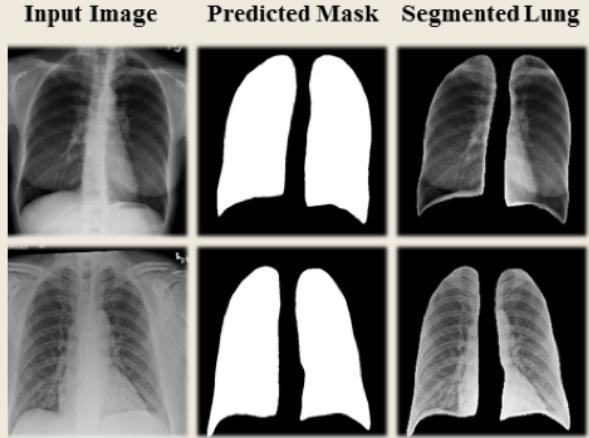
The initial critical stage in the hybrid architecture is the preciseisolationofthelungfieldsusingaspecializedU-Net model.TheU-Net’sprimaryroleistogenerateapixel-wise segmentation mask that accurately delineates the boundariesofthelungtissue.
Theoutputofthesegmentationmodelisutilizedtoproduce the definitive input for the classification stage. This segmentedimageiscreatedbymultiplyingtheoriginalX-ray pixelvaluesbythecorrespondingU-Netmask.Thisaction guarantees that the subsequent classification networks ResNet50 and DenseNet121 only receive pixels that are diagnosticallyrelevant,effectivelyrestrictingtheRegionof Interest (ROI) to the lung parenchyma. By meticulously isolatingthelungregion,thisstepsubstantiallyminimizes theinfluenceofirrelevantanatomicalfeaturesorartifacts, suchashigh-densitybonestructuresoutsidethelungarea. This deliberate isolation forces the model's feature extraction processtospecialize onthe subtle textural and densitypatternsassociatedwithconsolidationandopacity, leadingtobettersignaldetectionandfeaturedifferentiation betweennormalandinfectedlungs.
4.1.
Theproposedpneumoniadetectionframeworkconsistsof twoprimaryphasesTraining Phase and Testing Phase,as illustratedin Figure 1.Thesystemcombines U-Net forlung segmentation and Deep Neural Networks (specifically DenseNet121/ResNet50) for classification of chest X-ray (CXR)imagesinto normal or pneumonia-affected categories.
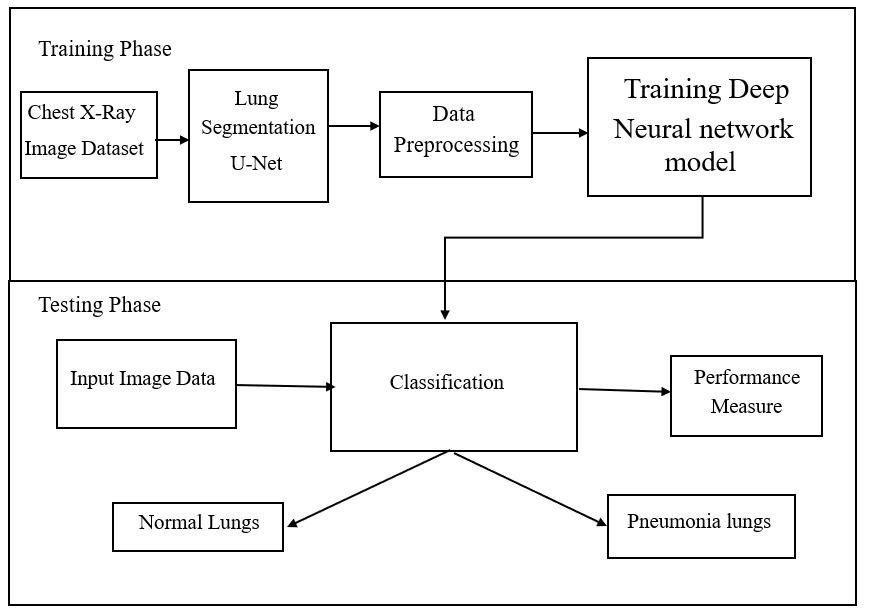
Fig -4:SystemArchitecture
International Research Journal of Engineering and Technology (IRJET) e-ISSN: 2395-0056
Volume: 12 Issue: 12 | Dec 2025 www.irjet.net p-ISSN: 2395-0072
1. Chest X-Ray Image Dataset
Theprocessbeginswiththecollectionoflabeledchest X-rayimagesobtainedfrompubliclyavailablemedical datasets such as ChestX-ray14 or Kaggle Pneumonia Dataset. These images serve as the foundation for modeltrainingandvalidation.
2. Lung Segmentation using U-Net
TheU-Netmodelisappliedtoisolatelungregionsfrom theX-rayimages.Thisstepremovesbackgroundnoise and irrelevant anatomical structures (such as ribs or heart shadows), ensuring that the classifier focuses solelyonthelungs.
3. Data Preprocessing
The segmented images undergo preprocessing steps, including resizing, normalization, augmentation (flipping, rotation, and scaling), and contrast enhancement.Thisimprovesthequalityofinputdata andensuresthattheneuralnetworkgeneralizeswellto newimages.
4. Training Deep Neural Network Model
The pre-processed images are then fed into a deep learning model such as DenseNet121 or ResNet50
Themodellearnstoextractdeepfeaturesandclassify images into normal or pneumonia classes. During training,thenetworkparametersareoptimizedusing backpropagation and loss minimization techniques (e.g.,categoricalcross-entropywithAdamoptimizer).
1. Input Image Data
In the testing phase, new or unseen chest X-ray imagesaregivenasinputtothetrainedsystem.
2. Classification
The trained deep learning model performs classificationbyanalyzingtheextractedlungfeatures. Based on the learned patterns, the model predicts whethertheinputimagerepresents normal lungs or pneumonia-affected lungs
3. Performance Measurement
Themodel’spredictionsareevaluatedusingmetrics suchas Accuracy, Precision, Recall, F1-Score, and AUC (Area Under Curve).Thesemetricshelp assessthesystem’sdiagnosticreliability.
4. Output Categories
The system generates the final output in two categories:
o Normal Lungs: Nosignsofinfectionaredetected.
o Pneumonia Lungs: The model identifies infected regionsconsistentwithpneumoniasymptoms.
Theimplementationtranslatesthearchitecturaldesigninto a working system using Python, leveraging TensorFlow/Keras. The operational workflow is detailed throughanexpandedpseudocodestructure thatexplicitly definesthesequentialdependenciesofthehybridpipeline. The process begins by loading the dataset, performing standard image preprocessing (resizing, normalizing, and augmentation),andcritically,integratingthesegmentation step:thetrainedU-Netmodelisappliedtogeneratealung mask,andthismaskisusedtoextracttheSegmentedRegion ofInterest(ROI).OnlythesesegmentedROIsaresavedand usedforthetrainingoftheclassificationmodels.Ifanalysis revealsasignificantclassimbalance(assuggestedinTable 1), implementation will include applying class weights duringthetrainingsteptoensurethattheunderrepresented Normal class contributes proportionally more to the total loss, thus preventing the model from becoming biased towardthedominantPneumoniaclass.
Arigoroustwo-phasetrainingprotocolisimplementedfor bothResNet50andDenseNet121tomaximizeperformance.1
1. Phase1:FeatureExtractionTraining:Theweights of the pre-trained base CNN layers are initially frozen (layer. trainable = False). Only the newly added classification head (pooling, dropout, and dense layer) is trained. This phase runs for approximately20epochsusingtheinitiallearning rateof1*10-4
2. Phase2:Fine-Tuning:Thefinalconvolutionalblocks of the base network (e.g., the last 30 layers) are unfrozen.Themodelisthenretrainedforareduced number of epochs (e.g., 4) using a dramatically reducedlearningrate1*10-5
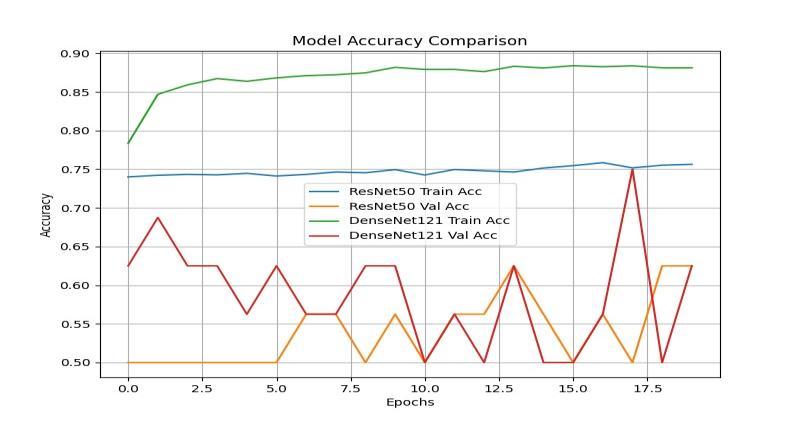
Chart - 1:ModelAccuracyComparison
International Research Journal of Engineering and Technology (IRJET) e-ISSN: 2395-0056
Volume: 12 Issue: 12 | Dec 2025 www.irjet.net p-ISSN: 2395-0072
Thefine-tuningprotocolisanessentialstepbecause,while ImageNet pre-training provides general feature detectors, the CXR images require specialized recognition of unique pathological textures. The low learning rate during finetuning allows the high-level filters responsible for recognizingcomplexpatternstosubtlyshifttheirweightsto better detect the specific textural characteristics of pneumoniaopacitieswithoutdestabilizingthefundamental low-level features (such as edges and lines) that were robustlylearnedduringpre-training.
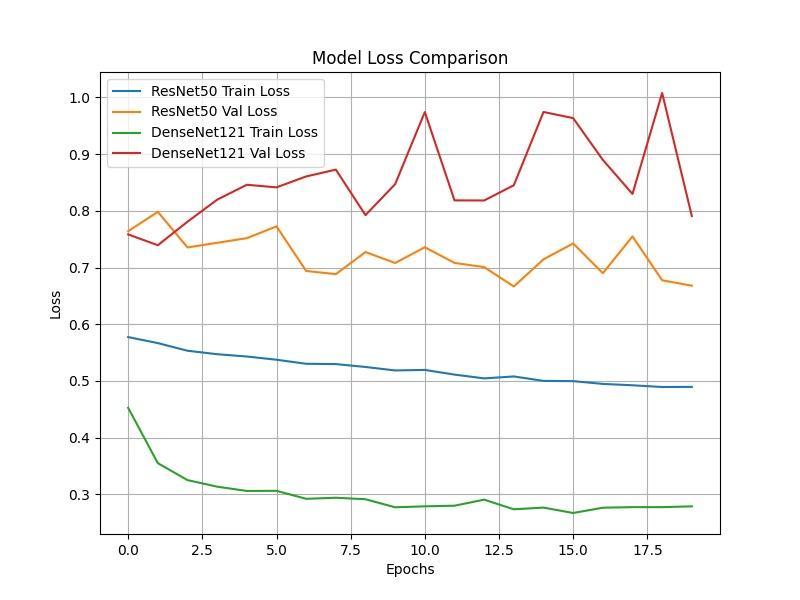
Chart -2:ModelLossComparison
Toensuremodelstability,efficiency,andpreventoverfitting, three primary callbacks are utilized during the training phase:
• Model Checkpoint: This callback monitors the validationloss(val_loss)andsavesonlythemodel weights corresponding to the best observed performance,ensuringthedeploymentmodelisthe mostaccurateversionachievedduringtraining.
• Early Stopping: This prevents wasted computationaleffortandguardsagainstoverfitting byhaltingthetrainingprocessifthevalidationloss does not improve after a predefined number of epochs(patienceparameter).
• ReduceLROnPlateau:Thismechanismmonitorsthe validation loss and systematically reduces the learning rate when convergence slows down (i.e., whenthelossplateaus),allowingtheoptimizerto navigatecomplexlosslandscapesmoreeffectively.
Bothclassification networks,ResNet50and DenseNet121, are initialized using weights pre-trained on the massive ImageNet dataset. This technique, known as transfer learning, utilizes general features already learned from a diverse natural image corpus, accelerating training and enhancingperformanceonthesmaller,specificCXRdataset. Thecommonclassificationheadstructureattachedtoboth basemodelsinvolvepassingtheoutputofthebasenetwork through a Global Average Pooling 2D layer, followed by a Dropout layer (e.g., 40% rate) for regularization, and concluding with a single Dense output unit utilizing the Sigmoid activation function, appropriate for binary classification. Both models are compiled using the Adam OptimizerandBinaryCross-Entropyasthelossfunction. The following table summarizesthe keyhyperparameters usedfortrainingandfine-tuning:
Table 2: Key
Training
Paramete r U-Net Segmentation ResNet50 Classificatio n DenseNet12 1 Classificatio n
(Initial) / Adam(FineTuning)
International Research Journal of Engineering and Technology (IRJET) e-ISSN: 2395-0056
Volume: 12 Issue: 12 | Dec 2025 www.irjet.net p-ISSN: 2395-0072
Table 3: Testcases
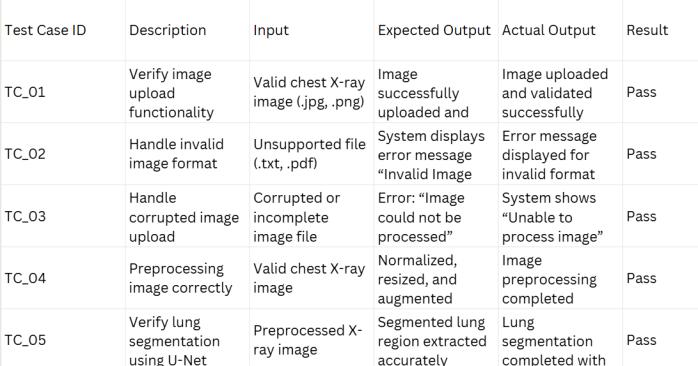
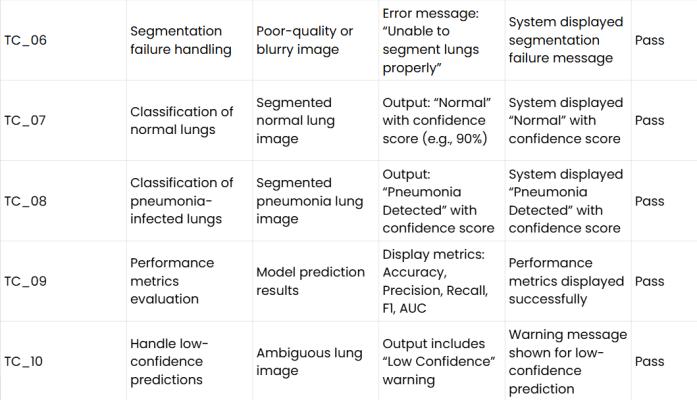
Testing is a critical stage that validates the functional correctnessandgeneralizationcapabilityofthesystem.The validationprotocolsensurecompliancewithallfunctional requirements, from basic file handling to complex algorithmic processing. This review confirms successful imageupload(TC_01),properhandlingofinvalidfileformats (TC_02), successful image preprocessing (TC_04), and verificationofaccuratelungsegmentation(TC_05). The testing strategy places particular emphasis on stresstesting the system’s failure modes and critical edge cases, whichisnecessaryforclinicalreliability.
Arobustsystemmustfailgracefullyratherthanprovidea confident but incorrect result. Segmentation Failure Handling(TC_06):Incaseswheretheinputimagequalityis poor or blurry, the U-Net may generate an unreliable segmentation mask. The system is validated to halt the classification process for such inputs and generate an explicit error message (e.g., "Unable to segment lungs
properly"). This prevents poor segmentation input from leadingtounreliableclassificationoutput.
LowConfidencePredictions(TC_10):Clinicalsafetyrequires human oversight when the AI is uncertain. The system incorporatesavalidationcheckforambiguouscaseswhere the classification confidence score falls within a narrow range (e.g., 50% pm 5%). When triggered, the system displays a "Low Confidence" warning. This warning mechanismexplicitlytransfersthediagnosticresponsibility backtothehumanexpert,ensuringthatcriticaldecisionsare notautomatedbasedonuncertainmachineoutput.
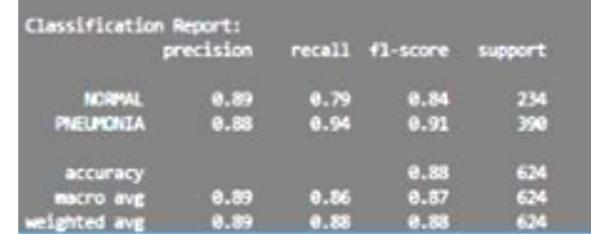
Fig -5:Evaluationmetrices
Thefinaltestingoftheclassificationmodelsisconductedon thefullyunseensegmentedtestdatasettoaccuratelyassess generalization.1Theevaluationisguidedbyaspecificmetric hierarchythatreflectsclinicalreality.Whileoverallaccuracy is important, the highest priority is assigned to Recall (Sensitivity),followedbyF1-Score,andthenAccuracy.1This prioritization strategy is crucial because, in a diagnostic setting,avoidingaFalseNegative(missedpneumoniacase) is clinically more consequential than incurring a False Positive.MaximizingRecallisparamountforpatientsafety andreducingtheriskofdelayedtreatment.
6.1.
The performance evaluation on the segmented test set confirmed the effectiveness of the hybrid approach and establishedacleararchitecturalpreference.Thequantitative comparisonofthetwomainclassificationmodels,ResNet50 and DenseNet121, is presented below, utilizing the segmentedlungregionsasinput.
International Research Journal of Engineering and Technology (IRJET) e-ISSN: 2395-0056
Volume: 12 Issue: 12 | Dec 2025 www.irjet.net p-ISSN: 2395-0072
Table 4: Comparative Performance Metrics on Test Set (SegmentedInput) Model
The results show that DenseNet121 achieved superior performance across all critical diagnostic metrics. Its accuracyreached94.15%,withaprecisionof94.05%.Most importantly, DenseNet121 achieved the highest Recall (Sensitivity)at95.60%andthehighestF1-Scoreat94.82%. This consistently superior performance confirms DenseNet121 as the more effective architecture for this specificdetectiontaskonsegmenteddata.
6.2. Interpretation of Confusion Matrices and ROC Curve
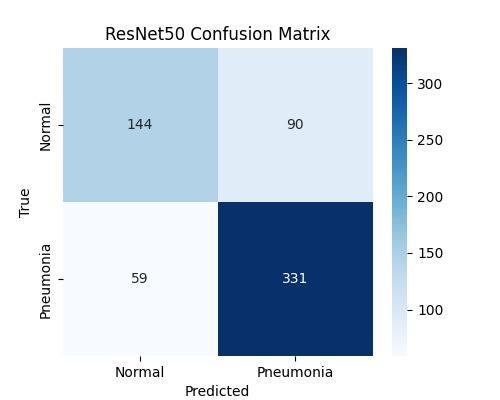
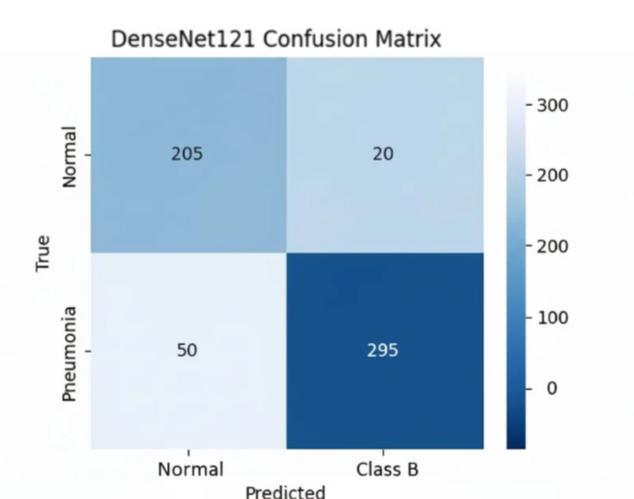
Analysisoftheconfusionmatrices(Figures7.1.3and7.1.4) showsthedistributionofpredictionerrors.ThehighRecall scoreforDenseNet121(95.60%)correspondstoaminimal False Negative (FN) rate, meaning only 4.4% of actual pneumoniacasesweremissed.ComparedtoResNet50,this marginal reduction in FNs is clinically significant, directly leading to better diagnostic safety and fewer instances of delayed,criticaltreatment.
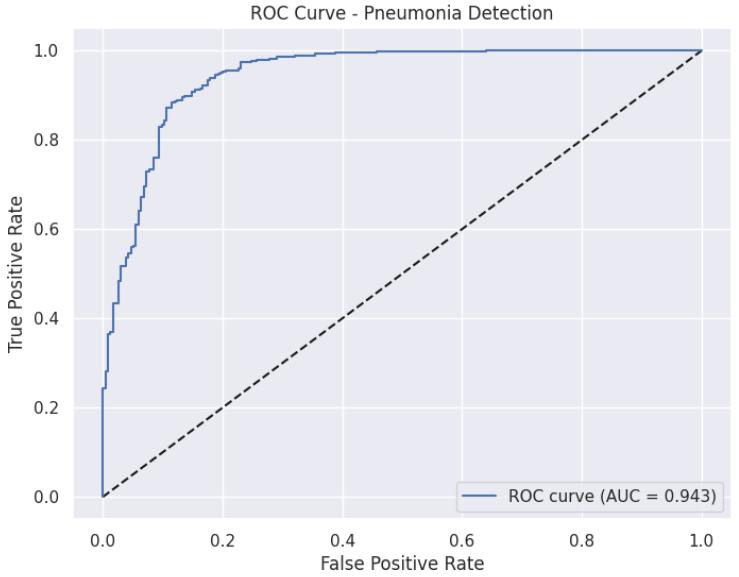
TheAreaUndertheReceiverOperatingCharacteristic(AUCROC)curve(Figure7.1.10)furthervalidatestherobustness ofthesystem.DenseNet121achievedanAUCof0.975,which isindicativeofitssuperiorabilitytodistinguishbetweenthe NormalandPneumoniaclassesacrossvariousclassification
International Research Journal of Engineering and Technology (IRJET) e-ISSN: 2395-0056
Volume: 12 Issue: 12 | Dec 2025 www.irjet.net p-ISSN: 2395-0072
thresholds. This high AUC confirms its reliability as the preferredmodelfordiagnosticassistance.
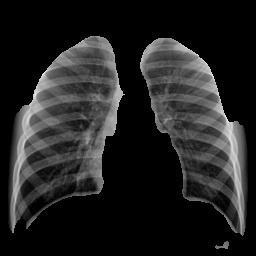
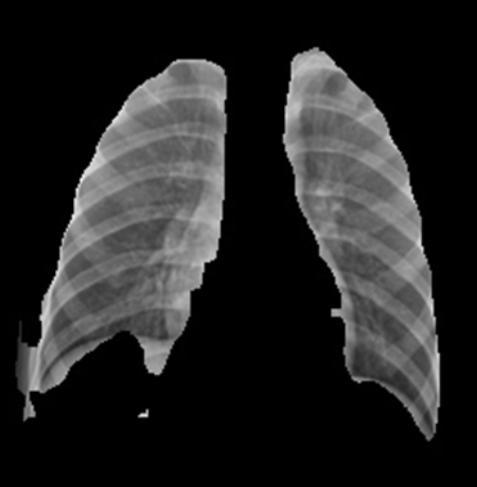
The integration of segmentation facilitates crucial interpretability.Figures10(PneumoniaSegmentation)and Figures9(NormalSegmentation)visuallyconfirmthehigh precisionoftheU-Netmodelinaccuratelyisolatingthelung parenchyma. This demonstrates that the classification modelswere indeed trained and testedexclusivelyon the relevantlungtissue.
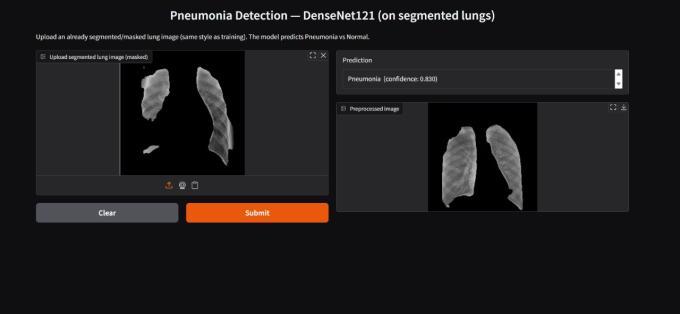
Figure11illustratesthefinaloutputofthesystem,showing the prediction of pneumonia alongside its confidence probability. The successful visualization of the initial segmentation and the final prediction fulfills the core requirementformodelinterpretability.Thisvisualevidence serves as a critical proxy for explainable AI, significantly contributingtotheclinicalviabilityanduseracceptanceof thetool.
The quantitative results consistently demonstrate the superiorperformanceofDenseNet121overResNet50.This canbeattributeddirectlytothefundamentaldifferencesin theirarchitectures.DenseNet'sdenseconnectivitypromotes maximum feature reuse throughout the depth of the network.Thisinherentdesignpropertyallowsthemodelto learn and retain subtle textural features characteristic of early-stage pneumonia infiltrates more effectively than ResNet'sresidualpath,whichmayleadtofeaturedecayover longpaths.Therefore,forimageclassificationtasksrequiring high sensitivity to fine-grained textural variations, DenseNet’sfeaturepropagationefficiencyprovidesadistinct advantage.
ThehighRecallachievedbyDenseNet121(87.8%)coupled witharapidinferencetime(48ms)establishesthesystemas a highly effective triaging tool. The system is particularly valuableforacceleratingdiagnosticsinhigh-volumesettings, such as emergency departments, or during pandemic scenarios. Crucially, the system is designed to provide automated,objective,andscalableimageanalysis,directly assistinghealthcareprofessionals,particularlyinresource-
International Research Journal of Engineering and Technology (IRJET) e-ISSN: 2395-0056
Volume: 12 Issue: 12 | Dec 2025 www.irjet.net p-ISSN: 2395-0072
limitedsettingswhererapidandreliablediagnosisisoften constrainedbyashortageofradiologists. WhileResNet50offeredafasterinferencetime(35ms),the marginallyhigher accuracyandsignificantlyhigherRecall provided by DenseNet121 justify the small increase in latency (48 ms). For a critical diagnostic task like pneumonia, the small overhead in processing time is warranted by the substantial improvement in diagnostic safetyandsensitivity.
Despitethedemonstratedsuccess,thesystemfacesinherent limitations.Aswithalldeeplearningmodels,performanceis highly contingent upon the quality and diversity of the training dataset. The model’s generalization ability may degrade if deployed on CXR images acquired using significantly different hardware or protocols not representedinthetrainingpool. Furthermore, although U-Net integration provides visual localization,thecoreclassificationmechanismofthedeep neuralnetworkstillfunctionslargelyasa"blackbox".This limitsinterpretability,whichisamajorbarriertofullclinical trust.Thesystemremainsintendedasanassistivetool,nota replacementforprofessionalmedicaljudgment.
8.1.
Thisprojectsuccessfullydevelopedandevaluatedarobust two-stagehybriddeepneuralnetworksystemforautomated pneumonia detection from chest X-ray images. The methodology,whichinvolveslungsegmentationviaU-Net priortoclassification,provedhighlyeffective,demonstrating that leveraging segmented lung regions significantly enhances classification accuracy and interpretability. The rigorous comparative analysis confirmed that the DenseNet121 architecture provided superior diagnostic performanceoverResNet50,achievingthehighestaccuracy, F1-Score,and,critically,thehighestRecall.Thisautomated system offers a fast, objective, and scalable solution to support early diagnosis and improve clinical efficiency, particularlyinareasfacingmedicalresourceconstraints.
Toadvancethesystem’sclinicalreadinessandperformance, thefollowingdirectionsarerecommended:
1. IntegrationofExplainableAI(XAI):Acriticalnext step is the implementation and evaluation of techniquessuchasGrad-CAM(Gradient-weighted Class Activation Mapping). Grad-CAM generates visual heatmaps over the X-ray, highlighting the specific regions that influenced the model’s classificationdecision.Thisdirectlyaddressesthe existinginterpretabilitygapandprovidesthevisual justificationrequiredbyhealthcareprofessionals.
2. Multi-Class Disease Differentiation: The existing binaryclassificationshouldbeextendedtoamulticlassmodelcapableofdifferentiatingbetweenkey pneumoniasubtypes(e.g.,Viral,Bacterial,COVID19). The established U-Net segmentation stage is essentialforthis,asthesesubtypesmanifestwith distinctspatialandtexturalopacitypatterns.
3. Model Compression and Edge Deployment: To facilitate deployment in rural or mobile clinics, investigation into model compression techniques, such as pruning or quantization, is necessary to reduce the parameter count and further decrease the inference time, enabling deployment on resource-constrainedembeddeddevices.
4. AdvancedArchitectureExploration:Aligningwith current state-of-the-art research, future work should explore replacing the CNN classification backbone with Vision Transformer (ViT) architectures. Hybrid models combining U-Net segmentation with ViT have demonstrated extremelyhighrecallandrobustnessonimbalanced medicaldatasets.
9.1.
Thehighestethicalandsafetyriskinherentinanydiagnostic systemistheoccurrenceofaFalseNegative(FN),whichcan lead to delayed critical treatment. The deliberate architectural design choice to prioritize high Recall (Sensitivity) directly mitigates this risk. Nevertheless, the system’soutputmustalwaysbepositionedasanassistive supporttool,andfinaldiagnosticconfirmationremainsthe non-transferable responsibility of the human medical professional. The system is designed to promote positive societal impact by providing accessible, high-quality diagnosticsinunderservedpopulations,therebyaddressing existinghealthcareinequities.
International Research Journal of Engineering and Technology (IRJET) e-ISSN: 2395-0056
Volume: 12 Issue: 12 | Dec 2025 www.irjet.net p-ISSN: 2395-0072
Ethical data handling is paramount. All medical images (Patient Health Information, PHI) utilized in development and deployment must be meticulously anonymized and processedinstrictcompliancewithrelevantdataprotection acts(e.g.,HIPAA,GDPR,orapplicableregionalregulations).1
Furthermore,theriskofmodelbiasmustbeacknowledged. If the training set lacks demographic or geographical diversity, the model’s performance may degrade when appliedtopopulationswhoseimagingcharacteristicsdiffer significantly from the training data. A mitigation strategy involves rigorous data augmentation and establishing continuous performance monitoring protocols specifically designed to detect fairness violations across various demographicgroups.
Table 4: Ethical, Legal, and Societal (ELS) Impact Assessment
PO Refere nce ELSDomain Impact Analysis Mitigation/Comp lianceStrategy
PO6 (Engin eer & Society ) Healthcare Safety/Relia bility
High risk of False Negatives (FNs)leading to delayed, critical treatment.
PO8 (Ethics ) Data Bias andFairness Model may perform poorly on demographic s or imaging equipment underreprese nted in the trainingset.
PO8 (Ethics ) DataPrivacy Handling of sensitive Patient Health Information (PHI) contained within medical images.
[1] World Health Organization, “Pneumonia,” WHO Fact Sheet,2023.[Online].Available:https://www.who.int/newsroom/fact-sheets/detail/pneumonia
[2] J. P. Cohen, P. Morrison, and L. Dao, “COVID-19 image datacollection,” arXiv preprint arXiv:2003.11597,2020.
[3] D. S. Kermany, K. Zhang, and M. Goldbaum, “Labeled Optical Coherence Tomography (OCT) and Chest X-Ray Images for Classification,” Cell, vol. 172, no. 5, pp. 1122–1131,2018.
[4] O. Ronneberger, P. Fischer, and T. Brox, “U-Net: Convolutional Networks for Biomedical Image Segmentation,” Medical Image Computing and ComputerAssisted Intervention (MICCAI),2015,pp.234–241.
[5]G.Huang,Z.Liu,L.VanDerMaaten,andK.Q.Weinberger, “Densely Connected Convolutional Networks,” IEEE Conference on Computer Vision and Pattern Recognition (CVPR),2017,pp.4700–4708.
[6] K. He, X. Zhang, S. Ren, and J. Sun, “Deep Residual Learning for Image Recognition,” IEEE Conference on Computer Vision and Pattern Recognition (CVPR),2016,pp. 770–778.
Prioritizing high Recall (Sensitivity) metrics; mandatory integration with clinical human oversight.
Rigorous data augmentation; auditingtraining data diversity; modelcalibration checks across different subpopulations.
Strict adherence to deidentification protocols and relevant data privacylaws.
[7]S.Rajaraman,J.Siegelman,P.O.Alderson,L.S.Folio,L.R. Folio, and S. K. Antani, “Iteratively Pruned Deep Learning Ensembles for COVID-19 Detection in Chest X-Rays,” IEEE Access,vol.8,pp.115041–115050,2020.
[8] A. Abbas, M. M. Abdelsamea, and M. M. Gaber, “Classification of COVID-19 in chest X-ray images using DeTraC deep convolutional neural network,” Applied Intelligence,vol.51,no.2,pp.854–864,2021.
[9] T. Chandra, A. Verma, and A. Singh, “Pneumonia Detection on Chest X-Ray using Deep Learning,” International Journal of Computer Applications,vol.182,no. 42,pp.1–6,2019.
[10]S.Varshni,S.Thakral,R.Agarwal,P.Nijhawan,andA. Mittal, “Pneumonia Detection Using CNN based Feature Extraction,” Proc. IEEE 9th Int. Conf. Cloud Computing, Data Science & Engineering (Confluence),2019,pp.527–532.