
International Research Journal of Engineering and Technology (IRJET) e-ISSN: 2395-0056
Volume: 12 Issue: 03 | Mar 2025 www.irjet.net p-ISSN: 2395-0072
International Research Journal of Engineering and Technology (IRJET) e-ISSN: 2395-0056
Volume: 12 Issue: 03 | Mar 2025 www.irjet.net p-ISSN: 2395-0072
Akshatha T, Akshatha S.A
1Professor, Dept. of Artificial Intelligence and Data Science Engineering, Bearys Institute of Technology, Mangalore, Karnataka
2Professor, Dept. of Computer Science and Engineering, Bearys Institute of Technology, Mangalore, Karnataka
Abstract - Theobjectiveofthispaperistoidentifyrealor fakemessagebyusingmachinelearning.Machinelearning algorithms play a crucial role in differentiating between authenticandfalsenewsarticles.HerewehaveusedLogistic Regression,GradientBoostingClassifier(GBC),andRandom ForestClassifierbecauseoftheireffectivenessinhandling text-based classification tasks. Two datasets containing 1,000 real and fake messages are preprocessed and then splitintotrainingandtestingdatasets.Thetestingdatasetis usedtoevaluatethetrainedmodels.Afterfourmodelswere trainedclassificationreportwasgeneratedandmanualtest wasperformedtocheckwhethermassageisrealoffake.
Key Words: Machinelearning,fakeandrealnews,Logistic Regression, Gradient Boosting Classifier (GBC), Random ForestClassifier
Detecting real and fake news is crucial to preventing misinformation, safeguarding democracy, and minimizing negative societal impacts. False information can deceive people, influence opinions, and cause unnecessary fear, particularlyinareaslikepolitics,health,andfinance.Italso erodestrustinmediaandinstitutionswhileenablingfraud and cybercrimes. By distinguishing between genuine and misleading news, we can ensure the spread of accurate information,promotecriticalthinking,andhelpindividuals make well-informed decisions based on credible sources. Thereexistvariousmethodsofdetectingfakeandoriginal news.
One of the most effective ways to verify information is through manual fact-checking. Websites like Snopes, PolitiFact,andFactCheck.organalyzeclaimsusingcredible sourcesandexpertevaluations.Additionally,individualscan comparetheinformationwithwell-establishednewssources todetermineitsreliability.Ifamessagelacksconfirmation fromtrustedorganizations,itislikelymisleadingorfalse.
b AI and Machine Learning-Based Detection
Artificialintelligence(AI)andmachinelearning(ML)playa key role in identifying misinformation. Natural Language
Processing (NLP) examines text structure, sentiment, and word patterns to detect inconsistencies. Deep learning modelsanalyzelargedatasetstorecognize characteristics common in fake news. These automated systems enhance the speed and accuracy of misinformation detection comparedtomanualmethods.
c
Evaluating the source of a message is essential in determiningitsauthenticity. Trustedsourcesaretypically transparent about their authorship and maintain a strong track record of accuracy. Examining metadata, including publication date, author details, and domain credibility, helps in assessing reliability. Websites that provide little information about their origins or frequently publish exaggeratedcontentmaybeunreliable.
The spread of misinformation is often linked to bots and coordinatedcampaigns.Byanalyzingsocialmediaactivity, unusual trends can be detected, such as new accounts repeatedly posting the same message. Another sign of misinformation is abnormal engagement, where content receives many shares but limited meaningful discussion. Identifyingthesepatternshelpsinrecognizingandlimiting thespreadoffakemessages.
Misleadingmessagesfrequentlycontainalteredimagesor videos to distort facts. Reverse image search tools, like Google Reverse Image Search and TinEye, help verify whether an image has been edited or used out of context. Additionally, deepfake detection technology examines inconsistenciesinvideoelements,suchasunnaturalfacial movements or lighting, which may indicate digital manipulation.
Inourresearchwehaveusedmachinelearningmethodsto identify the fake and original news. The methodology involves first collecting the data, classifying the data, data preprocessing, feature extraction, Model training and Evaluation,Modeltestingandthenresult.
Volume: 12 Issue: 03 | Mar 2025 www.irjet.net p-ISSN: 2395-0072
Data loading and Labeling:
The fake and real news datasets were downloaded from GitHub in .CSV format, with each dataset having a size of approximately 60 MB. The number of real and fake news messagesinthedatasetarebalanced,withanequalnumber ofrealandfakearticles.The'real.csv'and'fake.csv'datasets arestoredinafolderandthenloadedintotheprogramusing pandas by specifying the correct file paths on the local system.Thesetwodatasetsarethenstoredintwovariables, true and fake, as pandas DataFrames, which allow for manipulation, processing, and analysis of the data. A new columnnamed'label'iscreatedineachdataset,wherethe value '0' is assigned to the fake news dataset and '1' is assignedtotherealnewsdataset.
Data Preprocessing:
In the data preprocessing step, the first operation is to concatenate the two datasets using concat(), creating a singledatasetnamed'news'thatcombinesboththefakeand real news datasets.In the next step, the ‘news’ dataset is cleanedbyeliminatingmissingvaluesanddroppingcolumns that are not required. In further purification, the wordopt functionconvertsthetexttolowercaseandremovesURLs, HTMLtags,punctuation,numbers,andnewlinecharactersin thetextcolumnofthe‘news’dataframe.Theprocessedtext andlabelsarestoredintwovariables,xandy.
Weusethetrain_test_split functiontodividethedatainto training and testing sets. The dataset is split into x_train, x_test, y_train, and y_test, with half of the data (50%) allocated to the test set (test_size=0.5). Next, the TfidfVectorizer is imported to transform the text data (x_trainandx_test)intonumericalfeaturevectorsusingthe Term Frequency-Inverse Document Frequency (TF-IDF) method.
Model training and Evaluation:
Themodelsweredevelopedusingfouralgorithms:Logistic Regression, Decision Tree Classifier, Random Forest Classifier,andGradientBoostingClassifier.Thesealgorithms weretrainedonthetextdatatransformedusingTF-IDFto evaluatetheirperformanceintextclassification.Onceeach model was trained, we produced a classification report to assesstheirperformance.
Model testing:
TheLogisticRegression,GradientBoostingClassifier(GBC) andRandomForestClassifierareusedtopredictwhether newsisfakeorgenuine,anditalsoallowsformanualtesting byinputtinganewarticle.
3.Result:
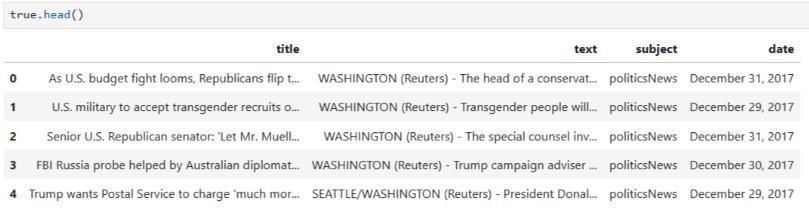
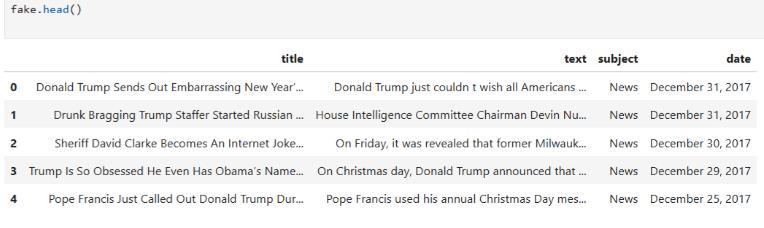
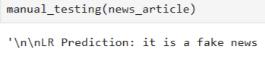

New_article=str(input()) function will take the input from the user and and manual_testing(news_article) function displaystheoutputafterprediction. Infigure-3wecansee theresultobtainedfromthreedifferenttrainedmodels.LR, GBCandRFCareidentifiedtheinputmessageasfake.
The code successfully handles basic model training and testing, but there are multiple opportunities for improvement. These include addressing edge cases, optimizing hyper parameters, comparing model performance, and incorporating more advanced text preprocessing techniques. By refining these aspects, the
International Research Journal of Engineering and Technology (IRJET) e-ISSN: 2395-0056
Volume: 12 Issue: 03 | Mar 2025 www.irjet.net p-ISSN: 2395-0072
model's overall performance and reliability can be significantlyimproved.
1) MichaelCrawford,Taghi.M,Khoshgoftaar,Joseph.D. Prusa AaronN.RichterandHamzahAlNajada"Studyofauditspam identification utilizing AI strategies" Journal of Big Data (2015) 2:23 ,Springer diary , DOI 10.1186/s40537-0150029-9.
2)KolliShivagangadhar,SagarH,SohanSathyan,Vanipriya C.H"FraudDetectioninOnlineReviewsutilizingMachine Learning Techniques" International Journal of ComputationalEngineeringResearch,Volume,05,Issue05, May-2015,ISSN(e):2250-3005.
3)Elmurngi,E.,Gherbi,A.(2018).Fakereviewsdetectionon moviereviewsthroughsentimentanalysisusingsupervised learning techniques. International Journal on Advances in SystemsandMeasurements,11(1):196-207.
4) Karupusamy, S., Maruthachalam, S., Mayilswamy, S., Sharma, S., Singh, J., Lorenzini, G. (2021). Efficient computation for localization and navigation system for a differential drive mobile robot in indoor and outdoor environments.Revued'IntelligenceArtificielle,35(6):437446.https://doi.org/10.18280/ria.350601
5) Al-Adhaileh, M.H., Alsaade, F.W. (2022). Detecting and analysing fake opinions using artificial intelligence algorithms.IntelligentAutomation&SoftComputing,32(1): 644-655.https://doi.org/10.32604/iasc.2022.02225