
International Research Journal of Engineering and Technology (IRJET) e-ISSN: 2395-0056
Volume: 12 Issue: 03 | Mar 2025 www.irjet.net p-ISSN: 2395-0072
International Research Journal of Engineering and Technology (IRJET) e-ISSN: 2395-0056
Volume: 12 Issue: 03 | Mar 2025 www.irjet.net p-ISSN: 2395-0072
Siddharth More1, Rajat Pandit2, Yash Salunke3 , Rohit Jawale4, Prof. Dr.Radhika Nanda5
1,2,3,4 B.E. Students Department of Computer Engineering 5 HOD, Department of Computer Engineering, Bharat College of Engineering, Opp. Gajanan Maharaj Temple, Kanhor Road, Badlapur (West), Thane, Maharashtra - 421503
Abstract – In today's digital era, emails have become a fundamental mode of communication for both personal and professional purposes. However, with the growing number of email users, the volume of spam emails has also increased. Spam, often referred to as junk mail, consists of unwanted messages sent in bulk to multiple recipients, typically for commercial gain. These emailsmayincludephishingattempts, image-based spam, malware, lottery scams, advertisements, and other unsolicited content.
Spam not only clutters inboxes with irrelevant messages but also poses security risks. It can slow down internet performance and enable cybercriminals to extract sensitive information, such as personal details, professional contacts, and financial data. As a result, distinguishing spam from legitimate (ham) emails is crucial.
Tocombat this issue, spamfilters are employedtoidentifyand block unwanted, unsolicited, and potentially harmful emails before they reach the inbox. Various machine learning and deep learning techniques are used for spam detection, with some of the most effective being convolutional neural networks (CNN), support vector machines (SVM), and naïve Bayes (NB).
Spam Email,phishingscams,unwanted communications, machine learning, convolution neural network CNN, support vector machine SVM, naïve bayes NB.
TheInternethasbecomeanintegralpartofmodernsociety, enablingseamlesscommunicationandglobalconnectivityat anytimeandfromanylocation.Oneofthemostwidelyused internet-based communication tools is email (electronic mail),whichisutilizedbystudents,professionals,business people, and government officials. Since sending emails is typically free, spammers exploit this feature to distribute largevolumesofunwantedmessages.
Initially,mostspamemailscontainedplaintext,however,as text-based spam filters improved by analyzing email headers, body content, and other features, spammers adapted by embedding text within images a technique known as image spam. They began incorporating backgrounds, noise, and other distortions into images to
evadedetectionfurther.Tocounterthis,OpticalCharacter Recognition(OCR)technologywasdevelopedtoextracttext from images, allowing traditional text-based filtering techniques, such as Naïve Bayes and other classification methods, to be applied. Despite these advancements, spammers continually evolve their strategies to bypass security measures, making spam detection an ongoing challenge.

This discussion focuses on how machine learning can enhance spam email detection while improving email optimization.Asemailusagecontinuestogrow,spamemails have become a major concern, leading to security threats and overcrowded inboxes. Machine learning techniques, including convolutional neural networks (CNN), support vectormachines(SVM),andnaïveBayes(NB),playacrucial roleinaccuratelyidentifyingandfilteringspammessages. Furthermore,craftingwell-structuredandoptimizedemails helps prevent legitimate messages from being mistakenly markedasspam.
International Research Journal of Engineering and Technology (IRJET) e-ISSN: 2395-0056
Volume: 12 Issue: 03 | Mar 2025 www.irjet.net p-ISSN: 2395-0072
1.1.1 Enhancing Security:
Spam emails frequently include harmful elements like malware, ransomware, or phishing links, which can jeopardizebothpersonalandorganizationaldatasecurity. Implementing effective spam detection and filtering mechanisms is essential to safeguarding users from these potentialthreats.
1.1.2 Improving Productivity:
Aclutteredinboxfilledwithspamcanbeoverwhelmingand time-consuming to manage. Effective spam filtering helps usersfocusonimportantemails,reducesdistractions,and enhances productivity by ensuring that only relevant messagesreachtheirinboxes.
1.1.3 Conserving Resources:
Spam emails take up storage space and use network bandwidth, putting strain on email servers and systems. Effective spam detection and filtering help minimize this burden,optimizingresourceusageandloweringoperational costsforindividualsandorganizations.
1.1.4 Enhancing User Experience:
A spam-free inbox improves usability, enabling users to managetheiremailsmoreefficientlywithoutthefrustration of sifting through irrelevant messages. Effective spam filtering ensures a smoother and more organized email experience.
1.1.5 Regulatory Compliance:
Different regions have laws mandating organizations to protectpersonaldataandmaintainsecurecommunication practices. Implementing robust spam detection helps organizationscomplywiththeseregulationsbypreventing unauthorizedaccess,reducingtheriskofdatabreaches,and ensuringthatcommunicationremainssecure,trustworthy, andalignedwithlegalrequirements
1.1.7 Reducing Legal Liabilities:
Effectivespamdetectionhelpsorganizationsminimizelegal risks associated with data breaches, phishing scams, and violations of anti-spam laws. Properly managing spam ensurescompliancewithregulations,enhancessecurity,and reducesthelikelihoodoffacinglegalconsequencesdue to unauthorizedaccessorfraudulentcommunications.
1.2 Scope
This topic focuses on detecting spam emails using machine-learningtechniquesandstrategiesforoptimizing email deliverability. It examines the nature of spam, its varioustypes,associatedrisks,anditsimpactonbothusers andorganizations.
Keymachinelearningalgorithms,includingconvolutional neuralnetworks(CNN),supportvectormachines(SVM),and naïveBayes(NB),playacrucialroleindistinguishingspam fromlegitimateemails.Thediscussionalsocoversessential processessuchasdatasetcollection,preprocessing,feature extraction, and model trainingto improvespamdetection accuracy. Additionally, evaluating and implementing machinelearningmodelsisessentialforenhancingprecision andreducingfalsepositives.
Another important aspect is email optimization, which involvesstructuringemailseffectivelytopreventthemfrom being misclassified as spam. The topic also explores emergingtrendsinAI-drivenspamdetection,advancements in cybersecurity, regulatory compliance, ethical considerations, and the continuous evolution of machine learningmodelstostrengthenemailsecurityandefficiency.
TrainingPrograms:Developeducationalinitiativestohelp usersidentifyandmanagespamemailseffectively.
Public Awareness Campaigns: Conduct outreach efforts to educateusersabouttherisksofspamandtheimportanceof emailsecurity.
1.3.2
Information Sharing: Partner with organizations and agencies to exchange insights on spam trends and best practices.
Standardization Efforts: Work towards establishing industry-wide spam detection protocols to improve efficiencyandinteroperability.
EnhancingEmailSecurity
Protection Against Malicious Content: Identify and block emailscontaining malware, phishingattempts,orharmful linkstopreventsecuritybreaches.
Reducing Inbox Clutter: Minimize spam emails to ensure important messages are easily accessible, improving organization and enhancing overall email management efficiency.
PreventingDisruptions:Reducespam-relateddistractions, allowinguserstofocusonlegitimatecommunicationwithout unnecessary interruptions, boosting productivity and workfloweffectiveness.
International Research Journal of Engineering and Technology (IRJET) e-ISSN: 2395-0056
Volume: 12 Issue: 03 | Mar 2025 www.irjet.net p-ISSN: 2395-0072
Researchers have extensively studied spam email detection due to the growing number of unsolicited messages that threaten security and privacy. Numerous studies have investigated machine learning techniques to identifyspam,strengthenemailsecurity,improvemessage deliverability, and enhance filtering accuracy while minimizingfalsepositivesforabetteruserexperience.
Detection:
2.1.1
One of the widely used models is the Naïve Bayes (NB) algorithm,knownforitsprobabilisticapproachandabilityto process large datasets efficiently. Research by Androutsopoulosetal.(2000)highlighteditseffectivenessin spamclassificationbyevaluatingwordprobabilitiesinspam andlegitimateemails.
2.1.2 Support Vector Machine (SVM):
SupportVectorMachine(SVM)isasupervisedlearning algorithmwidelyusedforclassificationandregressiontasks. Itisespeciallyeffectivefortextclassification,includingspam email detection, due to its capability to handle highdimensionaldataefficiently.
SVMoperatesbyidentifyinganoptimalhyperplanethat separates data points into distinct categories. In spam detection, the algorithm is trained on a dataset containing emails labeled as spam or non-spam (ham). It maps these emails into a high-dimensional space and determines a hyperplane that maximizes the margin between the two classes.Forcases where thedata is notlinearlyseparable, SVMapplieskernel functions,suchaspolynomialorradial basis function (RBF) kernels, to transform the data into a higher-dimensionalspacewhereclassificationbecomesmore effective.
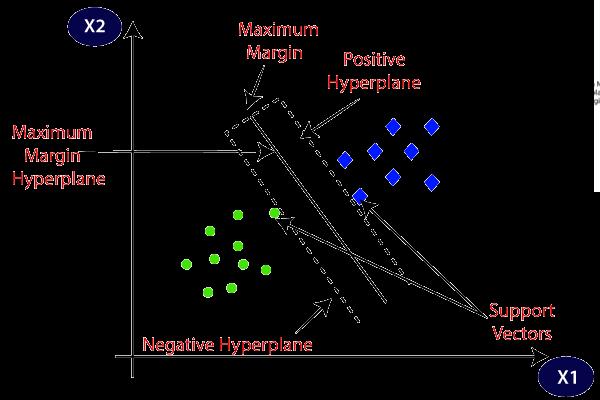
Fig. 2:SupportVectorMachine
Research highlights the significance of preprocessing emaildatatoenhancespamdetectionaccuracy.Zhouetal. (2016)emphasizedkeytechniques,including:
Tokenizationandstop-wordremovaltoeliminateirrelevant words.
Stemmingandlemmatizationtostandardizewordforms.
TermFrequency-InverseDocumentFrequency(TF-IDF)for effectivefeatureextraction.
Word embeddings (Word2Vec, GloVe) to improve deep learningmodelperformance.
Studiesonemaildeliverabilityindicatethatproperemail structuringreducesthelikelihoodofmessagesbeingmarked asspam.SpamAssassin(2021)recommendedbestpractices suchas:
Avoid excessive capitalization and special characters to maintainprofessionalism.
Use clear formatting and professional language for better readability.
Minimizingpromotionallanguagetopreventtriggeringspam filters.
Maintaining a balanced text-to-image ratio to improve deliverability.
Aspamemaildetectionsystemconsistsofseveralessential components, including gathering and processing data, extracting relevant features, training a machine learning model,andimplementingascoringmechanismtodetermine whetheranemailisspamorlegitimate.
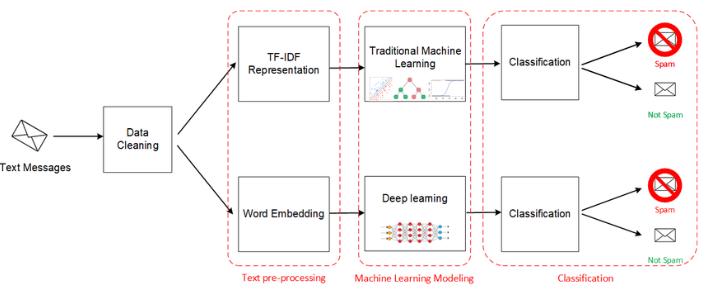
Fig. 3:SYSTEMARCHITECTUREANDDESIGN
International Research Journal of Engineering and Technology (IRJET) e-ISSN: 2395-0056
Volume: 12 Issue: 03 | Mar 2025 www.irjet.net p-ISSN: 2395-0072
Processors (CPUs):
Efficient and high-performance processors are crucial for handling complex tasks such as analyzing emails, running spam filters, processing large datasets, and ensuring accurate, real-time spam detection for improved cybersecurity
Memory (RAM):
Maximum RAM is useful for storing and processing email data,algorithms,andfilters.

Fig. 4:Hardware
Storage (Hard Disk/SSD):
Highstoragecapacityisrequiredtostoreemailindatabases, spamlists,andothernecessarydata.
Network Infrastructure:
A strong network infrastructure, including routers and switches,isessential formanaginglargevolumesof email traffic while ensuring efficient delivery and effective filtering.
Thissystemutilizesmachinelearningandnaturallanguage processing (NLP) to enhance spam detection accuracy, helping to prevent users from receiving malicious or unwantedemails.Thissectiondetailsthemethodologyand steps involved in its implementation. The proposed spam detectionsystemfollowsastructuredworkflowtoenhance accuracy and efficiency. It begins with data collection and preprocessing,whereemaildatasetsaregathered,cleaned, and standardized by removing duplicates, addressing missingvalues,andprocessingtextthroughtokenizationand stopword removal. Following this, feature extraction is conductedbyanalyzing email metadata,subjectlines,and body content using Natural Language Processing (NLP) techniques. The extracted text data is then converted into
numerical representations, such as TF-IDF or word embeddings,tofacilitateeffectiveprocessing.
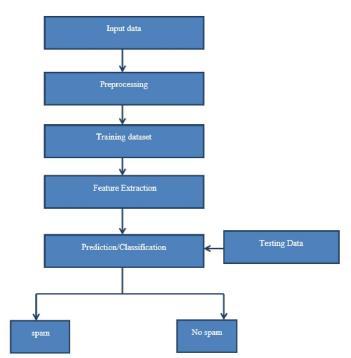
Fig. 5:WorkFlow
This system architecture consists of three feature
DetectingSpamEmailWithMachineLearning
Setspamfilter
WritingOptimizedEmail
4.1 Detecting Spam Email With Machine Learning
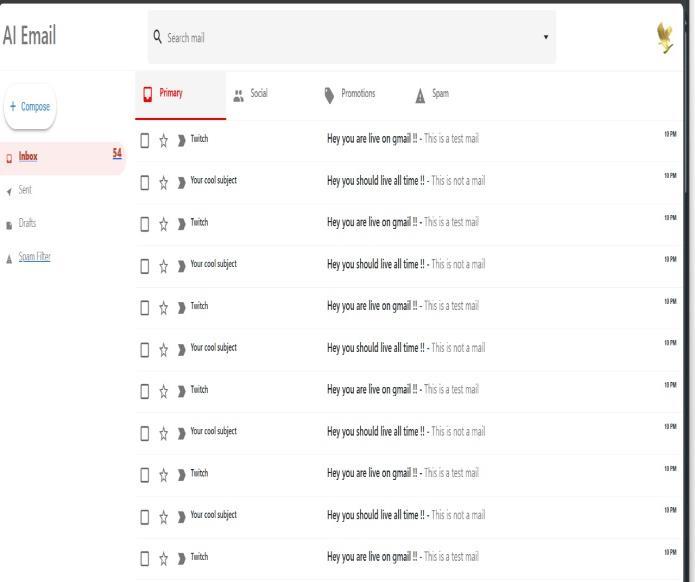
Fig. 6:Interface
This AI-powered email inbox system is designed to streamlineemailorganizationandenhancespamdetection. Theinterfacefeaturesmultipletabs,suchasPrimary,Social, Promotions, and Spam, allowing users to efficiently categorizeandmanagetheiremails.Anavigationpanelon
International Research Journal of Engineering and Technology (IRJET) e-ISSN: 2395-0056
Volume: 12 Issue: 03 | Mar 2025 www.irjet.net p-ISSN: 2395-0072
the left provides quick access to key email functions, includingInbox,Sent,Drafts,andtheSpamFilter.
Within the Primary tab, emails are displayed in a list format, featuring checkboxes for selection, star icons for markingimportantmessages,andsenderdetailsalongwith subject lines. The integrated AI system identifies potential spamandautomaticallycategorizessuchemailstomaintaina clutter-freeinbox.Additionally,theSpamFilteroptioninthe leftpanelallowsuserstoreviewflaggedemails,ensuringthat noimportantmessagesaremistakenlyclassifiedasspam.
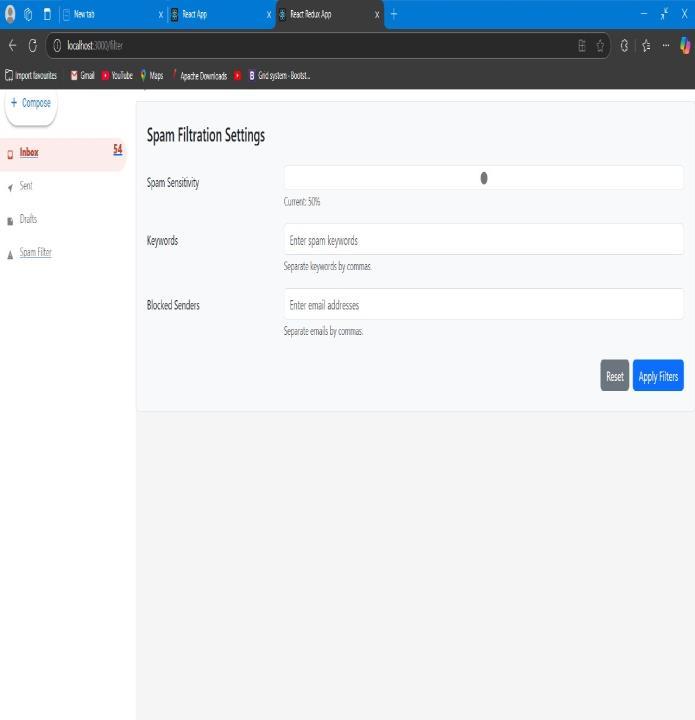
This interface highlights the Spam Filtration Settings feature,enablinguserstopersonalizetheirspamdetection preferencesforatailoredemailexperience.
SpamSensitivity:Asliderallowsuserstoadjustthelevelof spamdetection,determininghowstrictlythesystemfilters outunwantedemails.
Keywords:Userscanspecifycertainwordsassociatedwith spam, ensuring that emails containing these terms are automaticallyflagged.
BlockedSenders:Thissectionallowsuserstomanuallyadd email addresses they wish to block, preventing messages fromunwantedsenders.
Action Buttons: The "Reset" button removes all applied settings, while the "Apply Filters" button saves the user's customizedpreferences.
Thisfeatureenhancesemailsecurityandorganizationby allowing users to fine-tune their spam detection settings, ensuring important messages remain accessible while filteringoutunwantedemails.
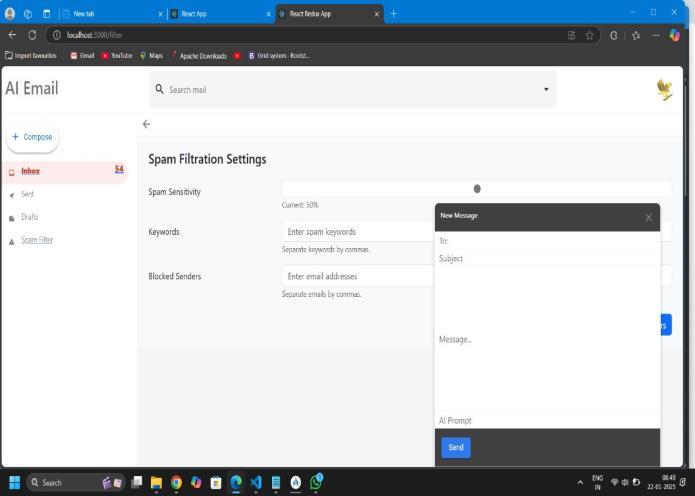
ThisfeaturepresentsanAI-poweredemailcompositiontool designedtohelpusersdraftemailsquicklyandefficiently.
NewMessageWindow:Userscanenterrecipientdetailsin the"To"field,alongwiththesubjectlineandmessagebody.
AIPrompt:Adedicatedfieldwhereuserscanprovideabrief input or request, allowing the AI to generate a wellstructuredemailaccordingly.
Send Button: Enables users to send the composed email instantlywithasingleclick.
This tool streamlines the email drafting process, ensuring professionalandwell-writtenmessageswithminimaleffort, makingcommunicationfasterandmoreefficient.
This research introduced a machine learning-based approachtoimprovingspamdetectionandoptimizingemail composition.Theproposedsystemenhancesemailsecurity by effectively filtering spam through automated classificationmodelsandcustomizablefilteringsettings.By leveraging machine learning algorithms, the system identifies spam emails based on content analysis, sender reputation,anduser-definedpreferences.Additionally,the integration of an AI-powered email composition tool simplifies the writing process using natural language processing(NLP)techniques.Thisallowsuserstogenerate well-structured and contextually relevant emails with minimaleffort.Theresearchfindingsindicatethatmachine learning significantly enhances email filtering accuracy, minimizing user exposure to spam and phishing threats. Moreover,theAI-drivenemail compositionfeatureboosts productivity by enabling faster and more efficient communication. Future improvements may include expandingthedataset,incorporatingdeeplearningmodels
International Research Journal of Engineering and Technology (IRJET) e-ISSN: 2395-0056
Volume: 12 Issue: 03 | Mar 2025 www.irjet.net p-ISSN: 2395-0072
formoreprecisespamdetection,andrefiningAI-generated emailpersonalizationbasedonuserbehaviorandintent.
Iamdelightedtopresentthisprojectreporton “Detecting Spam Emails with Machine Learning and Writing Optimized Emails.” Isincerelyappreciateand extend my heartfelt gratitude to everyone who contributed their valuable insights and support toward the successful completionofthisreport.
It is often said that every achievement is built on the contributionsofothers.Iamdeeplythankful to my guide, Prof. Radhika Nanda,fromthe Department of Computer Engineering, Bharat College of Engineering, Badlapur, Thane, whose unwavering support, encouragement, and expertiseplayedacrucialroleinthesuccessofthisproject. Hervaluableguidance,insightfulsuggestions,andconstant motivation greatly contributed to the completion of this work.
Ialsotakethisopportunitytoexpressmysinceregratitude to Prof. Dr. B.M. Shinde, Principal, BCOE,forprovidingthe necessaryresourcesandsupport.Mythanksextendto Prof. Radhika Nanda, Head of the Department of Computer Engineering, and Prof. Deepa Athawale, Project Coordinator, Department of Computer Engineering, BCOE,fortheirassistanceandencouragementthroughout thisproject.
Finally,Iamgratefultoeveryonewhodirectlyorindirectly contributedtothesuccessfulcompletionofthiswork.This projectwouldnothavebeenpossiblewithoutthecollective effortsandsupportofallthosementionedabove.
[1] Emmanuel Gbenga Dada et al. “Machine learning for email spam filtering: review, approaches and open researchproblems”,Heliyon5(2019)e01802Received 3 September 2018; Received in revised form 25 February2019;Accepted20May2019
[2] K.VarunKumar, etal.“MachineLearning-basedspam detection usingNaïve Bayes Classifier in comparison with logistic Regression for improving accuracy”, JournalofPharmaceuticalNegativeResults¦Volume13 ¦SpecialIssue4¦2022,PageNo.548-554
[3] NebojsaBacanin,etal “ApplicationofNaturalLanguage ProcessingandMachineLearningBoostedwithSwarm Intelligence for Spam Email Filtering”, Mathematics 2022, 10, 4173. https://doi.org/10.3390/math10224173
[4] S. S. a. N. N. Kumar, "Email Spam Detection Using MachineLearningAlgorithms,"inSecondInternational
Conference on Inventive Research in Computing Applications(CIRCA),2020.
[5] İ.A.D.a.M.D.H.Karamollaoglu,"DetectionofSpamEmailswithMachineLearningMethods,"inInnovations in Intelligent Systems and Applications Conference (ASYU),2018.
[6] Pooja Malhotra, et al “Spam Email Detection using Machine Learning and Deep Learning Techniques”, https://ssrn.com/abstract=4145123
[7] Neha Karadkar, et al. “Spam Mail Classification Using SVM and Genetic Algorithm”, Journal of Emerging TechnologiesandInnovativeResearch(JETIR),PageNo. e513-e517
[8] NareshVinod Wankhade, et al “Paper on Spam Email DetectionwithClassificationUsingMachineLearning”, INTERNATIONALJOURNALOFINNOVATIVERESEARCH INTECHNOLOGY,IJIRT156181,PageNo.1055-1059
[9] Rajesh Kumar J, et al. “Email Spam Detection using MachineLearningTechniques”,InternationalAdvanced Research Journal in Science, Engineering and Technology Vol. 8, Issue 6, June 2021, DOI: 10.17148/IARJSET.2021.8632PageNo.189-193
[10] A. Sharaff, A. Dhadse and Naresh K. Nagwani (2016), Comparativestudyofclassificationalgorithmsforspam email detection, in Emerging Research in Computing, communicationandapplications,Information,pp.237244,Springer,Berlin,Germany,DOI:10.1007/978-81322-2553-9_23.
[11] AlfandiO.,DahmaniN.andKaddouraS.,"ASpamEmail DetectionMechanismforEnglishLanguageTextEmails UsingDeepLearningApproach",IEEE29thInternational ConferenceonEnablingTechnologies:Infrastructurefor Collaborative Enterprises, France, Bayonne, pp. 193198,DOI:10.1109/WETICE49692.2020.00045.
7.


Prof. Dr. Radhika Nanda5 5 HOD, Department of Computer Engineering, Bharat College of Engineering,Opp.GajananMaharaj Temple, Kanhor Road, Badlapur (West), Thane, Maharashtra421503
Siddharth More PursuingB.Eincomputerfromthe departmentofcomputeratBharat College of Engineering Badlapur, thane,Maharashtra
International Research Journal of Engineering and Technology (IRJET) e-ISSN: 2395-0056
Volume: 12 Issue: 03 | Mar 2025 www.irjet.net p-ISSN: 2395-0072



Rajat Pandit
PursuingB.Eincomputerfromthe departmentofcomputeratBharat College of Engineering Badlapur, thane,Maharashtra
Rohit Jawale
PursuingB.Eincomputerfromthe departmentofcomputeratBharat College of Engineering Badlapur, thane,Maharashtra
Yash Salunke
PursuingB.Eincomputerfromthe departmentofcomputeratBharat College of Engineering Badlapur, thane,Maharashtra