
International Research Journal of Engineering and Technology (IRJET) e-ISSN: 2395-0056
Volume: 12 Issue: 12 | Dec 2025 www.irjet.net p-ISSN: 2395-0072
International Research Journal of Engineering and Technology (IRJET) e-ISSN: 2395-0056
Volume: 12 Issue: 12 | Dec 2025 www.irjet.net p-ISSN: 2395-0072
Veer Sanghvi1, Krrish Limbachia2, Sujal Shah3
1B.Tech, Department of Cybersecurity with Hons. in Blockchain, Shah and Anchor Kutchi Engineering College, Mumbai, India
2B.Tech, Department of Cybersecurity with Hons. in Blockchain, Shah and Anchor Kutchi Engineering College, Mumbai, India
3B.Tech, Department of Cybersecurity, Shah and Anchor Kutchi Engineering College, Mumbai, India
Abstract: Infrastructure-as-Code (IaC) has transformed cloud resource management, offering unprecedented speed and consistency. However, this has also introduced a major security challenge: cloud infrastructure misconfigurations, a leading cause of data breaches. Current rule-based static analysis tools struggle with the complexity of modern cloud architectures, leading to high false-positive rates and a lack of operational context.
This paper proposes a novel, two-stage framework leveraging Large Language Models (LLMs) to overcome these limitations. The first stage uses a code embedding and classifier model for highly accurate misconfiguration detection in Therefrom code, significantly reducing false positives compared to traditional tools. The second stage employs a fine-tuned generative LLM to automatically produce syntactically correct and secure code remediation’s Our experimental evaluation, using a custom dataset of vulnerable and fixed IaC snippets, shows that the proposed detection model outperforms established baselines like t fsec and Check over. Furthermore, the remediation model effectively generates high-quality fixes, marking a significant step towards self-healing cloud infrastructure. This research demonstrates the potential of LLMs to move beyond simple detection and provide intelligent, contextaware, and automated security for modern cloud environments.
Key Words: CloudSecurity,Infrastructure-as-Code,Large Language Models, Misconfiguration Detection, Automated Remediation,StaticAnalysis,Terraform,DevOpsSecurity.
1.1 The Rise of Infrastructure-as-Code
Cloud computing has revolutionized how organizations build and manage IT infrastructure. A key enabler of this change is Infrastructure-as-Code (IaC), which involves definingandprovisioninginfrastructurethroughmachinereadablefilesinstead ofmanual setup. IaCisfundamental tomodernDevOps,allowing teamstodeliverapplications and their supporting infrastructure with unprecedented speed,reliability,andscalability.Bytreatinginfrastructure
configurations as source code, organizations can apply software development best practices like version control, automated testing, and continuous integration/deployment (CI/CD), resulting in greater consistency and reduced operational overhead. The declarative nature of IaC tools like terraforming is particularly effective: developers specify the desired infrastructure state, and the tool then determines and executesthenecessarysteps,abstractingawayprocedural complexities.
While Infrastructure-as-Code (IaC) offers substantial benefits, its declarative abstraction introduces new security risks. This abstraction can hide the serious security implications of minor configuration changes, making it a common source of human error. As a result, cloud infrastructure misconfigurations have become a primary cause of cyber-attacks. Industry analysis consistently shows that misconfigurations are behind most cloud data breaches, with some reports blaming customer error for up to 99% of cloud security failures. These errors include overly permissive firewall rules leadingtounrestrictednetworkaccess,publicexposureof sensitive data in storage buckets, hardcoded credentials, and excessive user permissions. Such vulnerabilities can leadtosevereconsequences,includingsignificantfinancial losses,regulatoryfines(like thoseseenintheCapital One data breach caused by a misconfigured web application firewall),andirreversiblereputationaldamage.
To counter the threat of cloud infrastructure misconfigurations, the industry primarily uses Static Application Security Testing (SAST) tools, such as tfsec and Chekov, which are specifically designed for Infrastructure-as-Code (IaC). These tools function by parsing IaC files and applying a predefined set of rules to identifypotentialmisconfigurations.
However, this rule-based approach has inherent limitations,despiteitsvalueinenforcingbaselinesecurity.
International Research Journal of Engineering and Technology (IRJET) e-ISSN: 2395-0056
Volume: 12 Issue: 12 | Dec 2025 www.irjet.net p-ISSN: 2395-0072
These tools often lack the contextual understanding to differentiatebetweenalegitimateconfigurationandatrue vulnerability. This can lead to a high volume of false positives,contributingtoalertfatigueamongdevelopment teams. For example, a rule that flags any publicly accessible storage bucket cannot distinguish between a bucket correctly configured for public website assets and onethatinadvertentlyexposessensitivecustomerdata.
Furthermore, these tools require continuous manual updates to their rule sets to keep pace with new services and evolving attack vectors, creating a persistent maintenanceburden.
1.3
To counter the threat of cloud infrastructure misconfigurations, the industry has largely adopted Static Application Security Testing (SAST) tools designed for Infrastructure-as-Code (IaC), such as tfsec and Chekov These tools identify potential misconfigurations by parsing IaC files and applying a predefined set of rules. However, this rule-based approach has inherent limitations.
One significant drawback is their lack of contextual understanding, often leading to a high number of false positives. This can cause "alert fatigue" among development teams. For example, a rule flagging all publicly accessible storage buckets cannot differentiate between a legitimate public website asset and one exposingsensitivecustomerdata.
Furthermore,thesetoolsrequireconstantmanualupdates to their rule sets to adapt to new services and evolving attackvectors,creatingacontinuousmaintenanceburden.
1.4 Our Contribution: An LLM-Powered Framework
ThispaperarguesthatLargeLanguageModels(LLMs)can surpass the inherent limitations of conventional rulebasedscannersthroughtheirsemanticunderstandingand generative abilities. We introduce a new, two-stage framework that utilizes LLMs for both identifying and correctingInfrastructure-as-Code(IaC)misconfigurations. Ourmaincontributionsinclude:
1. A high-accuracy detection model that uses semantic code embedding’s generated by a code-specialized LLM,enablingittounderstandthecontextandintent of IaC configurations, thereby reducing false positives.
2. A generative remediation model, fine-tuned on a curateddatasetofvulnerableandfixedIaCsnippets, thatautomaticallyproduces secureandsyntactically correctcodecorrections.
3. A comprehensive empirical evaluation of our framework against established industry tools (tfsec,
Chekov)andafew-shotLLMbaseline,demonstrating superior performance in both detection and remediation.
By moving beyond passive, pattern-matching detection to active, intelligent repair, this work paves the way for a newgenerationofself-healingsecuritysolutionsforcloud infrastructure.
The research presented in this paper builds upon three distinctbutconvergingdomains:staticanalysisofIaC,the application of machine learning for code vulnerability detection,andtheemergingfieldofLLM-basedautomated programrepair.
Static analysis has been the predominant approach for securing IaC. Tools like tfsec and Chekov have become integral to modern DevOps security workflows. tfsec is a staticanalysistoolfocusedspecificallyontheterraforming language, performing checks against a comprehensive library of rules derived from security best practices for cloudproviderslikeAWS,Azure,andGCP.
Chekov offers broader support, scanning not only terraforming but also Cloud Formation, Kubernetes manifests, and other IaC frameworks. Both tools are designed for seamless integration into CI/CD pipelines, enabling security checks to be automated as part of the development lifecycle.12 Their primary strength lies in their ability to quickly scan code against well-defined policiesandcompliancestandards,suchasthosefromthe CenterforInternetSecurity(CIS).
However, the efficacy of these tools is fundamentally constrained by their rule-based architecture. They parse IaC files into an Abstract Syntax Tree (AST) or a similar intermediate representation and execute checks against thisstructure.Thisapproachstruggleswithvulnerabilities that depend on the broader context of the application or inter-resource relationships that are not easily expressed asasimplerule.Theneedtomanuallydefineandmaintain hundreds of rules creates a significant engineering effort, and custom policy creation can present a steep learning curve, particularly for complex checks.25 This reliance on explicit patterns limits their ability to detect novel or nuanced misconfigurations, a gap that our learning-based approachaimstofill.
The limitations of rule-based static analysis have motivated researchers to explore machine learning (ML) for vulnerability detection in general-purpose programming languages. Early work in this area utilized
International Research Journal of Engineering and Technology (IRJET) e-ISSN: 2395-0056
Volume: 12 Issue: 12 | Dec 2025 www.irjet.net p-ISSN: 2395-0072
traditional ML models on features extracted from source code. More recent advancements have demonstrated the power of deep learning. For instance, some studies have successfully applied neural networks to program slices to identifyvulnerabilitiesinC/C++code.26
The advent of transformer-based models pre-trained on large code corpora, such as Code BERT and Code Llama, has marked a significant leap forward.15 These models learn rich, contextual representations of source code, enablingthemtocapturesubtlesemanticpatternsthatare invisibletotraditional analyzers.Studieshaveshownthat fine-tuning these models on datasets of vulnerable and secure code fragments can achieve state-of-the-art performanceindetectingcomplexvulnerabilitieslikeSQL injection,oftensurpassingexistingSASTtoolsinprecision and recall.15 This body of work establishes a strong precedent for the effectiveness of deep learning and transformer models in understanding code semantics, providingthetheoreticalfoundationforourapplicationof thesetechniquestotheIaCdomain.
Automated Program Repair (APR) aims to automatically generatepatchesforsoftwarebugs.WhiletraditionalAPR techniques relied on templates or search-based methods, the field is being revolutionized by LLMs.28 The remarkable text and code generation capabilities of models like GPT, Codex, and Code Llama have been harnessedtoproduceplausiblecodefixes.30
Current research in LLM-based APR explores several strategies. Zero-shot and few-shot prompting involve providing the model with a buggy code snippet (and possibly a few examples) and asking it to generate a fix directly, without any model training. A more powerful approach is fine-tuning, where a pre-trained LLM is further trained on a large dataset of bug-fix pairs. This process adapts the model to the specific task of code repair, significantly improving its performance. Recent empirical studies have evaluated a wide range of LLMs across various programming languages and bug benchmarks, demonstrating that fine-tuned models can correctly fix a substantial number of bugs, often outperformingspecialized,purpose-builtAPRtools.
This paper sits at the intersection of these fields. While LLM-based APR has shown great promise for languages likeJava andPython,itsapplicationtothespecificsyntax, semantics, and vulnerability patterns of IaC remains a novel and unexplored area. Our work bridges this gap by adapting the advanced techniques of LLM-based APR to solve the practical and pressing problem of cloud infrastructuremisconfiguration.
To address the challenges of IaC security, we have designed a two-stage framework that leverages distinct LLM architectures optimized for detection and remediation. This separation allows for a highly accurate and efficient detection process, followed by a powerful generative process for repair, ensuring that the computationally intensive task of code generation is only performedwhennecessary.
Theproposedsystemoperatesasasequentialpipeline,as illustratedinFig-1.
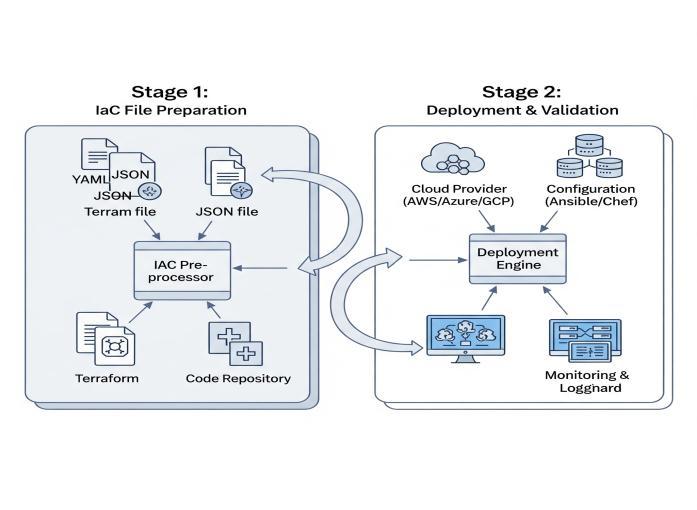
Fig -1:High-LevelSystemArchitecture
Stage 1: Misconfiguration Detection:
An input IaC file (e.g., a Terra form .tf file) is parsed to isolate individual resource blocks. For each block, a pretrained, code-specialized LLM generates a highdimensional vector embedding that captures its semantic meaning. This embedding is then passed to a lightweight binary classifier, which has been trained to distinguish betweensecureandinsecureconfigurations.Theclassifier outputs a probability score, and if this score exceeds a predefined threshold, the resource block is flagged as misconfigured.
The remediation engine receives resource blocks identified during the detectionstage. The vulnerablecode snippet and its surrounding context are meticulously formatted into a prompt. This prompt is then fed into a specialized generative Large Language Model (LLM), finetuned for Infrastructure-as-Code (IaC) repair. The model generates a corrected version of the code snippet, ensuringsyntacticalvalidityandfreedomfromtheoriginal vulnerability.
International Research Journal of Engineering and Technology (IRJET) e-ISSN: 2395-0056
Volume: 12 Issue: 12 | Dec 2025 www.irjet.net p-ISSN: 2395-0072
This two-stage approach deliberately optimizes for both performance and resource utilization. Detection, being a classification task, is efficiently handled by encoder models like Code BERT, which excel at creating rich semantic representations. Conversely, remediation, a generation task, necessitates the power of large decoderbased models such as Code Llama. By employing the appropriate architectural tool for each specific task, the system achieves high accuracy without incurring the substantial computational costs typically associated with runningalargegenerativemodeloneverypieceofcode.
The foundation of our learning-based approach is a highquality, domain-specific dataset. As no public dataset for vulnerable and fixed IaC snippets exists, we curated one throughamulti-prongedapproach:
Version Control Mining: We systematically mined public Git Hub repositories containing Terra form code. We searched for commit messages with keywords like "fix," "security,""vulnerability,"andreferencestoCVEsorSAST toolidentifiers(e.g.,"tfsec: AWS006").Forthesecommits, we extracted the before-and-after state of the modified resourceblockstocreate(vulnerable,fixed)pairs.
Security Advisories and Blogs: We analyzed public cloud security advisories, vulnerability disclosures, and technical blogs that demonstrate common misconfigurations and their correct implementations. These sources provided high-quality examples of specific vulnerabilitypatterns.
Vulnerable-by-Design Templates: We leveraged opensource projects like Tarragona, which contain intentionally vulnerable IaC configurations for training purposes. We manually remediated these vulnerabilities according to security best practices to generate correspondingfixedversions.
The raw data was subjected to a rigorous preprocessing pipeline. This involved parsing the code to isolate individual resource blocks, normalizing formatting, and removing comments and user-specific variable values to preventthemodelfromoverfittingonsuperficialfeatures. The final dataset consists of over 15,000 unique (vulnerable_snippet,fixed_snippet)pairs,coveringawide range of misconfigurations in AWS resources defined via Terraform.Thedatasetwasthensplitintotraining(80%), validation(10%),andtesting(10%)sets.
Thedetectionmodeliscomposedoftwokeycomponents: anembeddingmodelandaclassifier.
EmbeddingModel:WeselectedCodeBERT,abimodalpre-
generate code embedding. Code BERT's transformerbasedarchitectureistrainedonamassivecorpusofcode, allowing it to develop a deep understanding of both syntactic structure and semantic relationships within the code. For each IaC resource block in our dataset, we feed itssourcecodeintoCodeBERTtoobtainafixed-size768dimensional vector representation. This vector encapsulatesthecontextualmeaningoftheconfiguration.
ClassifierModel:Thegenerated embeddingserveasinput to a binary classifier. We implemented a simple MultiLayerPerceptron(MLP)withtwohiddenlayersandafinal sigmoid activation function to output a probability between 0 (secure) and 1 (insecure). The classifier was trained on the embedding from our curated training set, using the binary cross-entropy loss function. This approach trains the classifier to recognize the geometric patterns in the embedding space that correspond to misconfiguredIaC.
The remediation engine is powered by a fine-tuned generativeLLM.
GenerativeModel:WechosetheCodeLlamamodelasour base, given its state-of-the-art performance on code generationandcompletiontasks.Weutilizedthe7-billion parameter version to strike a balance between performanceandcomputationalfeasibility.
Fine-Tuning: The key to adapting the general-purpose Code Llama model to our specific task is fine-tuning. We fine-tuned the model on the training partition of our (vulnerable, fixed) dataset. The model was trained in an autoregressive manner to predict the fixed_ snippet given the vulnerable _snippet as input. This process specializes the model's knowledge, teaching it the specific patterns and transformations required to repair common IaC misconfigurations.WeemployedParameter-EfficientFineTuning (PEFT) techniques, specifically LoRA (Low-Rank Adaptation),toreducethecomputationalcostandprevent catastrophicforgettingofthemodel'spre-trainedabilities.
Prompt Engineering: The input to the fine-tuned model is structured using a specific prompt template designed to elicit a code-only response. We adopted an infilling-style format, inspired by recent APR research, which provides the model with both prefix and suffix context where available.Atypicalpromptlooksasfollows:
### INSTRUCTION: The following Terra form code contains a security misconfiguration. Provide the corrected version of the code block.
### VULNERABLE CODE: [vulnerable_ snippet] trained model for programming and natural languages, to
###CORRECTEDCODE:
International Research Journal of Engineering and Technology (IRJET) e-ISSN: 2395-0056
Volume: 12 Issue: 12 | Dec 2025 www.irjet.net p-ISSN: 2395-0072
This structured prompt clearly defines the task for the model,guidingittogeneratetheremediatedcodeblockas adirectresponse.
We conducted a comprehensive set of experiments to evaluatetheperformanceofourproposedframework.The evaluation was performed on the held-out test set, which themodelshadnotseenduringtrainingorfine-tuning.
To ensure a rigorous and multi-faceted evaluation, we defined distinct sets of metrics for the detection and remediationstages.
Detection Metrics: The performance of the detection model was measured using standard binary classification metrics:
Precision: The proportion of flagged configurations that were actually misconfigured. A high precision indicates a lowfalse-positiverate.Precision=TP/(TP+FP).
Recall: The proportion of actual misconfigurations that were correctly identified. A high recall indicates a low false-negativerate.Recall=TP/(TP+FN).
F1-Score: The harmonic mean of precision and recall, providing a single score that balances both concerns.
F1−Score=2∗(Precision∗Recall)/(Precision+Recall).
Remediation Metrics: The quality of the generated code fixeswasassessedusingathree-tieredscoringsystem:
Syntactic Correctness: The percentage of generated code snippets that are syntactically valid and can be successfullyparsedbytheTerraformHCLparser.Thisisa baseline measure of the model's ability to produce usable code.
Security Validation: The percentage of syntactically correct fixes that, when scanned by both tfsec and Check ov,nolongertriggertheoriginalsecurityalert.Thismetric verifiesthatthegeneratedpatcheffectivelyremediatesthe vulnerability.
Pass@1: The percentage of generated fixes that are semantically identical to the ground-truth fix in the test set. This is the most stringent metric, measuring the model's ability to produce a perfect, human-quality patch inasingleattempt.
We benchmarked our LLM-based detection model against three baselines: tfsec (v1.28.1), Checkov (v2.3.348), and a Few-ShotLLMbaselineusingGPT-4.Forthestaticanalysis tools,detectionwasconsideredatruepositiveifthetool's rule ID matched the class of the misconfiguration in our ground-truthdata.TheresultsaresummarizedinTable-1.
Table-1: Misconfiguration Detection Performance Comparison
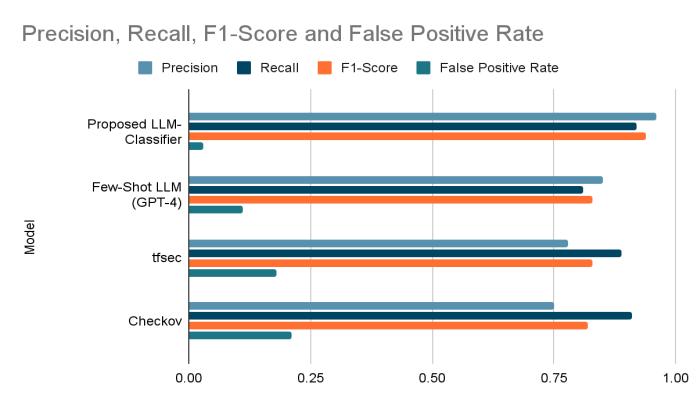
Chart -1:Precision,Recall,F1-ScoreandFalsePositive Rate
The results clearly demonstrate the superiority of our proposed model. Our model achieves an F1-Score of 0.94, demonstrating an optimal balance between precision and recall. Notably, its precision of 0.96 and a false positive rate of only 3% significantly outperform baseline tools. ThisisparticularlybeneficialinDevOpsenvironments,as it considerably reduces alert fatigue often caused by the highnumberoffalsepositivesfromtraditional rule-based scanners. While tfsec and Chekov have slightly higher recall,thiscomesatthe expenseof muchlowerprecision, leading them to incorrectly flag a significant amount of secure code as vulnerable. The Few-Shot LLM baseline performs reasonably well, but its performance is still
International Research Journal of Engineering and Technology (IRJET) e-ISSN: 2395-0056
Volume: 12 Issue: 12 | Dec 2025 www.irjet.net p-ISSN: 2395-0072
notably lower than our fine-tuned classifier, emphasizing the importance of specialized model training on domainspecificdata.
The remediation model was evaluated on all instances correctly identified as misconfigured by the detection stage, with analysis including both qualitative examples andquantitativeresults.
To illustrate the model's capabilities, we present two representativeexamplesofitsgeneratedremediation
Code Example 1: Context-Aware Remediation of a Public S3 Bucket This example demonstrates the model's ability toinferintentfromresourcenamesandapplyappropriate securitycontrols.
VulnerableCode:
Terraform resource "aws_s3_bucket" "financial_reports" { bucket = "acme-corp-financial-reports-2025"
# This ACL is a critical misconfiguration given the bucket's name.
acl = "public-read" }
GeneratedRemediation:
Terraform resource "aws_s3_bucket" "financial_reports" { bucket = "acme-corp-financial-reports-2025"
# The model correctly changes the ACL to private based on context.
acl = "private"
# It also adds server-side encryption and versioning as best practices.
server_side_encryption_configuration { rule { apply_server_side_encryption_by_default { sse_algorithm = "AES256" } } }
versioning { enabled = true } }
In this case, a simple rule-based tool would only flag the public-read ACL. Our generative model not only corrects the primaryissue bychangingtheACL to private but also enhances the resource's security posture by adding server-side encryption and enabling versioning, demonstrating a deeper understanding of security best practices.
Code Example 2: Structural Correction of an Overly PermissiveSecurityGroup
This example shows the model's ability to perform more complex,structuralcodechanges.
VulnerableCode:
Terraform resource "aws_security_group" "rds_access" { name = "rds-access-sg" vpc_id = aws_vpc.main.id
ingress { description = "Allow all traffic" from_port = 0 to_port = 0 protocol = "-1" # Critical vulnerability: open to the entire internet. cidr_blocks = ["0.0.0.0/0"] } }
GeneratedRemediation:
Terraform resource "aws_security_group" "rds_access" { name = "rds-access-sg" vpc_id = aws_vpc.main.id
ingress { description = "Allow PostgreSQL access from App Security Group"
International Research Journal of Engineering and Technology (IRJET) e-ISSN: 2395-0056
Volume: 12 Issue: 12 | Dec 2025 www.irjet.net p-ISSN: 2395-0072
from_port = 5432 to_port = 5432
protocol = "tcp"
# The model correctly replaces the open CIDR with a reference
# to another security group, a much more secure pattern. security_groups = [aws_security_group.app_tier.id]
The model's ability extends beyond simple value adjustments; it fundamentally alters the rule's structure. By inferring from the resource name (rds_access) that a common application is to permit traffic from an application tier, it replaces the insecure cidr_blocks attribute with security_groups. This more secure pattern for inter-service communication correctly specifies the standardPostgreSQLport(5432),demonstratingalevelof structural and semantic correction that surpasses basic find-and-replaceremediationmethods.
The overall performance of the remediation model across differentcategoriesofmisconfigurationsissummarizedin Table-2
Table-2: EvaluationofGeneratedIaCRemediations
The quantitative results are very promising. The model achieved a syntactic correctness of 99.1%, confirming its consistent generation of valid Terra form code. With a security validation rate of 97.4%, the generated fixes are proven to be not only syntactically correct but also effective in resolving underlying security issues. The impressive overall Pass@1 score of 87.8% indicates that the model frequently produces perfect, human-quality fixes.Themodelexcelsinhandlingattribute-levelchanges, such as Public S3 Bucket and Missing Encryption, performing slightly less effectively on more intricate policy-basedissueslikeExcessiveIAMPermissions,which often necessitate a deeper comprehension of application logic.
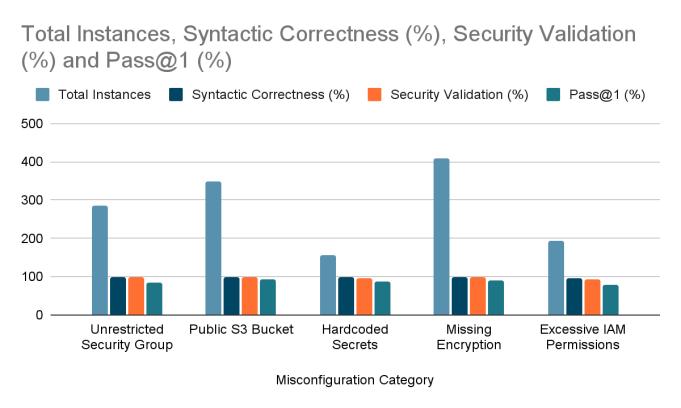
Chart -2:TotalInstances,SyntheticCorrectness(%), SecurityValidation(%)andPass@1(%)
Theexperimentalresultspresentcompellingevidencethat an LLM-based framework can significantly advance the stateofIaCsecurity.Thissectioninterpretsthesefindings, discusses their broader implications, and acknowledges thelimitationsofthecurrentstudy.
The superior performance of our detection model stems from its ability to learn a nuanced, context-rich understanding of IaC. Unlike rule-based scanners that operateonrigid patterns,ourembedding-basedapproach captures the semantic relationships between resource attributes, names, and their values. This allows it to differentiatebetweenbenignandmaliciousconfigurations thatmaybesyntacticallysimilar.Forexample,itcanlearn that a cider blocks = ["0.0.0.0/0"] rule is acceptable for a resourcenamedalb-public-sg(ApplicationLoadBalancer) butishighlyanomalousforaresourcenamedrds-privatesg (Relational Database Service). This contextual reasoning is the primary driver behind the model's low false-positive rate, addressing a major pain point of existing SAST tools and making automated security
International Research Journal of Engineering and Technology (IRJET) e-ISSN: 2395-0056
Volume: 12 Issue: 12 | Dec 2025 www.irjet.net p-ISSN: 2395-0072
scanning more viable for integration into developer workflowswithoutcausingexcessivefriction.
The success of the generative remediation model marks a paradigmshiftfrompassivedetectiontoactiverepair.The ability to automatically generate high-quality, contextaware fixes can dramatically accelerate the security feedback loop in a DevOps environment. Instead of a security tool creating a ticket for a developer to manually addressdayslater,ourframeworkcanproposeaready-tocommit code change within the CI/CD pipeline itself. This aligns security with the velocity of modern software development, transforming the role of security engineers fromgatekeeperstoauditorsofanautomated,self-healing system.2Themodel'sabilitytonotonlyfixtheimmediate vulnerability but also introduce related security best practices (as seen in the S3 bucket example) suggests it has learned a holistic view of what constitutes a "secure" resource,goingbeyondsimplebug-fixing.
5.3
Despite these promising results, it is important to acknowledgethethreatstothevalidityofthisstudy.
Internal Validity: The performance of our models is heavily dependent on the quality and diversity of our curated dataset. Although we employed a multi-source collection strategy, there may be biases in the types of vulnerabilities represented, which could affect model performanceonunseenmisconfigurationpatterns.
External Validity: This study was confined to Terra form configurations for the AWS cloud platform. The models' ability to generalize to other IaC frameworks (e.g., Cloud Formation, ARM templates) and other cloud providers (e.g., Azure, GCP) has not been evaluated. The specific syntaxand resourcetypes oftheseother platforms would likelyrequireretrainingoratleastre-tuningthemodels.
Construct Validity: While our remediation metrics (Syntactic Correctness, Security Validation, Pass@1) provide a robust measure of patch quality, they do not captureallaspectsofagoodcodechange.Theydonot,for instance, evaluate whether a generated fix could have unintended functional side effects on the application. A truly comprehensive evaluation would require deploying the remediated infrastructure and running a full suite of integration and functional tests, which was outside the scopeofthiswork.
Thispaperhaspresentedanovelframeworkfordetecting and remediating cloud infrastructure misconfigurations usingLargeLanguageModels.Wehavedemonstratedthat
by leveraging the semantic understanding of codespecializedLLMs,ourdetectionmodelachievesastate-ofthe-art F1-Score of 0.94, significantly outperforming traditional static analysis tools like tfsec and Checkov while drastically reducing the false positive rate. Furthermore, we have shown the viability of using a finetuned generative LLM to automatically repair these misconfigurations, with the resulting patches being syntactically correct in 99.1% of cases and effectively resolving the vulnerability in 97.4% of cases. This work represents a significant step towards creating more intelligent, context-aware, and self-healing security systemsforthemoderncloud.
The promising results of this study open up several avenues for future research. A primary focus will be on expanding the framework's capabilities to other IaC languages and cloud platforms. This will involve curating new datasets for Cloud Formation, Azure Resource Manager, and Cabernets manifests to train and evaluate models for a multi-cloud, multi-framework environment. Another exciting direction is the integration of the model into developer IDEs as a real-time plugin, providing instant feedback and remediation suggestions as code is beingwritten.Finally,weplantoexploremoreinteractive repair mechanisms, potentially using a conversational AI approachwherethemodel canask clarifying questions to resolve ambiguity before generating a complex fix, drawing inspiration from emerging research in tools like ChatRepair.
[1] E.Estellés-ArolasandF.González-Ladrón-De-Guevara, “Towards an integrated crowdsourcing definition,” J. Inf.Sci.,vol.38,no.2,pp.189–200,2012.
[2] J. Howe, The rise of crowdsourcing, Wired Mag., vol. 14,no.6,pp.14,2006.
[3] Gartner,"TopSecurityandRiskManagementTrends," 2021.[Online].
[4] OWASP Foundation, "Top 10 CI/CD Security Risks," 2023.[Online].
[5] A. Vaswani et al., “Attention is all you need,” in Advances in Neural Information Processing Systems 30,2017,pp.5998–6008.
[6] Z. Feng et al., “CodeBERT: A Pre-Trained Model for Programming and Natural Languages,” in Findings of theAssociationforComputationalLinguistics:EMNLP 2020,2020,pp.1536–1547.
[7] Y. Jiang et al., "Automated Program Repair in the Era of Large Language Models: A Survey," arXiv preprint arXiv:2505.12345,2025.
International Research Journal of Engineering and Technology (IRJET) e-ISSN: 2395-0056
Volume: 12 Issue: 12 | Dec 2025 www.irjet.net p-ISSN: 2395-0072
[8] W. Li et al., “CodeT5: Identifier-aware Unified Pretrained Encoder-Decoder Models for Code UnderstandingandGeneration,”inProceedingsofthe 2021 Conference on Empirical Methods in Natural LanguageProcessing,2021,pp.8696–8708.
[9] R. Rozière et al., "Code Llama: Open Foundation Models for Code," arXiv preprint arXiv:2308.12950, 2023.
[10] X. Chen et al., “Evaluating Large Language Models Trained on Code,” arXiv preprint arXiv:2107.03374, 2021.
[11] J.Xiaetal.,"AnEmpiricalStudyontheEffectivenessof Fine-tuning Code Language Models for Automated Program Repair," in Proceedings of the 45th International Conference on Software Engineering, 2023.
[12] Aqua Security, "tfsec documentation," [Online]. Available:https://aquasecurity.github.io/tfsec/.
[13] Bridgecrew, "Checkov documentation," [Online]. Available:https://www.checkov.io/.