
International Research Journal of Engineering and Technology (IRJET) e-ISSN: 2395-0056
Volume: 12 Issue: 05 | May 2025 www.irjet.net p-ISSN: 2395-0072
International Research Journal of Engineering and Technology (IRJET) e-ISSN: 2395-0056
Volume: 12 Issue: 05 | May 2025 www.irjet.net p-ISSN: 2395-0072
Yashwant Pole1 , Anil Sahu2
1Student of Master of Technology, Department of Mechanical Engineering, GHRCEM Pune. 2 Professor, Department of Mechanical Engineering, GHRCEM Pune.
Abstract - The design and structural integrity analysis of pressure vessels are critical for ensuring operational safety and efficiency in industrial applications. This study focuses on the design and analysis of a vertical pressure vessel using the guidelines set forth in the ASME Boiler and Pressure Vessel Code (Section VIII, Division 1) and advanced Finite Element Analysis (FEA) techniques. The design process involves determining the optimal dimensions, material selection, and wall thickness towithstand internalpressures while complying with ASME standards. The modeled vessel is subjected to various loading conditions including internal pressure, dead weight, and wind load. FEA simulations are performed using ANSYS software to evaluate the stress distribution, deformation, and safety factor of the vessel. Results from the FEA are compared with analytical calculations to validate the design. The analysis confirms that the vessel design meets all safety and code requirements, demonstratingthe effectiveness of combining code-based design with numericalsimulation for pressure vessel development.
Key Words:Shell,EndClosures(Head),Nozzles,Saddle Supports,ASMECode,SphericalVessel
Pressurevesselsareessentialcomponentsinindustriessuch aschemicalprocessing,oilandgas,powergeneration,and pharmaceuticals, where fluids or gases are stored or processed under pressure. The design of these vessels requires careful consideration of various mechanical, thermal,andoperationalfactorstoensuresafety,reliability, andcompliancewithregulatorystandards.
Among the different types of pressure vessels, vertical pressure vessels are commonly used due to their space efficiencyandeaseofmaintenance.However,theirvertical orientationalsointroducesuniquedesignchallenges,suchas handlingaxialloads,internalpressure,andexternalforces likewindorseismicactivity.
To ensure safety and performance, the design of pressure vesselsmustadheretoestablishedcodesandstandards.The ASMEBoilerandPressureVesselCode(BPVC),SectionVIII, Division 1, is the most widely accepted guideline, offering comprehensive rules for material selection, thickness calculation,stressanalysis,andtestingprocedures.
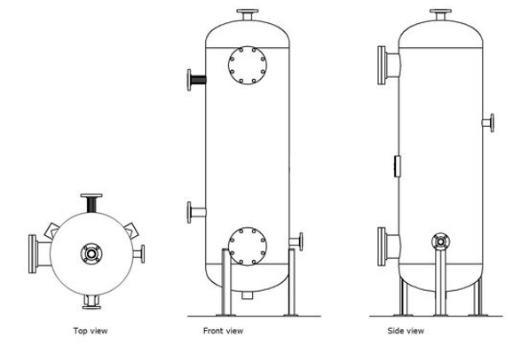
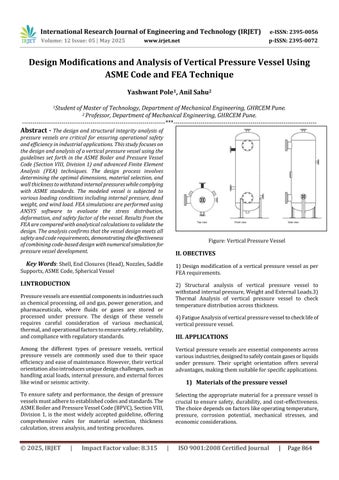
1)Designmodificationofa verticalpressurevesselasper FEArequirements.
2) Structural analysis of vertical pressure vessel to withstandinternalpressure,WeightandExternalLoads.3) Thermal Analysis of vertical pressure vessel to check temperaturedistributionacrossthickness.
4)FatigueAnalysisofverticalpressurevesseltochecklifeof verticalpressurevessel.
Vertical pressure vessels are essential components across variousindustries,designedtosafelycontaingasesorliquids under pressure. Their upright orientation offers several advantages,makingthemsuitableforspecificapplications.
Selecting theappropriate material fora pressurevessel is crucial to ensure safety, durability, and cost-effectiveness. Thechoicedependsonfactorslikeoperatingtemperature, pressure, corrosion potential, mechanical stresses, and economicconsiderations.
International Research Journal of Engineering and Technology (IRJET) e-ISSN: 2395-0056
Volume: 12 Issue: 05 | May 2025 www.irjet.net p-ISSN: 2395-0072
a) Strength, including creep – strength determines the minimum required thickness of vessel should be, to withstand the imposed loads or stresses. Ultimate tensile strength, yield strength, creep and rupture strengthareamongtheelementsusedtodeterminethe overallstrengthofthematerial.
b) Resistancetocorrosion–chemicalactionsorchangein environmental chemistry can deteriorate the metals overa longperiod oftime, wherethissinglefactoris sufficienttoinfluentthematerialselection.
c) Fracturetoughness–thecapabilityofamaterialtohold outagainstconditionsthatcanleadtobrittlefracture, characterized by the lack of deformation or yielding beforethecomponentfailscompletelywhenexposedto acombinationoflowtemperatureandhighstress.
d) Fabric ability – sufficient ductility of the material to permit the rolling process of the plate for ease of constructionofpressurevessel.Platematerialshould beweldabletoassembletheindividualsegments.
The methodology for designing and analyzing a vertical pressure vessel involves a systematic approach incorporating both analytical code-based design using the ASME Boiler and Pressure Vessel Code (BPVC) and validation through Finite Element Analysis (FEA). The processisdividedintothefollowingstages.ANSYS2022R2 softwareisusedforTheanalysisofthepressurevessel.The materialconsideredfortheanalysisareasperASMEGrade material,Carbonsteel.Thematerialpropertiesconsidered were having a yield stress of 260 MPa and poison’s ratio consideredwas0.3.
1) Applicable Code:
a) DesignCode:ASMESec.VIIIDiv.1Ed.2021
b) AnalysisCode:ASMESec.VIIIDiv.2Ed.2021
2) Design Calculations
Foracylindricalshellunderinternalpressure,therequired wall thickness t can be calculated using the following formula:
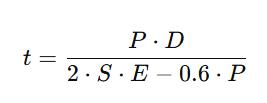
Where:
t=Thicknessofpressurevessel(mmorinches)
P=Designpressure(MPaorpsi)
D=Diameteroftheshell(mmorinches)
S=Allowablestress(MPaorpsi)
E=Efficiencyofjoint
This formula accounts for the internal pressure, material strength,andjointefficiency,ensuringthevessel'sstructural integrityunderoperatingconditions.
3) Considerations in Calculation
a) Corrosion Allowance:Acorrosionallowance(typically 2 to 3 mm) is added to the calculated thickness to account for material loss over time due to corrosive environments.
b) Joint Efficiency:ThejointefficiencyfactorEreflectsthe qualityofwelds.AnefficiencyfactorofE=1.0indicates perfect.
4) Material Selection
Materialsareselectedbasedon:
a) Pressure-temperatureratings
b) Corrosionresistance
c) Costandavailability
d) Codecompliance
5) Finite Element Analysis (FEA)
a) Pre-processing
i. ImportCADmodelintoFEAsoftware(e.g.,ANSYS, Abaqus).
ii. Assign material properties as per ASME selected materials.
iii. Applymesh(structuredorunstructured)andrefine nearstressconcentrationzones(nozzles,junctions).
b) Boundary Conditions and Loading
i. Applyinternalpressureasperdesigncondition.
ii. Apply external loads (weight, wind, seismic if applicable).
iii. Fixsupports(typicallyatskirtbase).
iv. Include thermal loads if thermal expansion is significant.
c) Simulation and Analysis
i. RunTransientStructuralAnalysis:
a. Determinestressdistribution(VonMisesstress).
b. Checkformaximumdisplacement.
ii. CompareFEAstresseswithallowablestress.
iii. CheckforReactionforces
6) Validation and Comparison
TheFEAresultsarecomparedfor:
i. Validatetheanalyticaldesign
ii. Identifystressconcentrationzones
iii. Evaluate deformation under operating conditions
Discrepancies, if any, are analyzed, and design modificationsareproposedtoenhancesafetyand reliability.
International Research Journal of Engineering and Technology (IRJET) e-ISSN: 2395-0056
Volume: 12 Issue: 05 | May 2025 www.irjet.net p-ISSN: 2395-0072
1) Design Stage – Modeling the Pressure Vessel
InthedesignofpressurevesselsusingANSYSSpaceClaimin accordancewiththeASMEBoilerandPressureVesselCode (BPVC) Section VIII, Division 1, the approach is primarily basedonestablisheddesignrulesratherthandetailedstress analyses.Thismethodologysimplifiesthedesignprocessby relyingonpredefinedformulasandsafetyfactors,whichare particularlyadvantageousforstandardvesselconfigurations andmaterials.
2) FEA Procedure:
i)Import Geometry
ImportCAD(AnsysSpaceclaim)intoANSYS
ii) CAD Cleanup
CADcleanupinANSYS(oranyothersimulationsoftware)is anessentialstepinthepreparationprocessbeforerunning simulations, particularly when you’re working with imported geometry. The main goal of CAD cleanup is to ensure that the model is accurate, efficient, and ready for meshingandsimulation.
iii) Analysis
Analysis is performed in ANSYS software. Performing an analysis in ANSYS involves a systematic approach, from importing the geometry to defining the physics, meshing, solving,andpost-processingtheresults.Eachstepiscrucial for obtaining accurate and meaningful results, and the processmayvaryslightlydependingonthetypeofanalysis youareperforming.
The 3D model has been meshed with SOLID185 for StructuralAnalysis.
The SOLID185 element in ANSYS is a versatile 3D 8-node structural solid used for modeling solid structures. For meshing with SOLID185, it's important to ensure that elements are properly numbered and not twisted, as impropernumberingcanleadtoissuessuchaszero-volume elements. The meshing process should also consider the specificmaterialbehaviorsandthegeometryofthestructure beingmodeled.
1) Material Definition:
The allowable stress values for materials are specified in ASMESectionII,PartD.
2) Meshing:
Finer mesh at stress concentration zones: nozzle-to-shell junctions, supports.3 elements across shell thickness to capture the material behavior and stress distribution accurately.
3) Loading Conditions and Boundary Conditions:
1) Internalpressure
2) ConvectionforInsulation
3) Temperature
4) EndCapForces
5) BoltPretensions
6) FixedSupport
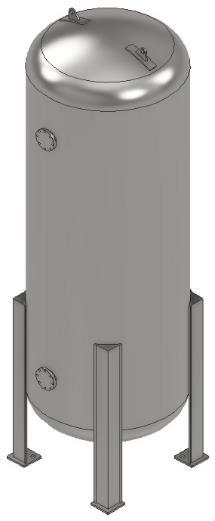
FEAModel
ThevonMisesstressisacriticalparameterinassessingthe structural integrity of pressure vessels, providing insights intothedistributionofstressthroughoutthevessel.Elevated stresslevelsarecommonlyobservedinregionswherethe vessel's geometry changes, such as at nozzle connections, transitionsbetweenvessel sections, orareaswithvarying wall thicknesses. These geometric discontinuities act as stressconcentrators,leadingtolocalizedhigh-stresszones thatcansignificantlyimpactthevessel'sperformanceand safety.Areaswherethewall thicknesschanges,suchas at welded joints or support attachments, are susceptible to stress concentrations. FEA studies indicate that these regions can experience significant stress intensification, necessitatingcarefuldesignandanalysis.
Table -1: Summeryforequivalentstresses.
Nozzles
International Research Journal of Engineering and Technology (IRJET) e-ISSN: 2395-0056
Volume: 12 Issue: 05 | May 2025 www.irjet.net p-ISSN: 2395-0072
Stresses observed in the nozzle N1, N2 and N3 are above allowablelimit.Sorequireddesignmodificationisdoneby usingappropriatepipedatatoovercomethepeakstresses whicharecomingonnozzleshelljunctionduedoExternal loading.
Nozzles Schedule Before Modification Thickness Before Modification Stresses observed In FEA
N1 Schedule80 5.54mm 378MPa
N2 Schedule80 5.54mm 394MPa
N3 Schedule40 7.11mm 648MPa
Table 2: NozzleDetailsbeforeModification
Nozzles ScheduleAfter Modification Thickness After Modification Stresses observed In FEA
N1 Schedule80 11.07mm 40.5MPa
N2 Schedule80 11.07mm 17MPa
N3 Schedule40 10.97mm 204MPa
Table 3:NozzleDetailsafterModification
The design of the Pressure vessels is safe. The Factor of safety that we consider is permissible and by which the designisconsideredsafe.Theburstingpressureisunderthe allowable stress so that the design does not fail. And the analysisissoclosetotheAnalyticaldesignhencetheboth dataarevalidatedandthedesignisconsideredassafeand therearenofailureoccursinthepressurevessel.
[1] M. Jadav Hyder, M Asif, “Optimization of Location and SizeofOpeningInAPressureVesselCylinderUsingANSYS”. EngineeringFailureAnalysis.Pp1-19,2008.
[2]RGPP JRInternationalJournalforInnovativeResearch inScience&Technology|Vol.1,Issue1,June2014|PageNo. 58-63.ISSN(online):2349-6010.
[3] EN 13445-2 :2002, Unfired Pressure Vessel – Part 2: Materials.Issue35(2009-01).
[4] Simon Sedmaka, Mahdi Algoolb, Aleksandar Sedmakc, UrosTt,EmnDzno,“Elst -plasticbehaviourofwelded jointsduringloadingandunloadingofpressurevssls”,Pro Stru tur l Int r ty P No 3546–3553. Doi 10.1016/j.prostr.2016.06.442.
[5]VijayKumar,PK“MpressurevesselusingPV-L”JRPInternationalJournalofScientificandResearchPublications,
Volume 4, Issue 4, April 2014 1, Page No 1-4, ISSN: 22503153.
[6]ProfMr.AniketKolekar,Mr.AkshayNatak,Mr.KiranNP MM“RM”RJournalofEngineeringandTechnology(IRJET) Vol-04Issue-04April-2017PageNo.2120-2125.ISSN-2935 0056.
2025, IRJET | Impact Factor value: 8.315 | ISO 9001:2008