
International Research Journal of Engineering and Technology (IRJET) e-ISSN: 2395-0056
Volume: 13 Issue: 02 | Feb 2026 www.irjet.net p-ISSN: 2395-0072
Design, Fabrication, and Performance Analysis of a Cost-Effective Remote-Controlled Firefighting Vehicle (RCFFV)
Jayanta Madhab Sarmah1 , Nayan Nirban Gogoi2 , Meboo Panging3 , Paran Sonowal4 , Rismrita Gogoi5 , Lakhimoni Phukan6 , Sonjoy Borgohain7 , Subrot Konwar8 , Chinmoy Gogoi9 , Denphra Gogoi10 , Dipjyoti Gogoi11 , Nikhil Bhuyan12 , Mrityunjoy Gogoi13 , Amarjeet Vishyakarma14 , Bastov Jyoti Chetia15 , Monikanta Hazarika16, Manash Jyoti Baishya17
1-16Diploma, Department of Mechanical Engineering, Dhemaji Polytechnic, Simen Chapri, Assam-787061 17Lecturer, Head of the Department of Mechanical Engineering, President of Institution's Innovation Council, Dhemaji Polytechnic, Simen Chapori, Assam-787061 ***
Abstract - Fire incidents pose serious risks to human life and property, especially when they occur in hazardous, confined, or inaccessible locations such as chemical factories and restricted industrial zones. Conventional firefighting techniques require direct human intervention, exposing emergency personnel to dangerous conditions, including high temperatures, toxic gases, and unstable structures. To reduce these hazards, a Remote-Control Firefighting Vehicle (RCFFV) that enables remote suppression (water) operations was designed, fabricated, and analytically modeled. The prototype is a small, autonomous ground vehicle equipped with a specialized water-jet system and a wireless remote-control interface. With a metallic chaintrack frame and a high-torque DC motor, the vehicle is designed to move on tough terrain. The vehicle's capacity to navigate obstacles, communicate over long distances, and put out small-scale fires efficiently was validated through experiments. This study confirms that Low-cost robotic technologies can greatly improve safety in disaster management scenarios.
Keywords: Firefighting Robot, Remote Control Vehicle, Unmanned Ground Vehicle (UGV), Disaster Management, Chain Track Mechanism.
1. Introduction
Firefighting remains one of the most dangerous professions, frequently requiring responders to navigate unfamiliar, hazardous terrain. In complex environments such as tunnels, industrial facilities, and dense urban infrastructure the unpredictable behavior of fire severely compromises personnel safety. Consequently, the integration of robotics and remote-control technology has emerged as a vital innovation, offering a safer and more effective alternative to direct human intervention. By acting as an automated assistant, a remote-controlled firefighting vehicle can traverse rough terrain to approach a fire's epicenter and deploy suppressants from a secure distance. This capability not only mitigates theimmediatethreattohumanlifebutalsofacilitatesrapid,preciseemergencyresponsesinotherwiseinaccessibleareas. The primary objective of this research is to construct a functional, remote-controlled vehicle that combines mechanical robustness with advanced electrical control systems to operate effectively in these high-risk environments. Specifically, this study proposes a design capable of 360-degree water delivery and robust movement across difficult terrains. The subsequentsectionsdetailthevehicle'sarchitecture,criticalparameters,andoperationalrange.
2. Literature Review
Recent advancements in robotics have greatly improved autonomous firefighting technologies. Today, these robots are actively used to mitigate risks to human responders in dangerous environments [1-2] Cakir et al. proposed a fan-based robot with unidirectional detection, which could risk spreading fires in open environments [3] Taha et al. developed a robot for enclosed spaces that was limited by a complex deployment and a single flame sensor with a narrow detectionrange[4] Sangewar et al. developedafire-detectingrobotequippedwithagassensor,acamera,andanArduino Mega 2560, but its reliance on manual operation limited its effectiveness [5] Kucukdermenci et al. developed a remotecontrolledfirefightingrobotwitha detectionangle,butitlackedautonomouscapabilitiesandreal-worldvalidation [6]
Basedonthisliteraturereview,theprimaryresearchgaphighlightsthelackofaremotelycontrolledfirefightingvehicle designcapableofomnidirectionalwaterdelivery,navigationacrossdifficultterrains,andpracticalreal-worldusability.
International Research Journal of Engineering and Technology (IRJET) e-ISSN: 2395-0056
Volume: 13 Issue: 02 | Feb 2026 www.irjet.net
3. Design specification and material selection
Thedesignspecificationsforremote-controlledfirefightingvehiclearelistedinTable1below:
Table 1 Designspecificationsremote-controlledfirefightingvehicle
parameter
vehicledimensions
p-ISSN: 2395-0072
specification
length:106.7cm,width:45.7cm,height:30.5cm
chassismaterial iron
locomotion
motors
controlsystem
dualDCmotorswithmildsteelmetallicchaintracks
24VDCmotor,3000rpm(2nos.)
BTS 7960 motor driver with FX-iA6 receiver module
remotecontrolrange upto1000meters
powersupply
waterpump
24Vrechargeableleadacidbattery
12VDCpump,flowrate:~9.5liters/min
watertankcapacity 15liters speed ~20km/h weight ~100kg
operationtime
around30-40minutespercharge
Figure1representstheschematicdiagramoftheproposedremote-controlledfirefightingvehicle,andFigure2illustrates thedifferentpartsoftheremote-controlledfirefightingvehiclealongwithitsdimensions.
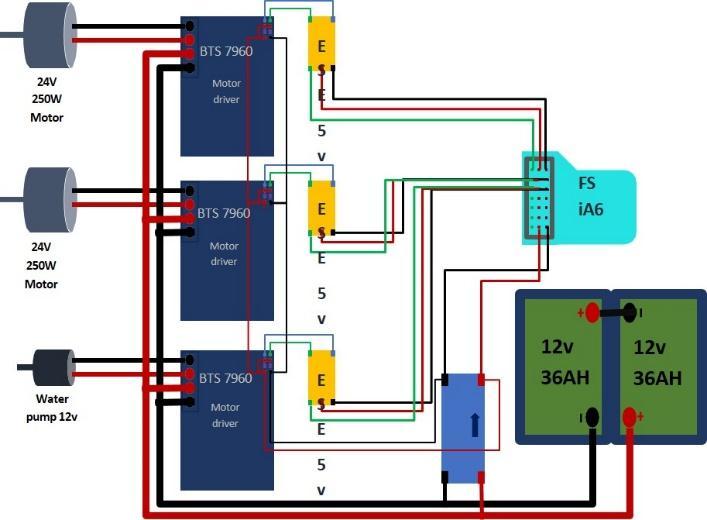
Figure 1. Schematiccircuitdiagramoftheremote-controlledfirefightingvehicleusedinthisproject.
International Research Journal of Engineering and Technology (IRJET) e-ISSN: 2395-0056
Volume: 13 Issue: 02 | Feb 2026 www.irjet.net p-ISSN: 2395-0072
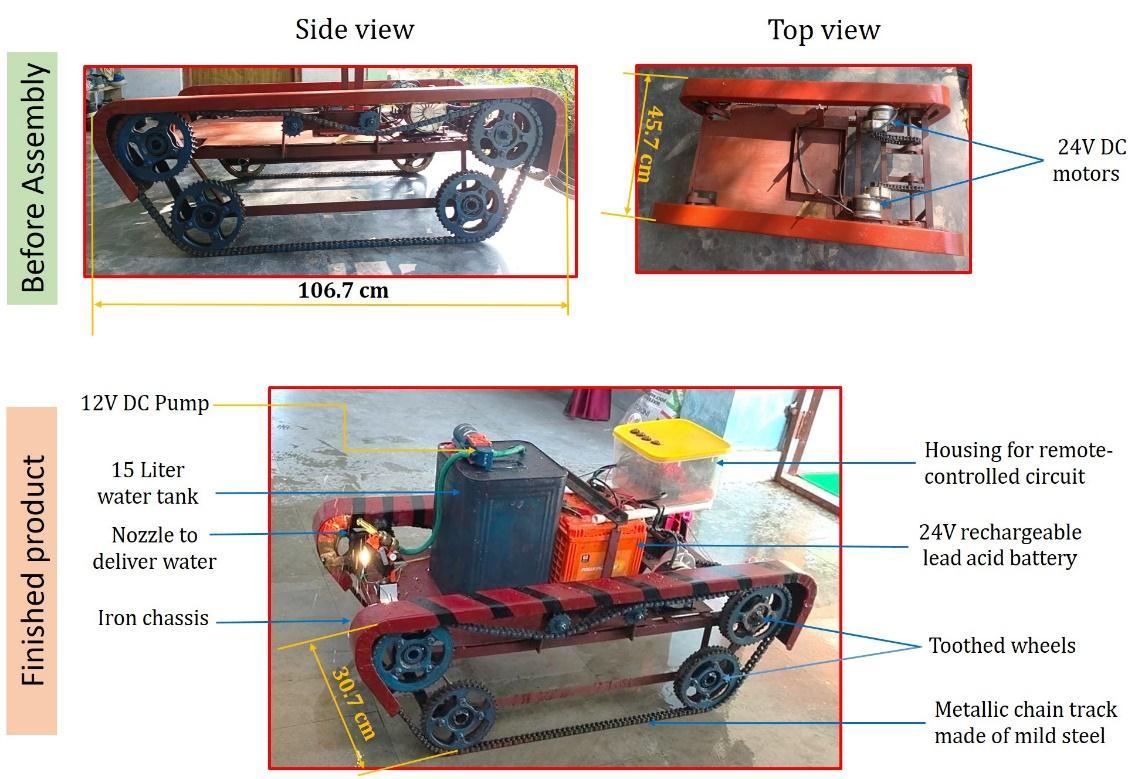
Figure 2. Illustrationofdifferentpartsanddimensionsofaremote-controlledfirefightingvehicle.
4. Analytical work
Thecalculationofimportantparameters,suchaspowerconsumption,currentrequirements,andoperationaltime,is presentedbelow:
1. Power Consumption of 24V DC Motors
Voltagesupplied,
Eachmotor'scurrentdrawunderload,
Numberofmotorsused
Totalmotorpower:
2. Power Consumption of 12V Water Pump
Voltagesupplied,
Currentdrawnbypump,
Pumppower:
3. Total Power Consumption
International Research Journal of Engineering and Technology (IRJET) e-ISSN: 2395-0056
Volume: 13 Issue: 02 | Feb 2026 www.irjet.net p-ISSN: 2395-0072
4. Battery Capacity and Operation Time
Batteryvoltage:
Batterycapacity:
Totalenergyavailable:
5. Estimated run time:
Actualruntimemaybelowerduetoinefficiencies,losses,orintermittentusagepatterns.
5. Test results and discussion
After fabrication, the RCFFV underwent a series of tests to evaluate its mobility, remote-control range, and firesuppression capabilities. The vehicle navigated both level and mildly uneven terrain smoothly, with its metal tracks effortlesslyclearingminorobstaclesupto2cmhigh.Itmaintainedanaveragespeedofroughly20km/h,anidealpacefor controlled movement in confined areas. The remote-control system proved reliable up to 1,000 meters in open areas, thoughsubstantialmetalbarrierscausedsomesignalinterference.Forfiresuppression,thebuilt-in12Vpumpdelivereda steady 1.5 liters per minute, reaching about 2 meters, proving highly effective at extinguishing small-scale test fires. However,the15-literwatertanklimitedcontinuoussprayingtoabout15-20minutesbeforerequiringarefill.Power-wise, thevehicleoperatedcontinuouslyfor30 to40minutes undera combinedload.Whileshorterthantheoretical estimates, this battery life was completely sufficient for short-duration tasks. Throughout all testing, the chassis remained structurallysound,demonstratingminimaltiltingorvibration
6. Conclusion and Future Work
The project successfully achieved its primary objective: designing and fabricating a low-cost, remote-controlled firefighting vehicle capable of navigating hazardous environments. Through its chain-drive system and remote-operated pump,theprototypedemonstrated botheffectivemobilityandreliablefiresuppression.Although thevehiclehascertain limitations namely, a restricted water capacity and a lack of extreme heat resistance it serves as an excellent educational model and a solid proof of concept for affordable disaster management. Ultimately, the system's distinct advantages lie in its cost-effectiveness, compact portability, and ability to keep human operators safely out of the immediatedangerzone.
Toadvancethisprototypetowardindustrialuse,futuredevelopmentwillfocusonfourkeyupgrades:addingthermaland smoke sensors for autonomous navigation, utilizing Wi-Fi or LoRa for extended signal range, switching to CO2 or foam suppressionforchemicalandelectricalfires,andupgradingtoafire-retardantchassisforsurvivalinextremeheat.
Acknowledgement
The authors gratefully acknowledge Mr. Pronob Prokash Khound, Principal of Dhemaji Polytechnic, for his invaluable guidance and support in this project We also grateful to Mr. Nilutpal Das and Mr. Sailen Baishya for their assistance in providing the workshop facilities that made the technical and practical aspects of this work possible. Additionally, we sincerelythankthemembersofInstitution’sInnovationCouncilofDhemajiPolytechnicfortheirconstantencouragement throughoutthiswork.
REFERENCES
[1] Alsammak, Ihab L. Hussein, et al. "The use of swarms of unmanned aerial vehicles in mitigating area coverage challengesofforest-fire-extinguishingactivities:Asystematicliteraturereview."Forests13.5(2022):811.
[2] Aizat, Muhammad, et al. "Parameters tuning for enhanced automated guided vehicle navigation in ROS/Gazebo simulationenvironment."JournalofAdvancedResearchinAppliedMechanics1(2025):63-77.
International Research Journal of Engineering and Technology (IRJET) e-ISSN: 2395-0056
Volume: 13 Issue: 02 | Feb 2026 www.irjet.net p-ISSN: 2395-0072
[3]Çakir,Abdülkadir,N.Farooq,andE.Ezzulddin."Fire-extinguishingrobotdesignbyusingarduino."IOSRJ.Comput.Eng 18.6(2016):113-119.
[4] Taha, Ihsan A., and Hamzah M. Marhoon. "Implementation of controlled robot for fire detection and extinguish to closedareasbasedonArduino."TELKOMNIKA(TelecommunicationComputingElectronicsandControl)16.2(2018):654664.
[5] Sangewar, Vyomkesh J., et al. "Design and Development of Multi-Purpose Fire Extinguisher Robot." International JournalofScienceandResearch10.7(2021):363-367.
[6] Kucukdermenci, Serhat, and Erdem ILTEN. "Arduino based fire extinguisher vehicle design and application." InternationalJournalofAdvancedNaturalSciencesandEngineeringResearches9.2(2025):223-232.
BIOGRAPHIES








Mr.JayantaMadhabSarmah, Diploma(Mechanical),Dhemaji Polytechnic
Mr.NayanNirbanGogoi,Diploma (Mechanical),DhemajiPolytechnic
MissRismritaGogoi,Diploma (Mechanical),DhemajiPolytechnic
Mr.MrityunjoyGogoi,Diploma (Mechanical),DhemajiPolytechnic
Mr.DenphraGogoi,Diploma, Diploma(Mechanical),Dhemaji Polytechnic
Mr.MebooPanging,Diploma (Mechanical),DhemajiPolytechnic






Mr.Paransonowal,Diploma (Mechanical),DhemajiPolytechnic
Mr.MonikantaHazarika,Diploma (Mechanical),DhemajiPolytechnic
MissLakhimoniPhukan,Diploma, Diploma(Mechanical),Dhemaji Polytechnic
Mr.SubrotKonwar,Diploma (Mechanical),DhemajiPolytechnic
Mr.BastovJyotiChetia,Diploma (Mechanical),DhemajiPolytechnic
Mr.NikhilBhuyan,Diploma (Mechanical),DhemajiPolytechnic
Mr.ChinmoyGogoi,Diploma (Mechanical),DhemajiPolytechnic
Mr.ManashJyotiBaishya,Lecturer, HeadoftheDepartmentof MechanicalEngineering,President ofInstitution'sInnovationCouncil, DhemajiPolytechnic
International Research Journal of Engineering and Technology (IRJET) e-ISSN: 2395-0056
Volume: 13 Issue: 02 | Feb 2026 www.irjet.net p-ISSN: 2395-0072 © 2026, IRJET | Impact Factor value: 8.315 | ISO 9001:2008



Mr.AmarjeetVishwakarma, Diploma(Mechanical),Dhemaji Polytechnic
Mr.DipjyotiGogoi,Diploma, Diploma(Mechanical),Dhemaji Polytechnic
Mr.SonjoyBorgohain,Diploma (Mechanical),DhemajiPolytechnic