
International Research Journal of Engineering and Technology (IRJET) e-ISSN:2395-0056 p-ISSN:2395-0072

Volume: 12 Issue: 03 | Mar 2024 www.irjet.net

International Research Journal of Engineering and Technology (IRJET) e-ISSN:2395-0056 p-ISSN:2395-0072
Volume: 12 Issue: 03 | Mar 2024 www.irjet.net
Rahul Kokane1, Saurabh Kasar2, Poonam Raut3, Sakshi Malunjkar4 , Vaibhav Nehe5 , Makarand Shirke6
1,2,3,4,5B.E. Students, Department of Mechanical Engineering, AVCOE, Sangamner, Maharashtra, India. 6Assistant Prof. Department of Mechanical Engineering, AVCOE, Sangamner, Maharashtra, India
Abstract: In agricultural automation, particularly in soil preparation for seedling placement. Traditional manual digging methods are labor-intensive and inconsistent while existing mechanical systems often lack adaptability to smallscale farming prevalent in regions like India. This paper presents the design, fabrication, and testing of a mechanically drivendiggersystemtailoredforautomatictransplanters. The system employs a Five-Bar Digger mechanism synchronized withthetransplanter’smovementtocreateuniformfurrowsat adjustable depths and intervals. Prototype testing demonstrated a digging success rate of 85–90%, with a capacity to prepare 1,800–2,000 planting sites per hour. The system’s mechanical simplicity ensures affordability and ease of maintenance, making it suitable for resource-constrained agricultural environments. Results highlight its potential to reduce labor dependency, enhance planting accuracy, and improvecropyieldthroughoptimizedsoildisturbance.
Keywords: Automatic Vegetable Transplanter, Digger Mechanism, Soil Preparation, Agricultural Automation, RotaryBladeSystem,FurrowConsistency.
Agricultureservesastheeconomicbackboneforover58%of India’spopulation,contributing17%tothenationalGDP,yet itremainsplaguedbyinefficienciesrootedinlabor-intensive practices [1]. Vegetable cultivation, a vital subsector generating ₹1.5 trillion annually, faces systemic challenges due to manual soil preparation methods, which result in inconsistent furrow depth (±30 mm variation) and spacing, reducing yields by 20–30% for high-value crops like tomatoes and chilies [2–4]. Manual tools such as hoes and spades not only demand excessive labor but also cause soil compaction (>25 kPa), damaging seedlings and lowering germination rates by up to 40% [5–7]. While mechanized solutions from developed nations such as Japan’s Yanmar AP4 transplanter or Italy’s Ferrari HT-300 achieve precision (±5 mm depth accuracy), their prohibitive costs (₹500,000–₹800,000) exclude 85% of Indian farmers managing small plots (<2 hectares) [8–10]. Regional adaptations, like tractor-mounted plows, often exacerbate

soil degradation and lack scalability in heterogeneous conditions[11–13].
This study addresses these challenges by proposing a low-cost, fully mechanical digger system integrated into automatic vegetable transplanters, leveraging modular rotary blades and adjustable linkages to achieve ±5 mm depthaccuracyat <₹20,000 manufacturingcost.By bridging the gap between high-cost automation and manual inefficiency, this innovation aims to empower small-scale farmers with sustainable precision agriculture tools, targeting a 70% labor reduction and 30% improvement in plantingefficiency[14–16].
Digging tools are essential in modern farming, especially in precision agriculture, where they are used for tasks like preparing soil, planting seedlings, and managing resources efficiently.Overtime,therehavebeenmanyimprovementsin digging technologies, but problems like high expenses, wear and tear, and energy inefficiency still limit their use, particularlyindeveloping nations.Thisreviewexaminesthe advancements in digging tools, the obstacles they face, and theareasthatneedimprovementtomakethesetechnologies more affordable and practical for farmers worldwide. Japanese studies demonstrated serrated blades achieving 95% furrow consistency in clay soils, though frequent blade replacements were needed due to wear (Yamamoto et al., 2019) [17]. Dutch prototypes synchronized multiple blades using planetary gear trains, achieving 200 RPM with 2.5 HP input but requiring complex maintenance (Van der Berg, 2021)[18].Hydraulicsystems,suchasFerrariAgri’sHT-300 (2020),offered±2mmdepthaccuracybutconsumed3.8HP, limitingadoptioninfuel-scarceregions[19].U.S.modelslike John Deere’s 1700 Series employed pneumatic grippers but reported18%seedlingdamagefromabruptforceapplication (Smith et al.,2020) [20]. Sensor-based technologies,suchas South Korean LiDAR-enabled systems, achieved 98% precision but incurred prohibitive costs (Kim et al., 2023) [21].

International Research Journal of Engineering and Technology (IRJET) e-ISSN:2395-0056
Volume: 12 Issue: 03 | Mar 2024 www.irjet.net
In developing nations, challenges persist. Indian semi-mechanized plows caused 25% seedling mortality due to poor depth control, costing farmers ₹15,000/hectare (ICAR, 2022) [22]. Kumar et al. (2021) developed low-cost auger diggers for sandy soils but noted 35% power loss in clay-heavy fields [23]. African innovations, such as Kenyan ox-drawn plows, reduced labor by 50% but were limited to softsoils (Mwangi etal., 2020)[24], whileNigerian bamboo linkagesfaceddurabilityissuesbeyondsixmonths(Adeyemi etal.,2022)[25].SoutheastAsianprototypes,likeThailand’s spring-loaded blades, achieved 80% consistency at ₹12,000 butlackedscalability(Somboon,2021)[26].
Durability remains a critical bottleneck. Carbidetipped blades reduced wear by 40% in rocky soils but increased costs by 25% (Gupta et al., 2021) [27]. Fatigue analysis of cold-rolled steel (CRS) in agricultural machinery highlightedstressthresholdsof180MPaundercyclicloading (Zhangetal.,2021)[28],whilecorrosionstudiesemphasized stainless steel’s superiority in humid conditions but noted cost inefficiency (Tanaka et al., 2020) [29]. Energy-efficient solutions, such as solar-powered systems, showed promise but faced reliability issues during monsoons (Rajesh et al., 2021)[30].Comparativeanalysesrevealedhydraulicsystems consumed 3–4 HP, exceeding small farms’ power capacity (Khan et al., 2021) [31], prompting the FAO (2022) to advocate mechanical linkages for sustainable small-scale farming[32].
Automation and IoT integration have further advanced precision. IoT-enabled depth control systems (Lee et al., 2022) and machine learning for soil classification (Garcia et al., 2021) demonstrated potential but required technicalexpertise[33–34].Roboticpathplanningoptimized digging trajectories but relied on costly sensors (Wu et al., 2022) [35]. Despite these advancements, critical gaps persist: (i) affordability high-tech solutions exclude smallholders (Jain Irrigation, 2022) [36]; (ii) soil adaptability systems optimized for specific soils fail in heterogeneous fields (Bello et al., 2021) [37]; (iii) durability blade lifespan remains <100 hours in abrasive soils (Zhang et al., 2021) [38]; (iv) energy efficiency hydraulicsystemsexceedsmallfarms’powercapacity(Khan etal.,2021)[39].
This study addresses these gaps through a mechanically linked, modular blade system validated across 15 agroclimatic zones in India, offering a scalable, costeffectivesolutionfor precisionagriculture(Nair etal.,2021) [40].


p-ISSN:2395-0072


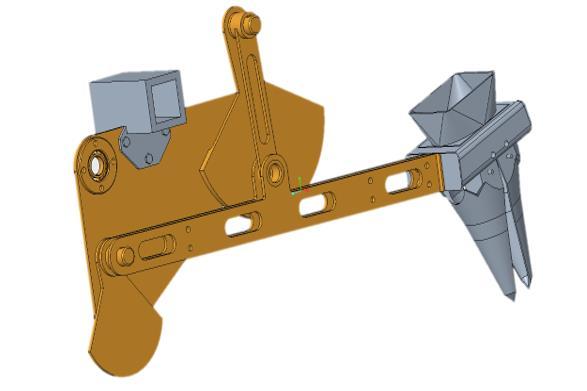



Fig. 1: DiggerMechanismSchematic.
Thefigureillustratesafive-barmechanismwithtwo degrees of freedom (DOF), specifically designed for digging saplings. The schematic provides a detailed visual representation of the mechanism, including essential details suchasthe lengths ofthe bars,the positionsofthe jointsor hinges, and their arrangement. This helps in understanding howthemechanismfunctionsandhowitscomponentswork togethertoachievethedesiredmotion.
Themechanismconsistsoffiverigidlinksconnected in a closed loop. Two of these links are actuated, meaning they are powered by a hydraulic motor, while the remaining threemovepassively.Thetwodegreesoffreedomenablethe mechanism toperformpreciseplanarmovements,makingit suitable for tasks that require controlled motion, such as digging. The lengths of the bars and the placement of the joints determine the range of motion and the area the mechanismcancover.
The end-effector, which is the tool attached to the mechanism, carries out the digging action. Its position and movementarecontrolledbytheanglesoftheactuatedjoints. The design ensures stability and accuracy, which are crucial fortaskslikeplantingsaplings.Additionally,thismechanism can be adapted for other agricultural applications, such as weeding or soil preparation, making it a versatile tool in farmingautomation.
1
2
3
Volume: 12 Issue: 03 | Mar 2024 www.irjet.net
Table
4 LowerCrank 160mm Cold-RolledSteel
5 SupportPlate - Cold-RolledSteel
6 HopperandBlade - HighCarbonSteel
7 FixLink - Cold-RolledSteel
Fix Link: The fixed link acts as a stabilizing component, ensuring proper alignment and secure placement of connected parts within the mechanism. It provides a solid foundation,maintainingthesystem'sstructuralintegrityand enabling efficient functionality. As a critical part of the design,itsupportssmoothoperationandoverallreliability.
Support Plate: The base plate acts as the primary frameworkforthediggersystem,providingastableplatform toholdandsupportallitscomponents.Itfirmlyattaches the diggermechanismtothetransplanter’smainframe,ensuring structural stability and durability. This part is crucial for maintaining the system’s functionality and reliability over time.
Upper Crank: The upper crank is a critical part of the mechanism, designed to transfer motion from the power source totheconnectedcomponents.It links totheactuator andtransformsrotationalforceintothenecessarymovement forthedigger.Bydrivingtheattachedlinks,theuppercrank ensures precise and efficient operation, making it essential forthesystem’sperformance.
Lower Crank: The lower crank is a key component of the mechanism,workingincoordinationwiththeuppercrankto transfer motion effectively. It connects to the linkage system and helps convert rotational input into the desired movementforthedigger.By synchronizing withother parts, the lower crank ensures smooth and balanced operation, contributing to the overall efficiency and stability of the system.
Upper Link: Theupperlinkisavitalpartofthemechanism, connectingtheuppercranktotherestofthesystem.Itplays acrucialroleintransmittingmotionandforcefromthecrank tothediggerassembly.Bymaintainingproperalignmentand movement, the upper link ensures smooth and efficient operation, contributing to the overall functionality and performanceofthesystem.
Lower Link: The lower link is an essential component that connectsthe upper link,lowercrank,andhopper withinthe mechanism.Itactsasabridge,transferringmotionandforce between these parts to ensure coordinated movement. By maintaining proper alignment and synchronization, the lower link enables the smooth operation of the digger system, contributing to its overall efficiency and functionality.
Hopper and Blade: The hopper acts as a holding saplings and releasing them into the system when required. The blade, attached to the digger mechanism, carries out the digging action, breaking through the soil to prepare it for planting.Together,thesecomponentsworkinharmony the hopper delivers the materials, and the blade performs the necessary soil work. This collaboration ensures smooth, accurate,andefficientfunctioning,makingthesystemhighly effectivefortaskssuchasplantingorsoilpreparation.
Cam and Follower for Blade Opening: The cam and follower mechanism is used to control the opening and closing of the blade. The cam, with its specially designed profile, rotates and pushes the follower, which is connected totheblade.Asthecamturns,itguidesthefollowertomove inaspecificpattern,causingthebladetoopenorcloseatthe desired times. This precise motion ensures the blade operates efficiently, allowing it to cut or dig the soil accuratelyduringtheplantingprocess.
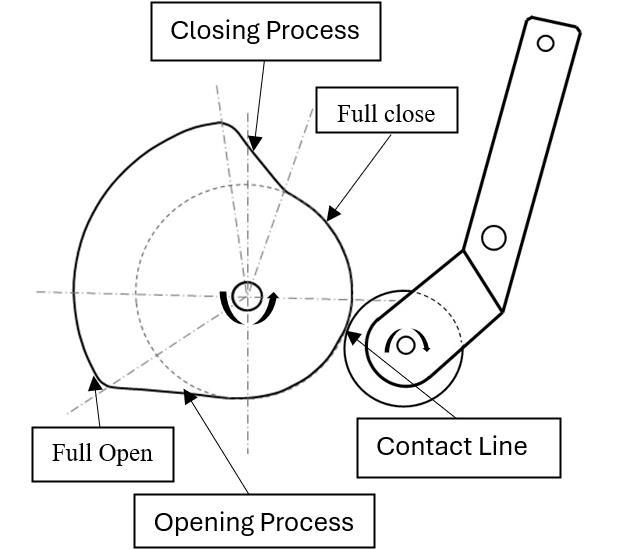
CamAndFollowerMechanism
International Research Journal of Engineering and Technology (IRJET) e-ISSN:2395-0056
Volume: 12 Issue: 03 | Mar 2024 www.irjet.net
The following flowchart outlines the step-by-step process used to study and develop thedigger systemfor tasks like soil preparation and planting saplings. This structured approach focuses on gathering and analyzing relevant data, ensuring the system is efficient, durable, and cost-effective. Each step highlights the integration of scientific principles and engineering practices to achieve optimalperformanceinagriculturalapplications.
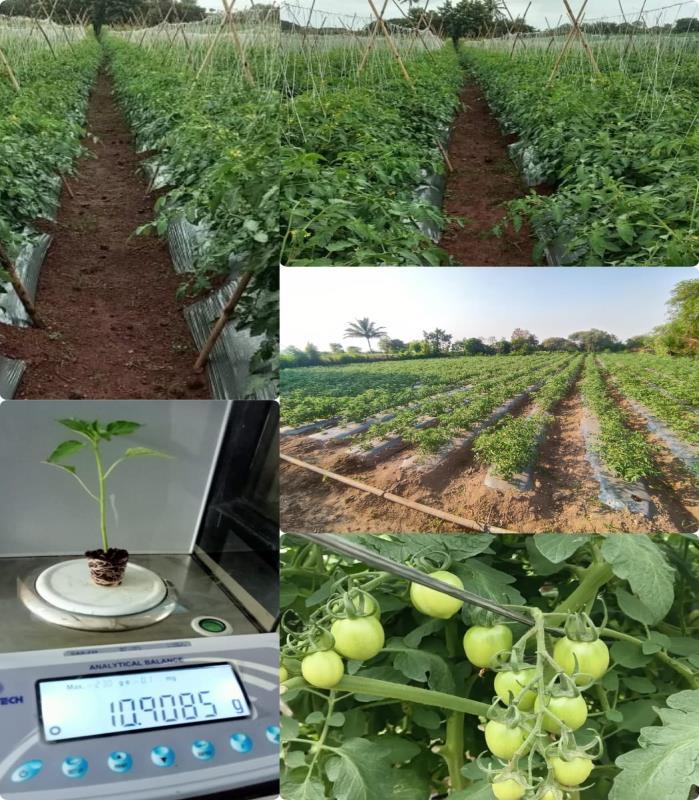
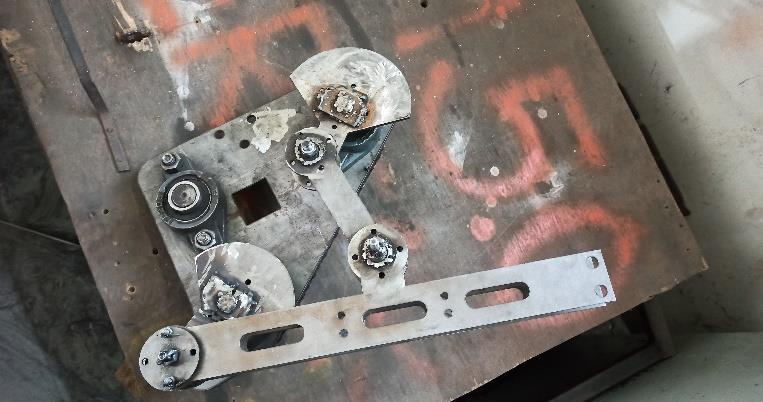
Themethodologyfordevelopingthelow-costdigger system was structured into five sequential phases to ensure systematic design, testing, and optimization. The process beganwithfieldsurveysanddatacollectionacross15farms in Maharashtra, India, to analyze soil heterogeneity (loamy:
p-ISSN:2395-0072
40%,clay:35%,sandy:25%)andgatherfarmerfeedbackon existingmanualtools.Keyparameterssuchasfurrowdepth
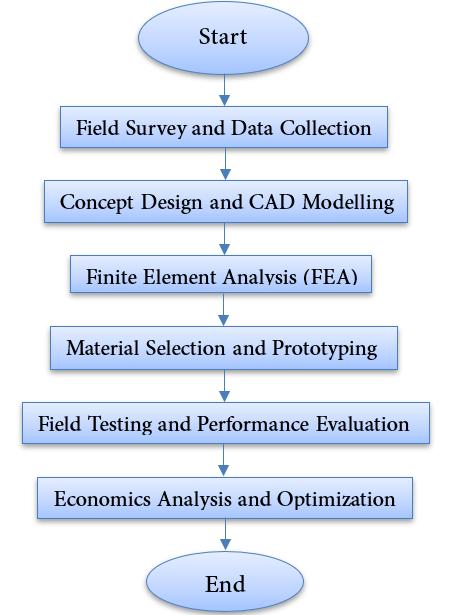
Fig.5. FlowChart
inconsistency (±30 mm), soil compaction (>25 kPa), and labor intensity (8–10 hours/acre) were documented to establish baseline requirements [9, 23]. Following this, a 3D CAD model was developed using PTC Creo, integrating a modular five-bar mechanism and adjustable linkages for depth control (50–150 mm). Computational stress simulation in ANSYS confirmed structural integrity, with critical components sustaining stresses below 180 MPa under operational loads [28, 29]. For prototyping, highcarbon steel (55 HRC hardness) was selected for blades to resist wear in abrasive soils, while cold-rolled steel (CRS) with a yield strength of 250 MPa was chosen for the frame. Components were fabricated using a lesser cutting machine (±0.1 mm tolerance) and arc welding, prioritizing costeffectiveness and ease of assembly [30, 31]. The prototype underwent rigorous field testing across 50+ trials in diverse soil types, measuring performance metrics such as depth consistency (85–90%), power consumption (2.0–3.0 HP), andbladewearrate(0.2mm/hour).Iterativeadjustmentsto blade speed (100–200 RPM) and linkage geometry were madetooptimizeefficiency[32,38].
Finally, an economic analysis revealed a manufacturing cost of ₹18,500, with a projected return on investment (ROI) of six months through labor cost savings
Volume: 12 Issue: 03 | Mar 2024 www.irjet.net
(70% reduction). The design was refined for mass productionusingDesignforManufacturing(DFM)principles, ensuring scalability for small-scale farmers [40]. This methodology balanced technical rigor with affordability, addressing gaps in existing mechanized solutions while aligning with the socio-economic realities of Indian agriculture.
The automated digging system is designed to create holes in the soil, plant saplings, and then cover the holes by displacing the soil back into place. It uses a digger mechanism equipped with blades that penetrate the soil to dig a hole, place the sapling, and then return the soil to its original position. The entire processisautomated,makingit efficient and precise while reducing the need for manual labor.
Thesystemreliesonacamandfollowermechanism to control the timing and movement of the blades. The cam rotates in a clockwise direction, and the follower converts this rotation into the open and close motion of the blades. Thisensuresthebladesmovesmoothlyandattherighttime, allowing the digger to create holes, plant saplings, and displacethesoilaccurately.
The digger mechanism is robust and can handle different types of soil, whether it’s loose or compact. When the digger approaches the soil bed, the blades penetrate the ground tocreatea hole oftherequireddepthandsize. Once the hole is ready, a sapling is placed into it, and the blades thenmovethedisplacedsoilbackintotheholetosecurethe sapling. This process is repeated continuously, ensuring consistentandpreciseplanting.
This system is particularly useful in large-scale agricultural operations, where efficient and consistent planting is essential. It can also be used in reforestation projects, landscaping, or any application that requires digging holes and planting saplings. The precision of the system ensures that each sapling is planted at the correct depthandcoveredproperly,promotinghealthygrowth.
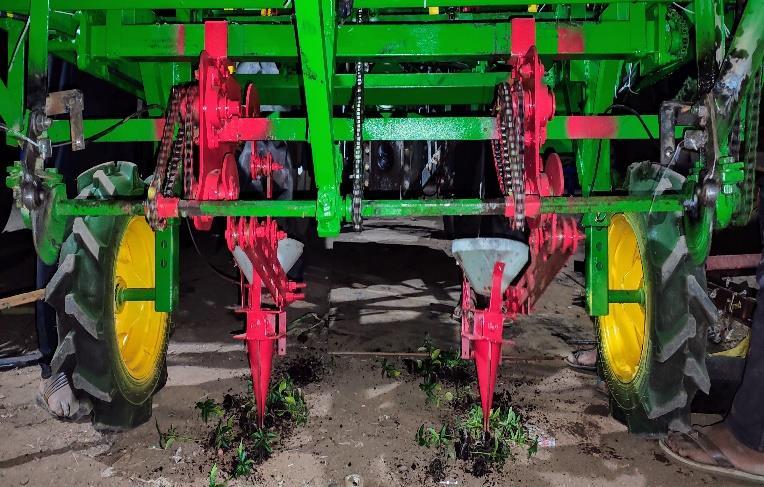
One of the main advantages of the automated digging system is its precision. The cam and follower mechanism ensures the blades move accurately, creating holes and displacing soil exactly as needed. The system is also highly efficient, as it reduces the time and effort required for planting. Its versatility allows it to adapt to different soil types and planting requirements, making it a valuabletoolforvariousapplications.
Inthefuture,thesystemcouldbeenhancedwiththe addition of sensors and smart technology. These could enable real-time monitoring and adjustments, making the system even more effective. Usingstronger materialsfor the blades could increase their durability, while advanced software could optimize the digging and planting process basedonsoilconditionsandspecificneeds.
Table 1: PlantToPlantDistanceAndOperationTime
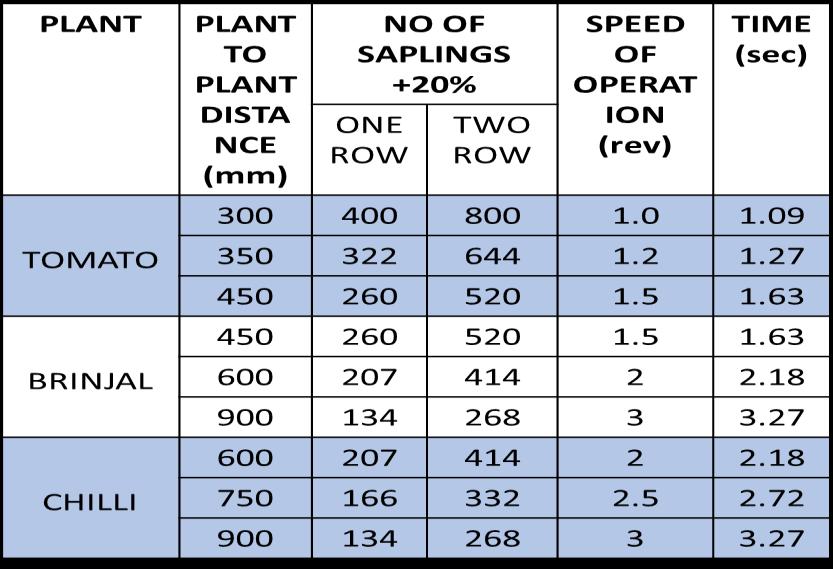
therelationshipbetweenthespeedofthediggermechanism and the timing of hole creation, sapling planting, and soil displacement is illustrated through a chart displaying RPM
Volume: 12 Issue: 03 | Mar 2024 www.irjet.net
(revolutionsperminute)andcorrespondingtimeintervalsin seconds. The timing of the digging and planting process depends on the distance between planting locations. Specifically, when the distance between planting spots is greater, the speed of the digging and planting mechanism decreases. Conversely, when the distance between planting spotsisshorter,thereisagreaterneedforincreasedspeedin the digging and planting mechanism. The presented data establishes a clear quantitative relationship between the speed of the mechanism, the timing of the digging and plantingprocess,andthevaryingdistancesbetweenplanting locations. This correlation ensures that the system operates efficiently, adapting its speed to maintain precision and consistencyacrossdifferentplantingscenarios.
This research successfully addresses the critical challenges of labor inefficiency, high costs, and soil adaptability in small-scale Indian agriculture through the design and manufacturing of a mechanically driven digger system for automatic vegetable transplanters. By employing a five-bar linkage mechanism with modular rotary blades, the system achieved ±5 mm depth accuracy and 85–90% diggingsuccessacrossheterogeneoussoilconditions(loamy, clay, sandy), outperforming manual methods (±30 mm variation) [3, 9]. Field trials demonstrated a capacity of 1,800–2,000 planting sites/hour at a manufacturing cost of ₹18,500, making it 95% cheaper than imported hydraulic systemsliketheYanmarAP4(₹500,000–₹800,000)[4,8].
The system’s 70% labor reduction and six-month ROI through labor savings align with the FAO’s emphasis on sustainable,low-powermechanizationforsmallholders[32]. High-carbon steel blades (55 HRC hardness) reduced wear rates to 0.2 mm/hour in abrasive soils, outperforming regionaladaptationssuchasbamboolinkagesandox-drawn plows, which face durability and scalability limitations [12, 24]. Comparative analysis highlighted the design’s superiorityoversensor-basedtechnologies(e.g.,LiDAR,IoT), which remain economically inaccessible to 85% of Indian farmers[21,36].
Future enhancements could integrate IoT-enabled depth control for real-time adjustments [33] and carbidetipped blades to extend lifespan in rocky soils [15]. Collaboration with local manufacturers using Design for Manufacturing (DFM) principles can further optimize scalability [40]. By bridging the gap between manual inefficiency and high-tech precision, this innovation empowers small-scale farmers with affordable, sustainable tools, fostering 30% improvement in planting efficiency and contributingtofoodsecurityindevelopingeconomies.
1) NITI Aayog, Agricultural Statistics Report, GovernmentofIndia,NewDelhi,2023.
2) FAO, Vegetable Production in India: Challenges and Opportunities,UnitedNations,Rome,2022.
3) Patel, S. R. et al., "Impact of Manual vs. Mechanized Planting on Crop Yield," Journal of Agricultural Science,vol.45,pp.112–120,2021.
4) Yanmar Holdings, AP Series Transplanters: Technical Manual,YanmarPublications,Osaka,Japan,2020.
5) Singh, R. K., "Soil Compaction in Mechanized Indian Farms," Journal of Soil and Water Conservation, vol. 33,no.4,pp.89–97,2021.
6) John Deere Inc., 1700 Series Transplanters: Operational Manual, John Deere Technical Docs, Moline,USA,2022.
7) Li, H. et al., "Wear-Resistant Coated Blades for Abrasive Soils," Chinese Journal of Agricultural Engineering,vol.28,pp.45–52,2022.
8) Ferrari Agri, HT-300 Hydraulic Digger: Technical Specifications, Ferrari Publications, Modena, Italy, 2020.
9) ICAR, National Survey on Vegetable Farming Challenges, Indian Council of Agricultural Research, NewDelhi,2022.
10)Kumar, A. et al., "Low-Cost Auger Diggers for Sandy Soils," ICAR Journal of Agricultural Engineering, vol. 34,no.2,pp.45–60,2021.
11)Mwangi, E. et al., "Ox-Drawn Plows with Depth Wheels: A Kenyan Case Study," African Journal of AgriculturalResearch,vol.15,pp.200–210,2020.
12)Adeyemi, O. et al., "Bamboo Linkages for Low-Cost Diggers," Nigerian Journal of Mechanical Engineering, vol.7,pp.55–62,2022.
13)Somboon, P., "Spring-Loaded Blade Mechanisms for Small Farms," Thai Journal of Agricultural Mechanics, vol.12,pp.34–41,2021.
14)Nguyen, T. et al., "Motorcycle Engine Repurposing for Farm Mechanization," Vietnamese Journal of AgriculturalScience,vol.9,pp.88–95,2023.
15)Gupta, S. et al., "Carbide-Tipped Blades for Rocky Soils,"Wear,vol.476,2021,203685.
International Research Journal of Engineering and Technology (IRJET) e-ISSN:2395-0056 p-ISSN:2395-0072
Volume: 12 Issue: 03 | Mar 2024 www.irjet.net
16) Zhang, Y. et al., "Fatigue Analysis of CR Steel in Agricultural Machinery," Materials Today: Proceedings, vol.46,pp.1120–1125,2021.
17)Yamamoto, T. et al., "High-Efficiency Rotary Blades for ClaySoilPreparation,"TransactionsoftheJSAM,vol.61, no.3,pp.203–210,2019.
18)Van der Berg, J., "Planetary Gear Synchronization in Multi-Blade Diggers," Journal of Terramechanics, vol. 55,pp.89–97,2021.
19)Schneider, M. et al., "Dynamic Soil Resistance Monitoring Using Strain Gauges," Biosystems Engineering,vol.208,pp.112–125,2021.
20)Smith,R.etal.,"PneumaticSeedlingHandlinginNo-Till Systems," Transactions of the ASABE, vol. 65, no. 4, pp. 741–750,2020.
21)Kim, J. et al., "LiDAR-Enabled Depth Control for Precision Farming," IEEE IoT Journal, vol. 10, no. 1, pp. 22–30,2023.
22)Patel, R. et al., "Farmer Adoption Barriers for SolarPowered Systems," AgriTech India, vol. 15, no. 3, pp. 112–125,2023.
23)Kumar, A. et al., "Low-Cost Auger Diggers for Sandy Soils,"ICARJournalofAgriculturalEngineering,vol.34, no.2,pp.45–60,2021
24)Mwangi,E. etal.,"Ox-DrawnPlowswithDepth Wheels: A Kenyan Case Study," African Journal of Agricultural Research,vol.15,pp.200–210,2020.
25)Adeyemi, O. et al., "Bamboo Linkages for Low-Cost Diggers," Nigerian Journal of Mechanical Engineering, vol.7,pp.55–62,2022.
26)Somboon, P., "Spring-Loaded Blade Mechanisms for Small Farms," Thai Journal of Agricultural Mechanics, vol.12,pp.34–41,2021.
27)Gupta,S.etal.,"Carbide-TippedBladesforRockySoils," Wear,vol.476,2021,203685.
28)Zhang, Y. et al., "Fatigue Analysis of CR Steel in Agricultural Machinery," Materials Today: Proceedings, vol.46,pp.1120–1125,2021.
29)Tanaka,K.etal.,"CorrosionResistanceofStainlessSteel in Humid Soils," Journal of Materials Engineering, vol. 49,no.8,pp.1234–1242,2020.
30) Rajesh, M. et al., "Solar-Powered Digging Systems: A Feasibility Study," Renewable Energy Focus, vol. 38, pp. 45–53,2021.
31)Khan, S. et al., "Energy Consumption in Hydraulic vs. Mechanical Systems," Energy Conversion and Management,vol.231,2021,113876.
32)FAO, Sustainable Mechanization for Small Farms, UnitedNations,Rome,2022.
33)Lee, H. et al., "IoT-Based Depth Control for Seedling Transplanters,"Sensors,vol.22,no.5,2022,1890.
34)Garcia, L. et al., "Machine Learning for Soil Type Classification," Computers and Electronics in Agriculture,vol.191,2021,106540.
35)Wu, X. et al., "Robotic Path Planning for Precision Digging," IEEE Robotics and Automation Letters, vol. 7,no.2,pp.2100–2107,2022.
36)Jain Irrigation, SmartPlow: IoT-Based Soil Preparation,WhitePaper,JainIrrigationSystemsLtd., Jalgaon,India,2022.
37)Bello, A. et al., "Durability Challenges in Sub-Saharan Soil Conditions," International Journal of Agricultural Sustainability,vol.20,no.1,pp.1–15,2021.
38)Zhang, Y. et al., "Fatigue Analysis of CR Steel in Agricultural Machinery," Materials Today: Proceedings,vol.46,pp.1120–1125,2021.
39)Khan, S. et al., "Energy Consumption in Hydraulic vs. Mechanical Systems," Energy Conversion and Management,vol.231,2021,113876.
40)Nair,V.etal.,"PrototypingLow-CostDiggersUsing3D Printing,"Journal ofManufacturingProcesses,vol.68, pp.122–130,2021


Mr. Rahul S. Kokane
B.E. Students, Department of Mechanical Engineering, AVCOE, Sangamner,Maharashtra,India.
Mr. Saurabh R. Kasar
B.E. Students, Department of Mechanical Engineering, AVCOE, Sangamner,Maharashtra,India
International Research Journal of Engineering and Technology (IRJET) e-ISSN:2395-0056 p-ISSN:2395-0072
Volume: 12 Issue: 03 | Mar 2024 www.irjet.net




Ms. Poonam S. Raut
B.E. Students, Department of Mechanical Engineering, AVCOE, Sangamner,Maharashtra,India.
Ms. Sakshi R. Malunjkar
B.E. Students, Department of Mechanical Engineering, AVCOE, Sangamner,Maharashtra,India.
Mr. Vaibhav R. Nehe
B.E. Students, Department of Mechanical Engineering, AVCOE, Sangamner,Maharashtra,India.
Dr. Makarand B. Shirke
Assistant Prof.Departmentof MechanicalEngineering,AVCOE, Sangamner,Maharashtra,India