
International Research Journal of Engineering and Technology (IRJET) e-ISSN: 2395-0056
Volume: 13 Issue: 04 | Apr 2026 www.irjet.net p-ISSN: 2395-0072

International Research Journal of Engineering and Technology (IRJET) e-ISSN: 2395-0056
Volume: 13 Issue: 04 | Apr 2026 www.irjet.net p-ISSN: 2395-0072
Vrushant Kishor Dhanpal1 , Himanshu Jayesh Patil2 , Vedant Sachin Raut3 ,Prof.Jayshree Sali4 1,2,3,4 Theem College of Engineering,Boisar-401501,Palghar,Maharashtra
Abstract - With the risingshift towardelectricmobility,the need for smarter and more reliable energy management in electric vehicles has becomeincreasinglyimportant.Thiswork introduces a combined approach that integrates a Battery Management System (BMS) with a Vehicle-to-Grid (V2G) framework. The primary function of the BMS is to supervise key battery conditions such as voltage levels, current flow, temperature variations, and the State of Charge (SOC), ensuring safe performance while minimizing risks like excessive charging, deep depletion, and overheating. The integration of V2G functionality permits bidirectional power exchange between the vehicle and the grid, thereby improving overall energy utilization efficiency. The entire system is developed using a microcontroller-based embedded platform capable of handling real-time data acquisition, maintaininguniformcellperformancethroughbalancing,and regulating power exchange intelligently. By combining these features, the system not only improves battery durability andoperational efficiencybutalsosupports grid reliability and encourages the adoption of sustainable energy practices in transportation.
Key words Battery Management System, Vehicle-toGrid, Electric Vehicles, State of Charge, Bidirectional Energy Flow, Cell Balancing, Smart Grid, LiFePO4 Battery, Embedded Platform, Sustainable Energy.
The adoption of electric vehicles (EVs) has increased significantly, transforming the modern transportation landscape significant attention as an alternative to conventionaltransportation,leadingtomajorchangesinthe automotive sector. This transition has increased the importance of efficient energy management and reliable power systems within EVs. An essential role in managing battery performance is performed by the Battery Management System (BMS), as it regularly monitors important factors like voltage levels, current flow, temperature, and State of Charge (SOC). . By doing so, it helpsinmaintainingsafeoperationandprotectsthebattery fromconditionslikeovercharging,excessivedischarge,and thermalstress.
Atthesametime,thedevelopmentofVehicle-to-Grid(V2G) technologyhasintroducedanewdimensiontoenergyusage in electric vehicles. Unlike traditional systems where vehicles only draw power, V2G allows energy to be
transferred in both directions. This means that EVs can returnstoredenergybacktothepowergridwhenrequired, especiallyduringhigh-demandperiods.Suchcapabilitynot onlyimprovesoverallenergyefficiencybutalsoplaysarole in stabilizing the grid and supporting the integration of renewableenergysources.
This project aims to develop an intelligent system that combinesBMSandV2Gfunctionalitiesintoasingleplatform. Thedesignapproachinvolvestheuseofembeddedsystems, power electronic circuits, and basic data processing techniques to manage energy effectively. The outcome is expectedtocontributetowardsmarterenergyhandlingand support the advancement of sustainable electric mobility solutions.
Existingresearchhasbroadlyexploredbatterymanagement andgridintegrationforelectricvehicles.Pilleretal.
[1] provided foundational methods for State-of-Charge (SOC) determination applicable across various battery chemistries,establishingthebasisformodernBMSdesign. Mutaetal.
[2]demonstratedhybridvehicleenergysystemarchitectures thatinfluencedbidirectionalenergymanagementstrategies inEVs.InthedomainofV2Gintegration,Kesteretal.
[3] reviewed enabling technologies for vehicle-to-grid systems,highlightingcommunicationprotocolsandpower electronicsrequirements.Hannanetal.
[4] presented a comprehensive review on lithium- ion battery charge and discharge management for vehicle applications, addressing SOC estimation accuracy and cell balancingstrategies.Communicationandcontrolaspectsfor V2G-enabledplug-inhybridEVswereaddressedbyMarkel etal.
[5], who demonstrated that standard communication protocols combined with intelligent control algorithms enableeffectivedemand-responseparticipation.
1.Design and implement a microcontroller-based Battery Management System (BMS) for real-time monitoring of voltage,current,temperature,andSOC.
2.DevelopabidirectionalVehicle-to-Grid(V2G)powerflow controlsystemenablingenergyexchangebetweenEVsand thegrid.
International Research Journal of Engineering and Technology (IRJET) e-ISSN: 2395-0056
Volume: 13 Issue: 04 | Apr 2026 www.irjet.net p-ISSN: 2395-0072
3.Implementactiveandpassivecellbalancingalgorithmsto ensureuniformbatterycellperformance.
4.Integrate communication protocols for seamless interaction between the BMS,V2G system,andsmartgrid infrastructure.
5.Validatesystemperformancethroughreal-timetestingof charging(G2V)anddischarging(V2G)modesundervarious loadconditions.
6.Developacost-effectiveandscalablehardwareprototype using lithium-ion battery pack, BLDC motor, bidirectional charger,andembeddedcontroller.
4.1 System Architecture
The proposed system consists of five integrated modules working together to deliver safe and efficient energy management.Thearchitectureenablesbidirectionalpower flowbetweentheelectricvehiclebatteryandthesmartgrid, coordinated through a central microcontroller-based decisionengineasshowninFig.1.
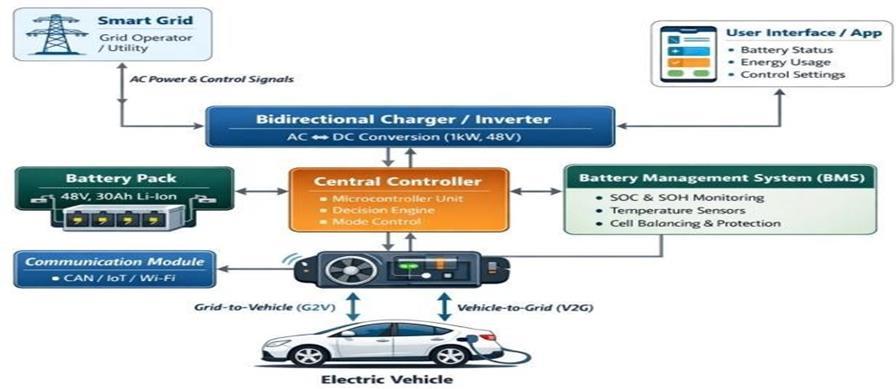
BatteryPack:A48V,30Ahlithium-ionbatterypackservesas theprimaryenergystorageunit.TheBMSinterfacesdirectly with the battery to monitor individual cell parameters. BatteryManagementSystem(BMS):Monitorsandcontrols voltage, current, temperature, SOC, and State of Health (SOH), enforcing protection thresholds and managing cell balancingviaCANbus.
BidirectionalCharger/Inverter:ConvertsACpowerfromthe gridtoDCforcharging(G2Vmode)andconvertsDCfrom batterybacktoACforgridsupply(V2Gmode),ratedat48V and1kW.TheMotorDriveSystemusesa48VBLDCmotor for vehicle propulsion and regenerative braking energy recovery.
4.2
The BMS continuously monitors cell voltage and temperature. It calculates State of Charge (SOC) using
Coulombcountingcombinedwithvoltage-basedcorrection asgivenbelow:
SOC(t)=SOC(t₀)−(1/C)×∫I(t)dt
WhereCisbatterycapacityinAhandI(t)isinstantaneous current.SOHisestimatedbycomparingcurrentmaximum capacity against rated capacity. Protection thresholds preventovercharging(above3.65V/cell),deepdischarging (below2.8V/cell),andoverheating(above60°C).
TheV2GmoduleusesarepurposedhomeUPSinverterasa cost-effectivebidirectionalpowerconverter.TheEVbattery (LiFePO4) connects to the DC input. In V2G mode, the module converts DC battery power to 230V AC to supply householdloadsorgrid-connectedinfrastructure. A voltage booster module bridges the charging voltage mismatch theUPSchargesat13.4VwhileLiFePO4requires14.6V. ModeswitchingbetweenG2VandV2Giscontrolledviarelay and microcontroller. In cases of deep discharge, a backup externalchargeractivatesautomatically.
The system incorporates hybrid cell balancing strategies, including passive dissipation of surplus energy through resistive elements and active redistribution of charge betweencellsviaDC-DCconversion,ensuringuniformcell performance. The balancing algorithm activates when voltagedeviationacrosscellsexceeds50mV.
Table 1: presentsthehardwarecomponentsusedinthe prototypeimplementation.Thedesignprioritizescosteffectivenessandscalability
Component Specifications Qty.
BatteryPack(LiFePO4) 3.2V/cell,6S 16 V2GModule 48VDC→220VAC, 1kW 1
Charge 48VDCcharger 1
Transformer 12-0-12,1KVA,48V, 1kW 1
BLDCMotor 1kW,48V 1
Microcontroller MCU(Arduino/STM32) 1
VoltageBooster DC-DCboostconverter 1
5.
5.1
The BMS was tested under varied charge and discharge conditions. Real-time monitoring of voltage, current, and temperaturewasvalidatedagainstreferencemeasurements.
International Research Journal of Engineering and Technology (IRJET) e-ISSN: 2395-0056
Volume: 13 Issue: 04 | Apr 2026 www.irjet.net p-ISSN: 2395-0072
SOC estimation accuracy was within ±3% across multiple chargecycles.
Table2: Presentsperformanceresultsacrosskey operationalparameters.
Parameter Measured Range Threshold
CellVoltage
2.9V–3.6V <2.8/>3.65V
Temperature 22°C–48°C >60°C
SOCError ±2.8%Balancing ΔV>50mVtrigger ΔV<20mVtarget
TheV2GmodulewastestedinG2VandV2Gmodesunder household load conditions. The repurposed UPS inverter delivered stable 230V AC output from the 48V LiFePO4 batterypack.Modeswitchingachievedsmoothtransitions withnoobservabletransientdisruptiontoconnectedloads.
Table3: V2GPowerFlowTestResults
Mode Input Output Eff.
G2V 230VAC 48VDC,~20A ~88%
V2G 48VDC 230VAC,800W ~85%
Backup 48VCharger LiFePO4pack ~90%
Asystemperformancesummarygivesaclearpictureofhow wellasystemisfunctioningoveraspecificperiod.Ithelpsin understandingwhetherthesystemismeetingitsexpected goalsandwhereimprovementsareneeded.
Table4: SystemPerformanceSummary
Performance Metric Result
SOCEstimationAccuracy
±2.8%error
V2GOutputVoltageStability 230V±2%
ModeTransitionTime <200ms
CellBalancingEffectiveness ΔVreducedto<20mV
ThermalProtectionResponse <50mstrigger
6. Limitations
ThecurrentV2GimplementationusingarepurposedUPSis not grid-synchronized, limiting operation to off-grid or backupsupplyscenarios.Thepricingmodeldoesnotadapt dynamicallytoreal-timegridtariffsignals.Resultsarebased onlaboratoryprototypetesting;real-worlddeploymentina moving EV will introduce additional variability from vibration,thermalcycling,andloadunpredictability. -Renewable Energy Storage: Storing excess energy from solar/windsystemsinEVbatteriesforsupplyduringpeak demand.
-EmergencyPowerBackup:UsingV2Gtosupplypowerto buildingsorcriticalinfrastructureduringoutages
Thisstudyintroducesadetaileddesignandimplementation of the proposed system framework for a Battery ManagementSystem(BMS)integratedwithaVehicle-to-Grid (V2G) system for electric vehicles. The proposed system effectively addresses key challenges in EV energy management including accurate SOC estimation, cell balancing,thermalprotection,andbidirectionalpowerflow. The microcontroller-based embedded design provides a cost-effective and scalable solution that enhances battery lifespan and improves energy efficiency.By bridging EV energystoragewithgridrequirementsusingarepurposed UPSastheV2Gmodule,thissystemdemonstratesapractical low-cost approach to bidirectional energy management. FutureintegrationwithAI,IoT,andblockchaintechnologies will further elevate the intelligence and capability of such systems.
Future developments include integration of Artificial Intelligence(AI)andMachineLearning(ML)forpredictive batterydegradationanalysis,faultdetection,andoptimized charging algorithms. IoT-based cloud connectivity will enableremotemonitoringofbatteryhealthandlarge-scale data analytics. Blockchain technology can enable decentralized, secure peer-to- peer energy trading in V2G networks. The BMS can be adapted for emerging battery chemistriessuchassolid-stateandlithium-sulfurbatteries. Long-term vision includes integration with smart city infrastructurewhereEVsserveasdistributedenergystorage nodeswithinrenewableenergyecosystems.
-EnhancedBatterySafety:Continuousmonitoringofvoltage, current,temperature,andSOCpreventsovercharging,deep discharging,andthermalrunaway.
-Extended Battery Life: Proper charge/discharge cycle control with active and passive cell balancing maintains uniformperformanceacrossthebatterypack.
-Vehicle-to-GridEnergyExchange:EVssupplystoredenergy tothegridduringpeakdemand,enablingloadbalancingand gridstabilization,withpotentialfinancialincentivesforEV owners.
-Support for Renewable Energy: EVs act as mobile energy storage units, storing surplus solar or wind power and supplyingitwhenneeded.
-Smart Grid Integration: The system supports IoT-based remotemonitoring,real-timedataanalytics,andpredictive maintenance.
International Research Journal of Engineering and Technology (IRJET) e-ISSN: 2395-0056
Volume: 13 Issue: 04 | Apr 2026 www.irjet.net p-ISSN: 2395-0072
-ScalableDesign:Microcontroller-basedarchitectureiscosteffectiveandsuitableforbothsmall-scaleandindustrialEV applications.
-ElectricandHybridVehicles(EVs/HEVs):Safe,efficient,and reliable battery operation and performance monitoring.Smart Grid Integration: Load balancing, grid stability, and demand-sideenergymanagementthroughV2Gtechnology.
[1]S.Piller,M.Perrin,andA.Jossen,"MethodsforState-ofCharge Determination and Their Applications," Journal of PowerSources,2001.
[2]K. Muta, M. Yamazaki, and J. Tokieda, "Development of New-GenerationHybridSystemTHSII,"SAETechnicalPaper, 2004.
[3]J. T. Kester, B. M. Hodge, and F. Milano .A review on Vehicle-to-Gridintegration,focusingonenablingtechnologies andapplications,publishedin,,"IEEETransactionsonSmart Grid,2018.
[4]M. A. Hannan, M. M. Hoque, and A. Mohamed,Research focusing on the management of charging and discharging processesinlithium-ionbatteriesusedinvehicles,featured inRenewableandSustainableEnergyReviews,2019.
[5]T.Markel,A.Simpson,andM.Kuss,"Communicationand ControlforPlug-inHybridElectricVehiclesSupportingV2G Integration,"IEEETransactionsonSmartGrid,2020