

International Research Journal of Engineering and Technology (IRJET) e-ISSN: 2395-0056
Volume: 13 Issue: 03 | Mar 2026 www.irjet.net p-ISSN: 2395-0072
DESIGN AND IMPLEMENTATION OF SMART SHOPPING CART WITH REAL-TIME PAYMENT AND E-RECIPT GENERATION
Alluru Komali1, Pachipala Reddy Preetham2, DS Jaipal Reddy3, Pogaku Salma4, M Revathy5
1-4UG Students, Dept. of ECE, JNTUA College of Engineering Kalikiri, Andhra Pradesh, India
5Assistant Professor (Adhoc), Dept. of ECE, JNTUA College of Engineering Kalikiri, Andhra Pradesh, India
Abstract – The usual billing procedure within most retail outlets remains a centralized check out point where the customers have to endure long queues in order to make a purchase. This usually causes inconvenience, long queues and unsatisfactory shopping experience particularly during peak time and very populated shopping malls. This issue gains more importance as the urban areas grow and the number of consumers grows requiring a more efficient and automated solution. Due to the fast development and mass usage of Internet of Things technology, there is an opportunity to change the traditional shopping process into a smart and more convenient one. The paper demonstrates the conceptual design of a smart shopping cart system that incorporates the use of the IoT technology to automate the payment process itself in the cart. The suggested system provides the possibility to monitor the products in real-time when they are being added to or removed from the cart. All objects are spotted in terms of barcode scanning and related information, e.g. cost and quantity, are automatically updated. The smart cart in effect keeps on estimating the overall price of the chosen purchases and shows the price to the customer in real time, thus removing the possibility of manual payments by billing machines. This not only ensures that it eliminates the need to rely on human intervention but also minimizes the errors that are characterized by the traditional billing systems. The system also improves the levels of transparency, as the customer can track his or her expenditure duringthe shopping process. The main task related to this approach is to make the checkout process mucheasier andfaster, minimize the number of people in billing counters, as well as to enhance customer satisfaction in general. In addition, the paper talks about system architecture, the methodology, andthe working flowof the proposed smart shopping cart and how it can transform the way people shop in the retail stores by automating and designing the system in an intelligent way.
Key Words: Smart Shopping Cart, Internet of Things, Automated Billing, E-Receipt, Retail Technology, Stock update, Theft-Control, Smart Retail.
1. INTRODUCTION
Shoppingmallsandsupermarketsstillusetheold-fashioned systemsofbillingwhenacustomerhastowaittilltheendof theshoppingtopay.Thishasthenegativeeffectofcreatinga lengthyqueue,morewaitingtimeandinconveniencetothe
customers particularly during the peak times. It is also a heavy burden on the billing workers, which causes inefficiencies and possible mistakes. These obstacles demonstrate that a more sophisticated and automated billingsystemisessentialtoalleviatecustomerexperienceat thesametimeincreasingtheefficiencyofoperation.Asthe Internet of Things has been growing rapidly, the new opportunities have become accessible to convert the ordinaryretailsystemsintosmartandautomatedspace.IoT facilitatesasmoothinteractionamongthedevices,andthe processingofdatacanbeperformedinreal-timewithoutthe participation of many people. Applying the IoT to the shopping cart in relation to the retail business will allow transforming the shopping experience to a new level of complete automation of identifying products, calculating their prices, and sending bills immediately. The smart shoppingcartsystemsuggestedismeanttodealwiththese shortcomings with technologies being added like barcode scanning, microcontrollers, and wireless communication. This system enables the clients to scan the goods as they shop, constantly update the total bill and makes real time payment with e-receipt printing. Thesystem will increase thelevelofconvenienceintheretailindustrybyeliminating the use of customers waiting in queues during checkout, decreasestheworkloadofthestaffandincreasestheoverall efficiencyoftheretailbusiness.
2. RELATED WORK
Anumberofstudieshavebeenconductedontheautomation of retail to enhance efficiency of the shopping and billing. Most of these research worksconcentrate on technologies includingRFIDorRadioFrequencyIdentification,scanning thatusesbarcodesandshoppingsolutionsthatusemobiles. RFID systems have the ability of automatic product identification through the attached RFID tags on the items wherebycartsorbillingsystemcansensenumerousproducts simultaneously without necessarily having to scan them manually. Likewise, the barcode-based will be reading the details of the products with handheld scanners or an integrated device, which is processed to produce the bills. Instead, mobile shopping apps can enable thecustomerto scantheproductwiththeirsmartphoneandmaintaintheir shoppingcartsonline.Althoughthesemethodssavesomuch intermsofmanuallabourandmakethebillingfaster,they alsohavesomelimitations.ExamplesofRFIDsystemsinclude the installation ofspecial tags and readersthat render the
Volume: 13 Issue: 03 | Mar 2026 www.irjet.net p-ISSN: 2395-0072
deploymentmorecomplexandexpensive.Systemsinvolving barcodes,thoughcheaper,stillneedactiveuserinvolvement inthescanningofindividualproducts,whichisnotalways developed.Solutionsbasedonmobilearesusceptibletothe levelofinteractionwithusersandcompatibilitywithmobile phones,hinderingtheirusebyallconsumers.Moreover,most of the current systems are associated with sophisticated architecturesandneedseriousinfrastructureadjustmentsin theretailingsettings.Theseaspectsmaymakeitdifficultto have large-scale adoption, particularly with small and medium-sized supermarkets. Thus, a cheaper, convenient, andefficientsmartshoppingcartsystemreducingtheeffort oftheusertothebareminimumandallowingittosupport real-timeandaccuratebillingisnecessary.
3. PROBLEM STATEMENT
The conventional billing system followed in various supermarketscausescustomerstowaitinalongqueueat the billing counter. This is a time-consuming process and maycauseerrorsinbillingduringpeakhourswhenalarge number of customers are shopping in these stores. Customersarenotabletotracktheirexpensesinrealtime duringshoppinginthesestores.Thereisaneedforasmart shoppingcartsystemtoautomatetheshoppingprocessby scanning the products in real time and generating bills accordingly.
4. PROPOSED SYSTEM
The proposed smart shopping cart system will help to improve the experience in the entire shopping process by incorporatingtheautomationinthesupermarketsetting,the real-timetrackmechanism,andeasynavigation.Thesystem hassmartaspectsthathelpthecustomersontheshopping process,thatisselectingtheproducts,uptomakingthefinal payment. The primary features of the system include the possibilitytolocateproductsofinterestwiththehelpofthe digitalmapornavigationsystem.Thiscontributestothetime thattheysaveinsearchingwhattheyneedanditenhances theshoppingefficiency,particularlyinthebigstores.Besides being able to navigate, the smart cart also has a barcode scanning system which enables the customer to scan the productstheyplacedirectlyinthecart.Afterthescanning, productinformationincludingthenamepriceandquantityis automaticallystoredandshownintheinterfaceofacart.This is because the system is updated constantly to show the amountthecustomerhasspentsofar,andthisenablesthem to monitor their bill and expenditure during the shopping process.Inaddition,thesuggestedsystemisinfavourofthe instant billingandpaymentfeatures.After the shoppingis closed, the sum can be paid directly by accounted digital paymentsystemswithoutanyexperienceoflongcheckout lines.Oncethisissuccessfullypaid,anelectronicreceipt(ereceipt)isproducedanddeliveredtothecustomerbyuseof email technology or through a mobile application. Comprehensively,thesystemwouldprovideasmoothand efficient and convenient shopping experience and less manuallabourandenhancestorefunctions.
5. IMPLEMENTATION OVERVIEW
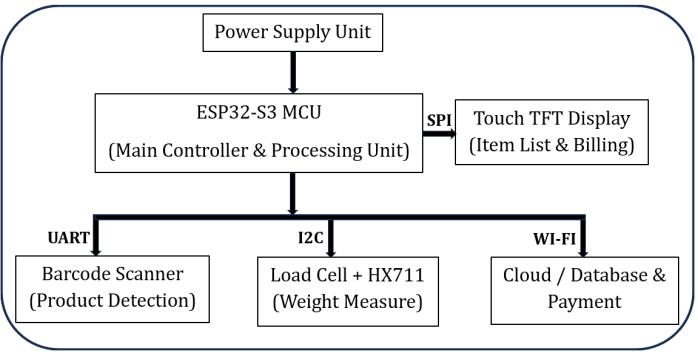
Fig -1:SystemArchitectureDiagram
Theinitialpartofintelligentapplicationofshoppingcartis dedicatedtoexperimentationoftheconceptofthesystem.
Hardware components: Waveshare ESP32-S3-7-inch capacitive touch display, Waveshare barcode scanner module(c),Loadcell,HX711amplifierandpowersource.
SoftwareModule:ArduinoIDE
Thebackendofthesoftwaremoduleconsistsofaweb-based adminportalcreatedusingHTML,CSS,andJavaScript. The adminportalisintegratedwithGoogleFirebase,whichacts as an intermediate cloud database between the smart shoppingcartandtheadminportal.
Atthisstage,systemisimplementedatthebarebonesstage to ensure that it is able to scale up to a large scale as comparedtocommercialusage.
6. HARDWARE COMPONENTS
6.1. ESP32-S3-7-inch Capacitive touch display
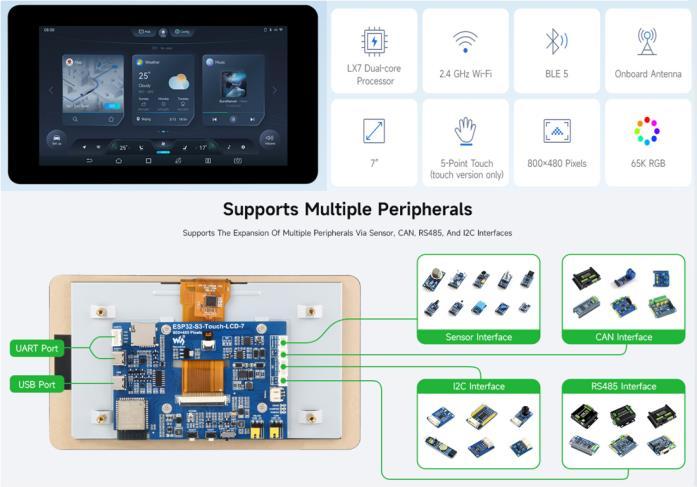
Fig -2:ESP32-S3-7-inchCapacitivetouchdisplay
ESP32-S3 7-inch capacitive touch display is the main controller and user interface for the smart shopping cart system.ItisequippedwiththeESP32-S3dual-coreXtensa LX7-basedMCUrunningupto240MHz,whichprovideshigh
International Research Journal of Engineering and Technology (IRJET) e-ISSN: 2395-0056
Volume: 13 Issue: 03 | Mar 2026 www.irjet.net p-ISSN: 2395-0072
processing performance for real-time operations. It is capable of supporting graphics libraries such as LVGL, allowing smooth graphical user interface operations and local data processing without the need for any external controller. It is equipped with a 7-inch capacitive touch display with a resolution of 800 × 480 pixels. It is also equippedwithIoTconnectivityfeaturessuchas2.4GHzWiFi and Bluetooth 5 connectivity, which enables smooth communicationwithcloudenvironments,storeservers,and databases. It is also equipped with UART, SPI, and I2C communication interfaces to connect peripherals such as barcodescanners.ItiscompatiblewiththeArduinoIDEand is powered by low voltage. It efficiently manages the operations of the product display, billing updates, and communication with the software backend for the smart shoppingcartsystem.
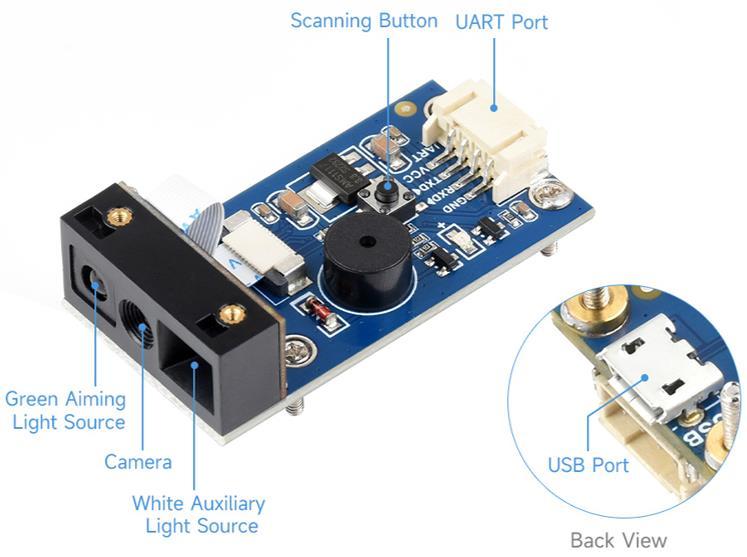
Thebarcodescannermoduleisusedinthesmartshopping cartsystemtoensuretheaccurateandquickscanningofthe product.Itiscapableofscanningone-dimensionalandtwodimensionalcodeswithhighaccuracy.
6.3. Load Cell
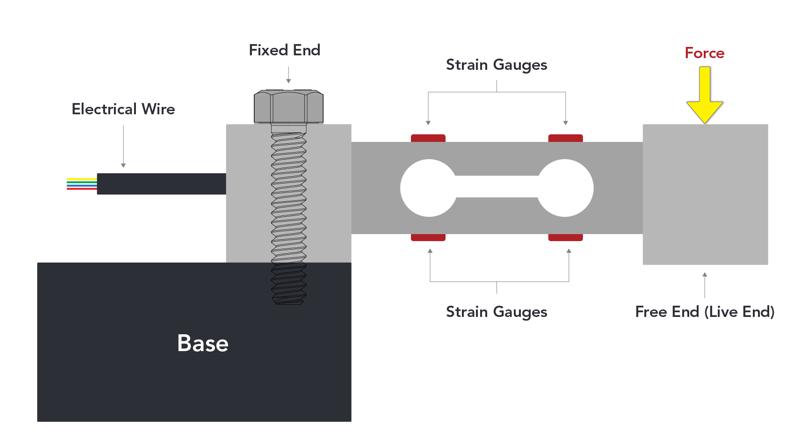
Load cell converts mechanical force like tension or compressionintoameasurableelectricalsignal.Itworksby using strain gauges bonded to a metal body that deforms slights under load. This deformation changes electrical resistance which then converted into a voltage signal proportionaltoweight.Measuresreal-timeweightvariation ofitemsplacedinthecartforproductverification.Enhances billingaccuracybyvalidatingscanneditemsthroughweightbasedconfirmation.
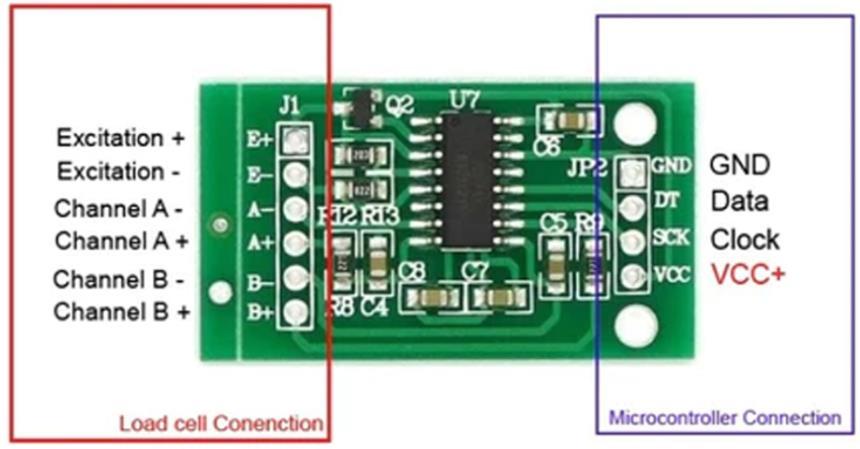
The HX711 amplifier module is employed in the smart shopping cart system for connecting the load cell to the controller. The module amplifies the weak analog signal from the load cell and converts it to digital data for the ESP32-S3microcontroller.Themodulehasaprecise24-bit analog-to-digital converter for enhanced precision. The HX711amplifiermoduleamplifiestheweaksignalfromthe load cell and converts it to digital data for the ESP32-S3 microcontroller.
6.5. Power Supply
The system operates using low-voltage embedded electronics. Aregulated3.3Vto5VDCsupplyisrequiredto powertheESP32-S3,display,andperipheralmodules.A5V 2Apowersupplyisrecommendedtoprovideasafetymargin andstableoperationofthesystemduringshopping.
International Research Journal of Engineering and Technology (IRJET) e-ISSN: 2395-0056
Volume: 13 Issue: 03 | Mar 2026 www.irjet.net
Table
-1: ComponentsTable
Component Specification
ESP32-S3
microcontroller
Integrated touchdisplay
Barcode scannermodule
LoadCell
HX711
Amplifier
32-bit microcontroller
Capacitive7-Inch display
Serialscanner
5Kgcapacity
24-bitADC
Function
Controlstheentire system
Userinteraction
Readsproduct barcode
Measuresproduct weight
Convertsloadcell signal
7. SOFTWARE IMPLEMENTATION
The software part of the smart shopping cart system is implemented using the Arduino Integrated Development EnvironmenttoprogramtheESP32-S3microcontroller.The firmwarecontrolsall theperipherals,suchasthebarcode reader, load cell, and touch display. The system will communicatewiththebackenddatabasehostedonGoogle FirebaseusingWi-Ficonnectivity.Thedatabasewillcontain informationsuchasproductID,productname,andproduct cost.Afterretrievinginformationontheproduct,thesystem willdisplayproductinformationonthetouchdisplay.The system will also update the total cost in real time. A graphical user interface is created on the touch display to display information on scanned products, total cost, and systemstatus.Inaddition,aweb-basedinterfaceiscreated to allow administrators to update product information on thedatabasehostedonGoogleFirebase.Thiswillallowrealtime updating of information on the database, ensuring efficientreal-timebillingforthesmartshoppingcartsystem.
8. METHODOLOGY
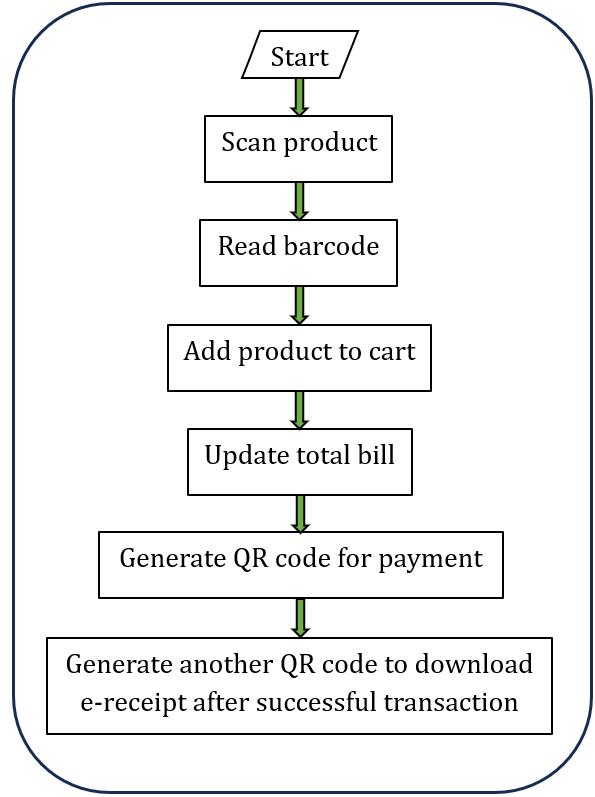
Thesmartshoppingcartfollowsaverystraightforwardstep bystepwayofwork.Firstly,whenthepoweristurnedON, the display gives the acknowledgement that the system is online. A static navigation map is provided to find the locationofproductsinthestore.Thegoodsareselectedand scanned with the assistance of barcode scanner, then the itemsareplacedintothecart.Thescanneddataissenttothe controller,whichretrievestheproductdetailsstoredinthe database.Thesystemautomaticallyidentifiestheweightof the products using load cell and HX711 amplifier. The microcontroller compares the product weight in the cart withthe database,ifthereisanymismatchthen checkout buttononthedisplaywillbedisabledelsethecustomercan continue shopping. The whole bill is calculated and the paymentQRcodeisdisplayedonthescreen,aftersuccessful payment another QR code is generated to download ereceipt.Allthetransactionsaresavedinadminportalalong
p-ISSN: 2395-0072
withtheinstantstock updateinfirebase.Theprocesswill removevariousscanningoperationsatthecheckoutpoints andwillgivehypeshoppingexperienceandpassion.
9. RESULTS AND DISCUSSION
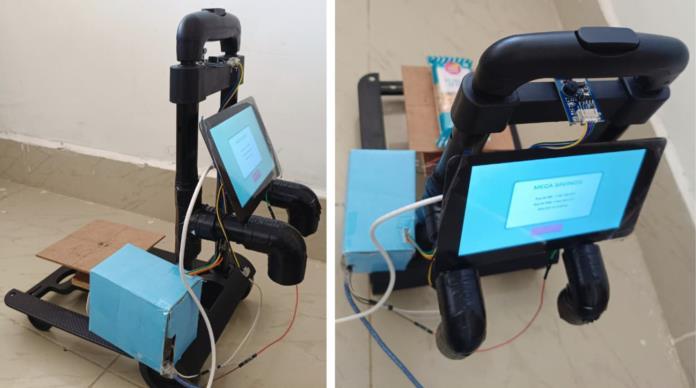
The proposed Smart Shopping Cart System is successfully designed and implemented to ensure the functionality, reliability, and real-time performance of the proposed system.ItisdesignedtointegratetheIoT-basedhardware, cloud connectivity, and sensor-based validation to ensure thedevelopmentoftheproposedsystem.Itisdevelopedto ensure the accurate performance of the product identification,billing,anddigitalpaymentprocesseswhile maintaining the data consistency with the cloud backend usingFirebase.
The following results ensure the performance and functionalityoftheproposedsystem:
Volume: 13 Issue: 03 | Mar 2026 www.irjet.net p-ISSN: 2395-0072
SysteminitializationandBootprocess
Theproposedsystemissuccessfullydesignedtoensure the ON process and initialization of the hardware components.Itdisplaysthewelcomemessagefollowed bytheWi-Fiandcloudconnectivitymessages.
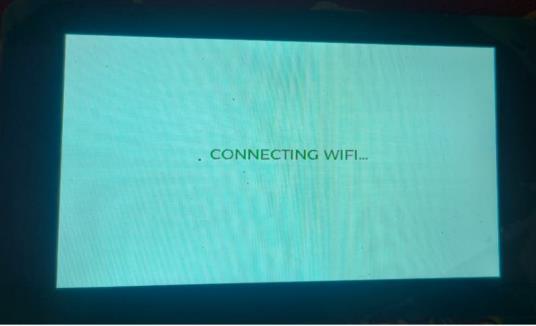
Fig -8:Initialscreen
SuccessfulWi-FiandCloudConnectivity
Thesystemsuccessfullyestablishesaconnectionwith the Wi-Fi network. Moreover, it synchronizes in realtime with the cloud database. The “System Online” status confirms the readiness of the system for operation.
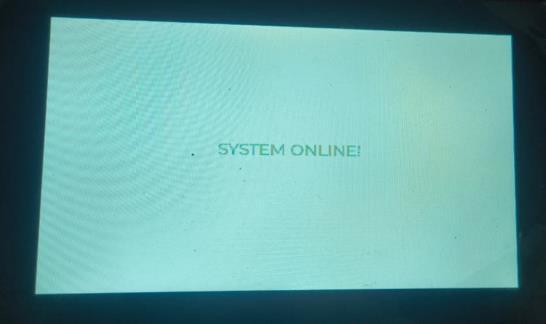
Fig -9:SystemOnlinescreen
DisplayofPromotionalOffers
The user interface successfully displays the dynamic promotionaloffers.Thus,itengagestheuser.Moreover, itservesasareal-timemarketingfeatureforthesystem.
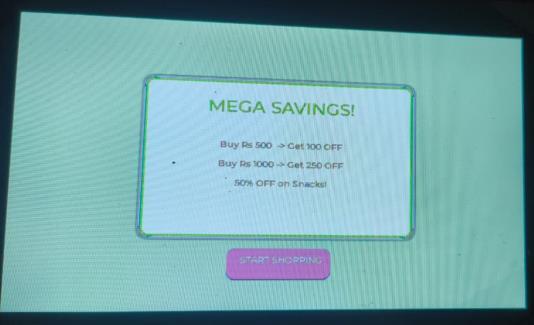
Fig -10:Advertisementscreen
StoreNavigationInterfaceFunctionality
The navigation interface successfully displays a static map of the store layout. Thus, the user can easily identifythelocationoftheproducts.
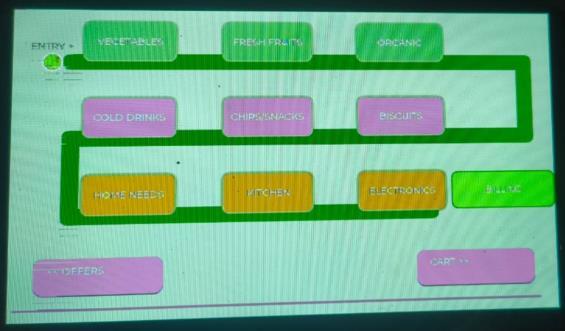
Fig -11:StaticStoreNavigationscreen
AccurateBarcode-BasedProductIdentification
The system successfully identifies the products by scanning the barcode. Moreover, it retrieves the required information from the cloud database. The scanned products are successfully added to the cart interface.
Real-TimeCartManagementSystem
The system successfully updates the cart in real-time. Moreover,theusercanadd orremove items fromthe cartthroughtheon-screeninterface.Thetotalamountis calculatedinreal-time.
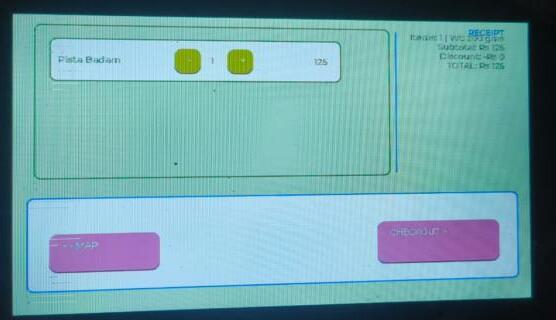
Fig -12:Cartinterface
EffectiveWeightVerificationMechanism
The load cell successfully integrates with the HX711 Load Cell Amplifier Module. Moreover, it accurately calculatestheweightoftheitemsinthecart.Thesystem successfully verifies the weight of the products by comparingitwiththeavailabledata.
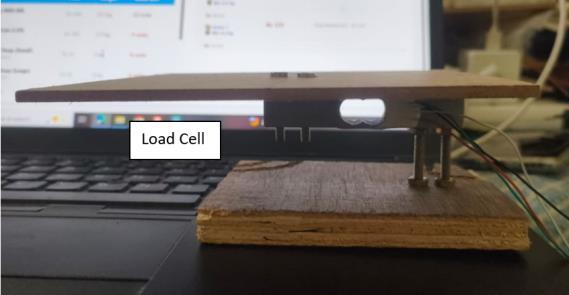
Fig -13:LoadCellsetup
International Research Journal of Engineering and Technology (IRJET) e-ISSN: 2395-0056
Volume: 13 Issue: 03 | Mar 2026 www.irjet.net p-ISSN: 2395-0072
MismatchDetectionandAnti-TheftFunctionality
Thesystemsuccessfullydetectsthemismatchinweight. Thus, it disables the check-out option. The anti-theft featurepreventsunauthorizedoperationsinthesystem.
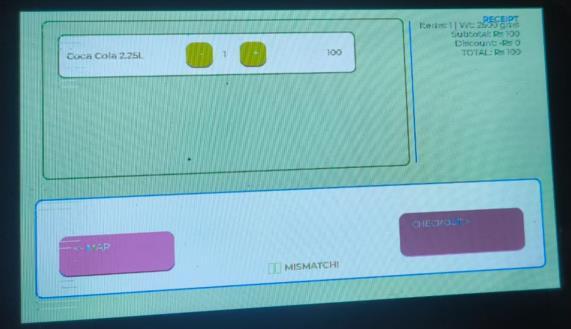
AutomaticRevalidationandRecovery
Oncethecorrectobjectisinsertedintothebasket,the process again verifies the weight and re-enables the checkoutoption.Thisprocessisuninterruptedanduserfriendly.
QRCode-BasedPaymentSystem
The system will create a QR code with the amount payableonthebill,facilitatingthepaymentthroughthe UPIapps.
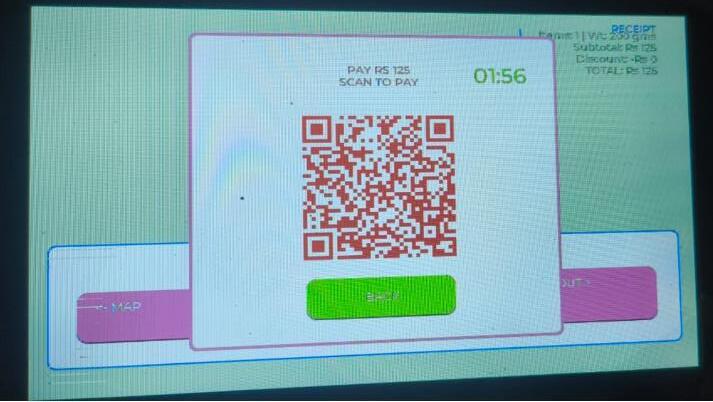
E-ReceiptGenerationandDownload
A second QR code is generated for the purpose of downloadingthereceiptafterthepaymentismade.
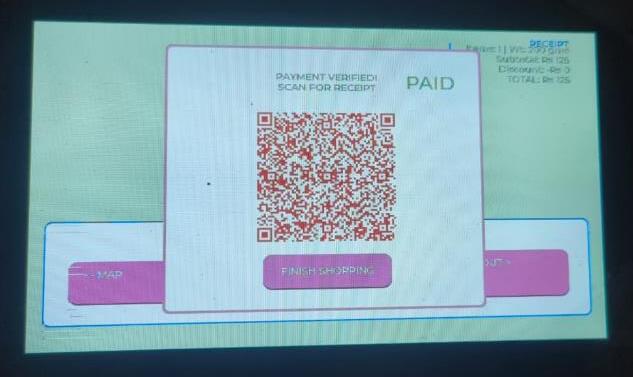
Real-TimeCloudDataStorageandSynchronization
Alltheinformationrelatedtothetransaction,including thebillID,itemspurchased,andtheamount,isstored ontheclouddatabasewiththehelpofFirebase.
AutomaticInventoryManagement
The system also keeps track of the stock level of the productsinrealtime,i.e.,aftereverytransaction.
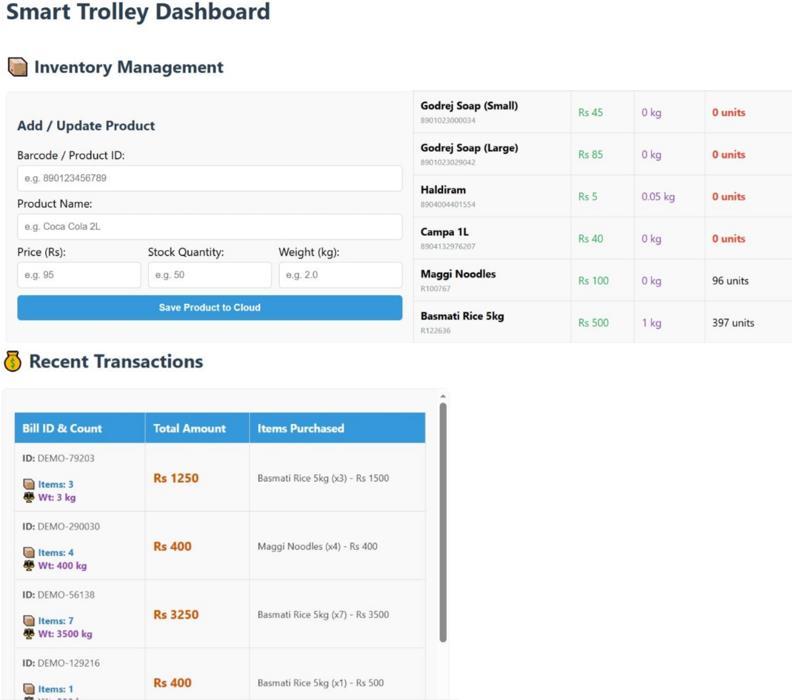
Fig -17:Inventorymanagement
TheexperimentalresultsprovethattheSmartShoppingCart system is working efficiently with high accuracy in the identification, billing, and validation processes. The integration of IoT, cloud computing, and sensor-based verification is ensuring the security, reliability, and userfriendlinessofthesystem.
10. CONCLUSIONS
Theproposedsystemisbasedontheideaofdevelopingan IoT-based smart shopping cart for the purpose of automatingthebillingprocessinretailsupermarketstores. It is designed to reduce the dependency on the checkout countersforbillingpurposes.Itprovidesthefunctionalityto scantheitems,calculatetheprice,andverifytheweightof the products directly on the shopping cart. It enables the customertoscantheproductsduringtheshoppingprocess, whichreducesthetimerequiredtowaitinthequeueatthe checkoutcounter.Itprovidesthebenefitsofdigitalpayment andthegenerationofe-receipts.Itcanbeintegratedwiththe cloud database for the purpose of real-time product monitoring. It can be further developed to incorporate advancedfeaturesinthefuturetosupportthedevelopment ofsmartshoppingenvironments.
International Research Journal of Engineering and Technology (IRJET) e-ISSN: 2395-0056
Volume: 13 Issue: 03 | Mar 2026 www.irjet.net p-ISSN: 2395-0072
11. FUTURE SCOPE
ArtificialIntelligence-BasedProductRecommendation: The integration of artificial intelligence may help in recommending products to customers based on their needsandpreferences.
ComputerVisionforAutomaticProductDetection:The integrationofcomputervisionmayhelpinremovingthe needforscanningproductsbyallowingthecamerato identifytheproductsandaddthemtothecart.
Mobile Application Integration: The development of a mobileapplicationmayhelpcustomersaccessthecart andmakepayments.
Advanced Payment Methods (NFC & Digital Wallets): The future version of the application may include multiple payment options such as near-field communication-based payment systems and digital walletsforefficientpaymentprocessing.
Real-TimeIndoorNavigationSystem:Technologiessuch asBluetoothbeaconscanhelpinimplementingarealtime indoor navigation system, which can help in directing customers to the location of the required productinamoreefficientmanner.
REFERENCES
[1] AishwaryaGiri,DarshanaBawane,MrunmayiKalejwar, Shrutika Mahalle, Tejshree Tekade, Dr. Swati Dixit, "AutomaticSmartShoppingTrollywithBilling",Vol.10, Issue12,Dec2023IRJET-V10I1233.
[2] Mr. M. Balaji Naiak, K. Akhila, U.L.S.M. Mouli, M.V.V. Avinash, G. Dileep, K. Abhihaas, "Tech Enhanced Shopping Trolley", Vol. 11, Issue 03, Mar 2024 IRJETV11I3127.
[3] M. Shyamsunder, Sambaraju Bhavani, Mohammed Mujtaba,MikkiliKeerthana,"SmartBillingTrolley",Vol. 08,Issue07,July2021IRJET-V8I7182.
[4] T. Thirumoorthy, S. Roshan Prakash, S. Surendran, T. Thenmozhi, "Smart Trolley with Automated Billing System",Vol.06,Issue03,Mar2019IRJET-V6I31127.
[5] Savita C Teli, "Design of an IoT based Smart Trolley PrototypeforRetailMart",Vol.07,Issue12,Dec2020 IRJET-V7I1297.
[6] Pritha N, Sahana S, Selvin Stephy N, Shiny Rose S, Unnamalai S, "Smart Trolley System for Automated BillingusingRFIDandIoT",Vol.05,Issue04,Apr2018 IRJET-V5I444.
[7] Chukwuka Michael, Akatobi Daniel, Chinedu Onyeka, OnyekaChidera,"DesignandImplementationofaLight FidelityBasedAutomatedSmartTrolley",Vol.10,Issue 05,May2023IRJET-V10I5199.
[8] Thiyagarajan.M, Aejaz.M, Kumar.M, "Smart Shopping Trolley",Vol.07,Issue04,Apr2020IRJET-V7I4278.
[9] Anitha G, Dr. Subburam S, Keerthana K, H Yoganandarajurs,"IoT-BasedIntelligentShoppingCart toEnhancetheShoppingExperience",Vol.09,Issue12, Dec2022IRJET-V9I12118.
[10] GhatolSonaliDigambar,Mrs.V.S.Jahagirdar,Pratiksha Dattatraya Khamitkar, "Smart Shopping Using Smart Trolley",Vol.05,Issue05,May2018IRJET-V5I5452.
[11] Om Ravi Mhaskar, Aditya Sandip Benichetake, Arjun Amar Dalvi, Shrivardhan Rajesh Chavan, "Automatic Human Follower Shopping Trolley", Vol. 08, Issue 01, Jan2021IRJET-V8I1300.
[12] P.Seema,M.Shalini,R.Sindhu,"SmartShoppingusing Smart Trolley", Vol. 05, Issue 03, Mar 2018 IRJETV5I3642.
[13] Tejal Deshpande, Karan Singh, Karan Parmar, "RFID based Smart Trolley using ARM Processor", Vol. 04, Issue04,Apr2017IRJET-V4I4621.
[14] MohammedMujtaba,MikkiliKeerthana,"SmartBilling Trolley",Vol.08,Issue07,July2021IRJET-V8I7182.
[15] M. Thiyagarajan, M. Aejaz, M. Kumar, "RFID Based AdvancedShoppingTrolleyforSuperMarket",Vol.04, Issue07,July2017IRJET-V4I7413.
BIOGRAPHIES





Ms. Alluru Komali is currently student from Department of Electronics and Communication EngineeringfromJNTUACollegeof Engineering Kalikiri, Andhra Pradesh,India
Mr. Pachipala Reddy Preetham is currently student from Department of Electronics and CommunicationEngineeringfrom JNTUACEK,AP,India
Mr. DS Jaipal Reddy is currently student from Department of Electronics and Communication Engineering from JNTUACEK, AP, India
Ms. Pogaku Salma is currently student from Department of Electronics and Communication Engineering from JNTUACEK, AP, India
Mrs. M. Revathy
Assistant Professor (Adhoc) at JNTUACEK from Department of Electronics and Communication Engineering,AP,India