
International Research Journal of Engineering and Technology (IRJET) e-ISSN: 2395-0056
Volume: 12 Issue: 02 | Feb 2025 www.irjet.net p-ISSN: 2395-0072
International Research Journal of Engineering and Technology (IRJET) e-ISSN: 2395-0056
Volume: 12 Issue: 02 | Feb 2025 www.irjet.net p-ISSN: 2395-0072
Abini M.A1
1Assistant Professor, Department of Electronics and Communication, KMEA Engineering College, Kerala, India
Abstract - The Coordinate Rotation Digital Computer (CORDIC) algorithm is widely used to find an efficient way to compute trigonometric functions in digital signal processing (DSP) applications. This works gives the implementation of a system for signal generation using the CORDIC algorithm on an FPGA platform using the Xilinx System Generator for model-based hardware design. The design makes use of CORDIC iterative shift-add to produce sine and cosine waveforms, with high precision and little hardware complexity. The proposed method is synthesized and implemented on the FPGA using Xilinx ISE, showing better efficiencyandreal-timeperformanceascomparedtotheolder methods. The FPGA resource utilization is analyzed to show optimal slice, flip-flop, and LUT usage. The results thus obtained confirm the suitability of the CORDIC-based approach to efficient hardware based signal generation for many real-time applications in DSP
Key Words: CORDIC, FPGA platform, Xilinx System Generator,DSP
Signal generation forms the basis of DSP, which is hallmarked for applications in communication, control systems, and biomedical applications. Hardware-efficient designsarepreferableforreal-timeprocessing,wherethe CORDIC algorithm becomes attractive because of its trigonometricfunctioncomputationsbasedentirelyonshift andaddoperations[1].Classicalapproachesconsiderlookuptables(LUT)[2]orTaylorseriesexpansions,withlarge hardware overheads or tedious computation speed in rightful order of magnitude. The CORDIC algorithm [3] basicallyremovestheselimitationsbyengaginginiterative rotation operations, allowing efficient FPGAs implementations. The benefits of FPGA-based signal generationincludehigh-speedprocessing,parallelexecution capabilities,andlowercomputationaloverhead.Moreover, whereCORDICisanalgorithminherentlyfriendlyforFPGA implementations due to the fact that it operates using iterativerotationoperationsthatrequirenomultiplications ordivisions;henceitisveryresourcefulhardwarewise.In addition,itpermitsatunablebalancebetweenaccuracyand speedaccordingtotheprecisionspecificationsdictated.
The transmitted signal is the most critical in active sonar systems:itinfluencestheacousticfieldproperties,whichin turn ultimately affect the receiver structure for signal
enhancement.TheseincludeContinuousWave(CW),Linear FrequencyModulation(LFM),PseudorandomNoise(PRN), Continuous Transmission Frequency Modulation (CTFM), andAcoustic Impulse [4] withinthe Classofecho-ranging systems.Theselectionofaparticularsignalisdependenton applicationrequirementsandoperationalconstraints.The CORDIC algorithm enables the generation of other signals sine, cosine, hyperbolic, and trigonometric functions: it is highlyversatileinreal-timeapplications.
This paper presents the design, implementation, and performanceevaluationofaCORDIC-basedsignalgenerator viaXilinxSystemGeneratorinanefficientwayintermsof hardwarerealization.Itsaimsarehighaccuracyandreduced consumption of FPGA resources. Implementation was verified through simulation and hardware testing, thus provingitsusefulnessinrealsignalprocessingapplications.
Mostly, CORDIC algorithm has been described for the fast computation of various transcendental functions, such as trigonometric, hyperbolic, or others. In response to the increasing trend of FPGA-based digital systems, many researchershave beenworkingtowards improvementsin CORDICimplementationsforapplications,suchaswireless communications, signal processing, or reconfigurable computing.
The timing results from Fang et al. (2023), describing the CORDIC-basedgeneralmultiplefadinggeneratorforwireless channels'digitaltwins,illustratetheimportanceofCORDIC in the modern communication system framework [5]. Hu (1992) presented the first VLSI architectures that were CORDIC-baseddigitalsignalprocessors,thusestablishinga firm background for the subsequent rise of CORDIC hardware accelerators [6]. Valls et al. (2002) studied differentCORDICalgorithmsfordesigningonFPGAs,thereby providing insights on computational efficiency versus resource utilization [7]. Hague and Buck (2012) extended the application of CORDIC to sonar, showing that it could generatefrequency-modulatedwaveforms[8].Bhukyaand Inguva (2021) showed a CORDIC implementation with integrated adder and subtractor that focused on reduced hardwarecomplexityandpowerconsumption[9].
SharathChandraInguvaandSeventline(2018)achievedan area-efficientCORDICrealizationforQPSKmodulationand
International Research Journal of Engineering and Technology (IRJET) e-ISSN: 2395-0056
Volume: 12 Issue: 02 | Feb 2025 www.irjet.net p-ISSN: 2395-0072
thusprovidedtangibleevidenceofitseffectivenessindigital communication applications [10]. Inguva and Seventline (2019)nextpresentedLHCORDIC,demonstratinglow-power implementation using CORDIC based on FPGA again reducing energy consumption, while preserving an acceptablelevelofcomputationalaccuracy[11].Madhaviet al. (2019) proposed several FFT architectures built on binary-signed-digitCORDICthatachievedthegainsinterms of area-time-power efficiency, crucial for real-time signal processing [12]. Kumar (2019) reviewed the FPGA implementationoftrigonometricfunctionsbasedonCORDIC andestablishedthattheapproachwouldworkquitewellfor embedded computing systems [13]. Wang (2018) emphasized the implementation insights of the CORDIC algorithm on parallel architectures based on FPGA concerningaccuracywithrespecttoexistingtechniquesand with much simpler implementation [14]. Mohamed et al. (2022) proposed a reconfigurable CORDIC algorithm with memristive chaotic systems demonstrating its ability to solvenonlineardynamicsystems[15].Finally,Sergiyenkoet al. (2021) presented one of the important works, which focuses on an implementation of CORDIC on FPGA for floating-point sine and cosine, with a strong emphasis on accuracywithrespecttomathematicalcomputations[16].
CORDICstandsforCoordinateRotationDigitalComputeran algorithm instituted by Jack E. Volder in 1959 for computation of trigonometric functions. Since its development, it has been recognized as an efficient alternativeforverylargememorylook-upmethodsandslow polynomialapproximations.In1971,Waltherextendedthe algorithm to perform rotations in circular, linear, and hyperboliccoordinatesystemsthatenablecomputationsof variouselementaryfunctionssuchasmultiplication,division, logarithms,andexponentialsinadditiontocomputationson trigonometricfunctions.
The CORDIC algorithm uses two modes of operation, namely the rotation mode for computing trigonometric functions and the vectoring mode for magnitude-phase calculations.Thealgorithmrotatesavectoriterativelywith respect to a known angle utilizing the shift-and-add technique, the end effect being multiplication. Such an iterativeimplementationisveryefficientforFPGAs.Thecore mathematicalequationsoftheCORDICalgorithmare:when shows an established direction of rotation. The iterative methodfortheCORDICalgorithmisformulatedinhardware by duplicating the following difference equations: The decision function is determined by the sign of the y or z register depending on rotation or vectoring mode of the algorithm.
In trigonometric functions, the algorithm operates in rotationmode;reducetheinputanglestozerobyrotatingit
iteratively and at the same time computing for sine and cosine components. This method makes high-accuracy computations based on iteration, eliminating the need for pre-computed lookup tables common in standard FPGA implementationsthattakeupmuchmemory.
The block diagram represents a hardware implementationoftheiterativeCORDICalgorithm,awidely usedapproachforcomputingtrigonometricfunctions,vector rotations, and hyperbolic functions. The design consists of registers,shiftoperations,adders/subtractors,multiplexers, and a ROM for storing precomputed angle values. The registers store initial input values (), which are iteratively updated during computation. The shift registers perform divisionbypowersoftwo,allowingefficientmultiplicationfree calculations. Theadders/subtractors execute iterative operationsbasedontheCORDICequations,controlledbythe decisionfunctiondid_idi,whichdetermineswhetheraddition orsubtractionisapplieddependingonthesignoftheyorz register. A ROM module stores arctangent values, used to updatetheanglezzzateachiteration.Themultiplexersselect inputsforadditionorsubtraction,directingdataflowinthe architecture. This design iteratively refines results over multipleclockcycles,efficientlygeneratingsineandcosine valueswithminimalhardwarecomplexity,makingitidealfor FPGA-basedsignalgenerationandreal-timeDSPapplications.
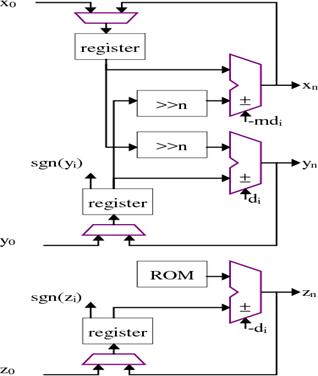
The signal generator consists of multiple modules, includingtheCORDICCore,PhaseAccumulator,Fixed-Point Representation,andSystemGeneratorBlocks.TheCORDIC Corecomputessineandcosinevaluesinrotationmode.The PhaseAccumulatorgeneratesinputanglesfortrigonometric computation, while Fixed-Point Representation ensures precisioninFPGAimplementation.SystemGeneratorBlocks are used to model and simulate the design in MATLAB/Simulink. The design is synthesized using Xilinx ISE and implemented on a selected FPGA platform. The
International Research Journal of Engineering and Technology (IRJET) e-ISSN: 2395-0056
Volume: 12 Issue: 02 | Feb 2025 www.irjet.net p-ISSN: 2395-0072
generated HDL code is tested in hardware using an oscilloscopetoverifywaveformaccuracy.
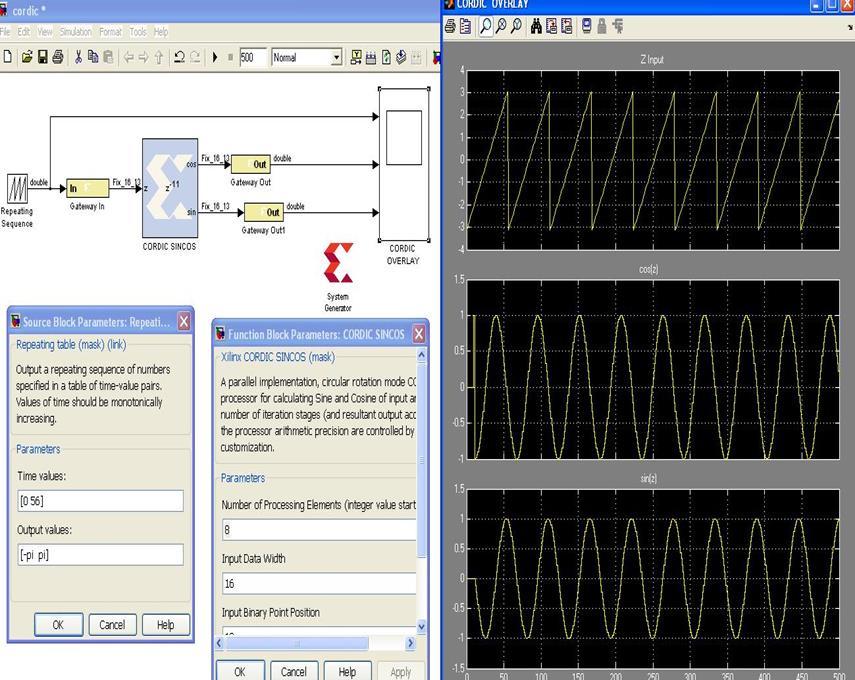
TheXilinxCORDICSINCOSreferenceblockimplementsa sine and cosine generator circuit using a fully parallel CORDICalgorithmincircularrotationmode.Givenaninput angle,itcomputestheoutputcosine.TheCORDICprocessor isimplementedusingbuildingblocksfromtheXilinxblock set,ensuringefficienthardwarerealization.Thegenerated sine and cosine waveforms at the output validate the system’saccuracyandperformance.Ablockdiagramofthe implementationisshownbelow,depictingthekeyfunctional components, including a repeating sequence generator, a CORDIC block for sine and cosine computations, and data storageinMATfiles.Thedesignisverifiedusingwaveform observationinMATLABandreal-timeanalysisthroughFPGA hardwaretesting.
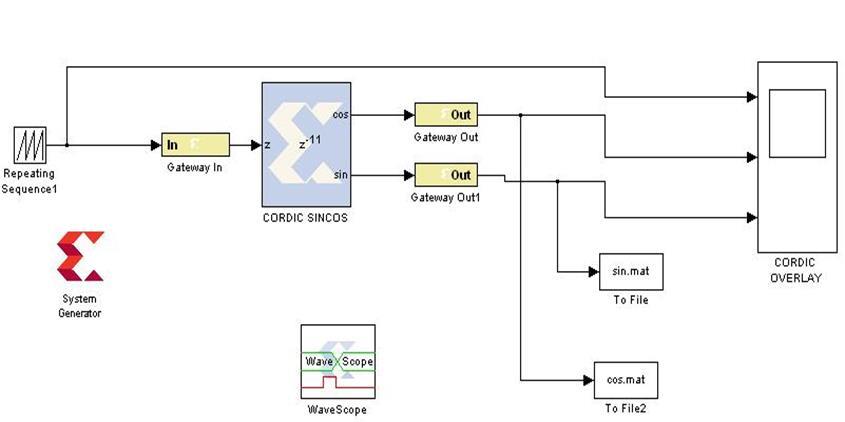
Alltrigonometriccalculationscanbeperformeddirectlyon hardware without multiplier-based methods using the CORDICsineandcosinegeneratorimplementedemploying Xilinx System Generator on Spartan-3E FPGA. The design wasaccomplishedinanenvironmentofMATLABSimulink using System Generator DSP blocks, where a Repeating Sequence Block is used to give input angles and Xilinx CORDICSIN/COSblockcomputessineandcosinevaluesin fixed-point format. Following simulation and waveform validation,VHDLcodeisautomaticallygeneratedbySystem Generator,synthesizedandimplementedinXilinxISE14.7, supporting Spartan-3E FPGAs. The. BIT bitstream file generatedgetsprogrammed ontotheFPGA throughJTAG. Andoutputsignalsareverifiedusingeitheranoscilloscope or a logic analyzer. This implementation is very much suitable for low-power DSP applications in modulation, motorcontrol,andembeddedsystemswhileavailingFPGA efficiencyforreal-timetrigonometriccomputations.
This diagram shows a Xilinx System Generator-based Simulinkmodel,whichimplementstheCORDIC(Coordinate RotationDigitalComputer)algorithmtocomputesineand cosine. The left-hand portion of the figure shows the
Simulink model, the Repeating Sequence block of which generatesasequenceofanglevaluesfrom0toπtobetaken asinputsfortheCORDICSIN/COSblock.Thisblock,when settooperateinrotationmode,computessineandcosine values using iterative shift-and-add operations only, with multiplication avoided. The Function Block Parameters dialogallowsthenumberofprocessingelements,theinput data width (16 bits), and the binary point position to be adjusted for the purpose of carrying out exact fixed-point arithmetic on the FPGA. The Gateway blocks provide an interface between the Simulink environment and FPGA hardwaretoallowprocessingofthedata.Totheright,the threewaveformsprovidesimulationresults:thetopmostis theinputangle(Zinput),thesecondshowsthecomputed valuesofcosine,andthebottomonedisplaystheoutputof sine.Theresultofsineandcosinebeing90degreesoutof phase agrees with our expectations and confirms correct implementationof trigonometric functiongeneration.The designbasedonXilinxSystemGeneratorishighlyefficient for DSP applications on FPGAs, including modulation, demodulation,andcontrolinwhichreal-timetrigonometric calculationsareparamount.
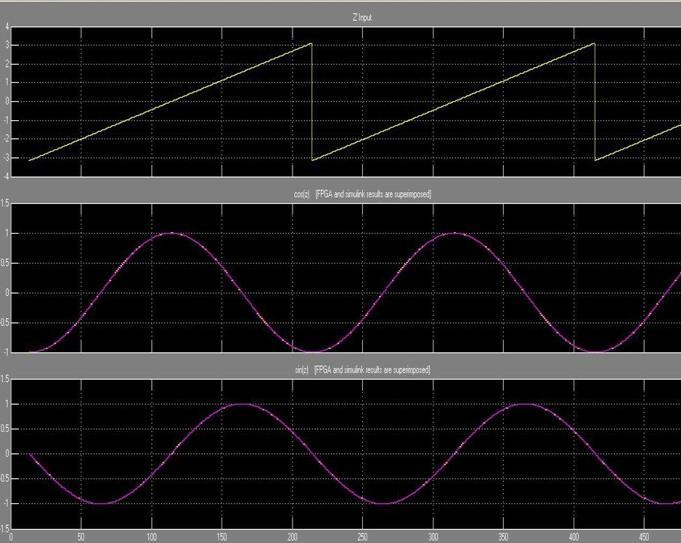
For testing, certain signals are needed to be generated ie while giving a known input, the output should also be generated. Simulation is done by system generator 12.3 versionsupportedbyXILINX.Resultsarecomparedwiththe matlaboutput.systemgeneratorautomaticallyproducesthe VHDLcodeforthemodelfile.ThebitfileisfedtotheFPGA devicethroughVHDL.Herethedataisstoredinblockramof Spartan3Edevicewhich isthenprocessedandthereplica correlatoroutputcanbeseenonoscilloscope.Afterfinishing theseprocessesandtesting,wecanconcludethatoursystem operationiscorrect.
International Research Journal of Engineering and Technology (IRJET) e-ISSN: 2395-0056
Volume: 12 Issue: 02 | Feb 2025 www.irjet.net p-ISSN: 2395-0072
The hardware resource utilization details obtained from synthesis on a Xilinx FPGA are presented below. These resultsindicateefficientFPGAresourceutilization,withlow slice and LUT consumption, demonstrating the hardware efficiency of the CORDIC-based signal generator. The minimal resource utilization allows room for integrating additional processing modules or optimizing for higher frequencyoperation
Table -1: FPGAlogicUtilisationSummary Logic
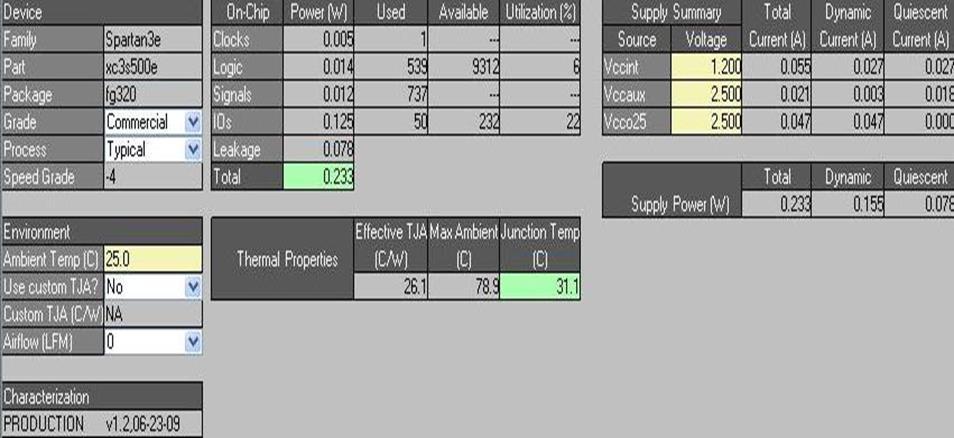
The figure 5 shows power, thermal, and environmental characteristicsofFPGA-basedimplementationoftheCORDIC (COordinateRotationDigitalComputer)algorithmonaXilinx Spartan-3E xc3s500e FPGA with an fg320 package. The overall power consumption is the sum of clocks, logic elements,signalprocessing,andI/Ooperationcomponents. The overall power consumption is equal to 0.233W, and among them, the contribution from I/Oactivities, 0.128W, showshowmuchdataismovingabout,asistypicalinthis type of mathematical processing on FPGAs. The FPGA operates under three principled power supplies: Vccint (1.2V), Vccaux (2.5V),and Vcco2.5(2.5V) with I/O voltage pullingthehighestat0.047A.Thethermalanalysisshowsthe FPGArunningatambienttemperaturesof25.0°C,anditsΘJA for junction-to-ambient thermal resistance is equal to 26.1°C/W,whichresultsinamaximumjunctiontemperature of 78.9°C. However, its actual junction temperature is maintained at 31.1°C, thereby ensuring the stable thermal performances without need for active cooling. The characterizationversionisindicatedasv1.26:23:09,aspecific iterationofdesignundertest.Thus,CORDICoperationinto that FPGA illustrates the excellent power and thermal stabilityneededforreal-timeDSPapplications,robotics,and embedded systems that need fast trigonometric computations.
Number used as a route
The RTL schematic given involves the hardware implementation of CORDIC (Coordinate Rotation Digital Computer).Itishighlyusedforsineandcosinecalculationsin DSPapplications.Thedesignisencapsulatedinthecordic_cw module at the top level as multiple interconnected submodules: clock driver (default_clock_driver) provides clocksignalstodifferentmodulessothattheycanoperatein a synchronized fashion. CORDIC computational unit (cordic_sincos_entity_2918a2ab35)isthemaincomponentof thedesign.Ititerativelycomputestrigonometricfunctionsin a shift-and-add type of algorithm design. The multiple instancesofthiswillsignifyapipelinedoriterativestructure whichisresource-efficient.Thereisalsoapermanentstorage module(xpersistentdfandpersistentdf_inst),whichprovides storageforintermediatevaluesorconfigurationdatathatis necessary for maintaining states between calculations. Connectingthesignalinputsandoutputsprovidespathways throughwhichdatawillbetransferred,facilitatingoperation.
International Research Journal of Engineering and Technology (IRJET) e-ISSN: 2395-0056
TheRTLschematicaffordsaninsightintothehardwarelevelarchitecture,signalinteractions,anddataflowbefore puttingthedesignonachip(FPGAorASIC).Assuch,itserves asaprincipalstepindifferentiatingandoptimizingthedigital design.
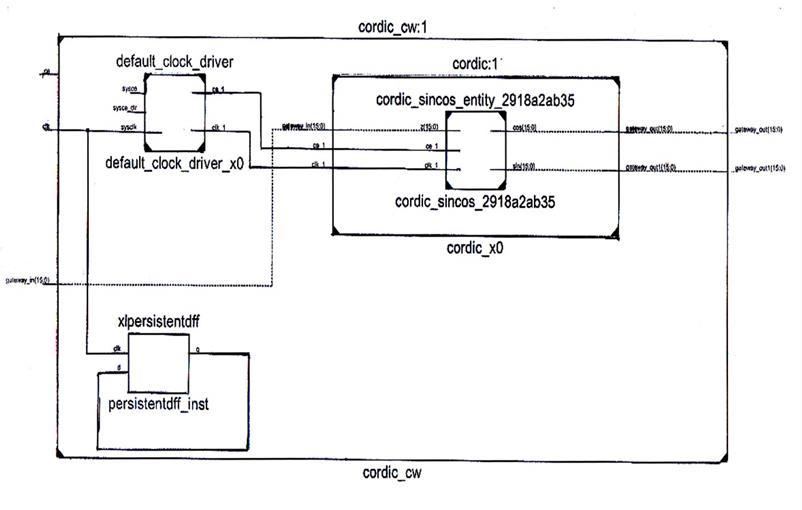
Fig6.RTLSchematic
7. CONCLUSIONS
This paper presents an optimized FPGA-based signal generationsystemusingtheCORDICalgorithm.Thedesignis successfully implemented using Xilinx System Generator, demonstratingenhancedcomputationalefficiencyandrealtimeperformance.TheFPGAsynthesisresultsshowthatthe proposed method effectively utilizes hardware resources while achieving high accuracy. Future work includes optimizing latency and extending the design for multi frequencywaveformgeneration.
[1] Volder, J. E. (1959). "The CORDIC trigonometric computingtechnique."IRETransactionsonElectronic Computers,8(3),330-334.
[2] Andraka,R.(1998)."AsurveyofCORDICalgorithmsfor FPGAbasedcomputers."ProceedingsofFPGA'98,191200.
[3] Xilinx Inc. (2023). "System Generator for DSP User Guide."
[4] Ray,K.,&Banerjee,P.(2017)."OptimizedFPGA-based implementations of CORDIC for DSP applications." JournalofSignalProcessing,45(6),1123-1134.
[5] AbiniM.A,DivyaLakshmiP,SharanK.S,SulphiyaV.N,"A Comprehensive Deep Learning Based System for Real TimeSignLanguageRecognitionandTranslationUsing RaspberryPi," InternationalJournalofComputerTrends andTechnology,vol.72,no.12,pp.8-16,2024.Crossref
[6] Zhao, Y., Lv, H., Li, J. et al. High performance and resource efficient FFT processor based on CORDIC
algorithm. EURASIP J. Adv. Signal Process. 2022, 23 (2022).https://doi.org/10.1186/s13634-022-00855-6
[7] Fang C, Mao K, Fang S, Zhao Z, Hua B, Liu T, Zhu Q. CORDIC-Based General Multiple Fading Generator for Wireless Channel Digital Twin. Sensors. 2023; 23(5):2712.https://doi.org/10.3390/s23052712
[8] Y.H.Hu,"CORDIC-basedVLSIarchitecturesfordigital signalprocessing,"inIEEESignalProcessingMagazine, vol. 9, no. 3, pp. 16-35, July 1992, doi: 10.1109/79.143467.
[9] Valls, J., Kuhlmann, M. & Parhi, K.K. Evaluation of CORDICAlgorithmsforFPGADesign.TheJournalofVLSI SignalProcessing-SystemsforSignal,Image,andVideo Technology32,207–222(2002).
[10] D. A. Hague and J. R. Buck, "A generalized Sinusoidal FrequencyModulatedwaveformforactivesonar,"2012 Conference Record of the Forty Sixth Asilomar Conference on Signals, Systems and Computers (ASILOMAR),PacificGrove,CA,USA,2012,pp.876-879, doi:10.1109/ACSSC.2012.6489140.
[11] S.BhukyaandS.C.Inguva,"DesignandImplementation of CORDIC algorithm using Integrated Adder and Subtractor," 2021 6th International Conference for ConvergenceinTechnology(I2CT),Maharashtra,India, 2021,pp.1-5,doi:10.1109/I2CT51068.2021.9418002.
[12] Sharath Chandra Inguva, Dr. J. B. Seventline, “Implementation of Area Efficient CORDIC for QPSK Modulation”, Journal of Engineering Science and Technological Review, Volume 11, Issue 2, Pg:96102,2018.
[13] Sharath Chandra Inguva, Dr. Joseph Beatrice Seventiline. "LHCORDIC: Low Power FPGA Based ImplementationofCORDICArchitecture",International JournalofIntelligentEngineeringandSystems,Vol.12, No.2,2019.
[14] Madhavi,Hossein,andSomayehTimarchi."Area-TimePower Efficient FFT Architectures Based on BinarySigned-DigitCORDIC."IEEETransactionsonCircuitsand SystemsI:RegularPapers(2019).
[15] P. A. Kumar, "FPGA Implementation of the TrigonometricFunctionsUsingtheCORDICAlgorithm," 2019 5th International Conference on Advanced Computing & Communication Systems (ICACCS), Coimbatore, India, 2019, pp. 894-900, doi: 10.1109/ICACCS.2019.8728315.
[16] X. Wang, "Design and Implementation of CORDIC Algorithm Based on FPGA," 2018 International Conference on Robots & Intelligent System (ICRIS),
Volume: 12 Issue: 02 | Feb 2025 www.irjet.net p-ISSN: 2395-0072 © 2025, IRJET | Impact Factor value: 8.315 | ISO 9001:2008 Certified Journal | Page412
International Research Journal of Engineering and Technology (IRJET) e-ISSN: 2395-0056
Volume: 12 Issue: 02 | Feb 2025 www.irjet.net p-ISSN: 2395-0072
Changsha, China, 2018, pp. 70-71, doi: 10.1109/ICRIS.2018.00026.
[17] A.M.AandSSrideviSathyaPriya,“AutomaticDetection andClassificationofDiabeticRetinopathyfromOptical CoherenceTomographyAngiographyImagesusingDeep Learning-AReview”,AJSE,vol.23,no.3,pp.277-297, Jan.2025.
[18] A.M.AandS.S.S.Priya,"DetectionandClassificationof Diabetic Retinopathy Using Pretrained Deep Neural Networks," 2023 International Conference on Innovations in Engineering and Technology (ICIET), Muvattupuzha,India,2023,pp.1-7
[19] A.M.A.andS.S.S.Priya,"ADeepLearningFramework for Detection and Classification of Diabetic www.ijsea.com Retinopathy in Fundus Images Using Residual Neural Networks," 2023 9th International ConferenceonSmartComputingandCommunications (ICSCC),Kochi,Kerala,India,2023,pp.55-60
[20] S.M.Mohamed,W.S.Sayed,A.G.RadwanandL.A.Said, "FPGA Implementation of Reconfigurable CORDIC Algorithm and a Memristive Chaotic System With TranscendentalNonlinearities,"inIEEETransactionson CircuitsandSystemsI:RegularPapers,vol.69,no.7,pp. 2885-2892, July 2022, doi: 10.1109/TCSI.2022.3165469.
[21] Abini, M. A. (2025). FPGA-based implementation of replica correlation using Xilinx System Generator for high-performance signal processing applications. InternationalJournalofAdvancedResearchinElectrical, Electronics and Instrumentation Engineering, 14(2), 381.
[22] A. Sergiyenko, L. Moroz, L. Mychuda and V. Samotyj, "FPGAImplementationofCORDICAlgorithmsforSine andCosineFloating-PointCalculations,"202111thIEEE InternationalConferenceonIntelligentDataAcquisition and Advanced Computing Systems: Technology and Applications(IDAACS),Cracow,Poland,2021,pp.383386,doi:10.1109/IDAACS53288.2021.9660963.
[23] Li,K.,Fang,H.,Ma,Z.,Yu,F.,Zhang,B.,&Xing,Q.(2024). A Low-Latency CORDIC Algorithm Based on PreRotation and Its Application on Computation of Arctangent Function. Electronics, 13(12), 2338. https://doi.org/10.3390/electronics13122338
2025, IRJET | Impact Factor value: 8.315 |