
International Research Journal of Engineering and Technology (IRJET) e-ISSN: 2395-0056
Volume: 13 Issue: 04 | Apr 2026 www.irjet.net p-ISSN: 2395-0072
International Research Journal of Engineering and Technology (IRJET) e-ISSN: 2395-0056
Volume: 13 Issue: 04 | Apr 2026 www.irjet.net p-ISSN: 2395-0072
Rupali Patel , Deenu Kumar karsh , Rahul Manhar , Manisha , Prof. Richa Dubey
Dept of EEE Chouksey Engineering College Bilaspur (CG)
Dept of EEE Chouksey Engineering College Bilaspur (CG)
Dept of EEE Chouksey Engineering college Bilaspur (CG)
Dept of EEE Chouksey Engineering College Bilaspur (CG)
Department of EEE , Chouksey Engineering College Bilaspur CG. India
Abstract - The rapid growth of electric vehicles has significantly increased the demand for efficient, sustainable, and user-friendly charging infrastructure. Conventional wiredchargingsystemsoftensufferfromlimitationssuchas mechanical wear, safety concerns, and inconvenience due to physicalconnections.Toaddressthesechallenges,thispaper presents the design and implementation of a solar-tracked wirelesshybridchargingstationforelectricvehicles.
The proposed system integrates multiple subsystems, including solar energy harvesting, automatic solar tracking, battery storage, and wireless power transfer. Two solar panels connected in parallel are mounted on a dynamic tracking mechanism that utilizes Light Dependent Resistors (LDRs) and DC geared motors to continuously align the panels with the direction of maximum sunlight. This enhances the overall energy conversion efficiency compared tofixedsolarinstallations.
The harvested energy is stored in a lithium-ion battery through a TP4056 charging module, which ensures safe charging with over-voltage and over-current protection. In addition to solar charging, the system incorporates a hybrid chargingfeaturethatallowsthebatterytobechargedusinga regulated 5V external power supply during low or no sunlight conditions, thereby ensuring uninterrupted operation.
The stored energy is transmitted wirelessly using an XKT412 module based on inductive coupling. Power transfer is demonstrated using transmitter and receiver coils, with an LED used as an output indicator at the receiver side. Experimental results show successful wireless power transfer at short distances, validating the feasibility of the system.
The proposed model offers a cost-effective, eco-friendly, and scalablesolutionforfutureelectric vehiclechargingsystems
bycombiningrenewableenergysourceswithwirelesspower transfertechnology.
Key Words: Wireless Power Transfer, Solar Tracking, Electric Vehicle Charging, Hybrid System, Inductive Coupling, TP4056
With the increasing adoption of electric vehicles worldwide, theneedforefficientandsustainablecharginginfrastructure has become more critical than ever. Traditional wired charging systems, although widely used, present several challenges such as cable management issues, risk of electric shock,wearandtearofconnectors,andlackofconvenience. Wirelesspowertransfer(WPT)technologyhasemergedasa promising alternative that eliminates the need for physical connectionsandenhancesuserconvenience.
This paper proposes a solar-powered wireless hybrid charging system designed specifically for electric vehicle applications.Thesystemutilizessolarenergyastheprimary source of power, thereby reducing dependence on conventional grid electricity and promoting environmental sustainability. To maximize the efficiency of solar energy harvesting, an automatic solar tracking mechanism is incorporated.
The solar tracking system uses Light Dependent Resistors (LDRs) to sense the intensity of sunlight and adjust the orientationofthesolarpanelsaccordinglyusingN20geared motors.Thisensuresthatthepanelsremainalignedwiththe sun throughout the day, resulting in improved energy generation.
The generated electrical energy is stored in a 3.7V lithiumionbatteryusingaTP4056chargingmodule,whichprovides regulated and safe charging. The stored energy is then
International Research Journal of Engineering and Technology (IRJET) e-ISSN: 2395-0056
Volume: 13 Issue: 04 | Apr 2026 www.irjet.net p-ISSN: 2395-0072
utilized by a wireless power transfer module (XKT-412), whichtransmitspowerthroughelectromagneticinduction.
At the receiver side, a coil captures the transmitted energy and converts it back into electrical form. This is demonstrated using a Light Emitting Diode (LED), which glows when sufficient power is received. The system is capableoftransferringpowerwirelesslyoverasmallairgap, demonstratingitspracticalfeasibility.
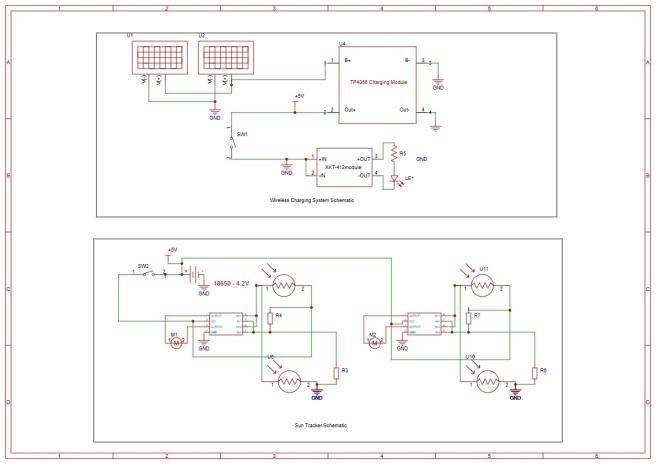
Fig-1: Schematic of a Solar-Tracked Wireless Hybrid ChargingStationforElectricVehicles
To ensure continuous operation, a hybrid charging mechanismisalsoincluded.Whensolarenergyisinsufficient or unavailable, the battery can be charged using an external AC supply via a regulated DC source. This enhances the reliability and usability of the system under varying environmentalconditions.
Overall, the proposed system integrates renewable energy, automation, and wireless technology into a compact and efficient solution for next-generation electric vehicle charging.
Various research studies have explored wireless power transfer as an alternative to conventional charging methods forelectricvehicles.Inductivecouplingtechniqueshavebeen widely used due to their simplicity and effectiveness in short-range energy transmission. Several works have also focused on improving efficiency through coil design, alignmentoptimization,andfrequencycontrol.Thesestudies highlight the potential of wireless charging in reducing dependencyonphysicalconnectorsandenhancingsafety.
In addition, solar-based charging systems have gained significant attention for their ability to provide sustainable energy solutions. Solar tracking mechanisms using light sensors have been shown to increase energy generation efficiency compared to fixed panels. However, limited work has been done on integrating solar tracking with wireless charging and hybrid backup systems. This paper aims to bridgethatgapbycombiningthesetechnologiesintoasingle system.
The proposed system consists of four main sections: solar energy generation, solar tracking mechanism, energy storage, and wireless power transfer. The solar generation unit includes photovoltaic panels connected in parallel to increase current output. These panels are mounted on a movable structure controlled by a tracking mechanism that adjuststheirorientationbasedonsunlightintensity.
The energy storage unit consists of a lithium ion battery connected through a charging module that regulates voltage and current. The stored energy is supplied to the wireless transmission unit, which transfers power to a receiver coil through electromagnetic induction. A hybrid input is also providedtoallowchargingthroughanexternalpowersource when solar energy is unavailable. The overall architecture ensuresefficientenergyflowandcontinuousoperation.
The system utilizes various electronic and mechanical componentstoachieveitsfunctionality.Solarpanelsareused to convert sunlight into electrical energy, while light dependent resistors act as sensors to detect light intensity. DC geared motors are employed to rotate the solar panel structure for tracking purposes, ensuring maximum exposuretosunlight.
Alithiumionbatteryisusedforenergystorage,supportedby a charging module that provides safe and controlled charging. The wireless power transfer module enables contactless energy transmission using inductive coupling between transmitter and receiver coils. Additional componentssuchasresistors,diodes,andswitchesare used to regulate current, protect the circuit, and control system operation.
The working of the system begins with solar energy generation, where photovoltaic panels convert sunlight into electricalpower.Thesolartrackingmechanismcontinuously
© 2026, IRJET | Impact Factor value: 8.315 | ISO 9001:2008 Certified Journal | Page3994
Volume: 13 Issue: 04 | Apr 2026 www.irjet.net
monitors light intensity using sensors and adjusts the panel position through motor control to maximize energy absorption. This dynamic alignment significantly improves theefficiencyofthesystemcomparedtofixedinstallations.
SolarPower:
P=V×I
Theoutputpowerofthesolarpaneldependsonvoltageand current.Thetrackingmechanismincreasescurrentoutputby maintainingoptimalalignmentwithsunlight.
WirelessPowerconcept:
Vinduced ∝1/d
The induced voltage in the receiver coil decreases with increasing distance, which affects the efficiency of wireless powertransfer.
The generated energy is stored in a rechargeable battery through a charging module. Once stored, the energy is supplied to a wireless transmitter circuit that produces an alternatingmagneticfield.Thisfieldinducesa voltageinthe nearbyreceivercoil,enablingwirelesspowertransfer.
The received energy is used to power a load, demonstrating theeffectivenessofthesystem.Intheabsenceofsunlight,the hybrid charging feature allows the battery to be charged usinganexternalpowersource.
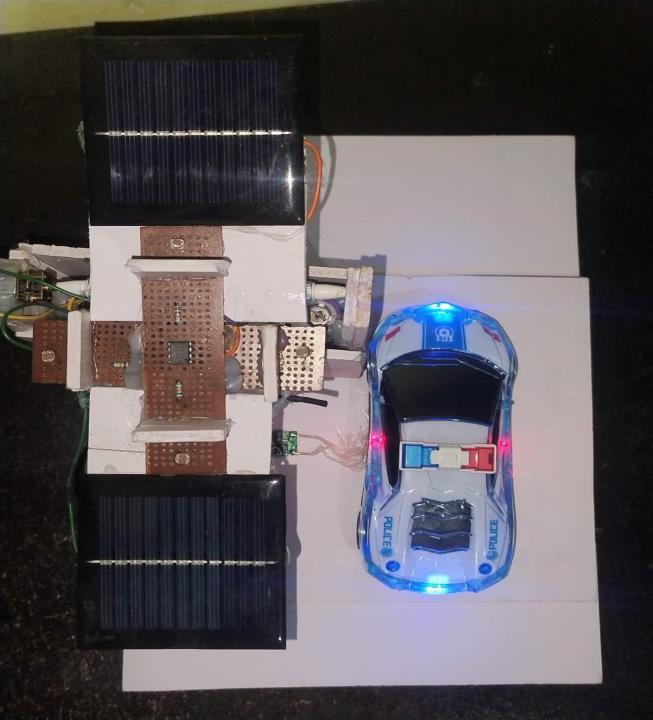
The system was experimentally tested to evaluate its performance under different operating conditions.It was observed that the LED intensity decreased significantly beyond 5 mm distance, indicatinga sharp drop in efficiency. Proper alignment between coils resulted in maximum brightness, while slight misalignment caused noticeable power loss. The solar tracking system showed improved outputcomparedtoafixedpanel,especiallyduringchanging sunlightconditions.
The solar tracking mechanism demonstrated improved energygenerationcomparedtoastationarypanelsetup.The hybrid charging feature ensured continuous operation during low light conditions, enhancing system reliability. Overall, the results confirm that the proposed system effectively integrates solar energy with wireless power transferforefficientoperation.
The proposed system offers several advantages over conventional charging methods. It utilizes renewable solar energy, reducing dependency on non-renewable resources andminimizingenvironmentalimpact.Thewirelesscharging feature eliminates the need for physical connectors, improvingsafetyandconvenienceforusers.
Additionally, the solar tracking mechanism increases energy generation efficiency, while the hybrid charging option ensures uninterrupted operation. The system is simple, cost effective, and suitable for small-scale implementation, makingitapromisingsolutionforfuturedevelopment.
Despite its advantages, the system has certain limitations. The wireless power transfer efficiency is limited to short distances, and performance decreases with misalignment betweenthecoils.Thisrestrictsitsapplicationtolowpower andclose-rangesystemsinitscurrentform.
Furthermore, the output power of the solar panels is relatively low, which limits the charging capacity. Environmental factors such as weather conditions can also affect system performance. These limitations highlight the needforfurtherimprovementsindesignandefficiency.
2395-0056
Volume: 13 Issue: 04 | Apr 2026 www.irjet.net p-ISSN: 2395-0072
The proposed systemcan befurther enhancedby increasing the power capacity and improving wireless transmission efficiency. Advanced coil designs and resonance techniques can be implemented to extend the range and efficiency of power transfer. Integration with smart control systems can alsoimproveautomationandperformancemonitoring.
Inaddition,thesystemcan bescaledforreal electricvehicle applications by using higher capacity batteries and larger solar arrays. The use of advanced tracking algorithms and energy management systems can further optimize performance.Thisopensopportunitiesfordevelopingsmart andsustainablecharginginfrastructure.
Thispaperpresentsasolartrackedwirelesshybridcharging system that combines renewable energy with contactless power transfer technology. The system successfully demonstrates the integration of solar energy generation,
[1]IEEEPapersonWirelessPowerTransfer
[2]SolarTrackingusingLDRSensors,IJERT
[3]TP4056Lithium-ionChargingModuleDatasheet
[4]XKT-412WirelessPowerModule
[5]RenewableEnergyBasedEVChargingSystems
tracking mechanism, energy storage, and wireless transmission in a single platform. The results indicate that the system operates effectively under different conditions andprovidesareliablechargingsolution.
The proposed model highlights the potential of using solar energyandwirelesspowertransferforfutureelectricvehicle charging applications. Although currently limited to smallscale implementation, it provides a strong foundation for further research and development. With improvements in efficiency and scalability, this technology can play a significant role in the advancement of sustainable transportationsystems.
The integration of renewable energy with wireless charging improves both efficiency and user convenience. The system providesa foundationforfutureadvancementsinsmart and sustainableEVcharginginfrastructure.