
International Research Journal of Engineering and Technology (IRJET) e-ISSN: 2395-0056
Volume: 13 Issue: 02 | Feb 2026 www.irjet.net p-ISSN: 2395-0072
International Research Journal of Engineering and Technology (IRJET) e-ISSN: 2395-0056
Volume: 13 Issue: 02 | Feb 2026 www.irjet.net p-ISSN: 2395-0072
SUSHEN JOGDAND1 , DIPAK KHODE2 , ATUL PALLAWE3,MANISH YAMGAR4 , PROF.SUSHMA HADBE5, PROF. ANIL NAIK6
,12,3,4 (Students, Department of Computer Engineering), S.Y.P SHREEYASH COLLEGE OF ENGINEERINGAND TECHNOLOGY (POLYTECHNIC), CHH.SAMBHAJINAGAR , India. 5 (Project Guid, Dept. of Computer Engineering), 6(HOD, Dept. of Computer Engineering), S.Y.P SHREEYASH COLLEGE OF ENGINEERINGAND TECHNOLOGY (POLYTECHNIC), CHH.SAMBHAJINAGAR , India
Abstract - In many educational institutions, information sharing is still carried out using traditional notice boards, which require manual effort and consume time. This paper presents the design and implementation of a Digital Notice Board System that allows administrators to upload notices digitally and display them on screens installed across the campus. The system provides a centralized platform where authorizedadmin users canupload, update,orremovenotices using a web-based interface. Once uploaded, the notices are automatically displayed on multiple digital screens in real time. This approach improves communication efficiency, reduces paper usage, andensures that important information reaches students andstaffwithout delay.Theproposedsystem is user-friendly, cost-effective, and suitable for colleges, schools, and other organizations. The Digital Notice Board System supports quick updates, better visibility, and secure access, making it a reliable solution for modern campus communication.
Key Words: Digital Notice Board, Web Application, Campus Automation, Information Display System, Paperless Communication, Admin Panel
Inthepresentdigitalera,educationalinstitutionsarerapidly adopting smart and automated systems to improve communicationandmanagementefficiency.Oneofthemost importantrequirementsinanycampusenvironmentisthe effective dissemination of information to students, faculty members,andstaff.Traditionally,thiscommunicationhas beencarriedoutusingphysicalnoticeboardswhereprinted notices are manually displayed. Although this method has beenusedformanyyears,itsuffersfromseverallimitations such as time consumption, manual effort, lack of instant updates,andexcessivepaperusage.
With the increasing demand for fast and reliable communication,thereisaneedforamodernsolutionthat can overcome the drawbacks of traditional notice boards. The Digital Notice Board System is designed to fulfill this requirement by providing a centralized, automated, and
paperless platform for notice management. This system enables administrators to upload notices digitally and displaytheminstantlyonmultiplescreensinstalledacross thecampus.Asa result,importantannouncementscanbe deliveredinrealtimewithoutphysicalintervention.
In educational campuses, notices related to examinations, class schedules, academic events, cultural programs, seminars,placements,andemergencyalertsmustreachthe intended audience without delay. Manual notice boards often fail to provide timely updates, especially when frequent changes are required. Additionally, outdated notices may remain displayed for long periods, leading to confusion among students. The proposed Digital Notice BoardSystemeliminatestheseissuesbyensuringthatonly thelatestandapprovednoticesaredisplayed.
TheDigitalNoticeBoardSystemoperatesusingaweb-based adminpanelthatallowsauthorizeduserstomanagenotices efficiently.Theadmincanupload,modify,orremovenotices from any location using an internet-enabled device. Once uploaded, the notices are stored securely in a centralized database or cloud server. Digital display units placed at different locations on the campus automatically fetch and display the updated content. This architecture ensures uniforminformationdeliveryacrossalldisplaypoints.
Another significant advantage of this system is its contribution to environmental sustainability. By reducing thedependencyonprintednotices,thesystempromotesa paperless environment, which aligns with green campus initiatives. Moreover, it minimizes operational costs associatedwith printing, distribution,and maintenance of physical notice boards. The system also improves the visibilityandreadabilityofnoticesthroughdigitalscreens, makinginformationmoreaccessibletousers.
SecurityandcontrolarealsoimportantaspectsoftheDigital Notice Board System. Only authorized administrators are allowedtoaccessthesystem,ensuringthatunauthorizedor misleadinginformationisnotdisplayed.Thesystemcanbe extended to support features such as scheduling notices, priority-based display, and multimedia content including
International Research Journal of Engineering and Technology (IRJET) e-ISSN: 2395-0056
Volume: 13 Issue: 02 | Feb 2026 www.irjet.net p-ISSN: 2395-0072
imagesandvideos.Duetoitsscalabilityandflexibility,the system can be implemented not only in educational institutions but also in offices, hospitals, railway stations, andpublicplaces.
Overall,theDigitalNoticeBoardSystemprovidesasmart, efficient, and reliable solution for modern campus communication.Byintegratingwebtechnologies,centralized datamanagement,anddigitaldisplays,thesystemenhances thewayinformationissharedandmanagedineducational environments.
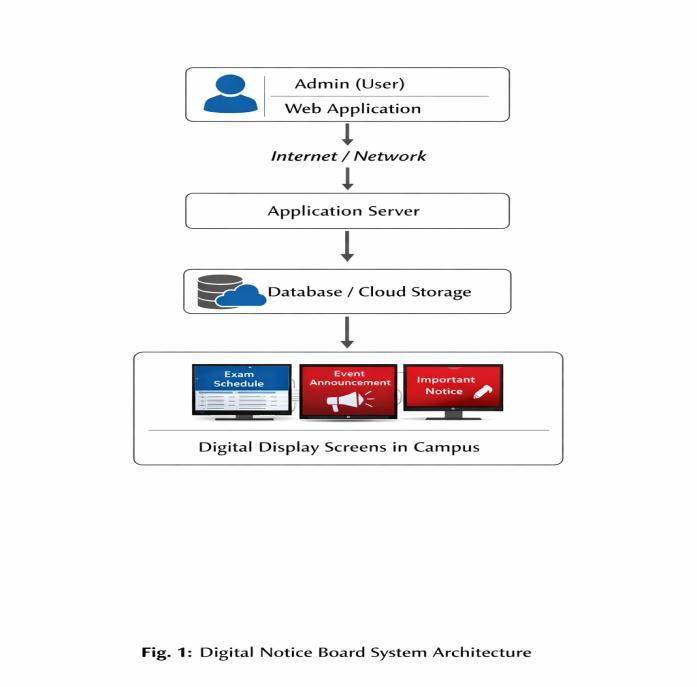
Fig.1illustratestheoverallarchitectureoftheDigitalNotice BoardSystemusedforeffectiveinformationdissemination in an educational campus. The architecture follows a centralized client–server model where notice creation, storage,anddisplayaremanagedefficiently.
The process begins with the Admin (User), who accesses thesystemthrougha web-basedapplication.Theadminis responsibleforuploading,updating,andmanagingnotices suchasexaminationschedules,eventannouncements,and important circulars. Secure login ensures that only authorizeduserscancontrol thecontent displayed on the noticeboards.
Once the admin uploads a notice, the information is transmitted throughthe Internet or campus network to the Application Server.Theapplicationserveractsasthe corecomponentofthesystem.Itprocessesadminrequests, validatesthedata,andcontrolscommunicationbetweenthe databaseandthedisplayunits.
The Database or Cloud Storage stores all notice-related information in a centralized manner. This ensures data consistencyandenablesmultipledisplayscreenstoaccess
the same updated content simultaneously. Centralized storage also helps in maintaining records of notices and supportsscalabilityofthesystem.
Finally, the notices are fetched by the Digital Display Screens installed across the campus. These screens continuously retrieve the latest data from the server and displaynoticesinrealtime.Anymodificationmadebythe adminisinstantlyreflectedonallconnecteddisplayunits, ensuringaccurateandup-to-dateinformationdelivery.
Overall,thearchitectureshowninFig.1providesareliable, efficient, and paperless solution for campus-wide communication.Itreducesmanualeffort,improvesvisibility ofnotices,andsupportsreal-timeupdatesacrossmultiple locations.
Inrecentyears,therapidgrowthofdigitaltechnologieshas transformed traditional communication systems in educational institutions. One such transformation is the replacement of conventional notice boards with Digital Notice Board Systems. Several researchers have studied digital display systems to improve information dissemination,reducemanualeffort,andsupportpaperless communication.
Early notice dissemination systems were mainly based on physicalnoticeboards,whereprintednoticesweremanually displayed. Studies highlighted that this approach was inefficientduetodelayedupdates,highmaintenanceeffort, andexcessivepaperusage.Researchersemphasizedtheneed for automated systems to ensure timely delivery of information, especially in large campuses where multiple noticeboardsarerequired.
Withtheadvancementofembeddedsystemsandnetworking technologies,electronicnoticeboardswereintroducedusing microcontrollers and LED or LCD displays. These systems allowed messages to be transmitted wirelessly using technologies such as Bluetooth, GSM, or Wi-Fi. Research worksshowedthatGSM-basednoticeboardswereeffective forsendingshorttextmessagesremotely;however,theyhad limitations suchas messagelengthrestrictionsandlack of multimediasupport.
Further studies explored web-based notice board systems wherenoticescouldbeuploadedusingacentralizedserver. ThesesystemsprovidedbetterflexibilitycomparedtoGSMbased solutions. Researchers reported that web-based systemsenabledreal-timeupdates,centralizedcontrol,and accessfromanylocationwithinternetconnectivity.However, some early implementations lacked proper security mechanismsandscalability.
Recentliteraturefocusesoncloud-supportedDigitalNotice Board Systems integrated with web technologies. These systems allow administrators to manage notices using a
International Research Journal of Engineering and Technology (IRJET) e-ISSN: 2395-0056
Volume: 13 Issue: 02 | Feb 2026 www.irjet.net p-ISSN: 2395-0072
secure admin panel, while digital display screens fetch updatedcontentautomatically.Researchersemphasizedthat cloud-basedstorageimprovesreliability,scalability,anddata consistency across multiple display units. The use of centralized databases ensures that all screens display the sameupdatedinformationwithoutdelay.
SeveralstudiesalsodiscussedtheroleofDigitalNoticeBoard Systems in promoting eco-friendly practices. By reducing dependency on paper, these systems contribute to green campusinitiatives.Researchersobservedthatdigitaldisplays improve visibility and engagement, especially when multimediacontentsuchasimagesandanimationsisused. Securityandaccesscontrol havebeenidentifiedascritical factorsinrecentresearch.Literaturesuggeststhatrestricting notice management access to authorized users prevents misuse and ensures content authenticity. Some studies proposed role-based access and login authentication to enhancesystemsecurity.
Overall,theliteratureclearlyindicatesashiftfrommanual noticeboardstointelligent,web-baseddigitalsystems.While earlier systems focused on basic message display, modern approaches emphasize real-time updates, centralized management, scalability, and user-friendly interfaces. The proposed Digital Notice Board System builds upon these existingworksbyprovidingasecure,efficient,andcampuswidesolutionforinformationdissemination.
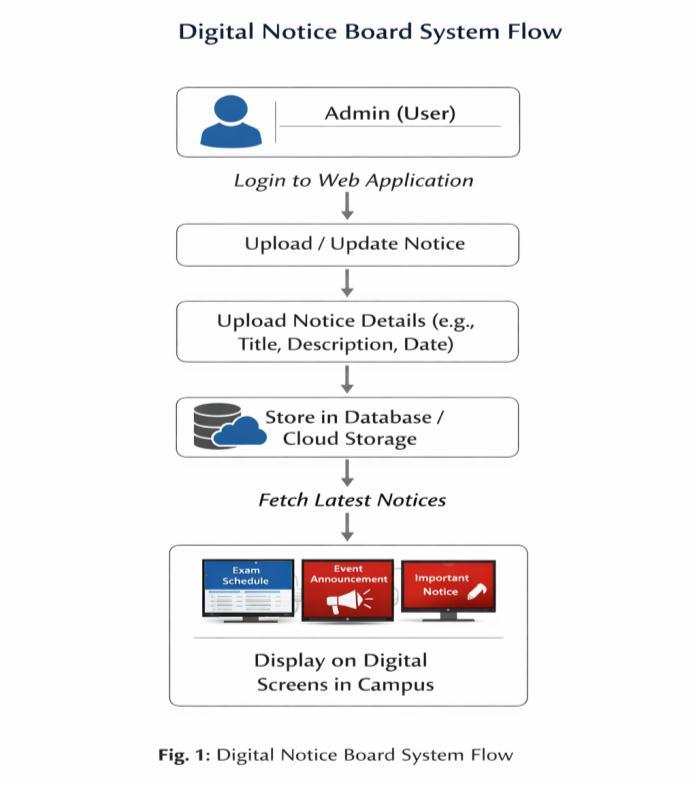
Fig. 1 illustrates the operational flow of the Digital Notice BoardSystemusedforeffectivecommunicationwithin an educational campus. The flow begins with the Admin
(User), who is responsible for managing and publishing noticesthroughthesystem.
Initially, the admin logs into the web-based application usingauthorizedcredentials.Thisloginmechanismensures that only permitted users can upload or modify notice content.Aftersuccessfulauthentication,theadminproceeds to upload or update notices. Each notice includes important information such as title, description, date, and typeofannouncement.
Oncethenoticedetailsaresubmitted,thesystemstoresthe information in a centralized database or cloud storage. Thiscentralizedstorageensuresdataconsistencyandallows multiple digital display units to access the same updated content simultaneously. Storing data in the cloud also improvesscalabilityandreliabilityofthesystem.
Afterstorage,thesystemautomatically fetches the latest notices from the database. The updated content is then transmitted through the network to all connected display units.Thisprocessoccurscontinuously,ensuringreal-time synchronization between the admin panel and display screens.
Finally, the notices are displayed on digital screens installed across the campus, such as in corridors, departments,andcommonareas.Anychangemadebythe adminisinstantlyreflectedonallscreenswithoutmanual intervention. This flow ensures timely delivery of information, eliminates outdated notices, and improves overallcommunicationefficiency.
Overall, the flow diagram clearly demonstrates how the Digital Notice Board System enables centralized control, real-timeupdates,andpaperlessinformationdissemination acrossthecampus.
The proposed Digital Notice Board System is designed to provideanefficient,centralized,andautomatedsolutionfor information dissemination within an educational campus. Thesystemreplacestraditionalpaper-basednoticeboards with a digital platform that enables real-time notice managementanddisplay. Theproposed method followsa structuredapproachconsistingofadmininteraction,serversideprocessing,datastorage,andcontentdisplayondigital screens.
Thesystembeginswiththe adminauthenticationprocess, whereauthorizedusersloginthroughasecureweb-based application. Authentication ensures that only permitted personnelcanupload,modify,orremovenotices.Thisstepis essential to maintain the integrity and reliability of the informationdisplayedoncampusscreens.
Volume: 13 Issue: 02 | Feb 2026 www.irjet.net p-ISSN: 2395-0072
Aftersuccessfullogin,theadminuploadsnoticedetailssuch asnoticetitle,description,date,andcategory.Theproposed systemallowseasyeditingandupdatingofnotices,ensuring flexibilityinmanagingdynamicinformation.Oncethenotice is submitted, it is transmitted to the application server through the network. The server processes the request, validatestheinputdata,andpreparesitforstorage.
The validated notice information is then stored in a centralizeddatabaseorcloudstorage.Centralizedstorage ensures consistency of data and enables multiple display unitstoretrievethesameupdatedcontentsimultaneously. This method eliminates redundancy and ensures that all digital notice boards display accurate and current information.
Thedisplayunitsinstalledacrossthecampusareconnected tothesystemthroughinternetorlocalnetworkconnectivity. These digital screens continuously fetch the latest notices fromtheserveratpredefinedintervalsorinrealtime.The proposed method ensures that any update made by the admin is immediately reflected on all connected display screenswithoutmanualintervention.
Toenhancevisibilityandeffectiveness,thesystemsupports structuredformattingofnoticesandallowsprioritizationof importantannouncements.Urgentnoticescanbedisplayed prominently, ensuring quick attention from viewers. The proposed method also supports scalability, allowing additionalscreenstobeintegratedintothesystemwithout majormodifications.
Overall,theproposedDigitalNoticeBoardSystemprovidesa reliable, secure, and eco-friendly solution for campus communication. By automating notice management and enablingreal-timeupdates,thesystemsignificantlyreduces manual effort, paper usage, and communication delays, makingitsuitableformoderneducationalinstitutions.
The Digital Notice Board System presented in this paper providesaneffectiveandmodernsolutionforinformation dissemination within educational campuses. Traditional notice boards rely on manual processes that are timeconsuming,inefficient,andpronetoerrorssuchasoutdated information. The proposed system successfully addresses these limitations by introducing a centralized, digital, and automatedapproachformanaginganddisplayingnotices. The system allows authorized administrators to upload, update, and manage notices through a secure web-based application. Once uploaded, the notices are stored in a centralized database or cloud storage and are instantly displayed on multiple digital screens installed across the campus. This ensures real-time information delivery and uniformity of content on all display units. The system
significantlyreducesmanualeffortandeliminatestheneed forprintingandphysicalmaintenanceofnoticeboards.
OneofthemajoradvantagesoftheproposedDigitalNotice BoardSystemisitsflexibilityandscalability.Thesystemcan beeasilyexpandedbyaddingmoredisplayscreenswithout affecting its performance. It also supports quick updates, makingitsuitableforsharingurgentannouncementssuchas examinationschedules,eventnotifications,andemergency alerts.Theimprovedvisibilityofdigitaldisplaysenhances communication effectiveness and ensures that important informationreachestheintendedaudiencepromptly.
Thesystemalsocontributestoenvironmentalsustainability by promoting a paperless communication approach. By reducingpaperusage,itsupportsgreencampusinitiatives andlowersoperational costs associatedwithprintingand distribution of notices. Additionally, secure admin authentication ensures that only authorized content is displayed, maintaining the reliability and authenticity of information.
Inconclusion,theproposedDigitalNoticeBoardSystemisa reliable, efficient, and cost-effective solution for modern educationalinstitutions.Itimprovescampuscommunication, reduces manual workload, and supports real-time informationsharing.Thesystemcanbefurtherenhancedin future by integrating mobile notifications, multimedia content, and advanced scheduling features, making it a comprehensive smart communication platform for educationalenvironments.
[1] A.KumarandR.Sharma,“DesignandImplementationof aWebBasedDigitalNoticeBoardSystem,”International JournalofEngineeringResearchandTechnology,vol.9, no.4,pp.215–219,2020.
[2] S. Patil, P. Deshmukh, and A. Kulkarni, “Smart Digital Notice Board Using Web Technologies,” International JournalofComputerApplications,vol.176,no.25,pp. 18–22,2021.
[3] M.SinghandN.Verma,“CentralizedInformationDisplay System for Educational Institutions,” International JournalofAdvancedResearchinComputerScience,vol. 10,no.3,pp.45–49,2019.
[4] R.Gupta,“CloudBasedDigitalNoticeBoardSystemfor Campus Communication,” International Journal of InnovativeTechnologyandExploringEngineering,vol. 8,no.11,pp.1021–1025,2019.
[5] P. Kumar and S. Jain, “Web Application Based Notice ManagementSystem,”InternationalJournalofScientific
International Research Journal of Engineering and Technology (IRJET) e-ISSN: 2395-0056
Volume: 13 Issue: 02 | Feb 2026 www.irjet.net p-ISSN: 2395-0072
ResearchinEngineeringandManagement,vol.5,no.6, pp.1–5,2021.
[6] S. R. Gawande and V. S. Shinde, “Digital Information DisplaySystemforSmartCampus,”InternationalJournal ofEmergingTechnologiesandInnovativeResearch,vol. 7,no.5,pp.320–324,2020.
[7] N.B.VenkateshandR.Rao,“DigitalDisplaySystemsfor Smart Campus Applications,” International Journal of Smart Education and Urban Society, vol. 11, no. 2, pp. 30–38,2020.
[8] J. W. Webber, “Client–Server Architecture for Web Applications,” Journal of Network and Computer Applications,vol.35,no.1,pp.1–7,2018.
[9] A. Mishra and S. Kulkarni, “Secure Web Based InformationManagementSystem,”InternationalJournal ofComputerScienceandInformationSecurity,vol.17, no.4,pp.112–117,2019.
[10] R. Pressman, Software Engineering: A Practitioner’s Approach,8thed.,McGraw-HillEducation,2015.
BIOGRAPHIES
MR.SUSHEN JOGDAND
PursuingPoly(Co)
S.Y.P SHREEYASH COLLEGE OF ENGINEERINGANDTECHNOLOGY (POLYTECHNIC)
MR.DIPAK KHODE
PursuingPoly(Co)
S.Y.P SHREEYASH COLLEGE OF ENGINEERINGANDTECHNOLOGY (POLYTECHNIC)
MR. ATUL PALLAWE
PursuingPoly(Co)
S.Y.P SHREEYASH COLLEGE OF ENGINEERINGANDTECHNOLOGY (POLYTECHNIC)
MR.MANISH YAMGAR
PursuingPoly(Co)
S.Y.P SHREEYASH COLLEGE OF ENGINEERINGANDTECHNOLOGY (POLYTECHNIC)
PROF.SUSHMA HADBE
ProjectGuid
S.Y.P SHREEYASH COLLEGE OF
ENGINEERINGANDTECHNOLOGY (POLYTECHNIC)
PROF. ANIL NAIK HOD,Dept.ofComputer Engineering
S.Y.PSHREEYASHCOLLEGE OFENGINEERINGAND TECHNOLOGY (POLYTECHNIC)