
International Research Journal of Engineering and Technology (IRJET) e-ISSN: 2395-0056
Volume: 13 Issue: 04 | Apr 2026 www.irjet.net p-ISSN: 2395-0072
International Research Journal of Engineering and Technology (IRJET) e-ISSN: 2395-0056
Volume: 13 Issue: 04 | Apr 2026 www.irjet.net p-ISSN: 2395-0072
Bhad Abhishek1,Kiran Jangam2,Aksahy Shiledar3,Vidya Deshmukh4,Mahesh Deshmukh5
1Student,SND College of Engineering &RC,Yeola
2Student,SND College of Engineering &RC,Yeola
3Student,SND College of Engineering &RC,Yeola
4Student,SND College of Engineering &RC,Yeola
5AssistantProfessor, Dept.ofMechanicalEngineering SND College of Engineering &RC,Yeola
Abstract - The automation of industrial processes has significantly improved productivity, efficiency, and safety in manufacturing sectors. This research paper presents the design and fabrication of an automatic pneumatic hammer machine used for forging and shaping metal components. The machine operates using compressed air to drive a piston mechanism that delivers repetitive hammering action. Pneumatic systems offer advantages such as simplicity, low cost, and ease of maintenance compared to hydraulic and mechanical systems. The proposed system is designed to reduce manual effort and improve operational efficiency in small-scale industries. The fabrication includes key components such as a pneumatic cylinder, solenoid valve, compressor, frame, and control unit. The performance of the machine is analyzed in terms of stroke length, impact force, and operational speed. The results demonstrate that the developed system is efficient, cost-effective, and suitable for medium-duty applications. This machine can be widely used in workshops and manufacturing industries where repetitive hammering operations are required.
Key Words: Pneumatic system, Automatic hammer, Pneumatic cylinder, Solenoid valve, Compressed air, Fabrication, Automation
In the modern era of industrialization, automation has become a fundamental requirement for achieving high productivity, precision, and efficiency in manufacturing processes. Industries are continuously striving to replace manual operations with automated systems to reduce humaneffort,minimizeerrors,andimproveoveralloutput quality. One such operation that traditionally depends heavily on manual labor is hammering, which is widely used in metal forming, forging, shaping, and assembly processes.
Manual hammering not only requires significant physical effort but also results in inconsistent output due to variationsinhumanperformance.Additionally,prolonged exposure to repetitive hammering tasks can lead to operator fatigue, reduced efficiency, and potential workplace injuries. Therefore, there is a growing need to developautomatedsolutionsthatcanperformhammering operations with uniform force, higher speed, and improvedsafety.
Pneumatic systems offer an effective solution to this problem.Thesesystemsutilizecompressedairtogenerate mechanical motion and are widely used in industrial automation due to their simplicity, reliability, and costeffectiveness. Unlike hydraulic systems, pneumatic systemsare cleaner,safer,andeasier tomaintain, making them highly suitable for small and medium-scale industries. The use of compressed air eliminates the need forcomplexmechanicallinkagesandreducesmaintenance requirements.
Theautomaticpneumatichammermachineisdesignedto convert the energy of compressed air into reciprocating motion using a pneumatic cylinder. This motion is then used to drive a hammering mechanism that delivers repeatedimpactsontheworkpiece.Themachineoperates using essential components such as an air compressor, solenoid valve, pneumatic cylinder, and control unit. The solenoid valve regulates the airflow, enabling controlled andcontinuoushammeringaction
In modern manufacturing industries and small- to medium-scale workshops, hammering is a core operation essential to many processes such as forging, riveting, punching, and shaping of metals and other materials. Traditionally,thisoperationreliesheavilyonmanuallabor, where workers use hand-held hammers to perform repeated impact tasks. While the manual method is straightforward, it is also fraught with numerous drawbacks, including inconsistency in impact force, operator fatigue, increased safety risks, low productivity, and poor process reproducibility. As industries continuously strive for higher efficiency, accuracy, and quality control, manual hammering falls short in several areas. The force and frequency of manual impacts vary from worker to worker, leading to irregular results that may compromise product quality. Extended periods of repetitive manual hammering can cause significant operator fatigue, increasing the likelihood of errors and injuries such as musculoskeletal disorders. Additionally, manual labor requires continuous human involvement, inflating operational costs and reducing scalability especially problematic in mass production settings. The technical problems that must be addressed include: Designing a machine capable of translating pneumatic
International Research Journal of Engineering and Technology (IRJET) e-ISSN: 2395-0056
Volume: 13 Issue: 04 | Apr 2026 www.irjet.net p-ISSN: 2395-0072
actuator motion into controlled hammer blows. Ensuring adjustability for different operational settings and impact requirements.Developingacompact,portable,andcost
effective system suitable for integration into various manufacturingenvironments.
1) Todesignanddevelopapneumaticsystemfor automatichammeringoperation.
2) Toreducemanualeffortandincreaseefficiencyin hammeringtasks.
3) Toimproveaccuracyandconsistencycomparedto manualhammering.
4) To minimize operator fatigue and enhance workplace safety.
5) Todevelopacost-effectiveanduser-friendly hammering system suitable for small-scale industries
Thefollowingmethodologywill adoptedforthedesign and development of a Pneumatic system for automatic hammeringoperation
1) Identificationofproblemandsystemrequirements.
2)Conceptualdesignandplanningofthepneumatic hammeringsystem.
3)Selectionofsuitablepneumaticcomponents.
4)Designand FabricationofAutomaticPneumatic HammerMachine
4) Design calculations for cylinder size, air pressure, and force.
5)DevelopmentofCADmodelandsimulationofsystem operation.
6)Fabricationofframeandassemblyofcomponents.
7) Integrationofpneumaticandcontrolsystems..
An automatic pneumatic hammer machine utilizes compressedairastheprimarysourceof power to automate the hammering process, replacing traditional manual operations. The pneumatic system consists of an air compressor, a pneumatic cylinder, valves, and connecting components such as pipes and linkages. The automation of the hammering operation allowsfor
uniform, repetitive, and high-frequency impacts, making the hammer suitable for applications like sheet metal work, forging, riveting, and repetitive striking tasks in manufacturing and fabrication industries. The automatic pneumatic hammer machine works on the principle of converting pneumatic energy (compressed air) into mechanical motion to perform repetitive hammering operations. Pneumatics is the branch of engineering that uses gas or pressurized air to create mechanical motion. The system mainly consists of an air compressor, control valves,andapneumaticcylinderwithahammeringtool. Whencompressedairfromthecompressorentersthe
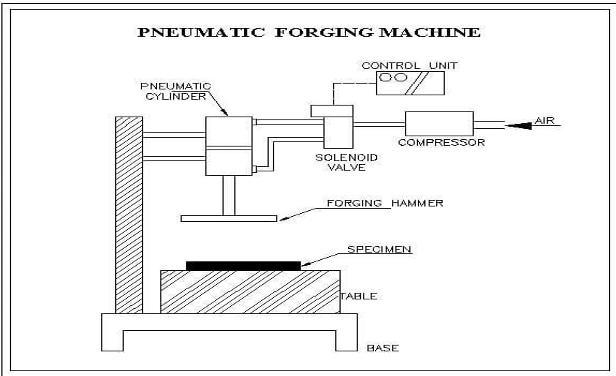
pneumatic cylinder, it pushes the piston forward. The piston rod connected to a hammer head converts this linear motion into a striking or hammering action on the workpiece. The control valve regulates the air supply so thatthepistonmovesupanddownrepeatedly,producing continuous hammering. By using automation (through solenoid valves or timing circuits), the machine can be operated automatically without constant manual intervention. This ensures consistent striking force, improved accuracy, and higher productivity compared to manual hammering. The pneumatic system operates at moderate pressure (typically 6–10 bar) and is known for its safety, simplicity, and low maintenance. It eliminates theneedforcomplexmechanismslikecrankshaftsorcams usedintraditionalmechanicalhammers.
WorkingPrinciple-Compressedairfromanaircompressor is supplied to the pneumatic cylinder. A solenoid valve regulates the direction of air flow to cause reciprocating motion in the piston. The piston is connected to the hammer(punching)through mechanical linkages. On each forward stroke, the hammer delivers an impact, and the processrepeatsinanautomatedcycle.
3. ADVANTAGES & LIMITATIONS
3.1 ADVANTAGES:-
1 Increased Efficiency and Productivity: Automatic pneumatic hammer machines operate faster and can handle repetitive hammering tasks, which reduces
International Research Journal of Engineering and Technology (IRJET) e-ISSN: 2395-0056
Volume: 13 Issue: 04 | Apr 2026 www.irjet.net p-ISSN: 2395-0072
productiontimeandincreasesoverallefficiencycompared tomanualhammering.
2. Uniformity and Precision: Pneumatic power delivers consistent force, ensuring uniform and precise hammering important for quality control in moulding andmetalworkingprocesses.
3. Reduced Labor and Fatigue: Automation decreases the need for manual labor, minimizing worker fatigue and the riskofinjury,whilealsoloweringlaborcosts.
4. Versatility: These machines are suitable for various applications such as foundries, metal forging, automotive, andcomponentsmanufacturing,astheycanbeadjustedfor differenttasksandmaterials.
5. Improved Quality: Consistency in operation leads to fewererrorsanddefectsinfinishedproducts,especiallyin castingandformingoperations.
6.EnvironmentallyFriendly:Aspneumaticmachinesoften use compressed air, they can be more sustainable compared to hydraulic counterparts that may use nonrenewable oils. Design and Fabrication of Automatic PneumaticHammerMachine
3.2 LIMITATIONS:-
1. Dependency on Compressed Air Supply: The machine requires a constant and adequate supply of compressed air;interruptionscanhinderoperationandproductivity.
2. Noise and Vibration: Pneumatic hammers can generate significant noise and vibration, leading to potential discomfortorhealthhazardsforoperatorsovertime.
3. Initial Cost and Maintenance: While they lower labor costs,theinitialinvestmentformachineryandcompressor setup can be high, and regular maintenance is needed for pneumaticcomponents.
4. Limited for Certain Materials: Extremely hard or large workpieces may exceed the machine’scapacity,requiring specializedorlargermachines.
5. Space Requirement: Pneumatic hammer setups can require significant workspace, making them less suitable forverysmallworkshops.
6. Potential Air Leaks and Inefficiency: Leakages in pneumaticlinescanreduceefficiencyandrequirefrequent monitoringandrepair.
The project “Design and Fabrication of Automatic Pneumatic Hammer Machine” focuses on developing a compact and efficient system that uses compressed air to perform repetitive hammering operations automatically. The main objective is to reduce human effort, increase productivity, and improve accuracy in manufacturing and assembly processes. In this system, compressed air is suppliedtoacylinder–pistonmechanism,whichconverts pneumatic pressure into linear mechanical motion. This motion drives the hammer to strike the workpiece with controlled force and frequency. The machine operates
automatically using valves and a timing control mechanism, minimizing manual intervention. The design includes components such as air compressor, pneumatic cylinder,solenoidvalve,controlunit,andhammeringtool. The frame is designed to withstand vibrations and repeatedimpactsduringoperation.
[1] Prof. Tanuja Hulavale, Dr. Harish Harsurkar, Samsher Karande, Vishal Sutar, “Design, Cad Modeling & Fabrication Of Automatic Hammering Machine”, International Journal Of Creative Research Thoughts, Volume12,Issue4,pp45,ISSN:2320-2882April2024.
[2] Manjunatha M, Dr. Vardhaman S M, “ Design and Fabrication of Automated Hammering Machine”, InternationalJournalofNovelResearchandDevelopment, Volume9,Issue3,pp752,ISSN:2456-4184 March2024.
[3]Mr.VinodkumarHP,“DesignandDevelopment ofPLC Controoled Pneumatic Pressing System”, International Journal of Engineering Research and Technology, Volume 12,Issue12,pp1,ISSN:2278-0181December-2023.
[4]Ahmed Ali Mohammed Said Al Aamri, Syed Mudassir, MithunVinayakaKulkarni, ArmandoHipolitoAzamAmer Said AlAwaid, “Modelling And Fabrication Of Power Hammer Machine”, EPRA International Journal Of Multidisciplinary Research, Volume 9, Issue 11, pp 370 ISSN:2455-3662November2023.
[5] G. Kasinaidu, G. Srinivasu, A. Rajesh, O. Manideep, N Abhishek, Dr. Pawan Kumar Singotia, “Design and Fabrication of Pneumatic Ramming Machine,” InternationalJournalofResearchPublicationandReviews, Volume4,Issue6,pp1294,ISSN:2582-7421June2023.
[6] Shubham S. Pawar, Shivam S. Panchal, Mandar N. Badad,“DesignandFabricationofAutomaticHammering Machine”, International Research Journal of Modernization in Engineering Technology and science, Volume05,Issue05,pp125,ISSN:2582-5208May2023.
[7]Prof.GovindDevke,Mr.VinayakSonavwane,Mr.Arjun Patare, Mr. Akash Kolte, Mr. Shubham Kamble, “ Automated Portable Hammering Machine”, International Journal of Advanced Research in Science, Communication and Technology, Volume 2, Issue 8, pp 661, ISSN:25819429June2022.
[8] Jhunjhun Kumar Mishra, “Design and Fabrication of Automatic and Multifunctional pneumatic machine”, International Journal Of Advance Research, Ideas And Innovations In Technology, Volume 5, Issue 2, pp115, ISSN:2454-132XMay2019.
International Research Journal of Engineering and Technology (IRJET) e-ISSN: 2395-0056
Volume: 13 Issue: 04 | Apr 2026 www.irjet.net p-ISSN: 2395-0072
[9] C.SenthilKumar,“DesignAndAnalysis Of Pneumatic Bearing Pusher And Puller”, International Journal of Mechanical Engineering and Technology, Volume 9, Issue 11,pp696,ISSN:0976-6340November2018.
[10] Karan Datt, “Analytical Description Of Pneumatic System”, International Journal of Scientific and Engineering Research, Volume 04, Issue 9, pp1443, ISSN: 2229-5518September2013.
2026, IRJET | Impact Factor value: 8.315 | ISO 9001:2008