
International Research Journal of Engineering and Technology (IRJET) e-ISSN: 2395-0056
Volume: 12 Issue: 12 | Dec 2025 www.irjet.net p-ISSN: 2395-0072
International Research Journal of Engineering and Technology (IRJET) e-ISSN: 2395-0056
Volume: 12 Issue: 12 | Dec 2025 www.irjet.net p-ISSN: 2395-0072
Brihadish JB1, Sajith N1, Lokesh P.N1, S. Thulasi2, and V.R. Sarma Dulipala3
1Final Year Student, Dept. of Automobile Engineering, University College of Engineering BIT Campus, Anna University, Tiruchirappalli, India
2Assistant Professor, Dept. of Automobile Engineering, University College of Engineering BIT Campus, Anna University, Tiruchirappalli, India
3Assistant Professor (Sr. Gr), Dept. of Physics, University College of Engineering BIT Campus, Anna University, Tiruchirappalli, India ***
Abstract - Unintended vehicle rollback on inclines remains a significant safety risk. Contemporary solutions, notably Hill Hold Assist, rely on co-opting the vehicle service brakes via the ABS controller, introducing hydraulic complexity and potential brake wear. Manual systems require driver intervention and are prone to error. This paper details the design, fabrication, and validation of a novel autonomous anti-rollback system that overcomes these limitations by introducing an independent, electropneumatically actuated mechanical lock. The proposed system integrates a robust ratchet and pawl mechanism with an Arduino-based control unit. An MPU6050 accelerometer provides real-time inclination data, which the microcontroller processes to autonomously trigger a 5 by2solenoidvalve.Thisvalvegovernsapneumaticactuator toengagethepawl,mechanicallypreventing rollback.Finite Element Analysis was employed to validate the system mechanical integrity and guide material selection. This analysis confirmed structural steel as insufficient, leading to the selection of AISI 4140 low-alloy steel. The final design was validated to withstand forces exceeding 20,000 Newtons, far exceeding the 7500 Newton operational load, with a maximum equivalent stress of 360.15 MPa andstrain of 0.0017 remaining well within the allowable limits of 393 MPa and 0.002. Experimental validation of the fabricated prototype confirmed its efficacy, demonstrating a rapid response time of 1.00 to 1.25 seconds and a greater than 99 percent engagement success rate. This research validates a low-cost, reliable, and fully autonomous mechatronic solution that serves as a viable alternative to brakedependentsystems,demonstrablyenhancingvehiclesafety.
Key Words: Autonomous Anti-Rollback System (AARS), Vehicle Safety, Ratchet and Pawl Mechanism, Finite Element Analysis (FEA), Hill hold Assist, Gear Design and Fabrication.
Unintended vehicle rollback on inclined surfaces is a persistent and significant safety concern in automotive engineering. Such incidents, often occurring during uphill starts or parking manoeuvres, can lead to collisions, property damage, and personal injury [1]. This risk is
particularly pronounced in vehicles with manual transmissions, where the driver must coordinate the clutch,throttle,andbrake.
To mitigate this, automotive manufacturers have implemented two primary solutions: the manual handbrake and electronic Hill Hold Assist (HHA). The manual handbrake, while mechanically simple, is entirely dependent on driver intervention. Its effectiveness is contingent on human factors, such as being correctly engaged with sufficient force, and it is prone to human error[2,4].
Modern vehicles increasingly adopt electronic HHA (also known as Hill Start Assist or HSA). These systems, however, are typically software-based functions that coopt the vehicle's existing Anti-lock Braking System (ABS) andElectronicStabilityControl(ESC)modules.HHAholds the vehicle by applying hydraulic pressure to the service brakes, temporarily preventing rollback after the driver releases the brake pedal. While effective, this approach relies on a complex network of sensors and hydraulic controls, adds potential electronic failure points, and contributestothewearoftheservicebrakes.
The literature reflects a clear need for a more robust and reliable alternative. Research has explored various mechanical anti-rollback mechanisms, including ratchet andpawldesigns,toimprovesafety[6,9].Someproposals have focused on integrating these mechanisms within the disc brake assembly [9], while others have suggested automating existingmanual levers[5].Whiletheseefforts validate the interest in mechanical solutions, a gap remains for a cost-effective, mechatronic system that is both fully autonomous (like HHA) and mechanically independentfromtheprimarybrakingsystem.
This paper details the design, fabrication, and multi-stage validation of a novel Autonomous Anti-Rollback System (AARS) that directly addresses this gap. The proposed system introduces a robust, independent mechanical lock based on a ratchet and pawl mechanism. This lock is not reliant on the vehicle's hydraulic brakes; instead, it is autonomously controlled by a dedicated mechatronic system. An Arduino microcontroller, processing real-time
International Research Journal of Engineering and Technology (IRJET) e-ISSN: 2395-0056
Volume: 12 Issue: 12 | Dec 2025 www.irjet.net p-ISSN: 2395-0072
data from an MPU6050 accelerometer, engages the lock via an electro-pneumatic actuation system. This choice of pneumatic actuation is notable for its high force output and reliability, and it offers significant adaptability. While theprototypewasdevelopedformid-sizecars,thesystem architecture is inherently suitable for heavy commercial vehicles, which already possess on-board air brake systemsthatcanbereadilytapped.
Thispaperpresentsthecompletemechatronicdesign,the critical role of Finite Element Analysis (FEA) in guiding material selection from structural steel to AISI 4140, and the quantitative performance results from a fully fabricated prototype. The validated system demonstrates a reliable, low-cost, and independent solution, offering a viable alternative to existing systems and enhancing overallvehiclesafetyacrossmultiplevehicleclasses.
Existing research on vehicle incline safety is largely bifurcated, focusing on two distinct challenges: the structural optimization of mechanical locking mechanisms [6,9]andtheparalleldevelopmentofautonomous,sensordrivenactuationtoeliminatedrivererror[4,5].
In the first domain, the ratchet and pawl mechanism is well-established as a robust mechanical lock. Collate et al. [6] explored the design and development of such mechanisms, validating their high reliability while noting theassociatedchallengesofmanufacturingcomplexityand cost-effectiveness. Prakash et al. [9] further investigated this concept by proposing a mechanical anti-roll system (ARS) that integrated the ratchet and pawl mechanism directly within the vehicle's disc brake assembly. This highlights a common design choice of attempting to integratethesafetylockwithexistingwheelcomponents.
Intheseconddomain,theliteraturedemonstratesastrong consensusthatmanualengagementisakeypointoffailure.
Both Joshi et al. [4] and Benssin et al. [5] identified the limitations of manual hill hold levers and proposed automatic actuation based on gradient sensors. This validates the core principle of using sensor data such as from an accelerometer to trigger an anti-rollback mechanism, thereby reducing driver workload and minimizingtheriskofhumanerror.
Despite these advancements, a distinct gap persists. Currentresearcheitherfocusesonpurelymechanicallocks that require integration into existing, complex assemblies [7, 9] or on electronic systems that rely on the primary servicebrakes(asdiscussedintheIntroduction).Thereisa clearlack ofresearchthatsuccessfullyintegratesa robust, independentmechanicallock(likearatchetandpawl)with a cost-effective, autonomous mechatronic control system (like an Arduino and electro-pneumatics). This research directly addresses this void by creating a hybrid system that combines the mechanical reliability from one field of
studywiththeautonomouscontrolfromanother,resulting inanovelandindependentsafetyarchitecture.
The development of the AARS followed a systematic mechatronic design methodology,visualizedin Fig.1. This process integrated virtual design, computational analysis, and physical fabrication to ensure system integrity. Initial concepts were translated into 3D models using CATIA V5, whichthenservedasthebasisforFiniteElementAnalysis (FEA) in ANSYS. This computational phase was critical for component-level validation prior to fabrication, especially formaterialselection.Theprocessconcludedwithphysical prototyping,sensorintegration,andperformancetesting.
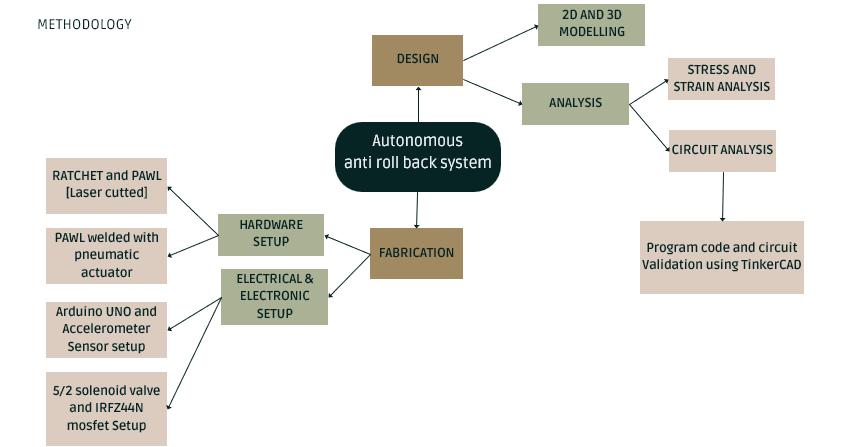
Fig -1:Thesystematicdesignmethodology,integrating virtualmodelling,computationalanalysis,fabrication,and validation.
The system's architecture is a hybrid mechatronic design composed of three primary sub-systems: the mechanical lock, the electronic control unit, and the pneumatic actuationcircuit.
The core of the AARS is an independent mechanical lock, separate from the vehicle's service brakes. This system employs a robust ratchet wheel and a corresponding pawl. The ratchet wheel is designed to be affixed to a component of the vehicle's driveline (e.g., the axleorwheelhub),allowingfreerotationinthe"forward" direction. The pneumatically-driven pawl is designed to engage with the ratchet's teeth, creating a positive mechanical stop that instantly prevents any reverse rotation(i.e.,rollback).
The system's "brain" is an Arduino UNO microcontroller. This unit processes real-time inclination data from a 3-axis accelerometer sensor (MPU6050/GY521). The control logic is programmed to continuously monitor the vehicle's tilt. When the accelerometer detects aninclinethatsurpassesapre-definedthreshold(e.g.,>3-5 degrees), the microcontroller interprets this as a rollback risk and immediately outputs a "high" signal to the actuationsub-system.Conversely,itdeactivatesthesystem
International Research Journal of Engineering and Technology (IRJET) e-ISSN: 2395-0056
Volume: 12 Issue: 12 | Dec 2025 www.irjet.net p-ISSN: 2395-0072
when the incline is non-critical or when a signal from the reverse gear selector is detected, allowing for intentional reverse manoeuvres, as shown in the simulation environmentinFig-2.
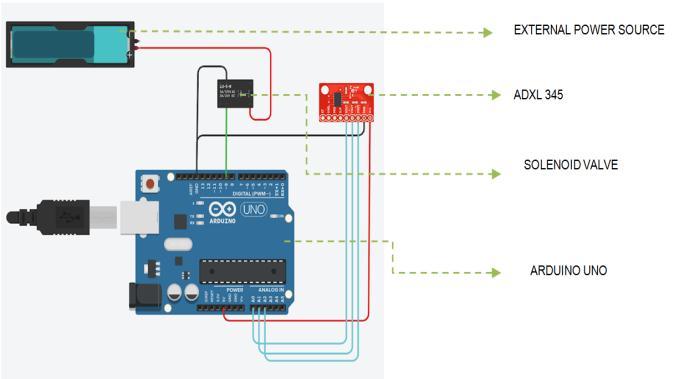
Fig -2:HardwaretestsetupinTinkerCAD
3.3 Electro-Pneumatic Actuation Sub-System
The microcontroller's logic signal is routed to an IRFZ44NMOSFET,whichactsasadigitalswitchcapableof handlingthecurrentrequiredtodrivea 5/2-waysolenoid valve.Thisindustrial-gradesolenoidvalvefunctionsasthe interface between the electronic and pneumatic systems. When activated, the solenoid directs compressed air to a pneumatic actuator (cylinder). This actuator converts the air pressure into a precise linear force, driving the pawl intoengagementwiththeratchetwheel.Whenthesignalis removed,thesolenoidventstheair,andthepawlretracts, disengaging the lock. The complete mechatronic control loopisillustratedinthesystemschematicinFig.3.
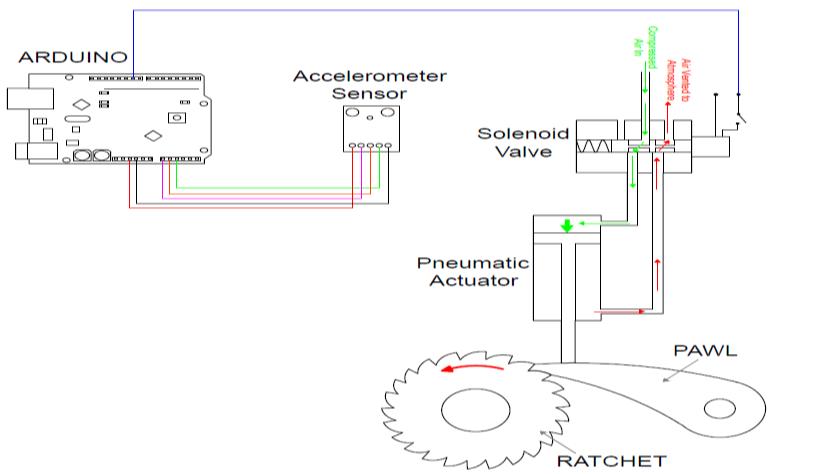
Fig -3:Systemarchitectureschematic,illustratingthe controlloopfromtheaccelerometertotheelectropneumaticactuationofthepawl.
3.4 Fabrication and Material Selection
The primary mechanical components, the ratchet and pawl, were fabricated using precision laser cutting to ensure tight tolerances. Based on the FEA results (discussedinSection4),thesecomponentswerefabricated from AISI 4140 low-alloy steel. This material wasselected
for its high tensile strength (655 MPa), high fatigue strength, and hardness (approx. 22 HRc) compared to standard structural steel. Its density is 7850 kg/m³. The assembledexperimentalprototypeisshowninFig.4.
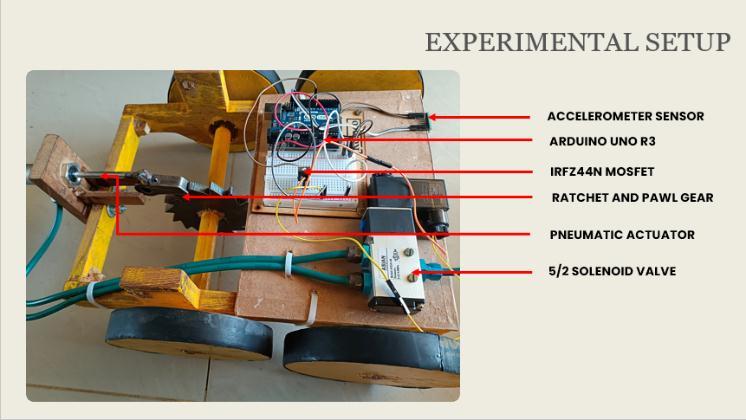
Fig -4:AssembledExperimentalSetupofAARS
4. RESULTS AND
The system's performance was validated through a twostage process: first, a computational validation of the mechanicaldesignusingFEA,andsecond,anexperimental validation of the fabricated prototype's mechatronic performance.
4.1 Computational Validation
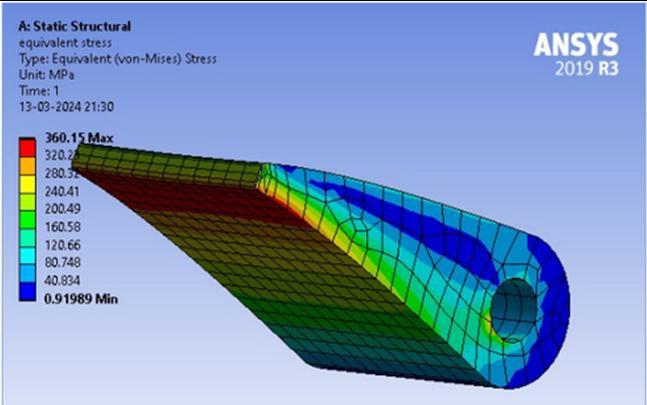
The system's mechanical integrity was validated computationally using ANSYS to ensure the ratchet and pawl components could withstand operational loads. The primaryobjectivewastovalidatethedesignforamid-size vehicle, with a calculated rollback force of 7500 N. Initial simulations performed on standard structural steel revealedthatthismaterialwasinsufficient,failingtomeet the load requirement. This analysis mandated a material changetoAISI4140low-alloysteel.Thefinaldesign,using AISI 4140, was then subjected to a simulated load of 10,000 N to ensure a robust safety margin. The results confirmedthedesign'sintegrity.Themaximumequivalent (vonMises)stress,whichoccurredatthehigh-contactroot of the pawl, was 360.15 MPa (with the ratchet at 280.11 MPa). This remained well below the material's allowable yieldstrengthof393MPa.
International Research Journal of Engineering and Technology (IRJET) e-ISSN: 2395-0056
Volume: 12 Issue: 12 | Dec 2025 www.irjet.net p-ISSN: 2395-0072
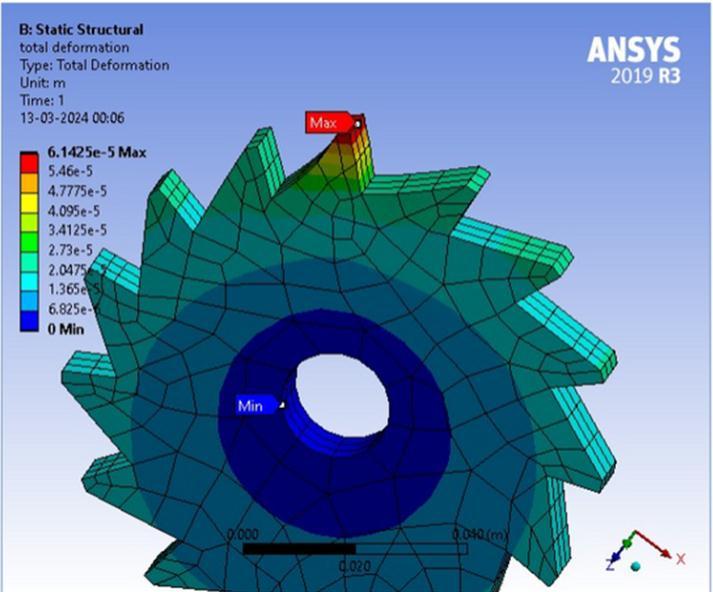
Fig -5:FEAresults(A)equivalent(vonMises)stresson thepawl,and(B)totaldeformationoftheratchet.
Theanalysisyieldedasafetyfactorof1.1forthepawland 1.4 for the ratchet. Similarly, the maximum equivalent strainonthepawlwas0.0017,whichwassafelybelowthe material's allowable strain limit of 0.002. These data points, summarized in Fig. 6, computationally validated thatthemechanicaldesignisrobustandwillnotfailunder theanticipatedoperationalloads.
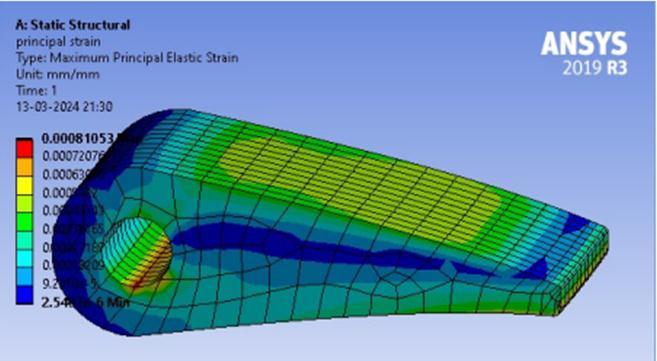
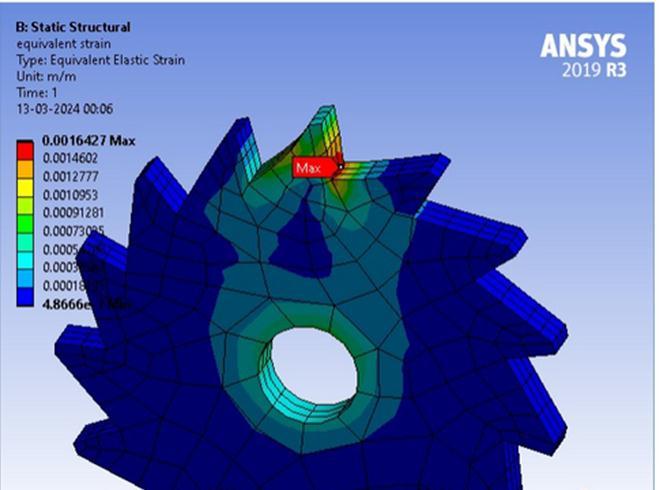
Fig -6:SummaryofFEAresults,(A)strainonpawl,(B) strainontheratchet.
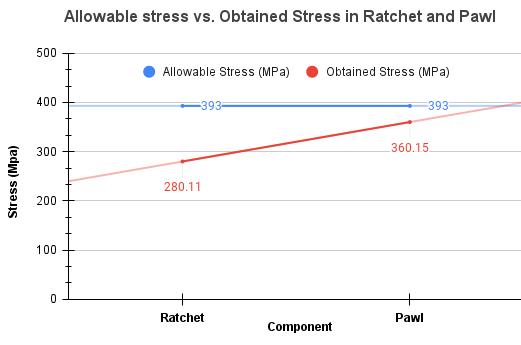
Fig -7:Equivalentstressintheratchetandpawlagainst theallowablelimitsofAISI4140steel.
Following computational validation, a physical prototype (as shown in Fig. 4) was fabricated and subjected to experimental testing to validate the mechatronic system's real-world performance. Two primary metrics were evaluated: system response time andengagementreliability
System Response Time: This was measured as the total duration from the moment the accelerometer's incline threshold was crossed to the full, positive engagement of the pawl. The system consistently demonstrated a rapid responsetimeintherangeof1.00–1.25seconds.
Engagement Reliability: Reliability was assessed over numeroustestcycles,simulatinginclinestops.Thesystem achieved a >99% success rate in correctly engaging the pawlandpreventingrollback.
The results from both computational and experimental validation confirm the efficacy of the AARS. The FEA data confirms the robustness of the mechanical design and the critical importance of material selection (AISI 4140). The experimental data confirms the effectiveness of the autonomous mechatronic control system. A sub-1.25-second response time combined with >99%reliabilityprovesthatthishybridelectro-pneumatic system is a viable and highly effective alternative to existing HHA systems. It successfully provides fully autonomous operation while remaining mechanically independentofthevehicle'sservicebrakes.
This research successfully demonstrated and validated a novel Autonomous Anti-Rollback System (AARS) that
International Research Journal of Engineering and Technology (IRJET) e-ISSN: 2395-0056
Volume: 12 Issue: 12 | Dec 2025 www.irjet.net p-ISSN: 2395-0072
provides a robust, independent mechanical lock, addressing the limitations of brake-dependent HHA and manual handbrakes. A two-stage validation process confirmed the system's efficacy: Finite Element Analysis (FEA) was essential in guiding the material selection to AISI4140steel (SF1.1-1.4), while experimental testing of the fabricated prototype confirmed a rapid response time (1.00-1.25s) and high reliability (>99%). This work thus validates a low-cost, autonomous mechatronic solution that enhances vehicle safety by remaining independent of theprimarybrakingsystem. Future research, which is currently underway, is focused on replacing the pneumatic system with a high-torque electric linear actuator. This investigation is also optimizing the mechanical integration to engage the differential/rear axle shaft directly and expanding the control logic to function as a fully autonomous, sensorbasedparkingbrake.
[1] M. E. Ansari, M. Tausif, M. Zeeshan, and R. D. Tare, "Automatic Reverse Breaking System for Trolley," International Research Journal of Engineering and Technology(IRJET),vol.5,no.4,pp.2688-2691,2018.
[2] A. Arunkumar, T. Muthumani, and V. Balasubramani, "Design and fabrication of anti-roll back system in vehicles using ratchet and pawl mechanism," International Journal of Emerging Technology in ComputerScience&Electronics(IJETCSE),vol.12,no. 3,pp.6-9,2015
[3] D. Jadhav Amol, K. Shubham, K. Kiran, K. Pratiksha, and S. N. Tale, "Intelligent Reverse Braking System," International Research Journal of Engineering and Technology(IRJET),vol.5,no.2,pp.1137-1139,2018.
[4] S. S. Joshi, V. S. Jadhav, and D. P. Bhosale, "Design of automatic braking system for vehicles in hill station," International Journal of Innovations in Engineering Research and Technology (IJIERT), vol. 4, no. 4, pp. 209-213,2017
[5] B.KB,S.Abinav,S.ArunPandiyan,A.HariPrasath,and S. Sivasaravanan, "Design and Fabrication of SelfLockingWheelMechanismforManualTransmission4 Wheeled Automobiles Subjected to Positive Gradients," International Journal of Research in EngineeringandTechnology(IJRET),vol.13,no.1,pp. 1-5,2024.
[6] V.D.Kolate,R.R.Kurup,andA.M.Latake,"Designand Development of Anti-Roll Back Mechanism," International Journal for Scientific Research & Development (IJSRD), vol. 5, no. 2, pp. 1290-1292, 2017
[7] V.Nadar,P.Balasubramanian,A.K.Rai,V.A.Kulkarni, and S. K. K, "Design and Development of an Antirolling Mechanism for Hand-Driven Tricycles," in ProceedingsofInternationalConferenceonIntelligent
Manufacturing and Automation (ICIMA 2020), Singapore:Springer,2020,pp.463-470.
[8] A.R.PatilandS.Bandekar, "Tool Evaluation&Design Analysis for Parking Pawl Mechanism," International Research Journal of Engineering and Technology (IRJET),vol.4,no.5,pp.1161-1165,2017.
[9] S. Prakash, et al., "Design of stable controller attachable Anti Roll System (ARS) for vehicles," IOP Conf. Ser.: Mater. Sci. Eng., vol. 993, no. 1, p. 012111, 2020.
[10] N.RoyandJ.Ba,"Design,AnalysisandOptimizationof Parking Pawl Mechanism using ADAMS," SAE Technical Paper, 2019-01-0336, 2019, doi: 10.4271/2019-01-0336.
[11] J. R. Saul, et al., "Pawl and ratchet assembly," U.S. Patent5328235,Jul.12,1994.
[12] S.P.Sreeram,"FabricationofReverseRollingArrester and Anti-Theft Locking System for a Four-Wheeler," International Journal of Pure and Applied Mathematics,vol.118,no.20,pp.2101-2105,2018.
[13] L. Yang, et al., "Structural Design and Dynamic Analysis of Anti-reversion Mechanism of Feed Mechanism," Advanced Materials Research, vols. 694697,pp.45-50,2013.