
International Research Journal of Engineering and Technology (IRJET) e-ISSN: 2395-056
Volume: 13 Issue: 04 | Apr 2026 www.irjet.net p-ISSN: 2395-072

International Research Journal of Engineering and Technology (IRJET) e-ISSN: 2395-056
Volume: 13 Issue: 04 | Apr 2026 www.irjet.net p-ISSN: 2395-072
KiruthikaSundari T1, Sunantha Jeyasurya G2, Vinoth S3, Varun K4, Prem Kumar P S5 , Velmurugan C6
1,2,3,4UG Scholar, Department of Aeronautical Engineering, Kumaraguru College of Technology, Coimbatore, India
6Professor, Department of Mechanical Engineering, Kumaraguru College of Technology, Coimbatore, India
5Professor, Department of Aeronautical Engineering, Kumaraguru College of Technology, Coimbatore, India
Abstract - Satellite communication (SATCOM) systems rely on radome structures that must simultaneously ensure efficient electromagnetic wave transmission and adequate mechanical protection. The present study focuses on the design and evaluation of polymer matrix composite panels capable of achieving this dual functionality. Two composite configurations, namely Glass Fiber Reinforced Polymer (GFRP) and hybrid Glass/Kevlar/Epoxy laminates, were developed and analyzed. The mechanical performance of these composites was investigated using ANSYS ACP through static structural analysis, while electromagnetic transparencywasevaluatedusingANSYSHFSSbyanalyzing transmission characteristics over a frequency range of 1–18 GHz. The results indicate that Kevlar-based composites exhibit superior mechanical strength with reduced deformation, whereas glass fiber composites demonstrate better electromagnetic transparency. The hybrid composite configuration provides an optimal balance between these conflicting requirements, making it suitable for SATCOM panelapplicationsinaerospacesystems)
Key Words: Satellite Communication, Radome Design, HybridComposites,DielectricProperties,Electromagnetic Transmission,StructuralAnalysis
1.INTRODUCTION
Satellite communication plays a critical role in modern aerospace systems by enabling navigation, real-time data transfer, and global connectivity. A key component of these systems is the SATCOM panel or radome, which serves as a protective enclosure for antennas while allowing electromagnetic waves to pass through with minimal attenuation. This dual functionality imposes stringentrequirementson material selection,asthepanel must possess both high structural integrity and excellent electromagnetictransparency.
Electromagnetic performance of materials is primarily governed by dielectric properties such as dielectric constant and loss tangent. Materials with low dielectric constant reduce signal reflection, while low loss tangent ensures minimal energy dissipation during wave transmission. Glass Fiber Reinforced Polymer (GFRP) is
widely used due to its favourable dielectric properties, typically exhibiting a dielectric constant in the range of 4 to5withlowlosscharacteristics.However,itsmechanical performance may not always meet the demanding conditionsofaerospaceapplications.
To overcome this limitation, hybrid composites incorporating Kevlar fibers are considered. Kevlar offers hightensilestrength,impactresistance,andrelativelylow dielectric properties, making it suitable for structural reinforcement without significantly compromising electromagnetic performance. The present work investigates the feasibility of hybrid composite panels to achieve an optimal trade-off between structural strength andelectromagnetictransparency.
Recent studies have emphasized the importance of material selection in achieving electromagnetic transparency in radome applications. Fiber-reinforced composites such as quartz, glass, and aramid fibers have been extensively explored due to their low dielectric properties and structural efficiency. Quartz fiber composites have been shown to significantly reduce dielectric constant and improve wave transmission, while maintainingthermalstabilityunderextremeconditions. Hybrid composite systems combining glass and aramid fibers have gained considerable attention due to their ability to balance mechanical and electromagnetic properties. Previous research indicates that glass fibers enhance electromagnetic transparency, whereas aramid fibers contribute to improved tensile strength and impact resistance. However, a trade-off between these properties is often observed, necessitating careful optimization of materialcompositionandstackingsequence.
In addition to experimental investigations, numerical simulation tools such as ANSYS HFSS and ACP have been widelyadoptedtoevaluateelectromagneticandstructural performance. These tools enable detailed analysis of wave propagation and stress distribution, thereby reducing the need for extensive physical testing. Despite significant advancements,limitedstudieshavefocusedonintegrating
Volume: 13 Issue: 04 | Apr 2026 www.irjet.net p-ISSN: 2395-072
bothmechanicalandelectromagneticanalysesforSATCOM panel design, highlighting the relevance of the present work.
3.1
Polymer Matrix Composites (PMCs) were selected for the SATCOM panel due to their ability to provide both electromagnetic transparency and mechanical strength. These materials exhibit low dielectric constant and low loss tangent, which are essential for minimizing signal reflectionandenergylossduringmicrowavetransmission. Inaddition,PMCsofferhighstrength-to-weightratio,good resistance to aerodynamic loads, and environmental stability,makingthemsuitableforaerospaceapplications. ReinforcementssuchasE-glassfiberandKevlarfiberwere chosen due to their complementary properties, where glass fiber enhances electromagnetic transparency and Kevlar improves structural strength. Hence, hybrid combinations enable an effective balance between functionalandmechanicalrequirements.
The composite laminates were fabricated using a compression moulding technique to ensure uniform thickness, proper fiber–matrix bonding, and minimal void formation. In this process, fiber layers were stacked with epoxy resin and subjected to controlled temperature and pressure conditions. The method was selected because it produces high-quality laminates with improved mechanical properties and surface finish. The fabricated panels included GFRP (glass/epoxy) and hybrid (glass + Kevlar/epoxy) composites with a total of 10 layers. The process ensured consistent material properties, making the specimens suitable for further simulation and experimentalanalysis.
ANSYS ACP (Composite PrepPost) is a specialized tool used for modeling and analyzing layered composite structures. It allows accurate definition of fiber orientation, stacking sequence, and material properties, whicharecriticalinpredictingcompositebehavior.Inthis study,ACPwasusedtosimulatetensileloadingconditions byfixingoneendofthelaminateandapplyingloadonthe other,replicatingreal-worldconditions.
The analysis provided stress, strain, and deformation results,helpingidentifymaterialperformanceandfailureprone regions. Among all materials, the Kevlar/epoxy composite exhibited the highest strength (236 MPa) and lowest deformation, indicating superior mechanical performance. Hybrid composites showed balanced
behavior,whereasglassfibercompositesexhibitedhigher deformation. Thus, ACP analysis confirms that Kevlarbased and hybrid composites are more suitable for structuralapplicationsinSATCOMpanels.
Specimen 1 – E-Glass/epoxy
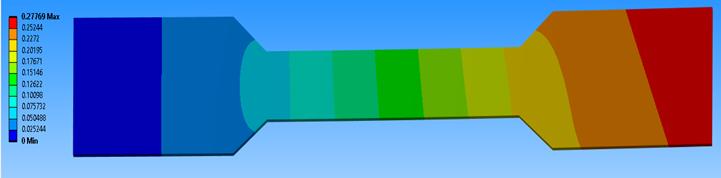
Fig-1:DirectionalDeformationofspecimen1
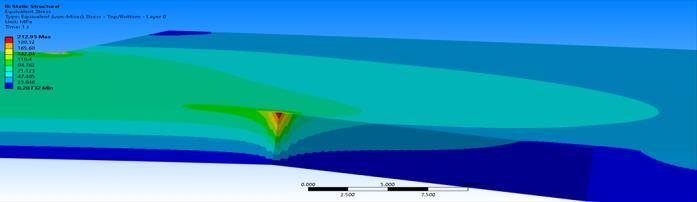
Fig-2:MaximumstressDistributionofspecimen1
Specimen 2 – HYBRID Glass/Kevlar/epoxy
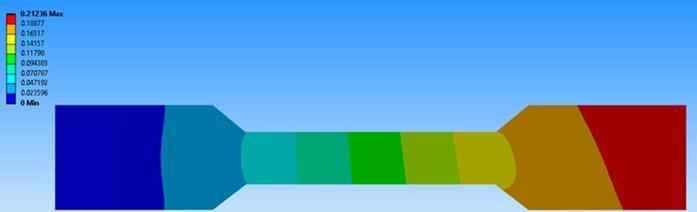
Fig -3:DirectionalDeformationofspecimen2
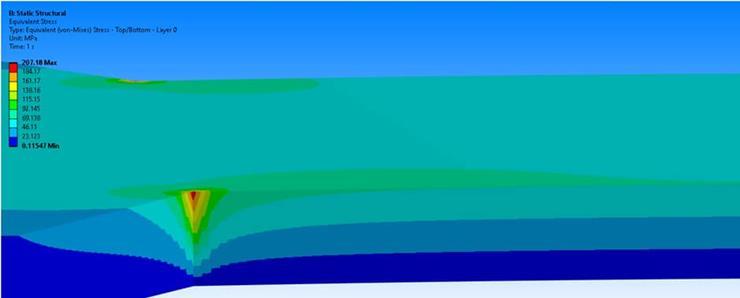
Fig-4:MaximumstressDistributionofspecimen2
Specimen 3 – Quartz/epoxy
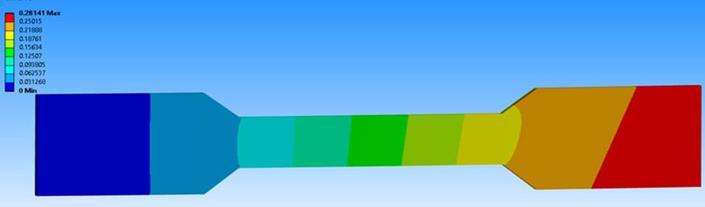
Fig -5:DirectionalDeformationofspecimen3
Volume: 13 Issue: 04 | Apr 2026 www.irjet.net p-ISSN: 2395-072
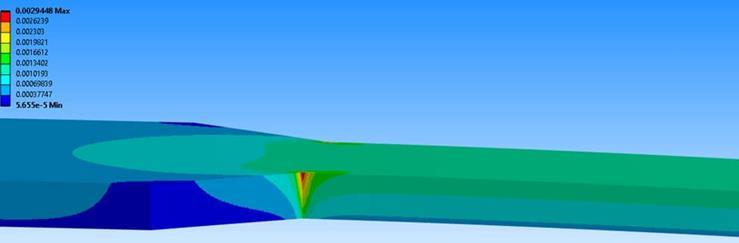
Fig -6:MaximumstressDistributionofspecimen3
Specimen 4 –HYBRID – GLASS/Quartz/epoxy
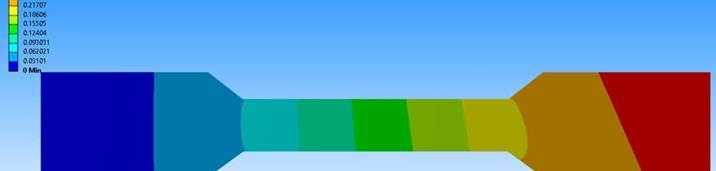
Fig -7:DirectionalDeformationofspecimen4
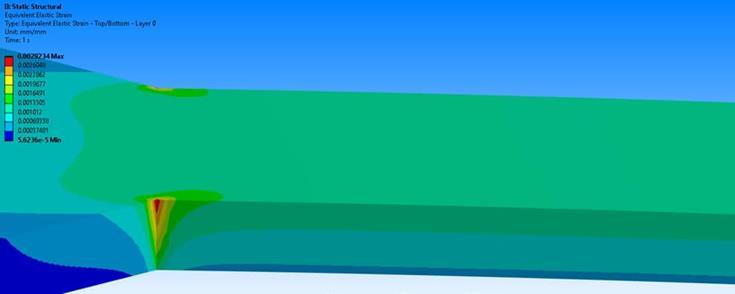
Fig -8:MaximumstressDistributionofspecimen4
Specimen 5 –Kevlar/epoxy
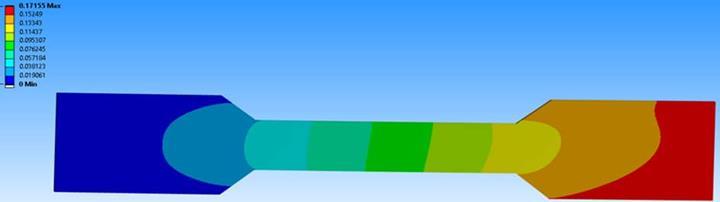
Fig -9:DirectionalDeformationofspecimen5
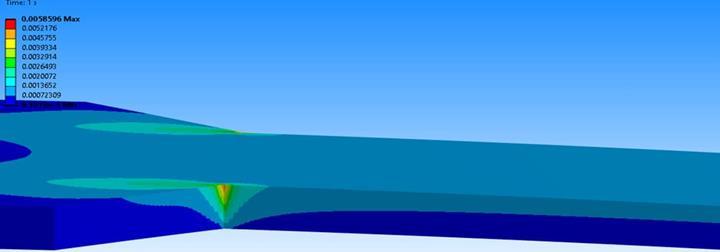
Fig -10:MaximumstressDistributionofspecimen5
3.4 Electromagnetic Analysis using ANSYS HFSS
ANSYS HFSS (High Frequency Structure Simulator) is an advanced electromagneticsimulationtool used toanalyze
wave propagation through materials. It is based on the Finite Element Method (FEM) and is widely used in antenna and radome design. In this study, HFSS was used toevaluatetheelectromagnetictransparencyofcomposite panels by modeling them as dielectric slabs of 2 mm thickness.
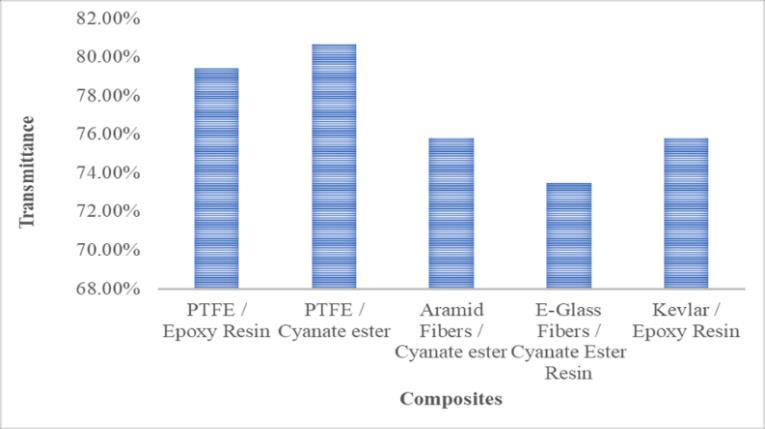
The simulation was conducted over a frequency range of 1–18GHz,andthetransmissioncoefficient(S21)wasused to measure wave transmission. A validation study was performed by comparing simulation results with experimental data, showing a low error of approximately 2.2%, confirming the reliability of the model. The results indicate that materials with lower dielectric constant and loss tangent exhibit higher transparency, with different composites performing better in different frequency bands. Thus, HFSS analysis validates the suitability of selectedmaterialsforSATCOMapplications.
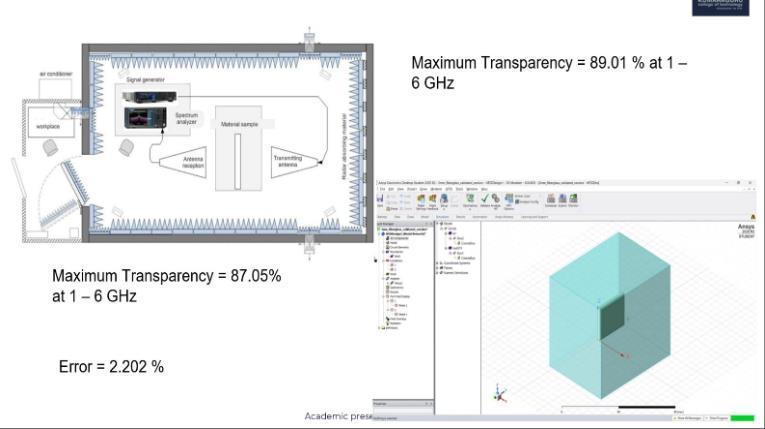
Fig -11:HFSSSetupwindow
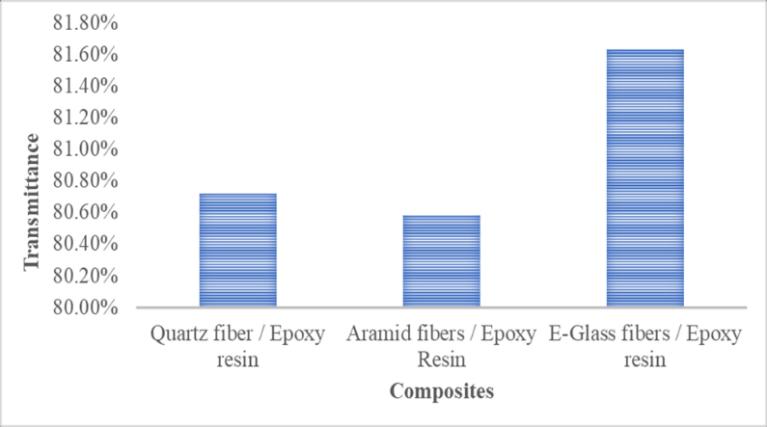
Fig -12:ComparisonchartforL-Band
Volume: 13 Issue: 04 | Apr 2026 www.irjet.net
The fabricated composite panels were further processed into standard test specimens using water jet cutting. This technique uses a high-pressure water stream to cut materials without generating heat, thereby preventing damagesuchasfiberbreakageormatrixdegradation.The specimenswerepreparedaccordingtoASTMstandardsto ensure accuracy and consistency during testing. This step isessential to maintain the original material properties andobtainreliableexperimentalresults.
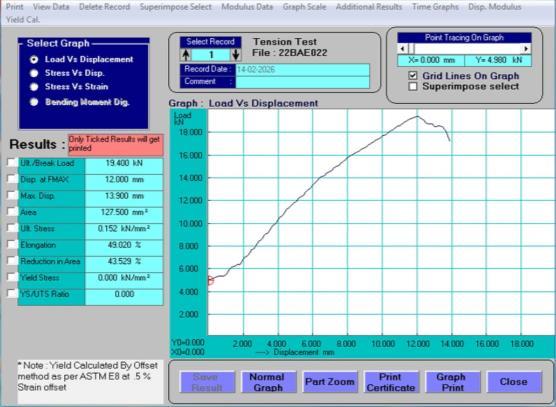
Tensile testing was performed to evaluate the mechanical performance of the fabricated composites under axial loadingconditions.Thetestmeasureskeypropertiessuch as ultimate strength, displacement, strain behavior, and failure characteristics. The results showed that hybrid composites (glass + Kevlar) exhibit improved ductility, toughness,andenergyabsorptioncomparedtopureglass fibercomposites.
While glass fiber composites showed relatively higher stiffness, they failed in a brittle manner with lower deformation.Incontrast,hybridcompositesdemonstrated higher load-bearing capacity and greater deformation before failure, indicating better resistance to mechanical damage. Therefore, tensile testing confirms that hybrid composites provide a more reliable and durable solution forSATCOMpanelapplications. Fig -14:TestedSpecimen1Fig -
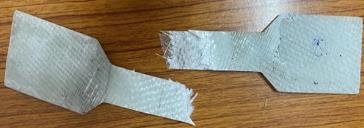
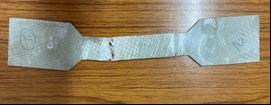
:TestedSpecimen2
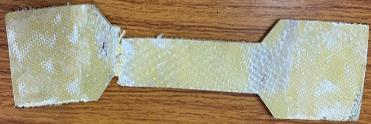
-16:TestedSpecimen3
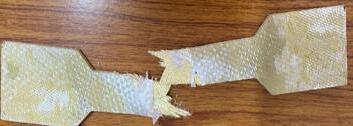
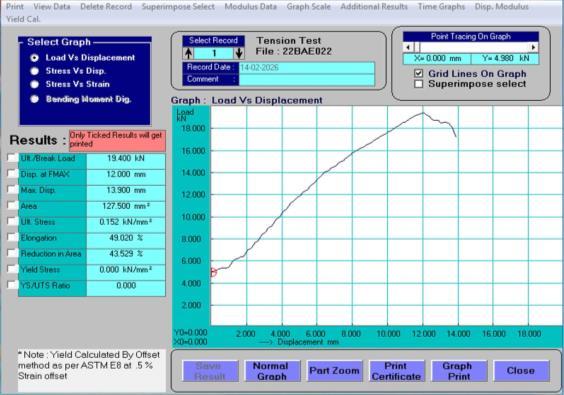
-18:LoadvsDisplacementgraphofTestedspecimen1 Fig -19:LoadvsDisplacementgraphofTestedspecimen1
Volume: 13 Issue: 04 | Apr 2026 www.irjet.net p-ISSN: 2395-072
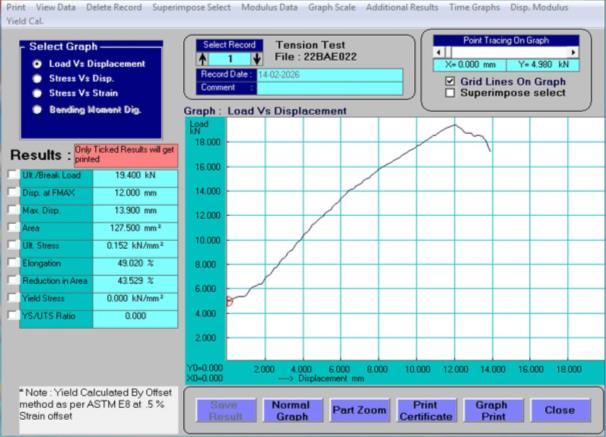
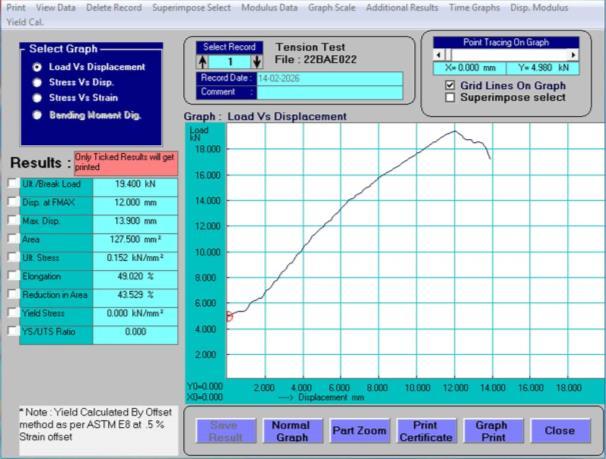
:LoadvsDisplacementgraphofTestedspecimen1
4. Results and Discussion
The structural analysis results obtained from ANSYS ACP revealsignificantdifferencesinthemechanicalbehaviorof the composite materials. Among the tested configurations, the Kevlar/epoxy composite demonstrates the highest load-bearingcapacity,withamaximumequivalentstressof approximately 236 MPa and the lowest deformation of about 7.18 mm. This indicates superior stiffness and resistance to mechanical loading. In contrast, glass fiber composites exhibit higher deformation values, suggesting lowerstiffnessdespitetheiradequatestrength.
Hybrid composites consisting of glass and Kevlar fibers show intermediate behavior, offering a balance between strength and deformation. Although their mechanical performanceisslightlylowerthanpureKevlarcomposites, theyprovideimprovedstructuralcharacteristicscompared toGFRP.
Electromagneticsimulationresultsindicatethatglassfiber composites exhibit better wave transmission due to their lower dielectric losses. Kevlar composites, while mechanically superior, show relatively reduced electromagnetic transparency. The hybrid composite configuration effectively balances these properties by
maintaining acceptable transmission characteristics while enhancingmechanicalstrength.
Theresultsclearlydemonstratethatnosinglematerialcan independentlysatisfybothmechanicalandelectromagnetic requirements.However,hybridizationprovidesapractical solutionbycombiningtheadvantagesofindividual materials.ThismakeshybridGlass/Kevlarcompositesa promisingcandidateforSATCOMpanelapplications.
Table -1: ComparisonTableforACPresults
International Research Journal of Engineering and Technology (IRJET) e-ISSN: 2395-056
Volume: 13 Issue: 04 | Apr 2026 www.irjet.net
Table -2: ComparisonTableforHFSSresults
Properti es
5.Conclusion
Thisstudypresentsthedesignandevaluationof compositematerialsforSATCOMpanelapplicationswitha focusonachievingbothelectromagnetictransparencyand mechanicalstrength.TheresultsindicatethatKevlarbasedcompositesprovidesuperiorstructural performance,whereasglassfibercompositesofferbetter electromagneticcharacteristics.Hybridcomposites successfullybridgethisgapbydeliveringabalanced combinationofbothproperties.
Theintegrationofstructuralandelectromagnetic simulationsusingANSYStoolshasproveneffectivein evaluatingmaterialperformanceandreducing experimentalefforts.Basedonthefindings,hybrid Glass/Kevlar/Epoxycompositesarerecommendedfor SATCOMpanelsinaerospaceapplications,astheymeet thefunctionalrequirementsofstrength,durability,and efficientsignaltransmission.
[1] J. Campbell, Complete Casting Handbook, 2nd ed., Oxford, U.K.:Butterworth-Heinemann,2015.
[2]ASMHandbook,Vol.15:Casting,ASMInternational, MaterialsPark,OH,2008.
[3]V. D.Tsoukalas,N.G.Karkalos,andA.P.Markopoulos, “Optimizationofporosityformationinaluminumpressure die casting,” Int. J. Adv. Manuf. Technol., vol. 36, pp. 120–130, 2008.
[4] S. Kalpakjian and S. Schmid, Manufacturing Processes forEngineeringMaterials,5thed.,Pearson,2014.
[5] H. Hu and X. Jiang, “Effect of process parameters onporosity in aluminum die casting,” J. Mater. Process. Technol.,vol.209,pp.456–462,2009.
[6]Q.C.HsuandC.Y.Yu,“Minimumporosityformationin pressure die casting by Taguchi method,” Advances in Materials Science and Engineering, vol. 2013, Article ID 920865.
[7]R.W.Heine,C.R.Loper,andP.Rosenthal,Principlesof MetalCasting,McGraw-Hill,1967.
[8]K.C.ApparaoandP.S.Rao,“Optimizationofdiecasting processparametersusingTaguchimethod,”ProcediaEng., vol.97,pp.129–136,2014.
[9] J. K. Kittur et al., “Modeling and multi-response optimizationofpressurediecastingprocess,”Int.J.Adv. Manuf. Technol.,vol. 76,pp. 1745–1758,2015.
[10] S. Kou, Welding Metallurgy, 2nd ed., WileyInterscience, 2003.
BIOGRAPHIES


Kiruthika Sundari T– UG Scholar inthedepartmentofAeronautical Engineering at Kumaraguru CollegeofTechnology
Sunantha Jeyasurya G– UG Scholar in the department of Aeronautical Engineering at Kumaraguru College of Technology
International Research Journal of Engineering and Technology (IRJET) e-ISSN: 2395-056
Volume: 13 Issue: 04 | Apr 2026 www.irjet.net p-ISSN: 2395-072




Vinoth S– UG Scholar in the department of Aeronautical Engineering at Kumaraguru CollegeofTechnology
Varun K– UG Scholar in the department of Aeronautical Engineering at Kumaraguru CollegeofTechnology
Prem Kumar P S – Professor in the department of Aeronautical Engineering at Kumaraguru CollegeofTechnology
Velmurugan C – Professor in the department of Mechanical Engineering at Kumaraguru CollegeofTechnology