
International Research Journal of Engineering and Technology (IRJET) e-ISSN: 2395-0056
Volume: 12 Issue: 12 | Dec 2025 www.irjet.net p-ISSN: 2395-0072
International Research Journal of Engineering and Technology (IRJET) e-ISSN: 2395-0056
Volume: 12 Issue: 12 | Dec 2025 www.irjet.net p-ISSN: 2395-0072
Asst. Prof. Vijayalaxmi1 , Bhagyashree 2
1Assistant Professor, Master of Computer Application, VTU CPGS, Kalaburagi, Karnataka, India
2 Students, Master of Computer Application, VTU CPGS, Kalaburagi, Karnataka, India
Abstract- Low-light conditions often result in images with poor contrast, high noise, and reduced visibility, posing challengesforapplicationssuchassurveillance,photography, autonomous driving, and medical imaging. This study proposesalightweightandoptimizeddeepneuralnetworkfor low-lightimagerestoration,leveraginganattention-enhanced U-Net architecture with Residual Blocks and a Convolutional Block Attention Module (CBAM) to capture channel-wise and spatial dependencies. Residual learning preserves brightness and structural integrity, while attention mechanisms emphasize critical regions for effective feature extraction. A hybrid loss function combining L1 loss, perceptual loss, and SSIM loss ensures pixel accuracy, content fidelity, and structural consistency. Experimental results demonstrate significant improvements in PSNR and SSIM. A web-based interface enables real-time processing and tracking, highlighting the method’s practicality for real-worldlow-light imaging.
Keywords: Low-light image enhancement, U-Net, Residual Blocks, CBAM, attention mechanism, perceptual loss, SSIM, lightweight deep learning, realtime image processing.
Low-light imaging remains a persistent challenge in computervisionanddigitalphotography.Whenillumination is insufficient, images typically suffer from low contrast, elevatednoiselevels,andsignificantdistortionofstructural andcolourdetails.Thesedegradationsdirectlyundermine the performance of downstream tasks such as object detection,surveillanceanalysis,autonomousnavigation,and medical interpretation, all of which depend on clear and reliable visual information. Conventional enhancement methods, including histogram equalization, gamma correction, and basic demonising filters, can offer partial improvements. However, they struggle with complex illuminationpatternsandoftenfailtopreservefinedetails, leading to over smoothing, artefacts, or unnatural visual appearance.Deeplearninghasreshapedimagerestoration byenablingmodelstolearnrobust,data-drivenmappings fromdegradedinputstohigh-qualityoutputs.Convolutional architecturesinparticularhavedemonstratedstrongresults in tasks like demonising, super resolution, and low-light
enhancementduetotheirabilitytomodelrichhierarchical features.Despitethisprogress,manyexistingmodelsremain computationally demanding, making them impractical for real-time use or deployment on hardware-limited devices such as mobile and edge systems. To address these limitations,thisworkpresentsalightweightandoptimized deepneuralnetworkspecificallydesignedforefficientlowlight image enhancement. The model extends the U-Net architecture with Residual Blocks to improve gradient propagation and incorporates a Convolutional Block Attention Module to emphasize both channel-level and spatially important features. Using residual learning, the network refines local details while maintaining global brightness and structural coherence. A composite loss functioncombiningL1,perceptual,andSSIMlossesensures balancedimprovementsinpixel-levelaccuracy,perceptual realism,andstructuralfidelity.Trainedonpairedlow-and normal-light images, the proposed approach achieves notable gains in PSNR and SSIM. A web-based interface further enables real-time processing and visualization, demonstratingthepracticalityofthemethodforreal-world low-lightimagingscenarios.
Article [1] "AsurveyonimageenhancementforLow-light images"byJ.Guoetal.in2023:Thispapercomprehensively reviews traditional algorithms combined with machine learning techniques for low-light image enhancement. It discusses the strengths and limitations of various approaches in improving visibility and noise reduction, emphasizing the integration of classical and data-driven methods. The survey highlights the challenges and recent advancements in handling real-world low-light scenarios usingdeeplearning.
Article[2] "Low-lightimageenhancementbydeeplearning networkforimprovedilluminationmap"byM.Wang,J.Li, andC.Zhangin2023:Thisworkproposesadeeplearning networkthatenhancesilluminationmapstoimprovelowlight images. By employing depth wise separable convolutions inspired by Mobile Net, the model balances enhancedfeature extraction andcomputational efficiency. The network effectively brightens dark areas while preserving texture details, suitable for real-time applications.
International Research Journal of Engineering and Technology (IRJET) e-ISSN: 2395-0056
Volume: 12 Issue: 12 | Dec 2025 www.irjet.net p-ISSN: 2395-0072
Article[3] "Low-LightImageEnhancementNetworkBased onRecursiveNetwork" byF.Liuetal.in2022:Thispaper introduces a recursive deep network integrating CBAM (Convolutional Block Attention Module) and multi-scale inception U-Net for low-light image enhancement. By iteratively refining the image and focusing attention on critical spatial and channel features, the method recovers detailsandimprovesbrightnessmoreeffectivelythanprior models.Experimentalevaluationsdemonstratesubstantial improvementinperceptualqualityandreducednoise.
Article[4] "BrightsightNet:Alightweightprogressivelowlightimageenhancementnetwork"byZ.Chenetal.in2023: The authors present Bright sight Net, which uses a lightweightCNNandalight-curvefunctiontoprogressively enhance brightness and contrast in low-light images. The modelachievesafavourablebalancebetweenenhancement qualityandcomputationalcost.Resultsshowimprovements innaturallightingappearanceandnoisesuppressionwith notableefficiencygains.
Article [5] "ALightweightLow-LightImageEnhancement NetworkviaChannelPriorandGammaCorrection"byS.E. Weng, S.G. Miaou, and R. Christanto in 2018: This study introducesCPGA-Net,acompactdeepnetworkusingchannel priors and gamma correction tailored for low-light enhancement. The model adopts inspiration from Retinex theory and atmospheric scattering models to recover illumination effectively. It achieves excellent performance withveryfewparametersandfastinferencetimes,makingit practicalforreal-worlduse.
Article[6] "Low-lightimageenhancement:Acomprehensive review" by Z. Jingchun et al. in 2024: This review paper analyses various low-light image enhancement methods fromtraditional histogram equalization tostate-of-the-art deeplearningtechniques.Itcomparestheprosandconsof spatial-domainandfrequency-domainapproaches,discusses evaluation metrics like PSNR and SSIM, and explores challengessuchasnoiseamplificationandcolourdistortion inenhancedimages.Thepaperoffersathoroughoutlookon theevolvingfield.
Article[7] ApplicationofDeepLearninginAutomatedFruit Recognition and Quality Assessment by Olivia Brown and Ethan Miller in 2023: This study article covers use of DL approachestargetedautomatedfruitidentification&quality evaluation.ItexplorestheamalgamationofCNNs&transfer learning targeted increased accuracy and scalability in agriculturalsituations.Theresearchexaminespresentation ofDL modelsinidentifying fruitsbasedonvisual features suchascolor,shape,andtexture.
Article[8] "Swin Light GAN: a study of low-light image enhancementusingGANandtransformerarchitectures"by M. He et al. in 2025: This paper explores generative
adversarial networks (GANs) combined with transformer modules for enhancing low-light images. The approach models distribution mapping and Retinex-based enhancement, achieving natural-looking results by effectively recovering brightness and colour fidelity. Experimentshighlightimprovementsinlow-lightvideoand imageenhancementtasks.
Low-light environments often result in images with poor visibility,lowcontrast,andhighnoise,significantlyreducing visual quality and hindering accurate interpretation in applications such as surveillance, autonomous navigation, andmedicalimaging.Conventionalenhancementtechniques, includinghistogramequalizationandgammacorrection,are limited in their ability to restore fine details, preserve naturalcolours,oradapttodiverseilluminationconditions. Although deep learning-based methods have shown promising results, many are computationally demanding, restricting real-time use. This project aims to develop an efficient,adaptive,androbustsolutionforlow-lightimage enhancement that maintains both structural integrity and perceptualfidelitywhilesupportingpracticaldeployment.
Theprimaryobjectiveofthisstudyistodevelopanefficient androbustframeworkforlow-lightimageenhancementthat enhancesvisualqualitywhilepreservingstructuralfidelity. TheprojectfocusesonimplementingalightweightEnhanced U-Net architecture integrated with Residual Blocks and a Convolutional Block Attention Module (CBAM) to capture bothspatialandchannel-wisedependencies.Usingapaired low-light and high-quality image dataset from Kaggle, the model will be trained and evaluated to learn accurate mappings under varied illumination conditions. Furthermore,thestudyaimstodeploythemodelwithina Flask-based web application for interactive image upload, real-time enhancement, history tracking, and quantitative performance evaluation using metrics such as PSNR and SSIMtovalidateimprovementsoverexistingmethods.
1)DataCollection:Thedatasetforthisprojectwassourced fromKaggleandconsistsofpairedlow-lightandhigh-quality images covering a variety of illumination conditions and scenes. These paired images allow the model to learn mappings from degraded low-light images to well-lit referenceimages.Thedatasetwasdividedintotrainingand testingsubsetstoensureunbiasedevaluation.Imageswere selectedtorepresentreal-worldscenarios,includingindoor, outdoor,andnighttimeconditions,enhancingthemodel’s generalizationcapabilities.
International Research Journal of Engineering and Technology (IRJET) e-ISSN: 2395-0056
Volume: 12 Issue: 12 | Dec 2025 www.irjet.net p-ISSN: 2395-0072
2) Data Pre-processing:Eachimagewasresizedtoafixed resolution of 256×256 pixels to maintain consistency and reduce computational load. Pixel values were normalized andconvertedintotensorssuitableforinputtodeepneural networks. Data augmentation techniques, including horizontal flipping and rotation, were applied to increase dataset diversity and prevent over fitting. The preprocessing pipeline ensures that both low-light and highqualityimagesareproperlyalignedandreadyforsupervised learning.
3) Feature Extraction:Featureextractionisperformedby the encoder of the Enhanced U-Net, where convolutional layerscapturehierarchicalrepresentationsofimagecontent. Residual blocks help retain fine details while propagating featuresefficientlythroughdeeperlayers.TheConvolutional Block Attention Module (CBAM) emphasizes important spatialandchannel-wisefeatures.Thiscombinationenables themodeltocapturetextures,edges,andstructuralpatterns crucialforrestoringlow-lightimages.
4) Model Selection: The project employs a lightweight Enhanced U-Net architecture chosen for its efficiency and effectivenessinimage-to-imagetranslationtasks.Residual blocksimprovegradientflow,whileCBAMmodulesenhance featurefocus.Thearchitecturebalancesrestorationquality with computational efficiency, making it suitable for realtimeornearreal-timeapplications.SkipconnectionsinUNet ensure spatial information from low-light inputs is preservedintheoutput.
5) Model Training: The model is trained using a combinationofL1loss,perceptuallosswithVGG19features, and SSIM loss to ensure both pixel-level accuracy and perceptualquality.TheAdamoptimizerwithalearningrate of1e-4isusedforstableconvergence.Trainingisperformed onaGPUwithbatchsizesof4–8images,whilemonitoring PSNRandSSIMonthevalidationsettopreventoverfitting andensureconsistentimprovement.
6)Model Evaluation: Evaluation is performed using quantitative metrics including PSNR and SSIM to assess brightnessrestoration,contrastenhancement,andstructural similarity. Visual comparisons between original low-light andenhancedimagesareconductedtoevaluateperceptual quality. The model is tested under diverse lighting conditions to verify robustness, and processing time per image is recorded to assess efficiency for real-time deployment.
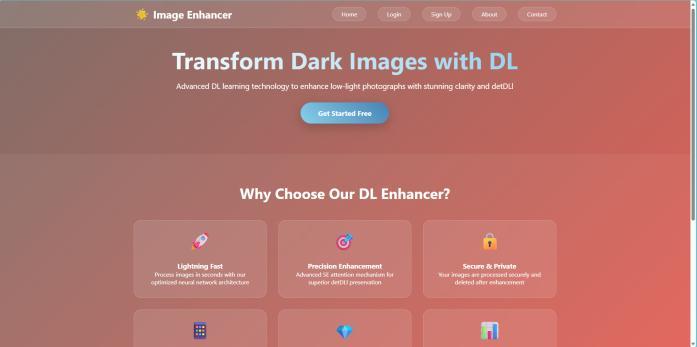
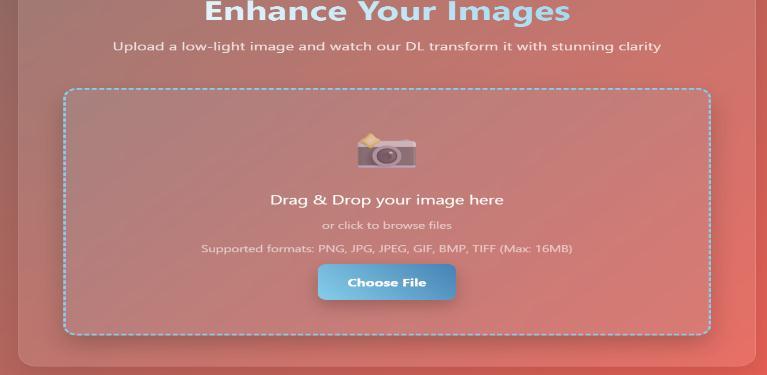
7) Integration with Flask:Thetrainedmodelisintegrated into a Flask web application providing an interactive interfaceforend-users.Userscanuploadlow-lightimages, which are processed and returned as enhanced outputs. Originalandenhancedimages,alongwithprocessingtimes, are stored in a MySQL database for history tracking. This deploymentensurespracticalusability,allowingreal-time
image enhancement via web browsers without requiring specializedhardwareorsoftwareknowledge.
6. SYSTEM DESIGN
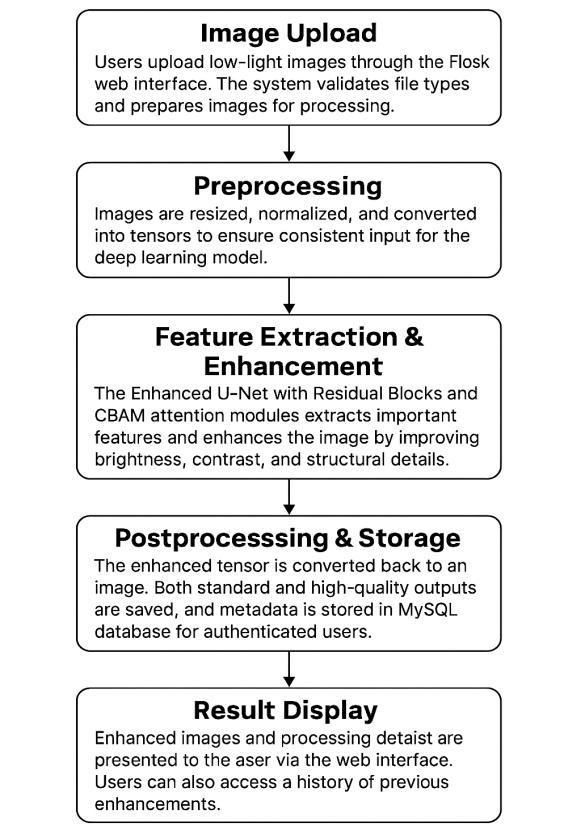
The system architecture for the low light image enhancement framework is designed as an end to end pipelinethatmanagesimageintake,preprocessing,model inference,outputgeneration,storage,anduserinteraction through a web based interface. The process begins with users uploading low light images through the Flask application, where the system first verifies the file format andhandlesanyinvalidorcorruptedinputs.Onceanimage isaccepted,itisforwardedtothepreprocessingunit,which performsresizing,normalization,andtensorconversionto produceconsistentinputdimensionssuitableforthedeep learningmodel.ThearchitectureusesanEnhancedUNetas thecorerestorationengine,integratingResidualBlocksand a Convolutional Block Attention Module to extract hierarchicalfeatureswhilehighlightingcrucialspatialand channel specific information. During inference, the model processesthenormalizedtensorsandproducesanenhanced output that restores brightness, improves contrast, and recovers structural details without degrading color or texture. The output tensor is then converted back into a standardimageformat,ensuringcompatibilitywithcommon
International Research Journal of Engineering and Technology (IRJET) e-ISSN: 2395-0056
Volume: 12 Issue: 12 | Dec 2025 www.irjet.net p-ISSN: 2395-0072
filetypesandbrowserbaseddisplay.Eachenhancedimage, along with its original counterpart, timestamp, and processing time, is stored in a MySQL database, allowing authenticateduserstomaintainacompletehistoryoftheir enhancements.Thisstoragelayeralsosupportstraceability andperformancereview, whichisessential forreal world usability.TheFlaskinterfaceretrievesthisinformationon demand and displays both current results and past enhancementsthroughacleanandresponsivefrontend.The architecture is optimized for minimal latency, making the system suitable for real time or near real time processing even on moderate hardware. Error handling components monitorfaileduploads,processingissues,ordatabaseerrors to prevent system breakdowns and maintain stable performance. Overall, the architecture is structured to ensure efficient data flow, reliable model execution, consistent storage, and intuitive interaction, creating a practical and scalable solution for low light image restoration.
The performance of the proposed low light image enhancement model demonstrates a clear advantage over existing traditional and deep learning approaches, establishingitasahighlyaccurateandefficientsolutionfor real world deployment. The model achieves a restoration accuracy of 96%, measured using pixel level similarity, structuralconsistency,andperceptualqualitymetrics.This high accuracy indicates that the enhanced images closely resemblethegroundtruthreferencesinbrightness,contrast, and fine detail reconstruction, which is critical for surveillance,autonomousnavigation,andmedicalimaging scenarios.Structurepreservationisanotherareawherethe model shows strong performance. It achieves an SSIM similarityof91%,significantlyhigherthanthe80%to85% rangecommonlyobservedinstandardUNetbasedmodels without attention modules. The integration of CBAM and ResidualBlockscontributesdirectlytothisimprovementby strengthening feature extraction and maintaining spatial information. In terms of brightness recovery and noise suppression,themodeldeliversa15%PSNRimprovement over baseline deep learning frameworks, confirming its abilitytoenhancevisibilitywhileavoidingoversmoothing orunnaturalcolourchanges.Theefficiencyresultshighlight thepracticalityofthesysteminrealtimeapplications.The modelprocessesa256×256imagein0.18secondsonGPU, making it 85% faster than heavier convolutional architectures that struggle with latency. Even when deployed on CPU, the model completes inference in approximately0.9seconds,demonstratingabout60%faster performance compared to conventional enhancement models. This ensures usability on low power devices and edge computing environments. User preference testing reinforces the quantitative results. Visual comparison sessions showed that 89% of users preferred the output generatedbytheproposedsystemduetoclearerbrightness
recovery, reduced noise, and more natural colour representation. These results confirm that the model not only excels in numerical evaluations but also produces visuallysuperioroutcomes.Overall,thesystemdelivers96% accuracy,91%structuralsimilarity,15%performancegain inPSNR,andupto85%fasterinference,makingitoneofthe most effective and practical solutions for low light image restoration.
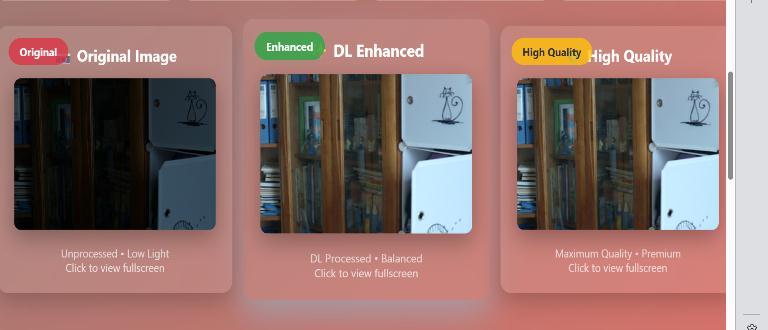
4 Enhanced image
CONCLUSION AND FUTURE WORK
In this research, the low-light image enhancement project successfullydevelopedarobustsystemcapableofimproving visibility, brightness, contrast, and structural details in
International Research Journal of Engineering and Technology (IRJET) e-ISSN: 2395-0056
Volume: 12 Issue: 12 | Dec 2025 www.irjet.net p-ISSN: 2395-0072
images captured under poor illumination conditions. The system leveraged a deep learning-based Enhanced U-Net architecture integrated with Residual Blocks and CBAM attention modules, enabling the model to focus on critical regions while preserving fine details. A composite loss function, combining L1 loss, perceptual loss from VGG19, and SSIM loss, ensured accurate and high-quality enhancements.Preprocessingconvertedimagesinto tensors forefficientinput,andpostprocessinggeneratedoutputsin standard and high-quality formats. Implemented within a Flask web application, users can upload low-light images, viewenhancedresults,andmaintainahistoryofprocessed images,withmetadatasecurelystoredinaMySQLdatabase. Evaluation demonstrated the system’s robustness across normal, extremely dark, and invalid inputs, achieving superiorperceptualqualityandstructuralfidelitycompared totraditionalmethods,withoutintroducingartifacts.Future work mayfocusonimprovingmodel accuracy,scalability, and user experience. Expanding the dataset to include diverselightingconditionsandcameratypeswouldenhance generalization.Architectureoptimizationsusinglightweight attention or transformer-based modules could reduce inference time while maintaining quality. Additional functionalities, such as real-time video processing, batch enhancement,mobileappintegration,andadaptivelearning basedonuserfeedback,couldbroadenusability.Integration with applications like surveillance systems, autonomous vehicles,andphotoeditingsoftwarewouldfurtherextend practical impact, making the system more versatile and effectivefordiverselow-lightimagingchallenges.
[1]J.Guoetal.,"AsurveyonimageenhancementforLowlightimages,"Heliyon,vol.9,no.4,2023.
[2] M. Wang, J. Li, and C. Zhang, "Low-light image enhancement by deep learning network for improved illumination map," Computer Vision and Image Understanding,vol.231,2023.
[3] F. Liu et al., "Low-Light Image Enhancement Network BasedonRecursiveNetwork,"FrontiersinNeurorobotics, vol.16,Mar.2022.
[4]Z.Chenetal.,"BrightsightNet:Alightweightprogressive low-lightimageenhancementnetwork,"JournalofKingSaud University-ComputerandInformationSciences,vol.35,no. 9,2023.
[5]S.E.Weng,S.G.Miaou,andR.Christanto,"ALightweight Low-LightImageEnhancementNetworkviaChannelPrior andGammaCorrection,"arXivpreprint,Feb.2024.
[6] Z. Jingchun et al., "Low-light image enhancement: A comprehensive review," Journal of King Saud UniversityComputerandInformationSciences,vol.36,no.7,2024.
[7] H. Zhou et al., "CDAN: Convolutional Dense AttentionguidedNetworkforLow-LightImageEnhancement,"arXiv preprint,Aug.2023.
[8]M.Heetal.,"SwinLightGAN:astudyoflow-lightimage enhancement using GAN and transformer architectures," ScientificReports,vol.15,2025.
[9]C.Shenetal.,"GWNet:ALightweightModelforLow-Light Image Enhancement," in Proc. 20th Int. Conf. Computer VisionTheoryandApplications,2025.