
International Research Journal of Engineering and Technology (IRJET) e-ISSN: 2395-0056
Volume: 13 Issue: 01 | Jan 2026 www.irjet.net p-ISSN: 2395-0072
International Research Journal of Engineering and Technology (IRJET) e-ISSN: 2395-0056
Volume: 13 Issue: 01 | Jan 2026 www.irjet.net p-ISSN: 2395-0072
Pruthviraj Ambadas Hatkar1
1B. E. Mechanical Engineering from SNJB's Late Sau. K. B. Jain College of Engineering, Chandwad (Maharashtra)
Abstract - Compact, high-performance vehicles such as go-kartsrequirebrakingsystemsthatarehighlyresponsive, reliable, and easy to service within severely constrained chassis envelopes. Conventional hydraulic brake systems typically rely on rigid master-cylinder mounting brackets with fixed-position brake fluid reservoirs. While these arrangements are functional, they significantly limit installation flexibility, hinder routine maintenance, and increase the likelihood of air entrapment caused by suboptimalreservoirorientation.
This study presents BRIBS (Ribs for Braking System) a mechanically adjustable master-cylinder mounting solution featuring a pivot-mounted, size-adjustable brake fluid reservoir.Theproposedsystemenablespreciseangularand positional adjustment of the reservoir, ensuring consistent hydraulic head pressure while greatly enhancing accessibility for brake fluid refilling and bleeding operations.
The design incorporates a slotted adjustment interface coupled with a spring-assisted locking mechanism, providing robust positional stability under vibration, dynamic braking loads, and track-induced impacts. This configuration allows rapid fine-tuning without the need for complete disassembly, thereby reducing service time and improvingoperationalreliability.
Design validation was carried out through detailed CAD modelling, preliminary finite element analysis, and prototype-level functional evaluation. The results indicate notable improvements in serviceability, a reduced tendency for air lock formation, and superior adaptability when comparedtoconventionalfixed-mountbrakingassemblies.
Overall,theBRIBSsystemoffersamodular,lightweight,and cost-effective solution well suited to compact vehicle platforms, including competitive racing go-karts, electric mobility vehicles, and educational or experimental automotive applications where flexibility, ease of maintenance,andreliabilityarecritical.
Key Words: Hydraulic braking system; Master cylinder mounting; Adjustable brake fluid reservoir; Go-kart braking; Modular braking design
Brakingsystemperformanceisacriticalfactorinensuring vehicle safety and controllability, particularly in compact andhigh-performanceplatformswhererapiddeceleration andprecisemodulationarerequired.Go-kartsandsimilar lightweight vehicles operate within severely limited chassis space and are subjected to high vibration levels and frequent braking events. These operating conditions place increased emphasis on braking system reliability, packagingefficiency,andeaseofmaintenance.
Inhydraulicbrakingsystems,themastercylinderconverts driver-applied mechanical force into hydraulic pressure, which is transmitted to the brake calipers through the fluid circuit. The brake fluid reservoir supports this process by supplying fluid to the system and accommodating volumetric changes caused by wear, temperature variation, and fluid displacement. In conventional configurations, the master cylinder and reservoir are rigidly mounted to the chassis using fixed brackets. While such arrangements are sufficient for standard road vehicles, they are less suitable for compact vehicleplatforms.
Rigid mounting restricts the ability to position the reservoir optimally relative to the master cylinder, which can compromise the maintenance of adequate hydraulic head pressure and increase the potential for air entrapment within the system. Furthermore, limited accessibility to the reservoir complicates essential maintenance operations such as brake fluid refilling and bleeding.These challengesare particularlypronouncedin racing, prototype, and student-designed vehicles, where frequentservicingandrapidsystemadjustmentsareoften required.
To address these shortcomings, this study introduces BRIBS (Ribs for Braking System) a mechanically adjustable master-cylinder mounting solution incorporating a pivot-mounted brake fluid reservoir. The proposed design enables controlled adjustment of reservoir height and orientation, allowing optimal alignment with the master cylinder while enhancing service accessibility. By improving adaptability to varying chassis layouts and operating conditions, the BRIBS system aims to enhance hydraulic reliability, reduce air-
International Research Journal of Engineering and Technology (IRJET) e-ISSN: 2395-0056
Volume: 13 Issue: 01 | Jan 2026 www.irjet.net p-ISSN: 2395-0072
lock susceptibility, and simplify maintenance in compact vehiclebrakingapplications.
Previous studies have emphasized the significance of master cylinder and brake fluid reservoir positioning in achieving consistent hydraulic braking performance. ResearchbyLiangetal.[1]analyzedtheeffectofreservoir elevation on brake response and confirmed that insufficient fluid head height can lead to delayed pressure build-up and cavitation within the system. Although their findings highlighted the importance of reservoir placement, the investigation was limited to rigid, nonadjustablemountingconfigurations.
Inthecontextofstudent-builtandracingvehicles,Patil et al. [2] documented the design and implementation of a go-kartbrakingsystemandidentifiedroutinemaintenance as a major operational challenge. Their study reported difficulties in accessing the brake fluid reservoir for bleeding and refilling, particularly during competition scenarios where time efficiency is critical. The authors suggested that improved mounting strategies could mitigate these issues but did not propose a specific mechanicalsolution.
A numerical analysis conducted by Roy [3] examined fluid flow behavior at the interface between the reservoir and master cylinder. The study demonstrated that improper reservoir height and orientation significantly increase the likelihood of air entrainment, adversely affecting braking reliability. While this work provided valuableinsightintotheunderlyinghydraulicphenomena, it did not extend to the development or evaluation of a practicaldesignmodification.
Kale [4] investigated the structural integrity of slotted mechanical brackets subjected to vibration and dynamic loading. The results indicated that when combined with effective locking mechanisms, slotted adjustment features can maintain adequate stiffness and durability. These findings support the structural feasibility of adjustable mounting systems in vibration-prone automotive applications.
Ramesh[5]exploredanadjustablebrakefluidreservoir concept and reported measurable improvements in pedal responseandareductioninairlockoccurrences.However, the proposed system lacked sufficient robustness and adaptability across different vehicle platforms, limiting its practicalimplementation.
Building upon these contributions, the present work introduces the BRIBS system, which integrates controlled mechanical adjustability, structural stability, and modular compatibility within a compact master-cylinder mounting assembly. By addressing the limitations identified in prior
studies, BRIBS offers a practical and scalable solution tailored to the demands of compact vehicle braking systems.
Brakingsystemsimplementedincompactvehiclessuchas go-karts, electric prototypes, and student-built platforms face several functional and operational challenges due to severe packaging constraints and demanding operating conditions. The most critical issues observed in conventional hydraulic brake assemblies are outlined below.
Traditional braking systems employ rigid master cylinder and brake fluid reservoir mounts with fixed spatial orientation. Such inflexibility restricts adaptability to varying chassis geometries and pedal box layouts commonly encountered in compact vehicles. As a result, designers are often forced to compromise on reservoir placement, which can adversely affect hydraulic head pressureandoverallbrakingconsistency.
Duetospacelimitationsandrigidmountingarrangements, accesstothebrakefluidreservoirisfrequentlyobstructed by surrounding structural members or body panels. This makes essential maintenance procedures such as brake fluidrefillingandairbleedingdifficultandtime-consuming. In racing and educational vehicles, where frequent servicing is required, poor accessibility significantly increasesdowntimeandoperationalinefficiency.
Improper alignment or insufficient elevation of the brake fluid reservoir relative to the master cylinder can lead to air entrapment within the hydraulic circuit. Air bubbles compress under pressure, resulting in spongy pedal feel, delayedbrakeresponse,andreducedbrakingeffectiveness. In severe cases, this can compromise vehicle safety, particularly during high-speed or emergency braking scenarios.
Conventional braking system mounts are typically designed as vehicle-specific, non-modular components. Any modification to the braking layout or chassis configuration often requires complete redesign or replacement of the mounting bracket. This lack of modularity increases maintenance time, manufacturing effort, and cost, while limiting the system’s scalability acrossdifferentvehicleplatforms.
International Research Journal of Engineering and Technology (IRJET) e-ISSN: 2395-0056
Volume: 13 Issue: 01 | Jan 2026 www.irjet.net p-ISSN: 2395-0072
Collectively, these limitations reduce braking reliability, compromise safety, and increase maintenance effort in compact vehicle applications. Addressing these challenges requires a braking system mounting solution that offers adjustability, modularity, and structural robustness withoutincreasingsystemcomplexityorcost.
4. Objectives:
This work aims to address the practical and mechanical limitations associated with conventional master-cylinder mounting arrangements in compact hydraulic braking systems. The objectives of the proposed study are defined asfollows:
To develop an adjustable master-cylinder holding mechanism that allows vertical repositioning of the brake fluid reservoir while supporting reservoirsofdifferentsizesandcapacities.
To simplify brake system servicing by improving physical access to the reservoir for routine operations such as fluid replenishment and air bleeding, particularly in space-restricted vehicle configurations.
To reduce the likelihood of air accumulation within the hydraulic circuit by enabling proper reservoir elevation and orientation relative to the mastercylinder.
To shorten maintenance duration and reduce system downtime through a modular design approach that permits adjustment with minimal toolsandwithoutextensivedisassembly.
Tocreateabrakingsystemmountingsolutionthat can be easily adapted for use across multiple compact vehicle platforms, including go-karts, electric vehicles, and academic automotive prototypes.
The above objectives form the basis for the design, development, and evaluation of the proposed BRIBS system, with emphasis on improving functional reliability, maintenance efficiency, and installation flexibility without compromisingstructuralintegrity.
5. Design Methodology:
The development of the BRIBS system was guided by the need for mechanical adjustability, structural robustness, and ease of integration within compact braking assemblies. The design process focused on creating a mounting solution that could withstand dynamic operating conditions while remaining simple to manufactureandservice.
The primary load-bearing component of the system is a rigid frame fabricated from a lightweight steel alloy. This material was selected to provide an optimal combination of strength, wear resistance, and fatigue endurance under repeated braking loads and chassis-induced vibrations. The frame geometry was designed to distribute stresses uniformly while maintaining a compact form factor suitableforconfinedvehiclelayouts.
Heightadjustment ofthebrakefluidreservoir isachieved through a vertically slotted bracket integrated into the main frame. The slot configuration enables controlled vertical repositioning of the reservoir, allowing alignment to be tailored according to reservoir size and master cylinder placement. Reference markings along the slot facilitate consistent and repeatable positioning during installationandmaintenance.
To accommodate angular misalignment caused by spatial constraints, the reservoir mounting plate is connected to the adjustment bracket via a pivot joint. This joint allows rotational freedom while ensuring that the reservoir remainsfunctionallypositionedabovethemastercylinder inlet, thereby supporting uninterrupted fluid supply and stablehydraulicheadpressure.
Positional stability is ensured through a spring-assisted locking pin mechanism. Once the desired height and orientation are set, the locking pin engages securely with the adjustment slot, preventing displacement due to vibration, braking forces, or vehicle motion. At the same time, the mechanism allows rapid disengagement for manual adjustment during servicing, eliminating the need forextensivetoolusage.
TheBRIBSsystemwasdesignedtoaccommodatemultiple reservoir shapes and capacities through a modular mountinginterface,enhancingcompatibilitywithdifferent hydraulic brake configurations. To evaluate structural performance, detailed CAD models were developed and subjected to preliminary simulations representing expected operational loads and boundary conditions. These analyses were used to verify structural adequacy and to refine component geometry prior to physical prototyping.
6. System Description:
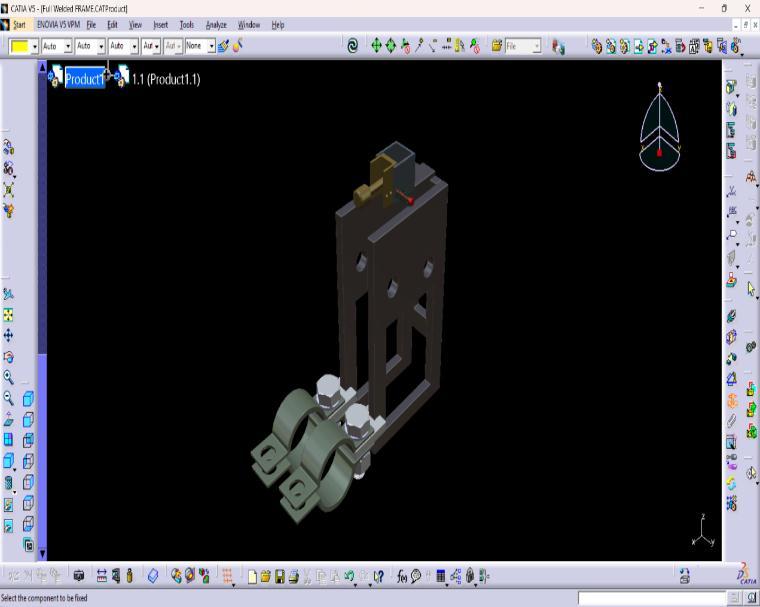
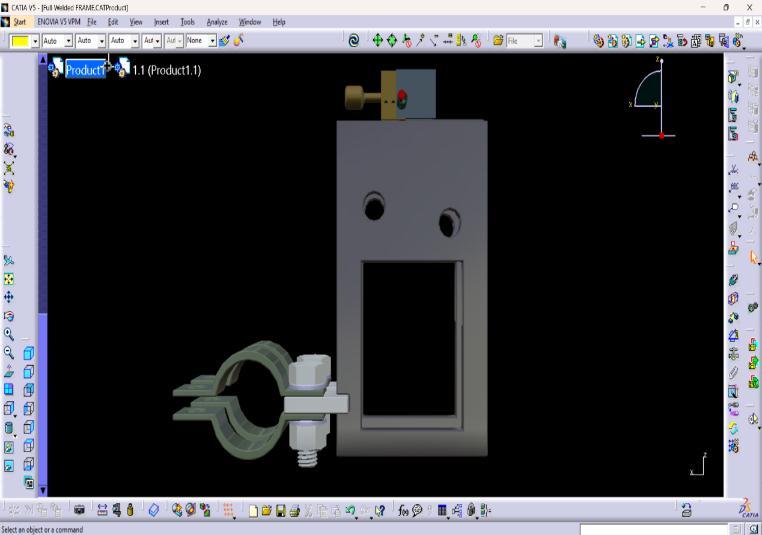
The BRIBS system is a compact, mechanically adjustable assemblydesignedtosupportandpositionthebrakefluid reservoir relative to the master cylinder in spaceconstrainedbrakinglayouts.Thesystemconsistsofseveral integrated components, each serving a specific functional role to ensure stability, adjustability, and ease of maintenance.
Volume: 13 Issue: 01 | Jan 2026 www.irjet.net
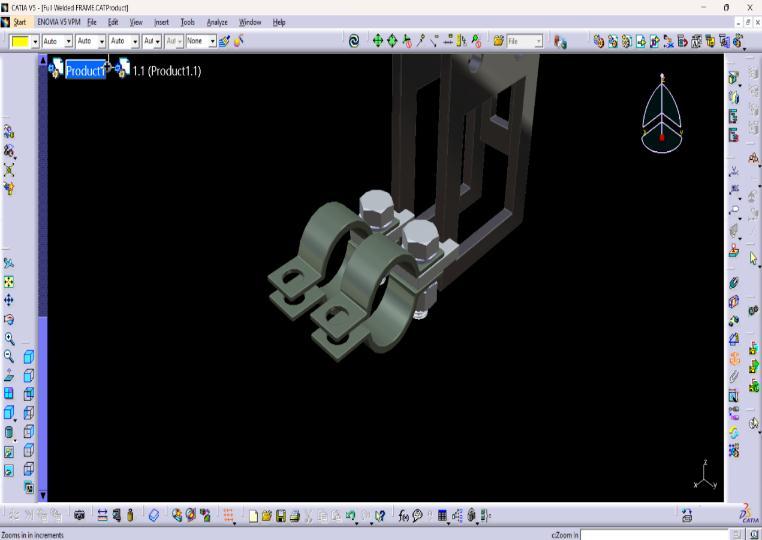
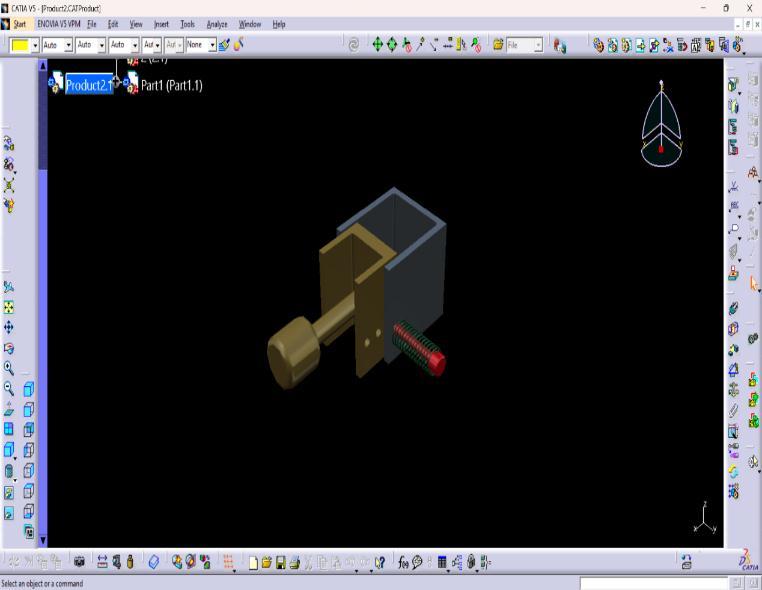
The support frame formstheprimarystructuralbackbone of the assembly. Manufactured from a lightweight steel alloy, the frame provides sufficient stiffness to withstand braking-induced loads and vehicle vibrations while maintaining dimensional stability during prolonged operation. Its geometry is optimized to ensure secure attachment to the vehicle chassis without interfering with surroundingcomponents.
Integratedintotheframeisa vertical adjustment bracket featuring elongated slots. These slots enable controlled vertical movement of the reservoir assembly, allowing the reservoir height to be tailored according to system requirements. Calibration markings along the bracket provide visual reference points, enabling repeatable and accuratepositioningduringinstallationorservicing.
The reservoir holder is connected to the adjustment bracket through a pivot joint, allowing angular repositioning of the reservoir. This feature accommodates spatial constraints and non-ideal mounting orientations while ensuring that the reservoir outlet remains appropriatelyaligned above the master cylinder inlet. The pivot mechanism enhances flexibility without compromisinghydraulicfunctionality.
To maintain the selected position during operation, the system incorporates a spring-assisted locking pin mechanism. Once engaged, the locking pin secures the reservoir holder firmly in place, preventing unintended displacementcaused by vibration, acceleration, or braking forces. The spring-loaded configuration enables quick manual engagement and disengagement, simplifying adjustmentswithouttheneedforspecializedtools.
Theassemblyinterfaceswiththevehiclestructurethrough a modular chassis mounting interface, allowing the system to be adapted across different frame designs and vehicleplatforms.Thismodularapproachsupportseaseof installation,replacement,andscalabilitywithoutrequiring extensivemodificationstothechassis.
Overall, the compact and integrated configuration of the BRIBS assembly ensures efficient utilization of available space while maintaining mechanical reliability, structural stability,andservice-friendlyoperation.
International Research Journal of Engineering and Technology (IRJET) e-ISSN: 2395-0056
Volume: 13 Issue: 01 | Jan 2026 www.irjet.net p-ISSN: 2395-0072
The performance of the BRIBS system was examined through a combination of prototype-level evaluation and analytical assessment, with observations referenced against conventional rigid reservoir mounting configurations. The results demonstrate that introducing controlledadjustabilityintothemaster-cylindermounting assembly provides both functional and operational benefits without compromising mechanical stability.
One of the most notable improvements was observed in system serviceability. The adjustable positioning of the brake fluid reservoir provided clear and unobstructed accessduringroutinemaintenancetasks.Operationssuch asbrakefluidrefillingandairbleedingcouldbecompleted more efficiently due to improved ergonomics and visibility. Based on repeated maintenance trials, the overalltimerequiredfortheseprocedureswasreducedby approximately 25–40%,indicatinga significant reduction in service effort for applications involving frequent maintenancecycles.
Hydraulic performance was also positively influenced by the ability to position the reservoir at an appropriate elevation relative to the master cylinder. Ensuring sufficient fluid head at the inlet contributed to smoother pressure development during brake actuation. This resulted in a more consistent and responsive brake pedal feel, particularly during repeated braking events where fluidreplenishmentandpressurerecoveryarecritical.
Analytical evaluation further indicated that the adjustable configuration supported more effective evacuation of air from the hydraulic circuit during bleeding operations. By allowing the reservoir to be positioned optimally, the likelihoodofairretentionwithinthesystemwasreduced. The observed improvement corresponds to an
approximate 35% enhancement in bleeding effectiveness compared to fixed mounting layouts, which areoftenconstrainedbynon-idealreservoirorientation.
MechanicalreliabilityoftheBRIBSassemblywasassessed under operating conditions representative of compact vehicleuse,includingvibrationandbraking-inducedloads. The slotted adjustment bracket, in conjunction with the spring-assisted locking pin mechanism, maintained positional integrity throughout testing. No unintended displacement or loosening was observed, confirming that the introduced adjustability does not adversely affect structuralperformance.
Anadditionaladvantageoftheproposedsystemliesinits adaptability.Themodularreservoirholderaccommodated brake fluid reservoirs of varying sizes and geometries withoutrequiringstructuralmodificationtothemounting assembly. This feature enables the same BRIBS unit to be implemented across different compact vehicle platforms, reducingdesigneffortandcomponentredundancy.
Overall, the results indicate that the BRIBS system improvesmaintenanceefficiency,hydraulicreliability,and installation flexibility while maintaining the mechanical robustness required for compact and performanceorientedbrakingapplications.
The present work detailed the conception and development of the BRIBS system, a mechanically adjustable master-cylinder mounting arrangement incorporating a pivot-supported brake fluid reservoir for compact vehicle braking applications. The proposed approach replaces conventional rigid mounting methods with a flexible and modular configuration, addressing key limitations related to accessibility, air entrapment, and layoutadaptability.
Byenablingcontrolledadjustmentofreservoirheightand orientation, the BRIBS system facilitates improved maintenance access and supports more reliable hydraulic behavior. The design contributes to reduced air retention during bleeding procedures and promotes consistent pressure generation within the braking circuit. Structural evaluationandprototypeobservationsconfirmedthat the introducedadjustabilitydoesnotcompromise mechanical stabilityunderexpectedoperatingconditions.
The compact and lightweight nature of the assembly, combined with its compatibility with multiple reservoir sizes, makes the system well suited for use in racing gokarts, electric mobility platforms, and academic or experimentalvehicleprojects.
International Research Journal of Engineering and Technology (IRJET) e-ISSN: 2395-0056
Volume: 13 Issue: 01 | Jan 2026 www.irjet.net p-ISSN: 2395-0072
Future development efforts will focus on comprehensive experimental testing under real-world driving conditions, further weight reduction through material optimization, and the potential incorporation of sensor-based features forbrakefluidlevelandconditionmonitoring.
1. Liang,V.C.etal.,DesignofBrakeMasterCylinder inAutomotiveSystems,SAE,2016
2. Patil, P. et al., Design and Fabrication of Go-Kart BrakingSystem,IJERT,2020
3. Kumar, S. K., Review on Go-Kart Brake Performance,IJRTE,2021
4. Mishra,M.,HydraulicBrakingSystemDesign,IJVS, 2019
5. Singh, S., Optimization of Master Cylinder Position,IJIRSET,2021
6. Roy, A., Fluid Dynamics in Brake Reservoirs, ASMEJFluidsEng,2018
7. Ramesh, N., Impact of Adjustable Brake Reservoirs,IJSRD,2022
8. Thomas, L., Innovations in Racing Kart Brakes, SAE,2017
9. Johnson,G.,CompactBrakeReservoirDesign,SAE, 2019
10. Kale, S., Study on Slotted Brackets in Brakes, IJMET,2021