
International Research Journal of Engineering and Technology (IRJET) e-ISSN: 2395-0056
Volume: 12 Issue: 03 | Mar 2025 www.irjet.net

p-ISSN: 2395-0072

DESIGN AND DEVELOPMENT OF AN AFFORDABLE ECO-FRIENDLY E-BICYCLE FOR URBAN MOBILITY
Dr.M.Jegadeesan 1 , C.S. Dinesh 2 , A.Guruz Stephen Alex 3
, S.Kanimurugan4
Professor, Department of Electrical and Electronics Engineering, K.L.N. College of Engineering, Pottapalayam, Sivagangai District.
Abstract - The increasing demand for sustainable urban transportationhasledtothedevelopmentofeco-friendlyand cost-effective mobility solutions. This study focuses on designing and developing an affordable electric bicycle (ebicycle) to enhance urban commuting. The proposed e-bicycle features a lightweight aluminum alloy frame, a permanent magnet DC motor, and a lithium-ion battery to provide efficientpower utilizationandanextendedrange. The design prioritizes rider comfort, safety, and ease of use, making it suitable for daily commutes. A cost analysis highlights its affordability compared to conventional e-bicycles and other transport modes. Byminimizing carbon emissions and traffic congestion, this e-bicycle promotes sustainable mobility and reducesdependenceonfossilfuels.Thestudydemonstratesthe feasibility of an economical and environmentally friendly transportation alternative for urban areas, supporting global sustainability goals.
Key Words: Electric bicycle (e-bicycle), urban mobility, sustainabletransportation,eco-friendlydesign,affordableebike, pmdc motor, lithium-ion battery, energy efficiency, carbon emission reduction, green mobility, cost-effective transportation, lightweight frame, smart commuting, alternativetransport,renewableenergyintegration,traffic congestionreduction,environmentalimpact.
1.INTRODUCTION
A low-cost electric cycle designed for sustainable urban mobilityoffersanaffordableandeco-friendlytransportation optiontailoredtocityresidents.Withrisingconcernsover urbancongestion,pollution,andthenegativeenvironmental impactoftraditionaltransport,thiselectriccyclepresentsan ideal solution that promotes cleaner, greener, and more efficient mobility.The bike features a lightweight frame craftedfromdurablematerialssuchasaluminumorhighstrength steel, making it both easy to handle and repair. Thesematerialsarenotonlycost-effectivebutalsoprovide the bike with long-lasting durability, ensuring it can withstandtherigorsofurbancommuting.
Thecycleispoweredbyarearhubmotororconventional motorpairedwithacompactlithium-ionbattery,providing pedal-assistfunctionality.Thisallowsriderstotravelarange of 20-30 km on a single charge, making it ideal for short commutesinthecity.Thepedal-assistfeatureensuresthat riderscaneffortlesslynavigatethroughtheurbanlandscape, reducingthephysicalexertionrequiredforlongertrips.

To further enhance the bike's sustainability, small solar panels can be integrated into the design to recharge the battery while the bike is parked outside, tapping into renewable energy sources and minimizing reliance on charginginfrastructure.Inaddition,asimplemobileappcan be introduced to track battery life, distance travelled, and otherkeymetrics,givingusersfullcontrolovertheirrides andmakingiteasiertomonitorthebike'sperformance.The bike'sdesignalsoencourageslocalmanufacturing,whichcan create jobs in the community, reduce shipping costs, and foster local economic growth. By partnering with local businesses for production and assembly, this approach ensuresthatthecycleremainsaffordablewhilesupporting the local economy. Moreover, the bike can be offered throughgovernmentsubsidiesorflexiblerentalplansaimed at low-income users, making it accessible to a broader population.Thisaffordabilitymodelensuresthateveryone, regardless of income, has the opportunity to use this sustainabletransportationoption.Safetyandridercomfort areprioritizedwithfeaturessuchasbuilt-inLEDlightsfor visibility,puncture-resistanttires,andanergonomicdesign. Thesefeatureshelpensurethatriderscantravelsafelyand comfortably, even in busy urban environments. The simplicityofthedesign,combinedwiththeinclusionofthese safetyfeatures,makesthebikesuitableforawiderangeof users, from commuters to occasional riders. Overall, this low-costelectriccyclerepresentsakeystepinthetransition toward more sustainable urban mobility. By encouraging morepeopletoadoptbikingastheirprimarymodeoftravel, ithelpsreducetrafficcongestionandemissions,contributing to healthier, cleaner cities. Furthermore, by offering an affordable, eco-friendly, and accessible alternative to traditionaltransportation,thisinitiativeplaysavitalrolein promoting a more sustainable urban lifestyle. Community engagementiscrucialtothisconcept'ssuccess.
Through partnerships with local businesses for manufacturingandassembly,theprojectnotonlystimulates the local economy but also ensures the production costs remain low. With options like government subsidies or rental plans, this project can make sustainable transportation accessible to more people, providing a practical and affordable solution to urban mobility challenges.

International Research Journal of Engineering and Technology (IRJET) e-ISSN: 2395-0056 p-ISSN: 2395-0072
Volume: 12 Issue: 03 | Mar 2025 www.irjet.net
2. METHODOLOGY
Thedesignofalow-costelectricbicycleforsustainableurban mobility aims to create an affordable, efficient, and ecofriendlytransportationsolution.Thekeyfocusistointegrate electricassistancewithhumanpedaling,reducingphysical effortandenhancingmobility,especiallyincongestedurban areas.Tomaintainalow-costdesign,essentialcomponents are optimized for affordability without compromising on performance.Thebicyclefeaturesalightweightyetdurable frame made from cost-effective materials like steel or aluminumalloys.Thesematerials offerbothstrengthandlow productioncosts,makingthebikeaffordablewhileensuring itslongevity.Theframeisdesignedtobesturdyenoughfor dailyuseinurbanenvironments,wherebikesfacevarying weather conditions and rough roads. A small, efficient conventional motor is integrated into the rear wheel to provide pedal assistance, which helps users travel longer distances without exerting excessive physical effort. The motoristypicallydesignedtooffer250-500Wofpower,ideal for urban commuting. This power range strikes a balance betweenperformanceandenergyefficiency,allowingriders toeasilynavigatecitystreets,includinghandlingmoderate inclinesandlongerrides.Speedcontrolismanagedthrougha simplethrottle,makingiteasyforuserstoadjustspeedas neededwithoutcomplexsettingsorinterfaces.Bycombining electricassistancewithhumanpedaling,thedesignenhances the overall efficiency of the bicycle while remaining userfriendly and cost-effective. The goal is to offer a practical alternative to cars, particularly in cities where traffic congestionandpollutionaresignificantchallenges. Thislowcostelectricbicycleservesasasustainable,practicaloption forurbancommutersseekingagreener,moreefficientmode oftransportation.Inthee-bicycletheDesigningabatteryfor a low-cost electric bicycle using a 6S Li-ion battery with a Battery Management System (BMS) involves creating a reliable, safe, and efficient power source. In a 6S configuration, sixcellsareconnectedinseries,providinga nominalvoltageof22.2V(3.7Vpercell)andafullycharged voltage of 25.2V (4.2V per cell), which is suitable for powering electric bike motors. The choice of Li-ion cells, typically 18650-type, ensures high energy density, long lifespan, and lightweight properties, making it ideal for electricbikes.
TheBMSplaysacriticalrolebymanagingthechargingand discharging processes, offering protections such as overcharge, over-discharge, overcurrent, andtemperature monitoring. Italsoensurescellbalancing, meaningeachcell withinthepackmaintainsanequalvoltage,improvingoverall batterylifeandefficiency.Thebatterypackcanbedesigned with a suitable capacity to provide a range of 20-30 km, dependingonthemotorpowerandusage.TheBMSensures safe operation and prevents damage, thus enhancing the battery’sperformanceandlongevity.Additionally,thebattery shouldbehousedinadurable,weather-resistantenclosure that protects it from physical damage and environmental conditionswhileensuringeaseofintegrationintothebike's frame.

3. PROPOSED METHOD
The proposed low-cost electric bicycle design modifies traditionalhigh-costmodelstocreateanaffordablesolution for urban mobility. It integrates a digital display and a batterymanagementsystemtooptimizebatteryefficiency and sustainability. The frame is made from lightweight aluminum, reducing weight and cost while maintaining durability.APermanentMagnetDC(PMDC)motor,known foritsaffordabilityandefficiency,isusedtoprovide250Wof power,suitableforurbancommuting.Thedesignfeaturesa simple steel frame and a single-speed gear system, both contributing to cost reduction without sacrificing functionality for short trips. The bicycle is powered by a lithium-ion battery that offers a range of 15-25 km per charge,makingitidealfordailycommutinginurbanareas. This low-cost e-bike also focuses on modularity, allowing easyrepairsandreplacementsofkeycomponents.Itsdesign is compatible with smart city infrastructure, facilitating integrationintobike-sharingschemesand makingitmore accessible. Additionally, government incentives can help makethise-bikeevenmoreaffordable.
Overall,thedesignaimstoofferasustainable,efficient,and budget-friendly transportation option for urban dwellers, promoting eco-friendly mobility and reducing traffic congestion.

Figure. 2: BlockDiagram
International Research Journal of Engineering and Technology (IRJET) e-ISSN: 2395-0056 p-ISSN: 2395-0072
Volume: 12 Issue: 03 | Mar 2025 www.irjet.net
Fig: The block diagram represents an electric bicycle control system centered around a PMDC controller. It connects to a PMDCmotordrivingthewheel,alithium-ion battery for power, and a charging system. Additional components include an accelerator (throttle), battery indicator, and headlight, ensuring efficient operation, monitoring,andusercontrol.
4. TESTING ANALYSIS
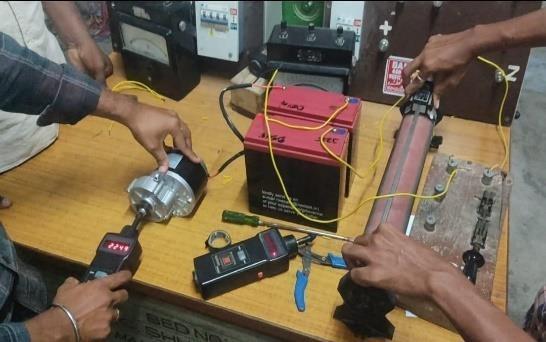
Thedesignanddevelopmentofanaffordable,eco-friendlyebicycle for urban mobility have yielded promising results. Theprototypesuccessfullyintegratesalightweightframe,an efficient brushless DC motor, and a lithium-ion battery, ensuring an optimal balance between performance and affordability.Testingrevealedthatthee-bicycleachievesa topspeedof25km/hwithabatteryrangeofapproximately 40 km per charge, making it suitable for daily urban commutes.Costanalysisindicatesthattheproposedmodel is significantly more affordable than existing market alternatives,makingitaccessibletoa widerdemographic. Testing and analysis of a PMDC (Permanent Magnet DC) motorinalow-coste-cycleiscrucialtoensurethemotor's efficiency, durability, and performance under various conditions.Theprocesstypicallybeginswithpowertesting, whereinputpower(voltageandcurrent)ismeasuredduring differentoperationalstages,suchasacceleration,cruising, anddeceleration.Thishelpsevaluateenergyconsumption andoverallefficiency.
The torque and speed performance are then assessed, testingthemotorundervariousloadstoensureitdelivers adequatepowerforhillclimbingandmaintainingspeed.The study highlights the potential of e-bicycles as a viable solution to urban transportation issues, offering a sustainablealternativetoconventionalvehicles.Overall,the projectsuccessfullymeetsitsobjectives,pavingthewayfor further research and development in affordable and ecofriendlyurbanmobilitysolutions.

5.CONCLUSION
Inconclusion,thelow-cost electric cyclepresents a viable solution for sustainable urban mobility, offering an affordable and eco-friendly alternative to traditional transportationmethods.
As urban areas face growing challenges like traffic congestion,airpollution,andtheenvironmentalimpactof fossil fuels, e-cycles provide an effective means to reduce carbon emissions and promote cleaner, healthier cities. Theiraffordabilitymakesthemaccessibletoabroaderrange of commuters, bridging the gap between cost and environmentalsustainability.E-cyclesareparticularlywellsuited for short-distance travel, common in cities, where their low-maintenance and energy-efficient design encourageswidespreadadoption.Byofferingasimple,lowcost solution for daily commuting, e-bikes can help ease congestion, reduce dependence on cars, and decrease harmful emissions. Additionally, their lightweight design andintegrationofelectricassistancewithpedalingreduce theeffortrequiredforurbancommutes,makingthemideal for a variety of users. To maximize the potential of lowcoste- cycles,itisessentialtoimproveurbaninfrastructure, expandcharging networks, and continue advancements in battery technology. These steps can increase the convenience and accessibility of e-cycles, helping them becomeakeyelementinmodernurbantransportsystems. Ascitiescontinuemovingtowardgreeneralternatives,the integration of low- cost e-bikes into daily commuting represents a critical step toward achieving a sustainable, zero-emission future. By providing a practical, affordable, and eco-friendly option, low-cost electric cycles are wellpositionedtotransformurbanmobilityforthebetter.
6.SUSTAINABLE DEVELOPMENT GOALS
SDG 3: Good Health and Well-being
A low-cost electric cycle promotes physical activity, contributing to better health and reducing the risk of
International Research Journal of Engineering and Technology (IRJET) e-ISSN: 2395-0056 p-ISSN: 2395-0072
Volume: 12 Issue: 03 | Mar 2025 www.irjet.net
lifestyle-related diseases. By encouraging cycling, it helps combat sedentary lifestyles and improves cardiovascular health.Additionally,electric cyclesreduceairpollution by decreasingrelianceonfossilfuel-poweredvehicles,leading toimprovedrespiratoryhealthinurbanareas.Cleanerair and increased physical activity together enhance overall well-being and quality of life for city dwellers. This aligns withthegoalofensuringhealthylivesandpromotingwellbeingforallatallages.
SDG 7: Affordable and Clean Energy
Electriccyclesarehighlyenergy-efficient,usinglessenergy perkilometercomparedtotraditionalvehicles.Theycanbe charged using renewable energy sources, supporting the transitiontoacleanerenergygrid.
By promoting the use of electric cycles, cities can reduce their dependence on fossil fuels, lower greenhouse gas emissions, and move towards more sustainable and affordable energy solutions. This supports the goal of ensuring access to affordable, reliable, sustainable, and modernenergyforall.
SDG
11:
Sustainable Cities and Communities
Electriccycleshelpreducetrafficcongestionandpollution, makingcitiesmorelivable.Theyprovideanaffordableand accessible mode of transport, improving mobility for all urban residents, including those with lower incomes. By integrating electric cycles into urban transport systems, citiescanenhancetheirsustainability,reducetheircarbon footprint, and create more inclusive and resilient communities. This supports the goal of making cities and humansettlementsinclusive,safe,resilient,andsustainable.
SDG 13: Climate Action
Byreducinggreenhousegasemissionsfromtransportation, electric cycles contribute significantly to climate change mitigation efforts. They support the development of sustainable urban transport systems that are resilient to climateimpacts.Promotingelectriccycleshelpscitiestake proactivestepstowardsreducingtheircarbonfootprintand addressing the urgent challenge of climate change. This supportsthegoaloftakingurgentactiontocombatclimate changeanditsimpacts.
7.REFERENCES
[1]Borgarello,L.,Galliera,E.,Avanzo,A.,Fagiano,A.,2015. Roller bench urban cycles identification for light 609 commercialvehiclesfuelconsumption.Ital.J.Appl.Stat.22.
[2] Shivnay,P.andR.S.Yadav,2021,DesignandAnalysisof ElectricBike.InternationalJournalofAdvancedResearchin Science,CommunicationandTechnology.
[3] L. Ballo, L. Meyer de Freitas, A. Meister, and K. W. Axhausen,“TheE-BikeCityasaradical3shifttowardzeroemission transport: Sustainable? Equitable? Desirable? [Manuscript 4 submitted for publication],” ETH Zurich, Zurich,2022.
[4] W.Steffen,W.Broadgate,L.Deutsch,O.Gaffney,andC. Ludwig,“Thetrajectoryofthe13Anthropocene:TheGreat Acceleration,”TheAnthropoceneReview,vol.2,no.1,pp. 81–1498,Apr.2015.
[5] B.Cox,C.L.Mutel,C.Bauer,A.MendozaBeltran,andD.P. vanVuuren,“Uncertainenvironmentalfootprintofcurrent andfuturebatteryelectricvehicles,”Environ.Sci.Technol., vol.52,no.8,pp.4989–4995,Apr.2018.
[6] T.Wang,T.-Q.Tang,H.-J.Huang,andX.Qu,“Theadverse impact of electric vehicles on traffic congestion in the morning commute,” Transportation Research Part C: Emerging Technologies,vol.125,p.103073,Apr.2021.
[7] Raut,Kiran,AshaShendge,JagdishChaudhari,andRavita Lamba. "Design of Low-Cost Hybrid Electric Bicycle." In InternationalConferenceonAdvancesinEnergyResearch, pp.501-511.Singapore:SpringerNatureSingapore,2023.
[8] J. Pucher and R. Buehler, “Introduction: Cycling to sustainability,” in Cycling for Sustainable Cities, R. Buehler andJ.Pucher,Eds.Cambridge:TheMITPress,2021