
International Research Journal of Engineering and Technology (IRJET) e-ISSN: 2395-0056
Volume: 13 Issue: 03 | Mar 2026 www.irjet.net p-ISSN: 2395-0072

International Research Journal of Engineering and Technology (IRJET) e-ISSN: 2395-0056
Volume: 13 Issue: 03 | Mar 2026 www.irjet.net p-ISSN: 2395-0072
Anto Mathew1 , Anjana P2 , Aparna A3 , Febin Jo Pious4
1 Dept. of Electrical Engineering, Rajiv Gandhi Institute of Technology Kottayam, Kerala, India
2 Dept. of Electrical Engineering, Rajiv Gandhi Institute of Technology Kottayam, Kerala, India
3 Dept. of Electrical Engineering, Rajiv Gandhi Institute of Technology Kottayam, Kerala, India
4Dept. of Electrical Engineering, Rajiv Gandhi Institute of Technology Kottayam, Kerala, India
Abstract -Water pollution caused by floating solid waste such as plastics and organic debris has become a major environmentalissueaffectingaquaticecosystems.Thispaper presents the design and development of a solar-powered aquatic waste collection system that efficiently removes floatingwastefromwaterbodieslikelakes,rivers,andcanals. The system operates using solar energy, making it environmentally friendly and cost-effective. It consists of a floating platform integrated with solar panels, a battery storage system, DC motors, a conveyor mechanism, and a wirelesscontrolsystembasedonESP32microcontrollers.The collected waste is transferred into a storage bin using a conveyor belt mechanism. The system can be operated remotely using a joystick-based control unit via ESP-NOW communication. The proposed system reduces human effort, ensures safe operation in polluted environments, and contributestosustainablewastemanagement.Theprototype demonstrates an effective and practical solution for maintaining clean water bodies.
Key Words: Solar Energy, Aquatic Pollution, Waste Collection System, ESP32, Conveyor System, Renewable Energy, Water Cleaning
Waterpollutionduetofloatingsolidwastehasbecomea significant environmental and engineering challenge, particularlyinurbanandsemi-urbanwaterbodiessuchas rivers,lakes,canals,anddrainagesystems.Thecontinuous accumulation of non-biodegradable materials, especially plastics, leads to severe ecological degradation, including reduction in dissolved oxygen (DO) levels, obstruction of sunlightpenetration,anddisruptionofaquaticfoodchains. Conventional waste removal techniques primarily rely on manualcleaningorfuel-poweredmechanicalsystems,which are inefficient, labor-intensive, and associated with high operational costs and environmental risks. Furthermore, existing large-scale aquatic cleaning systems are often unsuitable for confined or shallow water bodies due to limitations in maneuverability, scalability, and energy efficiency.Thesechallengesnecessitatethedevelopmentof compact,energy-efficient,andautomatedsolutionsforrealtimeaquaticwastemanagement.
Inthiscontext,theproposedsolar-poweredaquaticwaste collector integrates renewable energy systems with embedded control and electromechanical mechanisms to achieve efficient waste removal. The system utilizes a photovoltaic(PV)modulecoupledwithachargecontroller and battery storage unit to ensure uninterrupted power supply under varying environmental conditions. An embeddedmicrocontroller(ESP32)isemployedforsystem control, enabling wireless communication and real-time navigation using a joystick interface via low-latency protocols. The propulsion system, driven by DC/BLDC motors,facilitatesmovementacrossthewatersurface,while aconveyor-basedcollectionmechanismensurescontinuous removalandtransferoffloatingdebrisintoastorageunit. The integration of power electronics components such as DC-DC converters and motor drivers enhances energy optimizationandsystemreliability.Thisapproachoffersa sustainable, low-cost, and scalable solution for aquatic pollution control, aligning with modern environmental engineering practices and smart water management systems.Thenoveltyofthisworkliesintheintegrationof solar energy with a compact, low-cost conveyor-based aquaticcleaningsystemusingESP-NOWcommunication.
Recentresearchonaquaticwastemanagementfocuseson automatedsystemsforefficientremovaloffloatingdebris.S. S. et al. [1] proposed a microcontroller-based marine cleaningsystemintegratedwithsensorsandsolarenergyfor monitoring and waste collection. Although effective, the systemiscomplexandcostlyforsmall-scaleapplications. A. Akib et al. [2] developed a floating waste collector robot usingDCmotorsandaconveyormechanismcontrolledvia Bluetooth. Similarly, M. R. Ruman et al. [3] introduced an automatedsurfacecleaningsystemwithremotecontroland GSM-based monitoring. These systems improve efficiency butrelyonconventionalbatterypower,limitingcontinuous operation.S.H.Y.S.Abdullahetal.[4]designedaportable trashcollectorboatforsmallwaterbodieswithaconveyor mechanismandremotenavigation.However,theabsenceof renewable energy integration increases operational cost. Basedonthesestudies,thereisa needfora cost-effective andenergy-efficientsystem.
International Research Journal of Engineering and Technology (IRJET) e-ISSN: 2395-0056
Volume: 13 Issue: 03 | Mar 2026 www.irjet.net p-ISSN: 2395-0072
The proposed solar-powered aquatic waste collection systemaddressesthisgapbyintegratingphotovoltaicenergy withwastecollectionmechanisms.
Theproposedsolar-poweredaquatictrashcollectorisan integratedelectromechanicalsystemdesignedforefficient removal of floating waste from water bodies using renewableenergy.Thesystemcomprisesafloatingplatform equippedwithaphotovoltaic(PV)module,chargecontroller, batterystorageunit,embeddedcontrolsystembasedonan ESP32 microcontroller, propulsion unit using DC/BLDC motors,andaconveyor-basedwastecollectionmechanism. Thesolarpanelconvertssolarenergyintoelectricalenergy, which is regulated and stored in the battery to ensure continuousoperation,whilepowerelectroniccomponents such as DC-DC converters and motor drivers provide efficientpowermanagementandsystemstability.TheESP32 microcontroller enables real-time control, navigation, and wirelesscommunicationusinglow-latencyprotocolssuchas ESP-NOW,allowingjoystick-basedremoteoperation.Asthe system moves across the water surface, the conveyor mechanism collects floating debris and transfers it into a storagecontainer.
The working of the solar-powered aquatic trash collector is based on the coordinated operation of power generation, energy storage, control, and mechanical subsystems,asillustratedintheblockdiagram(fig.1)
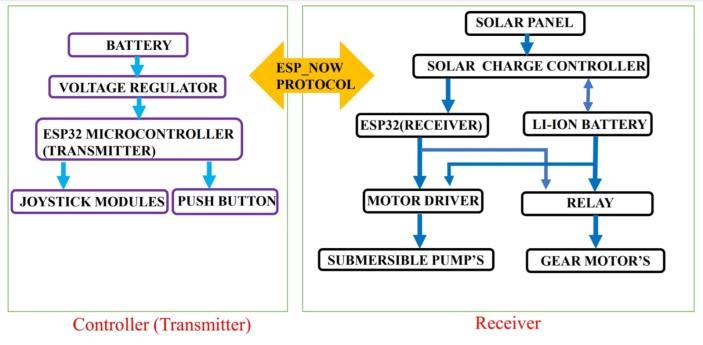
The photovoltaic (PV) panel converts incident solar radiation into electrical energy, which is regulated by a charge controller to maintain proper voltage levels and preventoverchargingordeepdischargeofthebattery.The regulatedenergyisstoredinarechargeablebattery,ensuring continuouspowersupplyevenduringlowsolarirradiance conditions.Thestoredelectricalenergyisthensuppliedto the embedded control unit, implemented using an ESP32 microcontroller, which acts as the central processing and control element of the system. The ESP32 receives input commandsfromajoystick-basedremotecontrollervialow-
latency wireless communication (ESP-NOW protocol), enabling real-time navigation and operation. Based on the control signals, the microcontroller generates appropriate controloutputstothemotordrivercircuits,whichamplify and regulate the signals to drive the propulsion motors (DC/BLDC)andtheconveyormotor.Thepropulsionsystem enablesdirectionalmovementofthefloatingplatformacross the water surface, while the conveyor mechanism continuouslycollectsfloatingdebrisandliftsitintoastorage bin.
Theapproximatepowerconsumptionofeachcomponentis givenbelow:
P total =0.5+1.2+7.2+3.6+1.0=13.5W
Thus, the total power requirement of the system is approximately:
P total ≈ 14 W
Solar Panel Selection:
Asolarpanelofrating15Wp(Watt-peak)isselected:
Pmax = 15 W
Assumingopen-circuitvoltage:
Voc = 22 V
Maximumpowerpointvoltage:
Vmp = 0.82×22=18 V
Maximumpowerpointcurrent:
Imp= P max / V mp = 15/18≈0.83 A
Energy Requirement:
Assumingoperationfor2hours/day
E required = 14 × 2 =28 Wh
Solar Energy Generation:
Assuming5hourssunlight/day:
E solar =15×5 =75 Wh
Considering20%losses:
E usable=0.8 × 75=60Wh
International Research Journal of Engineering and Technology (IRJET) e-ISSN: 2395-0056
Volume: 13 Issue: 03 | Mar 2026 www.irjet.net p-ISSN: 2395-0072
SolarPanel
SolarChargeController
10W,12V
12V,10A
ESP32 DevModule
Battery 12V,2600mah
GearMotor 9V,200rpm
BldcSubmersiblePump
QR30E,12V
JoystickModule Hw-504
MotorDriver L298N
Relay 2Channel
BuckConverter LM2596
-1:Components&Specification
Conclusion of Design: Eusable (60Wh)>E required(28Wh)
Thus,the15Wsolarpanelissufficientandmorereliable forthesystem.
Thetransmittersectionofthesystemisdesignedtoenable real-timewirelesscontroloftheaquatictrashcollectorusing anESP32microcontroller.Thecontrolinterfaceconsistsof twodedicatedjoystickmodulesandapush-buttonswitch.
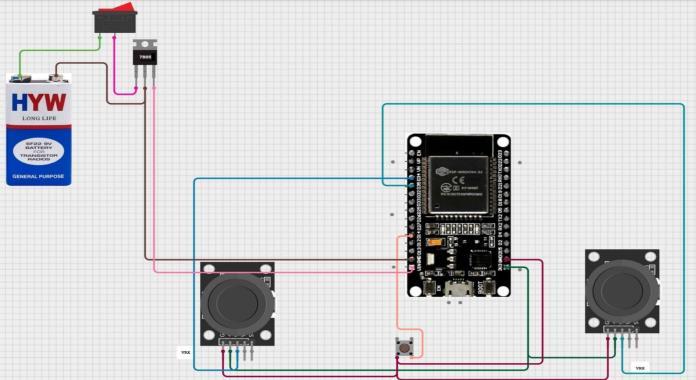
The joystick modules generate analog signals corresponding to user inputs, which are processed by the ESP32 through its built-in Analog-to-Digital Converter (ADC). These two joysticks are used to independently controlthespeedanddirectionofthepropulsionsystemby varying the input signals to the individual water pump motors, thereby enabling precise forward movement and directional control of the floating structure. In addition, a dedicated push-button switch is used to control the operationoftheconveyorbeltmechanism,allowingtheuser
to switch the waste collection system ON and OFF as required. The processed control signals are transmitted wirelessly to the receiver unit using the ESP-NOW communicationprotocol,ensuringlow-latencyandreliable datatransfer.
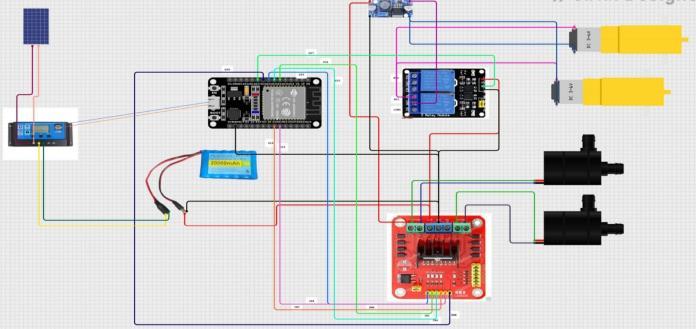
Inthereceivercircuit,thepropulsionsystemusingwater pumpmotorsiscontrolledthroughamotordrivermodule, whichregulatesthespeedanddirectionbyvaryingtheinput controlsignalsfromtheESP32microcontroller.Thisallows precise movement and maneuverability of the floating structure.Theconveyormechanismisoperatedusingagear motor, which is controlled via a relay module to enable simpleON/OFFswitchingbasedonreceivedcommands.A DC-DCbuckconverterisincorporatedinthesystemtostep downthe12Vbatterysupplytotherequiredvoltagelevel suitable for the gear motor and other low-voltage components,ensuringstableandefficientoperation.
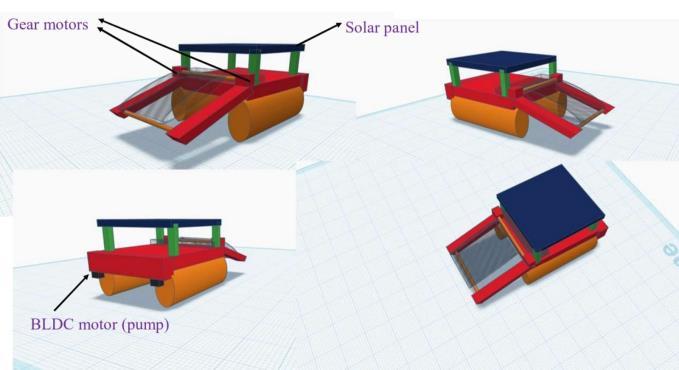
Thedevelopmentofthe3Dprototypemodelofthesolarpowered aquatic trash collector is carried out using Tinkercadasthedesignplatform.Themodelillustratesthe structural configuration and functional integration of the systemcomponentsinasimplifiedandvisualizedmanner. Thedesignfocusesonthearrangementandplacementofkey elementssuchasthephotovoltaic(PV)panel,floatingbody frame,propulsionsystem,andconveyorbeltmechanismfor waste collection. This virtual prototype aids in understandingthespatialalignment,componentinteraction, and overall system architecture before physical implementation. The 3D representation of the proposed modelisdepictedinthefollowingfigures.
Volume: 13 Issue: 03 | Mar 2026 www.irjet.net p-ISSN: 2395-0072
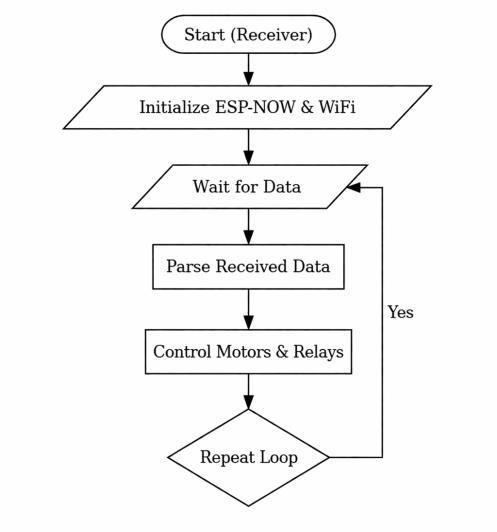
The software architecture of the system is based on embeddedprogrammingusingtheESP32microcontrollers, incorporating the ESP-NOW communication protocol for efficientwirelessdatatransmissionbetweenthetransmitter andreceiverunits.ESP-NOWisalow-latency,peer-to-peer communicationprotocolthatoperatesusingthebuilt-inWiFi hardware of the ESP32, offering advantages such as reduced power consumption, faster data transfer, and extendedcommunicationrangecomparedtoconventional Bluetooth-basedsystems.Thecommunicationbetweenthe twoESP32modulesisestablishedusingtheiruniqueMAC addresses, eliminating the need for a traditional network infrastructure. Both ESP32 units are programmed in embeddedCtoensurereal-timecontrolandefficientsystem operation.
In the transmitter unit, the program is designed to read analoginputsfromthejoystickmodulesandadigitalinput from a push-button switch. The joystick inputs correspondingtotheXandYaxesareprocessedthroughthe ADCchannelsoftheESP32andmappedintobinarycontrol signals (1 or 0) based on predefined threshold values, enablingdirectionalcontrolofthesystem.Thepush-button input is used to toggle the operation of the conveyor mechanismbetweenONandOFFstates.Theprocesseddata isstructuredintoadefineddatapacket(structmessage)and transmitted to the receiver ESP32 using the ESP-NOW protocol. A callback function is implemented to confirm successful data transmission, with an LED indicator providing visual feedback of the communication status. Small programmed delays are included to regulate the transmissionfrequencyandensurestablecommunication.
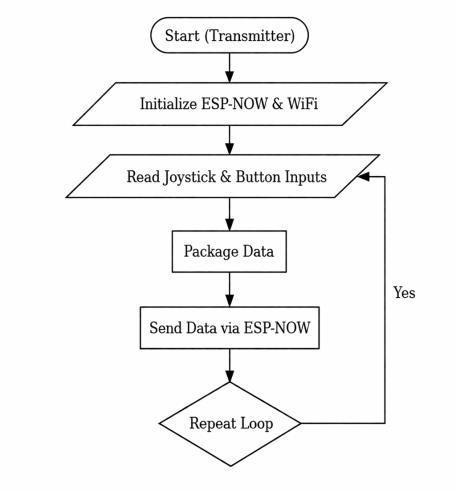
On the receiver side, the ESP32 is configured to operate usingtheESP-NOWprotocol,enablingittoreceivestructured datatransmittedfromthetransmitterunit.Thereceiveddata packetcontainsjoystickpositionvaluesandthepush-button state,whichareprocessedthroughacallbackfunctionupon successful reception. The callback function updates the corresponding global variables representing joystick movements and button status. Based on these inputs, the embeddedprogramgeneratesappropriatecontrolsignalsfor themotordriverandrelaymodules.Thepropulsionmotors are controlled according to the joystick inputs, where the systemremainsinastationarystatewhenthejoystickisin theneutralpositionandmovesindifferentdirectionsbased onvaryinginputcombinations.Theconveyormechanismis controlledusingthepush-buttoninput;whenactivated,the motor is driven using a Pulse Width Modulation (PWM) signaltoregulateitsoperation.Thisensuresefficientcontrol of both movement and waste collection mechanisms. The overall logic of the embedded programming for both transmitter and receiver ESP32 units is illustrated using a flowchart,asshowninthecorrespondingfigures.
International Research Journal of Engineering and Technology (IRJET) e-ISSN: 2395-0056
Volume: 13 Issue: 03 | Mar 2026 www.irjet.net p-ISSN: 2395-0072
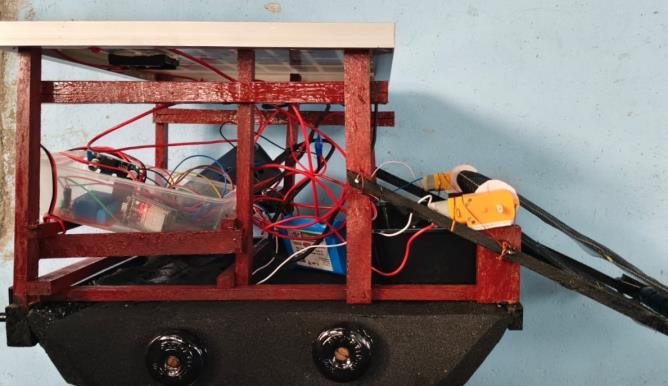
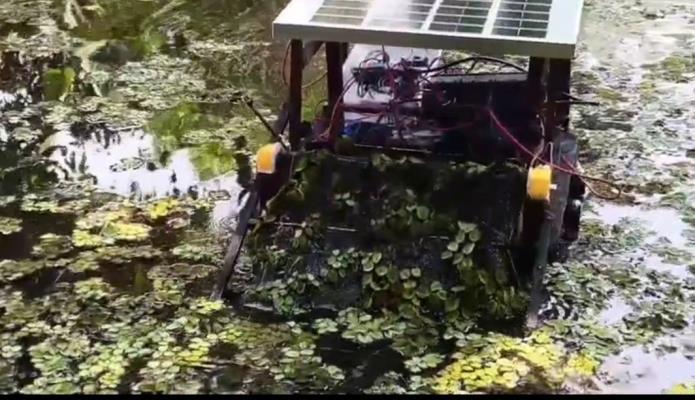
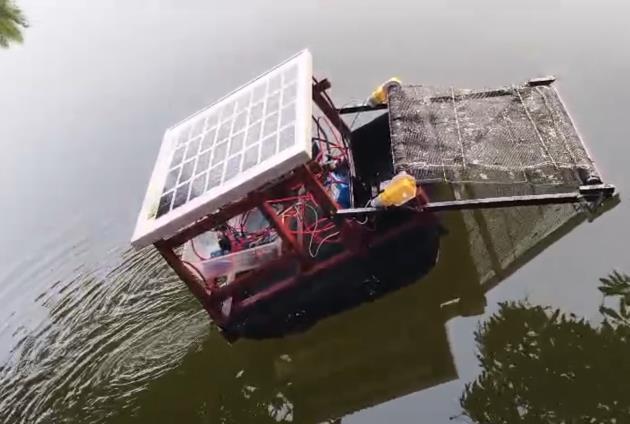
Afullyfunctionalprototypeofthesolar-poweredaquatic trashcollectorwassuccessfullydevelopedandimplemented, integratingkeysubsystemsincludingthephotovoltaic(PV) module,mechanicalfloatingframework,propulsionunit,and conveyor-basedwastecollectionmechanism.Theprototype demonstrates effective coordination between electrical, mechanical,andcontrolcomponents,validatingthefeasibility oftheproposeddesignforreal-timeaquaticwasteremoval.
The developed prototype demonstrated optimum and comparatively robust performance within its design constraints,effectivelycollectingfloatingwasteduringfield testing in a controlled aquatic environment. The system exhibitedstableoperation,reliablenavigation,andefficient wastecollection,validatingthepracticalityandeffectiveness oftheproposeddesign.
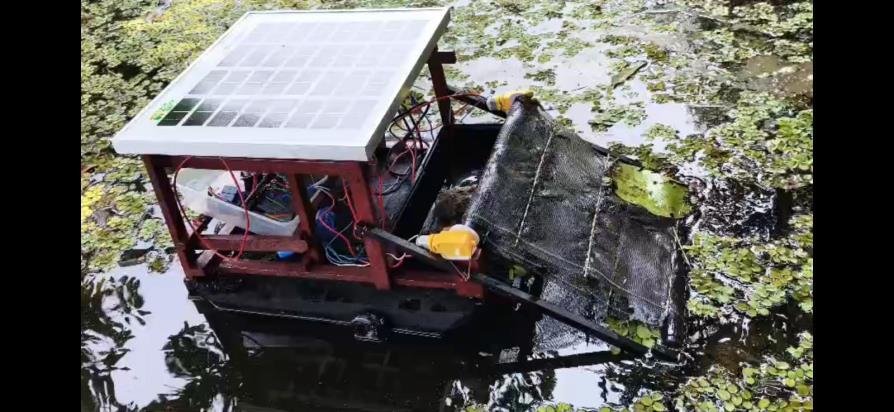
Themechanicalframeoftheproposedsystemisfabricated using rigid polyurethane foam, repurposed from an old refrigerator, due to its lightweight nature, buoyancy, and water-resistant properties, making it suitable for floating applications. To enhance structural strength and stability, small square unfinished wooden rods are used as a supporting framework, providing rigidity and proper alignmentofcomponents.Theconveyorbeltmechanismis constructedusingamosquitomeshnet,whichislightweight, flexible,andcapableofeffectivelycapturingfloating waste whileallowingwatertopassthrough.
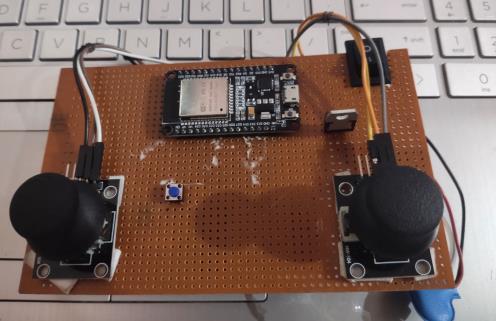
Aremoteunitwasdevelopedtomanagethenavigationand operationoftheprototype,consistingofjoystickmodules,a push-buttonswitch,anESP32microcontroller,andabattery power supply. The joystick modules enable directional control of the propulsionsystem, while the push buttonis used to operate the conveyor mechanism. All components were assembled on a perforated PCB board to ensure compact arrangement, ease of handling, and reliable electricalconnections.
International Research Journal of Engineering and Technology (IRJET) e-ISSN: 2395-0056
Volume: 13 Issue: 03 | Mar 2026 www.irjet.net p-ISSN: 2395-0072
The solar-powered aquatic waste collection system developed in this work demonstrates an effective and sustainablesolutionforremovingfloatingwastefromwater bodies.Theintegrationofaphotovoltaic(PV)energysystem withembeddedcontrolusingESP32microcontrollersanda conveyor-based waste collection mechanism ensures efficient and environmentally friendly operation. The prototype successfully achieved real-time navigation and wastecollectionthroughawirelesscontrolsystembasedon theESP-NOWprotocol,providinglow-latencyandreliable communication.
Theexperimentalresultsconfirmthatthesystemperforms efficiently under controlled conditions, exhibiting stable operation, good manoeuvrability, and effective waste collection capability. The use of lightweight and low-cost materialsinthemechanicalstructurefurtherenhancesthe practicalityandaffordabilityofthesystem.Althoughcertain limitationsexist,suchasdependenceonsolarirradianceand reduced efficiency for heavier waste, the overall design provestobeaviableapproachforsmallandmedium-scale aquaticcleaningapplications.
In conclusion, the proposed system offers a cost-effective and environmentally friendly solution for aquatic waste management. With further improvements such as automation, sensor integration, and enhanced power management,thesystemcanbescaledandadaptedforrealworlddeploymentinvariouswaterbodies,contributingto cleanerandhealthieraquaticenvironments
[1] S.S.SandO.S,“Microcontroller-Basedsmartmarine saver,”in20215thInternationalConferenceon IntelligentComputingandControlSystems(ICICCS), pp.1873–1878,2021.
[2] A.Akib,F Tasnim,D.Biswas,M.B.Hashem,K.Rahman, A.Bhattacharjee,andS.A.Fattah,“Unmannedfloating wastecollectingrobot,”inTENCON2019–2019IEEE Region10Conference(TENCON),pp.2645–2650,2019.
[3] M.R.Ruman,M.Das,S.I.Mahmud,andS.KumarNath, “Automated marine surface trash cleaner,” in 2019 IEEE5thInternationalConferenceforConvergencein Technology(I2CT),pp.1–4,2019.
[4] M.A.A.M.A.S.H.Y.S.AbdullahandA.Endut,“Design andprototypedevelopmentofportabletrashcollector boat for small stream application,” in International Journal of Innovative Technology and Exploring Engineering(IJITEE),pp.1–4,2019.