
International Research Journal of Engineering and Technology (IRJET) e-ISSN: 2395-0056
Volume: 13 Issue: 04 | Apr 2026 www.irjet.net p-ISSN: 2395-0072

International Research Journal of Engineering and Technology (IRJET) e-ISSN: 2395-0056
Volume: 13 Issue: 04 | Apr 2026 www.irjet.net p-ISSN: 2395-0072
MR. KOPPUL SWAPNIL SHRINIWAS 1 , MR. KOKAL AMIT RAGHVENDRA2 , MR. LONDHE VISHAL JAYANT 3 , MR. SHAIKH GOUSPAK SAMEER 4 , MR. YEMUL VYANKATESH BHASKAR 5 , MR. B.S. Swami 6
1 MR. KOPPUL SWAPNIL SHRINIWAS (Diploma Student Mech. Engg. Dept.SPM Polytechnic Kumathe, Solapur)
2 MR. KOKAL AMIT RAGHVENDRA (Diploma Student Mech. Engg. Dept.SPM Polytechnic Kumathe, Solapur)
3 MR. LONDHE VISHAL JAYANT (Diploma Student Mech. Engg. Dept.SPM Polytechnic Kumathe, Solapur)
4 MR. SHAIKH GOUSPAK SAMEER (Diploma Student Mech. Engg. Dept.SPM Polytechnic Kumathe, Solapur)
5 MR. YEMUL VYANKATESH BHASKAR (Diploma Student Mech. Engg. Dept.SPM Polytechnic Kumathe, Solapur)
6 Mr. B.S. Swami (Lecturer in Mechanical Engineering Department, SPM Polytechnic, Kumathe, Solapur)
Abstract - The plate cam (disc cam) is a vital mechanical component used to convert rotary motion into controlled reciprocating or oscillatory motion. This research focuses on the design, development, and performance evaluation of a plate cam fabricated using 3D printing technology for application in a seed sowing machine. The cam profile was designed using CAD software based on motion requirements such as lift, dwell, and return periods. The model was fabricated usingtheFusedDepositionModeling(FDM)process with PLA material.
The developed cam mechanism was integrated with a seed metering system to achieve controlled seed dispensing. Experimentalresultsindicatesmoothmotiontransfer,uniform seed spacing, andsatisfactorydimensionalaccuracy.Thestudy demonstrates that 3D printing offers a cost-effective, rapid prototyping solution for mechanical components. However, limitations in material strength restrict its use to low-load applications. This work highlights the potential of additive manufacturing in agricultural machinery and mechanical design education.
Key Words: Plate Cam, 3D Printing (FDM), Seed Sowing Machine, Cam and Follower Mechanism, PLA Material
1.INTRODUCTION
1.1 Overview of Plate Cam
Aplatecamisarotatingmechanicalelementusedtoconvert rotarymotionintoreciprocatingoroscillatingmotion.Itis widely used in machines requiring precise timing and motioncontrol.
1.2 Role of Cam in Mechanical Systems
Camscontrolmotionbasedontheirprofileandareusedin:
i.Internalcombustionengines
ii.Textilemachinery
iii.Packagingsystems
iv.Agriculturalequipment
They can generate: Uniform velocity motion, Simple harmonicmotionandAcceleratedmotion
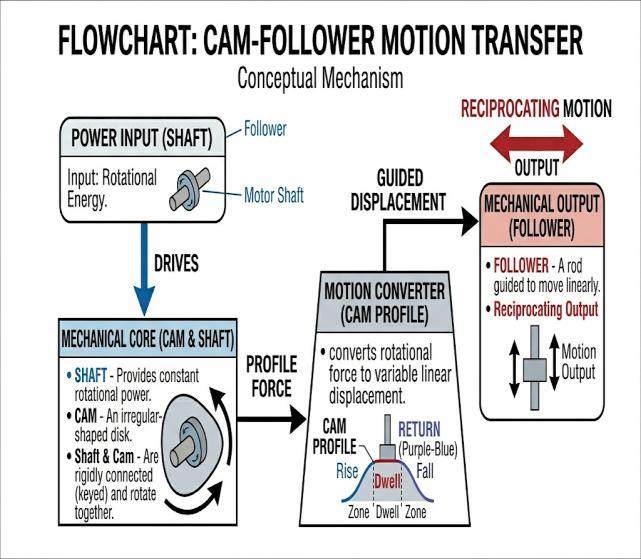
1.3 Cam and Follower Mechanism
Cam Rotation → Follower Movement → Output Motion
i.Camrotatescontinuously
ii.Followermovesbasedoncamprofile
iii.Motionistransferredtoworkingmechanism
1.4 Application in Seed Sowing Machine
In seed sowing machines, precise seed placement is required.Thecamhelps:
i.Controlseeddispensing
ii.Maintainuniformspacing
iii.Reduceseedwastage
1.5 Introduction to 3D Printing
3Dprinting(AdditiveManufacturing)buildsobjectslayerby layerfromadigitalmodel.
International Research Journal of Engineering and Technology (IRJET) e-ISSN: 2395-0056
Volume: 13 Issue: 04 | Apr 2026 www.irjet.net p-ISSN: 2395-0072
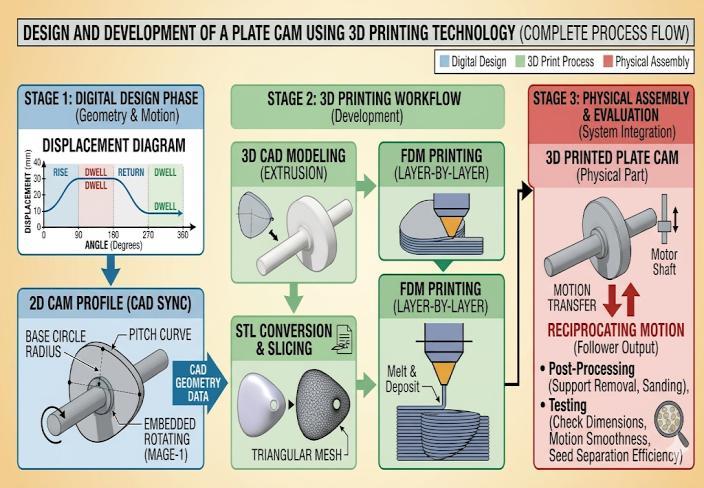
Steps:
i.CADmodeling
ii.STLconversion
iii.Slicing
iv.Printing
1.6 Advantages of 3D Printing
i.Lowcost
ii.Rapidprototyping
iii.Easydesignmodification
iv.Minimalmaterialwastage
1.7 Design Parameters of Cam
i.BaseCircle
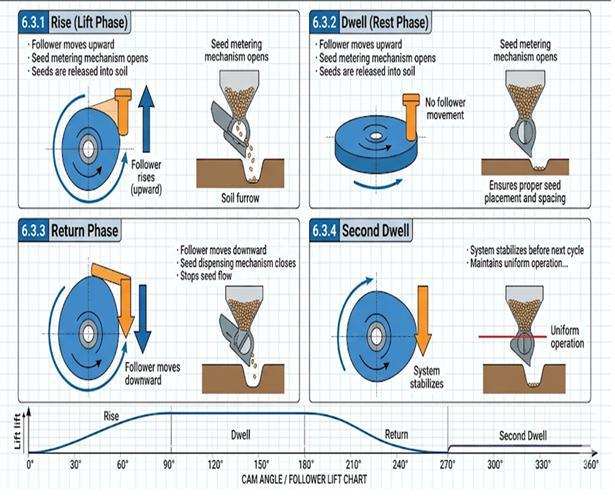
ii.Lift(Stroke)
iii.DwellPeriod
iv.RiseandReturn
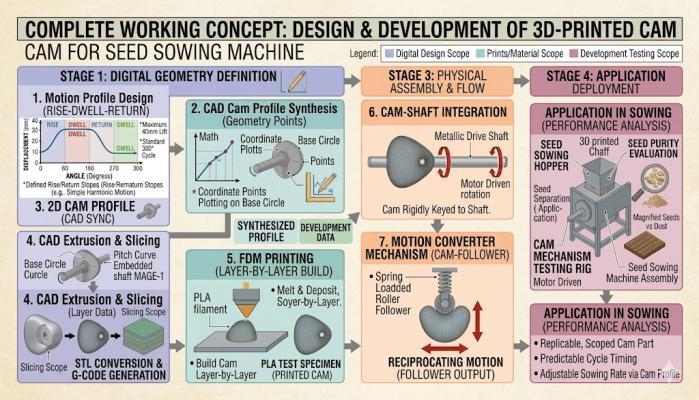
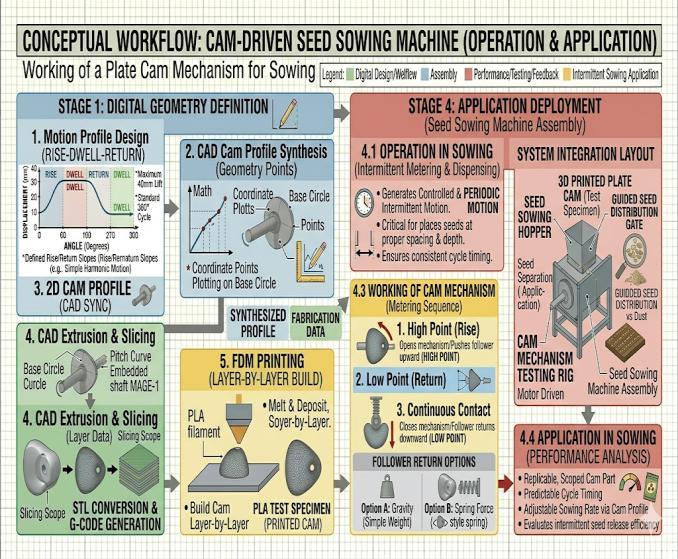
Themethodologyforthedesignanddevelopmentofthe plate cam begins with the identification of the functional requirements of the seed sowing machine. The system requirescontrolledandintermittentmotiontoensureproper seeddispensing,uniformspacing,andminimalseeddamage. To meet these requirements, a plate cam (disc cam) mechanism was selected due to its simplicity, compact design,andabilitytoproducepreciseandrepeatablemotion.
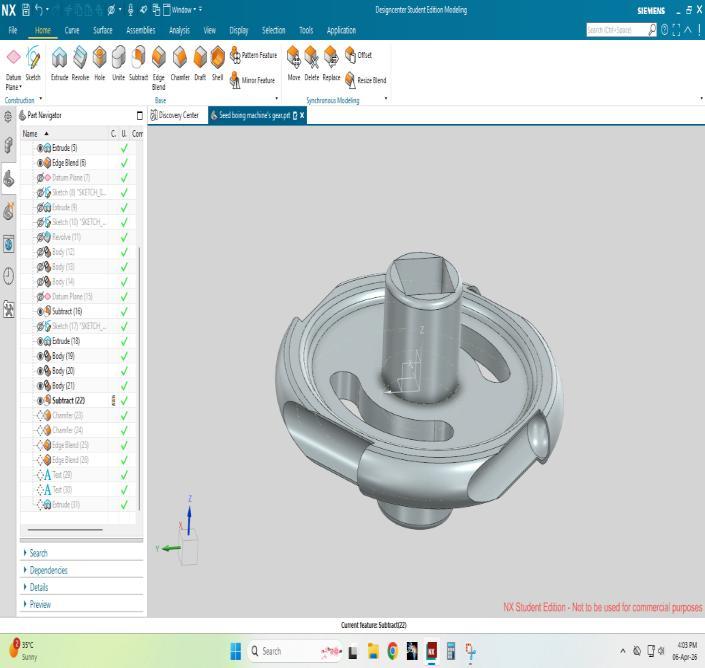
After selecting the cam type, a suitable follower mechanism,suchasarollerorflat-facedfollower,waschosen to ensure smooth contact and reduce wear. The next step involveddeterminingkeydesignparameters,includingbase circleradius,lift(stroke),andmotiontiming(rise,dwell,and returnperiods).Theseparametersweredefinedbasedonthe displacementrequirementsoftheseedmeteringmechanism. Toachievesmoothmotionandminimizevibration,simple harmonicmotion(SHM)wasselectedasthemotionlaw.The camprofilewasthendevelopedusinggraphicalmethodsby dividing the cam rotation into equal angular intervals and plottingthecorrespondingfollowerdisplacement.Thepoints werejoinedsmoothlytogenerateanaccuratecamprofile. ThedesignedprofilewasmodeledusingCATIAsoftware, wherea2Dsketchwasfirstcreatedandthenconvertedintoa 3D model through extrusion. The finalized model was exportedinSTLformatforfurtherprocessingin3Dprinting.
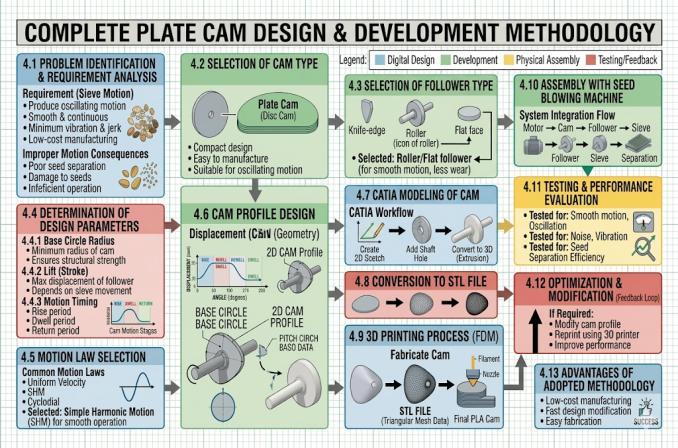
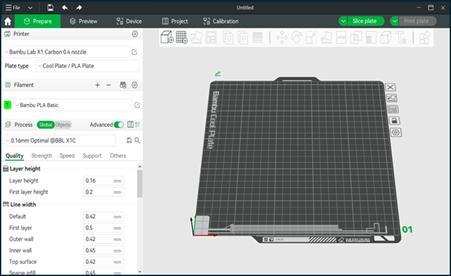
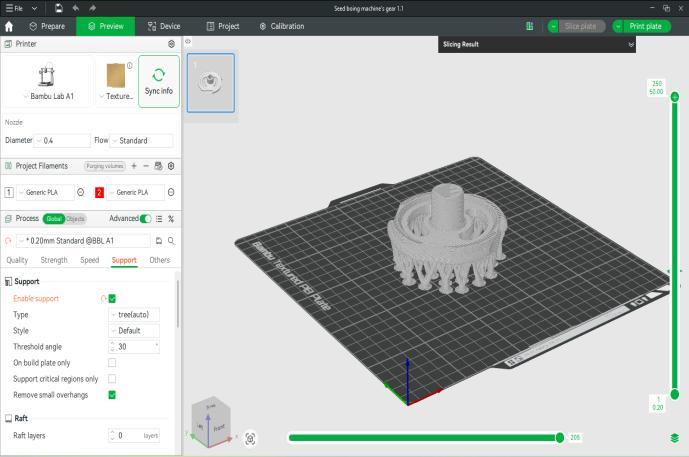
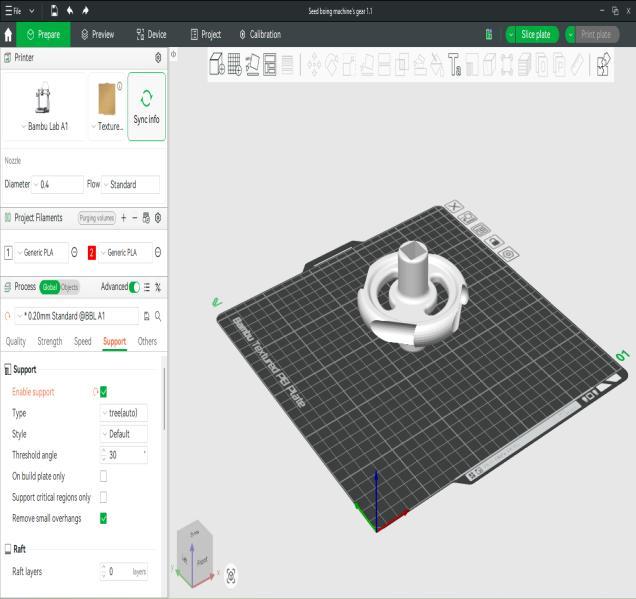
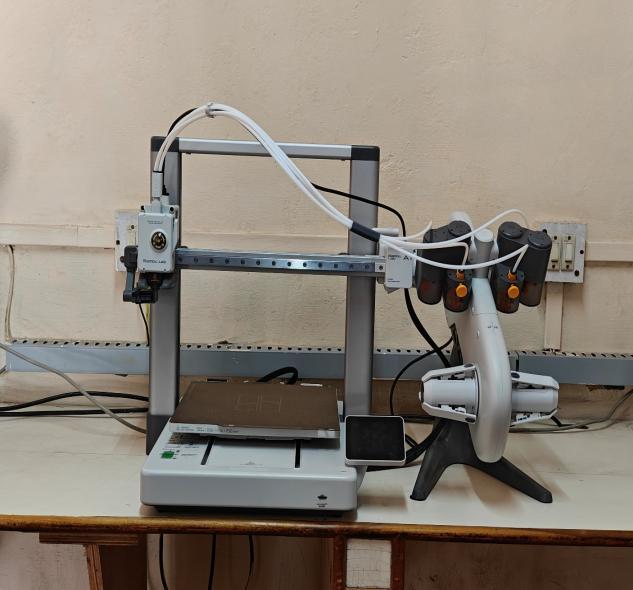
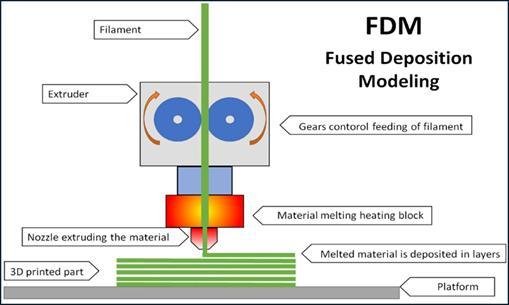
ThefabricationofthecamwascarriedoutusingtheFused Deposition Modeling (FDM) process, a widely used 3D printingtechnique.PLA(PolylacticAcid)wasselectedasthe materialduetoitslowcost,easeofprinting,andsufficient strengthforprototypedevelopment.TheSTLfileofthecam wasimportedintoslicingsoftware,whereparameterssuch aslayerheight,printingspeed,temperature,andinfilldensity wereset.Thecamwasthenprintedlayerbylayerusinga3D printer.
International Research Journal of Engineering and Technology (IRJET) e-ISSN: 2395-0056
Volume: 13 Issue: 04 | Apr 2026 www.irjet.net p-ISSN: 2395-0072
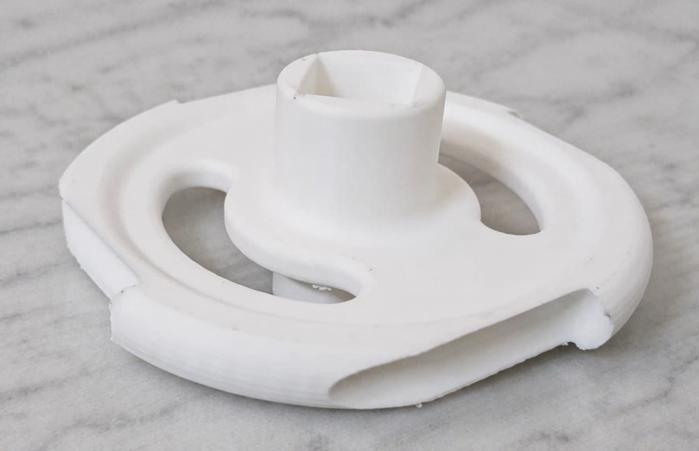
Afterprinting,post-processingoperationssuchasremoval of support material and minor surface finishing were performed to improve dimensional accuracy and surface quality.Thefabricatedcamwasthenmountedonashaftand assembledwiththefollowermechanism.Thisassemblywas integratedintoaseedsowingsetuptoevaluateitsfunctional performance.
The system was tested under working conditions to analyzeparameterssuchassmoothnessofmotion,vibration, noise,andaccuracyofseeddispensing.Thecammechanism successfully converted rotary motion into controlled reciprocating motion, ensuring uniform seed placement. Basedontheobservations,minormodificationsweremade to improve performance. This iterative process helped in optimizingthedesignandachievingreliableoperationofthe system.
3. RESULTS AND APPLICATIONS
3.1 Results
(a) Fabrication Results
i.Accurateshapeobtained
ii.Goodsurfacefinish
iii.Properalignment (b) Functional Performance
i.Smoothfollowermotion
ii.Nojerksobserved
iii.Effectivemotiontransfer
3.1.1 Working Concept
Motor → Cam → Follower → Seed Metering → Seed Placement
3.1.2 Seed Sowing Performance
(a)Uniformseedspacing (b)Controlleddispensing (c)Improvedefficiency
3.1.3-Dimensional Accuracy
3.2 Applications
(a) Agricultural
Seedsowingmachines,Grainsortingsystems (b) Mechanical Systems
Enginevalvemechanisms,Packagingmachines (c) Automation
Conveyorsystems,Indexingmechanisms (d) Educational Labexperiments,Demonstrationmodels
3.2.1 Advantages
i.Lowcost
ii.Lightweight
iii.Easymodification
3.2.2 Limitations
i.LowstrengthofPLA
ii.Wearovertime
iii.Notforheavyloads
International Research Journal of Engineering and Technology (IRJET) e-ISSN: 2395-0056
Volume: 13 Issue: 04 | Apr 2026 www.irjet.net p-ISSN: 2395-0072
International Research Journal of Engineering and Technology (IRJET) e-ISSN: 2395-0056
Volume: 13 Issue: 04 | Apr 2026 www.irjet.net p-ISSN: 2395-0072
4.
The study successfully demonstrates the design and developmentof a plate camusing 3Dprintingtechnology. Thecameffectivelyconvertsrotarymotionintocontrolled intermittentmotionrequiredforseedsowingapplications. The system exhibited smooth operation, accurate seed placement,andgoodfunctionalperformance.
TheuseofPLAmaterialandFDMtechnologyprovedtobe economical and efficient for prototype development. However,limitationsinstrengthandwearresistancerestrict itsusetolight-loadapplications.Overall,theintegrationof cam mechanisms with additive manufacturing offers a promisingapproachforlow-costagriculturalsolutionsand educationalpurposes.
[1] Shigley, J. E., & Uicker, J. J., Theory of Machines and Mechanisms,McGraw-Hill.
[2] Rattan, S. S., Theory of Machines, McGraw-Hill Education.
[3] Bhandari,V.B., Design of Machine Elements,McGrawHill.
[4] Khedkar,M.K.,CAD-BasedCamDesignStudies.
[5] Wang,L.,CamProfileOptimizationTechniques.
[6] Popescu, A., Comparison of FDM and CNC Manufacturing.
[7] Kumar,S.,Studyon3DPrintingParameters.
[8] Smith,J.,BiomedicalApplicationsofCamMechanisms.
[9] Brown, R., CAD/CAM Integration with Additive Manufacturing.
[10] Singh,P.,PerformanceAnalysisofPLAComponents.
[11] ASTMStandardsforPLAMaterials.
[12] ISOStandardsforMechanicalDesign.
[13] Wong,K.V., Additive Manufacturing Review,2012.
[14] Patil,R., Economical 3D Printer Using FDM,2017.M. Young,TheTechnicalWriter’sHandbook.MillValley, CA:UniversityScience,1989.
[15] R. Nicole, “Title of paper with only first word capitalized,”J.NameStand.Abbrev.,inpress.