
International Research Journal of Engineering and Technology (IRJET) e-ISSN: 2395-0056
Volume: 13 Issue: 04 | Apr 2026 www.irjet.net p-ISSN: 2395-0072

International Research Journal of Engineering and Technology (IRJET) e-ISSN: 2395-0056
Volume: 13 Issue: 04 | Apr 2026 www.irjet.net p-ISSN: 2395-0072
Kunal Nachanekar 1 , Shubham Pal2 , Sanjana Chaube3, Prof. Kashif Sheikh4
1,2,3, Diploma in Computer Engineering, Thakur Polytechnic, Mumbai, India
4 Professor, Department of Computer Engineering, Thakur Polytechnic, Mumbai, India
Abstract - Abstract Educational institutions frequently host workshops, seminars, cultural festivals, sporting events, hackathons, and technical activities. Manuallyorganizingtheseeventsusingspreadsheets,notice boards, or paper forms often leads to inefficiencies such as registration errors, redundant data, communication breakdowns,anddifficultyintrackingparticipationrecords. This paper presents the design and development of a CollegeEventManagementSystem,acentralizedweb-based platform intended to streamline the planning and administration of college events. The system provides an integrated interface for both administrators and students. Administrators can manage participant registrations, create events, update schedules, and monitor eventactivity, while students can browse available events, view event details, and register online. The system ensures proper storage of event-related data, improves event coordination, and reduces administrative workload. By automating the registration and management process, the platform enhances efficiency, transparency, and accessibility for both organizers and participants. Advanced features such as mobile applications, automated certificate generation, QRbased attendance, and payment gateway integration can furtherexpandthesystem.
Index Terms Django, College Event Management System, Web Application, Event Registration, Automation
College events greatly improve collaboration, skill development, and student engagement [1]. Activities such as technical workshops, seminars, hackathons, sporting events, cultural festivals, and guest lectures help students gainpracticalexperiencebeyondtheclassroom[4] However, successful planning of such events requires effective coordination among administrators, organizers, and participants [1]. In many educational institutions, event management is still performed using conventional methods such as spreadsheets, printed forms, and informal communication channels like notice boards [1] These methods often make it difficult to manage a large number of participants, maintain accurate records, and providetimelyupdatestostudents[7].
Additionally, manual systems result in issues such as
duplicate registrations, missing participantdata, and poor communication between organizers and participants [5]. Thesechallengesbecomeincreasinglydifficulttohandleas the number of events and participants rises [5]. To solve these problems, the College Event Management System was developed as a centralized web platform that automateseventmanagementtasks[4].Thesystemallows administrators to efficiently manage event schedules, track registrations, and publish event details, while students can browse upcoming events and register online without relying on manual paperwork [3]. The proposed system offers a structured and efficient method for handling college events, reduces manual effort, and improves the overall experience for both administrators andstudents[7]
Many colleges still use manual or semi-digital methods to manage extracurricular and academic activities [7] Event announcements are often made through posters, classroom notices, or social media groups, while student registrations are collected through handwritten forms or simpleonlineforms[3]
Thesemethodsleadtoseveraloperationaldifficulties:
1)There is no single platform where students can view allavailableevents.
2)It is difficult to maintain correct records of registered participants.
3)Manual data processing leads to incomplete or duplicateregistrations.
4)Communication between participants and event organizersislimited.
5) Managing event schedules and participant lists increasesadministrativeworkload.
6)Producing reports on participation and event performanceisdifficult.
Because of these difficulties, event organizers often spend more time handling registration information than concentrating on planning and executing the event itself. Therefore, a centralized automated system is required to streamline event management, ensure proper data storage, and improve communication between administratorsandstudents[4]
International Research Journal of Engineering and Technology (IRJET) e-ISSN: 2395-0056
Volume: 13 Issue: 04 | Apr 2026 www.irjet.net p-ISSN: 2395-0072
TheprimarygoalofthisprojectistocreateaCollegeEvent Management System that provides a centralized platform foreffectivelyplanningandmanagingcollegeevents[7].
Thespecificobjectivesareasfollows:
To create an online platform for publishing and managingcollegeevents.
To allow administrators to create, update, and delete eventdetails.
To enable students to view event details and register online.
Tomaintainpreciserecordsofeventregistrations.
To reduce the amount of manual paperwork required foreventplanning.
To improve communication between students and eventorganizers.
To provide secure system operation through rolebasedaccesscontrol.
To simplify event participation management and monitoring.
To simplify the process of acquiring, managing, and trackingeventsponsors.
To implement a feedback system for evaluating event performanceandenhancinguserexperience
Several researchers have explored digital solutions for event management in educational institutions [7]. Earlier systems mainly focused on online registration and event publishing, which improved accessibility but often lacked centralized participant tracking and real-time communication [3]. Some web- based event management systems successfully reduced paper- work and simplified record keeping, but many of them pro- vided limited administrative control and weak user interaction [3]. Recent studies on academic automation emphasize the useofwebframeworks,database-drivendesign,androlebased authentication for building reliable management platforms[5].Django,inparticular,hasgainedimportance because of its secure authentication support, modular structure,andrapiddevelopmentcapabilities [2].Existing research also highlights the importance of centralized data management for improving transparency, participation monitoring, and communication between stakeholders[6].
Despitethesedevelopments,manyavailablesolutionsstill suffer from limitations such as incomplete workflow integration, poor scalability, or lack of user-friendly interfaces.Theproposedsystemaddressestheseissuesby offering a centralized Django-based platform that integrates event creation, registration, participant tracking,andcommunicationinasingleapplication[3]
The proposed system offers an integrated platform that connects students and event planners through a centralized application [7]. The entire event lifecycle, including event creation, registration, monitoring, and communication,isintendedtobeautomated[3]
Theprimaryfeaturesofthesysteminclude:
5.1 Organizing and Managing Events
Administrators can create new events by entering event details such as event name, date, venue, description, and organizer information. They can also update or remove eventswheneverrequired.
5.2 Browsing Student Events
Students can log into the system and view all available events.Eventdetailsaredisplayedclearlysothatstudents canunderstandthepurposeandscheduleofeachevent.
5.3 Online Registration for Events
Students can directly register for events through the platform. The system records every registration and prevents duplicateentries.
5.4 Management of Participants
Administrators can access the list of students who have registered for each event. This helps organizers manage participationeffectivelyandprepareresourcesinadvance.
5.5 Updates and Notifications
The system enables event planners to notify students about schedule changes, venue updates, or important announcements.
5.6 Record Maintenance
All event data and registration records are stored in a structureddatabase,makingretrievalandanalysissimple.
5.7 Sponsorship Management
The system includes a feature to manage and maintain sponsordetailsefficiently.Ithelpsorganizerskeepproper records of sponsors and improves coordination related to eventfunding.
5.8 Floating Chatbot Integration
A chatbot is integrated into the system to assist users in real time. It helps in answering queries, guiding navigation,andimprovingoveralluserexperience
5.9 SMTP Email Notification System
The system sends automated email notifications for registrations, confirmations, and updates. This ensures clear and timely communication between organizers and participants.
5.10 Feedback Management System (UGC-based)
The system provides a feedback module where students can share their opinions and experiences after attending events. It helpsincollecting structuredfeedbackbasedon UGC guidelines, allowing organizers to analyze responses andimprovefutureevents.
International Research Journal of Engineering and Technology (IRJET) e-ISSN: 2395-0056
Volume: 13 Issue: 04 | Apr 2026 www.irjet.net p-ISSN: 2395-0072
ThearchitectureoftheCollegeEventManagementSystem is designed to ensure smooth communication between users, stored data, and application logic. The system follows a layered architecture consisting of three primary components:
6.1 User Interface Layer
This layer represents the part of the system where users interactwiththeapplication.Throughwebpages,students and administrators can access the system and perform taskssuch asviewingevents,managingregistrations,and handlingeventrecords.
6.2 Application Processing Layer
This layer manages the core functions of the system. It processes user requests, verifies credentials, manages eventdata,andhandlesregistrationactivities.
6.3 Data Storage Layer
This layer stores all user, event, and registration-related data.Itensuresthatallevent-relatedinformationisstored securelyandcanberetrievedwheneverneeded. Theinteractionbetweentheselayersallowsthe systemto process requests efficiently while maintaining accurate records.
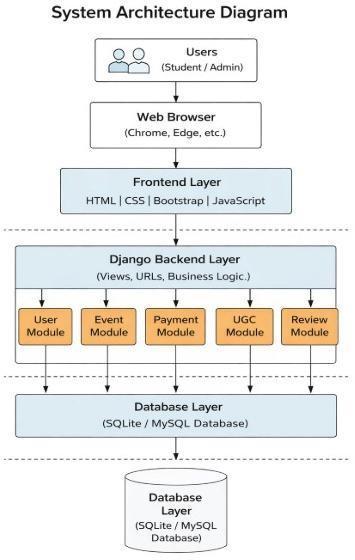
Fig-1 SystemArchitectureDiagramofCollege EventanagementSystem
Thedata flow oftheCollege EventManagementSystem is designedtoensuresmoothcommunicationbetweenusers, application logic, and stored data. Students and administrators interact with the system through the user interface layer. Their requests are forwarded to the application processing layer, which handles tasks such as authentication, event data management, and registration processing. The processed information is then stored in thedatabaselayer.
Thedataflowdiagramrepresentshowinformationmoves between these components to maintain consistency and reliabilit
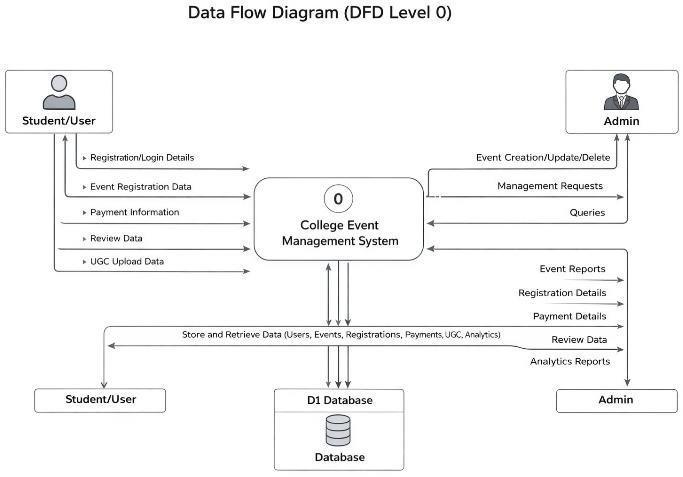
Fig-2 DataFlowDiagram(DFDLevel0)ofSystem
In this diagram, two main external entities are identified: Student/User and Admin. The student interacts with the system by providing registration and login details, event registration data, payment information, review submissions, and UGC uploads. The system processes this dataandstoresitinthecentraldatabase.
The Admin interacts with the system by sending requests relatedtoeventcreation,updates,anddeletion.Theadmin can also raise queries and manage system operations. In return,thesystemprovides outputssuchaseventreports, registration details, payment records, review data, and analyticsreports.
All the data processed within the system is stored and retrieved from a centralized database (D1), which maintains records of users, events, registrations,
International Research Journal of Engineering and Technology (IRJET) e-ISSN: 2395-0056
Volume: 13 Issue: 04 | Apr 2026 www.irjet.net p-ISSN: 2395-0072
Thedatabasestructureisdesignedtofacilitatetheeffective storage and retrieval of event-related data. The major entitiesinthesystemareUser,Event,andRegistration.
8.1 User Entity
The User entity stores information about individuals accessingthesystem.Itsattributesinclude:
UserID
Name
Password
Role
8.2 Event Entity
The Event entity stores details about college events. Its attributesinclude:
EventID
EventName
Date of Event
EventLocation
EventDescription
8.3 Registration Entity
TheRegistrationentitykeepstrackofstudent registrationsforevents.Itsattributesinclude:
RegistrationID
UserID
EventID
RegistrationDate
8.4 Payment Entity
The Payment entity stores details of event registration payments and helps in tracking transactions securely. It includes:
PaymentID
UserID
EventID
PaymentAmount
PaymentStatus
A student can register for more than one event, and each eventcan have more thanone student registered [5] The many- to- many relationship between User and Event is managedthroughtheRegistrationentity[5]
The operation of the system can be explained in the followingsteps:
1) Theuseropenstheeventmanagementwebsite.
2) Theuserlogsintothesystemorcreates anaccount.
3) Studentsbrowsethelistofupcomingevents.
| Page394 payments,UGCcontent,andanalytics. Thus, the DFD Level 0 provides a high-level overview of how the system functions, ensuring smooth data flow, propercommunicationbetweenusersandadministrators, andefficientdatamanagement.
4) A student selects an event and submits aregistration request.
5) Thesystemvalidatestheregistrationrequest.
6) If valid, the registration record is stored in the database.
7) Theuserreceivesaconfirmationmessage.
8) Adminlogsinandmanageseventsbycreating, updating,ordeletingthem.
9) Administrators use the dashboard to manage events andviewparticipantlists.
10) Adminviewsregistrations,payments,reviews,and analyticsreports.
The workflow ensures organized and efficient event management. The system workflow shows how users and administrators interact with the College Event Management System [1]. Users can register, log in, view events, register for events, make payments, and submit reviewsorUGCcontent.Thesystemprocesseseachaction andstoresthedatainthedatabase
On the other hand, the admin manages events, monitors registrations and payments, and views reports and analytics. All operations are handled through different modules, ensuring smooth functioning and efficient data management.
Additionally, the system enhances user interaction through features like automated email notifications and chatbotassistance,whichhelpinprovidingtimelyupdates and resolving user queries. These features improve communication, user experience, and overall system efficiency
The proposed system is developed using the Django frame-work, which provides a secure and scalable environmentforwebapplicationdevelopment.HTML,CSS, andBootstrapcanbeusedtodesignaresponsivefrontend interface [2], while SQLite or MySQL can be used as the backend database for storing user, event, and registration data[5].
The deployment of the system can be carried out on institutional servers or cloud platforms depending on the scale of usage. The modular design of Django allows easy maintenance, future updates, and extension of system features [2]. Security can be enhanced through authenticatedlogin,role-basedaccesscontrol,andproper database backup mechanisms. These implementation technologies make the system reliable, practical, and suitable for real-time deployment in educational institutions.
2026, IRJET | Impact Factor value: 8.315 | ISO 9001:2008
International Research Journal of Engineering and Technology (IRJET) e-ISSN: 2395-0056
Volume: 13 Issue: 04 | Apr 2026 www.irjet.net p-ISSN: 2395-0072
The proposed system offers several advantages over traditionalmanualmethods:
• Reducesmanualpaperworkandadministrativeeffort
• Preventsduplicateregistrationsanddatainconsistency
• Providescentralizedaccesstoeventinformation
• Improves communication between organizers and participants
• Enables accurate participant tracking and record management
• Simplifies report generation and administrative monitoring
• Enhances accessibility for students through online registration.
• Providescentralizedandeasyaccesstoeventdetails
• Enhances overall user experience through online registration
• Improves communication between organizers and participants
• Prevents duplicate registrations and ensures data accuracy
Automateseventmanagementprocessesforefficiency
Although the system provides major improvements over conventionalmethods,itstillhascertainlimitations:
The system requires internet connectivity for access andoperation.
Users with limited digital literacy may face difficulty inusingtheplatforminitially.
Large-scale deployment may require stronger server infrastructureandmaintenancesupport.
Data security and privacy risks may arise if not properlymanaged
System maintenance and updates are required regularly
Dependence on third-party services (e.g., payment gateway,emailservices)
Systemmayfaceperformanceissuesduringhighuser traffic
Thedevelopedsystemeffectivelyautomatestheprocessof organizingcollegeevents.Studentscanregisterforevents throughaneasy-to-useinterface,whileadministratorscan efficiently manage event details. The system provides a structured approach to handling event-related activities, reducing manual errors and improving overall coordination. In addition, the system ensures faster processing of registrations and better accessibility to event information through a centralized platform. It also enhances communication between students and
organizers by providing timely updates and notifications. The integration of features such as payment processing, feedback collection, and sponsorship management further improves the functionality of the system. Overall, the implementation of the system demonstrates improved efficiency, reliability, and user satisfaction, making it a practical solution for managing academic and extracurriculareventsineducationalinstitutions.
Furthermore,thesystemisscalableandcanbeadaptedto different institutional requirements. It provides a flexible framework that can support future enhancements and integration of additional features, making it suitable for long-termuse.
Thesystemprovidesseveraladvantages:
Reductioninmanualdocumentation
Fastereventregistrationprocess
Centralizedstorageofeventinformation
Accuratetrackingofparticipants
Better communication between students and organizers
Accuratetrackingofparticipants
Better communication between students and organizers
Moreeffectiveplanningofcollegeevents
The College Event Management System provides a practical solution for organizing college events through a centralized digital platform. By replacing conventional manual methods, the system simplifies event planning, registration,andparticipantsmanagement.
The system improves efficiency, reduce administrative burden, and ensures accurate record maintenance by automating event-related activities. It also enhances accessibility for students by making it easy to find and participate in events. The implementation demonstrates how digital solutions can significantly improve the organizationsifacademicandextra-curricularactivitiesin educationalinstitutions.
The developed system successfully automates the college event management process. Administrators can easily manageeventdetails,andstudentscanregisterforevents throughasimpleinterface.
Thefuturescopeofthesystemincludes:
Mobileapplicationsupport
Automatedcertificategeneration
QR-basedattendancetracking
Paymentgatewayintegration
Enhancedanalyticsandreporting
These improvements can further increase the usefulness andscalabilityofthesystem.
International Research Journal of Engineering and Technology (IRJET) e-ISSN: 2395-0056
Volume: 13 Issue: 04 | Apr 2026 www.irjet.net p-ISSN: 2395-0072
The authors would like to express their sincere gratitude to Prof. Kashif Sheikh for his valuable guidance, continuous support, and encouragement throughout the development of this project. His insights and suggestions played a crucial role in shaping the design and implementationofourproject.
[1] Author, “Online Event Management Systems in Educational Institutions,” International Journal of Computer Applications, vol. 10, no. 2, pp. 12–18, 2021.
[2] DjangoSoftwareFoundation,“DjangoDocumentation,” Available:https://docs.djangoproject.com/
[3] P.KumarandR.Singh,“Web-Based Registration and Management Platforms,” Journal of Web Engineering,vol.8,no.4,pp.45–52,2020.
[4] S. Sharma, “Automation in Academic Event Management,” in Proc. International Conference on SmartEducationSystems,2022.
[5] M. Patel, “Database Design for Event Registration Systems,” International Journal of Database Management,vol.15,no.1,pp.30–36,2021.
[6] R. Verma, “Role-Based Access Control in Web Applications,”
[7] Journal of Information Security, vol. 6, no. 3, pp. 67–74,2019.
[8] T. Mehta, “Digital Platforms for Student Engagement and Event Coordination,” International Journal of Educational Technology, vol. 12, no. 5, pp. 88–95, 2023.
International Research Journal of Engineering and Technology (IRJET) e-ISSN: 2395-0056
Volume: 13 Issue: 04 | Apr 2026 www.irjet.net p-ISSN: 2395-0072