
International Research Journal of Engineering and Technology (IRJET) e-ISSN: 2395-0056
Volume: 13 Issue: 04 | Apr 2026 www.irjet.net p-ISSN: 2395-0072
International Research Journal of Engineering and Technology (IRJET) e-ISSN: 2395-0056
Volume: 13 Issue: 04 | Apr 2026 www.irjet.net p-ISSN: 2395-0072
Vaishnavi Sanjay Chaubey 1 , Dr. Rais Khan2
1 M.Tech Scholar, School Of Computer Science And Engineering, Sandip University, Nashik, Maharashtra, India. 2 Guide, SOCSE, Sandip University, Nashik, Maharashtra, India.
Abstract - This project is aimed at developing a Web Portal to reduce the count of illiteracy. The Portal can be accessed by Municipal Corporation (MNC), Hospitals, SchoolsandallNGO’sworkingtofindthechildrenwhoare not taking Primary education. For all the stakeholder’s proper login is provided. The people who face financial crisesforcetheirchildrentoworkandearnmoney,inthe age when they should actually go to school and study. Becauseofsuchreasonsthecountofilliteracyisincreasing, hencetoreducethiscountandconvincetheparentsandfor raising the awareness regarding education this portal is helpful.ThisportalcanbeusedbySchoolstomaintain all admission records of student instead maintaining them manually and make that records accessible to Municipal Corporation.Also,hospitalwouldabletomaintainallbirth records on portal instead of maintaining them manually and access them whenever needed. NGOs would able to maintainallchildren’sbirthrecordwiththehelpofportal andwill able to stayconnectedwith themincoming days for their school admission. All birth entries made by HospitalandNGO’swillbecentralizedinBirthcertification Module (BCM) for make these records accessible to Municipal Corporation. For finding non-admitted children Municipal Corporation would consider the records from Birth certification Module for particular year and after 5 years Municipal Corporation would consider the records fromSchoolandcomparesbothoftheserecordsandfilter themaccordingtoareaandsendittorespectiveschooland NGO’s and school/NGO’s informs the parents of those studentswhoarenotadmitted.
Key Words: NGO (non-governmental organization), MNC (Municipal Corporation), BCM (Birth certification Module)
ThisprojectisaimedatdevelopingaWebPortaltoreduce the count of illiteracy. The Portal can be accessed by Municipal Corporation (MNC), Hospitals, Schools and all NGO’sworkingforfindingthechildrenwhoarenottaking Primaryeducation.Forallthestakeholder’sproperloginis provided. The people who face financial crises force their children to work and earn money, in the age when they
should actually go to school and study. Because of such reasonsthecountofilliteracyisincreasing,hencetoreduce this count and convince the parents and for raising the awarenessregardingeducationthisportalishelpful.
ThisportalcanbeusedbySchoolstomaintainalladmission recordsofstudentinsteadmaintainingthemmanuallyand make that records accessible to Municipal Corporation. Also, hospital would able to maintain all birth records on portal instead of maintaining them manually and access them whenever needed. NGO’s would able to maintain all children’sbirthrecordwiththehelpofportalandwillable tostayconnectedwiththemincomingdaysfortheirschool admission. All birth entries made by Hospital and NGO’s willbecentralizedinBirthcertificationModule(BCM)for maketheserecordsaccessibletoMunicipalCorporation.
Inthecurrentdigitallandscape,educationalwebplatforms have revolutionized the way information is accessed and disseminated,openingupnewavenuesforenhancingearly childhoodeducationandparentalsupport.Althoughthere is a growing recognition of the vital importance of early childhood development for lifelong learning and health, dependable and accessible resources for parents are still scarce, particularly in underprivileged areas. The EduIndia:AChildBirthEducationTrackWebPortalseekstofill this gap by offering parents and caregivers a comprehensive, culturally sensitive, and user-friendly resource tailored to assist in a child's development from birth. This platform will provide research-based informationoncrucialsubjectssuchasprenatalcare,infant health,developmentalmilestones,earlylearningstrategies, and health and safety guidelines, ensuring that parents receive timely and practical advice to help them make informeddecisionsthroughouttheirchild'sgrowthstages. ThemissionofEduindiatranscendsmerecontentdelivery; it aims to offer an engaging and inclusive experience tailoredspecificallyforIndianparentsandcaregivers.Built withuser-friendlyHTMLandCSS,theplatformprioritizes accessibility and versatility across a range of devices, making it beneficial for both tech- savvy individuals and beginners. By incorporating milestone tracking features, expertadvicesections,andcommunitydiscussionforums, Eduindiacultivatesasupportiveenvironmentforlearning and informed parenting. Ultimately, Eduindia seeks to
International Research Journal of Engineering and Technology (IRJET) e-ISSN: 2395-0056
Volume: 13 Issue: 04 | Apr 2026 www.irjet.net p-ISSN: 2395-0072
empower families with easily accessible resources, align with broader public health initiatives for early childhood, and address educational disparities by ensuring that all parents have access to dependable information that supportstheirchild'sgrowthandoverallwell-being.
The design and architecture of an Education Ecosystem Registry (EER) draw upon interdisciplinary research and existing implementations across digital identity management, interoperable data systems, enterprise architecture, and education technology platforms. This section reviews relevant frameworks, standards, and systemsthatinformtheproposedregistrymodel.
2.1 Digital Identity and Trust Frameworks
Digitalidentitysystemsprovidefoundationalconceptsfor secure,verifiable,andfederatedaccessacrossdistributed ecosystems.
• Self-Sovereign Identity (SSI) models emphasize decentralized identity control, enabling learners and institutions to manage verifiable credentials independently.
• The World Wide Web Consortium (W3C) Verifiable Credentials(VC)standardenablestamper-proofdigital credentials.
• The OpenID Foundation developed OpenID Connect (OIDC), widely adopted for authentication and federation.
• The International Organization for Standardization (ISO/IEC 24760) defines frameworks for identity management.
These models contribute to authentication, authorization, and trust verification mechanisms within an education registry.
Interoperabilityiscentraltoecosystem-basededucation systems.
• IMS Global Learning Consortium (now 1EdTech) developed Learning Tools Interoperability (LTI), OneRoster,andCommonCartridgestandards.
• TheEd-FiAllianceprovidesastandardizeddatamodel forK-12educationalsystems.
• The Schools Interoperability Framework Association (SIF)supportsdataexchangeamongschoolsystems.
• The IEEE Learning Object Metadata (LOM) standard definesmetadataschemasforlearningresources.
Thesestandardsinformtheregistry’smetadatastructure, APIspecifications,andsemanticalignment.
Architecturaldesignprinciplesforlarge-scaleregistriesare influencedbyestablishedenterpriseframeworks.
• The The Open Group Architecture Framework (TOGAF) provides methodology for enterprise architecturedevelopment.
• The Object Management Group (OMG) Model-Driven Architecture (MDA) supports modular, platformindependentsystemdesign.
• Microservices architecture and Service-Oriented Architecture (SOA) principles guide scalable registry development.
• Cloud-nativepatterns(containerization,APIgateways, orchestration) enable distributed ecosystem integration.
These frameworks support modularity, scalability, governance,andlifecyclemanagementwithinthe registry architecture.
Several platforms demonstrate practical implementations ofeducationalregistriesandcredentialrepositories.
• MIT Media Lab developed the Blockcerts open standardforblockchain-basedacademiccredentials.
• The European Commission introduced Europass Digital Credentials for interoperable qualification records.
• The Learning Economy Foundation supports decentralizedlearningrecordinfrastructures.
• The Parchment provides transcript and credential exchangeservicesglobally.
These systems highlight approaches to credential verification, learner-owned records, and cross-border recognition.
International Research Journal of Engineering and Technology (IRJET) e-ISSN: 2395-0056
Volume: 13 Issue: 04 | Apr 2026 www.irjet.net p-ISSN: 2395-0072
Government and National Education Registries
National-level education registries provide insights into governance,compliance,andscalability.
• The National Student Clearinghouse maintains enrollment and degree verification records in the UnitedStates.
• GovTech Singapore supports digital identity integration (Singpass) across education and public services.
• The Ministry of Education of India promotes digital infrastructure initiatives such as Academic Bank of Credits(ABC).
These initiatives demonstrate large-scale registry governance models, regulatory integration, and public–privatecollaboration.
2.6 Distributed Ledger and Blockchain-Based Registries
Blockchain technologies have been explored to enhance immutabilityandtrustineducationalecosystems.
• Platforms such as Ethereum support smart contractbasedcredentialverification.
• The Hyperledger Foundation enables permission blockchain infrastructures suitable for regulated educationenvironments.
While blockchain enhances transparency and tamper resistance, scalability, privacy, and governance trade-offs mustbecarefullyevaluated.
2.7 Knowledge Graphs and Semantic Web Technologies
Education registries increasingly leverage semantic technologiesforinteroperabilityandintelligentdiscovery.
• RDF and OWL standards developed by the World WideWebConsortiumsupportlinkeddatamodels.
• Knowledge graph architectures enable mapping between institutions, programs, competencies, credentials,andlearners.
Semantic frameworks enhance discoverability, analytics, andcross-platformintegration.
Existingsystemsprovidestrongfoundationsin:
• Identitymanagement
• Credentialverification
• Datainteroperability
• Enterprisearchitecture
• Blockchain-enabled trust
However,mostimplementationsoperateinsilos focusing either on credentialing, identity, or institutional data management. There is limited research on a holistic, modular,andinteroperableEducationEcosystemRegistry thatintegrates:
• Multi-stakeholdergovernance
• Federatedidentityandtrustmodels
• Cross-platforminteroperability standards
• Credentiallifecyclemanagement
• Real-timeanalyticsandecosystemintelligence
The proposed framework aims to bridge these gaps by synthesizingidentitystandards,interoperabilityprotocols, enterprisearchitectureprinciples,anddecentralizedtrust mechanismsintoaunifiedregistryarchitecture.
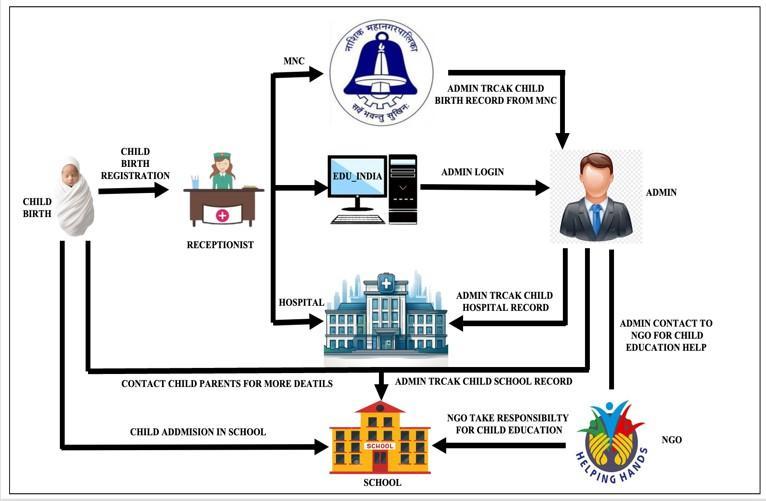
This picture outlines a complex information stream and interactiondemonstratedamongdifferentsubstances included in birth record enrollment, issuance of birth certificates,andfollowingofnon-admittedchildrenfor potentialschoolconfirmations.Eachcomponentwithinthe chartspeakstoanorganizationordatabase collaborationtoguaranteethateachchild’sbirthrecordis preciselyenlisted,aspecialrecognizableproof numberisissued,andupgradesapproximatelythechild’s statusarecommunicatedtosignificantparties. MainEntitiesandTheirInteractions:
1. Parents:
Parentsareatthecenterofthesystemastheyarenotified abouttheirchild’srecordsandreceiveinformationsuchas theuniqueIDgeneratedbythesystem.Parentsarenotified aboutvariousupdatesfromthemunicipalcorporationand mayreceiveimportantinformationregardingtheirchild’s birthcertificateandvaccinationschedules.
2. School:
Schools are responsible for registering admitted students andsendingstudentrecordstotheSchoolDatabase(School
International Research Journal of Engineering and Technology (IRJET) e-ISSN: 2395-0056
Volume: 13 Issue: 04 | Apr 2026 www.irjet.net p-ISSN: 2395-0072
DB).The school also communicates with the Municipal Corporationtoregisterstudentsandprovidesalistofnonadmittedchildren,whichisalistofchildrenwhoarenotyet inschoolbutneedmonitoring.
3. Non-Governmental Organization (NGO):
NGOs are involved in monitoring children who may not haveaccesstoformaleducationorwhoseadmissionstatus needstracking.NGOsreceivenotificationsandlistsofnonadmitted children from the Municipal Corporation, which helpstheminoutreachandensuringthatchildreninneed receive support. NGOs also store information in the NGO Database(NGODB)andprovidebirthrecordsbacktothe MunicipalCorporationforcentralizedtracking.
4. Municipal Corporation:
Thisisthecentralentitythatmanagesinteractionsanddata exchange between different organizations. The Municipal Corporation registers birth records, monitors nonadmitted children, and sends vaccination notifications to parents. It also manages admission entries from schools, updatesthelistofnon-admittedchildrenbasedonschool data,andsharesthisinformationwithNGOsforfollow-up actions. The Municipal Corporation Database (Municipal Corporation DB) stores all records related to registered children, including birth records from hospitals and updatesfromtheBirthCertificateModule.
5. Hospital:
Hospitals register birth records and send them to the HospitalDatabase(HospitalDB),whichinturnsharesthese records with the Municipal Corporation DB. This data is crucialforinitialbirthregistrationandverification,which issubsequentlyusedintheBirtCertificateModule.
Thismoduleisresponsibleforgeneratingbirthcertificates for registered children based on birth records obtained fromhospitals.TheBCMDatabase(BCMDB)storesallbirth recordsandgeneratesauniqueIDforeachchild,whichis thensenttotheparents.TheBCMDBcoordinateswiththe MunicipalCorporationDBandsendsbirthrecorddataback toensurerecordsareup-to-dateacrosssystems.DataFlow andCommunication:BirthRecordCreationandUniqueID Generation:Whenachildisborn,thehospitalrecordsthe birthinformationintheHospitalDB.Thisdataisthensent to the Municipal Corporation DB. The Birth Certificate Module retrieves birth records from the Municipal CorporationandBCMDBtoissueauniqueIDandgenerate thebirthcertificateforeachchild.ThisuniqueIDandbirth recordarethencommunicatedbacktoparents,completing theinitialregistrationprocess.
TheMunicipalCorporationusesschoolandNGOrecordsto identifychildrenwhohavenotyetbeenadmittedtoschool. Schools send admission entries and lists of non-admitted childrentotheMunicipalCorporation.NGOsreceivesimilar liststoperformoutreachandensurethatthesechildrenare notleftoutofeducationalopportunities.
8. Vaccination Notification:
The Municipal Corporation DB has a role in notifying parents about vaccinations. This ensures that registered children receive timely vaccinations based on their birth records. This flowchart shows an integrated data management system where multiple organizations work togethertotrack,update,andmanageeachchild’srecords from birth through early education. The system ensures that all relevant data is centralized in the Municipal Corporation DB, allowing for efficient tracking, communication, and record management for children across the network. This model also highlights how NGOs and schools contribute to the education tracking process, assisting the government in monitoring and supporting non- admitted children and improving educational outreach.
The problem stated was many children are deprived of primary education. As per our proposed solution, the system efficiently finds out the students who are not admittedinanyoftheschool,takingintoconsiderationthe birthrecordsandschoolrecords.Notifiestheirparentsfor admission. This would bring awareness among parents regardingtheirchild’seducationandthereforeplayagreat roleinsolvingtheproblem.
International Research Journal of Engineering and Technology (IRJET) e-ISSN: 2395-0056
Volume: 13 Issue: 04 | Apr 2026 www.irjet.net p-ISSN: 2395-0072
[1] ShishayTadesseAbay1andAtakltiGebreyesusGebreegziabher. Status and associated factors of birth registration in selected districts of Tigray region, Ethiopia,2020.
[2] Sarah Reed,JosephineShabani,DorothyBoggs,Nahya Salim.Countingonbirthregistration,2021.
[3] ClaireCody.“universalbirth registration is impossible to ignoreandentirelypossibletoachieve”.
[4] Nishen Rai.“ContributionsofNGOsTowardsPrimary Education with Special Reference to East District Of Sikkim”,2017.
[5] Rizlaili Istiqomah, Kristiani, Budi Wahyono. The Implementation of Online-Based New Student AdmissionsinSurakarta,2020
[6] Jun-ichi Okabe* and Surjit1 Village-Level Birth Records:ACaseStudy.
[7] HarbitzM,delCarmenTamargoM.Thesignificanceof legal identity in situations of poverty and social exclusion:thelinkbetweengender,ethnicity,andlegal identity.NewYork:BankI-AD;2009.
[8] Sustainable development goals. http://www.un.org/ sustainabledevelopment/sustainabledevelopment-goals/ Accessed15Aug2020.
[9] TooleD,AbouzahrC,LeFrancC,MunkHansenR,Joshi K,SteinC,ChapmanN.Adevelopmentimperative:civil registration and vital statistics systems in the AsiaPacificregion.Asia-PacPopulJ.2015;29:9–37.
[10]AbouZahr C, de Savigny D, Mikkelsen L, Setel PW, Lozano R, Nichols E, Notzon F, Lopez AD. Civil registration and vital statistics: progress in the data revolution for counting and accountability. Lancet. 2015;386(10001):1373–85.
[11]WHO. Every newborn: an action plan to end preventabledeaths.2014.
[12]MoxonSG,RuysenH,KerberKJ,AmouzouA,Fournier S,GroveJ,MoranAC,VazLME,BlencoweH,ConroyN,et al. Count every newborn; a measurement improvement roadmap for coverage data. BMC PregnancyChildbirth.2015;15(2):S8.
[13]UNICEF.Birthregistration. https://data.unicef.org/topic/child-protection/birthregistration/.Accessed15Aug2020.
[14]IsaraA,AtimatiA.Socio-demographicdeterminantsof birth registration among mothers in an urban community in southern Nigeria. J Med Tropics. 2015;17(1):16–21.
[15]Mohanty I, Gebremedhin TA. Maternal autonomy and birth registration in India: who gets counted? PLoS One.2018;13(3):e0194095.
[16]World Bank. Incentives for improving birth registration coverage: a review of he literature. Washington, DC: World Bank License: Creative CommonsAttribution3.0IGO(CCBY3.0IGO);2016.
[17]14. Amo-Adjei J, Annim SK. Socioeconomic determinants of birth registration in Ghana. BMC Int HealthHumRights.2015;15:14.
[18]Fisker AB, Rodrigues A, Helleringer S. Differences in barriers to birth and death registration in Guinea-
Bissau:implications for monitoring national and global healthobjectives.TropicalMedIntHealth. 2019;24(2):166–74.
[19]Montagu D, Sudhinaraset M, Diamond-Smith N, CampbellO,GabryschS,FreedmanL,KrukME,Donnay F. Where women go to deliver: understanding thechanginglandscapeofchildbirthinAfrica.