
International Research Journal of Engineering and Technology (IRJET) e-ISSN: 2395-0056
Volume: 12 Issue: 10 | Oct 2025 www.irjet.net p-ISSN: 2395-0072
International Research Journal of Engineering and Technology (IRJET) e-ISSN: 2395-0056
Volume: 12 Issue: 10 | Oct 2025 www.irjet.net p-ISSN: 2395-0072
1Post graduate student, Department of Civil Engineering, SGBIT College, Belagavi, Karnataka, India
2Assistant Professor, Department of Civil Engineering, SGBIT College, Karnataka, India ***
Abstract - Therapidgrowthofurbanizationhas increased the demand for high-rise buildings, highlighting the importance of structural design and analysis. This project focuses on the design and analysis of a multi-storey high-rise buildingusingETABSsoftwaretoensuresafety,serviceability, and cost-effectiveness while complying with IS codes. A structural model is developed with realistic dimensions, materials, and loading conditions, including dead, live, wind, and seismic loads. Key parameters such as displacement, bending moment, shear force, and axial load are evaluated. Emphasis is placed on seismic performance, with results confirmingcompliance,stability,andefficiency,demonstrating ETABS as an effective tool
Key Words: Bending moment, Shear force, Axial load, Displacement, Response Spectrum
1.
The increasing need for urban space has led to the emergenceoftallstructures,makingthedesignandstudyof high-rise buildingsa vital featureofmodernconstruction. Thesestructuresneedtobesafe,cost-effective,andableto supportavarietyofloads,suchasearthquake,wind,dead, andlivingloads.Apopularprogramforstructuralmodelling anddesign,ETABS(ExtendedThree-DimensionalAnalysisof BuildingSystems)providespreciseanalysisofmulti-story buildingsinreal-worldscenarios.Inthisproject,ETABSis usedtomodelandanalyseahigh-risestructure.Shearwalls, beams, columns, and slabs are among the structural elementsthataredevelopedinaccordancewithapplicable codes.ThestudyshowshowwellETABSworksinhigh-rise building design while ensuring that the structure satisfies stability,strength,andserviceabilityrequirements.
Loads are the external forces or actions applied to a structure that cause stress, deformation, or displacement. Theseincludedeadloads(permanent/staticloadslikeselfweight), live loads (temporary or movable loads such as peopleorfurniture),windloads,earthquakeloads,andsnow loads.Eachtypeofloadaffectsthestructuredifferentlyand mustbeconsideredduring design.Loadcombinationsare sets of various loads applied together to simulate real-life conditions. They help engineers ensure that the structure remains safe and stable under multiple loading scenarios. Codes such as IS 456 and IS 875 provide guidelines for
determining these combinations. By analysing load combinations, designers can assess the most critical conditionsanddesignthestructureformaximumsafetyand performance.
1.Jenita Kuriakose, et al. (2023): The report says that a comprehensivedesignand analysisofa high-risebuilding utilizingETABSsoftware,withaparticularemphasisonthe effectsofwindload.Thephenomenonofrapidurbanization in cities such as Mumbai has resulted in a scarcity of available space, thereby rendering vertical construction viable solutions. ETAB’S facilitates the efficient modelling, designing,andanalysisofstructuressubjectedtobothstatic anddynamicloadsinaccordancewithIndianStandard(IS) codes.Themethodologyemployedinvolvesthepreparation of architectural plans using AutoCAD, followed by their importation into ETAB’S, the modelling of structural components, the assignment of various loads, and the analysisofstructuralperformance.Theproposedbuildingis designedusingM40concreteandFe600steel,considering dead,live,wind,andseismicloads.Windloadsarechecked according to IS 875 (Part 3). The analysis results indicate thatdisplacementsandstoryshearincreasewithascending windspeeds,particularlyimpactingtheupperstoriesofthe structure.
2.WakaleYogeshNamdev,etal.(2022):Thestudysaysthat thestudyusesETAB’StoanalysesanddesignaG+26-story officebuildingwithanemphasisonwindandseismicload performance. Structural modelling, analysis, and member designweredonewithETAB’S,foundationdesignwasdone withCSISAFE,andreinforcementdetailingwasgenerated withCSIDetail.Thedesigntookintoaccountearthquakes, wind,dead,andliveloadsinaccordancewithISregulations, namelyIS1893,IS875,IS456,IS13920,andIS16700.The projectlocationhasazonefactorof0.16andisinseismic zone III. RC moment-resisting frames, robust diaphragms, andeconomicallyoptimalcolumnsizingwereallincludedin the modelling. Torsion, base reactions, displacement, and tale drift were among the main findings. Story drift, displacement,torsion,andbasereactionswereamongthe main outcomes, all of which were below acceptable code bounds.Underseismicloading,displacementrosefromthe firsttothetopstory.
3.B.Vamsi Krishna, et al. (2020): This study uses ETAB’S software to analyze, optimize, and design shear walls in
International Research Journal of Engineering and Technology (IRJET) e-ISSN: 2395-0056
Volume: 12 Issue: 10 | Oct 2025 www.irjet.net p-ISSN: 2395-0072
high-rise reinforced cement concrete (RCC) structures. In compliance with IS 1893:2002,a Ground plus Ten(G+10) structuremodelisanalyzedforSeismicZoneIII,accounting for both dynamic and static loads. To improve structural stability and lateral load resistance, shear walls were positioned, and their thickness was optimized. The study concentrated on a few important factors, such as support responses, shear pressures, displacement, and story drift. When compared to asymmetric structures, the results showed that symmetric shear wall layouts considerably increasedstability.
4.Shobha Ra, et al. (2021): The study uses ETAB’S with response spectrum analyzes to examine a 16-story RCframedstructurelocatedinseismiczonesII–V.Thefindings indicatethatbaseshearandstorydisplacementrisessharply withincreasingseismiczones,peakinginZoneV.storydrift decreases at the upper floor after increasing to the fourteenth story. The results indicate that regarding maintain stability and safety, increased seismic activity necessitates corresponding increases in strength characteristics.
To analyse and design structural members (columns andbeams)ofahigh-risebuildingusingbothmanual calculationandETAB’ssoftware.
Tocomparetheresultsofshearforce(SFD),bending moment(BMD)andaxialforceobtainedmanuallywith thesoftwareoutputs.
TounderstandtheaccuracyandefficiencyofETAB’Sin analysingcomplexhigh-risestructures
Tovalidatethereliabilityofmanualcalculationagainst softwareresultsforpracticalimplementation.












Conclusions
Table -1: Designparameter
Parameters
Heightofthestructure
Dimensionofbuilding 32.250*19.555m
Beamdimension
1. Sizeofperipheral beams
2. Sizeofmainbeams
400*750mm b. 450*900mm
Columndimension a. 1000*1000mm b. 1000*500mm c. 750*900mm d. 500*1000mm
Earthquakezone IV
Thicknessofslab 125mm
Numberofstory 16
Soiltype Terrain3
Importancefactor 1.2
Responsereductionfactor 5
Liveload 4KN/m2
Codesused IS456:2000 IS800:2007 IS1893-part1(2016) IS875-part3
International Research Journal of Engineering and Technology (IRJET) e-ISSN: 2395-0056
Volume: 12 Issue: 10 | Oct 2025 www.irjet.net p-ISSN: 2395-0072
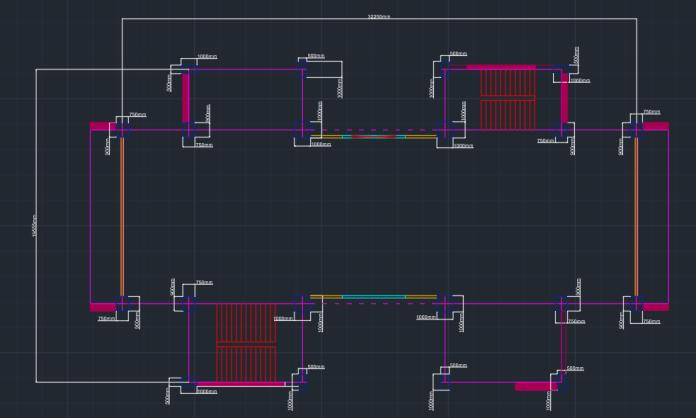
5.1 Architectural plan
5.2 Structural analysis in ETAB’S
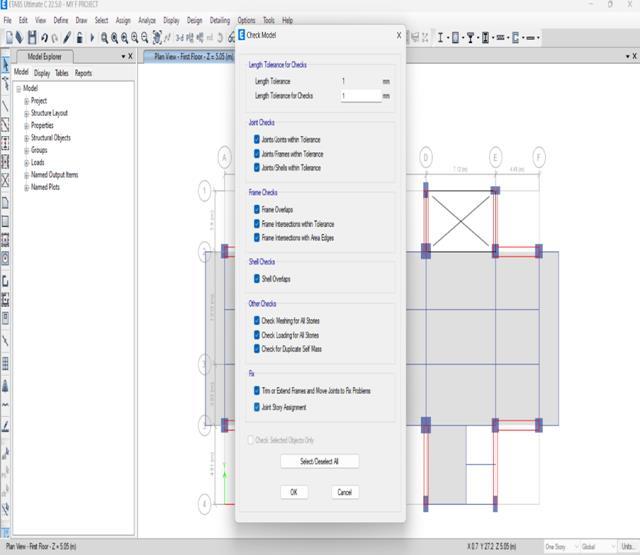
Fig -2: Checkforerrors
6. RESULTS
The design and analysis of high-rise building of g+16 was carried out in ETAB’S software. And a test beam and test column was selected to compare the results of manually calculatedbendingmoment,shearforceandaxialloadand theresultsgotfromtheETAB’Ssoftware.
6.1 Beam results
Manualcalculation:
SF=54.47kN
BM=64.64kN-m
ETABScalculation:
SF=66.7656kN
BM=66.3037kN-m
6.2 Column results
Manualcalculation:
AxialForce=2030.25kN
ETABScalculation:
AxialForce=2021.1127kN
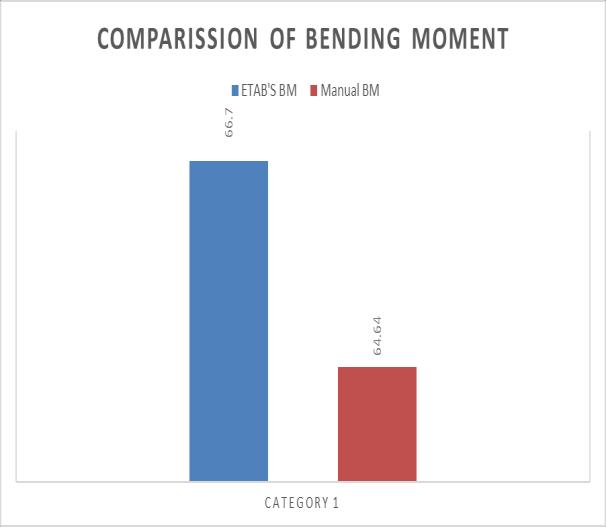
Chart-1:Comparisonofbendingmomentoftestbeam
The graph shows a comparison of bending moments obtainedfromETABSanalysisandmanualcalculationsfora test beam. The ETABS bending moment value is nearer at 66.7kN-mcomparedtothemanualvalueof64.13kN-m.
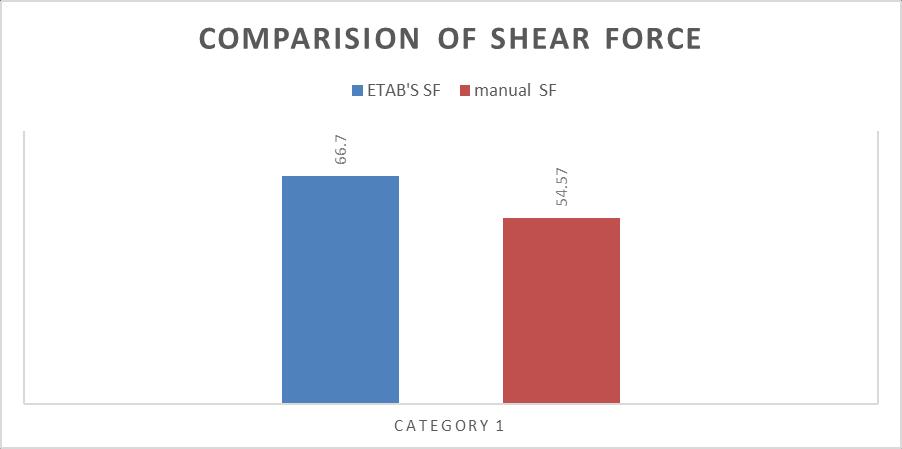
Chart-2: Comparisonofshearforceoftestbeam
International Research Journal of Engineering and Technology (IRJET) e-ISSN: 2395-0056
Volume: 12 Issue: 10 | Oct 2025 www.irjet.net p-ISSN: 2395-0072
Thegraphshowsacomparisonofshearforceobtainedfrom ETABSanalysisandmanualcalculationsforatestbeam.The ETABS shear force value comparison is ok at 66.7 kN comparedtothemanualvalueof54.57kN
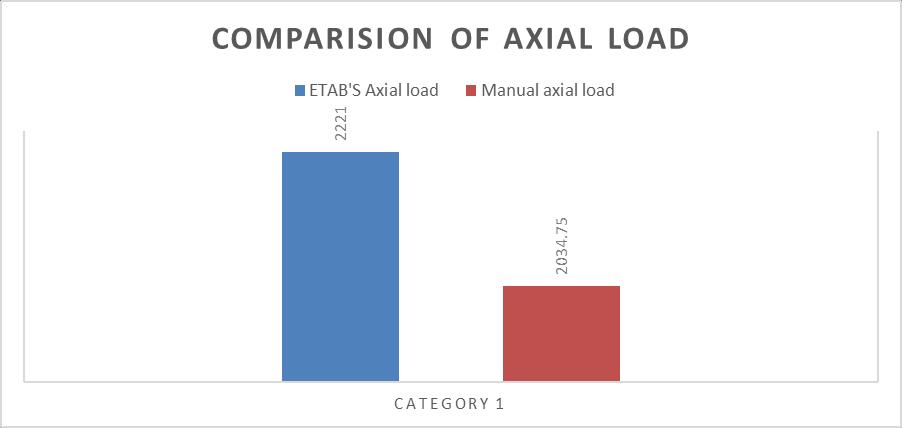
Chart-3:Comparisonofaxialloadontestcolumn
Thegraphshowscomparisonfromsoftwareandmanually obtained is ok to have this result it is nearer such slight differenceshappensoftware’sdatais2221kNandmanualis 20334.75kN
Theanalysiscomparingthevaluesobtainedthroughmanual calculationswiththeoutputfromETABSsoftwareindicates minor discrepancies in the results concerning bending moment,shearforce,andaxialforce.Thesevariationscanbe linked to the assumptions and simplifications inherent in manual calculations, such as neglecting secondary effects, employingapproximatemethodsorpresumingidealsupport conditions. Conversely, ETABS conducts a more thorough analysis, taking into account elements such as load combinations, stiffness distribution, and actual boundary conditions, resulting in more precise and comprehensive outcomes.Thevaluesforbendingmomentandshearforce arerelativelysimilar,demonstratingthemanualmethod's adequacyforpreliminaryassessments.However,thenotable difference in axial force points to the impact of additional factors such as load path, frame interaction, and higherorder effects that manual techniques may not adequately address. This underscores the necessity of utilizing structuralanalysissoftwarelikeETABSforthevalidationof final designs, particularly in intricate structures. Nevertheless, manual calculations continue to hold significance for comprehending structural behavior and corroboratingsoftwareoutputs.Thebendingmomentvalues frommanualandETABSarenearlythesame,showinggood agreement.However,shearforcevaluesdiffersignificantly,
indicatingthatsoftwareprovidesamoreprecisedistribution forcomplexloading.
IwanttoexpressmygratitudetoMs.ShradhaHiremath,an assistant professor in the S.G. Balekundri Institute of Technology's Department of Civil Engineering, for her unwaveringsupportanddirectionduringthisprojectreport. Additionally, I am appreciative of the helpful advice and supportprovidedbyDr.SantoshChikkabagewadi,Headof Department,andMr.ParasharamSawant,PGCoordinator. Mysinceregratitudetotheprincipal,Dr.B.R.Patagundi,for his unwavering encouragement. I also want to thank my parents, teachers, and friends for their encouragement throughoutthisproject.
Abrar Ahmad, et. al. (2020): “Comparative Study on Seismic Analysis and Design of High-Rise Buildings using Static and Dynamic Analysis by ETABS" InternationalCivilEngineeringConference.
Bilal Shaikh, et. al. (2019): “Planning, Analyzing and DesignofHigh-RiseBuildingUsingEtabs”International ResearchJournalofEngineeringandTechnology.
K.ChandrasekharReddyandG.LalithKumar(2019): “Percentage of Reinforcement in the Structure for Various Seismic Zones by Using Etabs” International JournalofManagement,TechnologyandEngineering.
IS456:2000,IndianStandardCodeforpracticeofplain and reinforced concrete (Fourth revision), Bureau of Indianstandards,NewDelhi,July2000.
IS 875(Part 2), Indian Standard Code for practice for designloads(otherthanearthquake)forbuildingsand structures,Imposedload(Secondrevision),Bureauof Indianstandards,NewDelhi,1989.