
International Research Journal of Engineering and Technology (IRJET) e-ISSN: 2395-0056
Volume: 12 Issue: 05 | May 2025 www.irjet.net p-ISSN: 2395-0072
International Research Journal of Engineering and Technology (IRJET) e-ISSN: 2395-0056
Volume: 12 Issue: 05 | May 2025 www.irjet.net p-ISSN: 2395-0072
Adish Joshi1 , Atharva Jadhav2 , Chinmayi Bhagwat3, Smit Talekar4, Varad Ghate5
1,2,3,4,5 Department of Mechanical Engineering, Walchand College of Engineering, Shivaji University, Sangli, India ***
Abstract - The main objective of a car suspension system is to improve the ride comfort without compromising the ride handling characteristic. The suspension system reduces the effect of vibration caused by the road and driving conditions. Over recent years the massive developments have made intelligent suspension systems more feasible to implement in automobile industry. But these suspensions possess some disadvantages such as vibration, mechanical failure and stiffness variation. So, through this project we highlight the idea of “ELECTROMAGNETIC INERTER” which will enhance the driving pleasure and control over road. Inerter suspension will allow us to get variable stiffness and much higher comfort just by playing with magnetic field. It will also allow us to reduce wear and tear along with less maintenance. The report also compares different types of inerter in the suspension, such as mechanical & electromagnetic, and optimizes the inertance and damping parameters for certain road conditions. This report uses a two-degree-of-freedom quarter vehicle model to simulate and analyze the suspension responses.
Key Words: Electromagnet, Eddy Current, Damping, Inerter
1.INTRODUCTION
TheElectromagneticInerterDamper,whichactsasbotha springandadampertoefficientlyregulatedynamicforces, marks a paradigm leap in vibration control technology. This new gadget has the potential to have a big influence in businesses where accurate vibration control is critical. Theproject'sgoalistouseelectromagneticprinciplesand sophisticated control algorithms to develop a flexible and adaptablesystemcapableofsuppressingvibrationsacross a wide frequency range. The introduction lays the groundworkforathoroughexaminationofthedesignand development process, emphasizing the relevance of the Electromagnetic Inerter Damper in addressing the changing needs of varied engineering applications. The next sections will go into the technical elements of the system architecture, electromagnetic design, control techniques, and the rigorous testing and validation processesusedtoassuretheefficacyanddependabilityof thisrevolutionarytechnology.
The inerter is a device that uses the energy from the oscillation against the spring's oscillation, rather than just
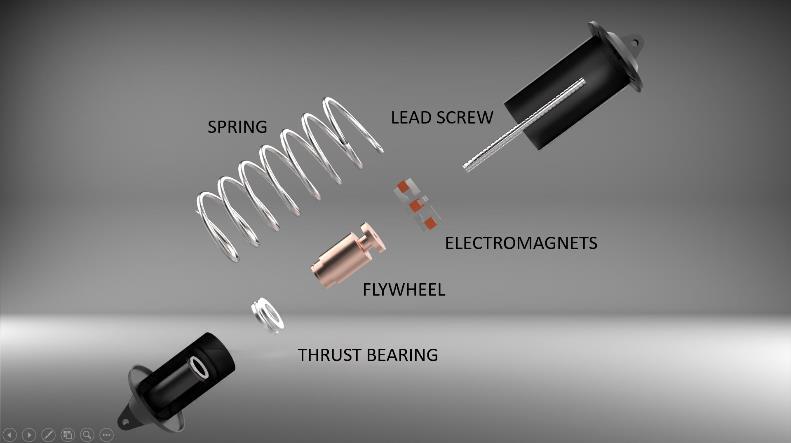
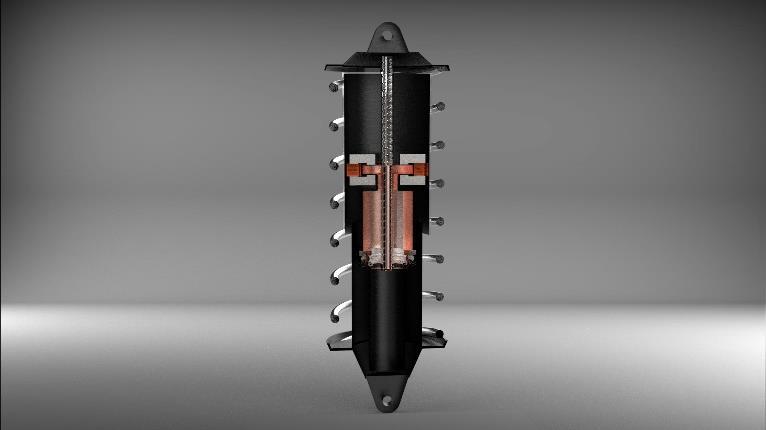
dissipating it. It consists of a lead screw and a flywheel. Whenaforceisappliedtooneendoftherod,itpushesup throughtheflywheel,causingittospin.Thisconversionof linear energy into rotational energy helps counteract the spring'soscillation.Oncetheforceisnolongerapplied,the momentum of the flywheel is returned back into the rod, making it want to continue in that direction. This helps reduce the oscillation of the spring and improves the stabilityofthecar.
When we plot the force of the inerter acting on the spring, we observe a wave-like pattern. Some dampening occurs due to the initial start-up of the flywheel spinning, but the significant dampening occurs when the spring rebounds.
International Research Journal of Engineering and Technology (IRJET) e-ISSN: 2395-0056
Volume: 12 Issue: 05 | May 2025 www.irjet.net p-ISSN: 2395-0072
3. Calculations -
3.1 Parameters for the calculations -
Table 1 -
C.G.height
Unsprung
3.2 Calculated data –
Table 2Parameter
Bumpforce 6529.52 N
Torquetomoveload 7.38 Nm
Helixangle 42.19 Degree
Torque
4. Analysis
Thesuspensionsystemisdesignedforaquartercarmodel (one of the four wheels) which is used to simplify the problem of two degrees of freedom system to a 1-D multiple spring-damper system. This system is then compared to a system of standard spring mass damper Using the mathematical blocks in MATLAB SIMULINK, we have done an analysis based on the dynamic equations of thesuspensionsystemofthequartercarmodeltoanalyze the effect of the mechanical and electromagnetic inerter ontheresponseofthesuspensionsystem.
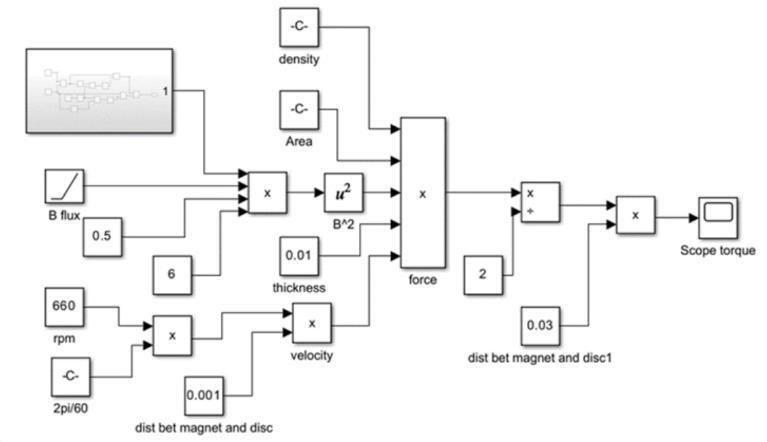
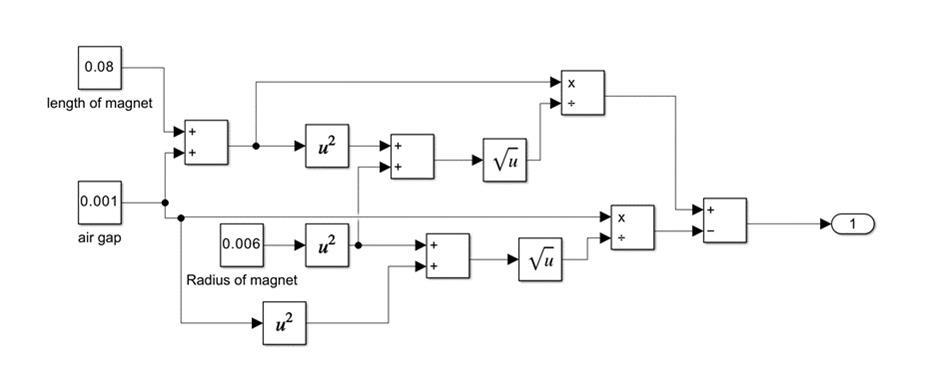
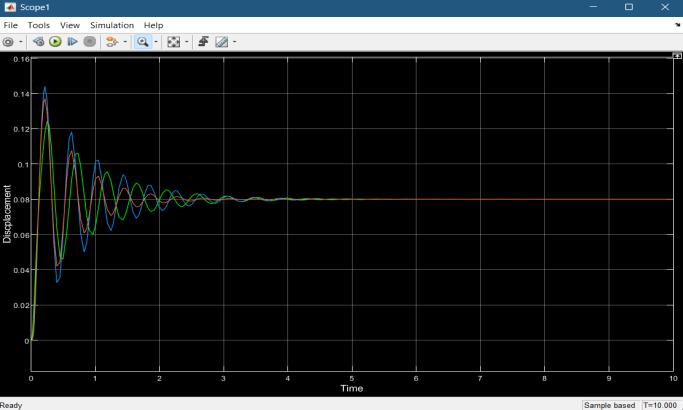
-4: Mainsystemsimulinkmodel 1] For load 4500 N load (200 kg load on quarter car model):
1.SpringMassDampersystem(Bluelineingraph):
MaximumDisplacement-63mm
2. Spring Mass Damper Inerter system (Red line in graph):
MaximumDisplacement-58mm
3. Spring Mass Electromagnetic Inerter system (Green lineingraph):
MaximumDisplacement-45mm
International Research Journal of Engineering and Technology (IRJET) e-ISSN: 2395-0056
Volume: 12 Issue: 05 | May 2025 www.irjet.net p-ISSN: 2395-0072
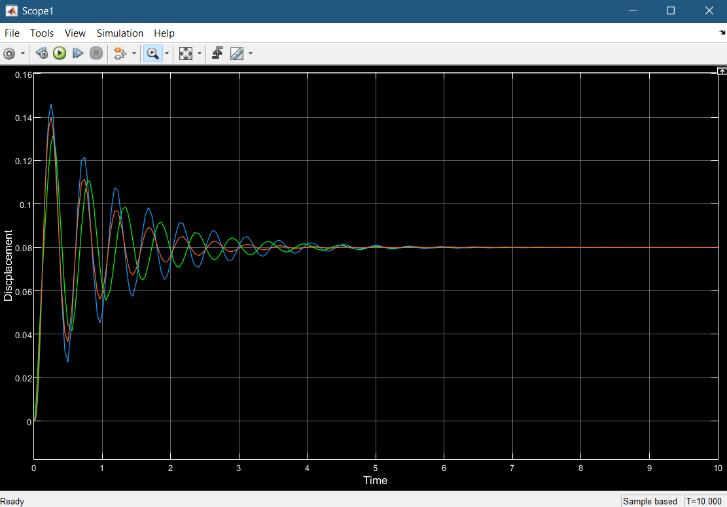
2] For load 6500 N load (275 kg load on quarter car model):
1.SpringMassDampersystem(Bluelineingraph):
MaximumDisplacement-65mm
2. Spring Mass Damper Inerter system (Red line in graph):
MaximumDisplacement-60mm
3. Spring Mass Electromagnetic Inerter system (Green lineingraph):
MaximumDisplacement-52mm
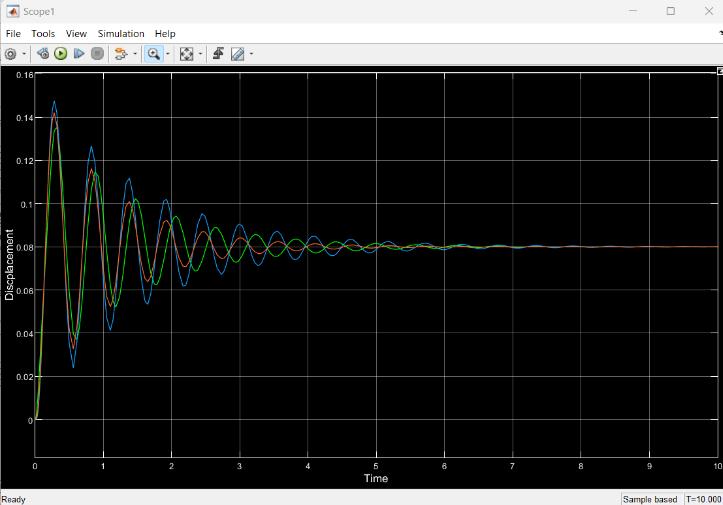
3] For load 8000 N load (360 kg load on quarter car model):
1.SpringMassDampersystem(Bluelineingraph):
MaximumDisplacement-70mm
2. Spring Mass Damper Inerter system (Red line in graph):
MaximumDisplacement-62mm
3. Spring Mass Electromagnetic Inerter system (Green lineingraph):
MaximumDisplacement-55mm
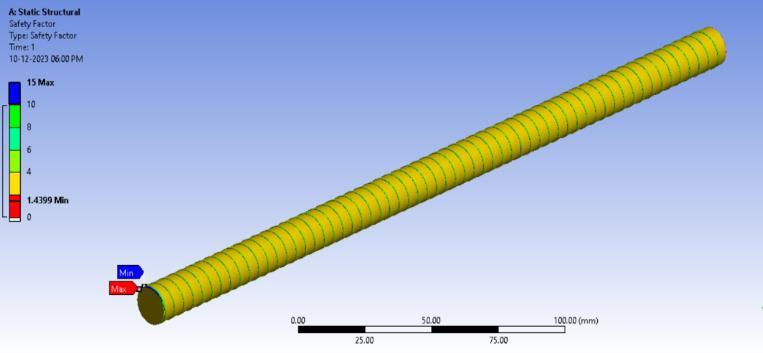
A static structural analysis of the lead screw in the system was conducted. A conservative force of 12,000 N was applied, 30% higher than the damper's maximum force. The analysis showed a minimum factor of safety (FOS) of 1.43, confirming the screw's structural integrity. The results affirm the lead screw's reliability and safe operationunderexpectedconditions. Modal frequency analysis –
Themodalanalysisresultedintheidentificationofthefirst 6 natural frequencies and their corresponding mode shapes.Theresultsaresummarizedinatablebelow:
International Research Journal of Engineering and Technology (IRJET) e-ISSN: 2395-0056
Volume: 12 Issue: 05 | May 2025 www.irjet.net p-ISSN: 2395-0072
Sincethesystemoperatesat660RPM(11Hz)anditisnot near any of these frequencies, we can conclude that resonanceissuccessfullyavoided.
By changing the magnitude of force applied on damper according to the change in velocity by which a vehicle is approaching the bump the values of displacement from themeanpositionforthevelocityof10Km/hr,30Km/hr and 50 Km/hr are tabulated below. The values are taken from simulating respective mass and force parameters on MATLABSimulink.
Theresultstobetabulatedas:
Table -1: Displacementvariationbyloads
In conclusion, the data clearly demonstrates that the electromagneticinerteroffersasuperiorvibrationcontrol solution compared to conventional methods. Lower displacement across various velocity conditions, along with the ability to address resonance issues, make it a promising technology for enhancing structural stability and protecting equipment from vibration-induced damage.
[1] Sarthak Vaishnav,“Modeldevelopmentandsimulation of vehicle suspension system with magnetorheologicaldamper”IOPConf.Ser.:EarthEnviron.Sci. 850012035.
[2] Pranav Teli , Vinayak Tamhankar , Suyash Zagade , Aniket Suvre, “Study of Electromagnetic Damper” PaperID:IJERTV8IS090197
[3] Alexei Filatov, Larry Hawkins, “Active Radial Electromagnetic Damper”, Conference: 2019 IEEE International Electric Machines & Drives Conference (IEMDC)
[4] Nabeel Alshabatat, Tamir Shaqarin, “Impact of Using an Inerter on the Performance of Vehicle Active Suspension”July 2022Advances in Science and Technology–ResearchJournal16(3):331-339
[5] Sneha Chavan,ChinmaySoni,YashrajZanwar,Rutuja Phatangare, “Design and Fabrication of Eddy Current Braking System”. 2019 JETIR April 2019, Volume 6, Issue4