
Volume: 12 Issue: 05 | May 2025 www.irjet.net p-ISSN:2395-0072
Volume: 12 Issue: 05 | May 2025 www.irjet.net p-ISSN:2395-0072
Mr. Sanjiv Pawar1 , Dr. Nitin Korde2
1Student, Department of Mechanical Engineering, G H Raisoni College of Engineering and Management pune Maharashtra, India
2Professor and Dean Academics, Department of Mechanical Engineering, G H Raisoni College of Engineering and Management pune Maharashtra, India
Abstract - The aim of this study is to evaluate the chemical compatibility and stability of two commonly used desiccants, activated alumina and molecular sieves, with three types of lubricants: Polyalkylene Glycol (PAG), PolyvinylEther(PVE),andPolyolEster(POE)oils.Following the ASHRAE 97 standard, the study tests the chemical stability of the desiccants in each oil type to ensure optimal performance in refrigeration and air conditioning systems. The research focuses on two key objectives: assessing desiccant degradation through a crushing test and measuring pH values to identify any chemical reactions afterexposure.
The experimental procedure involves placing the desiccants in sealed glass tubes with PAG, PVE, and POE oils, then subjecting them to elevated temperatures over an extended period,asoutlinedbyASHRAE97.Aftertheexposureperiod, thedesiccantsundergoacrushingtesttodetermineanyloss in mechanical strength or structural degradation. In addition, the pH of the oils is measured to identify any changes in acidity or alkalinity, which would indicate chemicalreactionsbetweenthedesiccantsandtheoils.
Initial findings suggest varying levels of compatibility between the desiccants and the oils, with both activated alumina and molecular sieves showing some degree of mechanicaldegradationinspecificoilenvironments.
In conclusion, the study highlights the importance of selecting desiccants that are chemically stable and compatible with the specific oils used in refrigeration systems. These findings provide valuable insights for optimizingsystemlongevityandperformance,ensuringthat the choice of desiccant minimizes chemical reactions and systemfailures.
Key Words: Desiccant,FilterDrier,ASHRAE,PAGOil,PVE Oil,POEOil
1. INTRODUCTION
Refrigeration System Moisture Management In refrigeration and air conditioning systems, managing
moisture effectively is critical to ensuring optimal performanceandlongevityoftheequipment.Moisturecan leadtoseveralissues,suchascorrosion,iceformation,and a decrease in system efficiency. If moisture is not adequately controlled, it can damage vital components, leading to expensive repairs and reduced operational reliability [15]. To address this, desiccants like activated alumina and molecular sieves are used to absorb excess moisture. These materials help maintain the system's performance by preventing water-related damage. However,desiccantscaninteractwithlubricatingoilsused in refrigeration systems, including Polyalkylene Glycol (PAG), Polyvinyl Ether (PVE), and Polyol Ester (POE) [2]. Understanding how desiccants interact with these lubricants is essential because it can influence the efficiency and stability of the entire refrigeration system [7].
Core: Thecoreensuresproperflowandpreventsclogging or damage to other components. It holds the filter and desiccantmaterialssecurelyinplace.
Inner Bore: Itdirectstheflowofrefrigerantinanefficient manner to maximize the exposure to the desiccant and filter materials, ensuring effective moisture removal and filtration.
Screen: The screen prevents solid contaminants from reachingsensitivepartsofthesystemlikethecompressor, valves, or expansion devices. It prolongs the life of the desiccantandkeepsthesystemrunningsmoothly.
Spring: The spring ensures that the components remain securely positioned, preventing movement that could causeleaksorpoorfiltrationperformance.
● Activated Alumina & Molecular sieves: Activated alumina plays A critical role in removing water from the system & molecular sieves act as both a filter and drying agent in the refrigerationsystem [10] e-ISSN:2395-0056
e-ISSN:2395-0056
Volume: 12 Issue: 05 | May 2025 www.irjet.net p-ISSN:2395-0072
Chemicalstabilityreferstoamaterial'sabilitytomaintain its physical and chemical properties under specific conditions over time. When desiccants are exposed to lubricating oils in a refrigeration system, chemical reactions can occur. These reactions can lead to the degradationofthedesiccant,reducingitsabilitytoabsorb moisture effectively [14]. Additionally, these interactions canimpactthepropertiesofthelubricatingoil,suchasits viscosity and acidity, which are crucial for maintaining proper lubrication and preventing mechanical wear [9]. Lubricating oils play a vital role in refrigeration systems by reducing friction between moving parts, dissipating heat, and sealing critical components. If a desiccant interacts negatively with a lubricating oil, it can cause changesintheoil'sproperties,leadingtopoorlubrication, increased wear and tear, and a higher risk of system failure. Activated alumina and molecular sieves are commonly used desiccants in refrigeration systems. Activated alumina consists of highly porous aluminum oxide that provides excellent moisture absorption, while molecular sieves are synthetic crystalline materials with uniform pores designed for selective moisture adsorption [11] Although both desiccants are chemically stable undernormalconditions,theymaydegradewhenexposed to high temperatures, contaminants, or incompatible lubricants.
Corrosion: Moisture can react with metal components, leadingtorustanddeterioration.Thisweakensthesystem andcancauseleaksorcompletefailure.
Ice Formation: Inlow-temperatureapplications,moisture can freeze and block narrow passages, disrupting refrigerantflowandreducingcoolingefficiency.
Acid Formation: Moisture can interact with refrigerants and oils to form acids, which can degrade system componentsovertime.
Oil Degradation: If moisture reacts with lubricating oils, it can change the oil's viscosity, making it less effective at reducingfrictionandprotectingmovingparts [8].
The ASHRAE 97 standard is a widely recognized testing method used to evaluate the compatibility and chemical stabilityofmaterialsinrefrigerationsystems.
These standards outline procedures to assess how different materials, such as desiccants and lubricants,
behaveunderhightemperaturesandoperatingconditions [3]. The ASHRAE 97 testing process involves exposing materialstoelevatedtemperaturesforanextendedperiod whilemonitoringtheirphysicalandchemicalchanges.Key factors assessed in these tests include: Mechanical Degradation: How well the desiccant maintains its structure and absorption capacity under high temperatures.
pHChanges:Anychangesintheacidityoralkalinityofthe lubricating oil, which can affect its performance and lead topotentialsystemdamage.
Oil Stability: Whether the oil maintains its viscosity and lubricating properties after prolonged exposure to the desiccant.
By following ASHRAE 97 guidelines, researchers can determine whether activated alumina and molecular sievesaresuitableforusewithdifferentlubricatingoilsin refrigeration systems. The goal of these tests is to ensure that desiccants and lubricants work together efficiently without causing chemical instability or reducing the system’slifespan.
Understanding the interaction between desiccants and refrigeration lubricants is essential for selecting the right combination of materials to maximize system efficiency and durability [13]. Below is a breakdown of how activated alumina and molecular sieves interact with differentlubricatingoils.
1.5.1 Polyalkylene Glycol (PAG) Oil PAG oils are widely used in automotive air conditioning systems and some refrigeration applications. They offer excellent lubrication propertiesandthermalstability [12]
PVE oils are commonly used in CO₂ refrigeration systems and are known for their excellent thermal stability and lubricationproperties [7].
POE oils are used in modern refrigeration systems, particularly those using hydrofluorocarbon (HFC) refrigerants. They offer good lubrication and chemical stability but can be sensitive to moisture. Activated Alumina with POE: Effective in moisture absorption but maycontributetoslightacidformationovertime.
Volume: 12 Issue: 05 | May 2025 www.irjet.net
e-ISSN:2395-0056
1.5.4
1.Moisture management is a crucial aspect of maintaining refrigerationandairconditioningsystems.
2.Desiccants such as activated alumina and molecular sieves help remove moisture, preventing common issues like corrosion, ice formation, and oil degradation. However,theirinteractionwithlubricatingoilscanimpact systemperformance.
3.By adhering to ASHRAE 97 standards, researchers and engineers can assess the compatibility and stability of desiccantswithdifferentlubricatingoils.
4.Molecular sieves generally offer better performance in maintainingoilstabilityandpreventingchemicalreactions thatmaycompromisethesystem’sefficiency.
5.Understanding these interactions allows for better materialselection,ultimatelyenhancingthereliabilityand lifespanofrefrigerationandairconditioningsystems.
2. Literature Review
1.Stephen Kujak et. Al (2022) carried out Chemical Stability
InvestigationsofUltra-LowGWPRefrigerantsandtheir lubricant.Theyusedsealedglasstubemethodasper
ASHRAE 97 standards and observed that lubricant chemistry on the breakdown of the various hydrofluoroolefin(HFO)refrigerantstested [1].
2 Stephen Kujak et. Al (2022) carried out Chemical Stability Investigations of Low GWP Refrigerants with lubricants. They used sealed glass tube method as per ASHRAE 97 standards and observed that potential compatibility issues and reactivity concerns that could affect the reliability and lifespan of refrigeration equipment. The research addresses a gap in existing literature regarding the interactions between these refrigerantsandmaterials [2]
3.Morgan Herried et. Al (2022) Chemical Stability InvestigationsofLowGWPRefrigerantsChemicalStability Investigations of Low GWP Refrigerants R-454B, R-454C, R-455A, R-468A, R-466A with Lubricants They used sealed glass tube method and observed lubricant chemistry involvement on the breakdown of various hydrofluoroolefinrefrigerant [3].
4 S Tominaga et. Al (2002) various performance of polyvinyl ether (PVE) with HFC Refrigerant. They used Actual machine tests were conducted to evaluate PVE
performance and observed that PVE demonstrates superior lubricity and solubility with HFC refrigerants. PVE reduces capillary tube blockage compared to POE. PVE has lower precipitation temperature in practical conditions [4].
5.Nunez et. Al (2008) Tribological Study Comparing PAG andPOELubricantsusedinAir-ConditioningCompressors under the Presence of CO2. They used High pressure tribometerfortribologicaltests.Pin-on-diskconfiguration for lubricant evaluation and observed that tribological behaviour. Selecting the right lubricant is crucial for efficient,sustainableair-conditioningsystems [5]
6.Gunsel et. Al (1999) Elastohydrodynamic Lubrication with Polyolester Lubricants and HFC Refrigerants .They used ultrathinfilmEHDinterferometrytechniqueforfilm thickness measurement and observation is It focuses on predicting lubricant film thickness. The challenge lies in evaluating lubricant properties under varying conditions [6].
In order to determine degradation pathways and filmthickness behaviours, these studies use sealed glass tube tests, real-cycle system trials, and EHD interferometry to assess the chemical stability of ultra-low and low GWP refrigerantswithvariouslubricants.
Using high-pressure pin-on-disk tribological evaluations, PAG,POE,andPVEoilsarefurthercompared,especiallyin CO₂ and HFC environments, to maximize wear, friction, andcompatibilityforlow-GWPrefrigerationsystems.
The compatibility of desiccants with lubricating oils is crucial for the reliable operation of refrigeration and air conditioningsystems,aschemical interactionscanlead to desiccant degradation and compromised system performance. This study seeks to identify the effects of activated alumina and molecular sieves on the stability of polyalkylene glycol (PAG), polyvinyl ether (PVE), and PolyolEster(POE)oils,followingASHRAE97standards.
4.1
ASHRAE 97 standards provide guidelines for evaluating the thermal stability and chemical compatibility of lubricants and desiccants in refrigeration and industrial applications. These standards help determine the performance of materials under specified temperature conditions over an extended period. The controlled
e-ISSN:2395-0056
Volume: 12 Issue: 05 | May 2025 www.irjet.net p-ISSN:2395-0072
exposure conditions ensure that the degradation and interactions of lubricants and adsorbents are measured accurately.Thestandardtestingproceduresinclude [3].
4.1.1Materials Selection:
1.Desiccant used:
a) Molecular Sieves (3A to4A): A porous material commonlyusedformoistureremovalandgaspurification. used50gpersample
b)ActivatedAlumina(3to4mm):aporousmaterialused removewatermoisture.Used50gpersample
2.lubricant used: 100mL per sample
a) Polyvinyl ether (PVE): A synthetic lubricant commonly usedinR-134arefrigerationandindustrialapplications.
b) Polyol ester (POE): A widely used lubricant in R-134a airconditioningandrefrigerationsystems.
c)Polyalkyleneglycol(PAG):Asyntheticoilwithexcellent thermalstabilityUsedinautomotiveR-134aRefrigeration airconditioningsystem.
3.Beakers (250 ml): six beakers used to hold the oil and desiccantseparately,ensuringnocrosscontamination.
4.1.2 Equipment’s: To ensure accurate and reliable results,thefollowingequipmentwasused
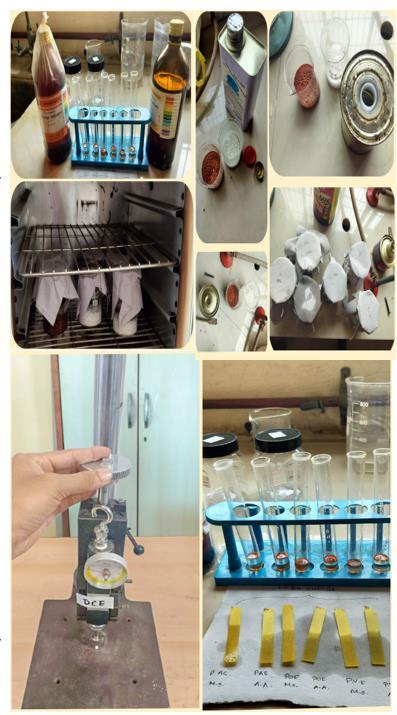
1.Hot Air Oven: Set to maintain a consistent temperature of 70°C for 14 days to simulate prolonged exposure conditions.
2.Crushing Strength Tester: It is used to measure the mechanical integrity of the adsorbents after exposure to theoils
3.pH Testing Materials: pH paper for quick qualitative assessment. o Universal Indicator for more precise pH measurement.
4.Weighing Balance: High-precision balance used to measuretheadsorbentsaccurately(50gpersample)
5. Glassware: Beakers, stirrers, and pipettes for handling andmixingthesamples.
4.2 Experimental Procedure:
1.Beakerscleanedwithlab gradesoapandwater.
2.BeakerPlacedfordrying.
3.Sampleofdesiccantsandlubricantswereprepared.
4. Each beaker is filled with 100ml oil (PAG, POE, PVE), and each oil has two samples of activated alumina and molecularsieves50geach.
5.Mixture of activated alumina and molecularsieves were prepared for the three different oil (PAG, POE, PVE) samples
6. beakersweresealedwithfilterpaper.
7.The hot air oven was pre heated and set for 70°C temperature
8.Oncethe70°Ctemperatureisreached,thesampleswere keptintoovenfor14days
9.After 14 days of exposure, the samples were removed from hot air oven and kept for cooling at the room temperature.
10. desiccants were separated from the oils and taken for pH measurement using Ph paper as well as universal indicator
11.After pH measurement, separated desiccants were preservedforcrushingtest.
12.The results obtained from the laboratory tests were evaluatedandanalyzed
5.Results analysis:
5.1 Crushing Strength Test of Desiccants: During crushing test, we checked 15 sample each and took the average value of these samples (fresh & after exposure) foractivatedaluminaandmolecularsieves.
Table -1: Crushingstrengthtest
Crushing Strength Test
Analysis of activated alumina
Fresh Activated Alumina shows a solid baseline crushing strengthof13.17Kg.
PAG oil exposure slightly increases the crushing strength (13.53 Kg), possibly due to minimal chemical interaction oroilresiduefillingsurfacepores.
PVE exposure shows the lowest strength (12.53 Kg), indicating potential weakening of structure, likely due to chemicalsofteningorporedamage.
POE oil results in a moderate value (12.80 Kg), showing somereductionbutnotassignificantasPVE
The pie chart supports this by showing a relatively even distributionamongcondition.


Chart -1:Crushingstrength
OilexposuredoeshaveamildeffectonActivatedAlumina. TheimpactismostnoticeablewithPVE,suggestingitmay compromisemechanicalintegrityovertime.
Molecular sieve:
Fresh Molecular Sieves have a high initial strength of 20.27 Kg, already significantly stronger than Activated Alumina. PAG oil increases crushing strength (22.80 Kg), which may result from pore filling or oil-induced surface hardening.
PVE causes a slight drop (19.53 Kg), indicating a small weakeningeffect.
POE oil shows the highest average strength at 24.23 Kg, implying excellent stability and potential reinforcement underthiscondition.
The pie chart for Molecular Sieves reveals a stronger contributionfromPOEandPAG

Chart -2:Crushingstrength
Molecular Sieves consistently outperform Activated Aluminaincrushingstrength.They
exhibit not only better initial strength but also greater resistanceand,insomecases, improvement when exposed to oil environments, especiallyPOE.
Final Remark:
Molecular Sieves are more mechanically robust than ActivatedAlumina,acrossallconditions

Graph -1:AAV/SMS
PVE tendstoweakenbothmaterials.
POE appearstostabilizeor enhancestrength,particularly inMolecularSieves.
Theseinsightsarecritical forselecting the right desiccant in refrigeration systems, where chemical interaction with oilsisinevitable.
The experimentaimed to studythechemical stability (via pH check) of two desiccants Molecular Sieves and Activated Alumina after being exposed to synthetic refrigerantoils(PVE,POE,andPAG)at70°Cfor14daysin acontrolledovenenvironment.
All samples(1to 6) weresubjected to both pH Paperand Universal Indicator testing methods before and after oil exposure.
The pH remained neutral (~7) in every case before and after the 14-day exposure, indicating no significant acidic or basic degradation occurred in any oil-desiccant combination.
The consistency across both pH testing methods (pH paper and universal indicator) further confirms the accuracyandrepeatabilityoftheresults
Table -2: pHMeasurements
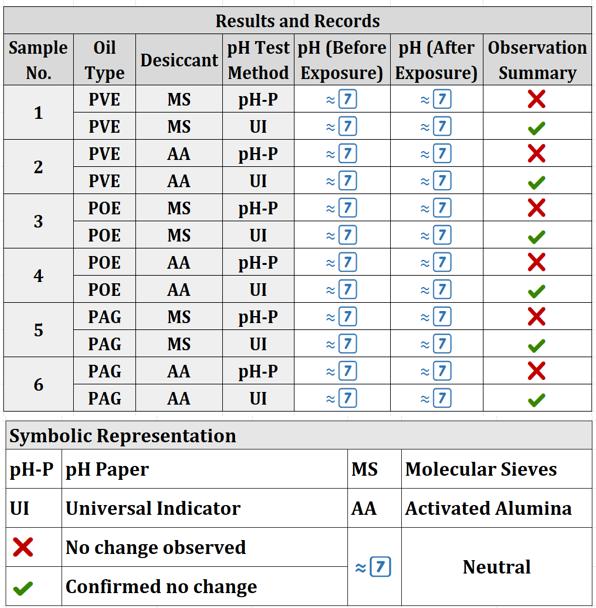
Theresultsindicatechemicalstabilityandcompatibilityof both Molecular Sieves and Activated Alumina with PVE, POE, and PAG oils, even after prolonged exposure to elevated temperatures. This reinforces their suitability as desiccants in systems using these synthetic oils, with no adverseeffectonoilpHordegradation.
6. CONCLUSIONS:
The experiment results showed that POE refrigeration compressor oil was highly compatible with Molecular Sieves.in comparison, PVE compressor oil demonstrated poor compatibility with both desiccants. In case of PAG refrigeration compressor oil shows increasing crushing strengthwithbothdesiccants.
There was no change in pH before and after testing, proving both desiccants are chemically stable. pH tests confirmed that all samples stayed neutral (~7) even after 14 days at 70°C. This means both desiccants are safe and stableinuse.
Molecular Sieves with POE oil are the best choice for reliableperformanceofrefrigerationsystem.
[1] Kujak, S., Herried-Leehey, M. and Robaczewski, C., 2022. Chemical Stability Investigations of Ultra-Low GWP Refrigerants R-1336mzz (Z), R-1336mzz (E), R-514A, R1233zd(E),andR-1224yd(Z)withLubricants
Volume: 12 Issue: 05 | May 2025 www.irjet.net
[2] Kujak, S., Herried-Leehey, M. and Robaczewski, C., 2022. Chemical Stability Investigations of Low GWP Refrigerants R-1234ze (E), R-450A, R-515B, R-1234yf, R513AandR-516AwithLubricantswithLubricants
[3] Kujak, S., Herried-Leehey, M. and Robaczewski, C., 2022. Chemical stability investigations of low GWP refrigerants R-454B, R-454C, R-455A, R-468A, R-466A withlubricants.
[4] Tominaga, S., Tazaki, T. and Hara, S., 2002. Various performance of polyvinylether (PVE) lubricants with HFC refrigerants.
[5] Nunez, E.E., Demas, N.G., Polychronopoulou, K. and Polycarpou, A.A., 2008. Tribological study comparing PAG and POE lubricants used in air-conditioning compressors under the presence of CO2. Tribology Transactions, 51(6), pp.790-797.
[6] Gunsel, S. and Pozebanchuk, M., 1999. Elastohydrodynamic Lubrication With Polyolester Lubricants and HFC Refrigerants. Air Conditioning and Refrigeration Technology Institute, Arlington, VA, 1, pp.23810-102.
[7] Karnaz,J.andSeeton,C.,2018.Evaluationoflubricant propertiesandrefrigerantinteraction.
[8] Sporlan Valve Company. (1994, February). Compatibility of filter-drier desiccants with HFC refrigerants and polyolester lubricants (Form 40-130). Missouri:SporlanValveCompany.
[9] Field, J.E., 1995. Sealed tube comparisons of the compatibility of desiccants with refrigerants and lubricants. Final report, August 1993 January 1995 (No. DOE/CE/23810-54). Spauschus Associates, Inc., Stockbridge,GA(UnitedStates).
[10] Chauhan, V.S., Dwivedi, P.K. and Iyengar, L., 2007. Investigations on activated alumina based domestic defluoridation units. Journal of Hazardous materials, 139(1),pp.103-107
[11] Zhang, H., Wang, Y., Zhang, Z. and Niu, B., 2020, June. Preparation and Characterization of a New Composite AdsorptionMaterialsComposedofTwoActivatedAlumina and Microporous Molecular Sieve and Its Adsorption PropertytoWater.InJournalofPhysics:ConferenceSeries (Vol.1549,No.3,p.032112).IOPPublishing.
[12] Tominaga, S., Tazaki, T. and Hara, S., 2002. Various performance of polyvinylether (PVE) lubricants with HFC refrigerants.
e-ISSN:2395-0056
p-ISSN:2395-0072
[13] Akram, M.W., Polychronopoulou, K. and Polycarpou, A.A., 2014. Tribological performance comparing different refrigerant–lubricant systems: The case of environmentally friendly HFO-1234yf refrigerant. TribologyInternational,78,pp.176-186
[14] Cartlidge, D. and Schellhase, H., 2003. Using acid number as a leading indicator of and air conditioning system performance (No. DOE/OR22764/611-50060-01).
Air-Conditioning and Refrigeration Technology Institute (US).
[15] . Majurin, J.A., Sorenson, E., Staats, S.J., Gilles, W. and Kujak, S.A., 2014. Material Compatibility and Lubricants Research for Low GWP Refrigerants–Phase II: Chemical andMaterial Compatibility ofLowGWP Refrigerants with HVAC&R Materials of Construction. Air-Conditioning, HeatingandRefrigerationInstitute.



Mr. Sanjiv Pawar is a student of MTech in Heat power Engineering G H Raisoni College of Engineering and Management Pune
Dr. Nitin Korde is working as Professor and Dean Academics G H Raisoni College of Engineering and Management Pune