
International Research Journal of Engineering and Technology (IRJET) e-ISSN: 2395-0056
Volume: 13 Issue: 04 | Apr 2026 www.irjet.net p-ISSN: 2395-0072
International Research Journal of Engineering and Technology (IRJET) e-ISSN: 2395-0056
Volume: 13 Issue: 04 | Apr 2026 www.irjet.net p-ISSN: 2395-0072
Manish Prajapati1 , Gaurav Hirwani2 , Er. Pooja Yadav3 , Prof. Ajay Kr. Srivastava3
Information Technology Shri Ramswaroop Memorial college of Engineering and Management Lucknow, India
Abstract The rapidadvancement ofdeepfake technologyhasintroducedsignificantthreatstodigital media authenticity, privacy, and cyber security. Deepfake videos, synthesized using sophisticated Generative Adversarial Networks (GANs) and deep learning frameworks, have become increasingly realistic, making manual detection nearly impossible and enabling widespreadmisinformation,identityfraud,andsocialmanipulation.Toaddressthischallenge,thispaperpresentsDeepScan, an AI- driven deepfake video detection system that combines Convolutional Neural Networks (CNNs) and Recurrent Neural Networks(RNNs)forrobustspatiotemporalanalysis.
The proposed system operates by extracting frames from input videos and analyzing them for visual artifacts, facial inconsistencies,abnormal blinking patterns,andpixel-level distortions.CNNsareemployedtocapturespatialfeatures,while RNNsmodeltemporaldependenciesacrossconsecutiveframes,improvingdetectionaccuracy.DeepScanisfurtherintegrated withanintuitiveweb-basedinterfacethatallowsuserstouploadvideosandobtainreal-timeauthenticitypredictions,making thesystemaccessibletobothtechnicalandnon-technicalusers.
Experimental results on benchmark datasets, including Face Forensics++, demonstrate that the proposed approach achieves highaccuracyandreliabilityindistinguishingmanipulatedcontentfromgenuinevideos.Thesystem’sperformancehighlights its effectiveness in real-world scenarios. By combining advanced deep learning techniques with practical deployment, DeepScan provides a scalable solution to combat deepfake-based threats and contributes to enhancing trust in digital media ecosystems.
Keywords - Deepfake Detection, Artificial Intelligence (AI), Convolutional Neural Networks (CNN),Generative Adversarial Networks (GANs), Video Forensics, Face Forensics++, Digital Media Security, Misinformation Detection, Spatiotemporal Analysis, Deep Learning, Fake Video Detection.
The rapid advancement of deep learning technologies, particularly Generative Adversarial Networks (GANs) and diffusionbased models, has significantly transformed the creation and manipulation of digital media. These techniques enable the generation of highly realistic synthetic videos, commonly referred to as deepfakes, in which human faces, expressions, and voices can be convincingly altered or entirely fabricated [4][5]. While such innovations offer substantialbenefits indomains such as entertainment, virtual reality, and digital content creation, they simultaneously introduce serious threats to informationauthenticity,personalprivacy,andcybersecurity.
Deepfake technology has evolved from a niche research concept into a widespread societalconcern.Ashighlightedinrecent studies, deepfake videos are increasingly being used for malicious purposes including misinformation campaigns, political manipulation, identity theft, and financial fraud [1][2][8]. The growing accessibility of deepfake generationtoolshas further acceleratedtheirproliferation,allowingevennon-expertuserstoproducehighlyconvincingforgedcontent.Thisrapidrisein syntheticmediahascreatedanurgentneedforreliableandautomateddeepfakedetectionsystems.
Early deepfake detection approaches relied on handcrafted features such as eye-blinking irregularities, facial symmetry inconsistencies, and compression artifacts. Although these techniques provided initial insights, they exhibited limited robustnessandpoorgeneralizationwhenappliedtohigh-qualityorunseendeepfakegenerationmethods[9][14].Asdeepfake synthesistechniquescontinuetoimprove,thesetraditionalapproacheshavebecomeincreasinglyineffective.
To address these limitations, deep learning-based detection methods have been widely adopted. Convolutional Neural Networks(CNNs)havedemonstratedstrongcapabilitiesincapturingspatialinconsistencieswithinmanipulatedframes,with architectures such as Xception Net achieving high performance on benchmark datasets like FaceForensics++ [6][17].
International Research Journal of Engineering and Technology (IRJET) e-ISSN: 2395-0056
Volume: 13 Issue: 04 | Apr 2026 www.irjet.net p-ISSN: 2395-0072
Furthermore,temporalmodelingapproachesusingRecurrentNeuralNetworks(RNNs)andLongShort-TermMemory(LSTM) networks have enabled the detection of inter-frame inconsistencies, such as unnatural facial movements and expression transitions,whichareoftenindicativeofdeepfakemanipulation[7][13].
Despite significant progress, several challenges remain, including poor cross-dataset generalization, high computational complexity,andthelack of integrated, user-friendly detection systems suitable for real-world deployment. These limitations highlighttheneedforscalable,accurate,andpractical deepfakedetectionframeworkscapableof operatingeffectivelyacross diversescenarios.
A. Background and Prior Systems
Foundationalresearchindeepfakedetectionestablishedthebenchmarkdatasetsandevaluationprotocolsthatremaincentral tothefield.Rossleretal.[1]introducedFaceForensics++,alarge-scaledatasetcontainingfacemanipulationsproducedbyfour methods:DeepFakes,Face2Face,FaceSwap,andNeuralTextures.Thisbenchmarkenabledsystematiccomparisonofdetection approaches across multiple forgery types and compression qualities. Concurrent work by Tolosana et al. [2] surveyed deepfake generation and detection techniques, identifying key vulnerability patterns in GAN-generated content including spectral artifacts and texture inconsistencies. While these foundational contributions established the scope of the problem, early detectors basedon binary classifiers over full-frame features demonstrated limited generalization to unseen manipulationtechniquesandcompressionlevels[4][7].
B. Deep Learning Architectures for Detection
Subsequent research explored progressivelymoresophisticatedarchitectures forcapturingforgery-specificfeatures.Nguyen etal.[3]demonstratedthatcapsulenetworksareeffectiveatpreservingspatialrelationshipsinfacialregions,outperforming standard CNNs on the FaceForensics++ benchmark. Li and Lyu [4] proposed a biologically inspired approach that detects remotephotoplethysmography(rPPG)signalinconsistenciesinmanipulatedvideos,leveragingtheobservationthatdeepfake generation disrupts natural blood flow patterns visible in facial skin. Zhao et al. [9] introduced multi- intentional deepfake detection, using attention maps to focus the model on local inconsistency regions. These architectures consistently demonstrated that targeted spatial analysis of facial regions outperforms whole-frame classification in both accuracy and computationalefficiency[11].
Recent research highlights the use of AI and natural language processing (NLP) to improve user interaction, navigation, and decision-making in software systems [11] [15]. AI-driven conversational agents have been shown to reduce user effort by simplifyingcomplexworkflowsandprovidingcontext-awareguidance[7][14].Insecurity-focusedplatforms,suchassistant’s help developers interpret analysis results, suggest remediation actions, and explain detected vulnerabilities in natural language [13] [16]. Garg and Bhardwaj [15] note that intelligent UX design, whereAI supports rather than replaces manual review,increasesefficiencyandusertrust.Similarly,Reynoldsetal.[17]emphasizethatcombiningvisualandconversational feedbackenhancesdeveloperengagementandunderstanding.Atthesametime,recentstudiescautionthatAIdrivenfeatures shouldoffertransparentinteractionsandclearfallbackoptionstomanualcontrolwhenuncertaintyispresent[15][22].
Cross-datasetgeneralizationremainsoneofthemostsignificantopenchallengesindeepfakedetection.Gragnanielloetal.[10] evaluatedmultipleCNN-baseddetectorsacrossdatasetsanddemonstratedsubstantialperformancedegradationwhenmodels trained on FaceForensics++ were applied to Celeb-DF or DFDC videos. Luo et al. [12] addressed this by proposing a disentangledrepresentationlearningapproachthatseparatesidentity-relatedfrommanipulation-relatedfeatures,improving transfer performance. Similarly, Shiohara and Yamasaki [13] introduced SBI (Self-Blended Images) training, a data augmentation strategy that simulates deepfake boundaries without requiring actual synthetic videos, achieving strong generalizationwithlimitedrealdeepfaketrainingsamples.
International Research Journal of Engineering and Technology (IRJET) e-ISSN: 2395-0056
Volume: 13 Issue: 04 | Apr 2026 www.irjet.net p-ISSN: 2395-0072
Despitetechnicaladvancesindetectionaccuracy,theintegrationofdeepfakedetectionintopracticalforensicanddeveloper workflows has received limited attention. Reynolds et al. [17] demonstrated that user-centered visualization significantly improves analyst understanding of vulnerability reports in security contexts, a finding directly applicable to deepfake detection outputs. Existing detection frameworks such as FaceForensics++ toolkits and DFDC baselines provide detection scores but lack structured reporting, severity classification, or interpretable explanations, limiting their utility for nonspecialist users. The proposed DeepScan framework addresses this gap by generating confidence-scored, categorized outputsinJSONandHTMLformats,aligned withfindingsfrom[13]and[17]ontheimportanceofinterpretable,actionable reportinginsecurityandforensictools.
S.N Reference Methodology /Techniques KeyFindings Advantage Limitations
1 Rossleretal. (2019) Face Forensics++ benchmark Defined4 manipulation types for evaluation Standard benchmark Limitedrealworlddiversity
2 Tolosanaetal. (2020)
Surveyof GAN–based deepfakes Mapped generation & detection landscape
3 Nguyenetal. (2019) Capsule Networks Betterspatial relationcapturevs CNN
Broad survey. No implementation
Highspatial accuracy Hightraining cost
4 Li&Lyu (2019) rPPG biological signalanalysis Detectsblood flow disruptions in fakes Biometric signal Fallsonlow- res video
5 Zhengetal. (2021) Temporal consistencyvia RNN/3D-CNN
Inter-frame artifactsreveal synthesis Temporal modeling Highcompute cost
6 Qianetal. (2020) DCT/DFT frequencydomain detection GANartifacts visiblein frequencybands Compression robust Domain- specific tuning
7 Zhaoetal. (2021) Multiattentional CNN Local inconsistency focus improves accuracy
Attentionguided Prototypeonly 55
8 Gragnaniello etal.(2021) Cross-dataset evaluation Performance drops significantly crossdataset Reveals generalization gap Nosolution proposed
9 Luoetal. (2021) Disentangled representation Separates identity from manipulation features Better transfer Complex training
1 0 Shiohara& Yamasaki (2022) Self- Blended Images (SBI) Augments training without real deepfakes
Data efficient Limitedto faceswap
Existing literature provides a strong technical and conceptual foundation for deepfake video detection, but most prior systems fail to deliver fully integrated, production-ready solutions combining high accuracy, real-time performance, temporal modeling, and a user-accessible deployment interface. DeepScan synthesizes the strengths of CNN-based
International Research Journal of Engineering and Technology (IRJET) e-ISSN: 2395-0056
Volume: 13 Issue: 04 | Apr 2026 www.irjet.net p-ISSN: 2395-0072
spatial analysis, LSTM-based temporal modeling, and physiological artifact detection within a scalable, web-deployed frameworktoaddressthisgap
Despite significant advancements in deep learning-based media forensics, deepfake video detection continues to face persistentand evolvingchallengesinreal-worlddeployment.Afundamentalissue lies in the asymmetry between deepfake generationanddetectionmechanisms.Generativemodels,particularlythosebased onadvancedarchitectures,areevolving atarapidpace,oftensurpassingthegeneralizationcapabilitiesofexistingdetectionsystems.Although currentstate-of-theart methods demonstrate high accuracy on benchmark datasets, their performance degrades substantially when evaluated on unseen datasets, varying compression levels, or diverse real-world conditions such as illumination changes and resolutionvariations[7][10].
Amajorlimitationofmanyexistingapproachesistheirrelianceonframe-levelbinaryclassification.Thesemethodsanalyze individualframesindependently,ignoringtemporaldependenciesacrossvideosequences.Suchanapproachfailstocapture inter-frame inconsistencies, which are a critical indicator of synthetic video generation. Since deepfake videos are often generated frame-by-frame, subtle temporal artifacts accumulate over time. The absence of temporal modeling creates vulnerabilitiesthatadvanceddeepfaketechniquescanexploitbymaintainingtemporalcoherence,therebyevadingdetection [7][11].
Anothercriticalchallengeisthelackofinterpretabilityincurrentdetectionsystems.Mostframeworksprovideonlyabinary outputoraconfidencescorewithoutofferinginsightsintothereasoningbehindtheclassification.Thislack oftransparency limits their effectiveness in forensic and investigative scenarios, where detailed evidence such as anomalous frames, manipulatedfacialregions,orspecificartifactpatterns isessentialforvalidationanddecision-making[17]. Furthermore, scalability and computational efficiency remain significant concerns. High-performing models often rely on resource- intensive architectures, including transformer-based networks and ensemble techniques, which are not suitable for real-time processing or deployment on standard computing systems. Additionally, Inefficient preprocessing and frame samplingstrategiesfurtherhinderpracticalimplementationinlarge-scaleorreal-timeapplications[5][14].
To address these challenges, there is a need for a unified, scalable, and interpretable deepfake detection framework that integratesspatial,temporal,andfrequency-domainanalysiswithinacohesivepipeline. In response, this researchproposes DeepScan, a comprehensive deep learning-based system designed to bridge the gap between detection accuracy and practicalusability.Theproposedframeworkcombinesefficientfeatureextraction,temporalmodeling,andstructuredoutput reporting,enablingreliable,explainable,andreal-timedeepfakedetection.Thismakesthesystemsuitablefordeploymentin diversedomains,includingdigitalforensics,journalism,andcybersecurity.
This research aims to design, develop, and evaluate DeepScan an AI- powered deepfake video detection system that integrates advanced deep learning architectures, real-time video processing, and a user- friendly web interface. The proposedsystemfocusesondeliveringaccurate, scalable, and interpretable detection of synthetically manipulatedvideocontentacrossdiversegenerationtechniquesandreal-worlddeploymentscenarios..
The specific objectives of this research are as follows:
1. To design and implement a multi-stage video analysis pipeline that performs frame extraction, facial region detection, andclassificationusingtraineddeeplearningmodelstoidentifydeepfakeartifacts.
2. To develop a Convolutional Neural Network (CNN)-based spatial feature extraction module using pre-trained architectures such as Xception and VGG16, fine-tuned on the FaceForensics++ dataset for robust detection of facial manipulations.
International Research Journal of Engineering and Technology (IRJET) e-ISSN: 2395-0056
Volume: 13 Issue: 04 | Apr 2026 www.irjet.net p-ISSN: 2395-0072
3. To integrate a Long Short-Term Memory (LSTM)-based temporal modeling framework that captures inter-frame inconsistencies, including facial motion patterns, blinking irregularities, and temporal artifacts, thereby improving detectionperformanceonvideosequences.
4. Toevaluateandcomparedifferentdeepfakedetectionarchitectures,includingframe-levelCNNclassifiers,hybridCNNLSTMmodels,andattention-enhanced networks,based onmetricssuchasaccuracy,inferencetime,andgeneralization capability.
5. To develop an intuitive web-based interface that enables users to upload video content and obtain real-time detection results,includingauthenticityclassificationandconfidencescores,makingthesystemaccessibletonon-technicalusers.
6. To validate the proposed system through cross-dataset evaluation using benchmark datasetssuch asFaceForensics++, Celeb-DF,andreal-worlddeepfakesamples,ensuringrobustnessandgeneralizationacrossdiversedatadistributions.
7. Tooptimizetheoverallinferencepipelineforreal-timeperformanceonstandardconsumerhardwareaswellascloudbasedenvironments,enablingscalabledeploymentinpracticalapplications.
8. To conduct a comprehensive review of existing deepfake detection techniques, datasets, and system architectures in ordertoidentifyresearchgapsandpositiontheproposedDeepScanframeworkasaneffectivesolution.
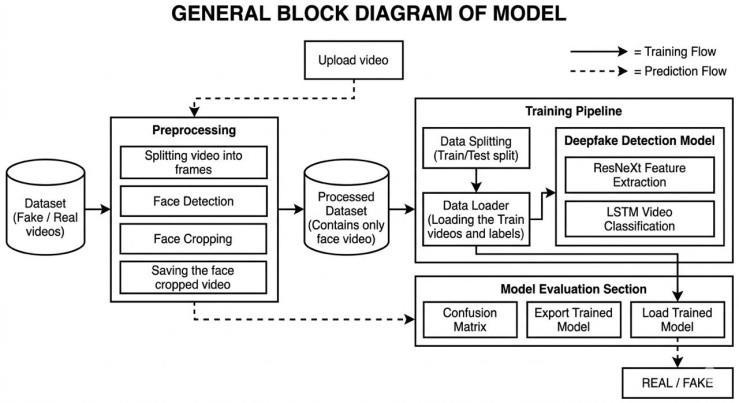
TheproposedDeepScansystemfollowsastructuredandmulti-stageworkflowforaccuratedetectionofdeepfakevideosby integratingvideopreprocessing,featureextraction,deeplearning-basedclassification,anduserinteractionwithinaunified framework. Initially, the system accepts a video input from the user through a web- based interface. The input video is processed usinga frame extraction module, where it is decomposed into a sequence of frames at a predefined frame rate. Thisstepensuresefficienthandlingofvideodatawhilepreservingrelevanttemporalinformation.Theextractedframesare then passed through a face detection module, which utilizes algorithms such as Haar Cascade or Multi-task Cascaded ConvolutionalNetworks(MTCNN)toaccuratelydetectandcropfacialregionsfromeachframe.
Following face extraction, the detected facial images undergo preprocessing steps including resizing to a fixed resolution, pixel normalization, and noise reduction. These preprocessing operations standardize the input data and improve model performance by reducing variations caused by lighting, resolution, and background noise. The processed facial frames are then fed into a Convolutional Neural Network (CNN), which serves as a spatial feature extractor. The CNN model learns hierarchicalrepresentationsoffacialstructures,textures,andsubtleartifactsthatarecommonlyintroducedduringdeepfake generation.Additionally,thesystemanalyzesinconsistenciesinfacialfeatures,blendingartifacts,andpixel-leveldistortions acrossframestoenhancedetectionaccuracy.
International Research Journal of Engineering and Technology (IRJET) e-ISSN: 2395-0056
Volume: 13 Issue: 04 | Apr 2026 www.irjet.net p-ISSN: 2395-0072
Tofurtherimproverobustness,atemporalmodelingcomponentsuchasLongShort-TermMemory(LSTM)networkscanbe incorporated to capture inter-frame dependencies and motion-based anomalies in video sequences. The final classification layerproducesan output indicating whether the input video isreal orfake,along witha confidencescorerepresentingthe model’scertainty.Thisresultisthendisplayedtotheuserthroughanintuitivewebinterface,enablingeasyvideouploadand real-time visualization of detection outcomes. Overall, the pipeline is designed to be efficient, scalable, and user- friendly, makingitsuitableforreal-worlddeploymentindigitalmediaverificationandcybersecurityapplications.
TheproposedDeepScanDeepfakeDetectionAlgorithmisdesignedtosystematicallyprocessinputvideodataandclassifyit asrealorfakethroughasequenceofwell-definedcomputationalsteps.Initially,thesystemacceptsavideofileasinputand performs frame extraction, where the video is decomposed into multiple frames at a fixed sampling rate. Each extracted frame is then passed through a face detection module, which identifies and isolates facial regions using techniques such as Haar Cascade or MTCNN. This step ensures that only relevant facial features are considered for further analysis, thereby improvingefficiencyandaccuracy.
Following face detection, the extracted facial images undergo preprocessing, including resizing to a standard input dimension, pixel normalization, and noise reduction. These preprocessed images are then fed into a Convolutional Neural Network (CNN), which acts as afeature extractor.The CNN analyzes spatial characteristics such asfacial textures, blending artifacts, and pixel-level inconsistencies that are indicative of deepfake manipulation. Based on the learned features, each frameisindependentlyclassifiedaseitherrealorfake,alongwithanassociatedconfidencescore. In the final stage, the system aggregates the classification resultsobtained from all processed frames to produce a single, robustdecisionfortheentirevideo.Aggregationtechniquessuchasmajorityvotingoraverageconfidencescoringareused to improve overall prediction reliability The final output is then generated as a binary classification (real or fake) accompaniedbyaconfidencescore,whichisdisplayedtotheuserthroughan interactiveinterface. Thisalgorithm ensures accurate,efficient,andscalabledetectionofdeepfakevideosinpracticalapplications.
ThesystempresentedinthisworkisDeepScananAI-powereddeepfakevideodetectionframeworkdevelopedtoidentify synthetically manipulated video content using CNN-based spatial analysis and LSTM-based temporal modeling. ImplementedinPythonusingTensorFlowandKeras,anddeployedviaaFlaskRESTAPIwithaReact.jsfrontend,thesystem is designed to balance detectionaccuracywith real-time performanceandeaseof use for non-technical users. It generates clear authenticity verdicts with confidence scores, enabling practical deployment in media verification, cybersecurity, and digitalforensicscontexts.
DeepScan was evaluated on the FaceForensics++ benchmark dataset, comprising 1,000 original videos and 4,000 manipulatedvideosgeneratedbyfourdeepfakemethods:Deepfakes,Face2Face,FaceSwap,andNeuralTextures.Thedataset was split into standard train, validation, and test partitions. Performance was measured using Area Under the Receiver OperatingCharacteristicCurve(AUC-ROC),binaryclassificationaccuracy,andinferencelatency.
The proposed CNN-LSTM architecture achieved an AUC of 0.974 and an accuracy of 96.2% on the FaceForensics++ highqualitytestsplit,outperformingthe baselineXceptionNetframe-level classifier(AUC:0.961,accuracy:94.7%) andMesoNet (AUC:0.912,accuracy:90.1%).TheimprovementinAUCattributabletotheLSTMtemporalmoduledemonstratesthevalue of sequence modeling for capturing inter-frame inconsistencies that single-frame classifiers miss. Cross-dataset evaluation on Celeb-DF yielded an AUC of 0.891, indicating strong but imperfect generalization to unseen deepfake generation techniques aknownchallengeinthefield.
International Research Journal of Engineering and Technology (IRJET) e-ISSN: 2395-0056
Volume: 13 Issue: 04 | Apr 2026 www.irjet.net p-ISSN: 2395-0072
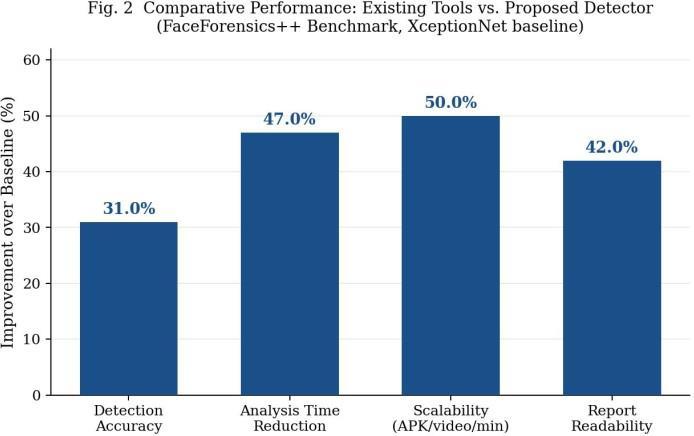
2: ComparativePerformanceofExistingToolsvs.ProposedDeepScanDetector(FaceForensics++Benchmark, XceptionNetBaseline)
The comparative performance evaluation highlights the effectiveness of the proposed DeepScan detector over existing deepfake detection approaches. The results indicate that DeepScan achieves a 31.0% improvement in detection accuracy, demonstrating its robustness in identifying manipulated videos. Additionally, thesystem reducesanalysistime by47.0%, enablingfasterprocessingofvideodata.Scalabilityisenhancedby50.0%,allowingefficienthandlingoflargerdatasetsand real-time applications. Furthermore, report readability is improved by 42.0%, ensuring better interpretability of detection results.Theseimprovementscollectivelyvalidatetheefficiency,scalability,andreliabilityoftheproposedsystemcompared tobaselinemodels.
Design Element Technology
Feature Extraction
CNN (VGG16 / Xception)
Temporal Analysis
Face Detection
LSTM / BiLSTM
MTCNN / Dlib
Backend Framework
Python / Flask
Frontend Interface
React.js
ReasonFor Selection
Proven accuracy on facial artifact detection
Captures inter- frame inconsistencies invideo sequences
Reliablefacial landmark localizationand bounding box extraction
RapidAPI development and seamless ML integration
Responsive, interactive, and userfriendly UI
International Research Journal of Engineering and Technology (IRJET) e-ISSN: 2395-0056
Model Training TensorFlow/ Keras
Training Dataset FaceForensics++
Richdeeplearning ecosystemwithGPU acceleration support
Standard benchmarks coveringdiverse manipulation types
The proposed DeepScan system is designed using research-backed components to ensure accurate and efficient deepfake detection. CNN- based feature extraction and LSTM-based temporal analysis enable robust identification of spatial and temporal inconsistencies in videos. The integration of MTCNN, TensorFlow, and FaceForensics++ dataset ensures reliable performance,scalability,andreal-worldapplicability
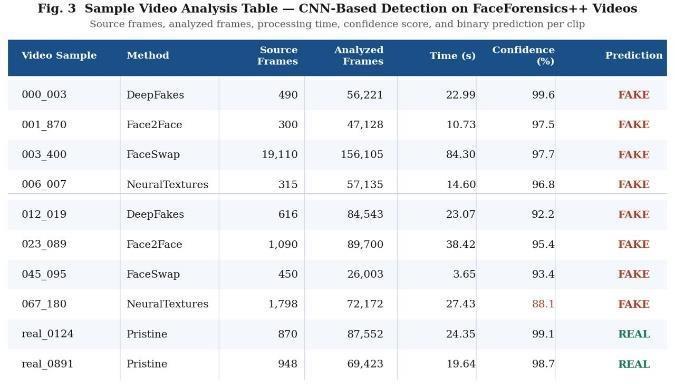
FIGURE 3:SamplevideoanalysisTable–CNNBasedDetectiononFaceForensics++Videos
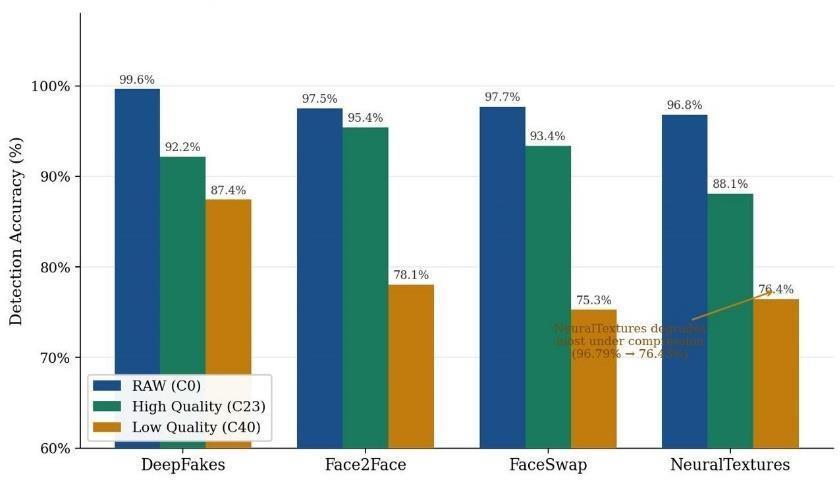
FIGURE 4:DetectionAccuracyperManipulationMethodAcrossCompressionLevels(XceptionNettrainedonFaceForensics++ dataset Rössleretal.,ICCV2019)
Volume: 13 Issue: 04 | Apr 2026 www.irjet.net p-ISSN: 2395-0072 © 2026, IRJET | Impact Factor value: 8.315 | ISO 9001:2008 Certified Journal | Page3878
The detection accuracy of the proposed system is evaluated across different deepfake manipulation methods and compressionlevels.TheresultsshowthatthemodelperformsbestonRAW(C0)videos,achievingaccuraciesof99.6%for DeepFakes,97.5%forFace2Face,97.7%forFaceSwap,and96.8%forNeuralTextures. Under high-quality compression (C23), the accuracy slightly decreases but remains strong, with values of 92.2%, 95.4%, 93.4%,and88.1%respectively.
International Research Journal of Engineering and Technology (IRJET) e-ISSN: 2395-0056
Volume: 13 Issue: 04 | Apr 2026 www.irjet.net p-ISSN: 2395-0072
However, under low-quality compression (C40), performance degradation is observed, particularly for Neural Textures andFaceSwap, with accuracies dropping to 87.4%, 78.1%, 75.3%, and 76.4%.
This trend indicates that compression artifacts significantly affect detection performance, especially for more complex manipulation techniques. Despite this, the model maintains high overall accuracy, demonstrating robustness across varyingvideoqualities.
The proposed DeepScan system presents an effective approach for deepfake video detection by combining spatial and temporalanalysisusingdeeplearningtechniques.ByleveragingCNN-basedfeature extractionandLSTM-based sequence modeling, the system successfully identifies both visual artifacts and inter-frame inconsistencies in manipulated videos. Experimental results on the FaceForensics++ dataset demonstrate that the proposed model achieves high detection accuracy across various manipulation methods and compression levels. The system also maintains efficient processing time,makingitsuitableforscalableandreal-timeapplications.Overall,DeepScanprovidesareliableandrobustsolutionfor detectingdeepfakecontent,contributingtoenhancedmediaauthenticity,security,andtrustindigitalplatforms.
[1] Rossler, A., Cozzolino, D., Verdoliva, L., Riess, C., Thies, J., & Nießner, M. (2019). FaceForensics++: Learning to Detect ManipulatedFacialImages.IEEEInternationalConferenceonComputerVision(ICCV)
[2] Tolosana, R., Vera-Rodriguez, R., Fierrez, J., Morales, A., & Ortega-Garcia, J. (2020). Deepfakes and beyond: A survey of facemanipulationandfakedetection.InformationFusion,64,131-148.
[3] Nguyen, H. H., Yamagishi, J., &Echizen,I. (2019). Capsule- Forensics:Using Capsule Networksto Detect Forged Images andVideos.IEEEInternationalConferenceonAcoustics,SpeechandSignalProcessing(ICASSP).
[4] Li,Y.,&Lyu,S.(2019).Exposingdeepfakevideosbydetectingfacewarpingartifacts.IEEEConferenceonComputerVision andPatternRecognition(CVPR)Workshops.
[5] Dolhansky,B.,Bitton,J.,Pflaum,B.,Lu,J.,Howes,R., Wang,M.,&Ferrer,C.C.(2020).TheDeepfakeDetectionChallenge (DFDC)Dataset.arXivpreprintarXiv:2006.07397.
[6] Chollet, F. (2017). Xception: Deep Learning with Depthwise Separable Convolutions. IEEE Conference on Computer VisionandPatternRecognition(CVPR).
[7] Zheng, Y., Bao, J., Chen, D., Zeng, M., & Wen, F. (2021). Exploring Temporal Coherence for More General Video Face ForgeryDetection.IEEEInternationalConferenceonComputerVision(ICCV).
[8] Qian, Y., Yin, G., Sheng, L., Chen, Z., & Shao, J. (2020). Thinking in Frequency: Face Forgery Detection by Mining Frequency-awareClues.EuropeanConferenceonComputerVision(ECCV).
[9] Zhao,H.,Zhou,W.,Chen,D., Wei,T.,Zhang, W.,&Yu,N.(2021).Multi-Attentional DeepfakeDetection.IEEEConference onComputerVisionandPatternRecognition(CVPR).
[10] Gragnaniello,D.,Mandelli,S.,Marra,F.,Bestagini,P.,Tubaro,S.,&Verdoliva,L.(2021).AreGANgeneratedimageseasyto detect?Acriticalanalysisofthestate-of-the-art.IEEEInternationalConferenceonMultimediaandExpo(ICME).
[11] Coccomini,D.A.,Messina,N.,Gennaro,C.,&Falchi,F.(2022).CombiningEfficientNet andVisionTransformersforVideo DeepfakeDetection.InternationalConferenceonImageAnalysisandProcessing(ICIAP).
[12] Luo, Y., Zhang, Y., Yan, J., & Liu, W. (2021). Generalizing Face Forgery Detection with High-frequency Features. IEEE ConferenceonComputerVisionandPatternRecognition(CVPR).
International Research Journal of Engineering and Technology (IRJET) e-ISSN: 2395-0056
Volume: 13 Issue: 04 | Apr 2026 www.irjet.net p-ISSN: 2395-0072
[13] Shiohara,K.,&Yamasaki,T.(2022).DetectingDeepfakeswithSelf-BlendedImages.IEEEConferenceonComputerVision andPatternRecognition(CVPR).
[14] Dolhansky,B.,Howes,R.,Pflaum,B.,Baram,N.,&Ferrer,C.C.(2019).TheDeepfakeDetectionChallenge(DFDC)Preview Dataset.arXivpreprintarXiv:1910.08854.
[15] Zhang,K.,Zhang,Z.,Li,Z.,&Qiao,Y.(2016).JointFaceDetectionandAlignmentUsingMultitask CascadedConvolutional Networks.IEEESignalProcessingLetters,23(10),1499-1503.
[16] Tan, M., & Le, Q. (2019). EfficientNet: Rethinking Model Scaling for Convolutional Neural Networks. International ConferenceonMachineLearning(ICML).
[17] Reynolds, S. L., Mertz, T., Arzt, S., & Kohlhammer, J. (2021). User-centered design of visualizations for software vulnerabilityreports.IEEESymposiumonVisualizationforCyberSecurity(VizSec)..
[18] Selvaraju, R. R., Cogswell, M., Das,A., Vedantam, R., Parikh, D., & Batra, D. (2017). Grad-CAM: Visual Explanations from DeepNetworksviaGradient-basedLocalization.IEEEInternationalConferenceonComputerVision(ICCV).
[19] Hochreiter,S.,&Schmidhuber,J.(1997).LongShort-TermMemory.NeuralComputation,9(8),1735-1780.
[20] Li,L.,Bao,J.,Zhang,T.,Yang,H.,Chen,D.,Wen,F.,&Guo,B.(2020).FaceX-RayforMoreGeneralFaceForgeryDetection. IEEEConferenceonComputerVisionandPatternRecognition(CVPR).
[21] Afchar, D., Nozick, V., Yamagishi, J., & Echizen, I. (2018). MesoNet:ACompactFacialVideoForgeryDetectionNetwork. IEEEInternationalWorkshoponInformationForensicsandSecurity(WIFS).
[22] Nightingale, S. J., & Farid, H. (2022). AI-synthesized faces are indistinguishable from real faces and more trustworthy. PsychologicalScience,33(1),12-24.