
International Research Journal of Engineering and Technology (IRJET) e-ISSN: 2395-0056
Volume: 13 Issue: 04 | Apr 2026 www.irjet.net p-ISSN: 2395-0072

International Research Journal of Engineering and Technology (IRJET) e-ISSN: 2395-0056
Volume: 13 Issue: 04 | Apr 2026 www.irjet.net p-ISSN: 2395-0072
Vijay
Chakole1, Akshita Lanjewar2, Astha Jadhao3, Pallavi Chikate4, Mayuri Sawalakhe5
1Professor, Dept. of Electronics and Telecommunication Engineering, K.D.K. college of eng.,Nagpur, India 234Student, Dept. of Electronics and Telecommunication Engineering, K.D.K. college of eng.,Nagpur, India
Abstract -Deepfake technology has rapidly evolved with the advancement of artificial intelligence, enabling the creation of highly realistic synthetic images and videos. While this technology has useful applications, it also raises serious concerns related to misinformation, identity misuse, and digital security. Detecting such manipulated content has become increasingly challenging due to the complexity ofmoderngenerationtechniques.
This paper presents a deep learning-based approach for detecting deepfake images using multiple Convolutional Neural Network (CNN) architectures. Models including GoogLeNet,InceptionV3, VGG16,DenseNet121, andXception were implemented using transfer learning. The dataset was preprocessed, augmented, and divided into training, validation,andtestingsetstoensurereliableevaluation.
The models were compared based on accuracy and performance metrics, where VGG16 achieved the highest accuracy among all models. The final system was deployed using a Flask-based web interface, allowing users to upload images and obtain real-time predictions. The results demonstrate the effectiveness of CNN-based approaches for deepfake detection and their potential for real-world applications.
Key Words: Synthetic media analysis, Artificial intelligence in forensics, Convolutional neural networks (CNNs) ,Transferlearning techniques,Image classification models, Digital content authenticity ,Deep learning architectures,Dataaugmentationmethods.
In recent years, the rapid advancement of artificial intelligenceanddeeplearninghasledtotheemergenceof deepfake technology,whichenablesthe creationofhighly realistic manipulated imagesand videos. These deepfakes are generated using sophisticated algorithms that can replace or alter facial features, making it difficult to distinguish between real and fake content. While such technology has useful applications in fields like entertainment and virtual reality, it also introduces seriousrisks,includingmisinformation,identitytheft,and privacyviolations.
Traditional image processing techniques are often inadequatefordetectingdeepfakesduetotheirinabilityto
capture complex and subtle visual patterns. In contrast, deep learning models, especially Convolutional Neural Networks (CNNs), have proven to be highly effective in imageclassificationtasks.Thesemodelscanautomatically learn important features from images, making them suitableforidentifyingmanipulatedcontent.
This research focuses on developing a deepfake detection system using multiple CNN architectures. By implementing and comparing models such as GoogLeNet, InceptionV3, VGG16, DenseNet121, and Xception, the study aims to identify the most effective architecture for accurate detection. Additionally, the project extends beyond model development by deploying the bestperforming model using a web-based interface, making thesystempracticalforreal-timeuse.
Hany Farid conducted significant research in the field of digital image forensics, proposing methods to detect manipulated media by analyzing inconsistencies in visual and statistical patterns. These techniques laid the foundation for forgery detection; however, they are less effective when applied to highly realistic deepfake images generatedusingadvanceddeeplearningmodels.
Andreas Rössler et al. introduced the FaceForensics++ datasetandevaluatedseveraldeeplearningapproachesfor detecting manipulated facial images. Their work demonstratedthatConvolutionalNeuralNetworks(CNNs) outperform traditional methods in identifying deepfakes, although their performance depends heavily on dataset qualityanddiversity.
Karen Simonyan and Andrew Zisserman developed the VGG16 architecture, which uses deep convolutional layers toextractdetailedimagefeatures.Duetoitsstrongfeature extraction capability, VGG16 has been widely adopted in imageclassificationanddeepfakedetectiontasks.
Christian Szegedy et al. proposed the Inception architecture, including GoogLeNet and InceptionV3, which utilizemulti-scaleconvolutionfilterstocapturefeaturesat different resolutions. This approach improves computational efficiency while maintaining high performance.
International Research Journal of Engineering and Technology (IRJET) e-ISSN: 2395-0056
Volume: 13 Issue: 04 | Apr 2026 www.irjet.net p-ISSN: 2395-0072
GaoHuangetal.introducedDenseNet,anarchitecturethat connectseachlayertoeverypreviouslayer,allowingbetter feature reuse and improved gradient flow. This design enhanceslearningefficiencyandreducescommontraining issuessuchasvanishinggradients.
FrançoisCholletproposedtheXceptionarchitecture,which uses depthwise separable convolutions to improve model efficiency and performance. This model has shown promising results in various image classification and deepfakedetectiontasks.
The proposed system is designed to detect whether an inputimageisrealorfakeusingdeeplearningtechniques. The system follows a structured pipeline that includes data preprocessing, model training, evaluation, and deployment.The primaryobjectiveisto buildanaccurate and efficient deepfake detection system by comparing multiple Convolutional Neural Network (CNN) architectures.
Thesystembeginswithcollectingandorganizingadataset containing real and fake images. These images are then preprocessedtomatchtheinputrequirementsofdifferent CNNmodels.Dataaugmentationtechniquesareappliedto increase dataset diversity and improve model generalization.
Multiple pretrained CNN models GoogLeNet, InceptionV3, VGG16, DenseNet121, and Xception are implementedusingtransferlearning.Inthisapproach,the base layers of each model are retained, and custom classification layers are added for binary classification. This helps reduce training time while maintaining high performance.
After training, the models are evaluated using performance metrics such as accuracy, confusion matrix, precision, recall, and F1-score. A comparative analysis is performedtodeterminethebest-performingmodel.
Finally,theselectedmodelisdeployedusingaFlask-based web application. This allows users to upload images and obtain predictions in real time, making the system practicalanduser-friendly
Theproposedmethodologyfollowsasystematicapproach todevelopandevaluateadeepfakedetectionsystemusing multipleCNNmodels.
The dataset used in this project consists of images categorized into two classes: real and fake. The dataset is dividedintothreesubsets:
• Trainingset
• Validationset
• Testingset
This structured division ensures proper training, validation during learning, and final evaluation of model performance.
Before training,all imagesare resizedaccording to model requirements:
224 × 224 × 3 for GoogLeNet, InceptionV3, VGG16, and DenseNet121
299×299×3forXception
Additionally, pixel values are normalized to the range [0,1], which helps in faster convergence and stable trainingofthemodels.
To improve model generalization and reduce overfitting, data augmentation techniques are applied using ImageDataGenerator.Theseinclude:
• Rotation
• Zooming
• Widthandheightshifting
• Shearing
• Horizontalflipping
These transformations increase dataset variability and helpthemodellearnrobustfeatures.
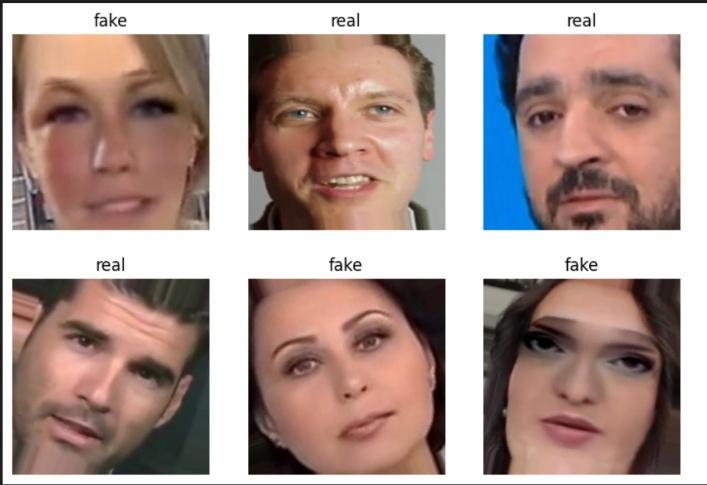
Fig-5.3: DataAugmentation
International Research Journal of Engineering and Technology (IRJET) e-ISSN: 2395-0056
Volume: 13 Issue: 04 | Apr 2026 www.irjet.net p-ISSN: 2395-0072
Five pretrained Convolutional Neural Network (CNN) architecturesareimplementedusingtransferlearning:
GoogLeNet – Uses Inception modules for multi-scale featureextraction
InceptionV3 – Improved version of Inception with optimizedcomputation
VGG16 – Deep architecturewith strong feature extraction capability
DenseNet121 – Uses dense connections for efficient featurereuse
Xception – Uses depthwise separable convolutions for betterperformance
Inallmodels,pretrainedweightsfromImageNetareused, and custom classification layers are added for binary classification.
4.5
Themodelsaretrainedusingthefollowingconfiguration:
• Optimizer:Adam
• LearningRate:0.0001
• LossFunction:BinaryCrossentropy
• Epochs:10
• BatchSize:32
The validation dataset is used during training to monitor performanceandpreventoverfitting.
Theperformanceofthemodelsisevaluatedusing:
Accuracy
ConfusionMatrix
Precision,Recall,andF1-score
These metrics provide a comprehensive understanding of how well the model performs in classifying real and fake images.
4.7
The trainedmodel isusedtoclassifynewinputimagesas real or fake. The final system is deployed using a Flaskbased web application, allowing users to upload images andreceivepredictionsinrealtime.
The performance of the implemented CNN models was evaluated using accuracy and classification metrics. A comparative analysis was conducted to determine the mosteffectivemodelfordeepfakedetection.
Theaccuracyobtainedbyeachmodelispresentedin
Table 1: AccuracycomparisonofCNNmodels
From the results, it is observed that VGG16 achieved the highest accuracy, indicating its strong ability to extract detailedfeaturesfromimages.DenseNet121andXception alsoperformedwellduetotheirefficient architectureand featurereusemechanisms.InceptionV3showedmoderate performance, while GoogLeNet achieved lower accuracy butmaintainedfastercomputation.
Thetrainingandvalidationaccuracygraphsshowthatthe models learned effectively over epochs, with minimal overfitting due to the use of data augmentation techniques. Confusion matrices further demonstrate the model’s capability to correctly classify real and fake images.
Overall, the results confirm that deeper architectures combined with transfer learning provide better performanceindetectingdeepfakeimages.
6.1
The trained model was tested on unseen images to evaluate its performance in real-world scenarios. The system successfully classifies input images into two categories: Real and Fake, based on probability scores generatedbythemodel.
In the demonstrated output, the uploaded image is predicted as REAL with a confidence score of approximately 67.33%, indicating the model’s ability to generalizeandmakereliablepredictionsonnewdata.
To make the system practically usable, a web-based interface was developed using the Flask framework. This
International Research Journal of Engineering and Technology (IRJET) e-ISSN: 2395-0056
Volume: 13 Issue: 04 | Apr 2026 www.irjet.net p-ISSN: 2395-0072
interfaceprovidesaneasyandinteractivewayforusersto testthemodel.
Thekeyfeaturesoftheinterfaceinclude:
• Selectionoftrainedmodels
• Imageuploadfunctionality
• Automaticpreprocessingoftheinputimage
• Real-timepredictionoutput
• Displayofconfidencescore
After uploading an image and clicking the Predict button, the systemprocessesthe image anddisplays the result as either Real or Fake along with the corresponding confidencevalue.


System Workflow
Theoverallworkflowofthesystemisasfollows: Input Image → Preprocessing → CNN Model → Prediction →OutputDisplay
International Research Journal of Engineering and Technology (IRJET) e-ISSN: 2395-0056
Volume: 13 Issue: 04 | Apr 2026 www.irjet.net p-ISSN: 2395-0072
This pipeline ensures efficient processing and enables real-time deepfake detection through a user-friendly interface.
ThecomparativeevaluationofdifferentCNNarchitectures highlights the importance of model design in deepfake detection. Among all the implemented models, VGG16 achieved the highest accuracy, which can be attributed to its deep architecture and ability to capture fine-grained imagefeatures.Thismakesitmoreeffectiveinidentifying subtledifferencesbetweenrealandmanipulatedimages.
DenseNet121 and Xception also demonstrated strong performance due to their advanced architectural designs. DenseNet121 improves feature reuse through dense connections, while Xception enhances efficiency using depthwise separable convolutions. These characteristics contribute to better learning and improved classification results. In contrast, Inception-based models such as GoogLeNet and InceptionV3 showed comparatively lower accuracy, indicating a trade-off between computational efficiencyanddetectionperformance.
The use of transfer learning played a crucial role in improvingmodelperformance,aspretrainedmodelswere able to leverage previously learned features. Additionally, data augmentation helped increase dataset variability, reducing overfitting and improving generalization on unseendata.
The deployment of the system using Flask demonstrates its practical applicability. By providing a simple interface for users to upload images and receive predictions, the system bridges the gap between theoretical models and real-worldusage.Thismakesitsuitableforapplicationsin digitalmediaverificationandcybersecurity.
This research presents a comprehensive deepfake detection system using multiple Convolutional Neural Network (CNN) architectures. The study combines a review of existing methods with the implementation and evaluation of different models, providing a complete analysisofdeepfakedetectiontechniques.
Among the implemented models, VGG16 achieved the highest accuracy, demonstrating its strong capability in extracting detailed image features. DenseNet121 and Xception also showed competitive performance, highlightingtheeffectivenessofadvancedarchitecturesin improvingdetectionaccuracy.Theuseoftransferlearning significantlyreducedtrainingtimewhilemaintaininghigh performance, and data augmentation techniques further enhancedmodelgeneralization.
In addition to model evaluation, the system was successfullydeployedusingaFlask-basedwebapplication. This allows users to upload images and receive real-time predictions,makingthesystempracticalanduser-friendly. The integration of model performance and real-world implementation strengthens the overall contribution of thiswork.
Overall,theresultsconfirmthatdeeplearningapproaches are highly effective for detecting deepfake images. The study also emphasizes the importance of selecting appropriate architectures and preprocessing techniques toachievebetteraccuracyandreliability.
Although the proposed system demonstrates effective performance in detecting deepfake images, there are several areas where further improvements can be made. Futureworkcanfocusonenhancingboththeaccuracyand scalabilityofthesystem.
One possible direction is to use larger and more diverse datasets, which can help the model generalize better and improveitsrobustnessagainstdifferenttypesofdeepfake techniques. Additionally, advanced architectures such as EfficientNet or Vision Transformers can be explored to achievehigheraccuracyandbetterfeaturerepresentation.
Another important extension is the implementation of video-based deepfake detection, where temporal information and frame-level analysis can be utilized to detect manipulated videos more effectively. This would significantly increase the practical applicability of the system.
The system can also be improved by developing a realtime detection application for mobile or web platforms, making it more accessible to users. Furthermore, integrating explainable AI techniques can help in understanding model decisions and improving transparency.
Overall, future enhancements can make the system more accurate,efficient,andsuitableforreal-worlddeployment inareassuchascybersecurity,digitalforensics,andmedia verification.
The authors sincerely acknowledge the contributions of the research community in the fields of artificial intelligenceanddigitalforensicsthatsupportedthiswork. We also extend our thanks to our guides and institution for their valuable support and encouragement during the project.
International Research Journal of Engineering and Technology (IRJET) e-ISSN: 2395-0056
Volume: 13 Issue: 04 | Apr 2026 www.irjet.net p-ISSN: 2395-0072
[1] J.J.BirdandA.Lotfi,“CIFAKE:ImageClassificationand Explainable Identification of AI-Generated Synthetic Images,”IEEEAccess,vol.12,2024.
[2] H. Farid, “Image Forgery Detection: A Survey,” IEEE Signal Processing Magazine, vol. 26, no. 2, pp. 16–25, Mar.2009.
[3] A.Rössler,D. Cozzolino, L. Verdoliva,C. Riess, J. Thies andM.Nießner,“FaceForensics++:LearningtoDetect Manipulated Facial Images,” Proc. IEEE International Conference on Computer Vision (ICCV), 2019, pp. 1–11.
[4] Y. Li and S. Lyu, “Exposing DeepFake Videos By Detecting Face Warping Artifacts,” Proc. IEEE Conference on Computer Vision and Pattern RecognitionWorkshops(CVPRW),2019.
[5] D. Güera and E. J. Delp, “Deepfake Video Detection Using Recurrent Neural Networks,” Proc. IEEE International Conference on Advanced Video and Signal-BasedSurveillance(AVSS),2018,pp.1–6.
[6] C. Szegedy, W. Liu, Y. Jia, P. Sermanet, S. Reed, D. Anguelov, D. Erhan, V. Vanhoucke and A. Rabinovich, “Going Deeper with Convolutions,” Proc. IEEE Conference on Computer Vision and Pattern Recognition(CVPR),2015.
[7] C. Szegedy, V. Vanhoucke, S. Ioffe, J. Shlens and Z. Wojna, “Rethinking the Inception Architecture for ComputerVision,”Proc.IEEEConferenceonComputer VisionandPatternRecognition(CVPR),2016.
[8] K. Simonyan and A. Zisserman, “Very Deep Convolutional Networks for Large-Scale Image Recognition,” Proc. International Conference on LearningRepresentations(ICLR),2015.
[9] G. Huang, Z. Liu, L. Van Der Maaten and K. Q. Weinberger, “Densely Connected Convolutional Networks,”Proc.IEEEConferenceonComputerVision andPatternRecognition(CVPR),2017.
[10] F. Chollet, “Xception: Deep Learning with Depthwise Separable Convolutions,” Proc. IEEE Conference on Computer Vision and Pattern Recognition (CVPR), 2017.
[11] B.Dolhanskyetal.,“TheDeepfakeDetectionChallenge Dataset,”arXivpreprintarXiv:2006.07397,2020.
[12] H. Nguyen, J. Yamagishi and I. Echizen, “CapsuleForensics: Using Capsule Networks to Detect Forged Images and Videos,” Proc. IEEE International Conference on Acoustics, Speech and Signal Processing(ICASSP),2019.
[13] X. Yang, Y. Li and S. Lyu, “Exposing Deep Fakes Using Inconsistent Head Poses,” Proc. IEEE International Conference on Acoustics, Speech and Signal Processing(ICASSP),2019.
[14] S. Agarwal et al., “Protecting World Leaders Against Deepfakes,” Proc. IEEE Conference on Computer Vision and Pattern Recognition Workshops (CVPRW), 2019.
[15] Z. Wang et al., “CNN-generated Images are Surprisingly Easy to Spot… for Now,” Proc. IEEE Conference on Computer Vision and Pattern Recognition(CVPR),2020.