
International Research Journal of Engineering and Technology (IRJET) e-ISSN: 2395-0056
Volume: 13 Issue: 02 | Feb 2026 www.irjet.net p-ISSN: 2395-0072
International Research Journal of Engineering and Technology (IRJET) e-ISSN: 2395-0056
Volume: 13 Issue: 02 | Feb 2026 www.irjet.net p-ISSN: 2395-0072
N. Anjali1 , Karne Charan Kumar 2 , Basvoju Sharath Kumar3 , Garrepalli Abhilash4 , Goskonda Rohith Reddy 5
1Assistant Professor, Department of Information Technology, TKR College of Engineering and Technology, Telangana, India
2345Department of Information Technology, TKR College of Engineering and Technology, Telangana, India
Abstract - However, modern agriculture is increasingly beset by uncertainties in terms of weather and environmental changes, which makes precise forecasting more imperative than ever. This project examines the potential of deep learning, and more specifically, a GRU-based model, to enhance crop yield prediction by learning from climatic data, soil data, and past crop yields. The model analyzes raw agricultural data through a sophisticated preprocessing and time-series feature engineering process to producerobustand informative inputs for the GRU model. After training, the model predicts future crop yieldsandassociatedvalues,andits accuracy is verified by RMSE, MAE, and R² measures to ensure its reliability and accuracy. Through the demonstration of the power of AI prediction in agriculture, this project will help create a smarter agricultural ecosystem. Apart from prediction, this project will help in the allocation of resources and the risks associated with climate variability, leading to improved food security.
Key Words: Crop Yield Prediction, Deep Learning, GRU (Gated Recurrent Unit), Time-Series Analysis, Climatic and Soil Data, Precision Agriculture, Agricultural Decision Support
Agricultureplaysanimportantroleinourdailylives,butit is also one of the most affected sectors by changes in weatherandtheenvironment.Farmersoftenhavetomake importantdecisionswithoutknowinghowfutureconditions willturnout,whichcanaffectfoodsupply,income Having the right information at the right time can make a big difference.
Today, there is more data available than ever before, includingweatherrecords,soilinformation,andpastcrop yields. The main challenge is turning all this data into somethinguseful.Thisprojectfocusesondoingexactlythat byusingmoderndeeplearningapproach,specificallyaGRUbasedmodel,topredictcropyieldsmoreaccurately.
Bystudyingpatternsinclimateandsoildataovertime,the model can be trained relationships that are difficult to capturewithtraditionalmethods.Thiscanhelpsfarmersand
planners better understand risks, plan ahead, and make smarterdecisions.
The project follows step by step process that starts with cleaningandpreparingrawdataandtrainingthemodelon historicalagriculturaldata.Themodel’sperformanceisthen evaluatedusingstandardmeasureslikeRMSE,MAE,andR² toensurethepredictionsarereliable.
Despitetheavailabilityoflargevolumesofagriculturaldata, mostdecision-makinginfarmingstillreliesonintuitionor delayed historical analysis. Conventional statistical and machine learning models often fail to capture long-term temporal dependencies and nonlinear interactions among climatic,soil,andmarketvariables.Asa result, prediction accuracy degrades significantly under volatile conditions such as irregular rainfall, climate anomalies, and market fluctuations. This gap between data availability and actionableintelligencehighlightstheneedforadvanceddeep learning approaches capable of extracting meaningful temporalpatternsfromcomplexagriculturaldatasets.
Recurrent neural networks have shown promise in timeseries prediction; however, traditional RNNs suffer from vanishing gradient problems when learning long-term dependencies. Gated Recurrent Units (GRUs) address this limitationthroughupdateandresetgates,enablingefficient learningwithreducedcomputationalcomplexitycompared toLSTMmodels.ThismakesGRUparticularlysuitablefor agricultural forecasting, where datasets are large, multivariate, and sequential in nature. By leveraging GRU architecture, the proposed system achieves a balance between prediction accuracy, training efficiency, and scalability.
The objective of this project is to create an effective GRU forecasting model that is capable of comprehending the patternsofcropyieldsandprices.TheGRUmodelisableto analyzethedataandlearnthepatternsthataffectcropyields. The use of the GRU model is effective because it is able to provide accurate results compared to other models.
Thecorecomponentofthisprojectistheforecastingmodel thatiscapableofanalyzingdatainordertoprovidefuture
International Research Journal of Engineering and Technology (IRJET) e-ISSN: 2395-0056
Volume: 13 Issue: 02 | Feb 2026 www.irjet.net p-ISSN: 2395-0072
projections.Thedataprovidedbytheforecastingmodelcan beusedtomakeeffectivedecisionsintheagriculturesector.
Inadditiontoyieldprediction,theGRUmodelalsosupports market intelligence by learning price movement trends influenced by seasonal patterns, production volume, and climatic variability.Themodel processessequentialinputs usingaslidingwindowmechanism,allowingittounderstand short-termfluctuationsaswellaslong-termseasonaleffects. Thisdualcapabilityenablesthesystemtofunctionnotonly as a forecasting engine but also as a strategic decisionsupporttoolforfarmersandagriculturalstakeholders.
The need for precise forecasting of crop prices is becoming increasingly necessary in order to help and support farmers, traders, and agricultural markets. Crop pricesdirectlyaffecttheincomeandplanningoffarmers,but theyarealsoaffectedbyunpredictablefactorssuchascrop supply,markettrends,andweatherconditions.Farmerscan decideonwhichcropstogrow,whentosellthem,andhow to deal with financial risks using the assistance of precise croppriceforecasts.
The complexity of the problem makes it difficult for conventionalmodelstodealwith.Conventionalmodelsare lessreliablewhenthesituationisrapidlychanging,asthey tendtoworkoncertainassumptionsandtrends.Therefore, theirpredictionsmaynotbeaccurateandmaynotconsider theunpredictabilityoftherealworld.
Beyond individual farmers, accurate agricultural forecastingplaysacriticalroleinstabilizingsupplychains andsupportingpolicy-levelplanning.Governmentagencies, cooperatives,andagri-marketsrequirereliableinsightsto manage storage, pricing policies, and food distribution. A data-driven forecasting system powered by deep learning cansignificantlyreduceuncertaintyacrosstheagricultural ecosystem, enabling proactive interventions instead of reactive measures. This broader impact further motivates the development of an intelligent, scalable forecasting framework.
This model applies a GRU deep learning model to predict what will happen in agricultural time series. It is not like othermodelsbecauseitcanidentifycomplexrelationships betweentemperature,rainfall,humidity,soil,andpastcrop growth.SinceitappliestheGRUmodel’sgatingmechanism,it can learn seasonal patterns and short-term patterns. This helpsittomakeaccuratepredictions.
To ensure that the data it employs is accurate, this model employs a data cleaning process. This process removes missing data, validates data consistency, and handles time
series data such as lag features and rolling statistics. This modelemploysdatafromdifferentsourcessuchasweather APIs,farmdatabases,andremotesensing.Byemployingall this data, the GRU model is able to identify variables that affectthegrowthofcropsandotheragriculturaloutcomes. Moreover, the system has evaluation and deployment componentsthatcanbeusedforpracticalimplementation. The performance of the models is checked using common metrics like RMSE, MAE, and R² values. Visualization components such as prediction graphs and the plots of residuals can be used for understanding the output. The system is developed in such a way that it is modular and scalable,thereforeitcanbeimplementedonalocalmachine, andalsoitcanbeimplementedonacloudplatform.
The proposed system has many crucial advantages. The system is able to efficiently process complex agricultural databymodelingthenonlinearandseasonaldependencies between variables, which are difficult to capture using traditionalapproaches.Thesystemtakesacomprehensive approach to agricultural dynamics by considering multivariatedatafromweather,soil,andyieldsources,and it is able to improve the accuracy of predictions. The proposedsystemissuitablefordifferentregionsandtypes of crops, and it only requires less modifications for new environments. The system capability to work with live weatherdataandenablesreal-timeandfuturepredictions, which are used to make timely decisions related to irrigation, harvesting, and risk management. Additionally, the system use of user-friendly evaluation metrics and flexibledeploymentcapabilitiesensuresthatthesystemis usefulforawiderangeofusers.
The proposed system follows a modular pipeline architecture, ensuring clear separation between data ingestion, preprocessing, model training, forecasting, and visualization components. Such a design improves maintainability and allows individual modules to be enhancedorreplacedwithoutaffectingtheoverallsystem. This modularity also supports scalability, enabling the systemtoadapttonewcrops,regions,ordatasourceswith minimalstructuralchanges.
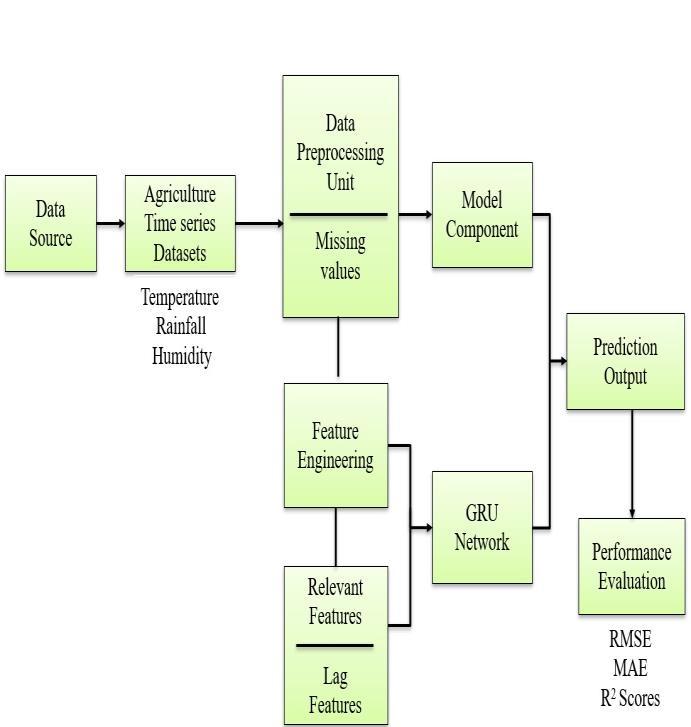
ThisflowchartillustratestheprocedureofaGRU-basedcrop yieldprediction model usingagricultural timeseries data. The procedure starts with the collection of raw data from various sources, including temperature, rainfall, and humidity,whichmakeuptheagriculturaltimeseriesdata. The data is then processed using the preprocessing step, where missing data is handled to ensure data quality. Featureengineeringisthenperformedtoidentifyimportant features like lag variables to represent temporal relationships.Thepreprocessedfeaturesaretheninputinto theGRUnetworkinthemodelcomponent,wherecomplex patterns are learned to produce prediction results. The
International Research Journal of Engineering and Technology (IRJET) e-ISSN: 2395-0056
Volume: 13 Issue: 02 | Feb 2026 www.irjet.net p-ISSN: 2395-0072
processconcludeswiththeevaluationofpredictionresults using metrics such as RMSE, MAE, and R² values to determineaccuracyandvalidity.
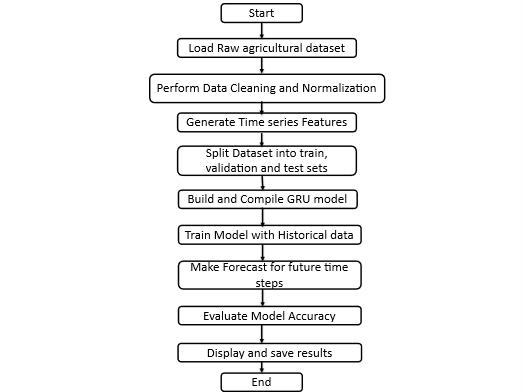
Thisflowchartrepresentstheentireprocessofcreatingand implementing a GRU deep learning model for agricultural forecasting.Theprocessstartswiththeloadingoftheraw agricultural data, followed by data cleaning and normalizationtogetthedatareadyformodeling.Then,time series features are extracted to identify the temporal patternsinthedata.
The data is then split into training, validation, and testing sets to properly evaluate the model. The GRU model is created and compiled, and then it is trained using past agricultural data to identify patterns associated with agricultural yields or prices. After training, the model forecasts future values. The accuracy of the model is then checkedusingappropriatemetricstoverifythecorrectness oftheforecastedvalues.
Finally, the results are shown and saved for future use, marking the end of the entire agricultural forecasting process.
This structured workflow ensures transparency and repeatabilityacrossallstagesoftheforecastingprocess.By systematicallyvalidatingeachphase fromdatapreparation to model evaluation the system minimizes error propagation and improves prediction reliability. The workflowdesignalsofacilitatesfutureenhancementssuch asautomatedretraining,real-timedataingestion,andmultistep forecasting, positioning the system for real-world agriculturaldeployment.
Thecollecteddatasetswerethencleanedandpreparedfor analysis and modeling. Missing values were handled carefullytoensurethattherewerenogapsinthedata,while outlierswereremovedtoensurethattheydidnotaffectthe performance of the model. The data was standardized to ensurethaterrorsandnoisethatcouldaffectthelearning process of the model were eliminated. At the end of the preprocessing phase, the data had been transformed to a cleanandtrustworthystate,readyforfeatureengineering.
Missingvalueswerehandledcarefullytoensurethatthere were no gaps in the data, while outliers were removed to ensurethattheydidnotaffecttheperformanceofthemodel. Numerical features were normalized and standardized to ensure that they were on an equal scale. Additionally, the datawascarefullycheckedandsynchronizedtoensurethat allinconsistencieswereeliminated.
Thecleaneddatawasconvertedintoaformofdatathatis more informative to aid the model in understanding the patterns that exist over time. New variables such as lag variables, rolling statistics, and season variables were introducedtothedatatoenablethemodeltounderstandthe trendsandthepastdependenciesthatexistinthedata.This step is greatly improved the accuracy of the forecast.
Featuresrelatedtolagweredevelopedtoindicatehistorical patterns of target variables, while rolling statistics were developed to indicate both short-term and long-term patterns.Seasonalfeatureslikemonthandweekwerealso
International Research Journal of Engineering and Technology (IRJET) e-ISSN: 2395-0056
Volume: 13 Issue: 02 | Feb 2026 www.irjet.net p-ISSN: 2395-0072
developedtoindicateperiodicpatternsinthedata.Allthe featureswerecarefullysynchronizedtoavoiddataleakage.
TheGRUneuralnetworkmodelwasdevelopedandtrained usingthedesignedfeaturestolearnpatternsfromthepast agriculturaldata.Thetrainingofthemodelinvolvedaseries oflearningiterationsforthemodeltoadaptitsparameters inordertoreducetheerrorsthatexistedinthepredictions. Thevalidationsetsandearlystoppingmethodswereusedto ensure that the model learned well without overfitting, in order to make predictions on new data. The model was optimizedusinghyperparameters,andthebestmodelwas chosenforfuturepredictionsandanalysis.Afterthisstage, theGRUneuralnetworkmodelhadgainedsufficientinsight into patterns in time to enable it to make accurate predictionsforagriculturalvariablessuchascropyieldsand othertime-dependentvariables.
The trained GRU model was tested on unseen data to determinetheaccuracyofthepredictionsmade on future values. The predictions were then compared to the actual historical values to determine both the strengths and weaknesses.TheperformancemetricsofMAE,RMSE,andR² were used to determine the accuracy of the predictions made. The residual analysis was used to determine the errorsmade,andtheresultsconfirmedthatthemodelhad mettheperformancecriteriaandwasreadyforuseinrealworldapplications.
Toimprovetrainingstabilityandgeneralizationcapability, multiple optimization strategies were employed during model development. Batch normalization layers were introduced to stabilize gradient flow and accelerate convergence, while dropout layers were used to reduce overfittingcaused byhigh model complexity.TheAdamW optimizerwasselectedduetoitsadaptivelearningrateand effective weight decay handling, which helps prevent excessive parameter growth. Early stopping based on validation loss further ensured that the model retained optimalweightswithoutunnecessarytrainingiterations.
UsingthetrainedGRUmodelandtheinputdataavailable, theprimarypurposeofthisstageistopredictthefuturethat itwillbehelpfulfor.Eventhoughmorecomplexfunctions such as multi-step prediction and the estimation of confidenceintervalsarecurrentlybeingdeveloped,atthis stage,theonlypredictionthatcanbemadeisasingle-step prediction.Theaimofmakingthesepredictionsistohave thembeasaccurateaspossibleandusefulforplanningand decision-making.
The forecasting capability of the proposed GRU model enablesproactiveagriculturalplanningratherthanreactive
decision-making.Bypredictingfutureyieldandpricetrends based on recent observations, the system allows stakeholders to anticipate market movements and production outcomes. Even in its current single-step forecasting configuration, the model provides valuable short-term insights that can guide harvesting schedules, storageplanning,andpricingstrategies.Thesepredictions formthefoundationforfutureextensionsintomulti-horizon forecasting.
This stage is all about providing the predictions and performance outcomes of the model in an organized and presentablemanner.Currently,primaryvisualizationtools suchasactualvspredictedgraphshavebeenincorporatedto giveafirstglimpseofhowthemodelisperforming. However, more sophisticated visualization tools, such as interactive dashboards and automated reporting capabilities,arestillbeingdeveloped.Additionally,workis beingputintoimprovingthestorageandorganizationofthe forecast output to ensure that the results can be easily accessedandevaluatedatalaterdate.Theaimofthisstage istoprovideameaningfulandpolishedvisualexperiencefor theend-user.
Visualization plays a critical role in building trust in predictive systems, especially in agriculture where users maynothavetechnicalbackgrounds.Bypresentingactual versuspredictedvaluesandtraining-validationperformance curves, the system enables users to visually assess model accuracy and learning behavior. Such interpretability ensures that the forecasts are not treated as black-box outputs,butasinformedinsightssupportedbyobservable performancetrends.
The performance of the proposed GRU-based predictive analytics system was evaluated using real agricultural datasetscontainingclimatic,soil,yield,andmarket-related parameters. The effectiveness of the model was assessed through both quantitative metrics and visual analysis to ensure reliability, stability, and practical usability in realworldagriculturaldecision-making.
To measure prediction accuracy, standard regression performance metricssuchasMeanAbsoluteError(MAE), Root Mean Squared Error (RMSE), and the coefficient of determination (R²) were used. MAE provides an intuitive measure of the average absolute prediction error, while RMSE penalizes larger errors more heavily, making it sensitivetoextremedeviations.TheR²scoreindicateshow
International Research Journal of Engineering and Technology (IRJET) e-ISSN: 2395-0056
Volume: 13 Issue: 02 | Feb 2026 www.irjet.net p-ISSN: 2395-0072
wellthepredictedvaluesexplainthevarianceintheactual data.
The obtained results show that the GRU-based model achieves low MAE and RMSE values, indicating minimal deviation between predicted and actual crop prices and yield-relatedoutputs.AhighR²scorefurtherconfirmsthat the model successfully captures the underlying temporal patterns and dependencies present in multivariate agricultural time-series data. These results validate the suitabilityofGRUnetworksforagriculturalforecastingtasks involvingcomplexnonlinearrelationships.
The training and validation loss curves were analyzed to evaluatethelearningbehaviorandgeneralizationcapability of the model. The observed curves exhibit smooth and consistent convergence, with both training and validation losses are decreasing steadily over successive epochs. Importantly,nosignificantdivergencebetweentrainingand validationlosswasobserved,indicatingthatthemodeldoes notsufferfromoverfitting.
Theuseofregularizationtechniquessuchasdropout,batch normalization,andearlystoppingcontributedsignificantly tostabilizingthelearningprocess.Earlystoppingensured that training was halted once the validation performance stoppedimproving,therebypreservingtheoptimalmodel state.Thisbehaviordemonstratesthatthemodeliscapable ofgeneralizingwelltounseendata,whichiscriticalforrealworldagriculturalforecastingapplications.
Visual inspection of the actual versus predicted plots providesfurtherinsightintothemodel’sperformance.The predictedvaluescloselyfollowtheactualdatatrendsacross most test samples, indicating strong predictive alignment. Minor deviations observed at certain points can be attributedtosuddenchangesinmarketbehaviororextreme climaticvariations,whichareinherentlydifficulttomodel accurately.
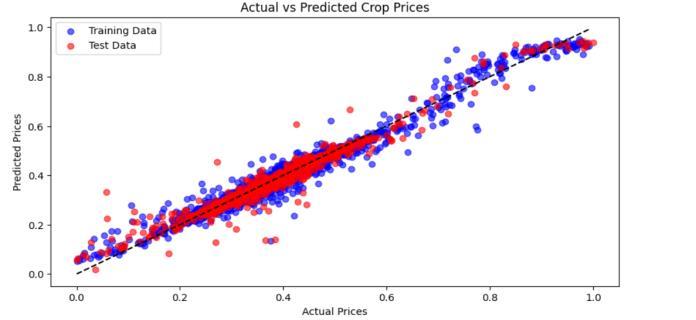
The predicted versus actual crop price graphs clearly illustratethemodel’sabilitytotrackseasonalfluctuations and trend shifts over time. Similarly, the training versus validationloss andMAEplotsconfirmstablelearningand consistenterrorreductionthroughoutthetrainingprocess. Thesevisualresultsreinforcethequantitativefindingsand increase confidence in the robustness of the proposed system.
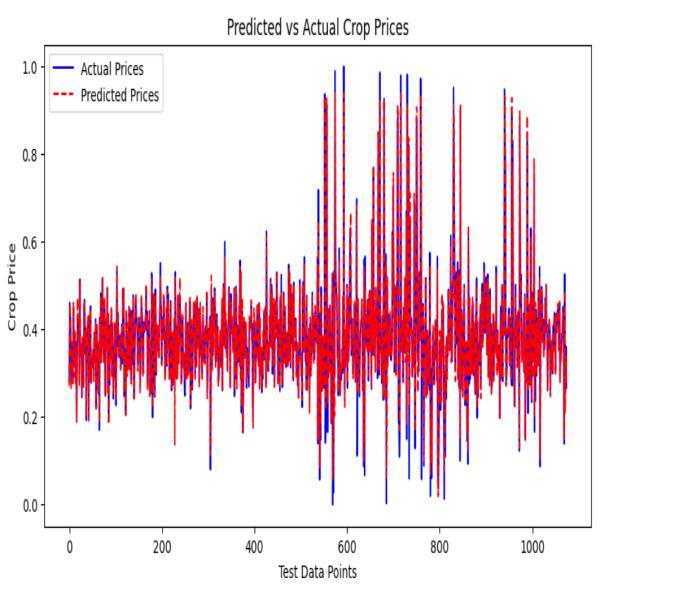
Traditionalstatisticalandmachinelearningmodelssuchas linear regression and ARIMA rely on strong assumptions aboutdatalinearityandstationarity.Whilethesemethods performadequatelyunderstableconditions,theystruggleto adapt to sudden variations caused by climate anomalies, changingsoilconditions,ormarketvolatility.
In contrast, the GRU-based model demonstrates superior adaptabilityduetoitsgatedarchitecture,whichselectively retains relevant historical information while discarding irrelevant noise. This enables the model to handle both short-term fluctuations and long-term seasonal dependencieseffectively.Asa result,theproposedsystem provides more reliable and consistent predictions under dynamicagriculturalconditionscomparedtoconventional approaches.
Theresultshighlightthepracticalusefulnessoftheproposed systemasadecision-supporttoolforfarmers,traders,and agriculturalplanners.Accurateforecastingofcropyieldand markettrendsenablesbetterplanningofplantingschedules, harvesting timelines, storage management, and pricing strategies.Byreducinguncertaintyandimprovingforesight, thesystemcontributestoimprovedresourceutilizationand reducedfinancialriskintheagriculturalsector.
International Research Journal of Engineering and Technology (IRJET) e-ISSN: 2395-0056
Volume: 13 Issue: 02 | Feb 2026 www.irjet.net p-ISSN: 2395-0072
Overall,theexperimentalresultsconfirmthattheproposed GRU-based predictive analytics framework is effective, stable, and suitable for real-world agricultural forecasting andmarketintelligenceapplications.
Conclusion
This project ended up working pretty well with deep learningforforecastingcropprices.Itusedoldagricultural and market data to spot patterns and trends that make prices go up and down. I think that part was key because withoutseeingthoseovertime,itshardtopredictanything useful.
Thepreprocessingstuffandfeatureengineeringhelpedalot too.Theycleanedupthedatasoitwasbetterquality,which probablyboostedhowaccuratetheforecastsgot.Notsureif everything was perfect there, but it seemed to make a difference.
WhenitcametotheGRUmodel, thathandledthesequential datafromfarmingreallyeffectively.Experimentsshowedit beatoutoldermethodslikeLinearRegressionandARIMA. Youknow,onmetricssuchasMAE,RMSE,andR squared. The predictions matched the real values closely, which confirmsthewholeapproachissolid.
Sometimesthough,trendsincroppricesfeelunpredictable, even with this. The visualization part for market optimizationwasinteresting,butImightbeoversimplifying howitalltiestogether.
Thevisualizationstuffinthesystemmakestheresultseasier to understand, you know, by showing forecasts in a way that’s clear and not too complicated for regular people. It helpsoutfarmersandtraders,evenpolicymakers,whenthey needtodecideonthingslikeplanningcropsorhowtostore them, pricing, or when to get into the market. I think accuratepredictionslikethatcutdownonalltheguesswork, anditprobablyboostsprofitsalongthewholeagricultural chain.
Deeplearning,especiallywithGRUnetworks,seemstohave alotofpotentialhereforturningoldschoolforecastinginto somethingsmarter,morebasedondatafordecisions.The system feels scalable and flexible, so it could work for differentcropsorareaswithoutmuchtrouble.Thisproject setsupasolidbase,Iguess,formoreideasinsmartfarming andmarketanalyticsdowntheline.
[1] S.Khaki,L.Wang,andS.V.Archontoulis,“ACNN-RNN frameworkforcropyieldprediction,” IEEEAccess,vol.8, pp. 134299–134311, 2020, doi: 10.1109/ACCESS.2020.3010465.
[2] Y.Mahale,N.Khan,K.Kulkarni,S.A.Wagle,P.Pareek, andK.Kotecha,“Croprecommendationandforecasting system using machine learning with LSTM,” International Journal of Advanced Computer Science and Applications,vol.13,no.5,pp.112–118,2022.
[3] S.-C.Liu,Q.-Y.Jian,H.-Y.Wen,andC.-H.Chung,“Acrop harvesttimepredictionmodelforbettersustainability, integrating feature selection and artificial intelligence methods,”
[4] G.SharmaandG.Shrivastava,“Cropdiseaseprediction usingdeeplearningtechniques,”
[5] V.V.Tidke,S.R.Gohane,A.A.Taile,andA.S.Shrikhande, “Weatherforecastingusingrecurrentneuralnetwork,”
[6] P. S. Patil and R. S. Deshmukh, “Machine learning approach for crop yield prediction using climatic parameters,”
[7] R.JainandP.K.Singh,“Smartagriculturesystemusing IoTandmachinelearning,”
[8] A. Kumar and S. R. Nair, “Prediction of rainfall using artificialneuralnetworks,”
[9] M. Patel and D. Shah, “Crop production analysis using dataminingtechniques,”
[10] S. Verma and N. Mehta, “Agricultural decision supportsystemusingmachinelearning,”