
International Research Journal of Engineering and Technology (IRJET) e-ISSN: 2395-0056 p-ISSN: 2395-0072

Volume: 11 Issue: 12 | Dec 2024 www.irjet.net


International Research Journal of Engineering and Technology (IRJET) e-ISSN: 2395-0056 p-ISSN: 2395-0072
Volume: 11 Issue: 12 | Dec 2024 www.irjet.net
Kallesh S C1 , Siddesh D S2 , Thejaswi M R3 , Kushi D N4
1Bachelor of Engineering, Information Science and Engineering, Bapuji Institute of Engineering and technology, Karnataka, India[1,2]
2Bachelor of Engineering, Information Science and Engineering, Bapuji Institute of Engineering and technology, Karnataka, India [3,4]
Abstract - Deep learning has revolutionized the field of drug discovery and pharmaceutical research. This paper provides a comprehensive review of the applications of deep learning in drug discovery and pharmaceutical research. We discuss the various deep learning architectures and techniques used in drug discovery, including convolutional neural networks (CNNs), recurrent neural networks (RNNs), and generative adversarial networks (GANs). We also highlight the challenges and limitations of using deep learning in drug discoveryandpharmaceuticalresearch.
Key Words: bioinformatics·cheminformatics·drugdesign· machine-learning·neuralnetwork·virtualscreening
Machine-learningprovidesatheoreticalframeworkforthe discovery and prioritization of bioactive compounds with desired pharmacological effects and their optimization as drug-likeleads.Biologicaltargetidentificationandprotein designareemergingareasofapplication.Amongthemany machine-learning approaches in molecular informatics, chemocentricmethodshavefoundwidespreadapplication. Their underlying logic typically follows three steps. First, thereistheselectionofaproblem-specificsetofdescriptors thatarebelievedtocapturetheessentialpropertiesofthe moleculesinvolved.Atpresent,thereareover5000diverse molecularrepresentations(“descriptors”)thataddressthe variouspropertiesofchemicalentities.[1]Second,ametric orscoringschemeisusedtocomparetheencodedmolecules tooneanother.[2]Finally,amachine-learningalgorithmis employed to identify the features that may serve to qualitativelyorquantitativelydistinguishtheactivefromthe inactive compounds.[3] Artificial neural networks (ANNs) wereamongthefirstmethodsborrowedfromthecomputer sciencesforthispurpose.
In 2013, public attention was drawn to a multi-
problemQSARmachine-learningchallengeindrugdiscovery posted by Merck. This competition on drug property and activitypredictionwaswonbyadeeplearningnetworkwith arelativeaccuracyimprovementofapproximately14%over Merck’sin-housesystemsandresultedinanarticleinThe New York Times. [5] Here, we present state-of-the-art of

advanced chemocentric machine-learning methods with a focus on emerging “deep learning” concepts. We highlight
recent advances in the field and point to prospective applications and developments of this potentially game changing technology for drug discovery. Ageneral task for machine-learning is to uncover the relationship between the moleculardescriptorsusedandthemeasuredactivityofthe compounds to obtain qualitative classifiers or quantitative structure-activity relationship (QSAR) models. Feature extractionfromthedescriptorpatternsisthedecisivestepin the model development process.[6,7] In current cheminformatics applications, the prevalent machinelearning architectures are “shallow” and contain a single layerof feature transformation. These architectures include linearandnonlinearprinciplecomponentanalysis,k-means clustering methods, partial least square projection to latent structures, decision trees, multivariate linear regression, linear discriminant analysis, support vector machines (SVMs), logistic and kernel regression, multi-layer Perceptrons and related neural network approaches.[8] Although all of these methods have proven to be useful for (Q)SAR modeling and moleculardesign,[9] thesingle feature transformationstepintoasuitablespaceforthesubsequent applicationof a linear patternseparation model might limit theirmodelingandrepresentationalpowerwhenappliedto morecomplexdataandsetups.A reasonfortheirsuccessin pharmacological applications may stem from the fact that a major part of the complexity inherent to molecular interactions has been engineered into the descriptors employed as patterns for model training, thereby allowing single layer machinelearning architectures to tackle the problem.[10] One challenging question is whether the underlyingdatacomplexityandhiddenfeaturescanbemore efficiently dealt with by shifting attention from descriptor engineering to the architecture of the machine-learning system and the training of the algorithms involved. This is thedomainof“deeplearning”.

Volume: 11 Issue: 12 | Dec 2024 www.irjet.net
International Research Journal of Engineering and Technology (IRJET) e-ISSN: 2395-0056 p-ISSN: 2395-0072
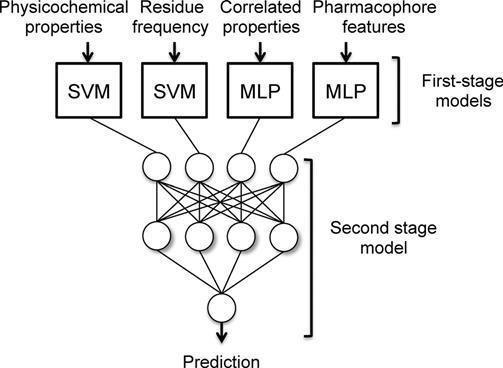
Figure 1. Schematic of a jury network (adapted from ref. 31). In this particular architecture, feature extraction is performedintwostages.Thesecond-stagemodelisafeedforward network that weighs the relevance of the firststage model and improves the overall prediction performance. Note that each first- stage model receives a different set of molecular descriptors as input. SVM, supportvectormachine;MLP,multi-layerPerceptron.
There are several advantages of deep learning neural net-worksthatsuggestthattheyshouldreplaceshallow ANNs:
(i) A deep, hierarchical architecture enables ANNs to per-form many nonlinear transformations, which leads to the learning of more abstract features compared to shallow networks.[53] This development allows for a more sophisticated combination of low-level features (i.e., nonlinear descriptor combinations) to achieve a better molecular representation and thus classification of compounds. This approach reduces the need fortheaprioriengineeringofmoresophisticated descriptors.Moreabstractnonlinearfeaturestend tobeinvarianttolocalchangesintheinput,leading to inherent noise reduction and increased networkrobustness.
Therefore,deeplearningarchitecturescapture certain families of functions exponentially more efficiently thanshallowarchitectures.
i) Deep architectures promote the reuse of features. This ensemble view of the same data corresponds to an improvement on the principle of cascading networks that share the intelligence of different
algorithms. How well- regularized deep learning networkscanactuallyexploitcommonalitiesbetween differenttaskstotransferknowledgeasinductivebias remainsamatterofdebate.Thisaspect is relevant for missingclasseswithinthetrainingset,whichistypical for large QSAR data sets. Aside from enabling “educatedguesses”onmissinginformation,multitask learning also has the benefits of presenting a shared, learnedfeatureextractionpipelinefor multiple tasks. Dahl suggested that this concept might have a regularization effect becauseweights tendtodevelop in a way that is useful for many targets instead of overfitting one target in particular.[54] All of these findings promise the simultaneous testing of bioactivitiesagainstmanyrelatedtargetsatarealistic computational cost. Such applications may be driven evenfurtherby thefieldofpolypharmacology.[55]In this case, deep learning might accompany current kernel methods to find additional applications for drugs (“re-purposing”) and to assist in the identificationofundesiredoff-targetactivities.
(iii) As highlighted by the Merck QSAR contest,[5] deep multitask neural networks can be successfully applied to QSAR modeling.[57] Generative deep architectures complement evolutionaryalgorithmsin computationaldrugdiscovery that are often used to find new compounds with specific features identified by some previously trained machine-learning architecture.[58] A trained deep generative neural network has learned to separatecompound activity classes within its architecture while being able to generate output according to the learned representation; thus, this network contains both functions in one algorithm. Therefore, deep learning might provide a fresh approachtosolvingthe“inverseQSARproblem”.
However, simply trading network width for depth alone does not automatically lead to better models. In the following sections, we highlight two deep learning architectures that we think deserve special attention and consideration for drug design and discovery: the Restricted Boltzmann Machine (RBM) and Convolutional Neural Networks (CNN). Many more deep learning approaches have been conceived, and the interested readerisreferredtotherespectiveliterature.
Boltzmannmachinesareundirected,generative,stochastic neuralnetworksthatrosetoprominencewhenHintonand coworkers proposed contrastive divergence[60] as a fast unsupervised learning algorithm.[61] Restricted Boltzmann Machines (RBM) are instances of Boltzmann machines without intra- layer interactions (Figure 3). Boltzmannmachinesare

Figure 2. Schematic of a restricted Boltzmann machine. The visible layer is the interface between the network and the outside world.Input can be clamped to this layer, and the resultingvisibleneuronconfigurationrepresentsasample from the network’s equi- librium distribution after an equilibration process. Hidden neurons(latent variables) transformtheinputdataanddetectprominentfeatures.The hidden layer models the visible layer in conjunctionwith theweightmatrix.
Notfeed-forwardmodels,whichisacrucialdifferencefrom thedeep feed-forwardneural networks presented inFigure 2. The given input states serve as input to the hidden neurons butinturnaredependentonthe resultinghidden neuron states that modify the “visible” neurons. This back and forth of mutual layer influencing eventually leads to an equilibrium of neuron activations regardless of the originally given input vector (Figure 3). The overall distribution governing theactivation of visible neurons at one of these steps is thenetwork’s “belief” of how the visible neurons behave. The goal is to nudge the network’s belief of the visible neuronstatedistribution intothe direction oftheactualinput datadistributionby intermittentlyaddingnewinputdatavectorsand adjusting the weights in such a way that their probability is increased. The idea is that over time the believed visible state distribution eventually approximates the real state distribution, i.e. the network “learns” the input distributioninanunsupervisedfashion.Apopularcriterion to evaluate the learning process is the reconstruction error,whichisameasureoftheabilityof
2395-0072 Volume: 11 Issue: 12 | Dec 2024 www.irjet.net

Figure 3. Restricted Boltzmann machine-learning. First, an input vector from the dataset enters the network. Subsequently,thehiddenlayerstateiscalculatedwithregard tothe newinput vector,fromwhich anewinput layer state can be calculated by the network. This iterative process continues for k steps, and the resulting visible layer state serves as a representative for the network’s belief in the visible layer states. A weight update is calculated and the trainingcycleisre-iteratedfromthedatainputvectorandthe beliefstatevector.
CNNs are inspired by neuroscience and imitate the image representation within the visual cortex that is created by successivetransformations oftheretinal signalsincortical areas called the “ventral stream” that end in the inferior temporal(IT)cortex.[68]ContemporaryCNNsrivaltheITcortex’s representational performance of a primate in “corevisualobjectrecognition”.[69]TheprototypeofCNNs istheNeocognitron,[16] whichwasconceived in the early 1980s. Related architectures for phoneme recognition followed afew years later; thereafter, CNNs for object recognition in images and document reading were developed just prior to the turn of the millennium.[70] CNN improvement together with the general advances in deeplearningbecameafocalpointof interest when a deep CNN wontheILSVRCimage recognitionchallengein2012
Volume: 11 Issue: 12 | Dec 2024 www.irjet.net
International Research Journal of Engineering and Technology (IRJET) e-ISSN: 2395-0056 p-ISSN: 2395-0072
bya widemargin.[71] CNNshavedominatedthischallenge ever since, as well as the field of object recognition and detection in images in general. They now constitute the underlying architecture for a wide range of applications ranging from image understanding, video analysis, speech recognition and language understanding to artificial intelligence.[72] The two guiding principles of weightsharing and local connectivity inaconvolutional net allow forthedetectionoffeatureswithintopologicallystructured input data. Additional use of pooling and many layers enable the network to learn increasingly abstract features with each additional layer. The concept of weight sharing and local connectivity is depicted in Figure 5. Here, the input data corresponds to the input image, the filter corresponds tothe weight- connections, and the feature map (activation map) corresponds to the first hidden layer.Incontrasttoafully connected network (Figure 2), hidden-layerneuronsareonlyconnect
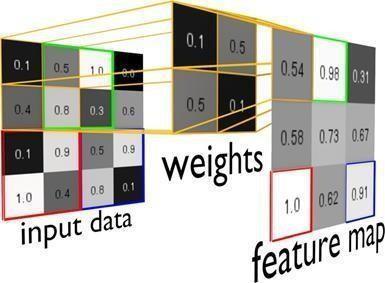
Figure 5. The figure depicts a toy example of a greyscale input image with pixel values between 0 and 1, a weightmatrix (filter) and the resulting feature map. Pre-activations of hidden neuronswithin the feature map are obtained by weightingpixel-values withina 2x2receptivefieldwiththe corresponding weights of the filter and summing up the resultingfourtermsasshowninorange.Toobtainthenext feature map value, the filter is moved across the image with a stride of 1 (e.g., from the orange to the green quadrant). The resulting feature map is a map of where thefeature encodedin thefilterhasoccurred in the input image. Here, the filter corresponds to a diagonalthatresults in astrong pre-acti-vation signal for the green, red and blue filterpositionsovertheinputimage,whichisreflectedinthe featuremapaccordingly.
Althoughtheconceptsofdeeplearningwereintroducedwith the conception of multi-layer neural networks,[78] the life science community has adapted some of these techniques onlyrecently(Table1).Infact,neural networkshavealong and fruitful history in drug discovery and design. Because they bear the risk of being easily over- trained and are
perceived as a “black box”,they have often been substituted byotherapproachessuchasSVMmodels.[27,79]Asnotedby Winkler in a review article from 2004, continuous methodological advances in the field of neural networks alleviatesomeofthepitfallsandmayhavemuchtoofferfor hit and lead discovery.[80] Evidently, deep network architectures will require a particularlycareful analysis and thorough definition of their respective domains of applicability,[81,82]andideallyprovidehands-onguidelines for chemists. Appropriate confidence measures for neural network classifiers have been developed and can readily be applied.[83]Fullappreciationofdeeplearningmethodswill likely only be achieved when the user gains an understanding of the underlying molecular features that enable pattern association and classification. With the development of new deep learning concepts such as RBMs and CNNs, the molecular modeler’s tool box has been equipped with potentially game-changing methods. Judging from the success of recent pioneering studies, we are convinced that modern deep learning architecture will be useful for the coming age of big data analysis in pharmaceuticalresearch,toxicityprediction,genomemining and chemogenomic applications, to name only some of the immediate areas of application. Personalized health care, in particular,couldbenefit fromthesecapabilities.However,it maybewisenottoputallofoureggs inonebasket. Westill need to fully understand the advantages and limitations of deep learning techniques. One should not blindly use them without simultaneously applying straightforward linear methods and pursuing chemical similarity approaches. By maintainingsomehealthyskepticism,wefeelthatthetimeis ripefor(re)discoveringandexploringtheusefulness of deep learningindrugdiscovery
G. S. is a co-founder of inSili.com LLC, Zurich, and a consultanttothepharmaceuticalindustry.
This research was supported by the Swiss National Science Foundation(grantno.200021_157190andCR32I2_159737)
References
[1] a) R. Todeschini, V. Consonni, Molecular Descriptors forCheminformatics,Wiley-VCH, Weinheim, 2009; b) R. Sawada, M. Kotera, Y. Yamanishi, Mol. Inf. 2014,33,719–731.
[2]P.Willett,Mol.Inf.2014,33,403–413.
[3]a)A.Lavecchia,DrugDiscoveryToday2015,20,318–331; b) E. J. Gardiner, V. J. Gillet, J. Chem. Inf. Model. 2015,55,1781–1803.
International Research Journal of Engineering and Technology (IRJET) e-ISSN: 2395-0056 p-ISSN: 2395-0072
Volume: 11 Issue: 12 | Dec 2024 www.irjet.net
[4] a) J. Devillers (ed.), Neural Networks in QSAR and Drug Design, Elsevier, Amsterdam; b) G. Schneider, P. Wrede,Prog.Biophys,Mol.Biol.1998,70,175–222;c)J. Zupan, J. Gasteiger, Neural Networks in Chemistry and Drug Design, Wiley-VCH, Weinheim, 1999; d) S. Agatonovic-Kustrin, R. Beresford, J. Pharm. Biomed. Anal.2000,22,717–727.
[5] J.Ma,R.P.Sheridan,A.Liaw,G.E.Dahl,V.Svetnik,J. Chem. Inf. Model. 2015, 55, 263– 274; b) J. Markoff, Scientists See Promise in Deep-Learning Programs.The NewYorkTimes,November23,2012.
[6] a) G. Schneider, S.-S. So, Adaptive Systems in Drug Design,LandesBioscience,Georgetown,2001; b)M.Reutlinger,G.Schneider,J.Mol.Graph.Model.2012, 34,108–117.
[7]G.E.Hinton,Cogn.Sci.2014,38,1078–1101.
[8]a) J. Gasteiger, T. Engel (eds.), Chemoinformatics: A Textbook, Wiley-VCH, 2003; b) G. Schneider, G. Downs (eds.), Machine Learning Methods in QSAR Modelling, QSAR Comb. Sci. 2003, 22(5); c) J. Bajorath (ed.) Chemoinformatics: Concepts, Methods, and Tools for Drug Discovery, Humana Press, Totowa, 2004; d) M. Dehmer, K. Varmuza, D. Bonchev (eds.) Statistical Modelling of Molecular Descriptors in QSAR/QSPR, Wiley-Blackwell,NewYork,2011.
[9] a)G.Schneider,K.-H.Baringhaus,MolecularDesignConceptsandApplications.Wiley-VCH,Weinheim,2008; b) G. Schneider (ed.), De Novo Molecular Design. WileyVCH,Weinheim,2013.
[10]J.Gasteiger,MiniRev.Med.Chem.2003,3,789–796.
[11]Y. Bengio, Foundations and Trends in Machine Learning2009,2,1–127.
[12] a) G. E. Hinton, R. R. Salakhutdinov, Science 2006, 313, 504 – 507; b) Y. LeCun, Y. Bengio, G.Hinton,Nature2015,521,436–444.
[13]Y.Roudi,G.Taylor,Curr.Opin.Neurobiol.2015, 35, 110–118.
[14]a)J.Fan,H.Liu,Adv.DrugDeliv.Rev.2013,65,987–1000; b) D. C. Cires¸an, A. Giusti, L. M. Gambardella, J. Schmidhuber,Med.ImageComput.Comput.Assist.Interv. 2013, 16, 411 – 418; c) N. T. Issa, S. W. Byers, S. Dakshanamurthy, Expert Rev. Clin. Pharmacol. 2014, 7, 293–298;d)F.F.CostaFF,Drug Discovery Today 2014, 19, 433– 440; e) S. J.Lusher,R.McGuire,R.C.vanSchaik, C.D.Nicholson,J.deVlieg,DrugDiscoveryToday2014,19, 859–868;f)J. B. Brown, M. Nakatsui, Y. Okuno, Mol. Inf. 2014, 33, 732– 741; g) L. Richter, G. F. Ecker, Drug DiscoveryTodayTechnol.2015,14,37–41.
[15] Y. Park, M. Kellis, Nat. Biotechnol. 2015, 33,825–826.
[16] a) K. Fukushima, S. Miyake, Pattern Recognit. 1982,15,455–469;b)K.Fukushima,NeuralNetw. 2013,37,103–119.
[17]a) P. J. Werbos, Beyond Regression: New Tools for Prediction and Analysis in the Behavioral Sciences.PhD thesis,HarvardUniversity,1974;b)D. E. Rumelhart, G. E. Hinton, R. J. Williams, Nature 1986, 323, 533–536.
[18]N.Qian,T.J.Sejnowski,J.Mol.Biol.1988,202,865–884.
[19]M.Punta,B.Rost,MethodsMol.Biol.2008,458,203–230.
[20] M. Spencer, J. Eickholt, J. Cheng, IEEE/ACM Trans. Comput.Biol.Bioinform.2015,12,103–112.
[21] Y. LeCun, B. Boser, J. S. Denker, D. Henderson, R.E. Howard, W. Hubbard, LD. Jackel, Adv. Neural Inf. Proc. Sys. (NIPS) 1989, 2, 396–404.
[22]a) Y. Bengio, P. Simard, P. Frasconi, IEEE Trans. NeuralNetworks 1994,5,157–166;b)S.Hochreiter, Y. Bengio, P. Frasconi, J. Schmidhuber, in: A Field Guide to Dynamical Recurrent Neural Networks (S. C. Kremer, J. F. Kolen, eds.), IEEE Press, New York, 2001.
[23]a)G.E.Hinton,TrendsCogn.Sci.2007,11,428–434; b) G. E. Hinton, S. Osindero, Y. W. The, Neural Comput. 2006,7,1527–1554.
[24] a)G.Schneider,J.Schuchhardt,P.Wrede,Comput. Appl. Biosci. 1994, 10, 635– 645; b) G. Schneider, Neural Netw. 2000, 13, 15 –16; c) S. Agatonovic-Kustrin, R. Beresford, J. Pharm. Biomed. Anal. 2000, 22, 717– 727.
[25]a) L. Breiman, Machine Learning 2001, 45, 5 – 32; b) N. Meinshausen, J. Mach. Learn. Res. 2006, 7, 983–999.
[26] a) Y. Sakiyama, Expert Opin. Drug Metab. Toxicol. 2009, 5, 149– 169; b) D. Plewczynski, S. A. Spieser, U. Koch, Comb. Chem. High Throughput Screen. 2009, 12, 358– 368; c) B. Sprague, Q. Shi, M. T. Kim, L. Zhang, A. Sedykh,E.Ichiishi,H.Tokuda,K.H. Lee, H. Zh, J. Comput. Aided Mol. Des. 2014, 28, 631–646;d)M.A.Khamis,W. Gomaa, W. F. Ahmed, Artif. Intell. Med. 2015, 63, 135–152; e) T. Rodrigues, D. Reker, M. Welin, M. Caldera, C. Brunner, G. Gabernet, P. Schneider, B. Walse, G. Schneider, Angew.Chem.Int.Ed.2015,inpress.
International Research Journal of Engineering and Technology (IRJET) e-ISSN: 2395-0056 p-ISSN: 2395-0072
Volume: 11 Issue: 12 | Dec 2024 www.irjet.net
[27] a) E. Byvatov, U. Fechner, J. Sadowski, G. Schneider, J. Chem. Inf. Comput. Sci. 2003, 43, 1882–1889; b) E. Byvatov, G. Schneider, Appl. Bioinformatics 2003,2,67–77.
[28]a) L. Yang, P. Wang, Y. Jiang, J. Chen, J. Chem. Inf. Model.2005, 45,1804– 1811;b)I.I.Baskin,V.A. Palyulin,N.S.Zefirov,MethodsMol.Biol.2008,458,137–158.
[29]A.Givehchi,G.Schneider,Mol.Divers.2005,9,371–383.
[30] a) A. C. Tsoi, A. D. Back, IEEE Trans. Neural Netw. 1994, 5, 229 – 239; b) B. Hammer, A. Micheli, A. Sperduti, M. Strickert, Neural Netw. 2004, 17, 1061–1085; c) D. V. Buonomano, Neuron 2009, 63, 423– 425; d)D.Plewczynski,J.Mol.Model.2011,17,2133–2141.
BIOGRAPHIES




KalleshSC
StudyingengineeringinBIET, Davanagere-577004 KhushiDN