
International Research Journal of Engineering and Technology (IRJET) e-ISSN: 2395-0056
Volume: 13 Issue: 04 | Apr 2026 www.irjet.net p-ISSN: 2395-0072

International Research Journal of Engineering and Technology (IRJET) e-ISSN: 2395-0056
Volume: 13 Issue: 04 | Apr 2026 www.irjet.net p-ISSN: 2395-0072
Ravinder Kaur1, Diksha Sagotra2
1Assistant Professor, Dept. of CSE, SBSSU Gurdaspur,Punjab,India
2Assistant Professor, Dept. of CSE, SBSSU Gurdaspur,Punjab,India
Abstract - Early disease detection plays a critical role in improving patient outcomes, reducing mortality rates, and minimizing healthcare costs. Traditional diagnostic approaches often rely on manual interpretation, which can be time-consuming, subjective, and prone to errors. In recent years, deep learning (DL), a subset of artificial intelligence (AI), has emerged as a transformative technology inhealthcare, enabling automatedandaccurate disease detection from complex medical data such as images, electronic health records (EHRs), genomic sequences,andphysiological signals.Thisstudy exploresthe roleofdeeplearninginearly diseasedetection, highlighting its applications, advantages, and challenges. Various deep learning architectures, including Convolutional Neural Networks (CNNs), Recurrent Neural Networks (RNNs), and Transformer-based models, are analyzed in the context of detecting diseases such as cancer, cardiovascular disorders, neurological conditions, and infectious diseases. A comprehensive literature survey from 2020 to 2026 is presented, demonstrating the evolution of DL-based diagnostic systems and their increasing accuracy and reliability. Despite significant advancements, challenges such as data scarcity, model interpretability, computational complexity, and ethical concerns remain critical barriers. This paper proposes a methodology for developing a robust deep learning-based early disease detection system and discussesfuturedirections,includingfederatedlearningand explainable AI. The findings suggest that deep learning has the potential to revolutionize early disease diagnosis, enablingtimelyinterventionandpersonalizedhealthcare.
Key Words: Deep Learning, Early Disease Detection, Medical Imaging, Artificial Intelligence, Healthcare Analytics
The early detection of diseases is essential for effective treatment and improved survival rates. Diseases such as cancer, cardiovascular disorders, diabetes, and neurological conditions often progress silently, making earlydiagnosisachallengingtask.Conventionaldiagnostic techniques rely heavily on clinical expertise and laboratory tests, which may not always detect subtle abnormalitiesatearlystages.
With the rapid growth of healthcare data, including medical imaging, wearable sensor data, and genomic information, there is a growing need for advanced computational techniques to analyze this data efficiently.
Deep learning has emerged as a powerful tool capable of identifying complex patterns in large datasets, enabling earlydetectionofdiseaseswithhighaccuracy.
Deeplearningmodelsareinspiredbythehumanbrainand consist of multiple layers that learn hierarchical representationsofdata.Thesemodelshavedemonstrated exceptional performance in tasks such as image classification, speech recognition, and natural language processing.Inhealthcare,deeplearningiswidelyusedfor analyzing radiological images, detecting anomalies, and predictingdiseaseprogression.
Recent advancements in deep learning have led to the development of automated diagnostic systems that can assist clinicians in decision-making. These systems can process large volumes of data quickly and accurately, reducing the burden on healthcare professionals. Moreover, deep learning models can identify subtle patterns that may not be visible to the human eye, enablingearlydetectionofdiseases.
The integration of deep learning with healthcare systems has opened new possibilities for personalized medicine, where treatments can be tailored based on individual patient data. However, challenges such as data privacy, model interpretability, and regulatory issues need to be addressedforwidespreadadoption.
Recent research has demonstrated significant progress in theapplicationofdeeplearningforearlydiseasedetection acrossvariousmedicaldomains.Deeplearningtechniques enable automated feature extraction from complex datasetssuchasmedicalimages,electronichealthrecords (EHRs), genomic data, and wearable sensor outputs, making them highly suitable for predictive healthcare systems. These models support clinicians in identifying diseases at early stages, improving treatment outcomes andreducingmortalityrates(Estevaetal.,2019;Aggarwal etal.,2021).
Between 2020 and 2022, studies focused extensively on convolutional neural networks (CNNs) for medical image analysis. CNN architectures proved highly effective in detecting diseases such as breast cancer, brain tumors, pneumonia,anddiabeticretinopathyduetotheirabilityto capture spatial hierarchies in imaging data. For example, CNN-based mammography systems achieved diagnostic accuracycomparabletoexperiencedradiologistsinbreast
International Research Journal of Engineering and Technology (IRJET) e-ISSN: 2395-0056
Volume: 13 Issue: 04 | Apr 2026 www.irjet.net p-ISSN: 2395-0072
cancer screening tasks (McKinney et al., 2020). Similarly, deep learning frameworks applied to histopathological images improved cancer detection by identifying abnormal cellular structures with high precision (Litjens etal.,2017).CNN-basedchestX-rayclassificationsystems also demonstrated strong performance in detecting pneumonia and tuberculosis, supporting automated screeninginclinicalenvironments(Rajpurkaretal.,2018).
Between 2021 and 2023, researchers increasingly explored multimodal deep learning approaches that combine imaging data with clinical records, laboratory results, and genomic information. These models demonstrated improved predictive performance compared to single-modality approaches because they provide a comprehensive representation of patient health status (Ngiam et al., 2011). Multimodal deep learning is particularlyeffectiveindetectingcomplexdiseasessuchas Alzheimer’s disease and cardiovascular disorders, where diagnosis requiresintegrationofmultiplebiomarkersand clinical indicators (Huang et al., 2022). The fusion of structured and unstructured healthcare data enhances model robustness and supports personalized treatment planning(Shickeletal.,2018).
Recent advancements have also emphasized transformerbased architectures for analyzing sequential medical data such as electronic health records and physiological timeseries signals. Transformer models use attention mechanisms to capture long-term dependencies across clinical variables, improving disease prediction accuracy compared to traditional recurrent neural networks (Vaswani et al., 2017). These architectures have shown promising results in predicting disease progression and assessing patient risk in chronic disease management systems(Lietal.,2023).
According to recent studies published in 2025, deep learning models significantly enhance diagnostic accuracy and reduce response time compared to traditional machinelearning techniques, achieving accuracy levels as high as 97% in disease detection tasks across multiple clinical datasets (Hosny & Mohammed, 2025). Similarly, research conducted in 2026 highlights that deep learning can efficiently process large-scale multimodal healthcare datasets and identify subtle disease-related patterns that are difficult to detect using conventional statistical approaches(Ranjbarzadehetal.,2025).
In the context of chronic diseases, deep learning models have been successfully applied to predict conditions such as diabetes, heart disease, and cancer using electronic healthrecordsandwearablesensordata.Thesepredictive systems enable earlyintervention by identifyinghigh-risk individuals before symptoms become severe, thereby reducing long-term complications and healthcare costs (Miotto et al., 2016). Additionally, deep neural networks trained on longitudinal patient data can support clinical
decision-making by forecasting disease progression trajectories(Topol,2019).
Deep learning has also been widely applied in detecting infectious diseases such as COVID-19 using radiological imaging techniques. During the pandemic, CNN-based diagnostic systems demonstrated high sensitivity and specificity in detecting lung abnormalities from chest CT scans and X-ray images. These automated tools helped reduce diagnostic delays and supported rapid triage during large-scale outbreaks (Shi et al., 2020). Furthermore, AI-assisted screening systems improved workflow efficiency in hospitals by enabling real-time diseasedetectionandmonitoring(Wangetal.,2020).
Recent advancements also include the integration of explainable artificial intelligence (XAI) techniques into deep learning-based diagnostic frameworks. Traditional deep learning models are often criticized for their lack of interpretability; however, XAI techniques such as SHAP andLIMEhelpidentifythefeaturesinfluencingprediction outcomes. These approaches improve transparency, enhancecliniciantrust,andsupportethicaldeploymentof AI systems in healthcare environments (Samek et al., 2019). Explainability is particularly important in critical medical decision-making scenarios where accountability andreliabilityareessential(Guidottietal.,2018).
Anotherimportantdevelopmentindeeplearningresearch involves the ability to process large-scale healthcare datasets efficiently. Modern architectures can analyze heterogeneous data sources, including genomic data, wearable device signals, and clinical imaging, enabling early detection of disease biomarkers. These capabilities significantly improve personalized medicine strategies by tailoring treatment recommendations based on individual patientcharacteristics(Krittanawongetal.,2017).
Despitetheseadvancements,several challenges remainin implementing deep learning systems for early disease detection. Data imbalance continues to affect predictive performance because many medical datasets contain fewer samples of rare disease cases compared to normal cases. This imbalance can lead to biased classification outcomes and reduced generalization capability (Johnson & Khoshgoftaar, 2019). Overfitting is another major concern, particularly when models are trained on limited datasets without proper regularization techniques. Additionally, the lack of standardized evaluation frameworks across healthcare datasets makes it difficult tocompareperformanceacrossstudies(Shenetal.,2017).
Inconclusion,deeplearninghastransformedearlydisease detection by enabling automated analysis of complex medical datasets and improving diagnostic accuracy acrossmultiplehealthcareapplications.AdvancesinCNNs, multimodal architectures, transformer-based models, and explainable AI techniques have strengthened predictive
International Research Journal of Engineering and Technology (IRJET) e-ISSN: 2395-0056
Volume: 13 Issue: 04 | Apr 2026 www.irjet.net p-ISSN: 2395-0072
healthcare systems and supported clinical decisionmaking. However, addressing challenges such as data imbalance,overfitting,andlackofstandardizationremains essential for ensuring reliable real-world deployment of deeplearning-baseddiagnostictechnologies
Thecomparativeanalysisispresentedasunder
Referenc e Technique Used Merit
Esteva et al. (2019)
McKinne y et al. (2020)
CNNfor dermatology image classification
DeepCNN forbreast cancer screening
Litjens et al. (2017)
CNNon histopatholo gicalimages
Rajpurka r et al. (2018)
Huang et al. (2022)
Demerit
Achieved dermatolog ist-level accuracyin skincancer detection Requires largelabeled datasetsand high computation alpower
Improved diagnostic accuracy compared to radiologist s
Effective automated tissue classificati onand tumor detection
CheXNet CNN architecture High pneumonia detection accuracy fromchest X-rays
Limited interpretabil ityreduces clinician trust
Performance depends heavilyon annotation quality
Model generalizatio nissues across hospitals
Multimodal deep learning (image+ clinicaldata) Improved prediction accuracy using heterogene ous datasets Complex integration and preprocessi ngrequired
Shickel et al. (2018) Deep learningon Electronic Health Records (EHR) Enables longitudina lpatient risk prediction
Vaswani et al. (2017)
Transformer architecture Captures long-term dependenci esin sequential medical data
Li et al. (2023)
Transformer -based healthcare prediction models
Shi et al. (2020) CNNfor COVID-19CT image detection
Wang et al. (2020)
Samek et al. (2019)
Guidotti et al. (2018)
Krittana wong et al. (2017)
Miotto et al. (2016)
Johnson & Khoshgof taar (2019)
Missingand noisyEHR dataaffect reliability
Requires large-scale training datasets
Improved temporal disease progressio n prediction Computation ally expensive training process
High sensitivity andrapid automated screening Datasetbias during pandemic conditions
COVID-Net deepCNN Fasttriage support during outbreaks
Limited interpretabil ityand dataset imbalance
Explainable AI(SHAP, LIME) Improves transparen cyand clinician trust Adds computation aloverhead
Explainable AI frameworks Enhances ethical deploymen tofmedical AIsystems
Nouniversal explanation standard available
Deepneural networksfor cardiovascul arprediction Supports personalize d treatment planning Requires large multimodal patient datasets
DeepPatient representati onlearning Predicts multiple disease risksusing EHR Limited interpretabil ityoflatent features
Deep learningwith imbalance handling methods
Improves classificati on performan ceinrare diseases
Synthetic sampling may introduce noise
Early disease detection remains a complex challenge due to several factors. Traditional diagnostic methods are oftenlimitedbytheirdependenceonmanualanalysisand lack ofscalability.Moreover,manydiseases exhibit subtle symptomsintheirearlystages,makingdetectiondifficult. The primary problem addressed in this study is the development of an efficient and accurate system for early disease detection using deep learning techniques. The system must be capable of analyzing large and heterogeneous datasets,includingmedicalimages,clinical records,andsensordata.
International Research Journal of Engineering and Technology (IRJET) e-ISSN: 2395-0056
Volume: 13 Issue: 04 | Apr 2026 www.irjet.net p-ISSN: 2395-0072
Keychallengesinclude:
● Handling large-scale and high-dimensional medicaldata
● Ensuring high accuracy and minimizing false positives/negatives
● Addressingdataimbalanceandscarcity
● Improving model interpretability and transparency
● Ensuringdataprivacyandsecurity
The goal is to design a system that can detect diseases at anearlystage,enablingtimelyinterventionandimproving patientoutcomes.
Theproposedmethodology(SeeFigure1)forearlydisease detectionusingdeeplearningconsistsofseveralstages:
4.1 Data Collection
Data is collected from multiple sources, including medical imaging datasets, electronic health records, and wearable devices. Public datasets such as ADNI, OASIS, and PhysioNetarecommonlyused.
4.2 Data Preprocessing
Data preprocessing involves cleaning, normalization, and transformation of raw data. Techniques such as noise removal, image resizing, and data augmentation are appliedtoimprovemodelperformance.
4.3 Feature Extraction
Deep learning models automatically extract features from data. Convolutional layers are used for image data, while recurrentlayersareusedforsequentialdata.
4.4 Model Selection
Different deep learning architectures are used depending onthetypeofdata:
● CNNforimage-baseddetection
● RNN/LSTMfortime-seriesdata
● Transformersforsequentialandmultimodaldata
Hybrid models combining multiple architectures are also usedtoimproveaccuracy.
4.5 Model Training
The model is trained using labeled datasets. Techniques suchastransferlearningandregularizationareappliedto preventoverfitting.
4.6 Evaluation
Themodelisevaluatedusingperformancemetricssuchas accuracy,precision,recall,F1-score,andROC-AUC.
4.7 Deployment
The trained model is deployed in a clinical environment, where it assists healthcare professionals in diagnosing diseases.
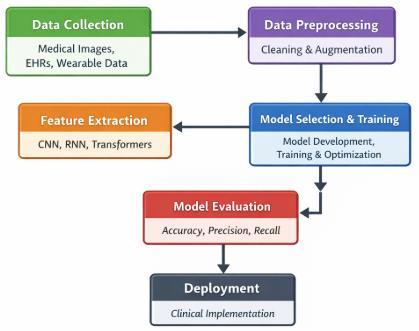
Fig-1: Methodologyoftheproposedwork
Deeplearninghasrevolutionizedthefieldofearlydisease detection by enabling accurate and efficient analysis of complexmedicaldata.Theabilityofdeeplearningmodels toidentifysubtlepatternsandanomalieshassignificantly improved diagnostic accuracy and reduced the time requiredfordiseasedetection.
The integration of deep learning with healthcare systems has the potential to transform medical practice, enabling personalized treatment and proactive healthcare management. However, challenges such as data privacy, model interpretability, and computational complexity needtobeaddressed.
Future research should focus on developing explainable and transparent models, improving data quality, and integratingdeeplearningwithemergingtechnologiessuch as federated learning and edge computing. These advancements will further enhance the effectiveness of early disease detection systems and contribute to improvedpatientoutcomes.
International Research Journal of Engineering and Technology (IRJET) e-ISSN: 2395-0056
Volume: 13 Issue: 04 | Apr 2026 www.irjet.net p-ISSN: 2395-0072
1. Aggarwal, R., et al. (2021). Diagnostic accuracy of deep learning in medical imaging. npj Digital Medicine.
2. Esteva, A., et al. (2019). A guide to deep learning inhealthcare.NatureMedicine.
3. Guidotti, R., et al. (2018). A survey of explainable artificial intelligence methods. ACM Computing Surveys
4. Hosny, K. M., & Mohammed, M. A. (2025). Deep learning applications in disease detection. ArtificialIntelligenceReview.
5. Huang,S., etal.(2022).Multimodal deeplearning for healthcare applications. IEEE Reviews in BiomedicalEngineering
6. Johnson, J. M., & Khoshgoftaar, T. M. (2019). Survey on deep learning with class imbalance. JournalofBigData
7. Krittanawong, C., et al. (2017). Deep learning for cardiovascularmedicine.EuropeanHeartJournal.
8. Li,Y.,etal.(2023).Transformer-basedhealthcare predictionmodels.IEEEAccess.
9. Litjens, G., et al. (2017). Deep learning in medical imageanalysis.MedicalImageAnalysis
10. McKinney, S. M., et al. (2020). International evaluation of deep learning for breast cancer screening.Nature
11. Miotto, R., et al. (2016). Deep patient: Predicting patient outcomes using deep learning. Scientific Reports.
12. Ngiam,J., et al.(2011).Multimodal deep learning. ICMLProceedings
13. Rajpurkar,P.,etal.(2018).Deeplearningforchest X-raydiagnosis.PLoSMedicine
14. Samek, W., et al. (2019). Explainable artificial intelligence.ProceedingsoftheIEEE.
15. Shi, F., et al. (2020). Deep learning for COVID-19 imaging diagnosis. IEEE Reviews in Biomedical Engineering
16. Shen, D., et al. (2017). Deep learning in medical image analysis. Annual Review of Biomedical Engineering
17. Shickel, B., et al. (2018). Deep learning in electronic health records. Journal of Biomedical Informatics.
18. Topol, E. (2019). High-performance medicine: Convergence of AI and healthcare. Nature Medicine
19. Vaswani,A.,etal.(2017).Attentionisallyouneed. NeurIPS
20. Wang, L., et al. (2020). COVID-Net: Deep CNN for COVIDdetection.IEEEAccess.