
International Research Journal of Engineering and Technology (IRJET) e-ISSN: 2395-005 : Volume :13 Issue: 04 | Apr 2026 www.irjet.net p-ISSN: 2395-0072

International Research Journal of Engineering and Technology (IRJET) e-ISSN: 2395-005 : Volume :13 Issue: 04 | Apr 2026 www.irjet.net p-ISSN: 2395-0072
Kanchan Dhomse1 , Mittal Jagtap2 , Priyanka Chaure3 , Kalyani Dadave4 , Samrudhi Shirode5
1Professor, Department of Information Technology, MET's Institute of Engineering, Nashik, Maharashtra, India 2,3,4,5Student, Dept. of Information Technology, MET's Institute of Engineering, Nashik, Maharashtra, India
Abstract - Waste management has become a critical challenge due to rapid urbanization and increasing waste generation. Traditional waste segregation methods are inefficient and prone to errors, leading to improper recycling processes. To address this issue, Artificial Intelligence-based techniques have been widely explored for automated waste classification. Deep learning models, particularly ConvolutionalNeuralNetworks(CNN)andYOLO,haveshown significantpotentialinimprovingclassificationaccuracyand enabling real-time detection. This paper discusses various deep learning approaches used for waste classification, highlightingtheirmethodologies,advantages,andlimitations. A comparative analysis of existing techniques is presented, along with key challenges such as dataset imbalance and environmental variations. The study also outlines future directions to enhance the performance and applicability of automated waste classification systems.
Key Words: Waste Classification, Deep Learning, CNN, YOLO, Image Classification, Smart Waste Management, TransferLearning,EfficientNet,ResNet,Real-TimeDetection, DataAugmentation,EnvironmentalSustainability
Wastemanagementhasbecomeaseriousglobalconcerndue torapidurbanizationandpopulationgrowth.Theincreasing volume of waste has led to environmental pollution and inefficient recycling processes. Traditional waste managementmethodsrelyheavilyonmanualsegregation, which is time-consuming, labor-intensive, and prone to humanerror.
To overcome these limitations, automated waste classificationsystemshavebeendevelopedusingArtificial Intelligence (AI). Deep learning techniques, particularly Convolutional Neural Networks (CNN), have proven to be highlyeffectiveinimageclassificationtasksbyautomatically extracting relevant features from input data. In addition, object detection algorithms suchasYOLO (You OnlyLook Once) enable real-time identification and localization of waste materials, making them suitable for practical applications.
TheseAI-basedapproachesimproveclassificationaccuracy, reduce manual effort, and support efficient waste managementprocesses.Thispaperdiscussesvariousdeep learningmethodsusedforautomatedwasteclassification,
analyzes their performance, and highlights the challenges andfuturedirectionsinthisdomain.
Despite advancements in technology, waste segregation remainsinefficientduetoseveralissues:
• Manualsortingislabor-intensiveanderror-prone
• Existing AI models lack real-time performance in practicalenvironments
• Datasetimbalancereducesmodelaccuracy
• Environmentalvariations(lighting,background)affect performance
• Highcomputationalrequirementslimitdeploymenton low-powerdevices
Thesechallengeshighlighttheneedforrobust,accurate,and efficientautomatedwasteclassificationsystems.
Recent studies have focused on improving waste classification systems using deep learning techniques. Researchers have primarily used Convolutional Neural Networks(CNN)forimage-basedclassification,whilesome approaches incorporate edge computing and real-time detection to enhance system efficiency. Although these methods show promising results, they still face challenges related to computational limitations and environmental variations.
Autho r & Year
A. Gupta etal. (2020
P. Sharm aetal. (2022
Method Used Dataset Accu racy Limitations
CNN+ Edge Comput ing (Waste Net)
Deep Learnin g(CNN)
Custom Dataset
Image Dataset
82% Efficientedgebasedsystem butlimitedby hardware capability
83% Class imbalance affectsmodel performance
International Research Journal of Engineering and Technology (IRJET) e-ISSN: 2395-005 : Volume :13 Issue: 04 | Apr 2026 www.irjet.net p-ISSN: 2395-0072
Y.Liet al. (2023
H. Zhang etal. (2020
M. Patel etal. (2024
G. Thung etal. (2016
H. Yanget al. (2019
Deep Learnin gModel
Garbage Dataset
Deep CNN TrashN et Dataset
CNNbased Model Image Dataset
Traditio nalML +CNN
TrashN et Dataset
Deep Learnin g Model Dataset
85% Sensitiveto environmental variations
86% Highaccuracy but computationall yexpensive
87% Limitedrealtime implementatio n
63% Early-stage modelwith loweraccuracy
84% Lacks robustnessin real-world scenarios
Fromtheaboveanalysis,itisevidentthatdeeplearning models,particularlyCNN-basedapproaches,dominatethe fieldofwasteclassification.Whilenewerarchitecturessuch as EfficientNet improve accuracy, challenges such as computationalcomplexity,datasetlimitations,andreal-time deploymentstillpersist.
Fromtheabovecomparison,itcanbeobservedthatCNNbased approaches are widely used for waste classification due to their ability to extract meaningful features from images. However, traditional models mainly focus on classificationanddonotsupportreal-timedetection.Edgebased systems improve response time but are limited by hardwareconstraints.
Additionally,mostmodelsaresensitivetoenvironmental conditions such as lighting and background variations. Therefore,integratingclassificationanddetectiontechniques can help improve overall system performance and make wasteclassificationsystemsmoreefficientandpractical.
Deep learning techniques are widely used in automated waste classification systems for analyzing image data efficiently. Among these, Convolutional Neural Networks (CNN) and YOLO are commonly applied due to their effectivenessinclassificationanddetectiontasks.
ConvolutionNeuralNetworks(CNN)arewidelyusedfor image classification tasks. They consist of layers such as convolutional and pooling layers that extract important features like edges, textures, and shapes from images. In wasteclassification,CNNmodelshelpcategorizewasteinto differentclasseswithgoodaccuracy.Duetotheirabilityto
automatically learn features, CNN-based approaches are commonlyusedinexistingresearch.
YOLO is a real-time object detection algorithm that identifiesobjectsandtheirlocationsinanimage.Itprocesses theimageinasinglestep,makingitfasterthantraditional methods. In waste classification systems, YOLO helps in detecting and locating waste materials, which improves systemefficiencyandsupportsreal-timeapplications.
Hybrid approaches combine CNN for classification and YOLOfordetection.Thisintegrationimprovesbothaccuracy and speed, making the system more effective for practical use.Suchapproachesareincreasinglyusedinmodernwaste classificationsystems.
Based on the literature survey, the following research gapsareidentified:
• Lackofintegrationbetweenclassificationandreal-time detection
• Limitedavailabilityoflargeandbalanceddatasets
• Poorgeneralizationinreal-worldenvironments
• Highcomputationalcostofdeeplearningmodels
• Limiteddeploymentonedgedevices
Addressingthesegapscansignificantlyimprovesystem performanceandpracticalapplicability.
Theproposedsystemforautomatedwasteclassification followsastructuredpipelinethatintegratesimage
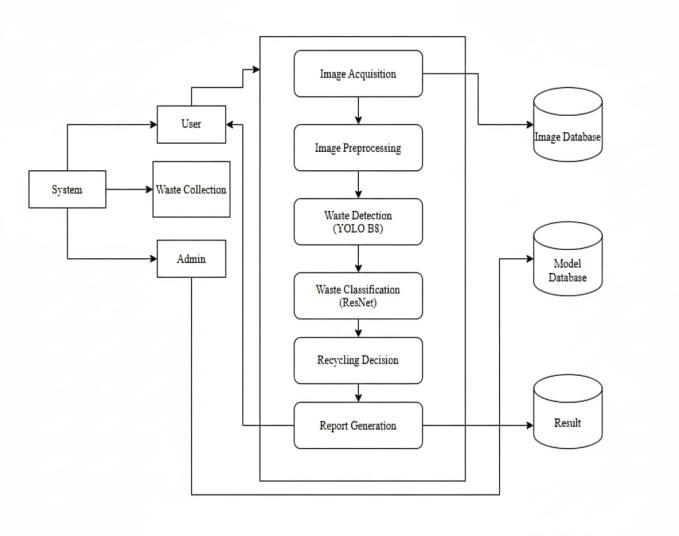
Fig.1 ProposedSystemArchitectureforWasteClassification usingCNNandYOLO
International Research Journal of Engineering and Technology (IRJET) e-ISSN: 2395-005 : Volume :13 Issue: 04 | Apr 2026 www.irjet.net p-ISSN: 2395-0072
processing, deep learning models, and decision-making mechanisms. The overall workflow, as illustrated in Fig.1: ProposedSystemArchitectureforWasteClassificationusingCNN and YOLO, consists of multiple stages including image acquisition, preprocessing, waste detection, classification, and report generation. This architecture is designed to ensureaccurateandefficientwastesegregationinreal-time environments.
The system involves three main entities: User, Admin, and Waste Collection System.Theuserinteractswiththe system by providing input images of waste materials. The waste collection module manages the collection process, whiletheadminmonitorssystemperformanceandupdates the model when required. The system processes the input data through a deep learning pipeline and stores relevant informationindatabasesforfurtheruse.
The first stage involves capturing images of waste materials using cameras or sensors. These images are collectedfromreal-worldenvironmentssuchassmartbinsor recyclingunits.Thecapturedimagesarestoredinthe Image Database, which serves as a repository for training and testingpurposes.
In this stage, the acquired images are preprocessed to improvetheirqualityandconsistency.Preprocessingsteps includeimageresizing,normalization,noisereduction,and dataaugmentationtechniquessuchasrotationandflipping. Theseoperationsenhancetherobustnessofthemodeland improve its ability to generalize across different environmentalconditions.
The preprocessed images are then passed to the YOLO (You Only Look Once) model for object detection. YOLO identifies and localizes waste objects within the image by drawingboundingboxesaroundthem.Thisstepiscrucialfor real-time applications, as YOLO processes the image in a singlepass,makingitfastercomparedtotraditionaldetection methods.
Afterdetection,theidentifiedwasteobjectsareclassified usingaConvolutionalNeuralNetwork(CNN),specificallythe ResNetarchitecture.Themodelextractsdeepfeaturesfrom thedetectedobjectsandclassifiesthemintocategoriessuch asplastic,metal,paper,glass,ororganicwaste.Thetrained model parameters are stored in the Model Database for efficientreuseandupdates.
Basedontheclassificationresults,thesystemdetermines theappropriaterecyclingordisposalmethodforeachtypeof waste.Thisstephelpsinautomatingthesegregationprocess andensuresthatwastematerialsaredirectedtothecorrect recyclingstreams.
Finally, the system generates a report containing classification results, detected waste types, and suggested recycling actions. These results are stored in the Result Database andcanbeaccessedbytheadminformonitoring and analysis. The report also helps in tracking system performanceandimprovingfuturepredictions.
Despite the advancements in deep learning-based waste classification systems, several challenges still affect their performanceandreal-worldapplicability.Oneofthemajor issuesistheavailabilityoflimitedandimbalanceddatasets, which can reduce model accuracy and generalization capability.
• Limited and Imbalanced Datasets: Insufficient and uneven data distribution leads to biased modeltrainingandreducedaccuracy.
• Environmental Variations and Similarity: Changesinlighting,background,andsimilarvisualfeatures amongwastecategoriesmakeaccurateclassificationdifficult.
• High Computational Requirements: Advanced models require significant processing power, limitingdeploymentonlow-resourcedevices.
• Real-Time and Deployment Issues: Achieving high accuracy with low latency and integrating systemsintoreal-worldapplicationsremainchallenging.
These challenges highlight the need for more efficient and robustmodelsforpracticalwastemanagementsystems.
Futureresearchcanfocusonthefollowingareas:
• Developmentoflightweightmodelsforedgedevices
• IntegrationofIoTwithsmartwastemanagementsystems
• UseofTransformer-basedmodelsforimprovedaccuracy
• Creationoflargeanddiversedatasets
• ImplementationofExplainableAI(XAI)
Deeplearningtechniqueshaveimprovedautomatedwaste classificationsystemsbyenablingaccurateidentificationof wastematerials.CNNiswidelyusedforclassification,while YOLOenhancesreal-timedetectioncapabilities.Theanalysis shows a shift from traditional classification methods to
International Research Journal of Engineering and Technology (IRJET) e-ISSN: 2395-005 : Volume :13 Issue: 04 | Apr 2026 www.irjet.net p-ISSN: 2395-0072
hybrid approaches that improve overall system performance. However, challenges such as dataset limitationsandcomputationalrequirementsstillexist.
We would like to express our sincere gratitude to Prof. Kanchan Dhomse for her invaluable guidance, constant encouragement, and insightful feedback throughout the development of this research work. Her expertise and supporthaveplayedacrucialroleinshapingthisprojectand ensuringitssuccessfulcompletion.
WealsoextendourthankstotheDepartmentofInformation Technology,METInstituteofEngineering,forprovidingthe necessaryresourcesandasupportiveresearchenvironment. Weappreciatethecooperationofallfacultymembersand peerswhocontributeddirectlyorindirectlytothisstudy.
1. A. Gupta, R. Verma, and S. Kumar, “WasteNet: Waste Classificationatthe Edge forSmartBins,” in Proc.Int. Conf. on Smart Cities and Sustainable Development, 2020,pp.142–147.
2. P. Sharma and N. Roy, “Waste Classification for SustainableDevelopmentUsingImageRecognitionWith Deep Learning Neural Network Models,” Journal of EnvironmentalInformaticsLetters,vol.5,no.1,pp.45–52,Jan.2022.
3. Y.LiandZ.Chen,“AnAutomaticGarbageClassification SystemBasedonDeepLearning,”inProc.IEEEInt.Conf. onArtificial Intelligence and BigData (ICAIBD),2023, pp.124–129
4. H. Zhang et al., “Garbage Classification Using Deep ConvolutionalNeuralNetworks,”IEEEAccess,vol.8,pp. 123456–123468,2020.
5. M.PatelandD.Shah,“AIPoweredWasteClassification Using CNNs,” International Journal of Computer Applications,vol.182,no.34,pp.10–15,Dec.2024
6. G. Thung and M. Yang, “Classification of Trash for Recyclability Status,” CS229 Project Report, Stanford University,2016.
7. H.YangandL.Thung,“DeepLearningforSmartWaste Classification,”IEEEAccess,vol.7,pp.123456–123465, 2019.
8. M.TanandQ.Le,“EfficientNet:RethinkingModelScaling forConvolutionalNeuralNetworks,”inProc.Int.Conf. onMachineLearning(ICML),2019.
9. A.Bochkovskiy,C.-Y.Wang,andH.-Y.M.Liao,“YOLOv4: OptimalSpeedandAccuracyofObjectDetection,”arXiv preprintarXiv:2004.10934,2020.
10. S.Jiang,Y.Liu,andZ.Wang,“Real-TimeWasteDetection UsingDeepLearningforSmartRecyclingSystems,”IEEE InternetofThingsJournal,vol.8,no.5,pp.3456–3465, 2021