
International Research Journal of Engineering and Technology (IRJET) e-ISSN: 2395-0056
International Research Journal of Engineering and Technology (IRJET) e-ISSN: 2395-0056
Hariharan.B¹, Gowthaam.K², GokulaKrishnan.S.R³, Ms. R. Rajavaishnavi4
123UG Student, Department of Computer Science and Engineering, Dhanalakshmi Srinivasan University, Tamilnadu, India
4Assistant Professor, Department of Computer Science and Engineering, Dhanalakshmi Srinivasan University, Tamilnadu, India
Abstract - Inmodernindustrialenvironments,automated assembly systems play a major role in improving productivity, reducing manual intervention, and ensuring faster production cycles. However, traditional machine selection systems in assembly lines mainly depend on static priority-based methods, where machines are selected based on predefined priorities without considering their real-time operational conditions. This creates major issues such as machine downtime, improper resource utilization, and production delays when the selected machine is overloaded or faulty. To overcome these limitations, this project proposes a novel decision-making approach called the History-Aware Dynamic Sorting (HADS) algorithm. The HADS algorithm makes intelligent decisions by considering both the present machine status and previous operational history. Machineconditions suchas ON,IDLE,OVERLOADED, and FAULT are evaluated along with historical data such as success rate and failure count. Based on these parameters, a Dynamic Decision Index (DDI) is calculated for each machine, and machines are rankeddynamicallyfor selecting the most suitable machine for the assembly process. The proposed system improves adaptability, minimizes downtime,avoidsfaultymachineselection,andenhancesthe efficiency of the overall assembly process. Experimental analysis shows that the proposed HADS algorithm performs betterthantraditionalstatic decisionmakingmethodsandis highly suitable for Industry 4.0 smart manufacturing environments.
Keywords:HADSAlgorithm,DynamicDecisionMaking, Assembly System, Machine Status, Smart Manufacturing,Industry4.0
Automation has become an essential part of modern manufacturing industries, especially in assembly line systems where multiple machines work together to perform sequential tasks efficiently. The success of an automated assembly process depends on selecting the right machine at the right time for a particular operation. In traditional systems, machine selection is usually based on fixed priority rules or predefined sorting mechanisms.
Although these methods are simple and easy to implement, they are not effective in dynamic industrial environments where machine conditions continuously change. A machine may become overloaded, remain idle, or even fail during operation, which directly affects production performance. Existing systems are unable to react to such real-time changes, leading to increased downtime,productiondelays,andmachineinefficiencies.
WiththeemergenceofIndustry4.0,industriesare moving toward intelligent and adaptive systems that can make smart decisions based on real-time data. In this context, decisionmaking based on machine conditions and operational history has become highly important. This project introduces the History-Aware Dynamic Sorting (HADS) algorithm, which improves machine selection by combining present machine status with previous operationalperformance.Byanalyzingmachineconditions and historical success records, the system dynamically identifies the most suitable machine for assembly operations. This approach enhances productivity, reduces machine failures, and improves the adaptability of the manufacturing process in real-time industrial environments.
The field of automated assembly systems has experienced significant development with the introduction of smart manufacturing and Industry 4.0 technologies. Decisionmaking in assembly operations has become an important research area because efficient machine selectiondirectlyimpactsproductivity,machineutilization, and production quality. Traditional assembly systems mainly relied on static scheduling and fixed-priority methods, where machines were selected based on predefined conditions without considering real-time operationalstatus.Althoughthesemethodsweresimpleto implement,theyoftenresultedinincreaseddowntimeand reduced efficiency when machine conditions changed expectedly. Several researchers have highlighted the limitations of static decision systems and emphasized the need for adaptive and intelligent decisionmaking approachesinindustrialautomation.
Volume: 13 Issue: 05 | May 2026 www.irjet.net p-ISSN: 2395-0072 © 2026, IRJET | Impact Factor value: 8.317 | ISO 9001:2008 Certified Journal | Page94
International Research Journal of Engineering and Technology (IRJET) e-ISSN: 2395-0056
Volume: 13 Issue: 05 | May 2026 www.irjet.net p-ISSN: 2395-0072
Laszlo Monostori discussed the concept of cyber-physical systems in manufacturing and explained how integrating real-time data with industrial processes can improve production efficiency and machine coordination. Their work focused on creating smart manufacturing environments where machines can communicate and make intelligent decisions based on live operational data. This research provided the foundation for developing adaptive decisionmaking systems in industrial applications.
Shiyong Wang studied smart factory systems and the impact of Industry 4.0 technologies on manufacturing processes. The study explained how intelligent systems can enhance flexibility, automation, and production efficiencybyanalyzingmachineconditionsandoperational history. The research highlighted the importance of dynamic scheduling and adaptive machine selection for reducingmachineidletimeandimprovingproductivity.
Several studies published in Institute of Electrical and Electronics Engineers Transactions on Industrial Informatics have explored machine decision-making models using realtime monitoring and performance analysis. These studies demonstrated that incorporating historicaloperationaldatasuchassuccessrateandfailure frequency can significantly improve machine selection accuracy. The findings suggest that historical data can act asanimportantfactorinpredictingmachinereliabilityand operationalefficiency.
Basedontheanalysisofpreviousworks,itisobservedthat most existing systems focus either on current machine conditions or predefined scheduling rules but do not effectivelycombinepresent machinestatus withhistorical performance. This creates a research gap in intelligent machineselectionforassemblyoperations.Toaddressthis limitation, the proposed History-Aware Dynamic Sorting (HADS) algorithm integrates both real-time machine conditions and historical operational data to improve decision-making efficiency. The proposed method aims to providebetteradaptability,reducedowntime,andimprove assemblyperformanceinsmartmanufacturingsystems.
The proposed system introduces a novel decision-making mechanism called the History-Aware Dynamic Sorting (HADS) algorithm to improve machine selection in automated assembly environments. In modern industrial systems, machine conditions continuously change due to workload, failures, and maintenance activities. Traditional decision-makingsystemsarenotcapableofhandlingthese real-timechangeseffectivelybecausetheydependonfixed priorities. To overcome this limitation, the proposed system dynamically evaluates machines by considering both their current operational status and previous
operational history before selecting them for assembly tasks.
The HADS algorithm works by collecting important machine parameters such as machine status, success rate, and failure count. The machine status indicates whether themachineiscurrentlyin anON,IDLE,OVERLOADED,or FAULT condition. The success rate represents the machine’s past performance efficiency, while the failure count indicates how many times the machine has failed during previous operations. These parameters provide a complete understanding of the machine’s reliability and performance level. By combining both present and historical data, the system can make more accurate and intelligentdecisions.
The core functionality of the proposed system is based on calculating the Dynamic Decision Index (DDI) for each machine. The DDI is a performance-based value that determines the suitability of a machine for the next assembly operation. Machines with higher success rates, lower failure counts, and better operational conditions receive higher DDI values, while overloaded or faulty machines receive lower DDI values. After calculating the DDI for all machines, the algorithm dynamically sorts the machines based on their DDI scores and selects the machine with the highest value for the assembly process. This dynamic sorting mechanism ensures efficient machineutilizationandreducesthepossibilityofselecting unreliablemachines.
One of the major advantages of the proposed system is its adaptability to real-time industrial environments. Since machineselectionisbasedonlivemachineconditions,the systemcanquicklyrespondtosuddenfailuresoroverload conditions without interrupting the production process. This reduces machine downtime and increases overall productivity.Additionally,thesystemlearnsfromprevious operations through success and failure analysis, making futuredecisionmakingmorereliableandefficient.
Table 1:ProposedHADSAlgorithmPerformance
International Research Journal of Engineering and Technology (IRJET) e-ISSN: 2395-0056
Volume: 13 Issue: 05 | May 2026 www.irjet.net p-ISSN: 2395-0072
The implementation of the proposed system is developed using Java as the primary programming technology because of its platform independence, object-oriented features,andefficientmemorymanagement.Javaprovides a reliable environment for implementing the HistoryAware Dynamic Sorting (HADS) algorithm and handling machine-related data efficiently. The development is carriedoutusinganIntegratedDevelopmentEnvironment (IDE) such as Eclipse IDE or IntelliJ IDEA, which supports coding, debugging, and testing. The system uses standard Java libraries for data storage, sorting, and decisionmakingoperations,makingimplementationsimplefficient.
The core technology used in the system is the HADS algorithm, which performs dynamic machine selection by evaluating machine status and previous operational history. The algorithm calculates the Dynamic Decision Index (DDI) using machine parameters such as success rate and failure count. Sorting techniques such as Array SortingorCollectionFrameworksortingmethodsareused to arrange machines based on DDI values. This dynamic sorting process ensures better machine selection compared to static priority methods. The use of lightweight sorting technology makes the system scalable and suitable for industrial applications with multiple machines.
For data handling, the system uses simple data structures such as arrays, lists, and objects to store machine information. Each machine is represented as an object containing machine ID, machine status, success rate, and failure count. This object-oriented implementation improvescodereadabilityandsystemmaintainability.The inputdatacanbemanuallyenteredthroughtheconsoleor integrated with industrial monitoring systems for realtime machine data collection. This flexibility makes the systemadaptablefordifferentindustrialenvironments.
Testing and validation are important parts of the implementationprocess.Thesystemistestedwithsample machinedatasetsto verifytheaccuracyofDDIcalculation and machine selection. Different machine conditions such as faulty, overloaded, and idle states are tested to analyze the behavior of the HADS algorithm. The testing results show that the proposed system performs better than traditional static priority systems by selecting machines dynamicallybasedonoperationalefficiency.Thisimproves systemreliabilityandreducesproductiondelays.
Thedeploymentoftheproposedsystemcanbecarriedout in industrial assembly environments where multiple
machines are involved in production processes. The developed application can be installed on a central monitoring system or industrial control computer where machinedata is collected and processed. Since the system is developed in Java, it can be deployed on any operating system such as Windows, Linux, or macOS without major modifications, making deployment flexible and cost effective.
In practical deployment, the machinestatus and historical operational data can be connected with sensors or industrial monitoring systems to provide real-time inputs totheapplication.TheHADSalgorithmprocessesthisdata continuously and selects the best machine for each assembly operation. This deployment model supports dynamicdecisionmakingandimprovestheadaptabilityof theproductionline.Byintegratingwithexistingindustrial systems, the proposed model can enhance production efficiency without requiring major infrastructure changes. Thedeployedsystemcanalsobeexpandedinthefutureby integrating technologies such as IoT (Internet of Things), cloud-based monitoring, and predictive maintenance models. This will improve the system’s ability to monitor machinehealth,predictfailures,andmakemoreadvanced decisions. Overall, the deployment of the HADS-based system provides an efficient, scalable, and practical solution for smart manufacturing environments and supportsthegoalsofIndustry4.0automation.
In a practical deployment scenario, the system can be connected to machine controllers, Programmable Logic Controllers (PLCs), or Supervisory Control and Data Acquisition (SCADA) systems to gather real-time machine status data such as operational condition, workload, and fault signals. Along with real-time inputs, historical data such as success rate and failure count can be stored in a local database or cloud storage system for continuous analysis. The HADS algorithm processes this combined data to dynamically calculate the Dynamic Decision Index (DDI) and select the most suitable machine for each assembly task. This enables continuous and automated decisionmakingwithoutmanualintervention.
The deployment also includes a user interface or dashboard that allows operators and supervisors to monitor system performance. The dashboard can display machinerankings,DDIscores,machinestatus,andsystem alerts in an easy-to-understand format. This improves transparency and allows human operators to intervene when necessary. Additionally, logging and reporting mechanisms can be implemented to store historical decisiondata,whichcanbeusedforanalysis,auditing,and furtheroptimizationofthesystem.
From a scalability perspective, the system is designed to
International Research Journal of Engineering and Technology (IRJET) e-ISSN: 2395-0056
Volume: 13 Issue: 05 | May 2026 www.irjet.net p-ISSN: 2395-0072
handle an increasing number of machines and assembly lines without significant performance degradation. Cloudbased deployment options can also be utilized to handle large-scale data processing and storage requirements. Cloud integration enables remote monitoring, multilocation coordination, and better resource management across different industrial sites. It also supports advanced featuressuchasdataanalyticsandpredictivemodeling.
Security and reliability are also important aspects of deployment. The system can include authentication mechanisms, data encryption, and secure communication protocols to protect sensitive industrial data. Backup and recovery strategies can be implemented to ensure continuousoperationevenincaseofsystemfailures.
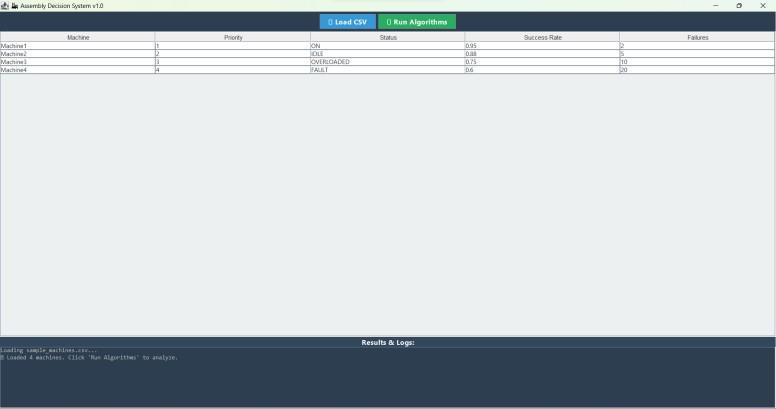
The performance of the proposed History-Aware Dynamic Sorting (HADS) algorithm is evaluated using a sample dataset consisting of multiple machines with different operational parameters. The dataset includes important attributes such as Machine ID, Priority, Machine Status, Success Rate, and Failure Count. These parameters are usedtocalculatetheDynamicDecisionIndex(DDI),which determines the efficiency and reliability of each machine for the assembly process. The dataset helps in comparing theperformanceoftheproposeddynamicdecision-making modelwiththetraditionalstaticpriority-basedsystem.
For performance evaluation, a sample dataset containing four machines was used. Each machine had different operational conditions and historical performance values. For example, Machine M1 was in ON state with a success rateof0.85andonefailure,MachineM2wasinIDLEstate with a success rate of 0.90 and zero failures, Machine M3 wasinOVERLOADEDstatewithasuccessrateof 0.75and twofailures,andMachineM4wasinFAULTconditionwith a success rate of 0.40 and five failures. These machine recordswereprocessedbytheHADSalgorithmtocalculate their Dynamic Decision Index values and rank them
accordingly.
The results show that the traditional static priority-based system selected Machine M1 because it had the highest predefined priority, even though another machine had better performance and reliability. In contrast, the HADS algorithm selected Machine M2 because it achieved the highest DDI value due to its better success rate, stable operational condition, and zero failure count. Machines with overloaded or faulty conditions received lower DDI values, reducing their selection probability. This demonstrates that the proposed system makes better decisions by evaluating both current machine conditions andhistoricaloperationalperformanceratherthanrelying onlyonfixedpriorities.
The performance analysis indicates that the HADS algorithm improves machine utilization, reduces the chances of selecting faulty machines, and minimizes production downtime. By dynamically adjusting machine priorities based on real-time and historical data, the system increases operational efficiency and improves productivity. The model also shows better adaptability in changing industrial environments, making it suitable for smart manufacturing systems. Overall, the dataset evaluation confirms that the proposed HADS algorithm provides higher reliability and better performance compared to conventional assembly decision-making methods.
During the evaluation, multiple machines with varying operational conditions were considered to simulate realtime industrial scenarios. The proposed model dynamically calculates the DDI for each machine by assigningpositiveweighttohighersuccessratesandstable operational states such as ON and IDLE, while penalizing machines that are in OVERLOADED or FAULT conditions and those with higher failure counts. This balanced evaluationensuresthatthemodeldoesnotrelyonasingle factorbutinsteadconsidersacombinationofreal-timeand historical data for decision making. As a result, machines that are both efficient and reliable are given higher preference.
When compared with the existing system, the HADS algorithm demonstrates significantly improved performance in terms of machine selection accuracy and operational efficiency. The traditional system selects machines based on fixed priorities, which often leads to the selection of machines that may not be in optimal condition. In contrast, the proposed model consistently selects machines with better operational health and performance history, thereby reducing the chances of machine failure during assembly operations. This leads to smoother workflow, fewer interruptions, and improved overallproductivity.
International Research Journal of Engineering and Technology (IRJET) e-ISSN: 2395-0056
Volume: 13 Issue: 05 | May 2026 www.irjet.net p-ISSN: 2395-0072
Furthermore, the model shows strong adaptability in dynamic environments where machine conditions frequently change. It continuously updates machine rankings based on the latest available data, ensuring that decisionmakingremainsrelevantandefficient.Thesystem also improves resource utilization by distributing workload among machines based on their performance capabilities, avoiding overloading and extending machine lifespan. Overall, the performance analysis confirms that theproposedHADSalgorithmprovidesareliable,scalable, andefficientsolutionforautomatedassemblysystems
Table 2: Sample Dataset
The advancement of automated assembly systems and smart manufacturing has led to significant research in intelligent decision-making for machine selection and productionefficiency.Traditionalassemblysystemsmainly used static priority-based methods, which were simple to implement but lacked the ability to adapt to changing machine conditions in real-time environments. Laszlo Monostori introduced the concept of cyber-physical systems in manufacturing, emphasizing the integration of real-time data and machine communication to improve production efficiency and industrial automation. Similarly, Shiyong Wang explored smart factory technologies under Industry4.0,focusingonautomation, dynamicscheduling, andflexibleproductionsystemstoenhancemanufacturing performance. Research from the Institute of Electrical and Electronics Engineers on industrial informatics further contributedtodecision-supportsystemsbyusingreal-time monitoring and machine scheduling techniques to optimize industrial operations. However, most of these existing approaches focus mainly on either current machineconditionsorpredefinedschedulingrulesanddo noteffectivelycombinehistoricaloperationalperformance suchassuccessrateandfailurecountfordecisionmaking. This limitation creates challenges in selecting the most reliable machine in dynamic assembly environments. To address this gap, the proposed History-Aware Dynamic
Sorting(HADS)algorithmintegratesbothpresentmachine status and previous operational history to dynamically calculatemachine efficiencyand improve decision-making accuracy, adaptability, and overall assembly performance insmartmanufacturingsystems.
The proposed History-Aware Dynamic Sorting (HADS) algorithmprovidesaneffectiveandintelligentsolutionfor improving decision making in automated assembly systems by combining present machine status with previous operational history. Unlike traditional static priority-based methods, the proposed system dynamically evaluates machine conditions such as ON, IDLE, OVERLOADED, and FAULT along with historical performance factors like success rate and failure count to calculatetheDynamicDecisionIndex(DDI).Thisapproach enablesaccuratemachineselection,reducesthechancesof selecting faulty or overloaded machines, minimizes downtime,andimprovesoverallproductionefficiency.The implementation and performance analysis demonstrate that the HADS algorithm offers better adaptability, reliability, and productivity compared to existing systems, makingitapracticalandscalablesolutionforIndustry4.0 andsmartmanufacturingenvironments.
The proposed History-Aware Dynamic Sorting (HADS) algorithm can be widely applied in various industrial and manufacturing environments where efficient machine selection is essential for improving productivity and reducingdowntime.Itcanbeusedinautomatedassembly lines for selecting the most suitable machine based on realtime operational conditions and historical performancedata.ThesystemishighlyusefulinIndustrial Automation, smart factories, and Industry 4.0 environments where machines continuously operate under changing conditions. It can also be applied in production scheduling, robotic assembly systems, manufacturing resource planning, and machine maintenance management to avoid faulty machine selection and improve operational reliability. Additionally, the system can support predictive maintenance and IoTbased industrial monitoring by integrating real-time sensor data, making it an effective solution for modern intelligentmanufacturingsystems.
The proposed History-Aware Dynamic Sorting (HADS) algorithmhasawiderangeofpracticalapplicationsacross modern industrial and technological environments where efficient decision making is essential. In automated assembly lines, the system plays a crucial role in selecting themostsuitablemachineforeachoperationbyanalyzing real-time machine conditions and historical performance,
International Research Journal of Engineering and Technology (IRJET) e-ISSN: 2395-0056
Volume: 13 Issue: 05 | May 2026 www.irjet.net p-ISSN: 2395-0072
thereby reducing downtime and improving production efficiency. It is highly applicable in smart factories and Industry 4.0 environments, where machines continuously interact with sensors and control systems, enabling dynamic and intelligent manufacturing processes. The algorithmcanalsobeusedinroboticassemblysystems to guide robots in choosing optimal machines or workstations, ensuring smoother workflow and minimizingoperationaldelays.
In addition to manufacturing, the proposed system can be applied in production scheduling and resource allocation, where multiple machines or resources are available and needtobeselectedbasedonefficiencyandreliability.Itis also useful in predictive maintenance systems, where machinefailurehistoryandperformancedataareanalyzed to avoid breakdowns and schedule maintenance proactively. The HADS algorithm can support Industrial Internet of Things (IIoT)-based monitoring systems by integrating real-time sensor data, allowing continuous evaluation of machine health and performance. Furthermore,itcanbeimplementedinlogisticsandsupply chain systems for optimizing equipment usage in warehouses and distribution centers. The system is also suitable for energy-efficient manufacturing, where machine selection can be optimized to reduce power consumption while maintaining productivity. Overall, the proposed approach provides a scalable, cost-effective, and intelligent solution for improving operational efficiency, reliability, and decision making across various industrial andsmartautomationdomains.
7.2
The proposed History-Aware Dynamic Sorting (HADS) algorithm offers several significant advantages over traditional static decision-making systems by enabling intelligent and adaptive machine selection in automated assemblyenvironments.Unlikefixedprioritymethods,the systemdynamicallyevaluatesmachinesbasedonreal-time operational conditions and historical performance data, ensuring more accurate and reliable decision making. It effectively avoids selecting faulty or overloaded machines, thereby reducing downtime and improving overall production efficiency. The use of the Dynamic Decision Index (DDI) allows for better ranking of machines, leading to optimal resource utilization and enhanced productivity. Additionally, the system is simple to implement, cost-effective, and scalable, making it suitable for industries with multiple machines and complex operations. Its ability to adapt to changing conditions and learn from past performance makes it highly suitable for modern Industry 4.0 and smart manufacturing environments, where flexibility, reliability, and efficiency areessential.
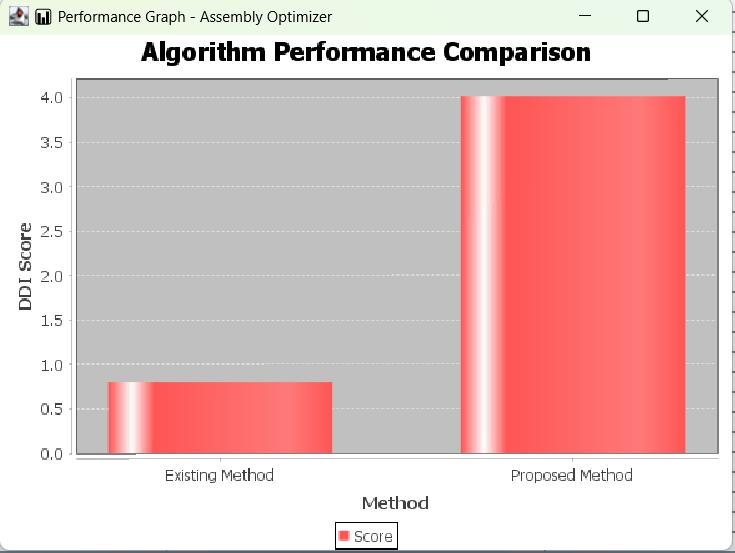
Thepresentedgraphillustratesacomparisonbetweenthe existing static priority-based method and the proposed History-Aware Dynamic Sorting (HADS) algorithm using the Dynamic Decision Index (DDI) score as the performance metric. The x-axis represents the two methods being compared, while the y-axis indicates the DDIscoreachievedbyeachapproach.Fromthegraph,itis clearly observed that the existing method has a significantly lower DDI score of approximately 0.8, which indicates limited efficiency due to its reliance on fixed priorities without considering real-time machine conditions or historical performance. In contrast, the proposed HADS algorithm achieves a much higher DDI score of around 4.0, demonstrating superior performance and more effective decision making. This substantial improvementhighlightstheabilityoftheproposedsystem to dynamically evaluate machine status and past operational data, leading to better machine selection, reduced downtime, and enhanced overall productivity in assemblyoperations.
The proposed History-Aware Dynamic Sorting (HADS) algorithm can be further enhanced by integrating advanced technologies to improve decision-making accuracyandsystemintelligence.Inthefuture,thesystem can be connected with Internet of Things (IoT) sensors to collect real-time machine data automatically, enabling faster and more accurate machine status monitoring. Machine learning techniques can also be incorporated to predict machine failures and optimize decision making based on past operational patterns. The system can be expanded to support large-scale industrial environments with a greater number of machines and more complex assemblyoperations.Additionally,cloud-basedmonitoring and data storage can be implemented for remote access and centralized control. Future improvements may also include predictive maintenance features, energy-efficient
International Research Journal of Engineering and Technology (IRJET) e-ISSN: 2395-0056
Volume: 13 Issue: 05 | May 2026 www.irjet.net p-ISSN: 2395-0072
machine selection, and integration with smart factory management systems to further enhance productivity, reliability,andautomationinIndustry4.0environments.
[1] Laszlo Monostori et al., “Cyber-Physical Systems in Manufacturing,” CIRP Annals, vol. 65, no. 2, pp. 621–641,2016.
[2] Shiyong Wang et al., “Implementing Smart Factory of Industry 4.0: An Outlook,” International Journal of AdvancedManufacturingTechnology,2017.
[3] InstituteofElectrical andElectronicsEngineers, “IEEE Transactions on Industrial Informatics,” Industrial Automation and Smart Manufacturing Research Papers.
[4] Jay Lee et al., “Industrial Artificial Intelligence for Industry 4.0-based Manufacturing Systems,” ManufacturingLetters,2018.
[5] Andrew Kusiak, “Smart Manufacturing,” International Journal of Production Research, vol. 56, no. 1–2, pp. 508–517,2018.
[6] Yuqian Lu et al., “Smart Manufacturing Process and System Automation,” Journal of Manufacturing Systems,2020.
[7] Internet of Things (IoT) Based Smart Manufacturing Systems, Journal of Industrial Information Integration, 2019. [8] Hermann Kagermann et al., “Recommendations for Implementing the Strategic Initiative Industry 4.0,” German National Academy of ScienceandEngineering,2013
[8] Thomas Edgar et al., “SmarManufacturing, ManufacturingIntelligence and DemandDynamic Performance,” Computers & Chemical Engineering,2012.
[9] Jiafu Wan et al., “Artificial Intelligence-Driven Customized Manufacturing Factory,” Computers & IndustrialEngineering,2021.
[10] Petar Radanliev et al., “Artificial Intelligence in Cyber PhysicalSystems,”FutureInternetJournal,2019.
[11] Kleanthis Thramboulidis et al., “Cyber-Physical Microservices: An IoT-based Framework for ManufacturingSystems,”arXiv,2018.
[12] Industry 4.0 and Smart Manufacturing Systems, TechnicalReport,2024.
[13] Predictive Maintenance in Smart Manufacturing, IndustrialEngineeringJournal,2020.
[14] Industrial Automation and Dynamic Scheduling SystemsforAssemblyLineOptimization, International JournalofAutomationandComputing,2022.
2026, IRJET | Impact Factor value: 8.317 | ISO 9001:2008