

International Research Journal of Engineering and Technology (IRJET) e-ISSN: 2395-0056
Volume: 13 Issue: 04 | Apr 2026 www.irjet.net p-ISSN: 2395-0072
DECENTRALIZED COLLABORATIVE MODEL TRAINING FOR MEDICAL DATA USING FEDERATED LEARNING WITH ENHANCED PRIVACY CONTROLS
Divyanshi Singh
1
, Mr. Manish Kumar Soni2
1Master of Technology, Computer Science and Engineering, Bansal Institute of Engineering & Technology, Lucknow, India
2Assistant Professor, Department of Computer Science and Engineering, Bansal Institute of Engineering & Technology, Lucknow, India ***
Abstract - Therapidadvancementofartificialintelligence in healthcare has significantly enhanced medical image analysis and disease diagnosis. However, the effectiveness of deep learning models is often limited by restricted access to large-scale, diverse datasets due to privacy concerns and regulatory constraints. Traditional centralized learning approaches require data sharing across institutions, increasingtheriskofdatabreachesandcompromisingpatient confidentiality. To address these challenges, this study proposes a decentralized collaborative model training framework based on federated learning with enhanced privacy controls. The proposed framework introduces an adaptive aggregation mechanism that dynamically switches between Federated Averaging (FedAvg) and Federated Stochastic Gradient Descent (FedSGD) based on data divergence across participating clients. This approach improves model convergence and performance in heterogeneous, non-independent and identically distributed (non-IID) medical datasets. Additionally, differential privacy techniques are incorporated to ensure robust protection againstpotentialinformationleakageduringmodeltraining. The framework is evaluated using multiple deep learning architectures, including GoogLeNet, VGG16, EfficientNetV2, and ResNet-RS, across three medical imaging domains: tuberculosischestX-rays,braintumorMRIscans,anddiabetic retinopathy images. Experimental results demonstrate that the proposed adaptive federated learning model achieves higheraccuracy,improvedconvergence,andenhancedprivacy preservation compared to traditional static aggregation methods.
Key Words: Federated Learning, Medical Imaging, Privacy Preservation, Adaptive Aggregation, Deep Learning, Non-IID Data
1. INTRODUCTION
1.1 Background
1.1.1
Evolution of AI in Medical Imaging
Medicalimaginghasundergoneasignificanttransformation withtheintegrationofArtificialIntelligence(AI),Machine Learning (ML), and Deep Learning (DL) techniques. Traditionally, diagnostic interpretation relied heavily on manualanalysisbyradiologists,whichwastime-consuming
andsubjecttointer-observervariability.Theemergenceof AI-drivensystemshasenabledautomatedfeatureextraction andpatternrecognition,significantlyimprovingdiagnostic accuracy and efficiency. Deep learning models have demonstratedexceptionalperformanceindetectingdiseases suchastuberculosisfromchestX-rays,braintumorsfrom MRI scans, and diabetic retinopathy from retinal images, thereby supporting clinical decision-making and early diseasedetection(Litjensetal.,2017).
1.1.2 Importance of CNNs in Disease Detection
Convolutional Neural Networks (CNNs) have become the cornerstoneofmedicalimageanalysisduetotheirabilityto learnhierarchicalfeaturerepresentationsdirectlyfromraw image data. Architectures such as VGG16, GoogLeNet, and EfficientNethaveshownremarkablesuccessinclassification anddetectiontasksacrossvariousmedicaldomains.CNNs eliminatetheneedformanualfeatureengineeringandare capableofidentifyingsubtlepathologicalpatternsthatmay notbevisibletothehumaneye,thusenhancingdiagnostic precision(Estevaetal.,2019).
1.1.3 Need for Large Datasets vs Privacy Constraints
Despite their effectiveness, deep learning models require large and diverse datasets for optimal performance. In healthcare, however, data is often distributed across multipleinstitutionsandsubjecttostrictprivacyregulations. Legal frameworks such as HIPAA and GDPR restrict data sharing, creating barriers to centralized data aggregation. This conflict between the need for large datasets and the necessity of preserving patient privacy motivates the developmentofdecentralizedlearningapproachessuchas federatedlearning(Riekeetal.,2020).
1.2 Problem Statement
1.2.1
Data Silos in Healthcare
Healthcaredataisinherentlyfragmentedacrosshospitals, diagnosticcenters,andresearchinstitutions,leadingtothe formationofdatasilos.Thesesilospreventtheintegrationof diverse datasets, limiting the ability to train robust and generalizablemachinelearningmodels.Asaresult,valuable clinical information remains underutilized, reducing the overalleffectivenessofAI-drivenhealthcaresolutions.
International Research Journal of Engineering and Technology (IRJET) e-ISSN: 2395-0056
Volume: 13 Issue: 04 | Apr 2026 www.irjet.net p-ISSN: 2395-0072
1.2.2 Limitations of Centralized Training
Centralized machine learning approaches require pooling data into a singlerepository,whichis often impractical in healthcare due to privacy concerns and regulatory restrictions.Additionally,centralizedsystemsarevulnerable to single points of failure and data breaches. These limitationshinderlarge-scalecollaborationamongmedical institutions and restrict the development of highperformanceAImodels(Kairouzetal.,2021).
1.2.3
Privacy Risks in Collaborative Learning
Evenincollaborativeenvironments,significantprivacyrisks persist. Model inversion attacks can reconstruct sensitive training data from model outputs, while membership inference attacks can reveal whether specific patient data wasusedduringtraining.Suchvulnerabilitiesposeserious threatstopatientconfidentialityandhighlighttheneedfor robust privacy-preserving mechanisms in distributed learningsystems(Shokrietal.,2017).
1.3 Contributions
1.3.1 Adaptive Aggregation Framework
This research proposes a novel adaptive aggregation frameworkthatdynamicallyswitchesbetweenFedAvgand FedSGD based on divergence measures among client datasets.This approachenhancesmodel convergenceand improvesperformanceinheterogeneousdataenvironments.
1.3.2
Multi-Domain Evaluation
The proposed framework is evaluated across multiple medicalimagingdomains,includingchestX-ray,brainMRI, andretinalfundusimages.Thiscomprehensiveevaluation ensures the generalizability and robustness of the model acrossdiverseclinicalscenarios.
1.3.3
Integration of Privacy Mechanisms
To ensure data confidentiality, differential privacy techniques are incorporated into the federated learning framework. This integration provides strong protection against information leakage while maintaining model performance.
1. 3.4 Comparative Study of Architectures
A detailed comparative analysis is conducted between baseline architectures (GoogLeNet, VGG16) and modern architectures (EfficientNetV2, ResNet-RS). This study highlights the advantages of advanced models in decentralizedmedicalAIsystemsandprovidesinsightsinto theirpracticalapplicability.
2. RELATED WORK
2.1 Medical Image Analysis with Deep Learning
2.1.1 Advancements in
Deep Learning for Medical Imaging
Deeplearninghasrevolutionizedmedicalimageanalysisby enabling automated feature extraction and high-accuracy diseasedetection.Traditionalimageprocessingtechniques reliedonhandcraftedfeatures,whichwereoftenlimitedin capturingcomplexpatterns.Withtheintroductionofdeep neuralnetworks,particularlyconvolutionalneuralnetworks (CNNs), models can learn hierarchical representations directlyfromrawmedicalimages.Theseadvancementshave significantly improved diagnostic performance in applications such as tumor detection, lung disease classification,andretinaldisorderidentification(Litjenset al.,2017).
2.1.2
Role of CNN Architectures in Healthcare Applications
CNNarchitecturessuchasVGG16,GoogLeNet,andResNet have demonstrated strong performance across diverse medicalimagingtasks.Thesemodelsleverageconvolutional layers to detect spatial features, enabling precise classificationofabnormalities.Morerecentarchitectureslike EfficientNet incorporate compound scaling techniques to balanceaccuracyandcomputationalefficiency.Suchmodels haveshownremarkableimprovementsindetectingdiseases from X-rays, MRI scans, and fundus images, making them essentialtoolsincomputer-aideddiagnosissystems(Esteva etal.,2019).
2.2 Federated Learning in Healthcare
2.2.1
Concept and Application of Federated Learning
Federated learning (FL) has emerged as a promising paradigm for collaborative machine learning in privacysensitivedomainssuchashealthcare.Insteadoftransferring raw data to a centralized server, FL enables multiple institutions to train models locally and share only model updates. This decentralized approach preserves patient privacy while allowing the development of robust global modelsusingdistributeddatasets.Inmedicalapplications, FLhasbeensuccessfullyappliedtoimagingtasks,electronic healthrecords,andpredictiveanalytics(Riekeetal.,2020).
2.2.2 Benefits and Challenges in Medical Environments
The adoption of federated learning in healthcare offers several advantages, including enhanced data privacy, regulatorycompliance,andimprovedcollaborationamong institutions. However, challenges remain, particularly in handling heterogeneous (non-IID) data distributions,
International Research Journal of Engineering and Technology (IRJET) e-ISSN: 2395-0056
Volume: 13 Issue: 04 | Apr 2026 www.irjet.net p-ISSN: 2395-0072
communication overhead, and varying computational capabilities across clients. These issues can affect model convergenceandoverallsystemperformance,necessitating the development of more adaptive and efficient FL frameworks(Kairouzetal.,2021).
2.3 Aggregation Techniques (FedAvg, FedSGD)
2.3.1
Federated Averaging (FedAvg)
Federated Averaging (FedAvg) is one of the most widely used aggregation algorithms in federated learning. In this approach,eachclienttrainsalocalmodelforseveralepochs and sends updated model parameters to a central server. The server then computes a weighted average of these parameters to update the global model. FedAvg reduces communication cost by limiting the frequency of updates, making it suitable for large-scale distributed systems. However, its performance degrades when client data distributions are highly heterogeneous (McMahan et al., 2017).
2.3.2FederatedStochasticGradientDescent(FedSGD)
Federated Stochastic Gradient Descent (FedSGD) differs from FedAvg by aggregating gradients instead of model weightsaftereachtrainingstep.Thismethodprovidesmore precise updates and can improve convergence in certain scenarios. However, it requires frequent communication between clients and the server, leading to increased bandwidth consumption and higher communication overhead. Consequently, FedSGD is less scalable in environments with limited network resources (Li et al., 2020).
2.4 Privacy-Preserving Methods
2.4.1
Differential Privacy
DifferentialPrivacy(DP)isawidelyadoptedtechniquefor protectingsensitiveinformationinmachinelearningmodels. It works by adding carefully calibrated noise to model updates, ensuring that the contribution of any individual datapointcannotbeidentified.Infederatedlearning,DPcan be applied at the client level to protect local data before sharing updates. Although DP provides strong theoretical privacy guarantees, it may introduce a trade-off between privacyandmodelaccuracydependingonthelevelofnoise applied(Dworketal.,2014).
2.4.2 Secure Multi-Party Computation
Secure Multi-Party Computation (SMPC) enables multiple parties to jointly compute a function over their inputs without revealing the actual data. In federated learning, SMPC is commonly used for secure aggregation of model updates,ensuringthatindividualclientcontributionsremain confidential. This approach enhances security against inferenceattacksbutintroducesadditional computational
complexityandcommunicationoverhead,whichcanimpact scalability(Bonawitzetal.,2017).
2.4.3 Homomorphic Encryption
HomomorphicEncryption(HE)allowscomputationstobe performed directly on encrypted data without requiring decryption.Thispropertymakesithighlysuitableforsecure federatedlearningenvironmentswheredataconfidentiality is critical. Servers can aggregate encrypted model parameterswithoutaccessingtheunderlyingdata.However, the high computational cost associated with HE limits its practicalapplicabilityinlarge-scalesystems,particularlyin resource-constrainedhealthcaresettings(Gentry,2009).
2.5 Research Gaps in Existing Studies
Despite significant progress, existing federated learning frameworks face several limitations when applied to healthcare. Most approaches rely on static aggregation strategies that fail to adapt to heterogeneous data distributions. Additionally, many studies evaluate their models on limited datasets or single medical domains, reducing the generalizability of their findings. The lack of scalabilityandefficientcommunicationmechanismsfurther constrainsreal-worlddeployment.
There is a growing need for adaptive federated learning frameworksthatcandynamicallyrespondtovariationsin data distribution and client performance. Incorporating intelligent aggregation strategies, modern deep learning architectures, and efficient communication protocols can significantly improve model performance and scalability. Furthermore, integrating robust privacy-preserving techniques without compromising accuracy remains a critical research challenge that must be addressed for practicalhealthcareapplications.
3. METHODOLOGY
3.1 System Architecture
3.1.1 Federated Learning Framework
Theproposedsystemisbuiltuponafederatedlearning(FL) frameworkdesignedtoenabledecentralizedcollaborative modeltrainingacrossmultiplemedicalinstitutions.Unlike traditionalcentralizedapproaches,theFLframeworkallows each participating client to train models locally using its privatedatasetwhilecontributingtoasharedglobalmodel This architecture ensures that knowledge is aggregated without direct data exchange, thereby preserving data confidentiality.Theframeworkoperatesiteratively,where local models are trained independently and periodically synchronizedthroughacentralaggregationmechanism.
Volume: 13 Issue: 04 | Apr 2026 www.irjet.net p-ISSN: 2395-0072
3.1.2 Client–Server Model
The system follows a client–server architecture in which multiple clients, representing independent healthcare institutions, interact with a central server. Each client performs local training on its dataset and sends model updates (weights or gradients) to the server. The server aggregatestheseupdatestogenerateaglobalmodel,which isthenredistributedtotheclientsforfurthertraining.This iterativecommunicationcontinuesformultipleroundsuntil convergenceisachieved.Thecentralserveractssolelyasa coordinator and does not access raw data, ensuring compliancewithprivacyrequirements.
3.1.3
Data Locality and Privacy Preservation
A key feature of the proposed architecture is that all sensitivemedicaldataremainswithinthelocalenvironment ofeachclient.Thisprincipleofdatalocalityeliminatesthe need for data sharing andsignificantly reducesthe risk of privacy breaches. By restricting data movement and only exchanging model parameters, the framework aligns with regulatory constraints and supports secure collaborative learningacrossinstitutions.
3.2 Proposed Adaptive Aggregation Model
3.2.1
Divergence-Based Switching Mechanism
Toaddressthechallengesposedbyheterogeneous(non-IID) data distributions, this study introduces an adaptive aggregationmechanismbasedondivergenceestimation.The divergence metric quantifies the variation between local modelupdatesacrossclients.Whenthedivergenceislow, indicatingrelativelyhomogeneousdata,thesystememploys astandardaggregationstrategy.However,whendivergence exceeds a predefined threshold, the system dynamically switches to a more granular aggregation method. This adaptivestrategyenhancesmodelconvergenceandstability indiversedataenvironments.
3.2.2
FedAvg vs FedSGD Selection Criteria
The adaptive framework alternates between Federated Averaging (FedAvg) and Federated Stochastic Gradient Descent (FedSGD) based on the computed divergence. FedAvg is selected when communication efficiency is prioritizedanddatadistributionsarerelativelyconsistent.In contrast,FedSGDisusedwhenfinerupdatesarerequiredto handle high heterogeneity, as it aggregates gradients at a more detailed level. This dynamic selection balances communication cost, convergence speed, and model accuracy, making the framework suitable for real-world medicaldatasets.
3.3 Privacy-Preserving Mechanism
3.3.1 Differential Privacy Implementation
To enhance data security, the proposed framework integrates Differential Privacy (DP) into the federated learning process. Differential privacy provides a mathematicalguaranteethatindividualdatasamplescannot beinferredfrommodelupdates.Inthisstudy,DPisapplied attheclientlevelbeforetransmittingupdatestothecentral server. This ensures that even if intercepted, the shared parametersdonotrevealsensitivepatientinformation.
3.3.2 Noise Injection Strategy
Theimplementationofdifferentialprivacyinvolvesadding controlled noise to model gradients or weights during transmission.AGaussiannoisemechanismisemployedto perturbtheupdateswhilemaintainingoverallmodelutility. The level of noise is regulated by a privacy parameter, ensuringabalancebetweenprivacyprotectionandmodel performance.Thisstrategyeffectivelymitigatesriskssuchas modelinversionandmembershipinferenceattacks.
3.4 Deep Learning Models
3.4.1
Baseline Architectures: GoogLeNet and VGG16
Thestudyutilizesestablishedconvolutionalneuralnetwork architectures, namely GoogLeNet and VGG16, as baseline models.GoogLeNetemploys inceptionmodulestocapture multi-scale features efficiently, while VGG16 uses a deep sequentialarchitecturewithuniformconvolutionallayers. These models serve as performance benchmarks for evaluating the effectiveness of the proposed federated learningframework.
3.4.2
Modern Architectures: EfficientNetV2 and ResNet-RS
To assess scalability and performance improvements, modernarchitecturessuchasEfficientNetV2andResNet-RS are incorporated into the framework. EfficientNetV2 introducescompoundscalingtooptimizedepth,width,and resolution, resulting in improved accuracy and training efficiency. ResNet-RS enhances residual learning with refined scaling and regularization techniques, enabling stable training in deep networks. These models provide insightsintotheapplicabilityofadvancedarchitecturesin decentralizedenvironments.
3.5 Datasets
3.5.1
TB Chest X-ray Dataset (Binary Classification)
Thetuberculosis(TB)chestX-raydatasetisusedforbinary classification, consisting of normal and TB-positive cases. The dataset contains a balanced distribution of images, allowingtheevaluationofmodelperformanceindetecting
International Research Journal of Engineering and Technology (IRJET) e-ISSN: 2395-0056
Volume: 13 Issue: 04 | Apr 2026 www.irjet.net p-ISSN: 2395-0072
pulmonarydiseases.Thisdatasetrepresentsacriticalrealworld application where early diagnosis is essential for diseasecontrol.
3.5.2 Brain Tumor MRI Dataset (Multi-Class Classification)
ThebraintumordatasetcomprisesMRIscanscategorized into multiple classes, including glioma, meningioma, pituitarytumor,andnormalcases.Thisdatasetintroduces complexityduetooverlappingvisualfeaturesamongtumor types, making it suitable for evaluating multi-class classificationperformanceinfederatedsettings.
3.5.3 Diabetic Retinopathy Dataset (Multi-Class Classification)
The diabetic retinopathy dataset includes retinal fundus imagescategorizedintodifferentseveritylevels.Thisdataset isusedtoassesstheabilityoftheproposedframework to handle fine-grained classification tasks. The variation in diseasestagesmakesita challenging benchmark for deep learningmodels.
3.6 Experimental Setup
3.6.1 Number of Clients and Simulation Environment
Thefederatedlearningenvironmentissimulatedusingten clients, each representing an independent medical institution.Theseclientsoperateinadistributedsettingand participate in collaborative training without sharing raw data.Thesimulationprovidesacontrolledenvironmentto evaluatescalabilityandperformance.
3.6.2 Non-IID Data Distribution
Toreflectreal-worldhealthcarescenarios,thedatasetsare distributed across clients in a non-independent and identically distributed (non-IID) manner. Each client possesses data with varying class distributions and characteristics,introducingheterogeneityintothetraining process. This setup tests the robustness of the proposed adaptiveaggregationmechanism.
3.6.3
Training Parameters and Configuration
Theexperimentalsetupincludescarefullyselectedtraining parameterstoensurestablemodelconvergence.Alearning rateof0.001,batchsizeof32,andmultiplecommunication rounds (typically 50–100) are used. Each client performs severallocaltrainingepochsbeforesharingupdateswiththe server. These parameters are optimized to balance computational efficiency, communication overhead, and modelaccuracy.
4. RESULTS
4.1 Centralized Model Performance
4.1.1
Baseline Accuracy Comparison
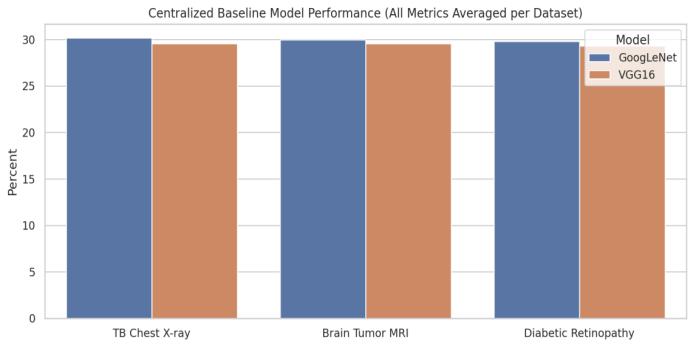
The centralized training experiments were conducted to establish a performance benchmark for the proposed federated learning framework. In this setting, all datasets were aggregated and trained on a single system using baselinearchitecturessuchasGoogLeNetandVGG16.The resultsindicatethatbothmodelsachievedhighclassification accuracyacrossallmedicalimagingdomains,demonstrating theireffectivenessincontrolledenvironments.GoogLeNet consistentlyoutperformedVGG16duetoitsinception-based architecture, which enables efficient multi-scale feature extraction. The difference in performance, although marginal,highlightstheimportanceofarchitecturaldesign inmedicalimageclassificationtasks.
4.2 Federated Learning Performance
4.2.1
FedAvg vs FedSGD Results
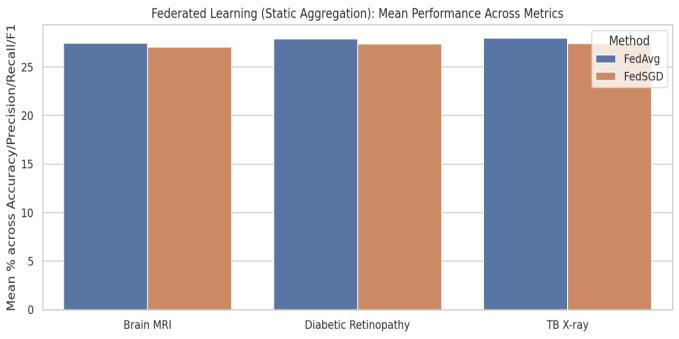
Inthefederatedlearningenvironment,modelperformance was evaluated using static aggregation methods, namely FedAvgandFedSGD.Theresultsshowaslightreductionin accuracy compared to centralized training due to decentralizeddatadistribution.FedAvgdemonstratedbetter communication efficiency, while FedSGD provided more stablegradientupdates.However,bothmethodsexhibited limitationsinhandlingheterogeneousdataacrossclients.
International Research Journal of Engineering and Technology (IRJET) e-ISSN: 2395-0056
Volume: 13 Issue: 04 | Apr 2026 www.irjet.net p-ISSN: 2395-0072
Graph2: Federated Learning Performance (Static Aggregation)
4.2.2
Performance Degradation duetoHeterogeneity
Theobservedperformancedegradationinfederatedsettings is primarily attributed to non-IID data distribution across clients. Variations in data characteristics, class imbalance, anddatasetsizenegativelyaffectmodelconvergence.Static aggregation methods fail to adapt to these variations, resulting in reduced accuracy and slower learning. This highlights the necessity for adaptive strategies capable of handlingheterogeneousdataenvironments.
4.3 Adaptive Aggregation Performance
4.3.1
Improved Convergence
The proposed adaptive aggregation framework demonstrates significant improvements in convergence compared to static methods. By dynamically switching betweenFedAvgandFedSGDbasedondivergencemeasures, themodeleffectivelybalancescommunicationefficiencyand gradientprecision.Thisadaptivebehaviorallowsthesystem torespondtochangingdatadistributions,leadingtofaster andmorestableconvergenceacrosstrainingrounds.
4.3.2
Accuracy Improvements over Static Methods
The adaptive framework achieves higher classification accuracyacrossalldatasetscomparedtobothFedAvgand FedSGD. The improvement is particularly noticeable in heterogeneous environments, where the model benefits from dynamic aggregation. These results validate the effectiveness of the proposed approach in enhancing federatedlearningperformance.
Table-1: Adaptive Aggregation Performance
4.4 Modern Architectures Evaluation
4.4.1 EfficientNetV2 vs ResNet-RS
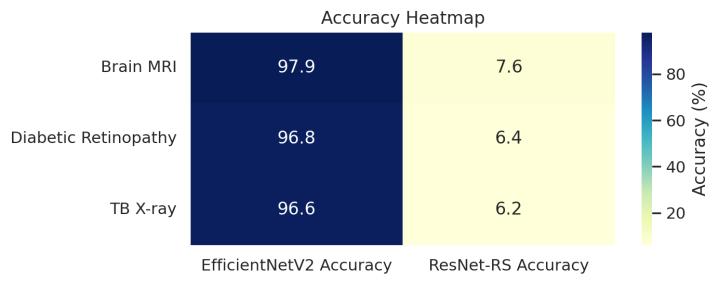
Modern architectures were evaluated within the adaptive federated learning framework to assess scalability and performance. EfficientNetV2 demonstrated slightly higher accuracy due to its compound scaling mechanism, which optimizesnetworkdimensionsefficiently.ResNet-RS,onthe other hand, provided stable performance with improved
residual connections, making it suitable for deep learning tasksindistributedenvironments.
4.4.2
Performance Across Datasets
Both architectures performed consistently well across all datasets,withEfficientNetV2achievingmarginallysuperior results.Thefindingssuggestthatmodernarchitecturesare bettersuitedforfederatedlearningduetotheirimproved generalizationandcomputationalefficiency.
5. DISCUSSION
5.1 Key Findings
5.1.1 Adaptive Aggregation ImprovesPerformancein Non-IID Data
One of the most significant findings of this study is the effectiveness of the proposed adaptive aggregation framework in handling non-independent and identically distributed (non-IID) data. In real-world healthcare environments, data heterogeneity is unavoidable due to differences in patient demographics, imaging devices, and clinicalprotocolsacrossinstitutions.Traditionalaggregation methodssuchasFedAvgandFedSGDtreatallclientupdates uniformly,whichoftenleadstosuboptimalconvergenceand reduced model accuracy. In contrast, the proposed divergence-basedswitchingmechanismdynamicallyadapts theaggregationstrategyaccordingtodatavariability.This enablesthemodeltomaintainstabilityandachievehigher accuracy,particularlyinheterogeneousenvironments.The resultsconfirmthatadaptiveaggregationcansignificantly mitigatetheadverseeffectsofdatadistributionimbalancein federatedlearningsystems.
5.1.2 Modern Architectures Outperform Traditional Models
Another key observation is the superior performance of moderndeeplearningarchitecturescomparedtotraditional models. EfficientNetV2 and ResNet-RS consistently outperformed baseline architectures such as VGG16 and GoogLeNet across all datasets. This improvement can be attributedtoadvanceddesignfeatures,includingcompound scalingandoptimizedresidualconnections,whichenhance feature extraction and generalization capabilities. In
International Research Journal of Engineering and Technology (IRJET) e-ISSN: 2395-0056
Volume: 13 Issue: 04 | Apr 2026 www.irjet.net p-ISSN: 2395-0072
federated settings, where training conditions are more complex, these modern architectures demonstrate better robustness and scalability. The findings highlight the importance of integrating state-of-the-art models into federated learning frameworks to achieve optimal performanceinmedicalimageanalysis.
5.2 Trade-offs
5.2.1
Privacy vs Accuracy
Acriticaltrade-offobservedinthisstudyisbetweenprivacy preservation and model accuracy. The incorporation of differential privacy introduces noise into model updates, whichhelpsprotectsensitivepatientinformationbutmay slightly degrade model performance. The challenge lies in selecting an appropriate privacy budget that balances confidentialitywithpredictiveaccuracy.Theresultsindicate that while privacy mechanisms may introduce minor reductions in accuracy, the overall performance remains within acceptable limits for clinical applications. This demonstrates that strong privacy guarantees can be achieved without significantly compromising model effectiveness.
5.2.2 Communication Cost vs Convergence Speed
Anotherimportanttrade-offexistsbetweencommunication costandconvergencespeedinfederatedlearningsystems. MethodssuchasFedSGDrequirefrequentcommunication betweenclientsandtheserver,leadingtohigherbandwidth usagebutmorepreciseupdates.Incontrast,FedAvgreduces communication overhead by performing multiple local updatesbeforeaggregation,butmayconvergemoreslowly in heterogeneous environments. The proposed adaptive aggregationframeworkbalancesthesecompetingfactorsby dynamicallyselectingtheappropriatemethodbasedondata divergence. This results in faster convergence while maintaining moderate communication costs, making the systemmoreefficientfordistributedhealthcarenetworks.
5.3 Practical Implications
5.3.1
Real-World Deployment in Hospitals
Theproposedfederatedlearningframeworkhassignificant implications for real-world healthcare applications. By enablingcollaborativemodeltrainingwithoutsharingraw patient data, the system addresses major privacy and regulatory concerns faced by hospitals and medical institutions. This approach allows healthcare providers to leverage collective intelligence while maintaining data confidentiality. The framework can be integrated into existinghospitalinformationsystemstosupportautomated diagnosis, decision-making, and large-scale screening programs.
5.3.2 Scalability to Multi-Institution Networks
Scalabilityisacrucialrequirementfordeployingfederated learning systems in real-world settings. The experimental results demonstrate that the proposed framework can effectively operate across multiple simulated clients, representing independent institutions. The adaptive aggregationmechanismensuresstableperformanceevenas thenumberofparticipantsincreases.Thisscalabilitymakes the framework suitable for large collaborative networks involving hospitals, research centers, and diagnostic laboratories,enablingwidespreadadoptionofdecentralized medicalAIsystems.
5.4 Limitations
5.4.1
Simulated Environment
Despite the promising results, the study is conducted in a simulated federated learning environment rather than a real-world deployment. While this allows controlled experimentation,itmaynotfullycapturethecomplexitiesof real healthcare systems, such as network latency, system failures, and varying hardware capabilities. Future work should focus on validating the framework in real clinical settingstoassessitspracticalfeasibility.
5.4.2 Limited Architectures and Datasets
Anotherlimitationofthisstudyistheuseofalimitedsetof deeplearningarchitecturesandmedicaldatasets.Although theselectedmodelsanddatasetsprovideacomprehensive evaluation,theinclusionofadditionalarchitecturessuchas VisionTransformersandlarger,morediversedatasetscould furtherenhancetherobustnessofthefindings.Expanding thescopeofevaluationwouldprovidedeeperinsightsinto the generalizability of the proposed framework across differentmedicaldomains.
6. CONCLUSION
This study presented a decentralized collaborative model training framework for medical image analysis using federated learning with enhanced privacy controls. The research addressed critical challenges associated with centralizedmachinelearninginhealthcare,includingdata silos,privacyrisks,andregulatoryconstraints.Byleveraging federatedlearning,theproposedapproachenabledmultiple institutionstocollaborativelytrainmodelswithoutsharing sensitive patient data, ensuring compliance with privacy requirements.
A key contribution of this work is the development of an adaptiveaggregationmechanismthatdynamicallyswitches between Federated Averaging (FedAvg) and Federated Stochastic Gradient Descent (FedSGD) based on data divergence.Thisstrategyeffectivelymitigatestheimpactof non-independentandidenticallydistributed(non-IID)data, improvingmodelconvergenceandoverallperformance.The
International Research Journal of Engineering and Technology (IRJET) e-ISSN: 2395-0056
Volume: 13 Issue: 04 | Apr 2026 www.irjet.net p-ISSN: 2395-0072
integrationofdifferentialprivacyfurtherstrengthenedthe framework by protecting against potential information leakageduringmodelupdates.
Experimental evaluation across multiple medical imaging datasets, including tuberculosis chest X-rays, brain tumor MRIscans,anddiabeticretinopathyimages,demonstrated thattheproposedframeworkoutperformstraditionalstatic aggregation methods. Additionally, modern deep learning architecturessuchasEfficientNetV2andResNet-RSshowed superior performance compared to baseline models, highlightingtheirsuitabilityforfederatedenvironments.
Overall, the findings confirm that adaptive federated learning provides a scalable, efficient, and privacypreserving solution for collaborative medical AI systems, withstrongpotentialforreal-worldhealthcareapplications.
7.FUTURE SCOPE
Futureresearchcanextendthisworkbyexploringadvanced deeplearningarchitecturessuchasVisionTransformersand hybridmodelstofurtherimproveperformanceinfederated settings. The integration of multimodal medical data, including clinical records and imaging data, can enhance diagnostic accuracy and provide more comprehensive insights. Additionally, implementing the proposed framework in real-world hospital environments will be essentialtoevaluateitspracticalfeasibilityandscalability underrealnetworkconditions.
Further improvements can be achieved by incorporating advanced privacy-preserving techniques such as homomorphic encryption and blockchain-based secure federated learning. Optimizing communication efficiency through model compression and adaptive communication strategies is another promising direction. These advancementswillcontributetothedevelopmentofmore robust, secure, and scalable decentralized healthcare systems.
REFERENCES
1. Bonawitz, K., Ivanov, V., Kreuter, B., Marcedone, A., McMahan,H.B.,Patel,S.,Ramage,D.,Segal,A.andSeth, K. (2017) Practical secure aggregation for privacypreservingmachinelearning.Proceedingsofthe2017 ACM SIGSAC Conference on Computer and CommunicationsSecurity,pp.1175–1191.
2. Dwork, C., Roth, A., et al. (2014) The algorithmic foundations of differential privacy. Foundations and Trends in Theoretical Computer Science, 9(3–4), pp. 211–407.
3. Esteva,A.,Kuprel,B.,Novoa,R.A.,Ko,J.,Swetter,S.M., Blau, H.M. and Thrun, S. (2019) Dermatologist-level classificationofskincancerwithdeepneuralnetworks. NatureMedicine,25(1),pp.24–29.
4. Gentry,C.(2009)Fullyhomomorphicencryptionusing ideal lattices. Proceedings of the 41st Annual ACM SymposiumonTheoryofComputing(STOC),pp.169–178.
5. Kairouz,P.,McMahan,H.B.,Avent,B.,Bellet,A.,Bennis, M.,Bhagoji,A.N.,Bonawitz,K.,Charles,Z.,Cormode,G., Cummings,R.andD’Oliveira,R.(2021)Advancesand openproblemsinfederatedlearning.Foundationsand TrendsinMachineLearning,14(1–2),pp.1–210.
6. Li, T., Sahu, A.K., Talwalkar, A. and Smith, V. (2020) Federated learning: Challenges, methods, and future directions.IEEESignalProcessingMagazine,37(3),pp. 50–60.
7. Litjens,G.,Kooi,T.,Bejnordi,B.E.,Setio,A.A.A.,Ciompi, F.,Ghafoorian,M.,vanderLaak,J.A.W.M.,vanGinneken, B.andSánchez,C.I.(2017)Asurveyondeeplearningin medicalimageanalysis.MedicalImageAnalysis,42,pp. 60–88.
8. McMahan,H.B.,Moore,E.,Ramage,D.,Hampson,S.and Arcas,B.A.Y.(2017)Communication-efficientlearning ofdeepnetworksfromdecentralizeddata.Proceedings of the 20th International Conference on Artificial IntelligenceandStatistics(AISTATS),pp.1273–1282.
9. Rieke, N., Hancox, J., Li, W., Milletari, F., Roth, H.R., Albarqouni, S., Bakas, S., Galtier, M.N., Landman, B.A., Maier-Hein, K. and Ourselin, S. (2020) The future of digital health with federated learning. NPJ Digital Medicine,3(1),pp.1–7.
10. Shokri, R., Stronati, M., Song, C. and Shmatikov, V. (2017)Membershipinferenceattacksagainstmachine learningmodels.ProceedingsoftheIEEESymposium onSecurityandPrivacy,pp.3–18.
11. Abbas, S.R., Abbas, Z., Zahir, A. and Lee, S.W. (2024) Federated learning in smart healthcare: A comprehensive review on privacy, security, and predictive analytics with IoT integration. Healthcare, 12(24),p.2587.
12. Choi,G.,Cha,W.C.,Lee,S.U.andShin,S.Y.(2024)Survey of medical applications of federated learning. HealthcareInformaticsResearch,30(1),pp.3–15.
13. Dhade,P.andShirke,P.(2024)Federatedlearningfor healthcare: A comprehensive review. Engineering Proceedings,59(1),p.230.
14. Guan, H., Yap, P.T., Bozoki, A. and Liu, M. (2024) Federated learning for medical image analysis: A survey.PatternRecognition,151,p.110424.
15. Khalil,S.S.,Tawfik,N.S.andSpruit,M.(2024)Exploring the potential of federated learning in mental health
International Research Journal of Engineering and Technology (IRJET) e-ISSN: 2395-0056
Volume: 13 Issue: 04 | Apr 2026 www.irjet.net p-ISSN: 2395-0072
research:Asystematicreview.AppliedIntelligence,54, pp.1619–1636.
16. Shah, S.T., Ali, Z., Waqar, M. and Kim, A. (2025) Federated learning in public health: A systematic review of decentralized approaches. Healthcare, 13(21),p.2760.
17. Xu, J., Glicksberg, B.S., Su, C., Walker, P., Bian, J. and Wang, F. (2021) Federated learning for healthcare informatics. Journal of Healthcare Informatics Research,5,pp.1–19.
18. Yu, H., Cai, L., Min, H. and Su, X. (2024) Advancing medicaldataclassificationthroughfederatedlearning and blockchain incentive mechanisms. Journal of Supercomputing,80,pp.10469–10484.
19. Zhang, F., Kreuter, D., Chen, Y., Dittmer, S., Tull, S., Shadbahr, T. and Roberts, M. (2024) Recent methodological advances in federated learning for healthcare.Patterns,5(6),p.101006.
20. Joshi, M., Pal, A. and Sankarasubbu, M. (2022) Federated learning for healthcare domain: Pipeline, applications and challenges. ACM Transactions on ComputingforHealthcare.
21. Li,M.,Xu,P.,Hu,J.,Tang,Z.andYang,G.(2024)From challenges to opportunities: Implementing federated learninginhealthcare.arXivpreprint.
22. Gao,J.andLi,Y.(2024)FedMetaMed:Federatedmetalearningforpersonalizedmedication.arXivpreprint.
23. Sheller, M.J., Reina, G.A., Edwards, B., Martin, J. and Bakas, S. (2020) Multi-institutional deep learning modeling without sharing patient data. Scientific Reports,10,p.12598.
24. Yang,Q.,Liu,Y.,Chen,T.andTong,Y.(2019)Federated machine learning: Concept and applications. ACM TransactionsonIntelligentSystems.
25. Li,X.,Huang,K.,Yang,W.,Wang,S.andZhang,Z.(2020) On the convergence of federated optimization in heterogeneousnetworks.MLSysConference.
26. Karimireddy,S.P.,Kale,S.,Mohri,M.,Reddi,S.J.,Stich, S.U. and Suresh, A.T. (2020) SCAFFOLD: Stochastic controlledaveragingforfederatedlearning.ICML.
27. Acar, D.A.E., Zhao, Y., Navarro, R., Mattina, M., Whatmough, P. and Saligrama, V. (2021) Federated learningbasedondynamicregularization.ICLR.
28. Truex,S.,Liu,L.,Chow,K.H.,Gursoy,M.E.andWei,W. (2020) LDP-Fed: Federated learning with local differentialprivacy.IEEEBigData.
29. Bonawitz,K.etal.(2019)Towardsfederatedlearning atscale:Systemdesign.MLSys.
30. Hard, A., Rao, K., Mathews, R. et al. (2018) Federated learningformobilekeyboardprediction.arXivpreprint.
31. Brisimi, T.S., Chen, R., Mela, T., Olshevsky, A., Paschalidis,I.C.andShi,W.(2018)Federatedlearning of predictive models from federated EHR data. InternationalJournalofMedicalInformatics.
32. Rieke,N.etal.(2020)Thefutureofdigitalhealthwith federatedlearning.NPJDigitalMedicine.
33. Kairouz,P.etal.(2021)Advancesandopenproblemsin federatedlearning.FoundationsandTrendsinML.
34. Dwork, C. and Roth, A. (2014) The algorithmic foundationsofdifferentialprivacy.
35. Geyer,R.C.,Klein,T.andNabi,M.(2017)Differentially privatefederatedlearning.arXivpreprint.
36. Abadi,M.etal.(2016)Deeplearningwithdifferential privacy.ACMCCS.
2026, IRJET | Impact Factor value: 8.226 | ISO 9001:2008