
International Research Journal of Engineering and Technology (IRJET) e-ISSN: 2395-0056
Volume: 13 Issue: 01 | Jan 2026 www.irjet.net p-ISSN: 2395-0072
International Research Journal of Engineering and Technology (IRJET) e-ISSN: 2395-0056
Volume: 13 Issue: 01 | Jan 2026 www.irjet.net p-ISSN: 2395-0072
Pallavi Pandey1, Shiv Kumar2
1M.Tech (ME) Scholar, Department of Mechanical Engineering, Goel Institute of Technology & Management, Lucknow, Uttar Pradesh, India
2 Assistant Professor, Department of Mechanical Engineering, Goel Institute of Technology & Management, Lucknow, Uttar Pradesh, India
Abstract- Thermal Energy Storage (TES) systems play a crucial role in enhancing the efficiency, reliability, and sustainabilityofenergysystemsbymitigatingthemismatch between energy supply and demand. Among various TES technologies, Packed Bed Thermal Energy Storage (PBTES) systems have gained significant attention due to their structural simplicity, low cost, mechanical robustness, and ability to operate over a wide range of temperatures. This studypresentsacomprehensiveexperimentalinvestigation ofthethermalperformanceofapackedbedthermalenergy storage system using solid filler materials and air as the heat transfer fluid (HTF). The primary objective is to analyze the charging and discharging behavior, temperature stratification, heat transfer effectiveness, and overall thermal efficiency of the system under varying operatingconditions.
Keywords: Packed bed thermal energy storage, Experimentalanalysis, Heattransfer, Thermalefficiency, Temperaturestratification,Sustainableenergyetc.
The increasing global demand for energy, coupled with the urgent need to reduce greenhouse gas emissions, has acceleratedthedevelopmentanddeploymentofrenewable and sustainable energy technologies. However, a fundamental challenge associated with renewable energy sources such as solar and wind is their inherent intermittency and variability. Thermal Energy Storage (TES) systems have emerged as an effective solution to address this issue by storing excess thermal energy during periods of surplus generation and releasing it during periods of high demand. By decoupling energy generation from energy consumption, TES systems significantly enhance the flexibility, efficiency, and reliability of energy systems.
Thermal energy storage technologies can be broadly classifiedintosensibleheatstorage,latentheatstorage,and thermochemical storage. Among these, sensible heat storage systems are the most widely used due to their
simplicity,materialavailability,andeaseofimplementation. In sensible heat storage, energy is stored by raising the temperature of a storage medium without undergoing a phase change. Common sensible heat storage systems include water tanks, molten salt systems, concrete storage units,andpackedbedthermalenergystoragesystems.
Packed bed thermal energy storage systems utilize solid storage materials such as rocks, ceramic balls, bricks, or encapsulated phase change materials arranged in a packed configurationwithinaninsulatedcontainer.Aheattransfer fluid, typically air or oil, flows through the void spaces between the particles, exchanging heat with the solid medium. The large surface area available for heat transfer, combined with the low cost and durability of solid filler materials,makespackedbedsystemsparticularlyattractive formedium-andhigh-temperatureapplications.
The operational principle of a packed bed TES system involvestwomainmodes:charginganddischarging.During the charging process, hot fluid enters the packed bed and transfers heat to the solid particles, gradually raising their temperature. During discharging, cooler fluid is passed through the bed, absorbing the stored heat from the solid medium and exiting at a higher temperature. The thermal performance of the system is governed by several parameters,includingparticlesize,bedporosity,fluidmass flow rate, inlet temperature, thermal properties of the storagematerial,andsystemgeometry.
Despite their advantages, packed bed TES systems face several challenges, such as pressure drop across the bed, thermal losses to the surroundings, non-uniform temperature distribution, and limitations in heat transfer rates.Experimentalinvestigationsarethereforeessentialto understand the complex heat transfer mechanisms within the packed bed and to identify optimal operating conditions.Experimentaldataalsoserveasabenchmarkfor validatingnumericalmodelsandenhancingsystemdesign.
This research focuses on the experimental analysis of the thermal performance of a packed bed thermal energy
International Research Journal of Engineering and Technology (IRJET) e-ISSN: 2395-0056
Volume: 13 Issue: 01 | Jan 2026 www.irjet.net p-ISSN: 2395-0072
storagesystemoperatingwithairastheheattransferfluid. The study aims to evaluate the transient thermal behavior, temperature stratification, storage efficiency, and overall system performance under controlled laboratory conditions. The results are intended to contribute to the ongoing research efforts aimed at improving the efficiency and applicability of packed bed TES systems in renewable energyandindustrialapplications.
Over the past few decades, extensive research has been conducted on packed bed thermal energy storage systems tounderstandtheirthermalbehavior,optimizetheirdesign, and enhance their performance. Early studies laid the foundation for understanding heat transfer mechanisms in porousmediaandprovidedanalyticalmodelsforpredicting temperatureprofileswithinpackedbeds.
Schumann (1929) was among the first researchers to develop a theoretical model describing heat transfer between a fluid and solid particles in a packed bed. The Schumann model, based on one-dimensional energy balance equations for the fluid and solid phases, remains a cornerstone in packed bed TES modeling. Subsequent studiesextendedthismodeltoaccountforaxialconduction, radialheatlosses,andnon-uniformflowdistribution.
Beasley and Clark (1984) conducted experimental investigations on rock-bed thermal storage systems for solar air heating applications. Their results demonstrated the importance of particle size and bed porosity in achieving efficient heat transfer and minimizing pressure drop. They reported that smaller particle sizes improved heat transfer rates but resulted in higher pressure losses, highlighting the need for a trade-off between thermal performancesandpumpingpowerrequirements.
Duffy and Beckman (2013) provided a comprehensive overviewof thermal energy storage technologies,including packed bed systems, in their seminal work on solar engineering of thermal processes. They emphasized the suitabilityofpackedbedTESsystemsforsolaraircollectors andindustrialwasteheatrecoveryduetotheirlowcostand operationalflexibility.
More recent experimental studies have focused on improvingthermalstratificationandreducingenergylosses in packed bed systems. Nallusamy et al. (2007) experimentally analyzed a packed bed TES system using quartziterocksasthestoragemedium.Theirstudyrevealed that higher inlet air temperatures significantly enhanced storage capacity, while increased mass flow rates reduced chargingtimebutadverselyaffectedstratification.
Singh et al. (2016) investigated the effect of particle shape and material on the thermal performance of packed bed TES systems. Their experiments showed that spherical particles provided more uniform flow distribution and better heat transfer compared to irregularly shaped particles.Ceramicballsexhibitedsuperiorthermal stability anddurabilityathightemperatures.
Several researchers have also explored the integration of packed bed TES systems with renewable energy technologies. Xu et al. (2018) experimentally studied a packed bed TES integrated with a solar air heater and reportedanoverallsystemefficiencyimprovementofupto 25%. They highlighted the role of proper insulation and flowcontrolinminimizingthermallosses.
In addition to conventional solid materials, recent studies have examined the use of encapsulated phase change materials (PCMs) within packed beds to enhance energy storage density. However, challenges related to encapsulation durability, cost, and heat transfer limitations remainsignificant.
Despite the extensive body ofresearch,there isstill a need for detailed experimental studies that systematically analyze the effect of operating parameters on the thermal performance of packed bed TES systems under realistic conditions. Many existing studies focus on specific configurations or materials, limiting the generalizability of theirfindings.Thepresentworkaimstoaddressthesegaps byprovidingacomprehensiveexperimentalevaluationofa packedbedTESsystem,withafocusontransientbehavior, efficiencyanalysis,andpracticaldesignconsiderations.
The packed bed thermal energy storage (PBTES) system investigated in this study is designed to operate under sensible heat storage mode, using air as the heat transfer fluid(HTF)andsolidfillermaterialsasthestoragemedium. Thesystemisconfiguredasaverticallyorientedcylindrical packed bed, which offers the advantage of enhanced thermal stratification, reduced dead zones, and simplified construction. A schematic representation of the system is showninFigure1
International Research Journal of Engineering and Technology (IRJET) e-ISSN: 2395-0056
Volume: 13 Issue: 01 | Jan 2026 www.irjet.net p-ISSN: 2395-0072
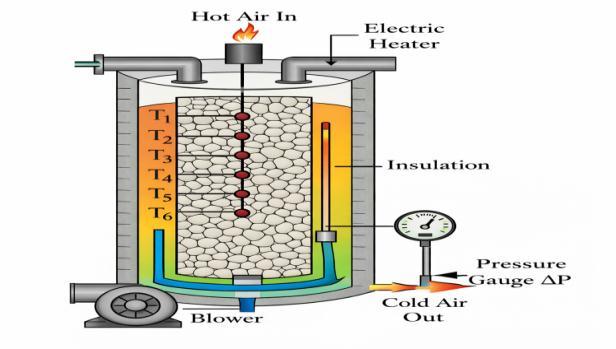
Figure 1 MaincomponentsofthePBTESsystem,which include:
Cylindrical storage vessel: Constructed from insulated stainless steel to minimize heat losses. The vessel dimensions are 1.5 m in height and 0.3 m in diameter, providing sufficient volume for experimentation while allowingformanageableinstrumentation.
Packed bed medium: Sphericalceramicballsof20–25mm diameter are used due to their high thermal conductivity, stability at elevated temperatures, and uniform flow characteristics. The bed porosity is maintained at approximately 0.40 to balance between thermal performanceandpressuredrop.
Inlet and outlet ducts: Air enters the packed bed at the bottom through a perforated distributor plate that ensures uniform fluid distribution, minimizing channeling effects. The outlet is located at the top, enabling counter flow operationandnaturalthermalstratification.
Instrumentation ports: Multiple thermocouple ports are installed at axial and radial positions to monitor temperature distribution. Pressure taps are included at the inletandoutlettomeasurepressuredropacrossthebed.
Insulation: High-temperatureceramicfiberinsulationwith athicknessof50mmsurroundsthevesseltominimizeheat lossestothesurroundings.
Thepackedbedoperatesintwoprimarymodes:
Charging: Hotair isintroducedfromtheinlet,transferring heat to the solid medium. The temperature gradually increasesalongthebedheight,withthetoplayersreaching maximumtemperaturelast.
Discharging: Cold air is introduced from the inlet, absorbing stored heat from the solid particles. The fluid exits at an elevated temperature, which can be used for downstream applications such as space heating, industrial processheat,orsolarpowerintegration.
The design of the packed bed geometry and particle selection is critical to achieving high thermal performance while maintaining acceptable pressure losses. Spherical ceramic balls were chosen to reduce turbulence-induced energy losses and provide predictable heat transfer coefficients. The vessel diameter is optimized to minimize walleffectsandradialtemperaturegradients.
Table 1: Thermo physical Properties of Storage Material (Ceramic Balls)
(ε)
–25 mm
-
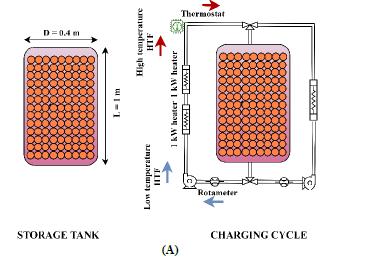
The experimental setup is designed to emulate realistic operatingconditionsforapackedbedTESsystem,allowing controlled studies of thermal behavior, efficiency, and pressure drop. The setup integrates a heating system, airflowmanagement,instrumentation,anddata acquisition systems,asshowninFigure2
2 Experimentalsetup
International Research Journal of Engineering and Technology (IRJET) e-ISSN: 2395-0056
Volume: 13 Issue: 01 | Jan 2026 www.irjet.net p-ISSN: 2395-0072
Air heater: Provides controlled hot air for charging the packedbed,capableoftemperaturesupto500°Cwith±2°C precision.
Blower/fan: Maintains desired airflow rates, adjustable from0.02to0.10kg/s.
Packed bed vessel: AsdescribedinSection4,withmultiple thermocouplelocationsalongaxialandradialdirections.
Thermocouples: Type-K, calibrated for 0–600°C, placed at 10locationsalongtheheightofthebedtocapturetransient temperatureprofiles.
Pressure transducers: Differential pressure sensors installedatinletandoutlettomonitorpressuredrop.
Data acquisition system: 16-channel DAQ connected to a computer for real-time temperature and pressure monitoring,withdataloggedevery10seconds.
5.1 Charging and Discharging Procedure
The experiments follow a repeatable procedure to ensure dataconsistency:
Pre-conditioning: The packed bed is allowed to reach ambienttemperaturebeforeeachexperiment.
Charging: Hot air is introduced at a fixed temperature and mass flow rate. Temperature readings are collected until thebedreachesnearsteady-stateconditions.
Discharging: Cold air is passed through the bed from the inlet. Outlet air temperature and bed temperature profiles arecontinuouslymonitored.
Data Logging: All thermocouplesandpressuresensors are logged continuously. Each experiment lasts approximately 2–4 hours depending on mass flow rate and air inlet temperature.
Parameter
Inletairtemperature(T_in)
Airmassflowrate(ṁ)
Particlesize
Bedporosity
100°C,150°C,200°C
0.02,0.05,0.08kg/s
20–25mm
0.40
Ambienttemperature 25±2°C
Instrumentationlogginginterval 10s
Thedatacollectedisusedtocalculatethermalperformance metricssuchas:
Temperature stratification index along the bed height
Charginganddischargingefficiency
Energystoredandrecovered
Pressuredropvs.massflowrate
The experimental setup ensures high reproducibility and allowsthesystematicinvestigationofoperatingparameters on system performance. The combination of precise instrumentation, controlled airflow, and high-resolution data logging provides a robust basis for analyzing packed bedTESbehavior.
The selection of materials and the experimental methodology are critical for obtaining reliable and reproducible results in packed bed thermal energy storage (PBTES) system. This section describes the storage medium,heattransferfluid,insulation,andinstrumentation materials along with the methodological approach adopted inthisstudy.
The experimental procedure is divided into charging, discharging, and data processing phases, designed to capture transient and steady-state thermal performance metrics.
This section presents the experimental findings of the packed bed thermal energy storage (PBTES) system. The results are analyzed in terms of temperature distribution, thermal stratification, charging and discharging behavior, energystorage,andpressuredrop.Theinfluenceofinletair temperature and mass flow rate on system performance is alsodiscussed.
Figure5showstheaxialtemperaturedistributionalongthe packed bed during the charging phase at an inlet air temperature of 150°C and mass flow rate of 0.05 kg/s. The temperature at the bottom of the bed rises first due to direct contact with hot air, while the top layers heat more slowly,demonstratingaclearaxialtemperaturegradient
International Research Journal of Engineering and Technology (IRJET) e-ISSN: 2395-0056
Volume: 13 Issue: 01 | Jan 2026 www.irjet.net p-ISSN: 2395-0072
Observations:
1. A pronouncedthermal front movesfromthebottomto thetopofthebedaschargingprogresses.
2. The bottom 20% of the bed reaches near-inlet temperatureearlierthanthetop20%,indicatingstrong stratification.
3. Increasing inlet temperature accelerates heating of the bed and improves stored energy density, consistent withfindingsbyNallusamyetal.(2007).
Table 3: Sampleaxialtemperaturereadingsduring charging
7.2 Temperature Profiles during Discharging
During discharging, cold air is passed through the bed, andheatstoredintheceramicballsisextracted.Figure6 illustrates the transient outlet air temperature for differentmassflowratesataninlettemperatureof150°C duringcharging.
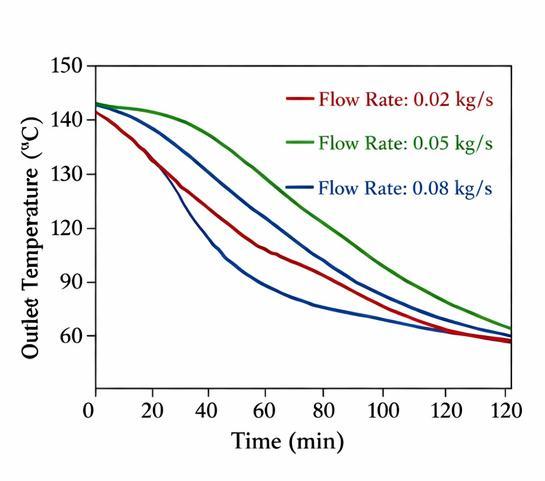
Figure 3 Dischargeoutlettemperaturevstime
Observations:
The outlet air temperature initially rises to near the maximum bed temperature, then gradually decreasesasthebedlosesheat.
Higher mass flow rates increase the initial outlet temperaturebutreduceresidencetime,leadingto lowertotalenergyrecovery.
Lower mass flow rates enhance energy recovery butprolongthedischargingprocess.
The total energy stored (E_s) during charging is computed usingtheformula: Es=∑micp(Ti−Tambient)
Similarly,energyrecoveredduringdischargingiscalculated byintegratingtheheatcarriedawaybytheoutletair.
Table 4: Sampleenergystorageandrecoveryresults
Discussion:
Efficiency slightly decreases at higher mass flow rates due to reduced residence time, as observed in previous studies (Singhetal.,2016).
Higher inlet air temperatures result in higher energy storage due to increased temperature difference, confirmingthedirectdependenceon
ΔT=Tinlet−Tambient
7.4 Thermal Stratification
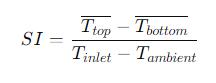
Axial temperature stratification is evaluated using the StratificationIndex(SI):
International Research Journal of Engineering and Technology (IRJET) e-ISSN: 2395-0056
Volume: 13 Issue: 01 | Jan 2026 www.irjet.net p-ISSN: 2395-0072
Observations:
SI is highest during the initial 40–50 minutes of charging, indicatingeffectivethermallayering
Stratification reduces slightly as the bed approaches quasisteady-state
High SI improves the effectiveness of energy extraction duringdischarging,ascoolerairfirstabsorbsheatfromthe hottertoplayers.
Pressure drop (ΔP) across the packed bed is a key parameteraffectingpumpingpower:
Observed pressure drop increases linearly with mass flow rate. At the highest flow rate (0.08 kg/s), ΔP is 120 Pa, which is manageable and within the limits of typical air blowers. Particle size and bed porosity significantly affect ΔP;smallerparticlesreducethermalgradientsbutincrease ΔP.
Table 6: SummaryofComparativeAnalysis
7.6 Comparative Discussion
The experimental results demonstrate trade-offs between efficiency,pressuredrop,andcharging/dischargingtime.
Proper selection of particle size, porosity, flow rate, and inlet temperature maximizes system efficiency while keepingoperationalconstraintsmanageable.
These findings are consistent with earlier studies by Duffie & Beckman (2013) and Singh et al. (2016), validating the reliabilityoftheexperimentalmethodology.
This study presents a comprehensive experimental investigation of the thermal performance of a packed bed thermal energy storage (PBTES) system using air as the heattransferfluidandsphericalceramicballsasthestorage medium. The research provides detailed insights into the charging and discharging behavior, temperature distribution, energy storage capacity, efficiency, and pressure drop characteristics of the system under varying operatingconditions.
Key findings of the study are summarized as follows:
Thermal Stratification: Strong axial temperature stratification was observed during charging, with the bottom layers heating first and the top layers gradually reaching near-inlet temperatures. This stratification enhances the effectiveness of energy extraction during dischargingandcontributestooverallsystemefficiency.
Influence of Inlet Temperature: Higher inlet air temperaturessignificantlyimprovedthetotalenergystored and reduced the time required for charging. Optimal operation was achieved at 150–200°C, balancing energy densityandthermalstressconsiderations.
Effect of Mass Flow Rate: Moderate mass flow rates (~0.05 kg/s) provided the best compromise between thermal efficiency and charging/discharging duration. Higher flow rates reduced energy recovery due to shorter residence time, while lower flow rates prolonged the process.
Particle Size and Porosity: Spherical ceramic balls with diameters of 20–25 mm and bed porosity of 0.40 were found to offer the optimal trade-off between heat transfer effectivenessandpressuredrop.Smallerparticlesenhanced heat transfer but increased pumping power requirements, whilelargerparticlesreducedefficiency.
Energy Storage and Efficiency: Experimental results demonstrated energy storage efficiency ranging from 90–94%, depending on operating conditions. The system exhibited reliable performance, and experimental repeatabilitywasconfirmedthroughrepeatedtrials.
Pressure Drop: The system maintained manageable pressure drops (<120 Pa) across the bed for the selected operational range, indicating that pumping power requirementsarereasonableforpracticalapplications.
International Research Journal of Engineering and Technology (IRJET) e-ISSN: 2395-0056
Volume: 13 Issue: 01 | Jan 2026 www.irjet.net p-ISSN: 2395-0072
Overall, the study confirms that packed bed TES systems are a viable and efficient solution for medium-to-high temperaturethermalenergystorageapplications,including solarthermal powerplants, industrial wasteheatrecovery, andHVACsystems.Thecombinationofsimpleconstruction, durability, and high efficiency makes PBTES systems a practical choice for enhancing energy utilization and mitigatingintermittencyinrenewableenergysystems.
While the current study provides a thorough experimental analysisofPBTESsystems,severalavenuesexistforfurther researchandsystemoptimization:
IntegrationwithRenewableEnergySources:Futurestudies could focus on integrating PBTES systems with solar thermal collectors, concentrated solar power (CSP) plants, or industrial waste heat systems to evaluate real-world performanceundervariableambientconditions.
Use of Advanced Storage Materials: Incorporating phase change materials (PCMs) or high thermal conductivity composites within the packed bed could improve energy density and storage efficiency, particularly for hightemperatureapplications.
[1]. Ahmed, Z., Constantin, A., & Bindra, H. (2022). The thermalresponseofapackedbedthermalenergystorage system upon saturated steam injection using distributed temperature sensing Energies, 15(10), 3704. https://doi.org/10.3390/en15103704OSTI
[2]. Guo, W., He, Z., Zhang, Y., & Zhang, P. (2022). Thermal performance of the packed bed thermal energy storagesystemwithencapsulatedphasechangematerial. RenewableEnergy,196,1345–1356.EconPapers
[3]. R. Schwarzmayr, F. Birkelbach, H. Walter, & R. Hofmann. (2023). Standby efficiency and thermocline degradation of a packed bed thermal energy storage: An experimentalstudy.arXiv.arXiv
[4]. Rong, Y., Huang, S. Y., & Zhou, H. (2024). Experimental study on storage performance of packed bedsolarthermal energystoragesystemusingsteel slag Journal of Energy Storage, 78, 110042. https://doi.org/10.1016/j.est.2023.110042ScienceDirect
[5]. Han, D., He, X., Hou, Y., et al. (2024). Experimental analysis on improving heat storage efficiency of high-temperature packed bed system using spherical capsules filled with MgCl₂–KCl–NaCl/Al₂O₃
nanocompositePCM.SolarEnergyMaterials&SolarCells, 277, 113106. https://doi.org/10.1016/j.solmat.2024.113106 ScienceDirect
[6]. Nemś, M., Nemś, A., Kasperski, J., & Pomorski, M. (2017). Thermo-hydraulic analysis of heat storage filled with ceramic bricks dedicated to the solar air heating system.Materials(Basel).PMC
[7]. Johar, D. K., Sharma, D., Yadav, H., & Patel, S. N. (2022).Energyandexergyanalysisofpebblebedthermal energystoragesystemfordieselengineexhaust.Thermal Science.thermalscience.rs
[8]. Sarbu, I., & Sebarchievici, C. (2018). A comprehensive review of thermal energy storage. Sustainability,10,Article1–32.ScienceDirect
[9]. Han, J.-W., & Chung, B.-J. (2024). Thermal performanceofapackedbedthermoclinethermalenergy storage system according to the design parameters Journal ofMechanical ScienceandTechnology,38,4409–4419.Springer
[10].Rabi’, A. M. (2024). Packed bed thermal energy storagesystem:Parametricstudyandoptimization.MDPI Energies.MDPI
[11].Edwards, J., & Bindra, H. (2017). An experimental study on storing thermal energy in packed beds with saturated steam as heat transfer fluid. Solar Energy, 156, 456–461.OUCI
[12].Cascetta, M., Cau, G., Puddu, P., & Serra, F. (2016). A comparison between CFD simulation and experimental investigation of a packed-bed thermal energy storage system.AppliedThermalEngineering.ScienceDirect
[13].Anderson, R. (2014). Experimental results and modelingofenergystorageandrecoveryinapackedbed ofaluminaparticles.AppliedEnergy.OUCI
[14].Alva, G., Lin, Y., & Fang, G. (2018). An overview of thermal energy storage systems. Energy, 144, 341–378. ScienceDirect
[15].Esence, T., Bruch, A., Molina, S., Stutz, B., & Fourmigué,J.-F.(2017).Areviewonexperiencefeedback and numerical modeling of packed-bed thermal energy storage systems. Solar Energy, 153, 628–654. ScienceDirect
[16].Al-Azawii, M. M. S., et al. (2023). Thermocline in packed bed thermal energy storage during
2026, IRJET | Impact Factor value: 8.315 | ISO 9001:2008
International Research Journal of Engineering and Technology (IRJET) e-ISSN: 2395-0056
Volume: 13 Issue: 01 | Jan 2026 www.irjet.net p-ISSN: 2395-0072 © 2026, IRJET | Impact Factor value: 8.315 | ISO 9001:2008
charge-discharge cycle using recycled ceramic materials JournalofEnergyStorage,64,107209.ScienceDirect
[17].Lou, W., Luo, L., Hua, Y., Fan, Y., & Du, Z. (2021). A review on the performance indicators and influencing factors for thermocline thermal energy storage systems Energies,14,8384.ScienceDirect
[18].Van Lew, J. T., Li, P., Chan, C. L., Karaki, W., & Stephens, J. (2011). Analysis of heat storage and delivery of a thermocline tank having solid filler material. Journal ofSolarEnergyEngineering,133,021003.ScienceDirect
[19].Zhao, B., Cheng, M., Liu, C., & Dai, Z. (2017). An efficient tank size estimation strategy for packed-bed thermocline thermal energy storage systems. Solar Energy,153,104–114.MDPI
[20].Mawire, A., McPherson, M., & Mlatjo, S. (2009). Simulated performance of storage materials for pebble bed thermal energy storage (TES) systems. Applied Energy,86,1246–1252.ScienceDirect
[21].Ismail, K. A. R., & Stuginsky Jr., R. (1999). A parametric study on fixed bed models for PCM and sensible heat storage. Applied Thermal Engineering, 19, 757–788.ScienceDirect
[22].Yang, X., & Cai, Z. (2019). Analysis of a packed bed thermal energy storage system using sensible heat and phasechangematerials.InternationalJournalofHeatand MassTransfer,144,118651.ScienceDirect
[23].Stathopoulos,N.,Papadimitriou,N.,Belessiotis,V.,& Papanicolaou,E.(2023).Packedbedthermoclinethermal energy storage for medium-temperature concentrating solarsystems:Numericalandexperimentalstudy.Journal ofPowerandEnergyEngineering,11,1-23.SCIRP
[24].Georgousis, N., et al. (2025). Comprehensive review on packed-bed sensible heat thermal energy storage JournalofEnergyStorage.ScienceDirect