
International Research Journal of Engineering and Technology (IRJET) e-ISSN:2395-0056
Volume: 12 Issue: 05 | May 2025 www.irjet.net p-ISSN:2395-0072
International Research Journal of Engineering and Technology (IRJET) e-ISSN:2395-0056
Volume: 12 Issue: 05 | May 2025 www.irjet.net p-ISSN:2395-0072
Dr. Kala Venugopal
Associate Professor & HOD Dept of ISE
Acharyainstituteof technologyAffiliatedtoVTU, Belagavi-590018Bengaluru–560107
Manjunath Dept of ISE
Acharyainstituteoftechnology AffiliatedtoVTU,Belagavi590018Bengaluru–560107
Abhigna D P Dept of ISE
Acharyainstituteof technologyAffiliatedtoVTU, Belagavi-590018Bengaluru –560107
Abstract This paper introduces a Drug Overdose Prediction System (DOPS) that leverages machine learningtopredictmortalityratesbasedondemographic and clinical data. The system is designed to provide early warnings, support decision-making, and improve public health response strategies. DOPS incorporates key components to improve predictive accuracy and provide early warnings for overdose risks. It begins with data preprocessing and feature engineering to ensure highquality input data, followed by predictive modeling that analyzes overdose risk patterns using machine learning techniques. Demographic clustering helps identify highrisk populations based on factors such as age, gender, and other characteristics. A real-time prediction engine continuously monitors emerging overdose trends, enabling timely detection of potential risk spikes. By integrating real-time analytics, DOPS enhances overdose prevention by shifting from reactive to proactive strategies.
Introduction
The opioid epidemic remains a pressing global health concern, leading to a continuous rise in overdose-related deaths [9]. The misuse of opioids, including prescription painrelieversandsyntheticdrugslikefentanyl, significantly burdens healthcare systems [2]. Despite ongoing efforts to mitigate this crisis, conventional surveillance and intervention methods often rely on historical data and manual reporting, resulting in delayed results [4]. These traditionalapproachesfocusonretrospectiveanalysisrather than proactive prevention, limiting their effectiveness in reducing overdose incidents and improving patient outcomes [4].. Current methods depend on static risk assessments and generalized models that do not consider
Ankitha Divitar Dept of ISE
Acharyainstituteof technologyAffiliatedtoVTU, Belagavi-590018Bengaluru –560107
Muli Pujitha Dept of ISE
Acharyainstituteoftechnology AffiliatedtoVTU,Belagavi590018Bengaluru–560107
dynamic changes in behavior, environmental factors, or emergingdrugtrends.
As a result, healthcare professionals and policymakers struggletodeploytimelyinterventionsandallocateresources efficiently.Thereisagrowingneedfordata-driven,predictive solutions that can analyze vast amounts of information and provide early warnings to prevent fatal overdoses. Machine learning (ML) offers a transformative approach to overdose prevention by detecting hidden patterns, analyzing risk factors,andmakingaccuratepredictionsbasedonlarge-scale datasets. Unlike conventional statistical models, ML algorithms can process complex relationships between demographic, clinical, and behavioral factors, enabling healthcare systems to identify individuals or populations at increased risk [7]. By leveraging predictive analytics, public health agencies can implement targeted intervention strategies, optimize resource distribution, and improve the effectiveness of harm reduction programs. This paper introduces the Drug Overdose Prediction System (DOPS), a machine learning-based framework designed to forecast overdose risks based on demographic and clinical data. The systemisstructuredtoprovideearlywarnings,supportdatadrivendecision-making,andenhancepublichealthstrategies. ThecorefunctionalitiesofDOPSinclude:
Data Preprocessing & Feature Engineering –Refiningand structuringdatatoimproveaccuracyandreliability[6]
Predictive Modeling –Applyingadvancedmachinelearning techniquestoassessoverdoserisklevels[7]
Demographic Clustering – Grouping individuals based on socio-demographic patterns to identify high-risk populations.
International Research Journal of Engineering and Technology (IRJET) e-ISSN:2395-0056
Volume: 12 Issue: 05 | May 2025 www.irjet.net p-ISSN:2395-0072
Real-Time Prediction Engine – Enabling continuous monitoringandtimelyriskassessment[9].
Automated Reporting Module – Generating actionable insightsforhealthcareprofessionalsandpolicymakers[3].
By integrating real-time data analysis with machine learning techniques, DOPS enhances existing overdose preventionstrategiesbyshiftingfromreactiveresponsesto proactive interventions. This system enables public health officialstodetectemergingoverdosetrends,prioritizehighrisk cases, and develop evidence-based policies to combat theopioidcrisis effectively[2].Insummary,DOPSservesas a cutting-edge solution to a long-standing public health challenge. By utilizing machine learning for overdose prediction, this system provides a scalable, efficient, and proactive approach to mitigating opioid-related fatalities. As the opioid crisis continues to evolve, adopting innovative, data-driven solutions will be essential for improvingpublichealthoutcomesandsavinglives.
Several studies have explored the application of machine learninginpredictingdrugoverdoseincidents[3].Research on Random Forest and Gradient Boosting models has demonstrated high accuracy in identifying key risk factors, achieving an R² score of 0.95 [7]. Studies leveraging deep learning techniques, such as Long Short-Term Memory (LSTM) networks and Convolutional Neural Networks (CNNs),haveproveneffectiveinanalyzingtime-seriesdata, though they require substantial computational resources [5] Other studies have employed K-Means clustering and regressionmethodstosegmenthigh-riskpopulationsbased on demographic attributes, making the approach scalable and adaptable to varying datasets [6]. Additionally, AIdriven early detection models have improved opioid surveillancebyprovidingreal-timealerts,enhancingtimely intervention strategies. Further research has explored the integration of electronic health records (EHR) and natural language processing (NLP) techniques to enhance the predictive accuracy of overdose incidents [9]. By analyzing clinicalnotes,prescriptionrecords,andsocialdeterminants of health, these studies have expanded the scope of predictive modeling beyond structured datasets. While these methods improve risk assessment, they also introduce challenges related to data privacy, standardization, and computational complexity [8] Moreover,geospatialanalysisandsocialmediadatamining have been leveraged to detect emerging drug use trends and regional overdose hotspots, contributing to more targeted intervention strategies [10]. While these studies
highlight the effectiveness of machine learning, they also reveal certain challenges, such as computational costs, demographic bias, and limited real-time integration. Our proposed system refines these approaches by implementing an optimized hybrid machine learning framework that incorporates automated feature selection, real-time data processing, and enhanced clustering techniques for more precise risk identification [1]. The inclusion of real-time surveillance and predictive analytics ensures timely decision-making, ultimately improving intervention efforts andreducingopioid-relatedfatalities.
The Drug Overdose Prediction System (DOPS) follows a structured approach to identifying overdose risks using machine learning and data-driven insights [6]. The process begins with data collection and preprocessing, where relevant information is gathered from public health databases,hospitalrecords,andoverdosereports.
Since raw data can often be inconsistent or incomplete, it undergoes cleaning and normalization to improve accuracy. Key factors such as age, gender, race, year, and panel type are extracted to identify trends and correlations related to overdose risks. Unlike traditional methods that rely on past data for analysis, DOPS proactively identifies patterns that indicate potential overdose risks, making it more effective forreal-timedecision-making.
Once the data is prepared, machine learning models are trained to analyze overdose risks based on historical patterns. Techniques like logistic regression, decision trees, random forests help in making accurate predictions. To refine the results, the system groups individuals into demographic clusters, ensuring that high-risk populations receive focused attention. A real-time prediction engine continuouslymonitorsriskfactors,providingearlywarnings fortimelyintervention.Additionally,anautomatedreporting module generates clear and actionable insights for healthcare professionals and policymakers, helping them make informed decisions. By integrating advanced data analysiswithreal-worldapplications,DOPSaimstoimprove publichealthstrategiesandreduceopioid-relatedfatalities.
1. Data Collection & Preprocessing –Thesystemcompiles data fromhealthcare recordsandoverdose reports, refining key attributes through cleaning and normalization for consistency[2].
International Research Journal of Engineering and Technology (IRJET) e-ISSN:2395-0056
Volume: 12 Issue: 05 | May 2025 www.irjet.net p-ISSN:2395-0072
2. Feature Engineering & Selection – Important predictive factors are identified, utilizing optimization techniques to enhance accuracy while reducing irrelevant data[4][7].
3. Predictive Modeling – Machine learning algorithmsanalyzepasttrends,detectingriskpatterns toprovideearlyoverdosepredictions[6][1].
4. Demographic Clustering – Clustering techniques categorize individuals with similar risk factors, enablingtargetedpreventionefforts[8].
5. Real-Time Monitoring & Risk Prediction – The system updates risk evaluations dynamically, integrating real-time data[9].
Modules and Dataflow:
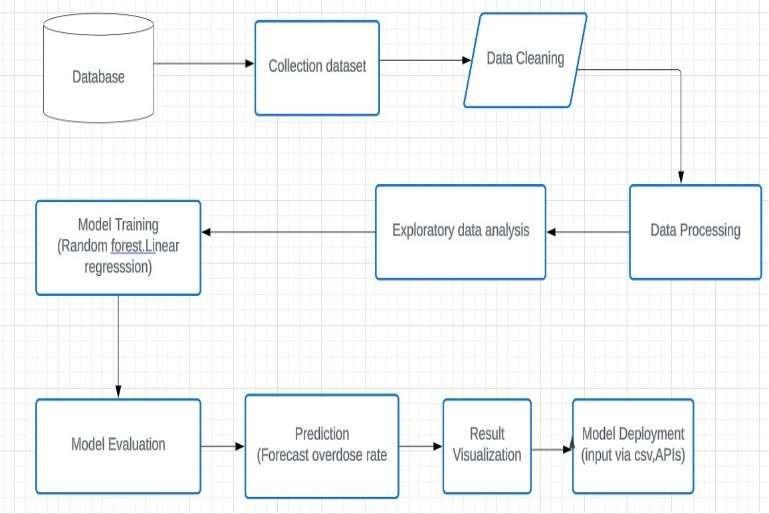
Fig.1Dataflowdiagram
Fig.1showsthedataflowofthemodelforthepredictionof drugoverdose.
Data Ingestion and Validation:
The system accepts datasets in structured formats (CSV, Excel) containing demographic and clinical attributes. A validation layer ensures data consistency by handling missing values, eliminating duplicates, and verifying schema alignmenttomaintaindataintegritybeforefurther processing.
Data Preprocessing:
The data is cleaned and prepared by imputing missing values, encoding categorical variables into numerical
format, and normalizing numerical features to enhance modelperformanceandaccuracy.
Exploratory Data Analysis and Feature Engineering:
This stage extracts meaningful insights by analyzing correlations, distributions, and patterns in the dataset. Feature engineering is applied to enhance predictive power by transforming existing attributes or creating new derived featuresthatimprovemodelefficiency.
Predictive Modeling:
Machine learning models such as Random Forest, Gradient Boosting, and Logistic Regression are trained on historical overdose data. The system optimizes model performance throughhyperparametertuning,ensuringhighaccuracyand minimalbiasinriskpredictions.
Model Evaluation:
To assess the reliability of predictions, the system evaluates model performance using key metrics such as accuracy, precision,recall,andF1-score.Thesemetricshelprefinethe modelandensureitgeneralizeswelltounseendata.
Real-Time Prediction:
For proactive intervention, the system processes live data streams and continuously updates risk assessments. This enables immediate response strategies to mitigate overdose risksinhigh-prioritycases.
By integrating structured data processing, predictive modeling,andreal-timeriskassessment,DOPSenablesdatadriven decision-making and timely overdose intervention, improvingpublichealthstrategieseffectively.
Implementation
User Interface & Model Deployment:
The system is deployed as a web-based application featuring a Data Upload Module for CSV/Excel files, a Model Selection Dashboard for real-time predictions, and Graphical Visualizations (bar charts, trend lines) for displaying the results. These components work together to provide an intuitive and efficient user experience.Thesystem architecture isshowninFig. 2, whichoutlinestheflowfromdatauploadtoprediction.
International Research Journal of Engineering and Technology (IRJET) e-ISSN:2395-0056
Volume: 12 Issue: 05 | May 2025 www.irjet.net p-ISSN:2395-0072
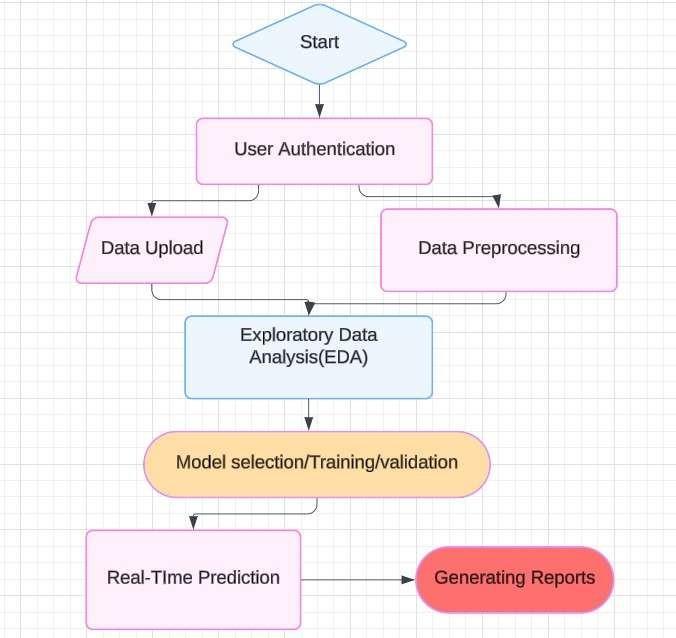
Fig.2SystemArchitectureforimplementation
Performance Metrics:
Table 1 shows the models were evaluated using R² Score andRootMeanSquaredError(RMSE),wherehigherR²and lower RMSE indicate better performance [6]. The following performancemetricswereobserved:
incorporates key factors such as year, age, gender, race, and panel type, which refine the prediction and provide a more accurate, context-sensitive assessment of overdose risk for this group. Additionally, continuous feedback loops help improve the model’s accuracy by integrating newly available data. These enhancements aim to increase predictive accuracy, improve real-time monitoring, and expand the system'sadaptabilitytonewdatasetsandtrends.

Fig.3Predictionanalysisonagerange
N/A
Table1:Performance Metrics
Results
Random Forest outperformed all other models in terms of predictive accuracy, as indicated by the highest R² score and lowest RMSE. K-Means Clustering effectively identified high- risk demographic groups, contributing valuable insights into the target population [8]. The real-time processing capability of the system ensures low latency, enablingquickpredictionsanddecision-making[9]
Drug Overdose Prediction Results:
The model classifies individuals based on age ranges and predictsoverdoseriskaccordingly.Forthe20-30agerange, it predicts a low risk with 80% confidence. The model
Fig. 3 shows a graph displaying drug overdose estimates by age group and gender, highlighting key trends for the Drug OverdosePredictionSystem(DOPS).Overdosecasesarelow in the 15-24 years age group but rise significantly in 25-34 years,peakinginthe35-44yearsand45-54yearscategories, with males at higher risk. The 55-64 years group shows a decline,continuingdownwardinthe65-74years and75-84 yearsgroups,withveryfewcasesinthoseaged85andover. The "All ages" category provides a general overview. Cases are minimal for individuals under 15 years, suggesting low risk.TheseinsightsaidDOPSintargetinghigh-riskgroupsfor effectiveintervention.
This study introduces a predictive framework for drug overdose mortality, utilizing machine learning and realtime data processing to enhance risk assessment [1]. By analyzing demographic and clinical factors, the system identifies high- risk populations with improved accuracy. The incorporation of demographic clustering allows for more precise predictions, facilitating targeted intervention strategies. Its adaptability to emerging overdose trends ensures continued effectiveness in addressing opioidrelatedchallenges.
International Research Journal of Engineering and Technology (IRJET) e-ISSN:2395-0056
Volume: 12 Issue: 05 | May 2025 www.irjet.net p-ISSN:2395-0072
Furthermore,thesystemsupportshealthcareprofessionals with automated reporting and interactive analytics, enabling data-driven decision-making. The integration of real-time data enhances prediction reliability, allowing timely responses to potential overdose incidents [7]. Future improvements may focus on deep learning techniques, real-time API integration for continuous monitoring, and geospatial analysis to identify regionspecific risk patterns, further strengthening public health interventions[6].
Additionally, the proposed system enhances data-driven decision-making by providing detailed insights into overdose risk factors. By integrating diverse data sources, the model adapts to evolving patterns in substance misuse, making it a valuable tool for public healthmanagement.
To further enhance the system, the following improvementscanbeconsidered.
1. Deep Learning Integration: Future iterations of the model canexploretheuseofLongShort-TermMemory (LSTM) networks or Convolutional Neural Networks (CNNs) to enhance the accuracy of time-series forecasting, allowing for more nuanced predictions basedonhistoricaldatatrends[5].
2. Enhanced Real-Time Capabilities: Theintegrationof healthcare APIs for live monitoring could enable the system to access real-time data from hospitals, pharmacies, and clinics, offering up-to-date risk assessmentsforusers[3].
3. Personalized Risk Assessments: Further development could include individualized overdose risk scoring, taking into account personal medical histories, lifestylefactors,andsocialdeterminantstoprovidemore preciseriskprofiles[8].
4. Geospatial Analysis: Addinggeospatialanalysiscould improve predictions by identifying regional overdose patterns and enabling localized interventions that are tailoredto specificcommunitiesorregions[9].
By advancing the integration of these enhancements, the model can contribute significantly to reducing opioidrelatedfatalities.Ithasthepotentialtobecomeanessential toolinpublichealthstrategies,improving bothprevention effortsandtargetedtreatmentsforat-riskpopulations.
[1] Scikit-learn contributors. “Scikit-learn: Machine Learning in Python,” Journal of Machine Learning Research,vol.12,pp.2825-2830,2023.Retrievedfrom https://scikit-learn.org
[2] BCenters for Disease Control and Prevention (CDC). “Drug Overdose Deaths in the United States, 2021,” NationalVitalStatisticsReports,vol.71,p.106,2023.
[3] López, F., Pérez, R., & González, J. “Data-driven Approaches for Opioid Overdose Risk Assessment,” International Journal of Data Science and Analytics, vol.10,no.1,pp.45-56,2020.
[4] Zhu, Y., & Wang, J. “Prediction and Analysis of Overdose Death Rates Based on Machine Learning Techniques,” Journal ofHealthInformatics,vol.15,no.2,pp.122-130, 2018.
[5] Chollet,F.“DeepLearningwithPython,”ManningPublicationsCo., 2018.
[6] Chen, T., & Guestrin, C. “XGBoost: A Scalable Tree Boosting System,” Proceedingsof the 22ndACMSIGKDD International Conference on Knowledge Discovery and DataMining,pp.785-794,2016
[7] Breiman,L.“RandomForests,”MachineLearning,vol.45, no.1,pp.5-32,2001.
[8] Hastie,T., Tibshirani,R., &Friedman, J.“TheElementsof Statistical Learning: Data Mining, Inference, and Prediction,”2nded.,Springer,2009
[9] World Health Organization (WHO). “Opioid overdose: Prevention, treatment and harm reduction,” Fact Sheet, 2022.
[10]
Kingma, D. P., & Ba, J. “Adam: A Method for Stochastic Optimization,” arXiv preprint arXiv:1412.6980, 2014. Retrievedfrom