
International Research Journal of Engineering and Technology (IRJET) e-ISSN: 2395-0056
Volume: 13 Issue: 02 | Feb 2026 www.irjet.net p-ISSN: 2395-0072
International Research Journal of Engineering and Technology (IRJET) e-ISSN: 2395-0056
Volume: 13 Issue: 02 | Feb 2026 www.irjet.net p-ISSN: 2395-0072
R. S. Kakade1 , Adak Rupesh Hanumant2 , Labade Vivek Anil3 , Shejul
Devendra Shirish
4
1HOD, Dept. of Computer Technology, P.Dr.V.V.P. Institute of Technology and Engineering (Polytechnic), Loni, Maharashtra, India
2,3,4 Final year Diploma Student, P.Dr.V.V.P. Institute of Technology and Engineering (Polytechnic), Loni, Maharashtra, India ***
Abstract - There is a direct correlation between the increase in youth unemployment and the exponential growth in the number of young people without the necessary skills. A rise in criminal activity, including robbery and burglary, is generally accompanied by these variables. Retailers, including jewelers and others, bear a disproportionate share of the crime rate associated with armed robberies. Offenders frequently hide their identities after an incident because they cover their faces. auther can successfully employ AI to prevent these outcomes and promptly notify the authorities inorder to curb this threat. For improved accuracy, auther train the weapon dataset which includes knives andrevolvers using a deep learning model called EfficientDet D4. The system starts receiving live feeds from the CCTV cameras after the data has been trained. The proposedmodel promptlyactivates the IOT model and issues a loud audio alert whenever a shoplifter brandishes a weapon against the store owner. When the IoT model is turned on, an Arduino-driven motor is instructed to automatically close the store's door. A loudaudio alert is then raised, and a WhatsApp alert is sent to the closest police station, along with a photo of the store and its location on a map.
Key Words: AI, EfficientDet D4, closed-circuit television, internet of things (IoT) paradigm
Traditional surveillance isn't always adequate to protectfinancialinstitutionsandretaillocationsfromhighstakescrimeslikearmedrobberiesintoday'stechnologically advanced world. Traditional CCTV systems are better for forensicinvestigationthanforprotectingpeopleorproperty. Toovercomethisissue,financialandretailinstitutionsneed anautomatedanti-robberysystem.Thisdigitalsentrymight employAI'slightning-fastdecision-makingtoanticipateand eliminate threats. This technology's debut is crucial since crimescanhappenfasterthanguardsorstaffcanactivate alarms.Thesetechnologiesinformauthoritiesquicklyifthey detectsuspiciousactivitiesorrisks.Thiscreatesaconstant line of defense without human fatigue or distraction, dramatically reducing response times, and ending bloodshed. The research relies on Google AI's net 4 deep learning model's robust convolutional neural network design.Itsuniqueblendofprocessingspeedandprecision makesitfamous.Theefficientb4modelofnet4scalesdepth,
width,andinputresolutionwithitsrevolutionarycompound scaling technique. It was chosen for this reason. This balanced scaling improves feature extraction with fewer parametersthanconventionalmodels,whichsolelyincrease layer count to improve performance. Retail and banking applications require low-latency HD video processing on commodityhardwareoredgedevices.Tosimulatea welltrainedcomputer brain,the model meticulouslyevaluates each frame of the video for intricate visual patterns that indicatedanger,suchasthepreciseoutlinesofaweaponor thefeelofamask,whileignoringbackgroundfeatures.
The project carefully blends several cutting-edge approaches to ensure the identification process works in varied situations. After pre-training on ImageNet, a successful net 4 model is fine-tuned using hundreds of weapons, masks, and suspicious stance photographs. This methodfocusesontransferlearning.Thisallowsthesystem tofocus on a problem while using its enormous library of visual attributes. Using backdrop matting and anomaly detectionisanotherkeymethod.Equipmentcandetectnonthreatening"abandonedobjects" fromordinaryconsumer flow. Real-time object identification and multi-object tracking monitor visitors' movements throughout the facilitiesforhostilityorexcessivetimeinprohibitedareas. Thesystemprovidescomprehensiveandscalablesecurityby combining optical identification with automated alert protocols like the simple mail transmission protocol for timely notifications. It transforms static surveillance into smart,dynamicdefense.
[1]Addingclassandlocationlabelstoeachtraining image is proposed by Keong-hun choi et al. to improve supervisedlearningforobjectdetection.Theabilityofthe newenvironmenttoidentifythingsoutsideofthetraining context depends on the presence of a matching label. Our research presents an object detection system that utilizes reinforcementlearning.Afewphotosandaninventoryofthe contentswilldothetrick. Threemodelsareproposed:one forarea-basedevaluation,oneforincentiveconfiguration, and one for transformer-based item proposal. [2] Khalid Elgazzarandcolleaguesinvestigatedtheapplicationofdeep learningtoobjectdetection.Usingthetrainingcapabilitiesof ConvolutionalNeuralNetworks(CNNs),thousandsofobjects canbereliablydetectedevenintoughlightingandocclusion settings.Theavailabilityofalargenumberoftrainingimages
International Research Journal of Engineering and Technology (IRJET) e-ISSN: 2395-0056
Volume: 13 Issue: 02 | Feb 2026 www.irjet.net p-ISSN: 2395-0072
allowsCNNstoachieveremarkableaccuracyacrossseveral classes.Findingandclassifyingitemsinphotosisabreeze withmodernCNN-basedobjectdetectors.[3]Thework of RameshChandraPooniaetal.Anenormousstrideforward inthefightagainstcrimeandforpublicsafetyhasbeenthe developmentofliveCCTVobjectdetection.Instate-of-theartvideosurveillancesystems,theYOLOmodelsaccurately identifyandcategorizeobjects.
Anexaminationofearlierresearchthatwasdeemed aLitereatureSurveyispresentedinthesecondpartofthis publication.Section3providesacomprehensivedescription oftheproposedmethodology,outliningthepathofaction. TheexperimentalevaluationiscoveredinPart4,possible modifications are discussed in Section 5, and the essay concludeswithaconclusionontheexistingplan.
[4]Deepconvolutionalneuralnetworks(CNNs)can identify items in complex landscapes collected by highresolutionremotesensingphotos,regardlessoftheirsize, accordingtoatwo-stageprocessdevelopedbyQiyangXieet al.Partofthemethodarethreesmallernetworks.Feature extractionfromdeeppicturescanbestartedbyutilizinga feature extraction backbone network. Two others are a multi-scaleregionproposalgenerator(MS-RGN)andafinegrained category and object position FC-RCN. Through comparison trials, the authors show that the method outperforms state-of-the-art algorithms on the FAIR1M aircraftcategorydataset.Nomatterthesizeoftheobjector thedegreeoffine-grainedtypecoverage,thisremainstrue. In order to greatly enhance the network's detection accuracy,futureresearchwillcenteroncomprehendingthe rotational characteristics of objects in remote sensing images.
[5]Totacklethesparsityof3DLiDARdataandthe inherentocclusionissues,MinhoChoetal.presentedanew methodcalled3DLiDAR-basedMulti-ObjectTracking(MOT).
Thismethodenhancestrackingaccuracyacrossavarietyof object morphologies by using multi-positive contrastive learningtoincreaseobjectsimilarityatdifferentdistances. InadditiontoreducingID-switchingmistakesandproviding strongtracking,deepreinforcementlearningisutilizedfor effective handling of obstructed targets. Compared to previous3DLiDARandcamera-LiDARfusionmethods,the suggested approach improves Order Tracking Accuracy (HOTA) scores while reducing ID-switching on the KITTI MOTdataset
[6]Theearlydetectionofclassifiedgunshotnoises helpswithbothincidentmanagementandcrimeprevention (Alirazaetal.,2015),whichisanimportantpartofcriminal investigations.Themainobjectiveofthisresearchistofind gunshotsbyemployingameta-learningapproach.Forour experiments, we used a benchmark dataset for gunshot
noises that included 851 audio samples taken from freely availablevideosonYouTube.
[7]ThatwasmadebyPengWangandcolleagues.A considerableportionofRSresearchisdevotedtodeveloping methods for object detection in RS photos. Contemporary methods often increase the number of network layers to extract more granular data from the initial attributes. To achievetheirimpressive performance improvement,deep neural networksreallyneed a bigamountoflabelleddata trainingsamples.
[8]Goingbeyondtheirobjectdetectionscorewhen itcametoidentifyingthehandwristcrease,Gokulakrishnan Elumalai et al. proved that innovative method of object detectionbycombiningHWC-Yolov8xwiththeYolov5and Yolov8 models. We could tweak the HWC-Yolov8x configuration'shyperparameterstogetanevenbetterobject detection score. The results of our study indicate that biometric identification using the hands and wrists could replaceexistingbiometrictechniquesinthenearfuture
[9]SafaRiyadhWaheedetal.presentedastate-ofthe-artobjectdetectionsystemthatcombinesTLwithSSMD (SemanticSegmentationandObjectDetection).Thefirststep wastoprepareamodelfortransferlearningbypre-training it.Followingthis,theKITTIdatasetwasusedtopre-trainthe SSMD-512 and SSMD-300 models. Using a set of strict performance metrics, the model's performance was evaluatedthoroughly.
[10] Using a combination of Dense ASSP and backdropmatting,MinguJeongetal.demonstratedawayto locateabandonedobjects.Theproposedmethodminimized theoccurrenceoffalsepositivesbyutilizingpre-processing, abandonedobjectrecognition(AOR),andabandonedobject decision by feature correlation (AODFC). This effectively addressed the shortcomings of current systems for abandonedobjectdetection.
[11] A wireless object recognition system that makes use of the Channel State Information (CSI) of WiFi channelshasbeenstudiedfordeployment,accordingtoIgor Bisio et al. The main goal was to thoroughly assess the system'sperformanceusing cutting-edgeCSI-basedtarget identification algorithms. Author accomplished this by creatingasystemthatcangatherCSIdata,cleanuptheraw data, extract valuable information from the amplitude component,andcategorizecommonplacethings.
[12] N. Harihara Valliappan et al. evaluated YAMNet's ability to identify gun models by implementing transfer learning and making selective hyperparameter adjustments. Through rigorous testing of the proposed model with varying parameter values during training, the authors demonstrate that YAMNet with fine-tuned hyperparameters surpasses state-of-the-art deep learning andhybridmethods.Ourresearchfocusesoninvestigating
International Research Journal of Engineering and Technology (IRJET) e-ISSN: 2395-0056
Volume: 13 Issue: 02 | Feb 2026 www.irjet.net p-ISSN: 2395-0072
and implementing additional Keras layers to enhance the model'strainingefficiency.
[13]Atechniqueforestimatingpitchlocationusing asinglecameraandaradargunwasintroducedbyDaishi Kitano et al. By doing away with complicated setups and costlyequipment,theapproachaspirestoofferanaccessible and accurate answer. Because of this, it is ideal for use in real-life field situations, especially by amateur baseball teams.
[14]ThiswasproposedbySaraAzizianAmiriand colleagues. Temperatures above 400 degrees Celsius are possiblewithcertainelectrosurgeryconditions.Thepurpose of this research was to improve the design of the smart electrosurgicalknifeinordertosolveimportantproblems including heat-induced optical alterations and debris attachment.Whentestedinreal-worldscenarios,including interrupted electrosurgery modes, the second version which used quartz and PTFE tubes showed the most promise.
[15] The difficulty of continuously cutting a large numberofcomplicatedspongesamplesisaddressedinthis studybyKunXieetal.,whichsuggestsanS-shapedsorting methodbasedonregionsegmentation.Effectivecontinuous cutting of sponge samples is made possible by this procedure, which specifies the sample's entrance and exit positions.
Thefirststepistocollectsamplesatthemolecularlevel.
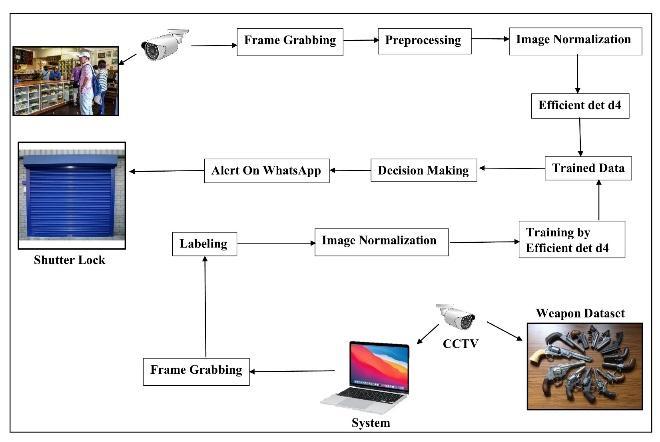
Thisstepfollows adescriptionofthestepsusedinthe overviewdiagramtodrivetheanti-robbingfromthe shopsandBanks
3.1
Before anything else, you'll need to use OpenCV to capturepicturesoftheweaponsthatarebreakingintothe
stores.Inordertoverifythemodel'sdetectioncapabilities, theVideoCapturemethodintheCV2packagetakespictures ofthetargetweapon.Allofthepicturesofweaponsarekept in the dataset folder. Some models, like the gun, are currently under development by the model. A folder is createdtocontaintheacquiredphotos,whichwillbeutilized inthesubsequentmodelprocess.
Here,weusethelabelingsoftwaretoannotatethe previouslytakenphotographs.Inordertolabelarectangle, theusermustinputtheimageintothelabelingsoftwareand mark the coordinates of its top right corner (x1, y1) and bottomright(x2,y2).Theacquiredcoordinatesaresavedin an.xmlfile,whichissubsequentlyutilizedtotrainthemodel withthehelpofaneffectivedetddeeplearningnetwork.4.
TheTensorFlowObjectDetectionAPIneedstobe installedinthisGoogleColabinstancefirst.Executingafew installation scripts and cloning the (https://github.com/tensorflow/models)arenecessaryfor this.Thefollowingcodeportionscanberunbyclickingthe play button. The next step in downloading and extracting cuDNN files is to install the conda environment. The next thingtodoistocopythetensorflowmodel’srepositoryoffof GitHub. And then the Object Detection API has to be installed.
3.4
ThisiswherewegetreadytopreparetheTensorFlow trainingdatabyuploadingourtrainingphotosandusingthe TFRecordgeneratingroutines.InordertocreateTFRecords fromourdata,weneedtouploadourphotos,dividethem into a train, validation, and test folder, and then execute scripts. To begin, on our local PC, create a single folder named "images.zip" and bundle all of our training images andXMLfilesintoit.Thefilesmusttobecontainedwithin the zip folder. After it's uploaded, we need to extract its contents and configure our picture folders using a few commands. In this particular instance, the file system's /content subdirectory is where these directories are generated.Toaccessthefilesystem,wecanusethe"Files" iconlocatedontheleftsideofthescreen.
3.5 Step 5: Split images into train, validation, and test folders
Locateour"images.zip"fileamongthelistedones; it's the folder icon on the left side of the screen. The next step, after the dataset has been uploaded, is to extract its contentsandcreatefolderstostorethephotographs.Inthis particularinstance,thefilesystem's/contentsubdirectoryis where these directories are generated. By utilizing the "Files"symbolsituatedontheleft,weareabletoperusethe
Volume: 13 Issue: 02 | Feb 2026 www.irjet.net p-ISSN: 2395-0072
filesystem.Thefollowingstepistodividethephotosinto threesets:train,validation,andtest.Thepurposeofeachset isasfollows:
3.5.1 Train: To train the model, these are the real photographs.Ateachstageoftraining,theneuralnetworkis fed a new batch of photos from the "train" set. In these pictures,thenetworkidentifieswhatthingsareandwhere they are located. The loss is computed by the training method, which then uses back propagation to modify the networkweights.
3.5.2 Validation: The training algorithm can utilize the images from the "validation" set to evaluate the training progressandmakehyperparameteradjustments,suchasthe learningrate.Thesephotos,incontrasttothe"train"images, areonlyutilizedonaperiodicbasisthroughoutthetraining process,specifically,onceeveryspecificnumberofsteps.
3.5.3 Test: Throughout training, the neural network does notseetheseimages.Ahumanbeingshouldutilizethemto dothelasttestsonthemodeltoseehowaccurateitis.
3.6 Step 6: Create TF Records: Lastbutnotleast,wemust transform the photos into TF Records, a data file format utilized by TensorFlow for training purposes. The data is automaticallyconvertedintoTFRecordformatusingPython programs.Wemustfirstestablishaclasslabelmapbefore wecanrunthem.A"labelmap.txt"filewithalistofclasses canbegeneratedbyexecutingthecodesectionbelow.Make anewlineforeachofourclasses(e.g.,"gun"and"knives") andreplacethewords"class1"and"class2"withthem.After that, press play to run the code. As a result, the object detection model's detectable classes are recorded in a "labelmap.txt"file
3.7 Step 7: Set Up Training Configuration
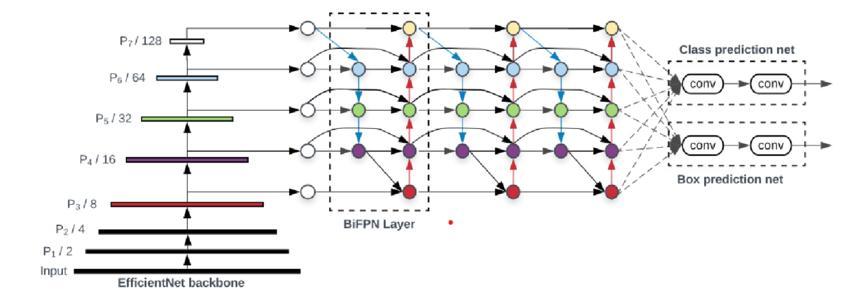
An effective configuration for training the det d4 modelisbeingbuiltupinthissection.Here,we'renaming theTensorFlow1ObjectDetectionModelthatwe'dliketo employasourstartingpoint.Aconfigurationfileisincluded witheachmodel.Thisfiledoesalotofthings,suchsetting trainingparameters(likelearningrateandtotalnumberof trainingsteps)andpointingtofilelocations.Wearemaking changestothecustomtrainingjob'sconfigurationfile.The firstpartofthecodeestablishesmanyfilenamesthatwillbe utilizedtodownloadthemodelandconfigurationfilelater onandlaysoutvariousmodelsthatareaccessibleintheTF1 ModelZoo.Thismakesitsimpletokeeptrackofthemodels we'reusingandtoaddmoremodelsasneeded.Totrainwith aspecificmodel,setthe"chosen_model"variabletoitsname. The"efficientdetd4-quantized"modelispresentlyselected. Afterthat,specifytheparametersforthepre-trainedmodel and the configuration file, and then press play in the following three steps to download them.After getting the modelandconfigurationfilesdownloaded,thenextstepisto addsomegeneraltrainingparameterstotheconfiguration
file. Training phases are controlled by the following variables:
3.7.1 num_steps:Thesumofallthestepsthatwillbeused totrainthemodel.Fortythousandstepsisadecentstarting point.Ifwefindthatthelossmeasuresarestillgoingdown whentrainingisover,wecanaddextrasteps.Ittakesmore timetotrainiftherearemoresteps.Ifthelosslevelreaches thespecifiedpointbeforethetrainingperiodends,training canbeterminatedearly.
3.7.2 batch_size: Thenumberofphotostoutilizeforeach trainingstage.Althoughtrainingamodelwithahigherbatch sizerequiresfewersteps,thesizecanonlybeasbigasthe GPU RAM that is available for training. In most cases, 16 GPUsisanadequateamountforaColabinstance.
3.7.3 quant_delay_steps: (Intendedsolelyfortrainingwith quantizationinmind)Therearealotofprocessesinvolved before the training algorithm simulates quantization by adding"fake"quantizationnodestothenetwork.Halvingthe totalnumberoftrainingstepsisadecentplacetostart.At thisstage,youalsoprovideadditionaltrainingdata,suchas thetotalnumberofclasses,thelocationoftheconfiguration file,andthefilecontainingthepre-trainedmodel.Inorderto applythetrainingparametersthatwehavejustdefined;we will needtoedittheconfiguration file. Thiscode will take the.config file you downloaded and save it as our own "pipeline_file.config" with all of the required parameters already filled in. Add our dataset, model checkpoint, and training parameters to the main pipeline file to create a customconfigurationfile.Thesubsequentblockupdatesthe trainingscriptsuchthatcheckpointsaresavedevery1000 steps.Toadjustthefrequencyofsavingcheckpoints,change 'num_eval_steps'. Table 1 below shows the design of the efficientdetd4.
3.8 Step 8: Train Custom TF1 Object Detector Ourobject identification model training has begun! The TF Object DetectionAPI's"model_main_tf2.py"scriptisusedtotrain themodel.InearliersectionsofthisColab,wehavedefined
International Research Journal of Engineering and Technology (IRJET) e-ISSN: 2395-0056
Volume: 13 Issue: 02 | Feb 2026 www.irjet.net p-ISSN: 2395-0072
all the arguments and parameters utilized by'model_main_tf2.py'.Model,batchsize,andtotalnumber of training steps determine how long the training process takes,whichcanrangefromtwotosixhours.Theresultisa. tflitefilethatwecanusetoputthemodelthroughitspaces.
3.9 Step 9: Testing the model for weapon detection
Here,thePythonsoftwareusesthemobilephone'scamerato recordvideoand,byextension,theframes.Itdoesthisby utilizingtheDroidCamapp,whichiscompatiblewithboth laptops and mobile phones. In order to identify the fire engine and ambulance in the live-streaming frames, the trainedmodelfile.tfliteisutilized.Thelocationofthestores iscommunicatedtotheappropriateauthoritiesassoonas firearms are identified, and neighbors are also alerted throughvoicealert.Thelaststepinpreventingshopliftingis toutilizetheESP32modeltolockthedoors.
The Windows-based system, which has 16 GB of main memory and an Intel Core i7 processor, is used to implement the proposed model. The Anaconda IDE repositoryforSpyderandJupyterIDEsisusedbythemodel for the experiment. The created model is rigorously evaluatedusingtheparametersoftheconfusionmatrix.You may understand the parameters of the confusion matrix usingthefollowingequations:accuracy,precision,recall,and macroF1.
Accuracy=(TP+TN)/(TP+FP+TN+FN) -(1)
Precision(P)=TP/(TP+FN) -(2)
Recall(R)=TP/(TP+FP) -(3)
Macro-F1=(2*P*R)/(P+R) -(4)
Atthispoint,wehaveTPfortruepositives,TNfor true negatives, FP for false positives, and FN for false negatives.
Theobtainedresultsareshownbelow,
1.ConfusionMatrix
2.F1-ConfidenceCurve
3.PrecisionConfidenceCurve
4.Precision-recallCurve
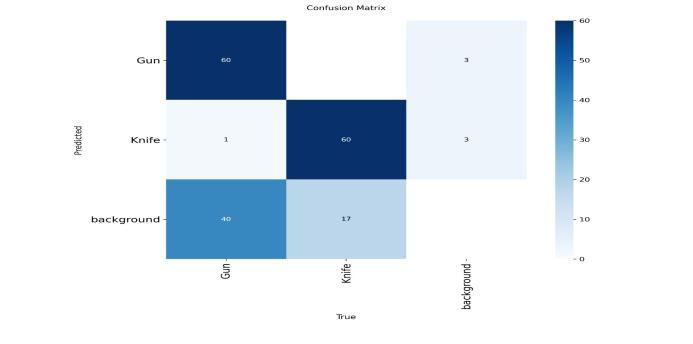
2: Confusion Matrix
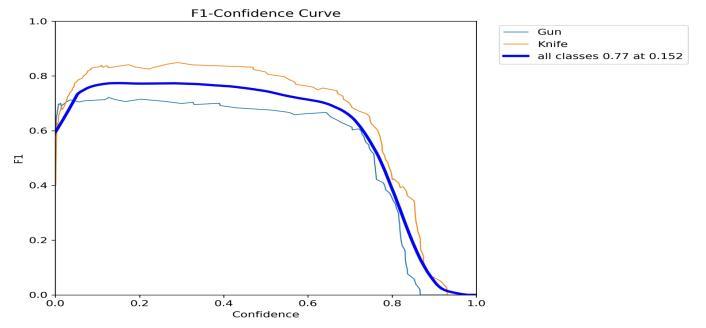
3: F1-Confidence Curve
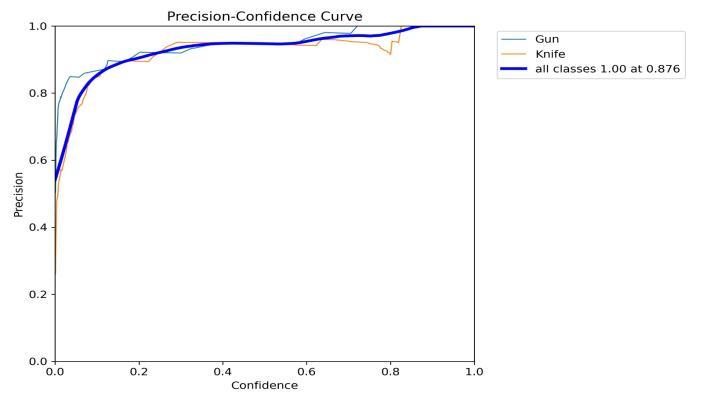
4: Precision-Confidence Curve
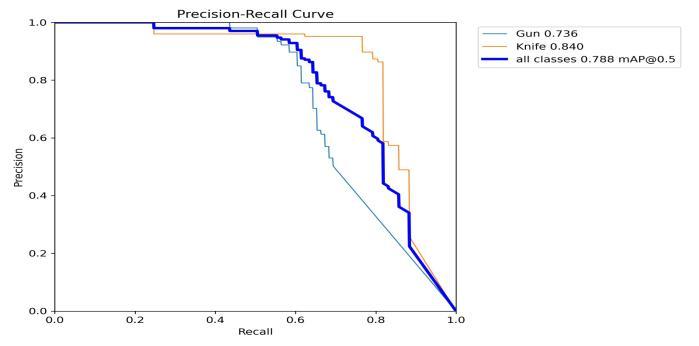
5: Precision-Recall Curve
International Research Journal of Engineering and Technology (IRJET) e-ISSN: 2395-0056
Volume: 13 Issue: 02 | Feb 2026 www.irjet.net p-ISSN: 2395-0072
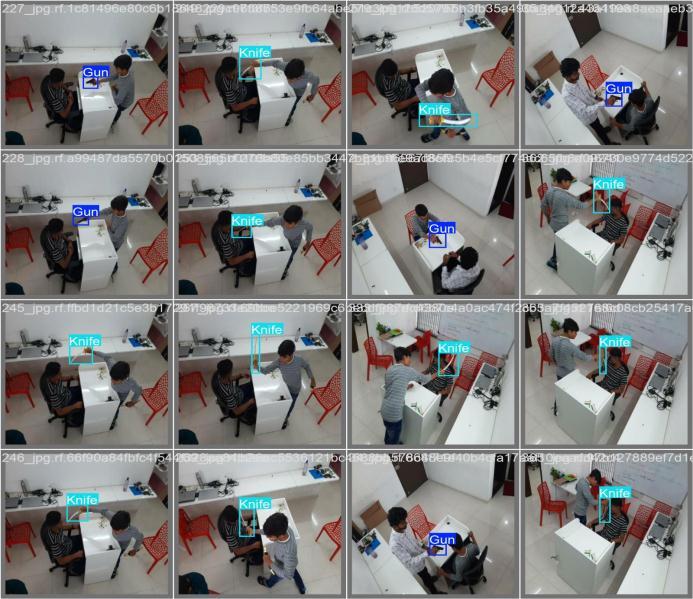
Onemajordeparturefromtheoldmodelofpassive surveillance is the creation of automated anti-robbery systems for banks and stores. This research achieves the difficultbalancingactof meetingtherigorous demands of fastprocessingandcutting-edgedetectionaccuracywiththe helpoftheEfficientNet-D4deeplearningmodel.Eveninthe busy, often dimly lit environments of banks and shopping malls, the EfficientNet architecture's built-in compound scalingmechanismguaranteesaccuratefeatureextraction, whether it be identifying a person wearing a mask or a weapon. Incorporating multi-modal techniques such as YAMNet for auditory gunshot recognition and backdrop mattingforabandonedobjectdetection,inadditiontovisual analysis, provides a thorough security framework. The system'saccuracyanditsabilitytoadapttonewsituations withlittleretrainingarebothenhancedbytheincorporation of transfer learning and meta-learning. In the end, this systemoffersaconstantandscalablesolutionthatimproves thesafetyofbothpublicandprivateareasbydecreasingthe likelihood of human mistake, increasing the speed of emergencyresponsetimes,anddeterringcriminalactivities.
Severalexcitingnewdirectionsfordevelopmentand application lie ahead for this technology. Improving the modelfortinymlandedgecomputingisatoppriority.This will make high-level security available to smaller retail enterprisesbyenablingtheefficientnet4architecturetorun directlyonlow-costcamerasandsmartdevices.
[1]K.-H.ChoiandJ.-E.Ha,“ObjectDetectionMethodUsing Image and Number of Objects on Image as Label,” IEEE Access, vol. 12, pp. 121915–121931, 2024, doi: 10.1109/ACCESS.2024.3452728.
[2] K. Elgazzar, S. Mostafi, R. Dennis, and Y. Osman, “Quantitative analysis of deep learning-based object detectionmodels,”IEEEAccess,vol.12,pp.70025–70034, May2024,doi:10.1109/ACCESS.2024.3401610.
[3]R.C.Poonia,K.Upreti,N.Singh,J.Kesarwani,andM.S. Alam, “An efficient detection of suspicious objects from dynamicvideosurveillancebyfusion-basedmultiviewdeep learningtechniques,”JournalofMobileMultimedia,vol.21, no.1,pp.1–26,2025,doi:10.13052/jmm1550-4646.2111.
[4]Q.Xie,D.Zhou,R.Tang,andH.Feng,“AdeepCNN-based detection method for multi-scale fine-grained objects in remote sensing images,” IEEE Access, vol. 12, pp. 15622–15630,Jan.2024,doi:10.1109/ACCESS.2024.3356716.
[5] M. Cho and E. Kim, "3D LIDAR Multi-Object Tracking Using Multi Positive Contrastive Learning and Deep ReinforcementLearning,"IEEEAccess,vol.13,pp.1244712461,2025,doi:10.1109/ACCESS.2024.3521334.
[6]A.Raza,F.Rustam,B.Mallampati,P.Gali,andI.Ashraf, "Preventing Crimes Through Gunshots Recognition Using Novel FeatureEngineering and Meta-Learning Approach," IEEE Access, vol. 11, pp. 103115-103131, 2023, doi: 10.1109/ACCESS.2023.3316695.
[7]P. Wang, X.Wang,E.Ji, Y.Zhang,J.Du,X. Wang,andX. Zhang, "Multilayer Feature Extraction Object Detection Based on Deep Forest," IEEE Journal of Selected Topics in AppliedEarthObservationsandRemoteSensing,vol.18,pp. 27224–27241,2025,doi:10.1109/JSTARS.2025.3622047.
[8]G.ElumalaiandG.Malathi,"DeepLearningBasedHand Wrist Crease Object Detection Models: An In-Depth Analysis,"IEEEAccess,vol.12,pp.83125–83139,2024,doi: 10.1109/ACCESS.2024.3409087.
[9]S.R.Waheed,N.M.Suaib,M.S.M.Rahim,A.R.Khan,S.A. Bahaj, and T. Saba, "Synergistic Integration of Transfer LearningandDeepLearningforEnhancedObjectDetection inDigital Images,"IEEEAccess,vol.12,pp.13525–13536, 2024,doi:10.1109/ACCESS.2024.3354706.
[10] M. Jeong, D. Kim, and J. Paik, "Practical Abandoned Object Detection in Real-World Scenarios: Enhancements UsingBackgroundMattingWithDenseASPP,"IEEEAccess, vol.12,pp.60808–60825,2024,doi: 10.1109/ACCESS.2024.3395172.
[11] I. Bisio, C. Fallani, C. Garibotto, A. Grattarola, F. Lavagetto, A. Sciarrone, S. Zappatore, and M. Zerbino, "PerformanceEvaluationofMachine/DeepLearning-Based Object Recognition Techniques Leveraging Channel State InformationUsingaRealTestbed,"IEEEAccess,vol.12,pp. 98680–98692,2024,doi:10.1109/ACCESS.2024.3428612.
[12]N.HariharaValliappan,S.DhanrajPande,andS.Reddy Vinta,"EnhancingGunDetectionWithTransferLearningand
International Research Journal of Engineering and Technology (IRJET) e-ISSN: 2395-0056
Volume: 13 Issue: 02 | Feb 2026 www.irjet.net p-ISSN: 2395-0072
YAMNet Audio Classification," IEEE Access, vol. 12, pp. 58940–58949,2024,doi:10.1109/ACCESS.2024.3392649.
[13]D.KitanoandD.Mikami,"PitchLocationMeasurement UsingaSingleCameraandRadarGun,"IEEEAccess,vol.13, pp.175336–175340,2025,doi: 10.1109/ACCESS.2025.3618720.
[14]S.AzizianAmiri,J.Dankelman,andB.H.W. Hendriks, "Enhancing Intraoperative Tissue Identification: Investigatinga SmartElectrosurgical Knife'sFunctionality During Electrosurgery," IEEE Transactions on Biomedical Engineering, vol. 71, no. 7, pp. 2119–2134, July 2024, doi: 10.1109/TBME.2024.3362235.
[15]K.XieandZ.Zhu,"OptimizationCuttingTrajectoryfor Ring Knife Sponge Cutting via S-Shaped Sequencing AlgorithmBasedonRegionSegmentation,"IEEEAccess,vol. 11,pp.99319–99330,2023,doi: 10.1109/ACCESS.2023.3313636.
2026, IRJET | Impact Factor value: 8.315 | ISO 9001:2008
|