
International Research Journal of Engineering and Technology (IRJET) e-ISSN: 2395-0056
Volume: 12 Issue: 06 | June 2025 www.irjet.net p-ISSN: 2395-0072
International Research Journal of Engineering and Technology (IRJET) e-ISSN: 2395-0056
Volume: 12 Issue: 06 | June 2025 www.irjet.net p-ISSN: 2395-0072
Sandesha
K M1 , Neman
Sharief
M.M2 , Dr.M.Inayathulla3
1PG Student(WRE), Department of Civil Engineering, University of Visvesvaraya College of Engineering, Bengaluru, 2Research Scholar, Department of Civil Engineering, University of Visvesvaraya College of Engineering, Bengaluru, 3Professor, Department of Civil Engineering, University of Visvesvaraya College of Engineering, Bengaluru, Karnataka, India ***
Abstract - Dams aremulti-functionalstructures widely used for storing water, generating electricity, andmanagingfloods However, their failure, especially during extreme rainfall events, can lead to catastrophicfloodingindownstreamareas. This study presents a comprehensive dam break analysis and flood inundation mapping for the Harangi Dam, located in Karnataka, India. Using HEC-RAS 2D and ArcGIS tools, simulations were carried out to model potential overtopping and piping failure scenarios. The resulting flood hydrographs and inundation extents were compared for different breach conditions. The peakflood discharges obtained were21,451.66 cumec for overtopping and 15,585.31 cumecfor pipingfailure. The maximum inundation area for overtopping was found to be 120.857 square kilometers, significantly higher than the areas affected by piping failure and large controlled release scenario. About 157 downstream villages were found to be at risk due to overtopping failure. The study highlights the importance of hydraulic modeling and floodplain mapping in identifying vulnerable zones, supporting disaster preparedness, and formulating mitigation strategies for dam safety management.
Key Words: Flood inundation mapping, Harangi Dam, ArcGIS, Overtopping failure, Piping failure, Emergency planning
Damsarecriticalinfrastructurethatplayavitalroleinwater resourcemanagement.However,theirfailurecanresultin significantlossoflifeandproperty.Withincreasingconcerns over climate-induced extreme rainfall and structural vulnerabilities, dam break studies have become essential. This paper focuses on the Harangi Dam in Karnataka, assessing flood risks arising from both overtopping and pipingfailurescenarios.FloodInundationMapping(FIM)is usedtoidentifyat-riskareasdownstreamofthedamusing HEC-RAStwo-dimensionalmodelingandGIStools.
Inrecentyears,withtherisingunpredictabilityofweather patternsandclimateextremes,therelevanceofdambreak modeling has increased significantly. Comprehensive risk assessments help in evaluating possible downstream
impacts and are instrumental in preparing mitigation strategies. This study incorporates both hydrological and hydraulic modelling components, offering a holistic approachtowarddamsafetyevaluation.
To determine the peak flood discharge resulting from a dam failure due to both overtopping and pipingfailure.
Topreparefloodinundationandfloodwavearrival time mapsforthedownstreamregionunderdam break conditions, and a flood inundation map for thedownstreamregionunder withoutdambreak condition.
To estimate the number of villages affected or inundatedduetoovertoppingfailure
TheHarangiDamisanessentialwaterinfrastructureproject built across the Harangi River, a tributary of the Cauvery, locatedinKodagudistrictofKarnataka.Positionedataround 12°29′30″Nlatitudeand75°54′20″Elongitude. Itbegan impoundingwater in1982,and since then, ithas playeda significant role in supporting regional agriculture and ensuringwatersecurityfornearbydistricts,especiallyduring dryspells.Thedamisacompositestructurewithmasonry andearthenmaterials,theHarangiDamspans845.82meters inlength.Inadditiontoitspracticalutility,theHarangiDam has also become a peaceful tourist destination, with wellmaintainedgardens,tranquilwaters,andscenicviewsofthe Western Ghats, especially captivating during the monsoon season. It has become a spot where infrastructure meets nature. In all, the Harangi Dam is a symbol of sustainable water management,agricultural support,and eco-tourism, quietly enriching the lives and landscapes of southern Karnataka.
International Research Journal of Engineering and Technology (IRJET) e-ISSN: 2395-0056
Volume: 12 Issue: 06 | June 2025 www.irjet.net p-ISSN: 2395-0072
A Digital Elevation Model (DEM) is a digital dataset that representstheEarth'ssurfaceterrainbyrecordingelevation valuesatconsistentspatialintervals.TheDEMusedinthis study was sourced from the Shuttle Radar Topography Mission(SRTM),offeringaspatialresolutionof30meters. This dataset was freely downloaded from USGS Earth Explorer,areliableplatformforglobalgeospatialdata.
Toaccuratelypredictafloodhydrographfromareservoir,it isessentialtohavetheelevation-storagerelationshipdataof the reservoir The reservoir data were collected from the damauthorityandareshowninChart-1.
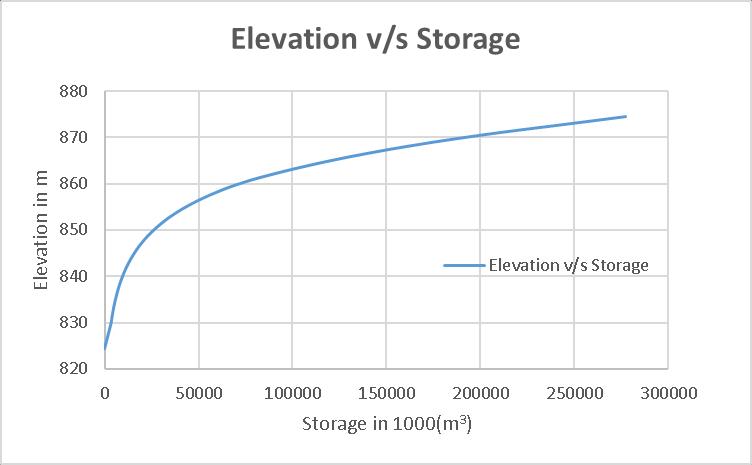
-1:Elevation-storagerelationshipfortheHarangi reservoir
Accurate estimation of water surface elevation depends heavily on selecting a suitable Manning’s roughness coefficient(n).TheLandUseLandCover(LULC)datausedin thisstudywasobtainedfromtheEsri10-meterresolution LandCoverdatasetfortheyear2024,whichisbasedonESA Sentinel-2satelliteimagery.
The study used a combination of hydrodynamic modeling and GIS-based analysis to simulate possible dam failure scenarios. Fig-1 showtheflowchartofthemethodologyused inthepresentstudy.
3.3
The PMF hydrograph is taken as the inflow for the flood; hence, it is also called the inflow hydrograph. The PMF hydrographdatawerecollectedfromthedamauthorityand areshowninChart-2.
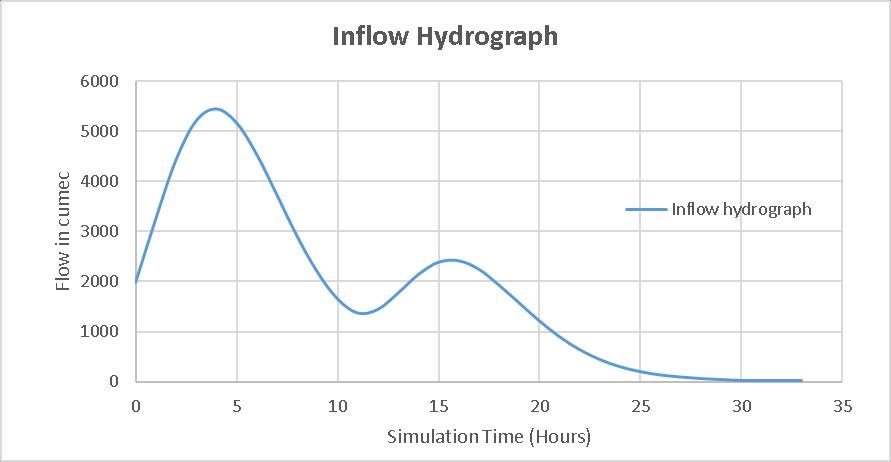
Chart -2:Inflowhydrograph
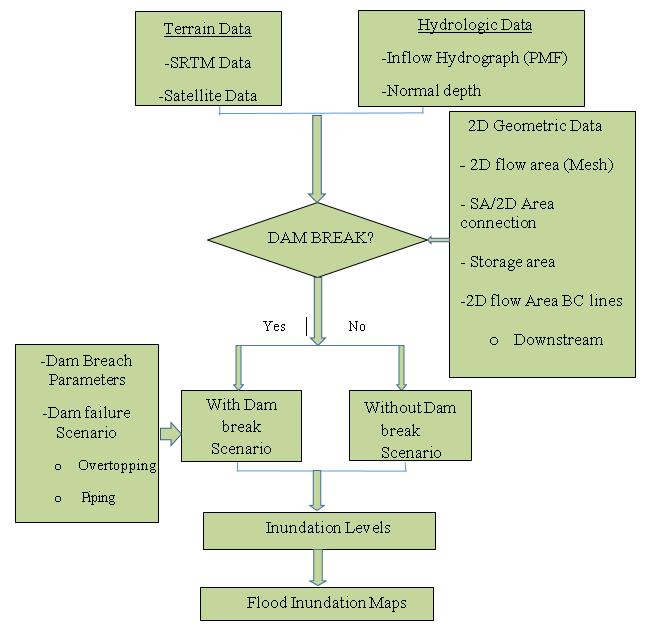
Fig -1:FlowchartoftheMethodologyUsed
TheprocessofdevelopingahydraulicmodelusingHEC-RAS 2Dinvolvesthefollowingkeysteps:
1. Creationoraddingaterrain
2. AddingGeometryDataandAssigningManning’sn Values
3. Adding Connection Data, and for dam Break Scenarios,EnteringBreachParameters
4. Enteringunsteadyflowdata
5. Performingunsteadyflowanalysis
6. UsingRASMapperandArcGISforpost-processing andgenerationofthemaps.
International Research Journal of Engineering and Technology (IRJET) e-ISSN: 2395-0056
Volume: 12 Issue: 06 | June 2025 www.irjet.net p-ISSN: 2395-0072
Step1: Creation or adding a terrain
A terrain layer, which is pre-processed and clipped in ArcGIS,isaddedtoRASMapperbyselectingthe‘CreateNew RASTerrain’option.Acorrespondingprojectionfileisalso addedtoensureitalignswiththecorrectcoordinatesystem.
Step2: Adding Geometry Data and Assigning Manning’s n Values
Inthisstep,astorageareaanda2Dflowareaarecreated using the geometry options in HEC-RAS. A 2D mesh is generated for the flow area with a cell size of 125 × 125 meters,resultinginatotalof79,943cells.Thestorageareais connectedtothe2DflowareausingtheSA/2Dconnection tool.Thedownstreamboundaryconditionisdefinedusing BClines.TheLandUse/LandCover(LULC)layeriscreated under Map Layers, and Manning’s n values are assigned basedonlandclassification.
Step3: Adding Connection Data, and for dam Break Scenarios, Entering Breach Parameters
Inthisstep,connectiondataareaddedbydefiningtheweir embankmentcharacteristicssuchasweirwidth,stationing, elevation, and weir coefficient. Under the gate section, detailsofthespillwayandriversluicegatesareentered.If modelingadambreakscenario,thebreachplanisselected, and breach parameters derived from relevant regression equations are input accordingly. (If modeling is without a dambreakscenario,skiptheentryofbreachparameters.)
Step4: Entering unsteady flow data
In this step, boundary conditions for both upstream and downstreamaredefinedundertheunsteadyflowdata.
-Flow/Discharge:Fortheovertoppingfailurescenario,the upstream boundary is assigned an inflow hydrograph representingthePMFwitha1-hourinterval.Forthepiping failurescenario,aconstantbaseflowof21m³/sisused.For thelargecontrolledreleasescenario,thespillwaydischarge capacity(includingriversluicedischarge)of3826.24m³/sis provided.
- Normal depth: At the downstream boundary, a normal depthvalueof0.001isassignedforallscenarios.
- Elevation-controlled gates: For the SA/2D connection, elevation-controlled gates are defined differently for each scenario. In the overtopping failure case, the gates are consideredfullyopen.Forpipingfailure,thegatesremain fully closed. In the large controlled release scenario, the gatesareset to open graduallyata rate of 0.2 meters per minute.
Step5: Performing unsteady flow analysis
1.Selecttheprogramstorun,
Geometric Preprocessor: Processes the geometric dataintoaseriesofhydraulicpropertytables.
Unsteady Flow Simulation: Uses the full dynamic Saint-Venant equations to perform unsteady flow calculations.
PostProcessor:Computesdetailedhydraulicresults asperuserspecifications.
Floodplain Mapping: Computation of static flood inundationmaps(DepthGrid).
2. Enter the starting and ending date and time for the simulation.
3.Setthecomputationsettingswhichincludecomputation interval, hydrograph output interval, mapping output interval,detailedoutputinterval.
4.ClicktheComputebuttontorunthesimulation.
Step6: Using RAS Mapper and ArcGIS for post-processing and generation of the maps.
Afterperformingtheunsteadyflowanalysis,theRASoutput isexportedandimportedintoArcGISinrasterformat.The rasterdataisoverlaidonthebasemap,andtheinundation areaiscalculatedbyconvertingtherastertoapolygonlayer. Finally, essential map elements such as the legend, north arrow,andothercartographicfeaturesareadded.
Floodinundationmapsareessentialtoolsforunderstanding the spatial extent of flooding, especially along riverbanks. Thesemapsplayacrucialroleindisasterpreparednessand response, as they support the development of effective Emergency Action Plans (EAPs). The unsteady flow simulation in HEC-RAS produced peak flows of 21,451.66 m³/s and 15,585.31 m³/s under overtopping and piping failurescenarios,respectively,asshowninFig.2andFig.3. Forlargecontrolledreleases,thepeakfloodcorrespondsto thedesigndischargecapacity,whichincludesbothspillways andtheriversluice.Theanalysisidentified157villagesthat would be affected in the event of a dam break caused by overtoppingfailure,highlightingtheneedforearlywarning systemsandevacuationplanninginthedownstreamregion
International Research Journal of Engineering and Technology (IRJET) e-ISSN: 2395-0056
Volume: 12 Issue: 06 | June 2025 www.irjet.net p-ISSN: 2395-0072
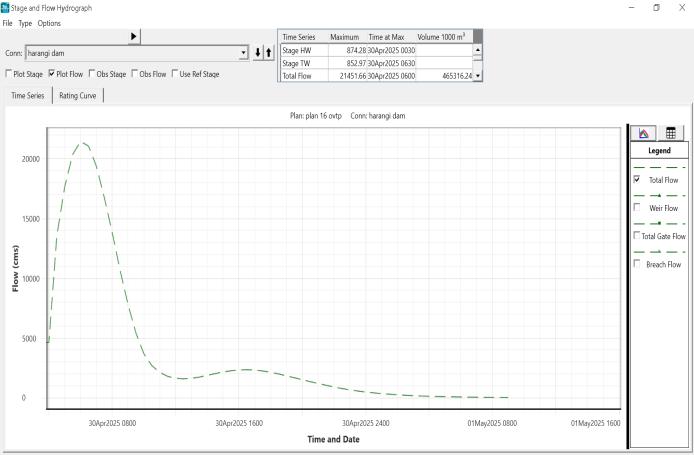
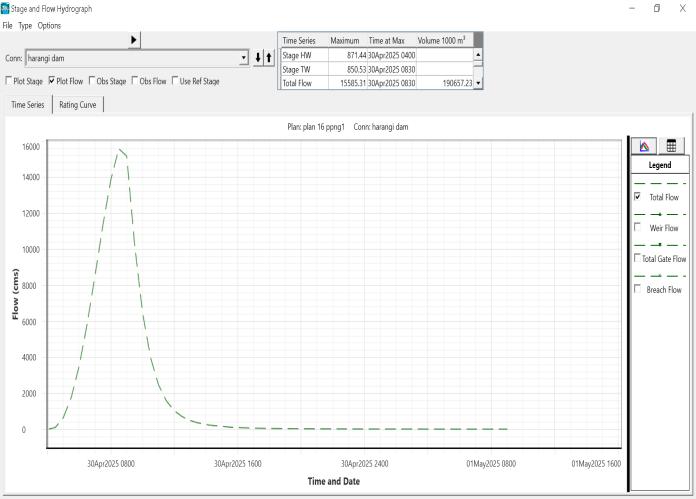
Fig-4 and Fig-5 show the flood inundation map and flood wavearrivaltimemapfortheovertoppingfailurescenario.
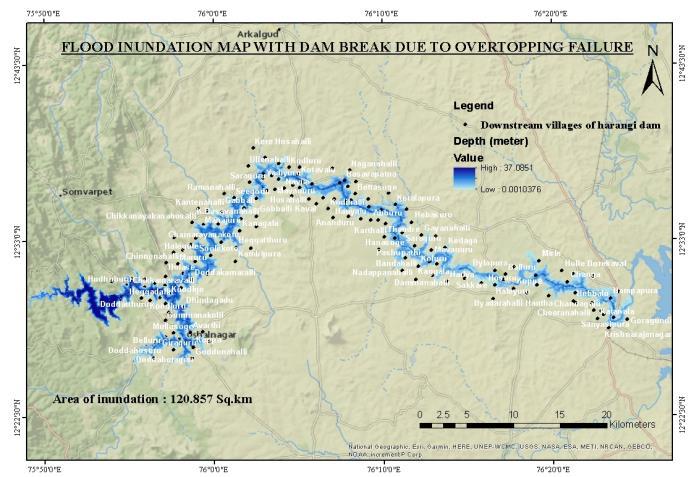
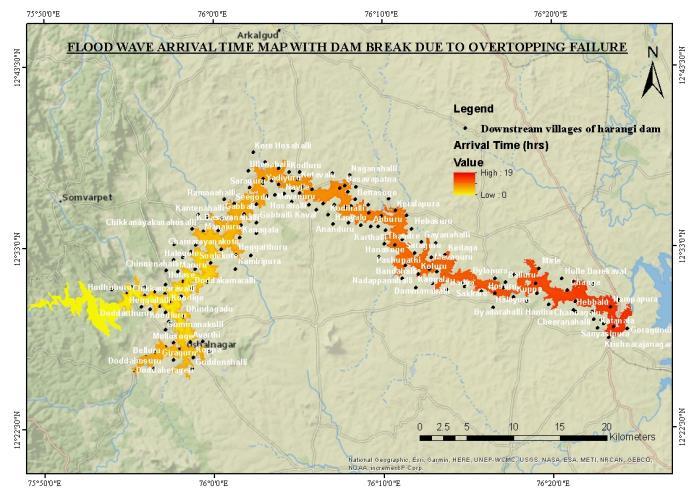
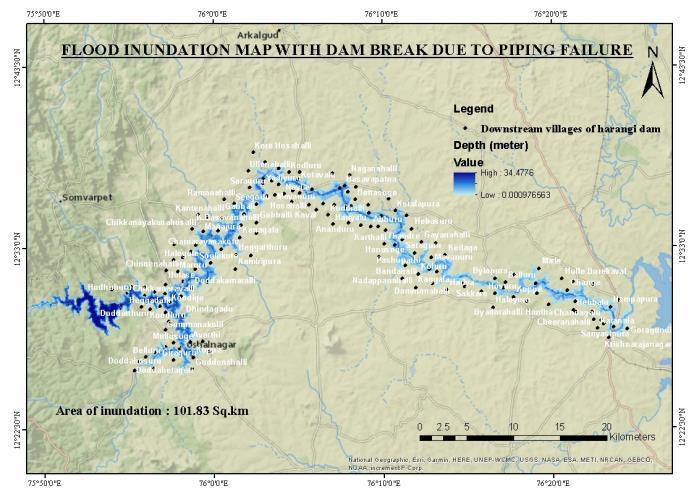
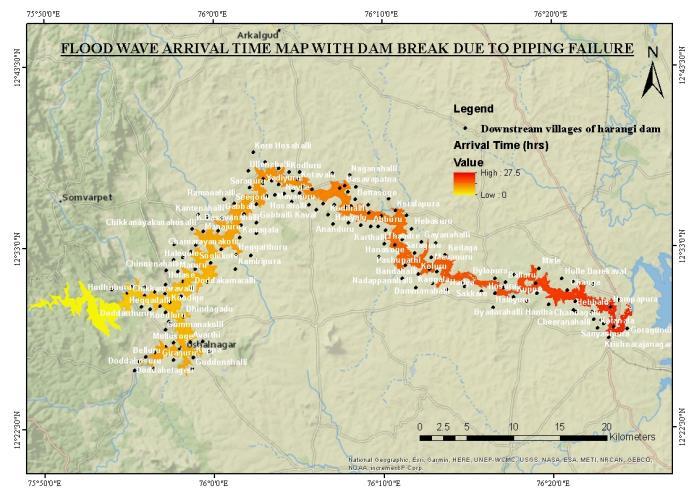
Fig-6andFig-7showthefloodinundationmapandflood wavearrivaltimemapforthepipingfailurescenario.
International Research Journal of Engineering and Technology (IRJET) e-ISSN: 2395-0056
Volume: 12 Issue: 06 | June 2025 www.irjet.net p-ISSN: 2395-0072
Fig.8showsthefloodinundationmapforthescenario withoutdambreak(i.e.,largecontrolledrelease).
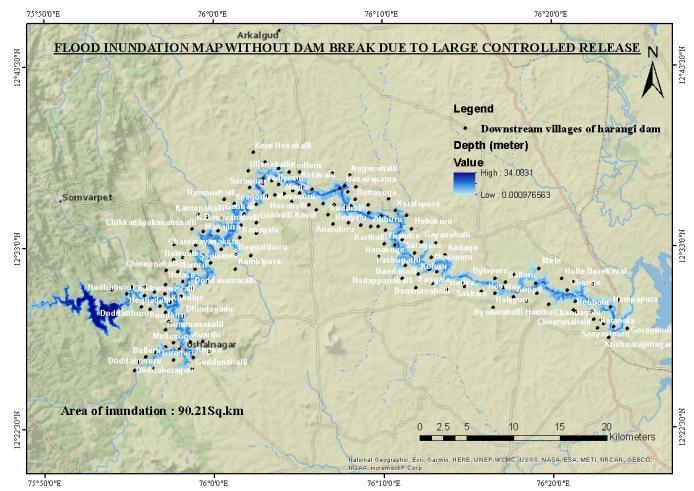
-8:Floodinundationmapforthescenariowithoutdam break
The dam break analysis conducted for the Harangi Dam resultedinthefollowingkeyinsights:
The overtopping failure scenario presents a significantlyhigherflood risk comparedto piping failure,withapeakdischargeof21,451.66m³/sand a maximum inundation area of 120.857 sq. km, underscoringitspotentialforwidespreaddamage.
Floodwaters can travel up to 90 km downstream, reachingtheKrishnarajasagarareservoir,indicating abroadgeographicextentofpotentialimpact.
Atotalof157villagesareprojectedtobeaffectedin the overtopping scenario, highlighting the urgent need for community-level disaster preparedness andevacuationplanning.
Comparativeanalysisofinundationmapsconfirms thatovertoppingposesagreaterthreatthanpiping orlargecontrolledreleasescenarios,necessitating focused mitigation measures for overtopping events.
TheHEC-RASsimulationeffectivelymodeledflood behavior, including water depth and flood wave arrivaltimes,validatingitsuseasareliabletoolfor floodplainzoningandEmergencyActionPlan(EAP) development.
Theresultsprovidecriticalinputsfordisasterrisk reduction,enablinginformedemergencyresponse planning,infrastructurereinforcement,andpolicy decisions aimed at safeguarding downstream communities.
[1]S.Bharath,R.Gowda,andP.Patil,“Dambreakanalysisof Hidkal dam using HEC-RAS,” International Journal of Civil Engineering and Technology (IJCIET), vol. 12, no. 2, Feb. 2021,pp.90–98.
[2]U.S.ArmyCorpsofEngineers,HEC-RASRiverAnalysis System:User’sManual(Version6.6),HydrologicEngineering Center,Davis,CA,2023.
[3] R. Sumira, R. Mardiana, and S. Wahyudi, “Flood risk assessment and dam break analysis for Sermo Dam using HEC-RAS,”InternationalJournalofDisasterRiskReduction, vol.61,Jan.2023,pp.102376
[4]A.Ramola,A.Jain,andS.Sharma,“Floodriskassessment ofPulichintaladamusingHEC-RAS,”InternationalJournalof AdvancedResearchinEngineeringandTechnology(IJARET), vol.12,no.4,Apr.2021,pp.11–23.
[5] C. Chongxun and Z. Lin, “Flood simulation and risk assessment for Chengbi River dam using HEC‑RAS 2D,” Water Resources Management, vol. 37, no. 4, Apr. 2023, pp. 945–959.
[6]M.Tessema,A.Kebede,andB.Worku,“Floodinundation mappinganddambreachanalysisforDiredamusingHECHMSandHEC-RAS,”WaterPracticeandTechnology,vol.19, no.1,Jan.2024,pp.10–24.
[7] D. Kiwanuka, T. Muwanguzi, and M. Nabwire, “Dam breachsimulationforKibimbadamusingHEC-RASandHECGeoRAS,”AfricanJournalofWaterandIrrigation,vol.15,no. 3,Jul.2023,pp.220–230.
[8] H. Shahrim and C.F. Ros, “Dam break simulation for TemenggorDamusingHEC-RAS,”MalaysianJournalofCivil Engineering,vol.32,no.2,Jun.2020,pp.101–112.
[9]V.Merwade,A.Cook,andJ.Coonrod,“GIStechniquesfor creating river terrain models for hydrodynamic modeling andfloodinundationmapping,”EnvironmentalModelling& Software,vol.23,no.10–11,Oct.2008,pp.1300–1311
[10]A.LeoulandA.Kassahun,“HEC-RASbaseddambreach and flood inundation modeling for Kesem Kebena dam,” Ethiopian Journal of Water Resources, vol. 15, no. 1, Mar. 2019,pp.34–45.