
International Research Journal of Engineering and Technology (IRJET) e-ISSN: 2395-0056
Volume: 13 Issue: 03 | Mar 2026 www.irjet.net p-ISSN: 2395-0072

International Research Journal of Engineering and Technology (IRJET) e-ISSN: 2395-0056
Volume: 13 Issue: 03 | Mar 2026 www.irjet.net p-ISSN: 2395-0072
Durva Patkar1 , Vaishnavi Rawate2 , Madhuri Patil3 , Sumedh Pundkar4
1Student,Dept of Computer Science and technology,Usha mittal institute of technology,Maharashtra, India
2Student,Dept of Computer Science and technology,Usha mittal institute of technology, Maharashtra, India
3Student,Dept of Computer Science and technology,Usha mittal institute of technology, Maharashtra, India
4Professor,Dept of Computer Science and technology,Usha mittal institute of technology, Maharashtra, India
Abstract - The mobile devices have become part of everyday life and the newfound use has turned them into easy targets of advanced cyber-attacks, including malicious apps, unprotected Wi-Fi networks, and backgroundconnections. The current mobile security tools tend to be based on the concept of static or signature detection and have therefore been left deficient in the protectionofzero-dayattacksandnetwork-basedexploits. The presented paper CyberSentinel, is an AI-driven Android security software that is intended to offer a fullfletched, real-time protection both on the device and network levels. CyberSentinel combines an AI-based malware detectionengine,whichcananalyzethebehavior of newly instigated and existing applications, a system of security mode configuration, an application-level network surveillance to identifymaliciousIP addresses,anda Wi-Fi scanner to assess the safety of the public network. The system also has an LLM-powered chatbot that provides actionable advice and explains security alerts to make them easier to use. Through the integration of intelligent malware, network threat, and user-focused design, CyberSentinel seals the most important vulnerabilities existing in the mobile security market and pushes the Androidcybersecuritytoahigherlevel.
Keywords–Android Security, Mobile Malware Detection, AI-based Threat Detection, Neural Networks, Wi-Fi Security Analysis, Large Language Models (LLM), Threat Remediation, Real-time Protection and Permission-based Features.
Smartphones are vital in the digital world, and used to communicate with friends and carry out banking transactions,aswell asaccesssensitiveinformation, but they are becoming targets of advanced cyber-attacks withoutthemajorityofusersunderstandingthedangers of downloading malicious software, using unprotected Wi-Fi,andunnoticed backgroundapplications.Available securitysolutionsprimarilyidentifyknownmalwareand cannot detect zero-day and network-based attacks [1]. One of the major issues is that the users install apps withoutunderstandingwhethertheyaresafeornot,and it can result in the theft of their data or the
communicationofharmfulmessages.Anothersignificant weakness is the presence of public Wi-Fi, which is usually not encrypted or even created by malicious individuals to capture data [5]. The proposed paper will consistofanadvancedAndroidsecurityapplication that provides both de-vice and network protection. It monitors the new applications and the old applications when a user selects it in new or existing modes and identifies suspicious activity using Al-driven, behaviorbasedsystems[2].Itisalsoabletonotifytheuserabout threats, block access to apps, or recommend deletion. The app also has an LLM-based chatbot, which explains notifications, gives guidelines, and directs users in real timetomaketheappmoreusable[9].
This paper is aimed to create an Android application that:IntroduceAI-basedmalwaredetectiontotracknew and already installed apps and their behavior to detect possible security threats in real-time [1]. Provide three customizable security levels (Low, Balanced, High) so that the users can tailor the degree of monitoring and security to their needs in terms of performance and security. Install an App-Level Network Monitor that keeps checking the app connections with the dynamically created database of legal malicious IP addresses, which gives proactive protection against network-basedattacks[3].AddaWi-FiNetworkScanner capable of assessing the security of public Wi-Fi networks based on the evaluation of important parameters like the type of network, its security status, and speed and has features of giving troubleshooting recommendations [6][8]. Provides an easy-to-use interface to track the security of the device and to react to the possible threats without impacting on the performance and battery life of the device significantly. Integrate an AI-based chatbot that will respond to the user, give direct explanations of security notifications, respond to questions, and make personalized suggestions to increase their understanding of the securityoftheirdeviceanditscontrol.
This paper adds to the area of mobile security by presenting a system that secures the user from threats coming from both malicious applications and insecure public Wi-Fi networks. It describes an Android
International Research Journal of Engineering and Technology (IRJET) e-ISSN: 2395-0056
Volume: 13 Issue: 03 | Mar 2026 www.irjet.net p-ISSN: 2395-0072
application that uses AI-based malware detection to analyze potential threats in real time, like zero-day attacks, without relying on traditional signature-based detection methods. The system has three adjustable security levels: Low, Balanced, and High, which offer different degrees of protection depending on performance trade-offs. It also includes an App-Level Network Monitor that can find network connections to suspicious IP addresses and a Wi-Fi scanner meant for checking how safe nearby networks are to help users stayawayfrominsecureconnections.
The paper [1] ReDroidDet (2021) suggests an Android malware detector based on Recurrent Neural Networks (RNN) and based on the use of the static features in the API calls, permissions, system events, and permission utilizationratesthathavehighaccuracy(~98.58%),and better than traditional machine learning models like SVMandKNNbecauseitonlyusesthestaticanalysisand is unable to detect the runtime malware or zero-day malware that conceals malicious activity. Correspondingly,[2]Hybrid AndroidMalwareDetection UsingDeepNeuralNetworksusesdeepneuralnetworks (DNNs) that combine several static predictors (permissions, API calls, code patterns) to better predict malware but will not detect the malware as it comes online to activate, and relies primarily on the static analysis. However, [3] Network-Traffic-Based Android Malware Detection is more dynamic behavior-based: it analyzes internet communication patterns, including IP addresses, traffic size and connection frequency, with bagging, random forest and boosting machine learning algorithms yielding more than 95 percent average malicious network activity detection. Lastly, [4] AntMonitor (VpnService-based monitoring system) uses the VpnService API of the Android system to establish a local VPN on the device, monitoring all app network traffic without becoming rooted, allowing the system to providedetailedapp-levelloggingofappnetworktraffic and detect privacy leaks; more than most researchoriented systems, which only raise red flags on suspicious behavior, this allows users to take real-time actionsagainstreal-timethreats.
George Chatzisofroniou and Panayiotis Kotzanikolaau (2025)securitydesignofWi-FiEasyConnect,infact,the Device Provisioning Protocol – DPP; which was brought toreplaceWi-FiProtectedSetuporWPS[5].Theirpaper discussed the authentication and cryptographic mechanismofDPP.Alsomentionedpossibleweaknesses like configurator impersonation, downgrade attack and implementationflaws.DPPhasbettersecuritythanWPS but according to them bad configuration can lead to vulnerability in security [5]. The study by Prateek
Bheevgade et al. (2024) discussed security threats as a supplementary approach with increased usage of public Wi-Fi networks [6]. This study uncovered through survey results and practical testing that packet sniffing, rogue access points as well as propagation of malware and man-in-the-middle attacks are some risks[6]. The authors stressed on user awareness along with protective measures such as secure authentication and VPNusagetomitigatethesethreats[6].
The article devoted to the accuracy of digital infrastructures and the expert use of AI models. A research by Reinaldo Sanchez-Arias et al. (2023) on accesstobroadbandconnectivityinPolkCounty,Florida, showed that the coverage and speed test in official FCC reports are frequently overemphasized in cases of rural communities[7].Theauthorscomparedthisinformation to crowdsourced data provided by Ookla and M-Lab; hence,theirargumentwasthatitisnecessarytoconduct real-worldspeedteststohelpplannersdetectareasthat are actually underserved. Continuing on this measurementfocus,KyleMacMillanetal.(2023)madea comparative study of the Ookla Speed test and NDT7 of M-Labs [8]. They discovered through laboratory experiments and thousands of tests in homes that the tools typically converge, but Ookla is more likely to record higher speeds in high-latency conditions, and NDT7 is less likely to record peak performance, indicatingthatthechoiceofserverandsoftwareversions arealsocriticaltocorrectdatainterpretation[8].Moving ontothetopicofartificialintelligence(AI),HanxiangXu et al. (2024) have offered a systematic examination of themeansofsyncingtheLargeLanguageModels(LLMs) to the realm of cybersecurity [9]. They have discussed 127 papers and reported that the functionality of the LLMscouldbeappliedeffectivelyinsolvingsuchtasksas malwareanalysisorvulnerabilitydetection,althoughthe research area is still concerned with data privacy, protection, and a shortage of various training sets [9]. Lastly, one of the studies on the educational technology elaborated the creation of a domain-specific chatbot based on RASA and LSTM networks. This system is intended to support student and user queries regarding exams and courses content, therefore, it is designed to automatize responses using intent recognition, which illustrateshowdeeplearningcangreatlyeasetheburden of administration and offer students access to informationinreal-time[10].
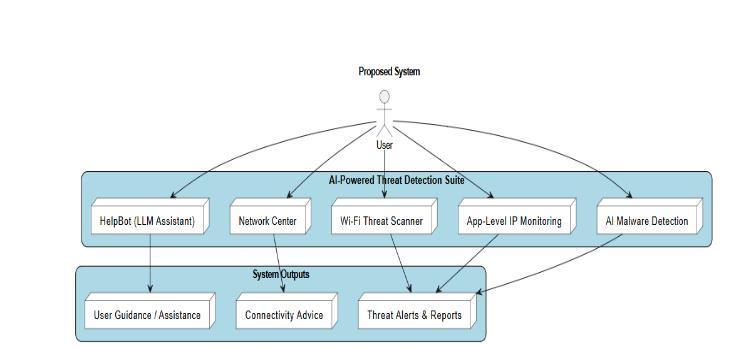
The methodology for developing the AI-based malware detector and application-level network threat detection system on Android devices is comprehensive, covering everything from the conceptual framework to data preparation,AIalgorithms,andsystemarchitecture.The core idea is to integrate machine learning-based
International Research Journal of Engineering and Technology (IRJET) e-ISSN: 2395-0056
Volume: 13 Issue: 03 | Mar 2026 www.irjet.net p-ISSN: 2395-0072
malware detection with real-time network traffic monitoringandthreatmitigation.
a. DREBIN Dataset:
This dataset contains approximately 15,000 samples of Android applications, corresponding to older malware, which was prevalent during the time of its collection, to test the perceptions of the static analysis and malware classification.
b.TUANDROMD Dataset:
It consists of around 4,000 Android apps, which containsrecentmalwaretrends.
c. COLCOM dataset:
Itcomprisesofaround400Androidapplicationsamples (where1indicatesmalware,0benignapplications),with a temporal range between DREBIN and TUANDROMD, whichcanbeusedtotestthemodelperformanceonnew orunseenmalwaresamples.
The feature engineering is concerned with the connection between various malware behavior and system permissions. Raw and engineered permission features are used. Raw features are 14 Android permissions whereas engineered features group related permissions into behaviour patterns related to a malware categories like spyware, ransomware and SMS worms,enhancingthedetectionofunknownsamples.
a. Wi-Fi Threat Detection and Risk Assessment
When the app is opened, it will check that all the necessary permissions (location access) are granted. Upon enabling Wi-Fi, it extracts network information such as SSID, BSSID and type of encryption [5]. It searches the nearby Wi-Fi networks and classifies them as high-risk systems by their encryption strength, signal strength, and consistency of the SSID. The networks are categorized into High Risk, Moderate, and Low Risk networksandtheuserisnotifiedonthesame.
b.Network Center Module
ItisthekeycontrolunitoftheWi-Fidiagnosticsandhas threesub-units:
• General Info: SSID, IP address, and encryption protocolinformationarepresented.
• Speed Test: A test that approximates the present
downloadanduploadspeed.
• Troubleshoot: Itisusedtocheck theconnectivityby usingpingtestswithexternalservers.
The Network Center also gives the users information on performanceaswellaspossiblesolutionstoconnectivity problems.
It is used to track app-level network traffic to detect communicationswithmaliciousIPaddresses.Itstartsby checking whether the network monitoring is on or off. Thesystemactivatesandreadstheinstalledapplications thenretrievestheTCPandUDPconnectiondataofthose applications using system files (/proc/net/tcp and /proc/net/udp). The obtained remote IP addresses are matched with a local threat intelligence database. If any malicious IP address is detected, it notifies the user and gives suggested remedial measures. Once this is done, after 5 minutes the system resumes again by repeating the monitoring cycle to provide continuous periodic scanning.
d.AI-Powered Malware Detection Module
It consist of User Interface and a Malware Detection Engine. The user is allowed to either scan all installed apps, or selected apps. The system identifies the chosen applications,getstheirpermissions,transformstheminto feature vectors, and runs the data through a pre-trained neuralnetworktogetamaliciousnessconfidencescore.A context-aware score is obtained by adding the model confidence and the app category risk along with sideloading status to decrease the false positives and increase the accuracy of the model using the following equation:
0.5 × Model Confidence + 0.3 × Category Risk + 0.2 × SideloadingScore
The system will then show the possible malicious apps aswellasrecommendedremedialaction.
e. Security Modes
The system has configurable protection modes that canenableuserstoselect:
• ManualMode:Manualconfigurationofsecurity settingsisdonebyauser.
• BalancedMode:Optimizestheoperations, dependingonthestatusofdevicesandtheir battery.
International Research Journal of Engineering and Technology (IRJET) e-ISSN: 2395-0056
Volume: 13 Issue: 03 | Mar 2026 www.irjet.net p-ISSN: 2395-0072
• SmartMode:Itisanautomaticadjustmentofthe intensityofprotectionbasedonsystem intelligence.
f. Help Bot Module
The system combines an AI chatbot which is an OpenRouter.ai (Mistral) bot that assists the end user to comprehend threats that are detected, clarify system notifications,andrecommendsuitablesecuritymeasures afterinteractingwithanaturallanguage[9].
g. Real-TimeSystemMonitoring
This continuously monitors Android package installations and OS-level this will monitor applications thathavejustbeeninstalledorupdated.Itautomatically initiates relevant scans to ensure that there is current security.
h. ThreatRemediation
After onethreathas been identified, be itanapplication threat or a network threat, then the system will show detailed threat information and offer the choice of Delete,Ignore, or Quarantine.Oncethesystemhasbeen remedied,itverifiesthattheremediationhasbeendone successfully and updates the user interface. The proposedworkflowwillguaranteethesuggestedsystem to conduct intelligent and automated detection of malware and network threats with deep learning and real-timemonitoring.
3.3. Artificial Neural Network for Malware Detection
The ANNs are computational models that are based on thestructureandoperationofthehumanbrain.Theyare made up of multiple interrelated layers of simple processing units known as neurons, and which learn patternsfromdatathroughweightedconnectivity.Image classification, natural language processing and malware detection are the tasks that neural networks are useful for. They are capable of detecting weak and hidden
malicious activities in Android applications due to their ability to automatically to learn features and make generalizationsbasedonlargeamountsofdata.
The neural network used here is a binary classifier having 28 input features. The architecture has two hiddenlayerwith64and32neuronsrespectively,where the ReLU (Rectified Linear Unit) activation function to provide non-linearity. The last layer is the output layer (one neuron),whichapplies sigmoidactivationfunction, to produce a probability score to determine the application to be benign or malicious. The model was executed in the TensorFlow framework, that automatically uses backpropagation in the training process to update the network weights and enhance the accuracyofclassification.
The architecture of the neural network applied in this paperisshowninthefollowingdiagram:
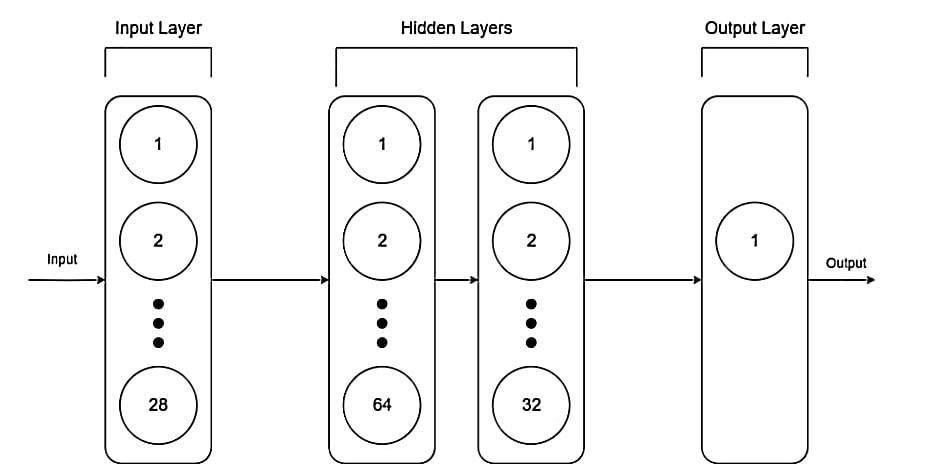
Fig. 2. NeuralNetworkArchitectureusedforAndroid MalwareDetection
Algorithm: Android Malware Detection using Artificial NeuralNetwork
Input: Static feature dataset with 28 features per Androidapplication.
Output:Classificationlabel-BenignorMalicious.
Step 1: Collect static features such as permissions and engineered behavioral indicators from Android applications.
Step 2: Preprocessthedatasetbynormalizingnumerical featuresandencodingcategoricalvalues.
Step 3: Splitthedatasetintotrainingandtestingsubsets.
Step 4: Initializetheneuralnetworkparameters:
Inputlayer:28neurons(oneforeachfeature).
Hidden Layer 1: 64 neurons with ReLU activation, definedas: ReLU(x)=max(0,x)
HiddenLayer2:32neuronswithReLUactivation.
Output layer: 1 neuron with Sigmoid activation, defined as:
σ(x)=1/(1+e^-x)
Step 5: Perform forward propagation - pass the input
International Research Journal of Engineering and Technology (IRJET) e-ISSN: 2395-0056
Volume: 13 Issue: 03 | Mar 2026 www.irjet.net p-ISSN: 2395-0072
data through the network to compute outputs at each layerusingtheactivationfunctions.
Step 6: ComputethelossusingtheBinaryCross-Entropy function to measure the error between predicted and actuallabels.
Step 7: Apply back propagation to adjust weights and biases, minimizing the loss using the gradient descent optimizationtechnique.
Step 8: Trainthemodelformultipleepochsuntiltheloss convergesanddesiredaccuracyisachieved.
Step 9: Evaluatethetrainedmodelusingthetestdataset tomeasureitsaccuracyandperformance.
Step 10: For a new application, extract the same 28 featuresandfeedthemintothetrainedmodel.
Step 11: Themodeloutputsaprobabilitybetween0and 1. If the output ≥ 0.5, classify the app as Malicious; otherwise,classifyitasBenign.
The Cyber Sentinel application Home Screen can be takenasthecentraldashboardthatallowsonetohavea briefglanceatthecurrentsecuritystatusofthedevice.It shows network-based threat warnings and information abouttheconnectedWi-Finetwork,suchasSSID,BSSID, type of encryption as well as the security classification based on internal scan. The bottom navigation bar enables easy access to the most important modules, including Malware Scan, Settings, and HelpBot, which ensures a smooth and intuitive navigation throughout the whole application. The Network Center Screen enables the user to conduct the manual network diagnosticsusingthreemodes:GeneralTest,SpeedTest, andTroubleshoot.
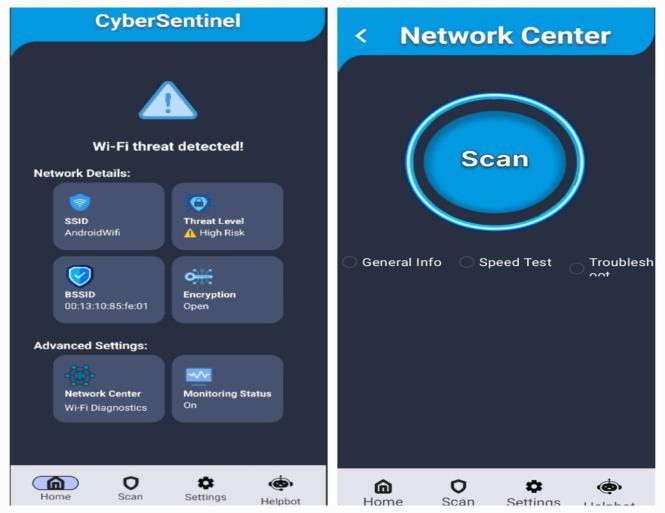
Network Center Screen: The General Test shows information on SSID, BSSID, IP address, type of encryptionandthegeneralsecurityrating.SpeedTestis
used to measure real-time upload and download speeds and the Troubleshoot mode is used to test connectivity by pitting an external server (8.8.8.8). This is a modular architecture that allows users to have necessary monitoringandmaintenancetoolsthatkeepthenetwork
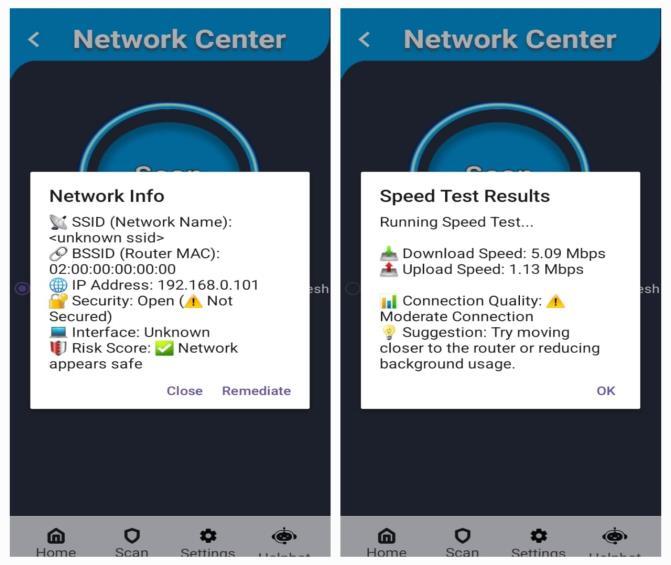
runningsafely.
The Malware Scanning Screen is the main interface of scanning devices. It also gives users two choices of scanning, All Apps, which scans all the installed applicationsandSelectAppswhichenablesuserstoscan specific applications. Key Scan button triggers the selected scanning procedure so the interface is easy, straightforward,anduser-friendly.
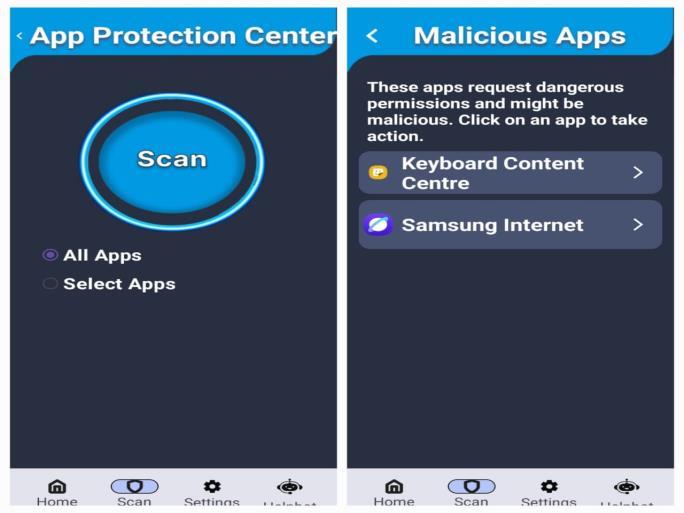
Fig. 5. AllAppScanInterfaceandDisplayMaliciousApps
International
Volume: 13 Issue: 03 | Mar 2026 www.irjet.net p-ISSN: 2395-0072
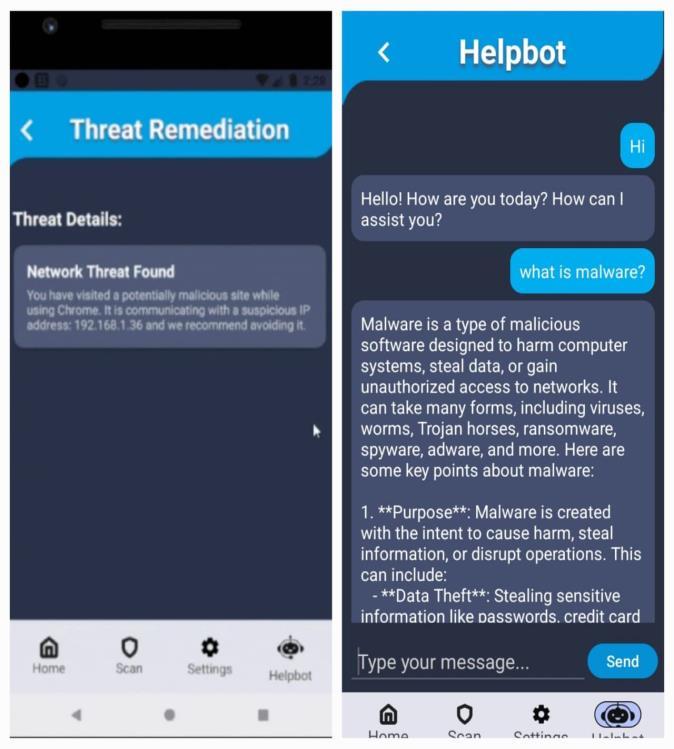
Threat Remediation is smart, taking into account risks detected. In the case of bad applications, it displays threatdetailsandhasaDeleteAppbuttontouninstallit. In the case of browser-based threats such as a phishing page or malicious URL, it does not provide the delete option,rather,itshowsa warning.Thismakesiteasyto understand and provides a contextual guide and makes the interface easy to use. Note: Google Play Services is not in fact connecting with the suspicious IP address in Figure. The IP was simply added in our threat intelligence database on a temporary basis to be used onlyasatest.TheHelpBotisa knowledgeassistantthat iscentralized and can be used to guide on the functionality of the application, security warnings and suggested actions that eventually can result in a more intuitive and userfriendlyplatform.
We trained our neural network on a mixed dataset of TUANDROMD which is a representation of newer malware and DREBIN which is a collection of older samples of malware [1][2]. The figure below shows a distribution of malware and benign samples in this dataset with almost equal distribution which practically dispelsanyclassimbalanceworries.
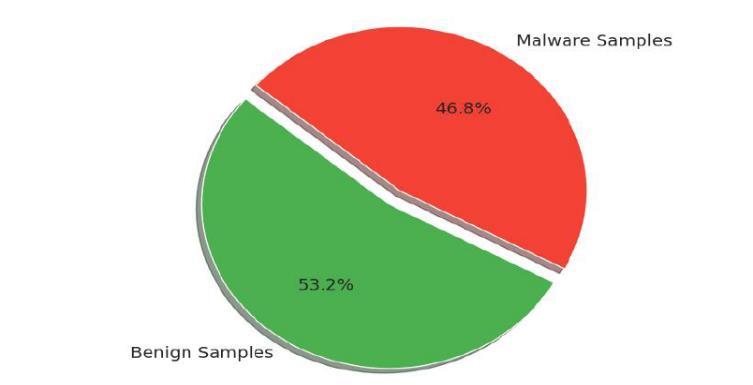
7. DistributionofBenignandMalwareSamplesin ourHybridDataset
The training of the model was done in 27 epochs. The figures below show the loss and AUCs during training. We find that the loss changes downward steadily, and almost reaches a point at the end, which means that learning is effective, and the change of the AUC is gradual,anditalsoapproachesapointwhichmeansthat thereisbetterandconsistentperformance
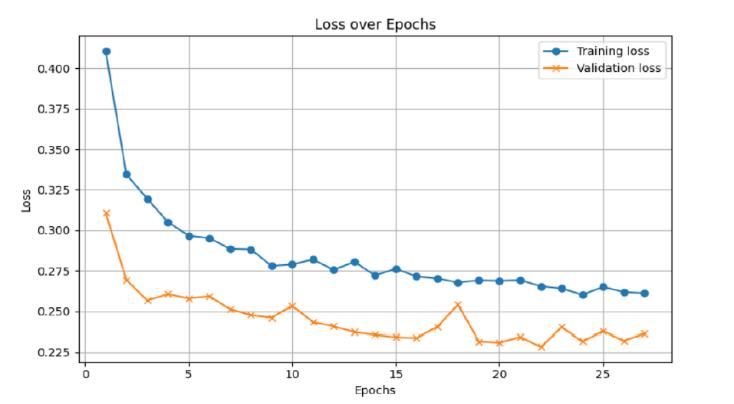
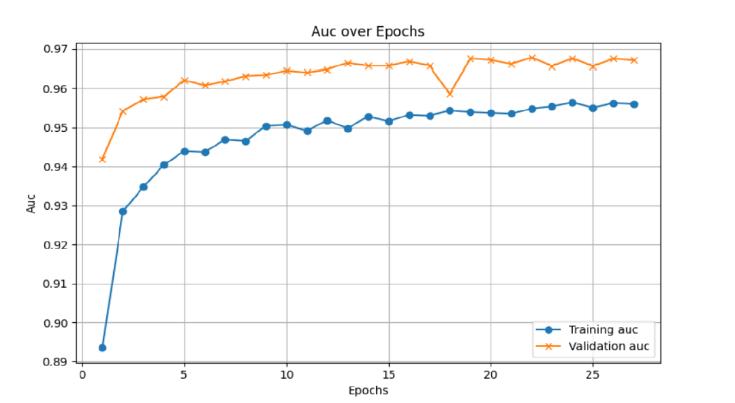
Fig. 9. AUCoverEpochs(AreaUndertheCurve)
International Research Journal of Engineering and Technology (IRJET) e-ISSN: 2395-0056
Volume: 13 Issue: 03 | Mar 2026 www.irjet.net p-ISSN: 2395-0072
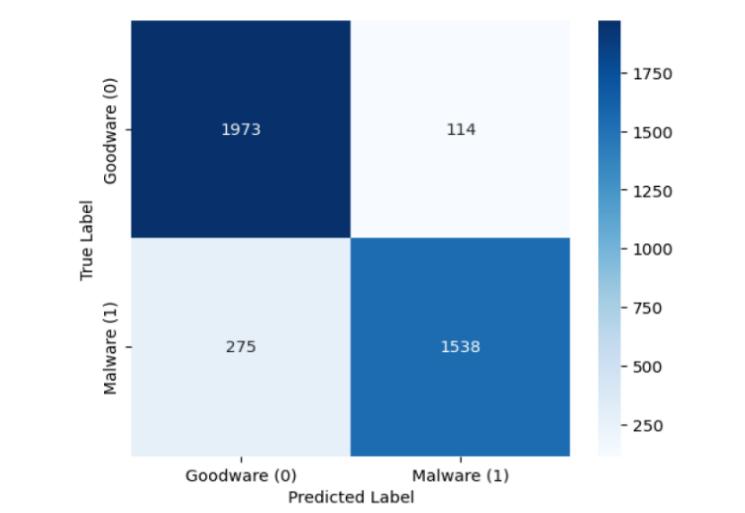
The confusion matrix of the test results is as shown in the following figure. Among 2087 samples of goodware, 1973 were correctly identified and 114 mistakenly identified as malware. In case of the 1813 samples of malware,1538sampleswereclassifiedwelland275had beenwronglyclassifiedasgoodware.
This introduced design and development of CyberSentinel, a smart Android security application which is a combination of machine learning-based malware detection system and real-time network monitoring and threat remediation system. We started with the description of Android Security Model, the analysis of existing models of permissions, and the survey ofpopulartypes of malware. The comprehensive comparative analysis of the commercial mobile security solutions has shown the main gaps existing in the current tools specifically absence of transparency, ongadgetintelligence,anduser-orienteddesign.Inorderto overcome these problems, we trained a neural network on a variety of datasets (DREBIN, TUANDROMD, COLCOM) and constructed permission-based features in ordertoprovidehighgeneralizationqualitywithunseen malware. We also combined CyberSentinel with a modular Android application which has features like Network Center, HelpBot assistant, and threat remediation.Lotsoftestinghaveshowedthatthesystem is capable of detecting threats with high accuracy, precision and yet it is lightweight and easy to use. CyberSentinel proves that implementing Al-based detection along with contextual awareness and systemlevel visibility can help enhance proactive mobile security to a great extent. The project offers a new securitysolutionaswell ascustomizableplatforminthe futureresearchofadaptiveon-devicethreatdefense.
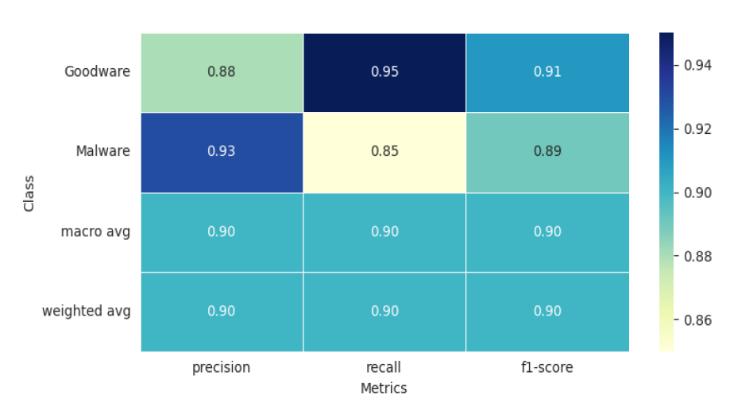
Allinall,themodelshowsarelativelylowfalsepositive and false negative, which indicates a high level of classification. The table below represents the visualization of the classification performance of the malware detection model. It reveals accuracy, recall as well as F1-score of the two classes: Good ware and Malware [1][2]. The model had a high recall with Good ware(0.95),i.e.,itrecognizedthemajorityofthebenign apps, whereas the recall on Malware (0.85) represents the fact that it failed to recognize some samples of malware. The precision is a little better with Malware (0.93) and indicates that the majority of the malware samples that were predicted were malicious. The balanceoftheoverallmacroandweightedaveragesofall metrics is at 0.90 which shows a steady result in both classes. Fig. 11.
We intend to add application-level network scanner support to Android 10 and beyond devices in the future by investigating other options that meet new security controls, such as VPN-based traffic inspection and AndroidnetworkmonitoringAPIs.Moreover,wearealso planningtoaddtheHelpBotmodule,whichwillhavethe voice interaction option, so a user will be able to be guided and operate any necessary action, based on a voice command. This will ensure that Cyber Sentinel is more convenient and approachable to the users who mighthaveamorefavourablereactiontohands-freeuse orneedanykindofanassistivetool.
[1] ReDroidDet – Android Malware Detection (2021). https://www.researchgate.net/publication/351682 116_ReDroidDet_ Android_Malware_Detection_Based_on_Recurrent_N eural_Network
[2] HybridAndroidMalwareDetection(2025). https://link.springer.com/article/10.1007/s44196025-00783-x
International Research Journal of Engineering and Technology (IRJET) e-ISSN: 2395-0056
Volume: 13 Issue: 03 | Mar 2026 www.irjet.net p-ISSN: 2395-0072
[3] AndroidTrafficMalwareAnalysis(2024).https: //www.sciencedirect.com/science/article/pii/S209 044792400515X
[4] AntMonitor–App-LevelMonitoring (SIGCOMM)(2021).https: //conferences.sigcomm.org/sigcomm/2015/pdf/pa pers/c2bid/p15.pdf
[5] Wi-Fi Easy Connect Security Analysis (2023). https://www.researchgate.net/publication/388801 920_Security_analysis_of_the_Wi-Fi_Easy_Connect
[6] The Rise of Public Wi-Fi and Threats (2023). https://www.researchgate.net/publication/375230 379_The_Rise_of_Public_Wi-Fi_and_Threats
[7] Broadband Connectivity – Speedtests (2023). https://www.researchgate.net/publication/373779 469_Understanding_the_State_of_Broadband_Connec tivity_An_Analysis_of_Speedtests_and_Emerging_Tec hnologies
[8] Ookla vs NDT7 Comparison (2023). https://www.researchgate.net/ publication/371934889_A_Comparative_Analysis_of _Ookla_Speedtest_and_Measurement_Labs_Network_ Diagnostic_Test_NDT7
[9] LLMs in Cybersecurity (2024). https://www.researchgate.net/publication/383064 112_Large_ Language_Models_for_Cyber_Security_A_Systematic_ Literature_Review
[10] Domain-SpecificChatbots(2022). https://www.researchgate.net/publication/362797 107_DomainSpecific_Chatbot_Development_Using_the_Deep_Lear ning-Based_RASA_Framework
[11] K. Jolly, S. Petersen, and B. Connelly, ooklaOpenDataR: Work with ’Speedtest by Ookla’ Global Internet Performance Data, 2022. R package version0.1.0.
[12] Ranya Sharma, Tarun Mangla, James Saxon, Marc Richardson, Nick Feamster, and Nicole P Marwell. 2022. Benchmarks or Equity? A New Approach to Measuring Internet Performance. A New Approach toMeasuringInternetPerformance(August3,2022) (2022).
[13] Xinlei Yang, Xianlong Wang, Zhenhua Li, Yunhao Liu, Feng Qian, Liangyi Gong, Rui Miao, and Tianyin Xu. 2021. Fast and Light Bandwidth Testing for InternetUsers..InNSDI.
[14] Tareq M, Safeia A (2021) Man in the middle attack in wireless-network. https://www.researchgate.net/publication/356290 033AcessonNovember2022
[15] Maimon D, Howell CJ, Jacques S, Perkins RC (2022) Situational awareness and public Wi-Fi users’ selfprotective behaviors. Secur J 35(1):154–174. https://doi.org/10.1057/s41284-020-00270-2
[16] Agarwal A, Kumari V, Sharma Y, Goel L (2021) Ranking based question answering system with a web and mobile application. In: 2021 11th International conference on cloud computing, data science&engineering(Confluence).IEEE,NewYork, pp52–58