
International Research Journal of Engineering and Technology (IRJET) e-ISSN: 2395-0056
Volume: 13 Issue: 03 | Mar 2026 www.irjet.net p-ISSN: 2395-0072
International Research Journal of Engineering and Technology (IRJET) e-ISSN: 2395-0056
Volume: 13 Issue: 03 | Mar 2026 www.irjet.net p-ISSN: 2395-0072
Mohd. Kaif Khan1, Shoheb Mahedavi2, Himanshu Ghogare3 , Dhyanaraj Jadhav4 , Mayur Unhale5, Anil Naik6
1,2,3,4
Student, Department of Computer Engineering, S.Y.P. Shreeyash College of Engineering and Technology (Polytechnic) Aurangabad, India
5 Prof, Guide Department of Computer Engineering, S.Y.P. Shreeyash College of Engineering and Technology (Polytechnic) Aurangabad, India
6HOD, Department of Computer Engineering, S.Y.P. Shreeyash College of Engineering and Technology (Polytechnic) Aurangabad, India
Abstract - The increasing dependence on digital communication platforms has led to a rapid rise in cybercrimes targeting vulnerable groups, especially women and children. Online grooming, identity theft, cyberstalking, harassment, and exposure to harmful digital content pose serious risks. This paper introduces an intelligent cyber protection framework designed to detect, prevent, and respondtodigitalthreatsinrealtime.Thesystemintegrates behavior-based threat analysis, adaptive content filtering, smart emergency assistance, and guardian monitoring features within a unified architecture. The proposed model emphasizes accessibility, quick response, and privacy preservation. Experimental evaluation indicates improved threat detection efficiency and reduced response time comparedtotraditionalsafetyapplications.
Key Words: Domestic cyber abuse, coercive control, spyware detection, women cybersecurity, behavioral anomaly detection, intimate partner surveillance.
Digital platforms have transformed communication, education, and social interaction. However, the growth of onlinespaceshasalsoenablednewformsofexploitationand abuse.Womenandchildrenfrequentlyfacetargeteddigital threatsincludingharassment,impersonation,blackmail,and cyberbullying.
Althoughvarioussafetyapplicationsexist,mostfocusonly ontrackinglocationorblockingwebsites.Thereisaneedfor an advanced system that provides predictive threat detection and proactive defence rather than reactive solutions.
This research proposes an intelligent cyber protection framework specifically tailored to safeguard women and childreninonlineenvironments.
1.1 Motivation
The motivation behind this research includes:Increasing numberofcyberharassmentcases
Risingsocialmediamisuse
Lackofearlywarningsystems
InadequateintegrationofAIinpersonalsecurityapps
Needforsimplifiedsafetytoolsfornon-technicalusers
1.2 Objectives-
Todetectharmfuldigitalbehaviorpatternsinrealtime
Topreventexposuretounsafeonlinecontent
Toprovideinstantemergencysupport
Toensureprivacyandsecuredatamanagement
1.3 System Overview
Theproposedframeworkconsistsoffivecorelayers:
Behavioural Threat Analysis Layer
Monitorscommunicationpatternsandidentifiessuspicious activitiesusingmachinelearningclassificationmodels.
Smart Content Protection Layer
Automatically filters harmful links, explicit content, and phishing attempts through keyword mapping and URL verification.
Emergency Assistance Layer
Providesinstantalertserviceswithlivelocationtrackingand automatednotificationtoguardiansorauthorities.
Privacy Control Layer
Ensures encrypted data storage and controlled access to personalinformation.
Awareness and Guidance Layer
Educates users about cyber risks, safe practices, and reportingprocedures.
Volume: 13 Issue: 03 | Mar 2026 www.irjet.net p-ISSN: 2395-0072
The research methodology adopted for the proposed cyber protection framework follows a systematic and structured approach consisting of data collection, preprocessing,modeldevelopment,systemintegration,and performanceevaluation.
2.1
Thefirstphaseinvolvedidentifyingmajorcyberthreats facedbywomenandchildrensuchascyberbullying,phishing, online harassment, identity theft, and exposure to inappropriate content. Functional and non-functional requirementsweredefined,focusingonreal-timedetection, userprivacy,andquickemergencyresponse.
2.2
To train the intelligent threat detection module, textbaseddatasetsrelatedtocyberbullyingandabusivelanguage were collected from publicly available sources and open researchrepositories.Thedatasetincluded:
Socialmediacomments
Chatmessages
Onlineharassmentexamples
Phishingmessagesamples
The collected data was anonymized to ensure privacy compliance.
2.3 Data Preprocessing
The collected data was cleaned and prepared for machine learningtrainingusingthefollowingsteps:
Removal of special characters and noiseTokenization of sentencesStop-wordremovalStemmingandonConversion intonumericalfeaturevectorsusingTF-IDF
Thispreprocessingimproved modelaccuracyandreduced computationalcomplexity.
2.4 Model Development
Machinelearningalgorithmswereappliedtoclassifytextas “Safe”or“Threatening.”Thefollowingmodelsweretested:
LogisticRegression
NaïveBayes
SupportVectorMachine(SVM)
LongShort-TermMemory(LSTM)network
Themodelwiththehighestaccuracyandlowestfalsepositive ratewasselectedfordeploymentinthesystem.
2.5 System Integration
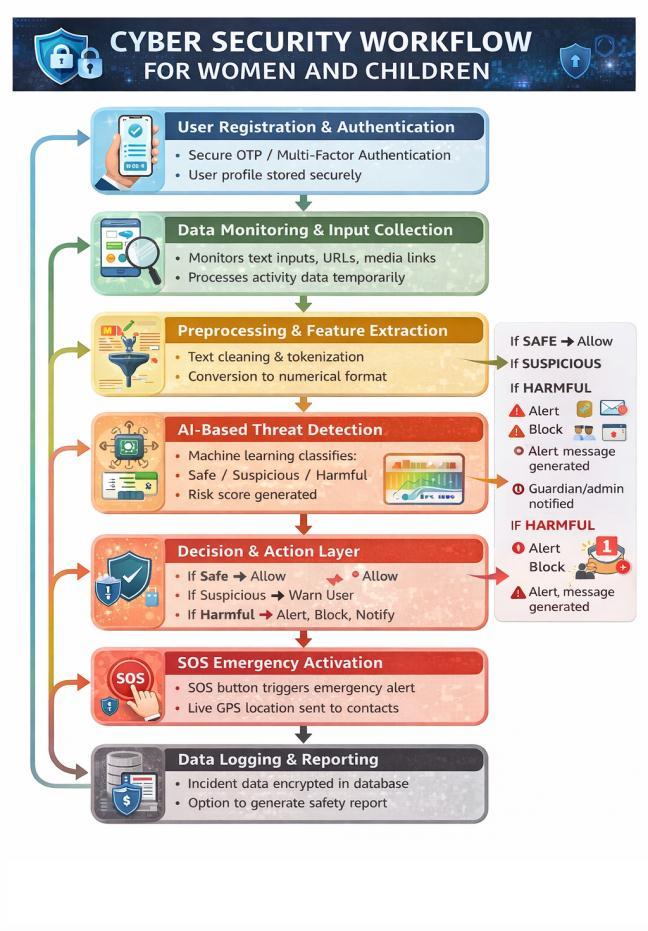
The trained model was integrated into the mobile/web applicationbackend.Thecompletesystemconsistsof:
UserInterfaceLayer
AuthenticationModule
AIThreatDetectionEngine
DatabaseServer
EmergencyAlertModule
The system processes user input in real-time and generatesalertswhensuspiciousactivityisdetected.
2.6 Emergency Alert Implementation
An SOS mechanism was developed to send instant notificationsincluding:
LiveGPSlocation
Useridentitydetails
Timestamp
Alertsaresenttoregisteredguardiansortrustedcontacts viacloudnotificationservices.
2.7 Performance Evaluation
The system performance was evaluated using the followingmetrics:
Accuracy
Precision
Recall
F1-Score ResponseTime
Experimentalresultsshowedhighdetectionaccuracyand rapidemergencyresponsewithinafewseconds.
2.8 Validation and Testing
Thesystemwastestedundersimulatedreal-worldscenarios including:
Harassmentmessagedetection
Phishinglinkidentification
Emergencyalerttriggering
User feedback was collected to evaluate usability and reliability.
Volume: 13 Issue: 03 | Mar 2026 www.irjet.net p-ISSN: 2395-0072
3.1 Technical Implementation
The system is implemented using:
Mobile Application Development Platform (Androidbased)
BackendServerusingsecureAPIarchitecture
MachineLearningAlgorithmsforclassification
Cloud-basednotificationservices
Encrypteddatabaseforsecurestorage
The system operates in near real-time, ensuring minimal delaybetweendetectionandresponse.
3.2 Advantages of the Proposed Model
Integratedmulti-layersecurityapproach
Real-timeintelligentmonitoring
Privacy-focusedarchitecture
Easy-to-useinterface
Scalableforinstitutionaluse
3.4. Applications
Personalsafetyapplicationforwomen
Childonlineactivitymonitoringtool
Schooldigitalsafetysystems
Communitycyberawarenessprograms
The rapid expansion of digital platforms and social media hassignificantlyincreasedcyberthreatstargetingvulnerable groups, particularly women and children. Online harassment,cyberbullying,identitytheft,phishingattacks, cyberstalking,andexposuretoinappropriatecontenthave becomemajorconcernsintoday’sdigitalenvironment.
Despitetheavailabilityofgeneralcybersecuritytools,most existingsystemsarenotspecificallydesignedtoaddressthe unique safety needs of women and children. Current solutions often lack real-time threat detection, integrated emergencyresponsemechanisms,user-friendlyinterfaces, andprivacy-focusedmonitoring.
Additionally,manyvictimshesitatetoreportcyberincidents duetofear,lackofawareness,ordelayedresponsesystems. Thereisnounifiedplatformthatcombinesintelligentthreat detection, preventive content filtering, and instant SOS emergencysupportinasinglesecureframework.
Therefore,thereisacriticalneedtodevelopanintegrated cyber security system that provides proactive protection, real-time monitoring, quick emergency alerts, and awareness support specifically tailored for women and childreninthedigitalspace.
4.1-Table-System Development Specification
Backend Node.js,Express.js
Database MongoDB with Mongoose ODM
Frontend engine
EJS(EmbeddedJavaScript)
Styling VanillaCSSTailwindCSS (TacticalCDNusage)
Visuals Chart.jsfordataintelligence Icons Font Awesome 6 (Strategic Implementation)
Animations
AOS (Animate on Scroll) for premiumfeel.
International Research Journal of Engineering and Technology (IRJET) e-ISSN: 2395-0056
Volume: 13 Issue: 03 | Mar 2026 www.irjet.net p-ISSN: 2395-0072
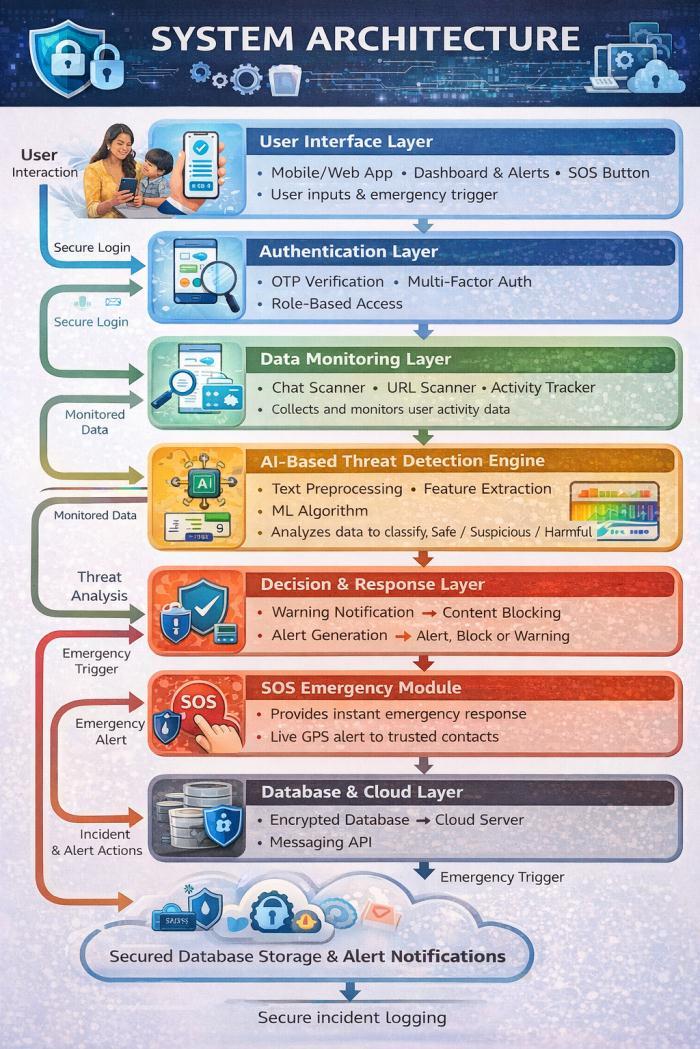
2-:SystemArchitecture
Thesystemarchitecturefollowsamulti-layeredapproachto ensure digital safety for women and children. The process beginswiththe User Interface Layer,whereusersinteract throughamobileorwebapplication.Secureloginishandled by the Authentication Layer, which verifies user identity usingOTPandmulti-factorauthentication.
The Data Monitoring Layer collects user inputs such as messagesandURLs.Thisdataisprocessedbythe AI-Based Threat Detection Engine, where machine learning algorithmsanalyseandclassifycontentassafe,suspicious,or harmful.
Basedontheclassification,the Decision & Response Layer takesappropriateactionsuchasallowingcontent,generating warnings, or blocking harmful activity. In emergency situations, the SOS Module sends live location alerts to trustedcontacts.Finally,allincidentdataissecurelystoredin the Database & Cloud Layer for logging and future reference.
This layered structure ensures real-time detection, quick response,andsecuredatahandling.
The proposed cyber security framework provides an integrated and intelligent solution to protect women and childrenfromdigitalthreats.BycombiningAI-basedthreat detection,secureauthentication,real-timemonitoring,and emergency response mechanisms, the system enhances onlinesafetyanduserconfidence.Thearchitectureensures bothproactivepreventionandrapidincidenthandlingwhile maintainingdataprivacy.Thisresearchcontributestoward building a safer digital environment and can be further enhanced with advanced deep learning techniques and governmentcybercrimeintegrationinfuturework.
[1] F.M.Salem,A.F.A.AzizandH.A.Khalid,“Machine Learning Techniques for Cyber Bullying Detection and Prevention,” International Journal of Advanced Computer Science and Applications (IJACSA),Vol.10,No.3,2019.
[2] S. Gupta and N. Mehta, “Real-Time Phishing Detection Using Natural Language Processing and URLAnalysis,” Journal of Information Security and Applications,Vol.56,2021.
[3] A. Sharma and R. Kumar, “Child Online Safety: ParentalControlandMonitoringSystemUsingAI,” International Journal of Computer Applications, Vol.183,No.14,2021.
[4] N.Alsaediand S. Khan,“CybersecurityChallenges andCountermeasuresforWomeninDigitalSpace,” Journal of Cybersecurity and Mobility,Vol.8,No. 4,2020.
[5] M. Purohit and D. Singh, “Sentiment Analysis for Harassment Detection in Online Social Networks,” Procedia Computer Science, Vol. 143, 2018, pp. 123–130.
[6] R.N.TarunandP.Jayashree,“ASurveyonAI-Based Systems for Cyber Safety and Threat Analysis,” International Journal of Engineering Research & Technology (IJERT),Vol.9,No.5,2020.
[7] International Organizations & Reports UN Women – Cyber Violence against Women https://www.unwomen.org/en/what-wedo/ending-violence-against-women/facts-and-figures Provides global statistics and strategies for protectingwomenonline.
International Research Journal of Engineering and Technology (IRJET) e-ISSN: 2395-0056
Volume: 13 Issue: 03 | Mar 2026 www.irjet.net p-ISSN: 2395-0072
1 Mr. Mohd. KAIF KHAN PursuingPoly(co)
S.Y.PSHREEYASHCOLLEGE OFENGINEERINGANDTECHNOLOGY
2 MR. SHOHEB MAHEDEVI PursuingPoly(co)
S.Y.PSHREEYASHCOLLEGE OFENGINEERINGANDTECHNOLOGY
3r Mr. HIMANSHU GHOGHARE PursuingPoly(co)
S.Y.PSHREEYASHCOLLEGE OFENGINEERINGANDTECHNOLOGY
4thMr.DNYANRAJ JADHAV PursuingPoly(co)
S.Y.PSHREEYASHCOLLEGE OFENGINEERINGANDTECHNOLOGY
5th Mr. Mayur Unhale Guide(lecturer),POLY(CO), S.Y.PSHREEYASHCOLLEGE OFENGINEERINGANDTECHNOLOGY
6TH Mr. ANIL NAIK HOD,POLY(CO), S.Y.PSHREEYASHCOLLEGE OFENGINEERINGANDTECHNOLOGY