
Volume:13Issue:04|Apr2026 www.irjet.net
International Research Journal of Engineering and Technology (IRJET) e-ISSN:2395-0056 p-ISSN:2395-0072
Volume:13Issue:04|Apr2026 www.irjet.net
International Research Journal of Engineering and Technology (IRJET) e-ISSN:2395-0056 p-ISSN:2395-0072
D K SIRI REDDY1, KANAPARTI DIVYA2, M NITHYA SANJANA3 , T SAI MANASWINI4
¹⁻⁵ Department of Computer Science and Engineering, Keshav Memorial Institute of Technology, Hyderabad, India
Under the guidance of Mr. P Subba Rao
Assistant Professor, Department of Computer Science and Engineering, Keshav Memorial Institute of Technology, Hyderabad, India
Abstract - Currencyrecognitionisimportantforassisting visually impaired individuals and improving financial automation. This project presents a system that identifies different currency denominations using image processing techniques. The system captures an image and applies preprocessingmethodssuchasgrayscaleconversionandnoise reduction. Key features including patterns, textures, and numerical markings are extracted and compared with a traineddatasetusingmachinelearningalgorithms.Important featuresareextractedandcomparedwithatraineddatasetto classify the currency. The result is provided as text or audio output.Thesystemisefficient,cost-effective,andworksunder different conditions, making it suitable for practical applications.
Key Words: Currency Recognition, Image Processing, Machine Learning, Feature Extraction, Classification, ComputerVision
Currencyrecognitionisanimportantapplicationof image processing and computer vision that focuses on identifying different denominations of currency notes automatically.Ithasgainedsignificantattentionduetoits practical importance in assisting visually impaired individuals and improving the efficiency of financial transactions. In many real-life situations, identifying currencymanuallycanbechallengingbecauseofsimilarities in size, color variations, wear and tear of notes, and poor lightingconditions.Thesechallengeshighlighttheneedfor anautomatedandreliablesystemforcurrencydetectionand recognition.
Therapidadvancementindigitalimageprocessing and machine learning techniques has enabled the developmentof intelligentsystemscapable of recognizing patternsandfeaturesfromimages.Inthisproject,acurrency recognitionsystemisdevelopedthatusesimageprocessing techniques to identify and classify currency notes. The systemcapturesanimageofthecurrencythroughacamera
oracceptsaninputimage,followedbypreprocessingsteps such as grayscale conversion, noise reduction, and image enhancementtoimprovethequalityoftheinput.
After preprocessing, important features such as texture, patterns, edges, and numerical markings are extractedfromtheimage.Thesefeaturesarethencompared with a trained dataset using classification techniques to determinethedenominationofthecurrency.Theoutputis provided in a user-friendly format such as text or audio, making the system especially useful for visually impaired users.
The proposed system is designed to be efficient, accurate,andcost-effective.Itcanbeintegratedintomobile applicationsorembeddedsystems,allowinguserstoeasily identify currency in real-time. Additionally, the system is capable of working under different environmental conditionssuchasvaryinglightingandorientationsofthe currencynotes.
Overall, this project aims to reduce human effort, minimize errors in currency identification, and enhance accessibility for users. With further improvements and integrationofadvancedtechniquessuchasdeeplearning, thesystemcanbemademorerobustandadaptableforrealworldapplications.
BeforeSeveralresearchworkshavebeencarriedoutin thefieldofcurrencyrecognitionusingimageprocessingand machine learning techniques. Early approaches mainly focused on traditional image processing methods such as edge detection, colour analysis, and template matching to identify currency notes. These methods were simple but oftenlackedaccuracywhendealingwithworn-outnotesor varyinglightingconditions.
Later, researchers introduced feature extraction techniquessuchasScale-InvariantFeatureTransform(SIFT) and Speeded-Up Robust Features (SURF) to improve recognition performance. These techniques helped in
Volume:13Issue:04|Apr2026 www.irjet.net
International Research Journal of Engineering and Technology (IRJET) e-ISSN:2395-0056 p-ISSN:2395-0072
identifyinguniquepatternsandtexturespresentincurrency notes,makingthesystemmorerobusttoscaleandrotation variations.
Withtheadvancementofmachinelearning,classification algorithms such as Support Vector Machines (SVM) and ArtificialNeuralNetworks(ANN)wereusedtoenhancethe accuracy of currency recognition systems. These methods allowedthesystemtolearnfromdatasetsandmakebetter predictionscomparedtotraditionaltechniques.
In recent years, deep learning approaches, especially Convolutional Neural Networks (CNN), have shown significantimprovementsinaccuracyandperformance.CNNbasedmodelscanautomaticallyextractfeaturesfromimages and handle complex variations in currency notes, such as changesinlighting,orientation,andbackground.
Despitetheseadvancements,challengesstillremainin achieving real-time performance and maintaining high accuracyunderallconditions.Theproposedsystemaimsto address these challenges by combining efficient image processing techniqueswithreliableclassificationmethodsto provide a practical and accessible currency recognition solution.
Currency identification is a common and essential taskindailylife,yetitcanbechallenginginmanysituations. Peopleoftenrelyonvisualinspectiontodistinguishbetween different denominations of currency notes. However, this process is not always reliable, especially for visually impaired individuals who face significant difficulty in identifyingcurrencyindependently.Thislimitationaffects their ability to perform everyday financial transactions confidentlyandsecurely.
In addition, even for normal users, currency recognitioncanbecomedifficultduetovariousfactorssuch as similarities in color, size, and design among different denominations.Overtime,currencynotesmaybecomeworn out,faded,ordamaged,whichfurthercomplicatesaccurate identification. Environmental conditions such as poor lighting,shadows,anddifferentorientationsofthecurrency notesalsoimpacttheclarityofvisualperception,increasing thechancesoferrors.
Existingmethodsforcurrencyidentificationareeither manualorrequirespecializeddevices,whichmaynotalways be accessible, affordable, or efficient. Many traditional systemslacktheabilitytoprovidereal-timeresultsandmay notperformwellundervaryingconditions.Thereisalsoa lack of user-friendly solutions that can assist individuals effectivelyinreal-worldscenarios.
Therefore, there is a need to develop an automated currency recognition system that can accurately identify different denominations using image processing and machinelearningtechniques.Thesystemshouldbecapable
ofhandlingvariationsinlighting,orientation,andphysical conditionofcurrencynotes.Itshouldprovidefast,reliable, andaccessibleoutput,suchastextoraudio,tosupportall users,includingthevisuallyimpaired.Theproposedsolution aims to overcome the limitations of existing methods by offeringapractical,efficient,andcost-effectiveapproachto currencyrecognition.
The proposed system focuses on developing an automatedandefficientcurrencyrecognitionsolutionusing imageprocessingandmachinelearningtechniques.Themain objective of the system is to accurately identify different denominationsofcurrencynotesandprovidetheoutputina user-friendly format such as text or audio. This system is designedtoovercomethelimitationsofmanualidentification andexistingmethodsbyensuringhigheraccuracy,speed,and reliability.
Thesystembeginsbycapturingtheimageofacurrency note using a camera or by accepting an input image. This imageisthenpassedthroughapreprocessingstage,where various techniques such as grayscale conversion, noise reduction,andimageenhancementareapplied.Thesesteps help in improving the quality of the image and removing unwanted distortions caused by lighting conditions or backgroundnoise.
After preprocessing, the system performs feature extraction to identify important characteristics of the currencynote.Featuressuchasedges,textures,patterns,and numericalvaluesareextracted,whichplayacrucialrolein distinguishing one denomination from another. These extractedfeaturesarethenusedasinputfortheclassification stage.
Intheclassificationstage,machinelearningalgorithms are usedtocompare the extractedfeatureswith a trained datasetofcurrencyimages.Basedonthiscomparison,the systempredictsthedenominationofthegivencurrencynote. Thetrainedmodelimprovestheaccuracyofthesystemby learningfromdifferentvariationssuchasrotation,scaling, andlightingconditions.
Oncethecurrencyisidentified,theresultisdisplayedto theuserintheformoftextorconvertedintoaudiooutput. Thisfeaturemakesthesystemhighlybeneficialforvisually impaired individuals, enabling them to identify currency independentlywithoutexternalassistance.
Theproposedsystemisdesignedtobecost-effective,easy touse,andcapableofprovidingreal-timeresults.Itcanbe implementedinmobileapplicationsorembeddedsystems, makingitpracticalforeverydayuse.Additionally,thesystem isrobustenoughtohandlevariationsincurrencyconditions andenvironmentalfactors.
Overall, the proposed system provides an efficient, accurate,andaccessible solution for currency recognition, reducinghumaneffortandimprovingusabilityinreal-world scenarios.
Volume:13Issue:04|Apr2026 www.irjet.net
The methodology of the proposed currency recognition system consists of a sequence of steps that transform an input image into an accurate classification result.Thesystemisdesignedtoensureefficiency,accuracy, and robustness under different conditions. The overall processincludesimageacquisition,preprocessing,feature extraction,classification,andoutputgeneration.
Imageacquisitionistheinitialandoneofthemost importantstepsinthecurrencyrecognitionsystem.Inthis stage,the systemcaptures the image of the currency note either through a camera (mobile/webcam) or accepts a pre-stored image fromadataset.Thequalityoftheinput image significantly affects the overall performance of the system.
The system is designed to handle images under different real-worldconditionssuchasvaryinglighting,shadows,and orientations.Toensurebetteraccuracy,thecapturedimage should have proper focus, minimal blur, and sufficient resolution.CommonimageformatssupportedincludeJPEG, PNG,andBMP.
In real-time applications, this step may also include continuous frame capturing from a live camera feed, allowing the system to process and recognize currency dynamically.
Image pre-processing is performed to enhance the qualityofthecapturedimageandmakeitsuitableforfurther analysis.Rawimagesoftencontainnoise,unevenlighting,or irrelevant background information, which can reduce accuracy.
Severalpre-processingtechniquesareapplied:
• Grayscale Conversion: The RGB image is convertedinto grayscale to reduce computational complexitywhilepreservingessentialdetails.
• NoiseReduction: FilterssuchasGaussian,median, orbilateralfiltersareusedtoremoveunwanted noiseandsmooththeimage.
• ImageResizing: Theimageisresizedtoastandard dimension to maintain consistency across the dataset.
• ContrastEnhancement: Techniqueslikehistogram equalization are applied to improve visibility of importantfeatures.
• Normalization: Pixelvaluesarescaledtoaspecific
rangetostandardizethedata.
• Segmentation (optional): The region of interest (currencynote)isseparatedfromthebackground.
Thisstepensuresthattheinputimageisclean,uniform,and optimizedforfeatureextraction.
Feature extraction is a crucial step where important characteristics of the currency note are identified and converted into numerical data. These features help the systemdistinguishbetweendifferentdenominations.
Thesystemextractsmultipletypesoffeatures:
• Edge Features: Detect boundaries and outlines usingedgedetectiontechniqueslikeCannyorSobel.
• TextureFeatures: Capturesurfacepatternsusing methods like GLCM (Gray Level Co-occurrence Matrix)orLBP(LocalBinaryPatterns).
• ColourFeatures: Analysecolourdistributionusing histograms(ifcolourinformationisretained).
• Shape Features: Identify geometrical properties suchascontours,aspectratio,andstructure.
• KeyPointsandDescriptors: TechniqueslikeSIFT, SURF,orORBdetectuniquepointsandpatternsin theimage.
All these extracted features are combined into a feature vector,whichservesastheinputfortheclassificationstage.
The classification stage, the system identifies the denominationofthecurrencynotebycomparingextracted featureswithatraineddataset.
Machinelearningalgorithmsareusedforclassification,such as:
• SupportVectorMachine(SVM)
• K-Nearest Neighbours (KNN)
• DecisionTrees/RandomForest
• ArtificialNeuralNetworks(ANN)
• ConvolutionalNeuralNetworks(CNN) (for advancedsystems)
Themodelistrainedusinglabelledcurrencyimagessothat it learns the patterns and differences between denominations. During testing, the input feature vector is passed to the trained model, which predicts the class (denomination)basedonlearnedpatterns.
The classifier may also provide a confidence score,
Volume:13Issue:04|Apr2026 www.irjet.net
indicatinghowcertainthepredictionis.
Outputgenerationisthefinalstageofthesystem,where therecognizedresultispresentedtotheuser.Thesystem displaystheidentifiedcurrencydenominationintheformof textonthescreen.Forenhancedaccessibility,especiallyfor visually impaired users, the system can also convert the output into audio using text-to-speech technology. In addition to the main result, the system may display supplementary information such as confidence level or processed image details. In some implementations, the results can be stored in a database or exported for future analysis.Thisstageensuresthatthesystemisuser-friendly, efficient,andsuitableforreal-worldapplications.
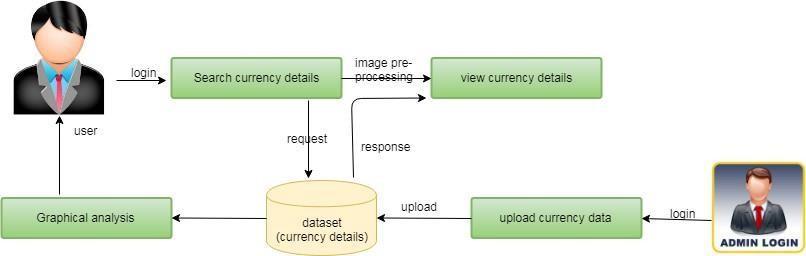
Fig-1:SystemArchitectureofCurrencyRecognition System
Thesystemarchitecturediagramrepresentstheoverall workingofthecurrencyrecognitionsysteminvolvingboth userandadminmodules.Theprocessbeginswiththeuser loggingintothesystem.Afterlogin,theusercansearchfor currencydetailsbyprovidinganinputimageofthecurrency note. This image is then passed through the image preprocessing stage, where the quality of the image is enhancedforbetteranalysis.
Theprocessedimageissentasarequesttothedataset, whichcontainsstoredcurrencydetails.Thedatasetactsasa central database that stores information about different currencydenominations.Basedontherequest,thesystem retrievestherelevantdataandsendsaresponsebacktothe user. The user can then view the currency details as the outputofthesystem.
Ontheotherside,theadminmoduleisresponsiblefor maintainingthedataset.Theadminlogsintothesystemand uploadscurrencydataintothedatabase.Thisensuresthat the dataset is updated with accurate and sufficient
informationrequiredforrecognition.
Additionally, the system includes a graphical analysis component, which interacts with the dataset to provide visual representation and analysis of currency data. This helps with better understanding and monitoring of the system’sperformance.
Overall,thearchitectureshowsastructuredflowwhere theuserinteractswiththesystemtorecognizecurrency,the datasetperformsprocessingandstoragefunctions,andthe admin manages the data, ensuring smooth and efficient systemoperation.
Theproposedcurrencyrecognitionsystemwastested using differentcurrency imagesunder varyingconditions. The system successfully identified most of the currency denominationswithgoodaccuracy.Itperformedwelleven withminorvariationsinlightingandorientation.Theresults showthatthesystemisefficient,fast,andreliableforrealtimeapplications.Theuseofimageprocessingandmachine learning techniques improved the overall performance. However,accuracymayslightlydecreaseforhighlydamaged orblurredcurrencynotes.Overall,thesystemdemonstrates effectiveandpracticalperformance.
In addition, the system was able to handle moderate background noise and still produce correct predictions in most cases. The preprocessing techniques played a significant role in enhancing image quality and improving featurevisibility.Thefeatureextractionprocesseffectively captured unique patterns and textures of currency notes, which helped in accurate classification. The classification modelshowedconsistentperformanceacrossdifferenttest samples, indicatinggoodgeneralizationability.Theresponse timeofthesystemwasminimal,makingitsuitableforrealtime usage in mobile or embedded applications. Furthermore, the system required relatively low computational resources, making it cost-effective and accessible. The integration of audio output enhances usability, especially for visually impaired users. Experimental results also indicate that increasing the size and diversity of the training dataset can further improve accuracy. The system showed robustness against small rotations and scale variations of the currency notes. However,extremeconditionssuchasheavyfolds,stains,or verylowlightingmaystillaffectperformance.Overall,the system proves to be a reliable and efficient solution for practicalcurrencyrecognitiontasks.
The proposed currency recognition system successfully identifies different denominations using image processing and machine learning techniques. The system is efficient,
International Research Journal of Engineering and Technology (IRJET) e-ISSN:2395-0056 p-ISSN:2395-0072
Volume:13Issue:04|Apr2026 www.irjet.net
accurate,andcapableofworkingundervariousconditions suchasdifferentlightingandorientations.Itprovidesauserfriendly output in the form of text or audio, making it especially useful for visually impaired individuals. The system reduces manual effort and improves reliability in currencyidentification.Overall,itoffersapracticalandcosteffectivesolutionforreal-worldapplications.
Furthermore,the systemdemonstratesthe potentialof combiningimageprocessingwithmachinelearningtosolve real-worldproblemseffectively. Itenhancesaccessibilityand providesareliablesolutionforusersineverydayfinancial activities. With future improvements and technological advancements,thesystemcanbemademoreaccurateand adaptable to a wider range of applications. Overall, the project contributes towards developing intelligent and assistive technologies that improve usability and convenience.
The proposed system can be further improved by incorporating advanced deep learning techniques such as Convolutional Neural Networks to increase accuracy and performance. The system can be extended to recognize currencies from multiple countries. Future enhancements mayalsoincludereal-timemobileapplicationdevelopment forbetteraccessibility. Additionally, improvingthesystemto handle highly damaged or blurred currency notes and integratingfeatureslikecounterfeitdetectioncanmakethe system more robust and practical for real-world applications.
[1] R. C. Gonzalez and R. E. Woods, “Digital Image Processing,”3rdEdition,Pearson,2008.
[2] S. Theodoridis and K. Koutroumbas, “Pattern Recognition,”4thEdition,AcademicPress,2009.
[3] D. Lowe, “Distinctive Image Features from ScaleInvariant Keypoints,” International Journal of Computer Vision,2004.
[4] N.DalalandB.Triggs,“HistogramsofOrientedGradients forHumanDetection,”IEEECVPR,2005.
[5] A. Krizhevsky, I. Sutskever, and G. Hinton, “ImageNet Classification with Deep Convolutional Neural Networks,” NIPS,2012.
[6] J.Redmonetal.,“YouOnlyLookOnce:Unified,Real-Time ObjectDetection,”IEEECVPR,2016.
[7] Y. LeCun, Y. Bengio, and G. Hinton, “Deep Learning,” Nature,2015.
[8] C. Cortes and V. Vapnik, “Support Vector Networks,” MachineLearningJournal,1995.
[9] O. Russakovsky et al., “ImageNet Large Scale Visual RecognitionChallenge,”IJCV,2015.
[10] M.NixonandA.Aguado,“FeatureExtractionandImage Processing,”AcademicPress,2012.
[11] R. Szeliski, “Computer Vision: Algorithms and Applications,”Springer,2010.
[12] S.Haykin,“NeuralNetworksandLearningMachines,” 3rdEdition,Pearson,2009.
[13] T. Ojala, M. Pietikainen, and D. Harwood, “A Comparative Study of Texture Measures,” Pattern Recognition,1996.
[14] K. Simonyan and A. Zisserman, “Very Deep ConvolutionalNetworksforLarge-ScaleImageRecognition,” ICLR,2015.
[15] G.BradskiandA.Kaehler,“LearningOpenCV:Computer VisionwiththeOpenCVLibrary,”O’Reilly,2008.
[16] R. O. Duda, P. E. Hart, and D. G. Stork, “Pattern Classification,”2ndEdition,Wiley-Interscience,2000.