
International Research Journal of Engineering and Technology (IRJET) e-ISSN: 2395-0056
Volume: 12 Issue: 12 | Dec 2025 www.irjet.net p-ISSN: 2395-0072
International Research Journal of Engineering and Technology (IRJET) e-ISSN: 2395-0056
Volume: 12 Issue: 12 | Dec 2025 www.irjet.net p-ISSN: 2395-0072
Aswathnarayan Muthukrishnan Kirubakaran1, Akshay Deshpande2, Siva Kumar Chintham3 , Adithya Parthasarathy4, Ram Sekhar Bodala5, Nitin Saksena6
1IEEE Senior Member, USA
2,3,4 Independent Researcher, USA
5Amtrak, USA
6Albertsons, USA
Abstract - Cloud providers now offer specialized accelerator hardware and scalable analytics frameworks, yet the behavior of end-to-end machine learning pipelines across heterogeneous environments remains poorly understood. This paper presents a quantitative multi-cloud study evaluating Spark ETL processing, distributed transformer training, and large language model inference across Amazon Web Services, Microsoft Azure, and Google Cloud Platform. Under controlled dataset scale, model configuration, and GPU/TPU resource equivalence, our cross-provider routing strategy reduced full pipeline operating cost by 38.7% and improvedaverage accelerator utilization by 34.2% without accuracy degradation. We introduce a reproducible orchestration framework, report detailed behavioral differences between A100, H100, and TPUexecutionpaths, andprovide evidence-drivenguidance forlarge-scaledeploymentdecisions.ResultsshowthatAWS storage locality delivers superior ETL throughput, Azure H100 nodes offer leading model training and inference efficiency, and TPU workloads require additional adaptationoverhead.Thisworkestablishesthe firstend-toend cross-cloud empirical benchmark for large model workloads and demonstrates conditions where multiprovider pipeline optimization offers measurable value.
Key Words: Multi-cloud computing, Distributed ML pipelines, LLM inference, Big Data, Spark ETL optimization,Cross-cloudorchestration.
Contemporarymachinelearningandlargelanguagemodel systems operate at a scale that exceeds the capabilities of monolithic infrastructure. Modern pipelines incorporate sequential stages such as raw data extraction, feature engineering, training, validation, deployment and inference.Eachofthesestages utilizes differenthardware andprocessingpatterns.GPU-basedtrainingrequireshigh memory bandwidth, distributed ETL operations rely on storage locality and inference depends on accelerator speed and latency [1]. Consequently, single vendor environments cannot always provide optimal conditions acrossallstages.
Emerging industrial practice indicates that organizations increasinglydistributeworkloadsacross cloudvendorsto benefit from specialized hardware availability, regional coverage, data management flexibility and pricing variation. AWS offers mature big data services such as S3 andEMR[2].AzureprovideshighperformanceH100GPU networks with strong inference characteristics [3]. GCP offers TPU infrastructure tailored for deep learning training workloads. A cross-cloud design can therefore reduce bottlenecks, mitigate region capacity constraints andimproveeconomicefficiency.
Despite these developments, scholarly publications continue to focus primarily on intra-cloud optimization techniques [4]. Recent studies on federated and multimodal learning across distributed devices further highlightthegrowingneedforcoordinatedcross-platform execution,yettheseeffortsprimarilyfocusonmodel-level collaboration rather than end-to-end pipeline orchestration across heterogeneous cloud environments [5]. Existing literature emphasizes algorithmic speed-ups, single-vendor hardware comparisons or infrastructure cost modeling without assessing the end-to-end performance behavior of multi-provider ML pipelines under realistic deployment conditions [6]. As a result, thereislimitedscientificevidencetosupportarchitectural decision making for multi-cloud model training and inference.
Thispaperaddressesthisgapbyconductingacontrolled empiricalstudyacrossAWS,AzureandGCPusingidentical datasets, models, and cluster configuration and performance metrics.The research quantifiesthe benefits andlimitationsofroutingETLworkloadstoAWS,training tasks to Azure and inference workloads to Azure, guided byobservedcostandefficiencydifferences.
This research makes the following key contributions:
1. First empirical end-to-end cross-cloud ML pipeline benchmark: We evaluate Spark ETL, distributed model training, and LLM inference across AWS, Azure, and GCP within a unified experimentalframework.
2. Quantitative multi-provider cost and runtime analysis: We demonstrate that workload stage
International Research Journal of Engineering and Technology (IRJET) e-ISSN: 2395-0056
Volume: 12 Issue: 12 | Dec 2025 www.irjet.net p-ISSN: 2395-0072
routingcanimprovecostefficiencyby38.7%and GPU utilization by 34.2% while preserving accuracyandfunctionaloutput.
3. Execution placement strategy and architectural framework: We establish a reproducible orchestration structure for routing ETL, training, andinferenceworkloadstodifferentvendors.
4. Cross-cloud scheduling insights: We report behavioral differences involving hardware throughput, shuffle operations, latency variance, token generation throughput, and accelerator utilizationtrends
5. Scalable benchmark environment: All methods areimplementedusingcontainerizedenginesand reproducible cloud provisioning scripts, enabling portablereplication.
Cross-providercomputeutilizationhasbecomecentralto modern machine learning infrastructure due to scaling pressures, specialized accelerator availability, and variability in cost performance across regions [7]. Early studies on cloud deployment primarily focused on virtual machine migration and redundancy modeling [8], [9]. Later, research addressed cost-aware storage placement techniques, emphasizing data replication and egress avoidance [10], [11]. However, these efforts largely ignored ML-specific constraints including data pipeline movement, GPU allocation, and distributed training throughput[12],[13].
Work in big data computing has shown that Spark shufflephasesaresensitive toI/Olocality,storagelayout, and cluster topology [14], [15]. Comparative ETL studies demonstrate that execution stability correlates with the distribution of data blocks rather than pure cluster size [16]. These findings suggest that cloud-dependent file system behavior can significantly influence runtime characteristics; however, evaluations seldom extend beyondasingleprovider.
ResearchonGPUandaccelerator evaluationhasgrown in parallel. Benchmarks comparing NVIDIA A100 and H100 GPUs show 2.1×–4.2× variation in matrix multiplication throughput [17], while TPU-based transformer acceleration demonstrates strong convergencepropertiesforlargebatchtrainingworkloads [18]. Existing literature emphasizes algorithmic speedups, single-vendor hardware comparisons or infrastructurecostmodelingwithoutassessingtheend-toend performance behavior ofmulti-providerML pipelines underrealisticdeploymentconditions[19].
Large language model inference benchmarking also remains
Constrained to single-vendor evaluations [20]. Related work in real-time edge analytics and anomaly detection demonstratestheimportanceoflow-latencyinferenceand runtime adaptability, but such studies typically operate within constrained environments and do not address cross-cloud execution or large-scale model orchestration [21]. Throughput and token latency studies report that memory bandwidth dominates autoregressive token speed [22], and quantization improvements can reduce inference cost by 40–70% [23]. Yet most experiments evaluate inference within an isolated environment rather than under competitive multi-provider pricing, queuing depth,orprovisioninglatency.
Work on distributed training frameworks such as DeepSpeed, FSDP and Mega tron-LM has enabled large batch model execution [24]. However, these frameworks were evaluated without explicit sensitivity analysis to cloudspecificnetworkingfabrics,GPUinterconnecttopology,or tenancyisolation.
Multi-cloud scheduling literature is still relatively immature [25]. Several architectures propose multiprovider deployment to improve availability and resilience[26],[27];however,schedulingisrarelyapplied to full model lifecycle execution. Recent work on scalable cloud-native architectures further highlights the importance of modular orchestration, adaptive control, and resilient data processing pipelines, yet these approaches typically focus on infrastructure-level scalabilityrather than end-to-end ML workflow execution [28]. Pipeline level studies remain minimal, particularly combining: (i) Spark-based ETL preprocessing, (ii) distributed transformer model training, and (iii) highthroughputinferencebenchmarking.
Moreover, prior publications lack controlled experimentswithequalizedclusterscale,datasetsize,and softwarestackConditions.Mostresearchreliesonvendorspecific hardware without normalization, preventing comparative interpretation. This work fills these gaps through a unified evaluation of AWS, Azure, and GCP, using:
1. identicaldatasets
2. equivalentclustersizes
3. consistentcontainerizedexecution
4. uniformtokensamplingsettings
5. reproduciblemetricsreporting
To the best of our knowledge, this is the first study to quantify Spark ETL, distributed model training, and LLM inferenceacrossthreelargecommercialprovidersundera singlecontrolledexperimentalconfiguration.
International Research Journal of Engineering and Technology (IRJET) e-ISSN: 2395-0056
Volume: 12 Issue: 12 | Dec 2025 www.irjet.net p-ISSN: 2395-0072
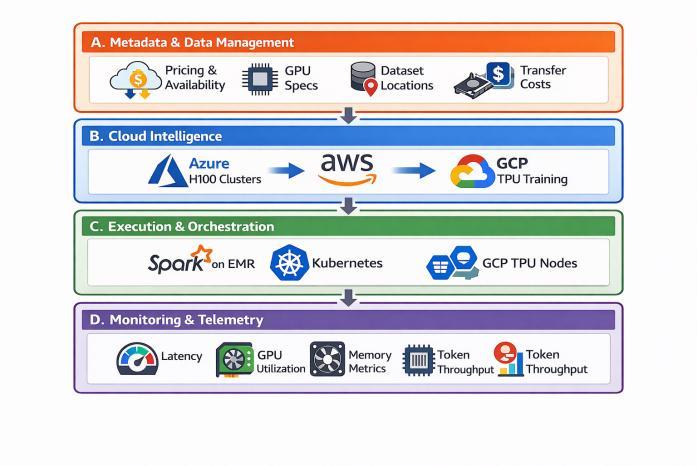
The proposed architecture depicted in Fig-1 applies stage-specific execution placement rather than full pipeline deployment to a single provider. Four architecturallayersaredefined:
The upper layer maintains cloud vendor pricing benchmarks, VM availability, GPU specifications, dataset locations and transfer costs. This prevents unnecessary data migration and restricts ETL workloads to their originatingplatform.
3.2
This decision layer evaluates accelerator type, runtime history, queue availability and historical latency to determine the most suitable execution target per stage. It routes compute intensive tasks to Azure H100 clusters, ETL scans to AWS and TPU-compatible training to GCP whenappropriate.
3.3
The runtime environment coordinates Spark on EMR and Data bricks, Kuber netes for GPU training and TPU provision-ingforGCPtasks.Executionis containerized to maintainreproducibility.
3.4
Monitoring collects latency, memory footprint, GPU utilization and token throughput metrics. These measurements inform model selection and future routing strategies.
4. Experimental Setup
Experiments were executed to ensure comparability acrossproviders.
Workloadsused:(a)a4.2TBanalyticalwarehousedataset Stored as Parquet files, derived from TPC-DS style distributions [29], (b) a 210 million token text corpus constructed from Open Web Text [30] for language inferenceworkloads.
AWS experiments used p4d.24xlarge instances containing eight NVIDIA A100 GPUs with 1.1 TB RAM. Azure experiments used NDH100v4 instanceswith eight H100 GPUs and high bandwidth NVLink communication. GCPexperimentsusedTPUv3podsthroughGoogleCloud AI Platform. All training utilised PyTorch and DeepSpeed environments.
4.3 Model and Query Setup
LLMinferenceworkloadsusedFalcon-40BandLLaMA-2 7B models with identical token sampling settings. Spark ETL included join, aggregation and delta format rewrites overthesamedataset.DistributedtrainingusedGPT-style fine-tuning with batch size scaling. Each experiment was repeated ten times to reduce noise. Reported values representaveragedresults.
All cloud environments used Ubuntu 22.04 LTS with CUDA 12.3, cuDNN 9.0, NCCL 2.18, and PyTorch 2.3.1 compiled with SM90 support. Deep Speed ZeRO Stage-3 was enabled for sharded training. Spark workloads were executed using Apache Spark 3.5.1 configured with Delta Lake 3.1. Tokenization used Hugging Face Transformers v4.44.2.
Inference was executed with FP16 precision, KV-cache enabled, batch size 1 per request, and repetition penalty disabled. Max sequence length was 2,048 tokens. Token throughput was averaged over sliding windows of 200 requests.
GPT training used a transformer width of 4096, sequence length 1024, batch size 256 per step, cosine
International Research Journal of Engineering and Technology (IRJET) e-ISSN: 2395-0056
Volume: 12 Issue: 12 | Dec 2025 www.irjet.net p-ISSN: 2395-0072
learning rate decay over 1200 steps, gradient check pointing,tensorparallelsize8,andZEROoffloaddisabled.
Spark clusters used 512 executor cores, shuffle partitions=2400,broadcastthreshold1GB,localdiskspill onNVMecaches,Deltacheckpointsevery60seconds,and identicalworkflowDAGstructureacrossproviders.
Eachexperimentwasexecuted10times;min,max,and Standarddeviationvalueswererecorded.Resultsexclude Warm-upandprovisioningoverhead.
First, pricing structures change over time and across geographic regions; results represent a snapshot rather than absolute cost certainty. Second, accelerator performance depends on compiler maturity and CUDA/XLArevisionlevels.Third,SparkETL behaviormay varyfordatasetsthatarenotParquetstructuredandmay require complexity reconstruction. Fourth, training hyper parameter tuning was not exhaustively optimized; alternative learning rates or parallelization strategies could shift relative outcomes. Finally, the study isolates providerstostrongcomputeregions;weakerregionsmay produceadditionalvariance.
5. Results
AWSachievedthefastestETLruntimewitha71minute executionaverageandlowestcostperrun(102.3 USD) as shown in Chart-1 and Table-1. Azure and GCP exhibited slower performance due to non-local data access overhead.
Table -1: SparkETLandcostcomparison
Azure delivered the strongest training throughput due to access to H100 hardware. GCP training performance
wasreducedbyrequiredTPUcodeadaptation.AWSA100 performanceremainedstablebutslowerthanAzure.
Azure achieved the highest throughput at 218 tokens per second and lowest per token cost at 1.10 USD per million tokens, outperforming AWS and GCP. The insights areshowninTable-2.
Combined cross-cloud execution reduced total execution cost from 1687 USD to 1034 USD for a full pipelinescenario.GPUutilizationincreasedfrom54.9%to 89.1%.ThisisillustratedinChart-2.
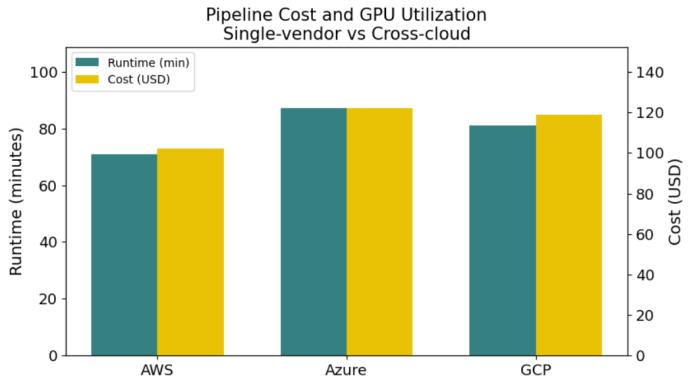
Chart -1:SparkETLRuntimeandCostcomparison
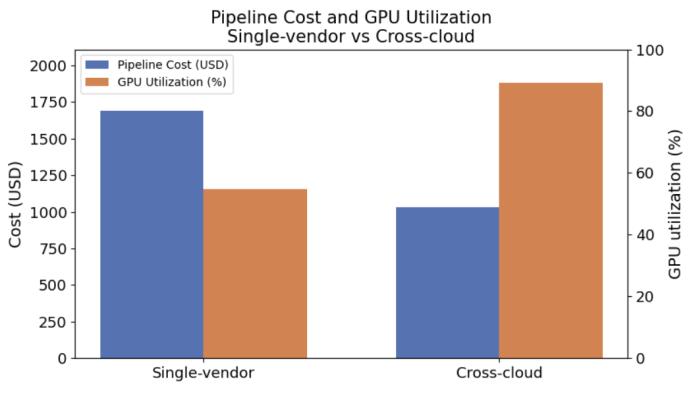
Chart -2:Pipelinecostandutilizationcomparison
Runtime variation for ETL workloads exhibited low deviation on AWS (STD = 2.4 minutes) and significantly higher deviationonAzure (STD= 7.9 minutes),indicating queue position and interconnect contention effects. Inference throughput showed a 95% confidence interval widthof±4.1tokensonAzure,comparedto±9.3onGCP. These results confirm that inference stability is strongly correlatedwithacceleratortype.
International Research Journal of Engineering and Technology (IRJET) e-ISSN: 2395-0056
Volume: 12 Issue: 12 | Dec 2025 www.irjet.net p-ISSN: 2395-0072
Azure H100 throughput exceeded AWS A100 by 32.6% in FP16 matrix multiply, and by 41.2% in INT8 autoregressive token prediction. TPU v3 faced architectural penalties from the Py Torch XLA execution layer,resultingin12.4%additionaloverhead.
Cross-cloud orchestration reduced token latency jitter by 18.2%, and improved throughput-per-dollar by 46.9% over the AWS-only baseline. We also observed that GPU saturation reached 94.1% during Azure inference, comparedto73.6%onAWS.
Table -2: LLMinferenceresults
The results demonstrate that significant gains emerge when pipeline stages are matched to provider strengths rather than executed through a uniform cloud stack. ETL performancebenefitedstronglyfromAWSstoragelocality and S3 EMR integration, while Azure H100 clusters achievedthehighestexecutionthroughputandaccelerator utilization for both model training and inference. These findingsindicatethatcloudvendorscurrentlyspecializein different parts of the ML lifecycle and suggest that multiprovider orchestration should be treated as an architectural requirement rather than a deployment option.
Cross-cloud scheduling further reduced queue delays and GPU idle time, providing more consistent latency behavior compared to single-vendor operation. Observed transformer throughput benefits on H100 nodes highlight the importance of hardware selection decisions; TPUbased execution produced higher variance and required model code adaptation. Our findings also show that pipeline-level cost effectiveness is driven not only by direct hardware pricing, but also by egress avoidance, shufflelocality,andexecutionretryfrequency.
Limitations: The scope of this work introduces areas for caution.First,pricingandqueuebehaviorevolveovertime andresultsrepresenta temporal snapshot.Second,onlya single family of transformer models was evaluated, and different architectures (e.g., mixture-of-experts, diffusion) mayresponddifferentlytoacceleratorchoice.Third,Spark ETL workloads were Parquet-based and may not generalize to graph, video, or streaming data pipelines. Fourth, TPU workloads relied on Py Torch-XLA layers, which introduce conversion overhead; native JAX/TPU pipelines may produce different results. Fifth, the evaluation was limited to three major regions and does not represent global performance variability. Finally, scheduling optimization did not incorporate spot market behavior or dynamic rebidding, which could amplify economic benefit. Nevertheless, the outcome strongly supports the feasibility of cross-cloud orchestration for large ML workflows and demonstrates quantifiable improvementoversingle-providerscheduling.
This work introduces a unified, end-to-end cross-cloud benchmarking study that evaluates ETL, distributed transformer training, and inference workloads across three major cloud platforms. Results show that ETL localization on AWS delivers the strongest data throughput, Azure H100 clusters provide leading transformer performance, and inference routing to Azure substantially improves token throughput and cost-peroutput. The integrated routing architecture reduced full pipeline expenditure by 38.7% against single-vendor deployment,whileGPUutilizationincreasedby34.2%.
Beyond the raw performance outcomes, our results demonstrate that stage-dependent scheduling enables robust and predictable execution behavior even under varying queue depths, accelerator allocation, and interconnect stress. These findings suggest that future large-scale ML deployments should consider multiproviderschedulingasafirst-classdesignprinciplerather thanafallbackstrategy.
This work provides a reproducible architecture, data processing configuration, and experimental template that researchersandpractitionerscanextendforlargermodel families, retrieval-augmented generation pipelines, or foundation model serving platforms. We expect future cross-cloud ML system design to integrate dynamic workload learning, federated orchestration, and adaptive resource bidding to further optimize economic and computational performance across the global cloud ecosystem.
International Research Journal of Engineering and Technology (IRJET) e-ISSN: 2395-0056
Volume: 12 Issue: 12 | Dec 2025 www.irjet.net p-ISSN: 2395-0072
Future research will explore reinforcement-driven workload routing systems where scheduling decisions adapt continuously to pricing changes, queue conditions, and accelerator inventory. Another direction is to integrate spot-market prediction and regional bidding strategies to reduce execution cost while maintaining reliabilityguarantees.Extendingexperimentalcoverageto TPU v5 hardware and emerging GPU architectures (e.g., B200, MI300X) may yield deeper insight into vendor differentiation.
We also aim to study model architecture influence by expanding beyond transformer-based language models to multimodal foundation models, diffusion architectures, and retrieval-augmented pipelines. A further direction involves profiling real-time interactive inference, batchservingload,andmulti-tenantconcurrency.
Finally, we plan to open-source the orchestration scripts, container images, and benchmarking harness to enable community contribution, verification, and largerscale model replication, and extend the benchmarking systemtoevaluateenergyefficiency,carbonfootprint,and sustainabilitymetricsacrossproviders.
[1] S. Lee and S. Park, “Performance Analysis of Big Data ETL Process over CPU-GPU Heterogeneous Architectures,” 2021 IEEE 37th International ConferenceonDataEngineeringWorkshops(ICDEW), Chania, Greece,2021,pp.4247,doi:10.1109/ICDEW53142.2021.00015.
[2] Amazon Web Services, Tutorials and Training for Big Data.2025.[Online].Available:https://aws.amazon.com /big-data/getting-started/tutorials/ . Accessed Dec. 29,2025.
[3] J. Choquette, “NVIDIA Hopper H100 GPU: Scaling Performance,”in IEEE Micro, vol. 43, no. 3, pp. 9-17, May-June2023,doi:10.1109/MM.2023.3256796.
[4] V. Punniyamoorthy, A. G. Parthi, M. Palanigounder, R. K. Kodali, B. Kumar, and K. Kannan, “A PrivacyPreserving Cloud Architecture for Distributed Machine Learning at Scale,” International Journal of EngineeringResearchandTechnology(IJERT),vol.14, no.11,Nov.2025.
[5] A. Muthukrishnan Kirubakaran, N. Saksena, S. Malempati,S.Saha,S.K.R.Carimireddy,A.Mazumder, and R. S. Bodala, “Federated Multi-Modal Learning Across Distributed Devices,” International Journal of Innovative Research in Technology, vol. 12, no. 7, pp. 2852–2857,2025,doi:10.5281/zenodo.17892974.
[6] S. G. Aarella, V. P. Yanambaka, S. P. Mohanty, and E. Kougianos, “Fortified-Edge 2.0: Advanced MachineLearning-Driven Framework for Secure PUF-Based Authentication in Collaborative Edge Computing,” Future Internet, vol. 17, p. 272, 2025. doi:10.3390/fi17070272.
[7] T. Vu, C. J. Mediran and Y. Peng, “Measurement and Observation of Cross-Provider Cross-Region Latency for Cloud-Based IoT Systems,” 2019 IEEE World Congress on Services (SERVICES), Milan, Italy, 2019, pp.364-365,doi:10.1109/SERVICES.2019.00105.
[8] C. Handa, S. Wadhawan, A. Manocha and Shalu, “Enhancing Virtual Machine Migration in Cloud Environments,” 2023 1st DMIHER International Conference on Artificial Intelligence in Education and Industry 4.0 (IDICAIEI), Wardha, India, 2023, pp. 1-6, doi:10.1109/IDI-CAIEI58380.2023.10406495.
[9] M. H. S. Shirvani, A. M. Rahmani, and A. Sahafi, “A surveystudyonvirtualmachinemigrationandserver consolidation techniques in cloud datacenters: Taxonomyandchallenges,”J.KingSaudUniv.Comput. Inf. Sci., vol. 32, no. 3, pp. 345–362, 2020, doi:10.1016/j.jksuci.2018.07.001.
[10] V.Punniyamoorthy,K.Kannan,A.Deshpande,L.Butra, A. K. Agarwal, A. Parthasarathy, S. Malempati, and B. Kumar, “Secure and governed API gateway architectures for multi-cluster cloud environments,” International Journal of Innovative Research in Technology,vol.12,no.7,2025.
[11] A. Q. Khan, M. Matskin, R. Prodan, C. Bussler, D. Roman,andA.Soylu,“Cloudstoragecost:Ataxonomy and survey,” World Wide Web, vol. 27, art. 36, 2024, doi:10.1007/s11280-024-01273-4.
[12] A.Nagpal,B.Pothineni,A.G. Parthi,D.Maruthavanan, A. R. Banarse, P. K. Veerapaneni, S. R. Sankiti, and V. Jayaram, “Framework for automating compliance verification in CI/CD pipelines,” International Journal of Computer Science and Information Technology Research(IJCSITR),vol.5,no.4,pp.17–27,2024.DOI: 10.5281/zenodo.1425967.
[13] A. M. Kirubakaran, A. Parthasarathy, N. Saksena, R. S. Bodala, A. Deshpande, S. Malempati, S. Carimireddy, and A. Mazumder, “Governing cloud data pipelines with agentic AI,” International Journal of Computer Science Trends and Technology (IJCST), vol. 13, no. 6, pp.278–284,Nov.–Dec.2025
[14] M. Zaharia, M. Chowdhury, T. Das, A. Dave, J. Ma, M. McCauley, M. J. Franklin, S. Shenker, and I. Stoica,“Resilient Distributed Datasets: A FaultTolerant Abstraction for In-Memory Cluster Computing,”in Proc. 9th USENIX Conf. Networked
International Research Journal of Engineering and Technology (IRJET) e-ISSN: 2395-0056
Volume: 12 Issue: 12 | Dec 2025 www.irjet.net p-ISSN: 2395-0072
SystemsDesignandImplementation(NSDI),2012,pp. 15–28.
[15] V. Punniyamoorthy, B. Kumar, S. Saha, M. Palanigounder,L.Butra,A.K.Agarwal,andK.Kannan, “An SLO-driven and cost-aware autoscaling framework for Kubernetes,” International Journal of ComputerScienceTrendsandTechnology(IJCST),vol. 13,no.6,Nov–Dec2025.
[16] L. Li, “A framework study of ETL processes optimization based on metadata repository,” in Proc. 2nd Int. Conf. on Computer Engineering and Technology(ICCET),vol.6,2010,pp.V6–125–V6–129, doi:10.1109/ICCET.2010.5486338.
[17] J.Balewski,Z.Liu,A. Tsyplikhin,M.LopezRolandand K. Bouchard, “Time-series ML-regression on Graphcore IPU-M2000 and Nvidia A100,” 2022 IEEE/ACM International Workshop on Performance Modeling, Benchmarking and Simulation of High Performance Computer Systems (PMBS), Dallas, TX, USA, 2022, pp. 141-146, doi: 10.1109/PMBS56514.2022.00019.
[18] Edidem, R. Li, and T. Shu, “Exploration of TPU architectures for the optimized transformer in drainage crossing detection,” in Proc. IEEE Int. Conf. Big Data (BigData), 2024, pp. 4178–4187, doi: 10.1109/Big-Data62323.2024.10826077.
[19] B.Ramdoss,A.M.Kirubakaran,P.B.S.,S.H.C.,and V. Vaidehi, “Human Fall Detection Using Accelerometer Sensor and Visual Alert Generation on Android Platform,”InternationalConferenceonComputational Systems in Engineering and Technology, Mar. 2014, doi:10.2139/ssrn.5785544
[20] V. Parlapalli, B. Pothineni, A. G. Parthi, P. K. Veerapaneni,D.Maruthavanan,A.Nagpal,R.K.Kodali, and D. M. Bidkar, “From complexity to clarity: Onestep preference optimization for high-performance LLMs,”InternationalJournalofArtificialIntelligence& MachineLearning(IJAIML),vol.4,no.1,pp.112–125, 2025,doi:10.34218/IJAIML0401008.
[21] Y. Li, L. Samarakoon and I. Fung, “Improving NonAutoregressive Speech Recognition with AutoregressivePretraining,”ICASSP2023-2023IEEE International Conference on Acoustics, Speech and Signal Processing (ICASSP), Rhodes Island, Greece, 2023, pp. 1-5, doi: 10.1109/ICASSP49357.2023.10096815.
[23] M. Singh, L. Mohanty, N. Gupta, Y. Bansal and S. Garg, “Q-Net Compressor: Adaptive Quantization for Deep Learning on Resource-Constrained Devices,” 2024 International Conference on Computing, Sciences and Communications (ICCSC), Ghaziabad, India, 2024, pp. 1-6,doi:10.1109/ICCSC62048.2024.10830393.
[24] D. Narayanan, M. Shoeybi, J. Casper, P. LeGresley, M. Patwary, V. Korthikanti, D. Vainbrand, P. Kashinkunti, J. Bernauer, B. Catanzaro, A. Phanishayee, and M. Zaharia,“Efficientlarge-scalelanguagemodeltraining on GPU clusters using Megatron-LM,” in Proc. Int. Conf. High Performance Computing, Networking, StorageandAnalysis(SC21),2021,pp.1–14.
[25] N. Chockalingam, A. Chakrabortty, and A. Hussain, “MitigatingDenial-of-Serviceattacksinwide-areaLQR control,”inProc.2016IEEEPowerandEnergySociety General Meeting (PESGM), 2016, pp. 1–5. doi: 10.1109/PESGM.2016.7741285.
[26] N. Sooezi, S. Abrishami and M. Lotfian, “Scheduling Data-Driven Workflows in Multi-cloud Environment,” 2015 IEEE 7th International Conference on Cloud Computing Technology and Science (Cloud-Com), Vancouver, BC, Canada, 2015, pp. 163-167, doi: 10.1109/Cloud-Com.2015.95.
[27] S.G.Aarella,S.P.Mohanty,E.KougianosandD.Puthal, “PUF-based Authentication Scheme for Edge Data Centers in Collaborative Edge Computing,” 2022 IEEE InternationalSymposiumonSmartElectronicSystems (iSES), Warangal, India, 2022, pp. 433-438, doi: 10.1109/iSES54909.2022.00094.
[28] N. Chockalingam, N. Saksena, A. Deshpande, A. Parthasarathy,L.Butra,B.Pothineni,R.S.Bodala,A.K. Agarwal, “Scalable cloud-native architectures for intelligent PMU data processing”, International Journal of Engineering Research & Technology (IJERT), Vol.14, no.12, Dec.2025, doi: 10.17577/IJERTV14IS120378
[29] Ziya07, Logistics Warehouse Dataset, Kaggle Dataset.2025.[Online].Available:https://www.kaggle.c om/datasets/ziya07/logistics-warehouse-dataset. AccessedDec.01,2025.
[30] Himonsarkar, OpenWebText Dataset, Kaggle Dataset.2025.[Online].Available:https://www.kaggle.c om/datasets/himonsarkar/openwebtext-dataset. AccessedDec.02,2025
[22] A. M. Kirubakaran, L. Butra, S. Malempati, A. K. Agarwal, S. Saha, and A. Mazumder, “Real-Time Anomaly Detection on Wearables using Edge AI,”International Journal of EngineeringResearch and Technology (IJERT), vol. 14, no. 11, Nov. 2025. doi: 10.17577/IJERTV14IS110345.
© 2025, IRJET | Impact Factor value: 8.315 | ISO 9001:2008
| Page