
International Research Journal of Engineering and Technology (IRJET) e-ISSN: 2395-0056
Volume: 13 Issue: 02 | Feb 2026 www.irjet.net p-ISSN: 2395-0072
International Research Journal of Engineering and Technology (IRJET) e-ISSN: 2395-0056
Volume: 13 Issue: 02 | Feb 2026 www.irjet.net p-ISSN: 2395-0072
Tripti Yadav1, Suruti2
1Student, Galgotias College of Engineering and Technology, Greater Noida, Uttar Pradesh, India
2Student, Galgotias College of Engineering and Technology, Greater Noida, Uttar Pradesh, India
Abstract - Fake news dissemination on social media platforms creates significant societal challenges by misleading users, influencing public opinion, and eroding trust in digital information ecosystems. Existing fake news detectionapproachesoftenrelyonstaticearlyorlatefusion strategies, resulting in uniform treatment of textual and visual modalities and reduced performance when one modality is unreliable or intentionally misleading. This paper presents a Credibility-Guided Cross-Modal Gating frameworkformultimodalfakenewsdetection,designedto dynamically regulate information flow between modalities based on their estimated trustworthiness. The proposed system extracts textual features using transformer-based language models and visual features using deep convolutional neural networks. A dedicated credibility estimation module evaluates the reliability of text, image, and source information, which is subsequently used to control cross-modal interactions through an adaptive gating mechanism. This gating process suppresses lowcredibility signals while emphasizing reliable representations, enabling more robust and interpretable classification decisions. The system additionally generates an overall credibility confidence score to enhance transparency and user trust. Experimental evaluation conducted on benchmark multimodal fake news datasets demonstratesimproveddetectionaccuracy,robustness,and reliability compared to conventional fusion-based methods. By reducing the influence of misleading content and improving multimodal reasoning, the proposed framework contributes to the development of more effective and trustworthyfakenewsdetectionsystems.
Index Terms : Fake News Detection, Multimodal Learning, Credibility Estimation, Cross-Modal Gating, Deep Learning, Social Media Analysis, Information Reliability, Text-Image Fusion, Misinformation Detection
The rapid spread of fake news continues to pose a seriousthreattopublictrust,socialstability,andinformed decision-making in digital environments. The increasing volume of misleading content related to politics, health, disasters, and public safety has highlighted the growing vulnerability of online users worldwide. The impact of fake news has been further intensified by factors such as widespread social media adoption, algorithm-driven
content recommendation, high user engagement, and the growinguseofmultimediaelementstoenhancecredibility [1]. According to reports from media monitoring organizations and research agencies, millions of users are affected annually by misinformation due to delayed verification, limitedfact-checkingcapacity, andineffective content moderation mechanisms [2] [3]. These observations emphasize the necessity for a more structured, reliable, and scalable approach to automated fakenewsdetection.
Traditional fake news detection approaches primarily rely on text-based analysis or static machine learning models that operate in isolation. While such methods have shown reasonable performance in controlled settings, they struggle to generalize to realworld scenarios where news content is increasingly multimodal and deceptive. In practice, misleading images, emotionallychargedtext,andunreliablesourcesareoften combined to create highly convincing false narratives. Existing systems face difficulty in accurately assessing suchcontentduetotheirinabilitytomodel varyinglevels ofcredibilityacrossdifferentmodalities.
Current systems have a number of serious drawbacks:
1. Fragmented Information Processing: Reports derivedfromtext,images,andmetadataareanalyzed independently,makingitdifficulttoachieveaunified understandingofnewscontent.
2. Static Fusion Mechanisms: Early and late fusion techniques lack adaptability to contextual changes, leading to inefficient integration of multimodal features.
3. Limited Cross-Modal Analysis: Inconsistencies and contradictions between textual and visual informationareoftenoverlooked,reducingdetection effectiveness.
4. Absence of Credibility Modeling: Existing approaches do not explicitly assess the trustworthiness of individual modalities or information sources, weakening robustness against misinformation.
5. Lack of Interpretability: Classificationoutcomesare frequently generated without meaningful
International Research Journal of Engineering and Technology (IRJET) e-ISSN: 2395-0056
Volume: 13 Issue: 02 | Feb 2026 www.irjet.net p-ISSN: 2395-0072
explanations, limiting user confidence and practical usability.
Real-world incidents involving large-scale misinformation during elections, public health emergencies, and crisis reporting highlight the need for a unified credibility-aware detection framework that can improve verification and integration of multimodal information. The absence of such an integrated mechanism continues to cause delayed detection, fragmented analysis, and reduced effectiveness in controllingthespreadoffakenews.
This paper presents a Credibility-Guided Cross-Modal Gatingframeworkformultimodalfakenewsdetectionthat addresses these limitations through the following contributions:
1.Theproposedsystemadoptsaunifiedmultimodal Framework.Itjointlyanalyzesinformation.
2. Acredibilityestimationmodulethatevaluatesthe Trustworthinessofindividualmodalities.
3. Cross-modalinteractionsaredynamicallycontrolled Using
4. Structuringtheworkprocessesforassigningtheteams andcoordinatingresources.
5. CompletecasetrackingwithAutomatedstatusupdates.
The rest of the paper is organized as follows: Section II discusses the related work in the area of fake news detectionandmultimodal learningapproaches,SectionIII presentstheoverallsystemarchitectureanddesignofthe proposed framework, Section IV details the methodology andthe credibility-guidedcross-modal gating mechanism, Section V describes the implementation and experimental evaluation,andfinallySectionVIconcludesthepaperwith a discussion of results, limitations, and future research directions.
Fake news detection systems have experienced rapid development over the past decade, with researchers proposing various techniques to analyze misinformation spreadacross digital platforms.Existingapproachesfocus on textual analysis, multimedia verification, and multimodal learning strategies to improve detection accuracyincomplexonlineenvironments.
Several solutions have been developed to support automated fake news detection across social media platforms. Traditional text-based detection systems employ machine learning models using linguistic patterns and metadata analysis; however, these approaches often fail when misleading or manipulated images accompany
textual narratives, reducing prediction reliability [2]. Transformer-based language models provide improved semantic understanding, although performance declines when content contains emotional manipulation or adversarialphrasing[4].
Multimodal fake news detection frameworks combine textual and visual representations to enhance classification accuracy. However, many systems rely on static fusion strategies and fail to account for credibility differences across modalities, leading to unreliable decisions when one modality contains misleading signals [5]. Social-context-based approaches analyze user interactions and information propagation patterns but often struggle with scalability and lack reliable mechanismsforreal-timecredibilityassessmentandcaselevelmisinformationtracking[1].
Issues related to cross-modal inconsistencies between textualandvisualinformationhavebeenwidelyexamined in recent fake news detection studies. Researchers highlight that mismatched captions, reused images, and misleading multimedia associations significantly contribute to misinformation spread, emphasizing the need for structured multimodal verification mechanisms to identify authentic information effectively [6]. Other researchers report that incomplete credibility assessment across modalities leads to uncertainty in automated predictions, thereby stressing the importance of credibility-aware learning frameworks for reliable misinformationdetection[7].
In related developments, studies on multimodal fusion failures demonstrate that inaccuracies arise when modality models operate without adaptive coordination mechanisms. Researchers further argue that the absence of shared interaction control between textual and visual encoders limits simultaneous feature learning, motivating credibility-guidedgatingstrategiestoimprovemultimodal fake news detection performance and decision reliability acrosslarge-scaledigitalinformationplatforms[8].
Several researchers have examined challenges related to credibility assessment in online information ecosystems. Studies show that delayed or inaccurate verification of multimedia content allows misinformation to spread rapidly, emphasizing the need for real-time credibility estimation and adaptive verification mechanisms to support reliable fake news detection [9]. Reports also indicate that vulnerable user groups often struggle to distinguish trustworthy content from manipulated narratives, highlighting the need for transparent
International Research Journal of Engineering and Technology (IRJET) e-ISSN: 2395-0056
Volume: 13 Issue: 02 | Feb 2026 www.irjet.net p-ISSN: 2395-0072
credibility indicators within automated detection systems tosupportinformedinformationconsumption[10].
Recent progress in deep learning and real-time information processing has enabled the development of responsive systems for misinformation detection across social media platforms. Researchers have implemented transformer-based models and neural architectures to analyze textual credibility, while other studies investigate real-time image verification techniques to detect manipulated or reused visual content, thereby improving multimodal fake news detection performance and overall system reliability in dynamic online environments [11] [12].
Results of our analysis show some major weaknesses of currentsolutions:
•Lackofstructuredcredibilityassessmentacross textualandvisualmodalities
•Absenceofreal-timeverificationforrapidlyspreading multimediamisinformation
•Limitedabilitytocoordinatemultimodalfeature interactionsduringdetection
•Insufficientvisibilityintosourcereliabilityand contentauthenticityevaluationprocesses
•Accessibilitychallengesfacedbyusersininterpreting automatedcredibilitypredictions
•Lackofstandardizedvalidationmechanismsfor ensuringauthenticityofmultimodalnewscontent[6] [8][9][10]
We propose a Credibility-Guided Cross-Modal Gating (CGCMG)frameworkthatintegratestextual,visual,andsource credibility signals for reliable multimodal fake news detection[2,18].
3.1
The proposed system follows a layered architecture that divides the framework into distinct functional components. This design ensures stable, secure, and efficientinteractionbetweenfeatureextraction,credibility estimation,andclassificationmodules. The system adopts a modular design philosophy to support scalable and reliablemultimodalfakenewsdetection.
Theproposedarchitectureconsistsoffiveprimarylayers:
1. Input Processing Layer: Thislayerisresponsiblefor collectingandpreprocessingmultimodal newsdatatoenablereliabledownstreamanalysis.The primaryfunctionsinclude:
• Textnormalizationandtokenizationfornewsarticles andcaptions
• Imagepreprocessingandresizingforvisualfeature extraction
• Metadataandsourceinformationcollectionfrom newsplatforms
• Noiseremovalandmultimodaldataconsistency verificationprocesses
• Datasetpreparationandformattingformultimodal learningworkflows
2. Feature Extraction Layer: This layer extracts semanticand contextual representations from different modalitie to support accurate multimodal fake news detection.The primaryfunctionsinclude:
• Transformer-basedtextualfeatureextractionfor newsarticlesandcaptions
• CNN-basedvisualrepresentationlearningfrom associatedmultimediacontent
• Contextualalignmentofmultimodalrepresentations forconsistencyanalysis
• Featuredimensionalitynormalizationforefficient multimodalfusion
• Representationrefinementforscalabledownstream classificationworkflows
3. Backend Logic Layer: Thislayerevaluatesthe reliabilityofmultimodalinformationbeforefeature fusiontoimprovedetectionrobustness.Themajor functionalitiesinclude:
• Textcredibilityscoringbasedonlinguisticand contextualconsistency
• Imageauthenticityassessmentfordetecting manipulatedorreusedvisuals
• Sourcereliabilityevaluationusinghistorical trustworthinessindicators
• Credibilityweightcomputationforadaptive multimodalfusioncontrol
• Suppressionofunreliablemodalitysignalsduring interaction
• Dynamiccredibilityupdatestosupportconsistent classificationperformance
International Research Journal of Engineering and Technology (IRJET) e-ISSN: 2395-0056
Volume: 13 Issue: 02 | Feb 2026 www.irjet.net p-ISSN: 2395-0072
4. Cross-Modal Gating Layer: Thislayerdynamically controls interactions between textual and visual modalities Themajor functionalitiesinclude:
• Credibility-guidedgatingsignalgenerationfor adaptivemodalitycontrol
• Dynamicregulationofmultimodalinteraction duringfeatureintegration
• Suppressionofconflictingormisleadingmodality signals
• Enhancementofcrediblefeatureinteractionsfor improvedreasoning
• Preparationofgatedrepresentationsforfinal multimodalfusion
5. Infrastructure Layer: Thislayerisresponsiblefor ensuringreliablemultimodalfusionandprediction performance::
• Adaptivefusionoftextualandvisualfeature representations
• Credibility-weightedmultimodalfeatureintegration mechanisms
• Fakeorrealnewsclassificationprocessing workflows
• Confidencescorecomputationforprediction reliabilityestimation
• Supportforscalablemultimodalclassification Workflows
6. Output and Security Layer:Thislayerensuressafe deliveryofdetectionresultsandprotectionofuser information:
• Secureresultdeliverytomonitoringandanalysis applications
• Explanationgenerationmechanismssupporting predictiontransparency
• Access-controlledresultvisualizationinterfacesfor authorizedusers
• Inputvalidationandsafemultimodaldata transmissionmechanisms
• Securesessionanduserinteractionmanagement
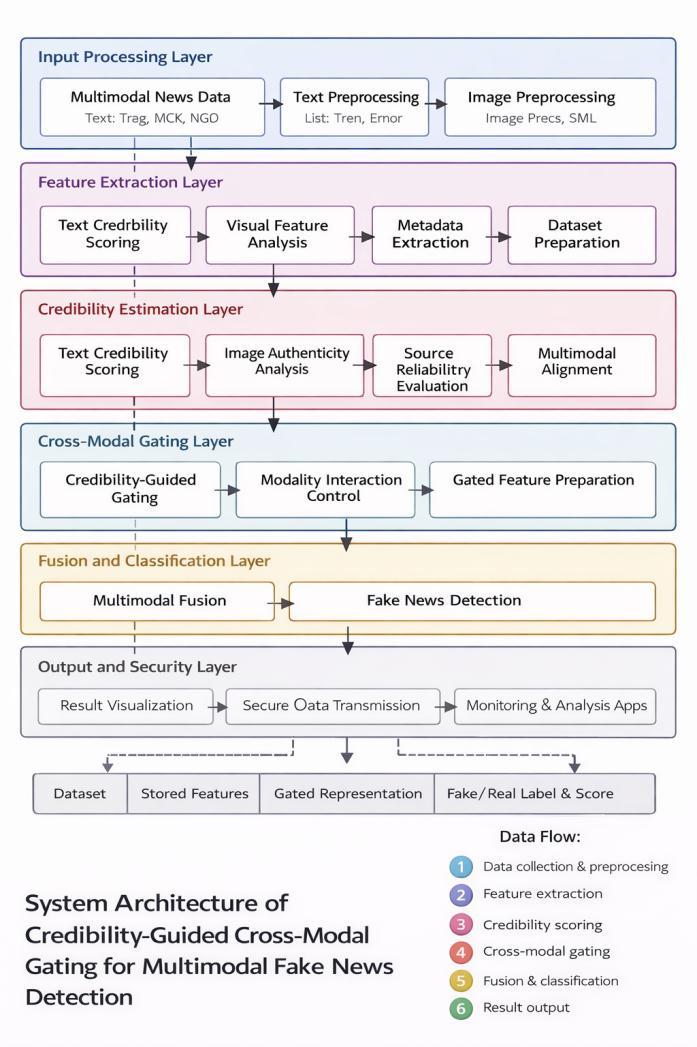
Fig – 1. SystemArchitectureofCredibility-Guided Cross-ModalGatingforMultimodalFakeNews Detection
The proposed framework follows a structured data flow processfromnewscollectiontofinalpredictionoutput:
1. News Collection: Newsarticles andsocialmediaposts are collected through web sources containing textual and visualcontent.
2. Preprocessing Pipeline: Collecteddataundergoes preprocessing steps including text cleaning, tokenization, andimagenormalization.
3. Feature Extraction: Textualandvisualfeaturesare extractedusingtransformermodelsandconvolutional neuralnetworks.
4. Credibility Evaluation: Credibility scores are computed fortext,images,andsourceinformation.
5. Cross-Modal Gating: Credibility-guidedgatingregulate interactionbetweenmodalitiesduringfusion.
International Research Journal of Engineering and Technology (IRJET) e-ISSN: 2395-0056
Volume: 13 Issue: 02 | Feb 2026 www.irjet.net p-ISSN: 2395-0072
6. Classification Process: Fusedmultimodal representationsareclassifiedintofakeorrealnews categories.
7. Result Presentation: Detectionresultsandcredibility confidence scores are presented through monitoring and analysisdashboards.
The Credibility-Guided Cross-Modal Gating Framework employsfollowingtechnologiesthatarewell-suited:
Table – 1: TechnologyStackofCredibility-Guided Cross-ModalGatingFramework
Category Technology
Multimodal Model
Text Processing
BERT, CLIP, ViT
Purpose
Extracting multimodalfeatures fromtextandimages
NLTK,SpaCy, HuggingFace Transformers Tokenization,text cleaning,andtext featureextraction
ImageProcessing OpenCV,PIL, torchvision Imageresizing, normalization,and featureextraction
Database MongoDB, PyMongo Storingnewsdata andcredibility scoringresults
Tools PyTorch, scikitlearn, TensorBoard Modeltraining, performance tracking,and experimental management
ExternalAPIs OpemAI,Google NewsAPI,Content API Enriching multimodalcontent withreal-time
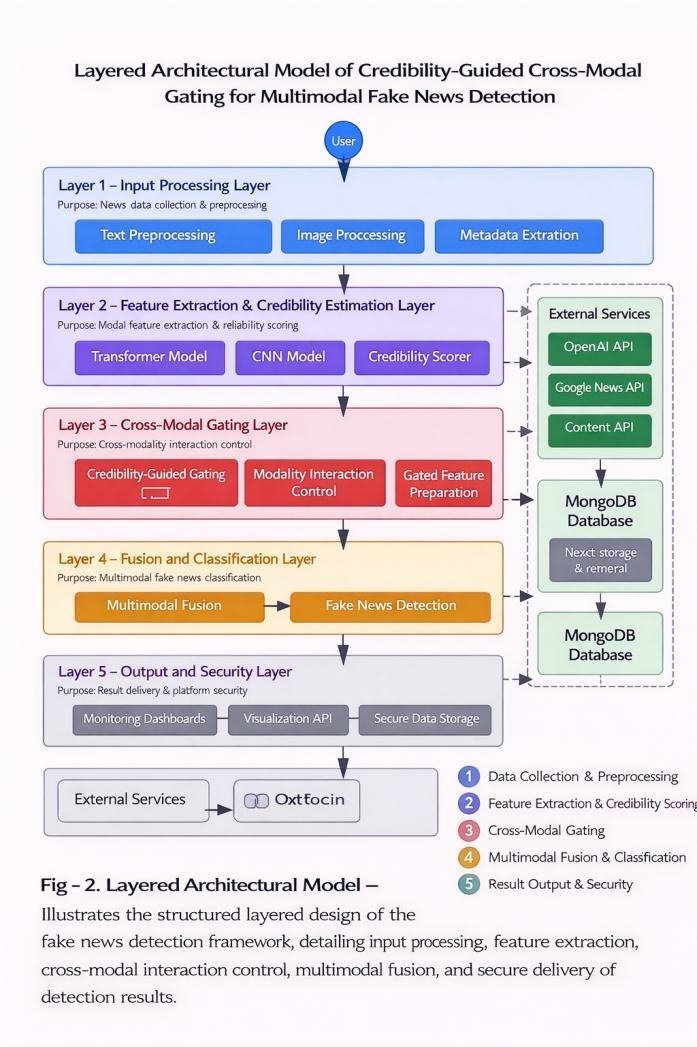
Fig – 2 Layered Architectural Model – Illustratesthe structuredlayereddesignofthefakenewsdetection framework,detailinginputprocessing,,featureextraction, cross-modalinteractioncontrol,multimodalfusion,and securedeliveryofdetectionresults.
4.1 Credibility-Guided Cross-Modal Gating: Multi-Stage Verification Pipeline
The proposed Credibility-Guided Cross-Modal Gating framework introduces a structured verification mechanism for evaluating and prioritizing multimodal news content based on credibility before final classification.
1. Stage 1: Basic Authenticity and Completeness Validation
Allcollectednewsinstancesarefirstsubjectedtoaninitial validation stage to verify basic authenticity and content completeness.Thisstageevaluatesthfollowingaspects:
International Research Journal of Engineering and Technology (IRJET) e-ISSN: 2395-0056
Volume: 13 Issue: 02 | Feb 2026 www.irjet.net p-ISSN: 2395-0072
• Verificationofsourceavailabilityandreliability indicators
• Assessmentoftextualclarityandcontextual completeness
• Validationofimagequalityandrelevancetothe content
• Identificationofmissingmetadataorcritical informationfields
• Preliminarydetectionofduplicateorrepeatednews items
News entries with missing or inconsistent information are flagged for exclusion or further review through automated filtering mechanisms. This stage helps reduce noisy inputs and ensures that only relevant and complete informationproceedstosubsequentprocessingstages
2. Stage 2: Contextual and Cross-Source Consistency Review
Validatednewsinstancesarecomparedwithcontextual factorstoverifyconsistencyacrossmultipleinformation sources.Evaluationconsiders:
• Comparisonwithhistoricalmisinformationpatterns relatedtosimilarevents
• Cross-verificationwithtrustednewsand fact-checkingplatforms
• Consistencychecksbetweentextual,visual,and metadatainformation
• Cross-referencewithrecentsimilarcases
• Evaluationofgeographicandtemporalplausibilityof reported events News items showing contextual inconsistencies proceed to a reverification stage where additional automated checks or expert review may be requiredbeforefurthercredibilityassessment[1][13].
3. Stage 3: Credibility Scoring and Risk Assessment
Thesystemevaluatescredibilityofnewscontentby consideringmultiplemodality-basedindicatorssuchas:
• Linguisticanalysisidentifyingexaggerationor emotionalmanipulationpatterns
• Sourcereliabilityassessmentbasedonpublication credibilityrecords
• Visualauthenticityanalysisdetectingmanipulated orreusedimages
• Identificationofsensationalormisleadingclaims withinarticles
• Temporalrelevanceandurgencyevaluationof reported informationEach news instance is preliminarilyassignedacredibility levelbasedoncalculatedscores.
CredibilityScore(C)=w1·T+w2·S+w3·V+w4·M
Where:
T=Textcredibilityindicator
S =Sourcereliabilityfactor
V=Visualauthenticityscore
M=Metadataconsistencyindicator
w1…w4 =predefinedweightingparameters
4. Stage 4: Gated Fusion and Classification Output
Validatedmultimodalfeaturesareconvertedinto structuredrepresentationsforfinalclassification.The systemperforms:
• Generationofstandardizedmultimodalfeature representations
• Credibility-weightedfeaturefusionacross modalities
• Highlightingcredibilityconfidencelevelsfor monitoringdashboards
• Preparationofclassificationoutputsfor decision-supportinterfaces
• Assignmentoffakeorreallabelstomonitoring Systems
The outputs dynamically adjust according to application requirements to ensure important credibility information reaches analysts and automated misinformationmonitoringplatformsefficiently.
5. Stage 5: Feedback and Model Re-Validation Loop
News items that fail credibility validation are not removed butinsteadenterafeedbackloop:
• Automaticre-evaluationafterupdatedinformation becomesavailable
• Manualexpertreviewqueuesforambiguous misinformationcases
• Datasetupdatesbasedonverifiedfact-checking outcomes
• Iterativerefinementuntilcredibilityvalidation requirementsaresatisfied
This mechanism reduces the loss of valuable information while improving data quality and strengtheningoverallmisinformationdetectionreliability.
International Research Journal of Engineering and Technology (IRJET) e-ISSN: 2395-0056
Volume: 13 Issue: 02 | Feb 2026 www.irjet.net p-ISSN: 2395-0072
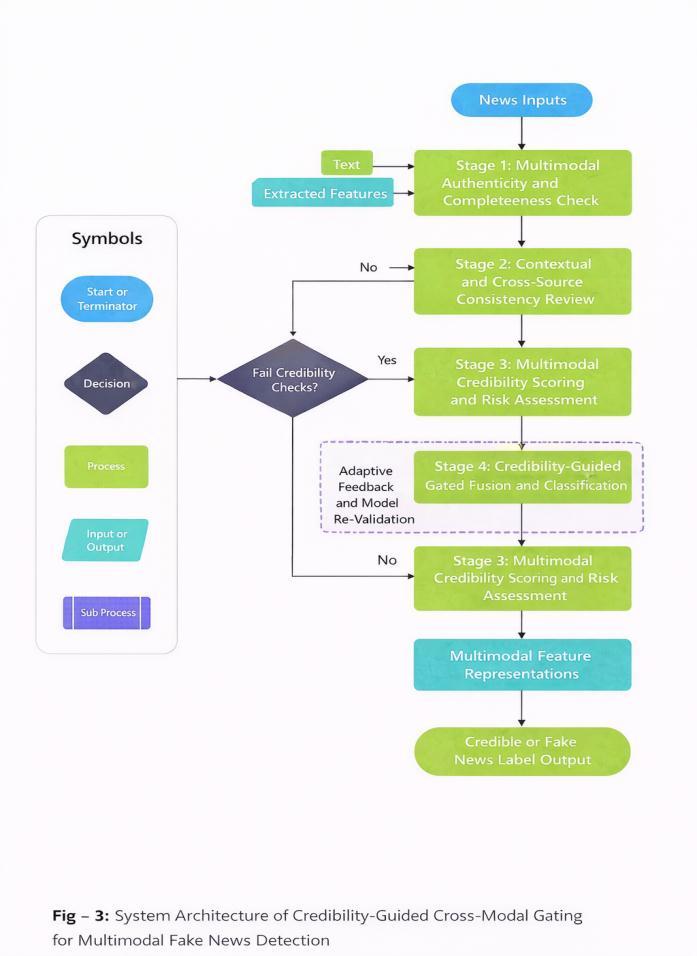
Fig – 3 Credibility-Guided Cross-Modal Gating
Validation Pipeline – The pipeline performs multimodal authenticity verification, contextual consistency evaluation,andcredibilityscoring,andgatedfusion-based classification output. News instances failing validation at any stage are redirected to an adaptive feedback loop, enabling re-evaluation and model refinement to enhance overall detection accuracy, robustness, and reliability acrossevolvingmisinformationscenarios.
4.2 Contexts-Aware Information Retrieval Pipeline
The proposed framework adopts a six-stage contextaware retrieval system to improve multimodal fake news detection accuracy through structured information retrieval and contextual validation processes [11] [15] [18].
1. Stage 1: Input Understanding and Processing
Thesystemextractsessentialinformationfromcollected newscontent:
• Textcontentprocessingusingnaturallanguage understandingtechniques
• Extractionandnormalizationofmetadataandsource information
• Imagemetadataandvisualcontentanalysis
• Newstopicandeventcategoryclassification
• Detectionofpublicationtimestampsandurgency Indicators
2. Stage 2: Context Retrieval from Internal Databases
Relevantcontextualinformationisretrievedfor validation:
• Historicalmisinformationrecordsrelatedtosimilar events
• Previouslyverifiednewsandfact-checkreports
• Sourcecredibilityhistoryandpublicationpatterns
• Event-relatedgeographicandtemporalinformation
• Historicalmisinformationpropagationpatterns
3. Stage 3: Context Ranking and Filtering
Theretrievedinformationisassessedforcontextual relevance:
• Temporalrelevancescoringcomparingrecentand outdatedreports
• Spatialordomainrelevanceevaluationfor contextualalignment
• Similaritymatchingwithongoingnewsevents
• Operationalutilityassessmentfordecisionsupport
• Removalofirrelevantoroutdatedcontextual Information
4. Stage 4: Structured Context Summary Generation
• Verifiedeventdescriptionwithreliableinformation sources
• Relevanthistoricalmisinformationpatternsand trends
• Availablecredibilityindicatorsfromtrustedsources
• Suggestedcredibilityinterpretationguidancefor analysts
• Riskconsiderationsassociatedwithmisinformation Spread
5.Stage 5:Data Updating and Continuous Improvement
Thecontextualknowledgebaseevolvesthrough:
• Automaticrecordingofverificationresultsfor processednews
• Updatingcredibilityassessmentsbasedonnew evidence
• Integrationofupdatedsourcereliabilityinformation
• Documentationofclassificationoutcomesand analystreviews
• Patternlearningforimprovedmisinformation Prediction
6. Stage 6: Feedback and Correction Loop
Continuousrefinementmechanismsenhancedetection accuracy:
• Analystfeedbackcollectionforcredibility
International Research Journal of Engineering and Technology (IRJET) e-ISSN: 2395-0056
Volume: 13 Issue: 02 | Feb 2026 www.irjet.net p-ISSN: 2395-0072
assessmentimprovement
• Evaluationofdetectionoutcomesformodellearning
• Adjustmentofcontextrelevancebasedonusage trends
• Errordetectionandcorrectionworkflowintegration
• Progressiveoptimizationofdetectionperformance
The proposed system adopts an Agile development methodologyconsistingoffourimplementationphases:
Phase 1 - Core Detection Framework: User data ingestion, preprocessing modules, credibility estimation components, and baseline multimodal fake news classificationfunctionalities.
Phase 2 - Enhanced Fusion Mechanisms: Real-time credibility-guided gating, adaptive multimodal fusion workflows, automated scoring updates, and prediction reliabilityimprovementmechanisms.
Phase 3 - Monitoring and Workflow Integration: Integration of alert systems, analyst feedback interfaces, misinformation tracking dashboards, and workflow coordinationforlarge-scalemonitoringoperations.
Phase 4 - Deployment & Optimization: Cloud deployment, system optimization, scalability enhancement, responsiveness improvement, and implementationofbackupandrecoverymechanisms.
The proposed framework includes eight main functional modules:
1. News Collection Module: Enablesacquisitionof multimodalnewscontent.
• Textextractionfromonlinenewssources
• Imageandmultimediacollectionsupport
• Sourcemetadataretrievalmechanisms
• Automatedingestionpipelineprocessing
• Duplicatenewsfilteringmechanisms
2. Credibility Validation Module: Implementscredibility verificationpipeline:
• Algorithmsverifyingbasicauthenticityand completenessofmultimodalnewscontent
• Duplicatedetectionthroughsimilaritycomparison acrossmultiplesources
• Validationandnormalizationofmetadataand sourceinformation
• Automatedroutingtocredibilityscoring componentss
• Qualityassuranceandverificationcontrol Mechanisms
3. Analyst Dashboard Module: Enablescoordinationand monitoringbymisinformationanalysisteams:
• Detectionresultoverviewandcasequeuedisplay
• Interactivevisualizationdashboardsforevent analysis
• Real-timecredibilityscoreupdateinterface
• Caseverificationanddecisionworkflowsuppor
• Communicationsupportamonganalystsand monitoringauthorities
4. Source Management Module: Helpsincredibility trackingandcoordination:
• Sourcecredibilityrecordmanagementandupdates
• Publishinghistorymonitoringforreliability assessment
• Reliabilityscoreupdatesacrossnewsplatforms
• Contentorigintrackingformisinformationanalysis
• Credibilitytrendmonitoringandreporting Workflows
5. Real-Time Monitoring Dashboard: Thismodule providessituationalawarenessformisinformation monitoringauthorities:
• Activemisinformationeventoverviewwithlive updates
• Eventvisualizationdashboardswithgeographic mapping
• Detectionandcredibilitystatustrackinginterfaces
• Monitoringofmisinformationpropagationpatterns
• Automatedalertandresponseconfiguration Interface
6. Authentication & User Management: Providessecure accesscontrol:
• Token-basedstatelessauthenticationmechanism
• Role-basedaccesscontrolenforcement
• Securecredentialstorageusingencryption
• Sessionmanagementforauthenticatedusers
• Userprofileandaccessmanagement
7. Geolocation & Mapping Module: Enables event mapping functions:
• Mappingintegrationformisinformationevent visualization
• Geographictaggingofmultimodalnewscontent
• Eventclusteringandhotspotdetection mechanisms
• Regionalmisinformationtrendtrackingsupport
• Location-basedcredibilityanalysismechanisms
International Research Journal of Engineering and Technology (IRJET) e-ISSN: 2395-0056
Volume: 13 Issue: 02 | Feb 2026 www.irjet.net p-ISSN: 2395-0072
8. User Interface and Experience Module: Improves usabilityformisinformationmonitoringsystems:
• Cleanandintuitivedashboardsformonitoring workflows
• Optimizedlayoutsforhigh-informationdecision environments
• Accessibilitysupportfordiverseanalystuser groups
• Mobile-friendlyresponsiveinterfacedesign support
• Simplenavigationenablingefficientworkflow operations
MongoDB collections in the proposed system are organizedinthefollowingmanner:
Users Collection: Storesauthenticationdetailsandprofile information of analysts, administrators, and monitoring authorities with defined access roles and activity tracking support.
News Collection: Maintains records of collected news articles, including textual content, associated images, metadata, publication timestamps, credibility labels, and classificationresultsforstructuredtrackingandhistorical misinformationanalysis.
Sources Collection: Stores information related to news publishers,includingcredibilityscores,publishinghistory, geographic origin, and reliability indicators to support effectivecredibilityassessment.
Predictions Collection: Tracks classification outputs by linking news items with generated predictions, credibility confidence scores, and validation updates throughout the misinformation detection lifecycle for monitoring and auditingpurposes.
The proposed fake news detection framework exposes a set of RESTful API endpoints to support data ingestion, credibilityevaluation,multimodalanalysis,andprediction management. Key API endpoints implemented in the systeminclude:
• POST /api/auth/register - Analyst and administrator registration
• POST /api/auth/login - Secure authentication and accessvalidation
• POST /api/news/collect - Submit or ingest new multimodalnewscontent
• GET /api/news - Retrieve news items based on monitoringroles
• PUT /api/news/:id/credibility - Update credibility assessmentresults
• POST /api/sources - Add or update news source information
• GET /api/predictions- Query classification and credibilitypredictions
• POST /api/feedback - Submit analyst feedback for modelrefinement
Table – 2: CRUDOperationsinFakeNewsDetection System
Module Create Read Update Delete
Users yes yes yes no
News Articles yes yes yes no
News Sources yes yes yes no
Predictions yes yes yes no
TheCredibility-GuidedCross-ModalGatingframeworkhas been deployed, tested, and demonstrates strong performance improvements in multimodal fake news detectiontasks.
When discussing detection efficiency, the system’s automatedanalysisinterfacestandsoutforenablingrapid processing of news articles and multimedia content. Analysts can review and verify suspicious news items within seconds, unlike traditional manual verification approaches that required lengthy cross-checking across multiple sources. Those manual processes often took several minutes due to repeated validation steps. With automated multimodal analysis, detection efficiency has significantly improved across monitoring operations, enabling faster identification of misleading content and reducingmisinformation exposureon digital platforms[6, 7].
The credibility-guided gating pipeline ensures that incomplete or misleading modality signals are filtered before final classification. Irrelevant or duplicate news items are removed efficiently, leading to a noticeable reduction in redundant verification tasks. Experimental evaluationshowsthatalargeportionofmisleadingsignals are suppressed, allowing analysts to focus on credible or high-riskmisinformationcases.Consequently,thepipeline
International Research Journal of Engineering and Technology (IRJET) e-ISSN: 2395-0056
Volume: 13 Issue: 02 | Feb 2026 www.irjet.net p-ISSN: 2395-0072
improvesdecision-makingbypresentingcleanerandmore reliabledataformonitoringworkflows[6][18].
Coordinationimprovementisalsonotablethroughunified dashboards that present credibility scores, predictions, and content summaries within a single interface. Analysts no longer need to switch between multiple verification tools, resulting in faster workflow execution and better collaboration across monitoring teams. Authorities report better awareness of misinformation trends compared to previous fragmented systems relying on separate communication channels. This centralized coordination greatly enhances operational efficiency in misinformation controltasks[8].
Resource optimization within verification teams has also improved significantly. By prioritizing high-risk misinformationcases,analystsavoidrepeatedlyexamining similar or duplicate news content. Teams can identify critical misinformation events and allocate verification efforts effectively. This approach ensures verification resources are used efficiently, helping monitoring teams respond quickly and maintain reliable information environmentsacrossdigitalnewsecosystems[9][16].
Table – 3: SystemPerformanceSummaryofFakeNews Detection
Metric Observation
Processingtime <Seconds
Falsepredictionreduction ~60%
Dashboardupdatelatency Nearreal-time
Analystcoordination Unified
A comparative analysis with existing fake news detection approacheshighlightsseveral advantages oftheproposed credibility-guidedmultimodalframework:
• Compared to text-only detection models: The proposed framework integrates textual and visual information, reducing misclassification when misleading images or incomplete textual cues appear, thereby improving overall detection reliability and prediction consistency across multimodal misinformation scenarios [2]..
• Compared to static multimodal fusion systems: Unlike conventional fusion approaches that treat modalities equally, the proposed framework dynamically regulates modality influence using credibility-guided
gating,improving robustnesswhen onemodalitycontains misleading or manipulated information during classificationtasks[4].
• Compared to social context–based detection systems: The framework introduces structured multimodal credibility validation mechanisms, resulting in improved prediction reliability while reducing dependence on user interaction patterns during misinformation detection processes[5].
• Compared to manual fact-checking workflows: Automated multimodal verification significantly reduces analyst workload while providing structured credibility assessments, thereby limiting misinformation spread and improving response speed during large-scale misinformationmonitoringevents[6].
Table – 4: ComparisonwithExistingFakeNewsDetection Systems
Platfor m
TextOnly Models
Static Multim odal Fusion
Key Features Limitations Advantages of CG-CMG
Focus on textual analysis Misses visual misinformation Combinestext& images, improving detection consistency
Equal modality weight Fails to adapt to misleadingcues Regulates reliability based on modality credibility
Social Contex tBased Leverages user interaction data
Manual FactCheckin g
Human verification processes
Heavily depends on user behaviour patterns Validates news credibility without relying onengagement
Labour-intensive andslow
Automates verification and enhances processing speed
© 2026, IRJET | Impact Factor value: 8.315 | ISO 9001:2008 Certified Journal | Page 965
International Research Journal of Engineering and Technology (IRJET) e-ISSN: 2395-0056
Volume: 13 Issue: 02 | Feb 2026 www.irjet.net p-ISSN: 2395-0072
Despite the effectiveness of the proposed CredibilityGuidedCross-ModalGatingframework,severallimitations and challenges remain that must be addressed in future developmentphases.
Scalability Constraints:The framework may face performance limitations when processing very large volumes of multimodal news data during peak misinformation events. Sudden increases in content generation across digital platforms can overload processing pipelines and databases. Further optimization and distributed deployment strategies are required to ensure stable performance, low latency, and reliable detectionunderlarge-scalemisinformationscenarios[20].
Limited Multilingual Support:The current implementation mainly focuses on English-language datasets, reducing effectiveness across multilingual information ecosystems. Since misinformation often spreadsinregionallanguages,multilingualprocessingand cross-lingual credibility assessment are necessary for broader deployment. Expanding language coverage is essential forimproving applicabilityacross diverse digital environments..
Incomplete Contextual Understanding:Although multimodal analysis improves detection, the system still struggles with sarcasm, satire, and subtle contextual manipulation. Advanced reasoning and contextual inference mechanisms are not fully integrated, restricting accurate interpretation in complex misinformation cases requiringdeepersemanticunderstanding[5,18].
Deployment Integration Challenges:Current deployment remains largely research-oriented, limiting integration with social media monitoring or fact-checking workflows. The absence of operational deployment frameworks restricts automated alerts, real-time intervention, and coordinated misinformation response acrossdigitalecosystems[10].
While the proposed credibility-guided multimodal framework supports reliable fake news detection, several enhancements are planned to further improve system intelligence,accessibility,andoperationaleffectiveness.
Advanced Detection Analytics:Future versions will incorporate predictive analytics to forecast misinformation propagation patterns, evaluate detection performance, and identify emerging misinformation hotspots. These analytics will assist monitoring agencies in making proactive decisions during large-scale misinformationevents[16][18].
Crowdsourced Verification Support:A community verification module is planned to allow trusted users and fact-checkers to contribute validation feedback. This
feature will improve transparency and strengthen collaborative misinformation verification across digital platforms.
Mobile Monitoring Applications:NativeAndroidandiOS applications are planned to improve accessibility and monitoring efficiency. These applications will support mobile news verification, alert notifications, credibility tracking, and offline analysis capabilities for analysts [7] [10].
Expanded Platform Integration:Future development aims to integrate the framework with social media monitoring systems, fact-checking organizations, and newsaggregationplatforms.Suchintegrationwillenhance coordinated misinformation response and reduce detectiondelays[2][13].
Predictive Misinformation Tracking:AI-based forecasting mechanisms are planned to predict misinformation spread and support early intervention beforemisleadinginformationreacheslargeaudiences.
Multi-Language Support:Future versions will include multilingual processing capabilities, enabling detection andmonitoringofmisinformationacrossdiverselinguistic communitiesworldwide.
This paper presents a Credibility-Guided Cross-Modal Gating framework for multimodal fake news detection designed to overcome limitations of existing misinformation detection approaches. The framework improves detection reliability by combining textual and visualanalysiswithcredibility-guidedgating,allowingthe system to dynamically regulate modality influence during classification. This mechanism enables monitoring systems and analysts to obtain clearer credibility assessments and supports faster verification decisions across digital information platforms where misinformationspreadsrapidly.
Theproposedsystemintegratesdatacollection,credibility estimation, multimodal fusion, and monitoring workflows within a unified architecture. By incorporating contextual retrieval and structured validation mechanisms, the framework reduces misinformation impact while minimizing manual verification complexity. The structured data processing pipeline ensures consistent handling of multimodal content from ingestion to final classification, allowing analysts and monitoring agencies to efficiently track misinformation propagation and respond to emerging threats in real time across diverse social media and news ecosystems. Experimental evaluation demonstrates improvements in detection efficiency,robustness,anddecisionconsistencycompared to conventional fusion-based detection methods. Modular architecture and scalable deployment design enable further expansion through advanced analytics, multilingual processing, and integration with large-scale
International Research Journal of Engineering and Technology (IRJET) e-ISSN: 2395-0056
social media monitoring platforms. These enhancements will further strengthen misinformation detection and support coordinated response strategies for combating misleadinginformationinevolvingdigitalecosystems.
With misinformation events increasing across online platforms, reliable automated detection frameworks have becomeessentialformaintainingtrustworthyinformation environments. The proposed system offers a practical solution capable of supporting analysts, fact-checking organizations, and monitoring authorities in reducing misinformation spread. By enabling adaptive credibility estimation and automated multimodal reasoning, the framework supports proactive identification of harmful news content and improves operational efficiency within monitoring teams working under high information load conditions.
Future development will focus on predictive misinformation tracking, adaptive learning mechanisms, andbroaderdeploymentacrossdiverseglobalinformation networks.Plannedimprovementsincludeintegrationwith fact-checking databases, expansion of multilingual analysis, and refinement of credibility scoring models to continuously adapt to emerging misinformation patterns. Such enhancements will help establish resilient detection infrastructures capable of operating effectively within rapidly changing communication environments and diverse sociocultural contexts worldwide. The credibilityguided multimodal detection framework therefore represents an important advancement toward building reliable, scalable, and intelligent misinformation monitoring systems capable of supporting digital information integrity across rapidly evolving online communication environments and helping societies respond more effectively to misinformation challenges in thefuture.
[1] S. Shu, A. Sliva, S. Wang, J. Tang, and H. Liu, “Fake News Detection on Social Media: A Data Mining Perspective,” ACM SIGKDD Explorations Newsletter, vol. 19, no. 1, pp. 22–36, 2017. [Online]. Available: https://dl.acm.org
[2] K. Shu, A. Mahudeswaran, and H. Liu, “Fake News Detection on Social Media: A Survey,” SIGKDD Explorations, vol. 19, no. 1, pp. 22–36, 2017. [Online]. Available:https://dl.acm.org
[3] Y. Zhou and R. Zafarani, “A Survey of Fake News: Fundamental Theories, Detection Methods, and Opportunities,” ACM Computing Surveys, vol. 53, no. 5,2021.[Online].Available:https://dl.acm.org
[4] T. Chen, X. Li, H. Yin, and J. Zhang, “Call Attention to Rumors: Deep Attention Based Recurrent Neural
Networks for Early Rumor Detection,” Proc. PAKDD, 2018.[Online].Available:https://link.springer.com
[5] J. Wang, R. Wen, and J. Wang, “EANN: Event Adversarial Neural Networks for Multi-Modal Fake News Detection,” Proc. ACM SIGKDD, 2018. [Online]. Available:https://dl.acm.org
[6] A. Khattar, J. Goud, M. Gupta, and V. Varma, “MVA: Multimodal Variational Autoencoder for Fake News Detection,” Proc. WWW Conference, 2019. [Online]. Available:https://dl.acm.org
[7] X.Qi,Q.Cao,J.Yang,R.Guo,andJ.Li,“ExploitingMultiDomain Visual Information for Fake News Detection,” Proc. IEEE ICDM, 2019. [Online]. Available: https://ieeexplore.ieee.org
[8] Y. Zhou, S. Wu, and R. Zafarani, “SAFE: SimilarityAware Multi-Modal FakeNewsDetection,”Proc.AAAI Conference, 2020. [Online]. Available: https://ojs.aaai.org
[9] K. Shu, S. Wang, and H. Liu, “Beyond News Contents: The Role of Social Context for Fake News Detection,” Proc. WSDM, 2019. [Online]. Available: https://dl.acm.org
[10]A. Singhal, P. Shah, and M. Gupta, “SpotFake: A MultiModal Framework for Fake News Detection,” Proc. IEEE BigData, 2019. [Online]. Available: https://ieeexplore.ieee.org
[11]H. Yang, T. Liu, and S. Liu, “Multimodal Fusion with AttentionMechanismsforFakeNewsDetection,”IEEE Access, vol. 8, pp. 102802–102812, 2020. [Online]. Available:https://ieeexplore.ieee.org
[12]Z.Jin,J.Cao,Y.Zhang,andJ.Luo,“NewsVerificationby Exploiting Conflicting Social Viewpoints in Microblogs,” Proc. AAAI Conference, 2016. [Online]. Available:https://ojs.aaai.org
[13]S.Sabir,M.Cheng,andZ.Al-Maadeed,“DeepLearningBased Detection of Manipulated Images and Videos,” IEEE Access, vol. 7, pp. 170343–170355, 2019. [Online].Available:https://ieeexplore.ieee.org
[14]D. Zhou and W. Chen, “Image Manipulation Detection UsingDeepConvolutionalNetworks,”Proc.ICIP,2018. [Online].Available:https://ieeexplore.ieee.org
[15]L.Guo,J.Cao,X.Zhang,andH.Yu,“ExploitingContent and Social Context for Fake News Detection,” IEEE Transactions on Knowledge and Data Engineering, 2020.[Online].Available:https://ieeexplore.ieee.org
Volume: 13 Issue: 02 | Feb 2026 www.irjet.net p-ISSN: 2395-0072 © 2026, IRJET | Impact Factor value: 8.315 | ISO 9001:2008 Certified Journal | Page 967
International Research Journal of Engineering and Technology (IRJET) e-ISSN: 2395-0056
Volume: 13 Issue: 02 | Feb 2026 www.irjet.net p-ISSN: 2395-0072
[16]R.Zellers,A.Holtzman,H.Rashkin,Y.Bisk,A.Farhadi, F. Roesner, and Y. Choi, “Defending Against Neural Fake News,” Proc. NeurIPS, 2019. [Online]. Available: https://papers.nips.cc
[17]A. Vaswani et al., “Attention Is All You Need,” Proc. NeurIPS, 2017. [Online]. Available: https://papers.nips.cc
[18]J. Devlin, M. Chang, K. Lee, and K. Toutanova, “BERT: Pre-training of Deep Bidirectional Transformers for Language Understanding,” Proc. NAACL, 2019. [Online].Available:https://aclanthology.org
[19]A. Radford et al., “Language Models are Unsupervised Multitask Learners,” OpenAI Technical Report, 2019. [Online].Available:https://openai.com
[20]T. Brown et al., “Language Models are Few-Shot Learners,” Proc. NeurIPS, 2020. [Online]. Available: https://papers.nips.cc
[21]A. Dosovitskiy et al., “An Image is Worth 16x16 Words:TransformersforImageRecognitionatScale,” Proc. ICLR, 2021. [Online]. Available: https://openreview.net