
Volume: 12 Issue: 04 | Apr 2025 www.irjet.net
Volume: 12 Issue: 04 | Apr 2025 www.irjet.net
M. Vijaya Raghavendra1, K. Manikanta Ramesh2 ,S. Seshu Kumar3 , N. Teja4 , Dr. J. kalpana5
1,2,3&4 B. Tech Final Year, Mechanical Engineering, Sanketika Vidya Parishad Engineering College 5AssosciateProfessor, Dept of Mechanical Engineering, Sanketika Vidya Parishad Engineering College
Abstract - This study explores the Computational Fluid Dynamics (CFD) and static structural analysis of a Diverging-Exit (DE) nozzle for a hybrid rocket systemusing Hydroxyl-Terminated Polybutadiene (HTPB) as solid fuel and Nitrous Oxide (N₂O) as the oxidizer. CFD simulations analysed internal flow characteristics, including pressure distribution, velocity profiles, and thermal gradients, to optimize expansion efficiency, thrust performance, and identify shock formations. Static structural analysis evaluated the nozzle's mechanical integrity under operational conditions, focusing on thermal stresses and material deformations. Results indicate that nozzle performance is highly sensitive to back pressure, with shock waves significantly affecting thrust and exit velocity. Ti-6Al-4V was identified as the optimal material due to its superior mechanical and thermal properties. The findings provide valuable insights for optimizing nozzle design, enhancing the performance, reliability, and longevity of hybrid rocket propulsion systems.
Key Words: Hybrid Rocket Propulsion, Nozzle Design Optimization, CFD, Material Selection, Thrust Efficiency, Thermal Stress.
1.1
Rocket propulsion systems are critical for space exploration, defence, and scientific research. Among the various propulsion systems, hybrid rockets have gained attention due to their unique combination of solid and liquid rocket characteristics. Hybrid rockets use a solid fuel,typicallyHydroxyl-TerminatedPolybutadiene(HTPB), and a liquid or gaseous oxidizer, such as Nitrous Oxide (N₂O). This configuration provides several advantages, including enhanced safety, controllability, and costeffectiveness compared to traditional solid and liquid rockets.
Oneofthekeyadvantagesofhybridrocketpropulsionisits inherent safety. Unlike solid rockets, where the fuel and oxidizer are premixed, hybrid rockets store the fuel and oxidizer separately, significantly reducing the risk of accidental detonation. Additionally, hybrid rockets offer throttlingandrestartcapabilities,makingthemidealfor missionsrequiringvariablethrustlevels,suchasprecision landingsormultipleburnsequencesinspaceexploration.
Thenozzleisacriticalcomponentofanyrocketpropulsion system,responsibleforconvertingthehigh-pressure,hightemperaturecombustiongasesintoahigh-velocityexhaust jet, thereby generating thrust. In hybrid rockets, the nozzle'sdesignandmaterialselectionsignificantlyimpact theoverallefficiency,stability,andthrustgeneration.The Convergent-Divergent(C-D)nozzle,alsoknownastheDe Laval nozzle, is commonly used in hybrid rockets to
accelerateexhaustgasestosupersonicspeeds,maximizing thrustefficiency
Thisstudyfocusesonthedesign,CFDanalysis,andstatic structural evaluation of a C-D nozzle for hybrid rocket enginesutilizingHTPBasthefuelandN₂Oastheoxidizer. The primary objectives are to optimize nozzle performance, minimize energy losses, and ensure structuralresilienceunderextremeoperationalconditions.
Numerous studies have explored the design and performanceofrocketnozzles,particularlyinthecontext ofhybridpropulsionsystems.Berens(2019)investigated the impact of thrust vectoring on nozzle performance, highlighting the importance of nozzle geometry in achieving optimal thrust and stability. Anderson et al. (1997) conducted experimental studies on hybrid fluidic/mechanical thrust vectoring, demonstrating the feasibility of using fixed-exit nozzles for enhanced manoeuvrability
RecentadvancementsinCFDhaveenabledmoreaccurate simulations of nozzle flow dynamics. Pansari and Jilani (2013) conducted a numerical investigation of the performanceofC-Dnozzles,identifyingtheformationof shockwavesasacriticalfactoraffectingthrustefficiency. Similarly,AndeandYerraboina(2018)studiedtheeffectof divergentangleonnozzleperformance,concludingthatan optimaldivergentangleof15°maximizesexhaustvelocity.
Material selection is crucial for ensuring the structural integrity and longevity of rocket nozzles. Ablative materials,suchascarboncomposites,arecommonlyused
International Research Journal of Engineering and Technology (IRJET) e-ISSN: 2395-0056
Volume: 12 Issue: 04 | Apr 2025 www.irjet.net
inhigh-temperatureenvironmentsduetotheirabilityto dissipate heat through gradual erosion. However, these materials have limited lifespans and require frequent replacement (Chiaverini & Kuo, 2007). Regeneratively cooled nozzles, which use circulating coolant to prevent overheating,offerextendedlifespansbutincreasedesign complexityandweight(Sutton&Biblarz,2016).
Recent studies have explored the use of advanced materials, such as Ti-6Al-4V and Inconel 718, for nozzle construction. These materials offer excellent thermal resistanceandmechanicalstrength,makingthemsuitable for high-thrust, long-duration missions (Belega et al., 2015).
Despitethegrowinginterestinhybridrocketpropulsion, several technical challengesremainin optimizingnozzle performance.Theprimaryconcernsinclude:
2.1 Flow Behaviour and Performance Optimization
Thenozzlegeometrysignificantlyinfluencestheexpansion efficiencyofexhaustgases.Inefficienciesinthedesigncan lead to shock formations, pressure losses, and thermal inefficiencies, ultimately reducing thrust. A lack of comprehensiveCFDsimulationsinhybridrocketnozzles has resulted in limited understanding of internal flow dynamics.
2.2
Hybridrocketsgenerateextremethermalandmechanical stresses on the nozzle due to high-temperature combustionandrapidexhaustgasexpansion.Nozzlesmust withstandhighthermalgradients,mechanicalstresses,and materialfatigue.
The choice of materials for the nozzle is crucial in determiningitslifespan,efficiency,andcost-effectiveness. A trade-off exists between using ablative materials, ceramiccomposites,andactivelycooledmetallicalloys.
3.1
The design of the C-D nozzle was based on the De Laval nozzlegeometry,whichconsistsofaconvergingsection,a throat, and a diverging section. The key parameters for nozzle design include the throat diameter (Dt), exit diameter(De),expansionratio(ε),andnozzlelength.The throatdiameter wascalculatedusingthemassflowrate equation:

p-ISSN: 2395-0072
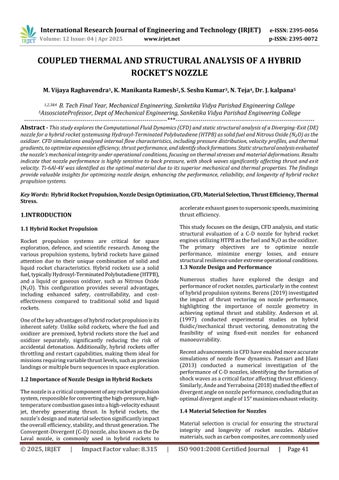
Where, is the mass flow rate, is the density of the propellantatthechamberpressure, isthecross-sectional areaofthethroat ,

Increasing the chamber's temperature will increase the rocket's efficiency. Less pronounced is the effect of pressureratioandbasic heatdissipation.Thecoefficientof nozzleexpansionisalsoanimportantparameterofnozzle design: (2)
Theoutputpressureofarocketnozzleistypicallydesigned to be equal to or slightly higher than the surrounding atmospheric pressure at a specific altitude (often at sea level or the design altitude). This ensures optimal performanceandminimizeslossesduetoover-orunderexpansion of the exhaust gases. However, as the rocket ascends and the atmospheric pressure decreases, the pressurethrustcomponentofthetotalthrustchanges F= ve+(Pe Pa) Ae (3)

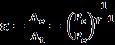
Theexhaustvelocity(ve)iscalculatedusingtheenthalpy changebetweenthechamberandtheexit:

ve= (4)
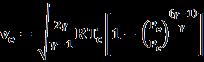
Usingisentropicrelations,theexhaustvelocitycanalsobe expressedintermsoftemperatureandpressureratios (5)
CFD simulations were conducted using ANSYS Fluent to analysetheinternalflowdynamicswithinthenozzle.The simulations focused on pressure distribution, velocity profiles,andthermalgradients.Thegoverningequations for compressible flow, including the Navier-Stokes equations,weresolvedusingafinitevolumemethod.The simulationswereperformedforvariousbackpressuresto studytheimpactofshockwavesonnozzleperformance.In the nozzle CFD analysis, the following steps were performed:
1. Modelling
2. Meshing
3. Pre-Processing
4. Solution
5. Post-Processing
International Research Journal of Engineering and Technology (IRJET) e-ISSN: 2395-0056
Volume: 12 Issue: 04 | Apr 2025 www.irjet.net p-ISSN: 2395-0072
Static structural analysis was conducted using ANSYS Mechanical toevaluatethe nozzle'smechanical integrity under operational conditions. The analysis focused on thermal stresses, material deformation, and structural stability.ThenozzlewasmodelledusingTi-6Al-4V,Inconel 718, and AlSi10Mg, and the results were compared to determine the most suitable material for nozzle construction.
ThedesignofaDeLavalnozzleforahybridrocketengine involvesseveral calculations.Fora typical hybridrocket propellant,suchasnitrousoxide(N₂O)astheoxidizerand HTPB as the fuel, the following parameters were calculated:
Throat Diameter (Dₜ): 6.43cm
Exit Diameter (Dₑ): 59.5cm
Expansion Ratio (ε): 85.74
Exit Velocity (vₑ): 951.2m/s
Nozzle Length (L): 25.7cm
Wall Thickness (t): 2cm
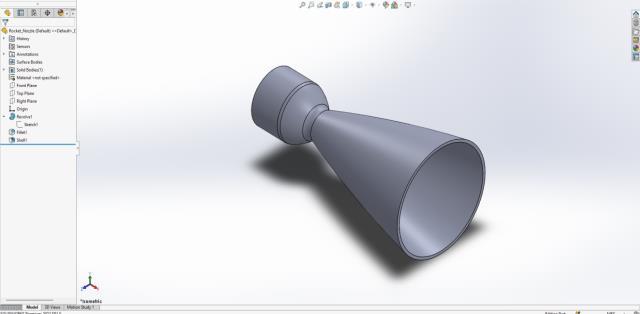
Computer-Aided Design (CAD) is a powerful tool for designing and analysing engineering components. SOLIDWORKS, a widely used CAD software, was employed to create a 3D model of the C-D nozzle. The nozzle was designed using sketch-based modelling, extrusions,andrevolves,andthefinalmodelwassaved inIGESformatforfurtheranalysis.
6.SIMULATION AND EXPERIMENTAL WORK
6.1 Computational Fluid Dynamics (CFD) Simulation
CFD simulations were conducted using ANSYS Fluent to analysetheinternalflowcharacteristicsoftheC-Dnozzle. Thesimulationsfocusedonpressuredistribution,velocity
profiles, and thermal gradients within the nozzle. The results were used to optimize the nozzle design for maximumthrustandefficiency.
6.1.1 Meshing and Boundary Conditions
Thenozzlegeometrywasdiscretizedintofiniteelements, andboundaryconditionswereappliedtosimulatetheflow ofexhaustgases.Theinletpressurewassetto9.8MPa,and theoutletpressurewasvariedtostudytheeffectofback pressureonnozzleperformance.
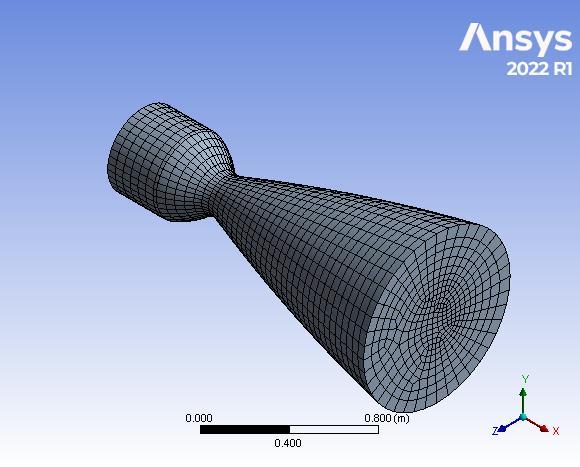
Fig6.1: Meshed part of fluid domain
6.1.2 Results of CFD Simulation
The CFD simulation results showed that the nozzle achievedsupersonicflowattheexit,withaMachnumber of3.647.Thepressureandvelocitydistributionswithinthe nozzlewereanalysedtoidentifyareasofhighstressand potentialshockwaveformation.
Finite Element Analysis (FEA) was used to evaluate the structural integrity of the nozzle under operational conditions. The analysisinvolveddiscretizing the nozzle into finite elements, applying boundary conditions, and solvingfornodaldisplacements,stresses,andstrains.The resultswereusedtoassesstheperformanceofdifferent materials,includingTi-6Al-4V,Inconel718,andAlSi10Mg.
Ti-6Al-4V: This material exhibited the lowest deformation and highest equivalent elastic strain, makingitthemostsuitableforCDnozzles.
Inconel 718: While offering slightly higher stress resistance, Inconel 718 had low elastic strain, makingitlesssuitableforCDnozzles.
AlSi10Mg: Despite its high stress resistance, excessive deformation made AlSi10Mg inadequate forhigh-precision,high-stressapplications.
International Research Journal of Engineering and Technology (IRJET) e-ISSN: 2395-0056
Volume: 12 Issue: 04 | Apr 2025 www.irjet.net p-ISSN: 2395-0072
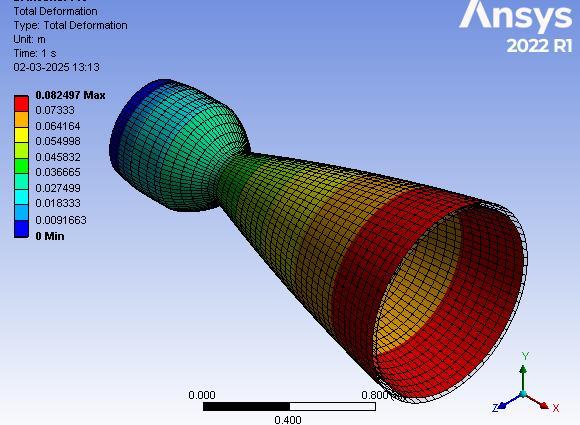
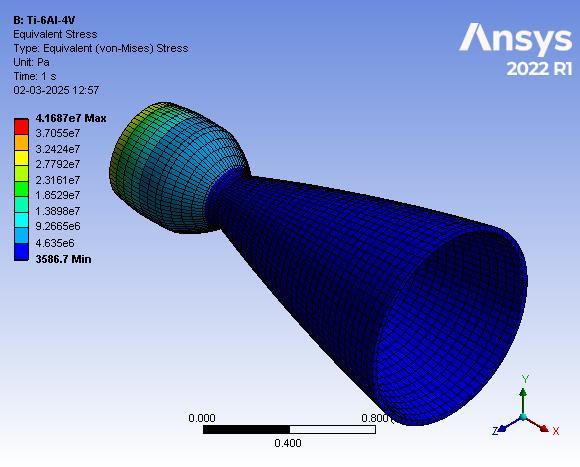
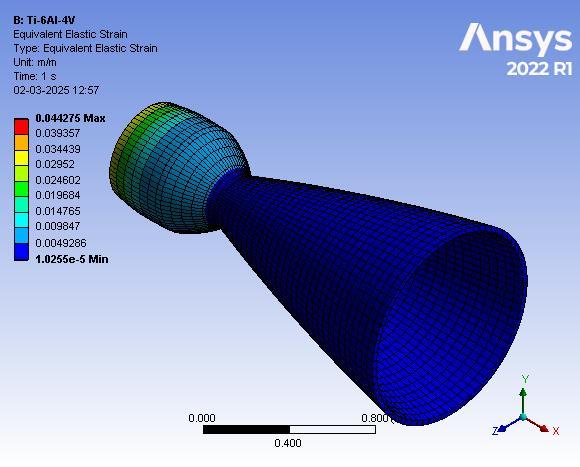
TABLE1: Comparedthestressvaluethemaximumyieldstrengthandthematerialsatisfied.
International Research Journal of Engineering and Technology (IRJET) e-ISSN: 2395-0056
Volume: 10 Issue: 03 | Mar 2024 www.irjet.net p-ISSN: 2395-0072
TheCFDsimulationswereconductedtoanalysetheinternal flow characteristics of the C-D nozzle, including pressure distribution, velocity profiles, and thermal gradients. The residualsgraph,shownbelow,illustratestheconvergenceof thesimulation,indicatingthatthesolutionreachedastable andaccuratestate.
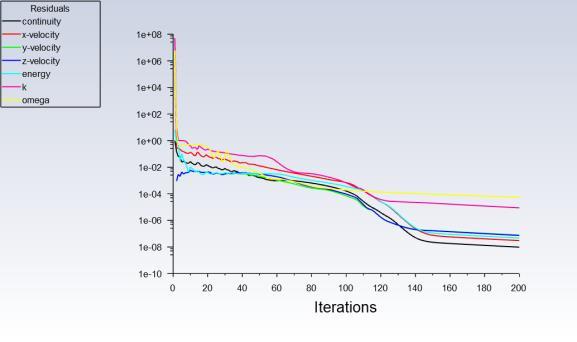
Fig8.1: Residual graph
This graph confirms that the CFD simulation achieved sufficient accuracy, providing reliable results for further analysis.Theconvergenceofresidualsisacriticalindicator ofthesimulation'sstabilityandvalidity,ensuringthatthe resultscanbetrustedforoptimizingnozzleperformance.
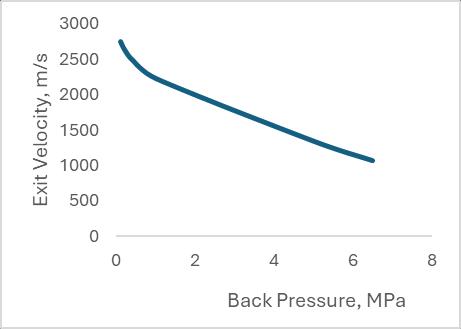
Thegraphhighlightstheinverserelationshipbetweenback pressureandexitvelocityinaC-Dnozzle.Asbackpressure increases, the exit velocity of exhaust gases progressively declines,signifyingalossofkineticenergy.
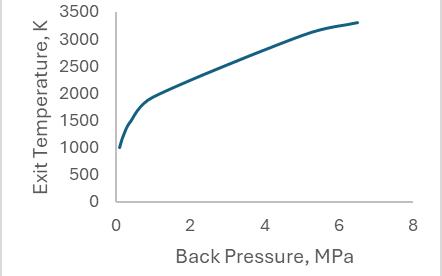
8.2 Back Pressure vs. Exit Temperature
Thegraphillustratesthedirectrelationshipbetweenback pressureandexittemperature.Asbackpressurerises,the exittemperatureoftheexhaustgasesincreases,indicatinga reductionintheefficiencyofthermalenergyconversioninto kineticenergy.
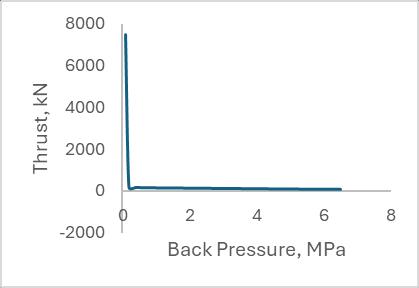
8.3 Back Pressure vs. Thrust
The graph shows the critical interplay between back pressure and thrust performance. At near-zero back pressure,thereisasharpsurgeinthrust,indicatingoptimal nozzleperformance.However,evenminorincreasesinback pressurecausearapidthrustdecline.
The study concludes that Ti-6Al-4V is the most suitable materialforConvergent-Divergent(C-D)nozzlesinhybrid rocket systems due to its superior mechanical properties, including low deformation and high elastic strain. The analysishighlightsthesignificantimpactofbackpressureon nozzleperformance,withincreasedbackpressureleadingto shock wave formation, reduced thrust, and higher exit temperatures. Experimental tests validated the CFD simulations, confirming the accuracy of the simulation model.Thefindingsemphasizetheneedforprecisenozzle design tailored to specific operating conditions, balancing thrust,efficiency,andstructuralintegrity.Futureresearch shouldfocusonadaptivenozzledesigns,advancedmaterials, andimprovedcoolingtechniquestooptimizeperformance across varying altitudes and back pressures. This study provides a robust framework for advancing hybrid rocket propulsion systems, contributing to more efficient and reliableaerospaceandspaceexplorationapplications.
International Research Journal of Engineering and Technology (IRJET) e-ISSN: 2395-0056
Volume: 10 Issue: 03 | Mar 2024 www.irjet.net p-ISSN: 2395-0072
Additionally, the study underscores the importance of integratingcomputationalandexperimentalapproachesto achievereliableandrobustnozzledesigns.Thecombination of CFD simulations, Finite Element Analysis (FEA), and experimental validation offers a comprehensive understanding of nozzle behaviour under extreme conditions. By addressing the challenges of thermal management, material selection, and performance optimization, this research paves the way for innovative solutionsinhybridrocketpropulsion.Theinsightsgained fromthisstudycanbeappliedtodevelopnext-generation nozzles capable of withstanding higher thermal and mechanicalloads,ultimatelyenhancingthesafety,efficiency, andsustainabilityofhybridrocketsystemsforfuturespace missions.
Reference:
[1] D. Kornack and P. Rakic, “Cell Proliferation without NeurogenesisinAdultPrimateNeocortex,”Science,vol. 294, Dec. 2001, pp. 2127-2130, doi:10.1126/science.1065467.
[2] Berens, T.M., "Pitch Thrust Vectoring Studies for the EurofighterTyphoonCombatAircraftwithImpactfrom External Aerodynamics," AIAA SciTech Forum, 7-11 January2019.
[3] Anderson, J.C., "Investigation of Hybrid Fluidic/Mechanical Thrust Vectoring for Fixed-Exit ExhaustNozzles,"AIAA,1997
[4] Ikaza,D.,"ThrustVectoringNozzleforModernMilitary Aircraft," Paper presented at the NATO R&T OrganizationSymposiumonActiveControlTechnology forEnhancedPerformanceOperationalCapabilitiesof Military Aircraft, Land Vehicles, and Sea Vehicles, Braunschweig,Germany,8-11May2000
[5] Orme, J.S., Hathaway, R., and Ferguson, M.D., "Initial FlightTestEvaluationoftheF15ACTIVEAxisymmetric VectoringNozzlePerformance,"AIAAPaper1998-3871, 34th AIAA/ASME/SAE/ASEE Joint Propulsion ConferenceandExhibit.
[6] Pansari, K., and Jilani, S.A.K., "Numerical Investigation the Performance of Convergent Divergent Nozzle," InternationalJournalofModernEngineeringResearch, September-October2013
[7] Ande, R., and Yerraboina, V.N.K., "Numerical Investigation on Effect of Divergent Angle in Convergent-DivergentRocketEngineNozzle,"Chemical EngineeringTransactions,May2018
[8] Ajoko, T.J., and Tuaweri, T.J., "Design Optimization of Convergent Divergent Aircraft Nozzle", International
Journal of Scientific & Engineering Research, January 2017.
[9] Zivkovic,S.,Milanovic,M.,Gligorijevic,N.,andPavic,M., "Experimental research and numerical simulations of thrust vector control nozzle flow," The Aeronautical Journal,May2016
[10] Noaman, H.R., Tang, H.B., and Khalil, E., "Numerical Simulation of Nozzle Flow Field with Secondary Injection Thrust Vector Control," MATEC Web of Conferences,May2018
[11] Dr. A Revanth Reddy, Design and Computational Analysis Of Two Dimensional Thrust Vectoring ConvergentDivergentNozzle,“Turkishonlinejournalof qualitativeinquiry”.
[12] MD.SafayetHossain,ComparativeStudyOfSupersonic Nozzle,“Internationaljournalofresearchinengineering 111111111andtechnology”.
[13] Daljit Majil, "Design and Analysis of Jet Vane Thrust VectoringNozzleUsingCFDandOptimizationofNozzle Parameters"
[14] In2012,M.Shademanetal,publishedapaperwiththe tide "CFD Study of Effects of Geometry Variations on FlowinaNozzle.
[15] In2015.KNehruetalpublishedapaperwiththetitle “ComputationalStudyofMechanicalThrustVectoring”.
International Research Journal of Engineering and Technology (IRJET) e-ISSN: 2395-0056
Volume: 10 Issue: 03 | Mar 2024 www.irjet.net p-ISSN: 2395-0072


Dr.J.Kalpana, an associate professor at Sanketika Vidhya Parishad Engineering College, serves as our invaluable guide for this project in Mechanical Engineering. With over 11 years of experience in to her field and holding a PhD in Mechanical Engineering from Centurion University ODISHA, Kalpana ' expertise greatly contributes to the project's success. Under her mentorship, we have conducted tests and obtained results with significant potential for future applications. Kalpana not only provides guidance but also extends extensive support throughout the project, ensuring its smooth progress. Our case study on "Coupled Thermal and Structural Analysis of a Hybrid Rocket's Nozzle” specifically revolves around improving hybrid rocket nozzle design by balancing aerodynamic efficiency and structural durability, supporting advancements in reusable and high-performance propulsion system using technologies in Mechanical Engineering, benefiting from Kalpana's profound knowledge and guidance benefiting from Kalpana's profound knowledge and guidance
.Vijaya Raghavendra: M. Vijaya Raghavendra is a dedicated 4th-year Mechanical Engineering student at Sanketika Vidya Parishad Engineering College with a strong theoretical knowledge and hands-on research experience in thermal-structural analysis and aerospace propulsion systems. As a team leader to the analysis project "Coupled Thermal and Structural Analysis of a Hybrid Rocket's Nozzle. The student demonstrated expertise in computational fluid dynamics (CFD), finite element analysis (FEA), and material selection for high-temperature applications, His work involved optimizing nozzle performance using ANSYS simulations, validating results through experimental testing, and identifying Ti-6Al-4V as the most suitable material for rocket nozzles due to its superior thermal and mechanical properties. The candidate holds certifications in CAD/CAM/CNC operations, and Generative AI applications, reflecting a versatile skill set., they combine theoretical knowledge with practical engineering solutions. Known for strong analytical thinking, problem-solving abilities, and adaptability to emerging technologies..