
International Research Journal of Engineering and Technology (IRJET) e-ISSN: 2395-0056
Volume: 13 Issue: 01 | Jan 2026 www.irjet.net p-ISSN: 2395-0072
International Research Journal of Engineering and Technology (IRJET) e-ISSN: 2395-0056
Volume: 13 Issue: 01 | Jan 2026 www.irjet.net p-ISSN: 2395-0072
Nagabhushan V S1 , Dr. Kiran T2
1Student of Master in Technology, Department of Civil Engineering, University of Visvesvaraya College of Engineering, Bengaluru, Karnataka, India.
2Associate Professor, Department of Civil Engineering, University of Visvesvaraya College of Engineering, Bengaluru, Karnataka, India.
Abstract- Impact loading at low velocity is one of the important design considerations for reinforced concrete elements under accidental and service-level dynamic actions. The paper reports an experimental study on the impact performance of steel Fibre reinforced concrete (SFRC) slabs internally reinforced with HYSD, hybrid (HYSD+GFRP), and GFRP bars in ambient temperature exposure. A total of six square slab specimens of size 500 × 500 × 50 mm were prepared using M30 grade concrete; two specimens for each type of reinforcement, with and without 0.65% steel Fibre volume fraction. All slabs were internally reinforced with a single layer of reinforcement near the tension face and tested under repeated low-velocity impact loading from a drop weight of 10 kg released from a height of 1 m. The impact performance was assessed in terms of the number of blows at whichthe first visible crack appearedandthe total number of blows withstood prior to failure. The test results show that HYSDbar-reinforcedslabshavethebestimpactperformance, with hybrid reinforcement closely following, while GFRPreinforced slabs have comparably poorer performance. Steel Fibres further enhance cracking resistance and also increase post-crack energy absorption amongst the types of reinforcements.Hybridreinforcementtendstogiveabalanced response in terms of combining the toughness of steel and the corrosion resistance of GFRP. The test results thus demonstrate the potential of addition of Fibres and hybridizationstrategiestoimprovetheimpactperformanceof concrete slabs under low-velocity impact loading conditions.
Key Words: Steel Fibre Reinforced Concrete (SFRC), Glass Fibre Reinforced Polymer (GFRP), impact loading, residual strength, energy absorption, crack propagation, bond degradation, impact resistance.
Concrete slabs in civil and industrial structures are often subjected to low-velocity impact load arising from falling objects, vehicular movements, industrial accidents, and extreme events. Such loading results in highly localized damage,degradationinstiffnessproperties,andprogressive cracking,andisnotsufficientlyelicitedthroughconventional static design procedures. Hence, a large number of experiments have been conducted and numerical
investigations done to understand the impact response of reinforcedconcreteslabs.
A few researchers have explored the influence of reinforcement detailing and slab parameters on impact performance. Yue Wang et al. (2021) and Senthil et al. (2024)foundthatthepeakimpactforceanddisplacement and mode of failure were significantly controlled by the thickness of the slab and the location of impact, while an increase in reinforcement ratio alone allows only limited improvementbecausethedamagemechanismisdominated byconcrete.Reinforcementspacinghasbeenexperimentally andnumericallystudiedbyTolgaYılmazetal.(2019),who demonstrated that closer spacing of the bar effectively restrictsdeflectionandpropagationofcracksunderdropweightimpactloading.
Withthepurposeofenhancingimpactresistance,steelfibre reinforced concrete has gained significant attention. ExperimentalworksbyTekleabandWondimu(2022)and Vivasetal.(2020)showedthatsteel fibres enhancecrack control, toughness, post-cracking energy absorption, and reductionofspallingandpunchingdamage.Similarly,Reddy etal.(2024)pointedoutthesynergisticeffectresultingfrom hybrid fibre systems, which exhibited high mechanical propertiesimprovementandoutstandingimpactresistance whencomparedtoplainconcrete.
Overthelastcoupleofdecades,therehasbeeninterestin non-corrosivereinforcementasanalternativetotraditional steel reinforcement. Experimental and numerical studies conducted by Maher A. Adam et al. (2021) and Hamid Sadraie et al. (2019) demonstrated that GFRP-reinforced slabsdeveloplargerdeflectionsandmoredispersedcracking under impact, attributed to the lower elastic modulus of GFRP.However,adequateimpactresistancemaybeachieved by adopting an appropriate reinforcement configuration. Further numerical studies by Liu Jin et al. (2023) have demonstratedthatduringimpact,concreteabsorbsmostof the energy, while GFRP reinforcement contributes insignificantly to energy dissipation but rather to postimpactintegrity.
Hybrid reinforcement systems are being presented to combine the advantages of steel and GFRP reinforcement. TohidMousaviandErfanShafeidemonstratedin2019that
International Research Journal of Engineering and Technology (IRJET) e-ISSN: 2395-0056
Volume: 13 Issue: 01 | Jan 2026 www.irjet.net p-ISSN: 2395-0072
theuseofhybridFRPsteelreinforcementincreasesimpact resistance because of balancing stiffness, ductility, and energy absorption. It leads to a more uniform crack distribution with lower residual damage compared to conventionalreinforcement.
Despitethese,themajorityofcurrentresearchconcentrates on steel-reinforced slabs, GFRP-reinforced slabs, or fibrereinforced concrete separately. Very few comparative experimental tests have been conducted at ambient temperature regarding low-velocity impact performance betweenHYSDsteel,hybridreinforcement(HYSD+GFRP), andGFRP-reinforcedSFRCslabsunderidenticalconditions. Thecombinedeffectsofreinforcementtypeandsteelfibre additiononcrackingresistance,numberofblowstofailure, ductility,andenergyabsorptioncapacityhavealsonotbeen adequatelyaddressed.
Therefore,thecurrentstudyinvestigatesexperimentallythe low-velocityimpactbehaviourofSFRCslabsreinforcedwith HYSDsteel,hybridHYSD+GFRP,andGFRPbars.Thestudy focuses on some of the main impact response parameters suchascrackingbehavior,peakimpactresponse,ductility, and energy absorption characteristics, hence providing experimental evidence for the development of impactresistantanddurableconcreteslabsystems.
The experimental program involved preparation andtestingofsixreinforcedconcreteslabspecimenswhich includedthreedifferent reinforcementsystems,thatwere HYSDsteel,hybrid(HYSD+GFRP),andGFRPreinforcements castwiththehelpoftwoconcretemixes,includingnormal concrete(NC)andasteelfibrereinforcedconcrete(SFRC). The aim was to determine the effect of the type of reinforcement and the incorporation of fibre on the effect performance of slab elements. All mixes were made using OrdinaryPortlandCement(OPC)53gradethatconformedto theIS12269.Fineaggregates(ManufacturedsandM-sand) withspecificgravityof2.65weretaken,andcrushedgranite coarseaggregatewitha maximum nominal sizeof20 mm was taken. All the aggregates qualified the grading requirements of the IS 383 and were kept dry to allow uniformity in the water-cement ratio during batching. NC andSFRCmixeswereadjustedinamannerthattheywould gainadistinguishingcompressivestrengthof30MPa(M30 grade)in28daysandwater-cementratioremainedconstant at 0.43. In the case of SFRC mix, the volume fraction of crimped steel fibre was 0.65 percent, a value chosen to improvethepost-crackingbehaviour,toughnessandbeable toabsorbenergyduringimpactloading.Thefibreswere67 in aspect ratio with the capability to bridge the crack and delaycrackpropagationeffectively.Bothmixeswereadded with a normal consistency plasticizer that met the requirements of IS 9103 to enhance workability and even distributionoffibres.Thereinforcementwasdifferentiated
bythetypeofspecimen.Thesingle-layerconstructionswere built with HYSD steel bars, GFRP bars and hybrid reinforcement(HYSD+GFRP)whichwereinstalledcloseto thetensionface.Layoutsallthereinforcementlayoutsused 6mmdiameterbarsandcentre-to-centrespacingof75mm longitudinally and transversely. The GFRP bars were in compliance with the specificationsof IS18255:2023,and thetensilestrengthofthebarwasaveragedto600700Mpa withamodulusofelasticityrangingbetween40-50Gpaand alsoHYSDbarsofferedductilebehaviourandunderwenta high plastic deformation before yielding. Each of the slab specimenswascastwithaconsistentsizeof500mmx500 mm x 50 mm and a nominal cement cover of 15mm was made so that the reinforcement was embedded in the shallowconcretedepth.Eachreinforcementcategoryhada slabcastwithNCandslabwithSFRCeach,whichallowed makingadirectcomparisonoftheimpactresistanceeffectof theincorporationofsteelfibres.
ThemixproportionsadoptedforM30concreteusedinthe studyaresummarizedinTable2.1.
Table 2.1: MixProportion
Theobjectiveoftheexperimentalprogramwasto examinethebehaviouroflow-velocityimpactsofSFRCslabs reinforcedwithvariousreinforcementsystemsinambient temperatureconditions.Sixslabspecimenswithandwithout steel Fibre were cast and tested and included three reinforcementtypesincludingHYSD,hybrid(HYSD+GFRP) and GFRP. All the specimens were experimented at room temperature under repeated drop-weight impact loading test.
Allslabspecimensmeasured500mm×500mm× 50 mm, with a single reinforcement layer placed near the tensionface.TheslabsweredesignatedasshowninTable 3.1basedonreinforcementcondition.
International Research Journal of Engineering and Technology (IRJET) e-ISSN: 2395-0056
Volume: 13 Issue: 01 | Jan 2026 www.irjet.net p-ISSN: 2395-0072
Specimen ID Reinforcement Fibres
H-NC HYSD NoFibre
H-SFRC HYSD 0.65%
SteelFibre
HG-NC HYSD+GFRP NoFibre
HG-SFRC HYSD+GFRP 0.65%
SteelFibre
G-NC GFRP NoFibre
G-SFRC GFRP 0.65%
SteelFibre
The impact behaviour was evaluated using a vertical drop-weight impact testing apparatus. A 10 kg steel impactorwasrepeatedlydroppedfromaheightof1meter ontothecentreofeachslabtoinduceprogressivedamage.
ImpactorMass:10kg
DropHeight:1.0m
ImpactEnergy(perblow):E=mgh≈98Joules
SupportSystem:Four-edgefixedframewithaclear spanof450mm
DamageTracking:Numberofblowstofirstvisible crackandultimatefailure
AsimpleschematicoftheimpactsetupisshowninFig-3.1
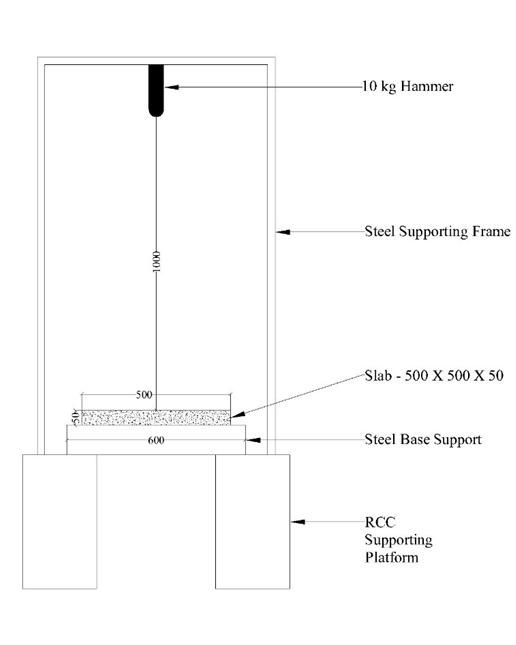
Fig-3.1: TestSetupofDropWeightImpactTest
During each drop, the impactor was manually guided to maintainaconsistentstrikeposition.Aftereveryblow,the slabwasvisuallyinspectedforsurfacecracks,edgefailure, spalling,delamination,andpenetration.Crackpatternswere traced using a permanent marker to record progressive damagecharacteristics.
Thedamage-basedandenergy-basedperformancemeasures were considered to be the primary measure of impact responseoftheslabspecimenswithoutexplicitimpactload anddisplacementtimehistory.Theprocessofwatchingthe progressofdamageduringthetestingprocessusedvisual inspectionandphotographicdocumentation.Thepatternsof crack initiation, crack propagation, surface spalling and failurepatternswerecapturedusingahigh-resolutiondigital camerafollowingeveryimpactblow.
The key response parameters considered in the present studywere:
Numberofblowsrequiredtoinitiatethefirstvisible crack
Numberofblowssustaineduntilultimatefailure
Totalenergyabsorbedbytheslabspecimen
Qualitative assessment of stiffness degradation basedonprogressivedamageevolution
Crack propagation characteristics and surface deteriorationpatterns
Theenergyabsorptionofeachspecimenwasevaluatedin terms of the cumulative impact energy sustained until failure. Since the mass of the drop hammer and the drop height were kept constant throughout the experimental program,theimpactenergyimpartedperblowwasassumed tobeconstantandwascalculatedusing:
Eb=mgh
WhereEb istheimpactenergyperblow(J), isthemassof thehammer(kg),gistheaccelerationduetogravity(9.81 m/s²), and is the drop height (m). The total energy absorbedbyaspecimen,Etotalwasthencomputedas:
Etotal=Nf×Eb
Where NF is the number of blows sustained until ultimate failure. This approach enabled a consistent and objective comparison of the impact energy dissipation capacity of differentslabspecimens.
The test was extended until the specimen showed loss of structuralintegrity,whichwasthedevelopmentofthroughthicknesscracking,extremesurfacecrushingintheimpact location, punching-type failure, or obvious rupture of reinforcementinthetensionarea.Thismethodologyenabled to conduct a credible evaluation of impact resistance and prioritize to experimentally significant and practically relevantperformanceindicators.
TheperformanceoftheSFRCslabsreinforcedwithvarious reinforcementmethodswastestedonthebasisoftheblows that are needed to cause the first visible crack and the number of blows that the structure can withstand till it becomes fractured. The findings give an idea about the
International Research Journal of Engineering and
Volume: 13 Issue: 01 | Jan 2026 www.irjet.net
impactoftypeofreinforcementandsteelfibreinclusionon low-velocityimpactresistance.
Table 4.1 – NumberofBlowstoFirstCrackandUltimate
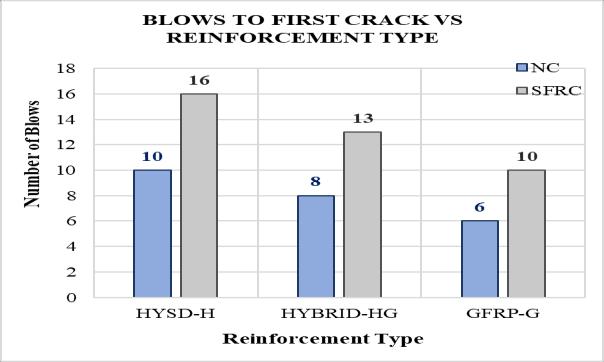
Chart-1: NumberofBlowstoFirstCrackVs ReinforcementType
Thenumberofblowstakentomakethefirstvisible crackgivesameasureoftheinitialstiffnessandresistanceto cracking of the slab system when subjected to repeated impactload.ThefindingsindicatethattheHYSD-reinforced slabs were the most resistant to crack initiation as the HSFRCandH-NCneeded16and10blowsrespectively.Thisis mostlyrelatedtothefactthatthereinforcementismadeof steel,whichhasahighermodulusofelasticityandaductile nature, thus is able to inhibit the development of tensile stressintheconcretematrix.
The slabs reinforced with hybrid proved to be intermediateconcerningcracking,whereHG-SFRCandHGNCfirstrecordedacrackat13and8blows,respectively.The steel also helped in enhanced crack control of the hybrid systemincomparisontoGFRP-reinforcedslabsentirelyand thelowerrigidityofGFRPledtotensilecrackingearlierthan HYSDsystems.
GFRP-reinforced slabs demonstrated minimum resistancetocrackformation,whereG-NCandG-SFRCslabs crack after receiving 6 and 10 blows respectively. Linear elasticityandthelesserelasticityofGFRPbarswasafactor ofincreasedtensilestraininconcrete,whichfavorsafaster crackdevelopment.
Theuseofsteelfibrethroughoutthereinforcement types enhanced the blows to first-crack, which confirmed their ability to slow down the occurrence and growth of micro-cracks.
Thedamagetoleranceandaftercrushingresistance ofslabspecimenstorepeatedimpactloadingarethenumber ofblowstakentoultimatefailure.Slabsthatwerereinforced withHYSDshowedbetterresistancetofailurewithH-SFRC taking30blowsascomparedtoH-NCtaking22blows.
Gradual stiffness degradation and progressive energy dissipation before failure were allowed by the capability of the steel reinforcement to go through plastic deformation.Hybrid-reinforcedslabswithstood26and20 blows(HG–SFRC)and(HG–NC),respectively,whichsuggests that they have greater damage tolerance than GFRPreinforcedslabsbutarenotaseffectiveasHYSD-reinforced systems.
The reinforcement of the steel plus the GFRP allowed the redistribution of stress partially, which led to both the post-cracking behaviour and the delayed failure. Slab reinforced with GFRP was most sensitive to failures withGFRP,G-NCandG-SFRCcollapsingat16and21blows, respectively.
There werenoyieldingcharacteristics and brittle rupturecharacteristicsofGFRPbarswhichrestrictedpostcrackingenergydissipation,causingswifterstiffnessdecay.
However, incorporation of steel fibre vastly enhancedthenumberofblowstofailureinallthetypesof reinforcements because of improved crack bridging and structuralintegrityduringmultipleimpactsloading.
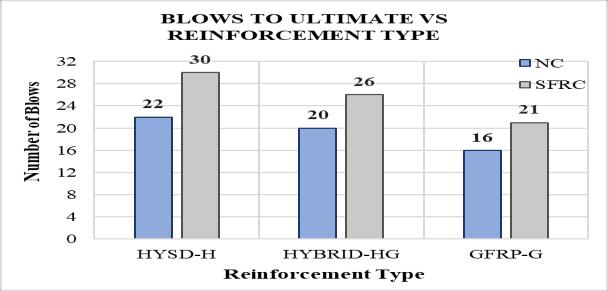
Chart-2: NumberofBlowstoUltimateVsReinforcement Type
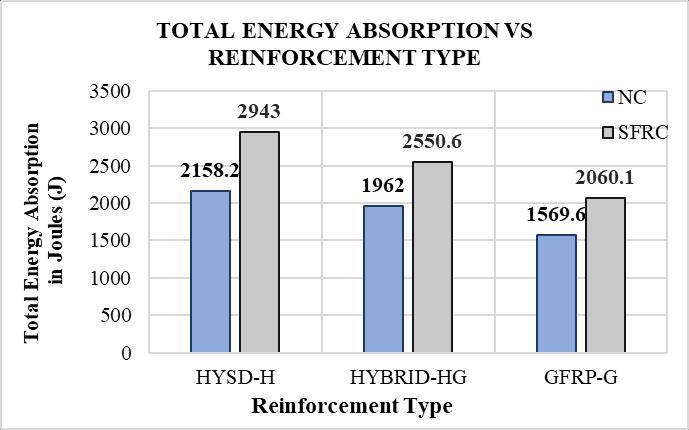
The total energy absorbed by the slab specimens was evaluated as the cumulative impact energy sustained untilfinalfailure.Theresultsindicatethatthereinforcement
International Research Journal of Engineering and Technology (IRJET) e-ISSN: 2395-0056
Volume: 13 Issue: 01 | Jan 2026 www.irjet.net p-ISSN: 2395-0072
system and the incorporation of steel fibres significantly influencetheimpactenergydissipationcapacityofconcrete slabs.
Amongallspecimens,H–SFRCexhibitedthehighest totalenergyabsorption(2943J),followedbyH–NC(2158J), demonstrating the superior damage tolerance of HYSDreinforcedslabs.Theenhancedperformanceisattributedto theductileyieldingbehaviourandhigherstiffnessofsteel reinforcement, which enabled progressive damage accumulation under repeated impact loading. Hybridreinforced slabs showed intermediate energy absorption capacities, with HG–SFRC (2551 J) and HG–NC (1962 J) sustaining lower total energies compared to HYSDreinforcedslabsbutsignificantlyhigherenergiesthanGFRPreinforced slabs. This response reflects the combined contributionofsteelandGFRPreinforcement,wheresteel facilitated energy dissipation while GFRP maintained structural continuity. GFRP-reinforced slabs absorbed the lowesttotalimpactenergy,withG–NCandG–SFRCrecording 1569Jand2060J,respectively.Therelativelylowerenergy absorptionisassociatedwiththelinearelasticresponseand brittle failure characteristics of GFRP bars, which limited post-crackingenergydissipation.However,theinclusionof steel fibres resulted in a noticeable increase in total absorbedenergyacrossallreinforcementtypes,particularly forGFRP-reinforcedslabs,wherefibrescompensatedforthe limitedductilityofthereinforcement.
Overall,theresultsconfirmthatsteelfibresenhance the post-cracking energy absorption capacity, while reinforcementtypegovernstheultimateenergydissipation potential of concrete slabs subjected to repeated lowvelocityimpactloading.
5. CONCLUSIONS
This paper experimentally examined the repeated low impact-velocitybehaviourofconcreteslabsreinforcedwith HYSDsteel,hybridreinforced(HYSD+GFRP)andGFRPbars, which were cast in normal concrete (NC) and steel fibre reinforcedconcrete(SFRC).Thefollowingconclusionsare madebasedontheresultsobtained:
1. Thisreinforcedsystemhadastrongeffectontheimpact response of slabs. Slabsreinforced with HYSD showed thegreatestabilitytoendurethecrackingprocessand finalfailure,followedbyhybridandGFRP-reinforcement slabs.
2. Slabs reinforced with HYSD steel took the longest number of blows to first crack and longest number of blowstofailwhichcanbeexplainedbythefactthatsteel reinforcement is stiffer and also ductile in its yielding behaviour.
3. Thehybrid-reinforcedslabsshowedintermediateresults, which implies that the mixed application of steel and GFRPreinforcedslabshelpsredistributestresspartially, and enhances the post-cracking capacity, which is superiortofullyGFRP-reinforcedslabs.
4. Compared to other reinforcement types, GFRPreinforcedslabswerefoundtoberelativelylessresistant torepeatedimpactloadingbecauseofthelinearelastic reaction and brittle failure nature of GFRP bars which restrainedthepost-crackingenergydissipation.
5. All slab specimens were considerably improved in impact performance due to the addition of steel fibre. The slabs of SFRC always had significantly later crack initiation,moreblowstofailureandlargertotalenergy absorptionwhencomparedtotheirNCcounterparts.
6. The reinforcement ductility as well as fibre inclusion controlled total energy absorption. The highest cumulative impact energy was absorbed in HYSDreinforced SFRCslabswhereasfibreaddition wasvery effectivetoenhancethepost-crackingresponseofhybrid andGFRP-reinforcedslabs.
In general, the findings validate that steel fibres are important in improving post-cracking toughness, and the selectionofthereinforcementsystemalsodictatesthetotal impactresistanceandtheenergy-dissipationabilityofpostcrackingconcreteslabsunderrepeatedlow-velocityimpact loading.
Based on the findings of this study, the following recommendationsareproposed:
1. HYSD-reinforced SFRC slabs are recommended for structural applications where repeated low-velocity impact loading is anticipated, owing to their superior cracking resistance, damage tolerance, and energy absorptioncapacity.
2. Hybridreinforcementsystemsmaybeconsideredasa viablealternativeinsituationswhereabalancebetween impactresistanceanddurabilityisrequired,particularly inaggressiveenvironments.
International Research Journal of Engineering and Technology (IRJET) e-ISSN: 2395-0056
Volume: 13 Issue: 01 | Jan 2026 www.irjet.net p-ISSN: 2395-0072
3. The use of GFRP reinforcement in impact-prone structures should preferably be accompanied by steel fibre incorporation to compensate for the limited ductilityandenergydissipationcapacityofGFRPbars.
4. Steel fibre inclusion is recommended for impactresistantslabdesignirrespectiveofreinforcementtype, as it consistently improves crack control and postcrackingperformance.
5. Future research should focus on the effects of fibre volumefraction,reinforcementratio,slabthickness,and elevated temperature exposure on repeated impact behaviour, supported by numerical simulations to extendtheapplicabilityofexperimentalfindings.
[1] Ö. Anil, E. Kantar, M.C. Yilmaz, Low velocity impact behavior of RC slabs with different support types, ConstructionandBuilding Materials 93(2015) 1078–1088.
[2] K.C.G.Ong,M.Basheerkhan,P.Paramasivam,Resistance offibreconcreteslabstolowvelocityprojectileimpact, CementandConcreteComposites21(1999)391–401.
[3] G.Ramakrishna,T.Sundararajan,Impactstrengthofa few natural fibre reinforced cement mortar slabs: a comparativestudy,CementandConcreteComposites27 (2005)547–553.
[4] K. Habel, P. Gauvreau, Response of ultra-high performance fibre reinforced concrete (UHPFRC) to impact and static loading, Cement and Concrete Composites30(2008)938–946.
[5] Y.Farnam,S.Mohammadi,M.Shekarchi,Experimental and numerical investigations of low velocity impact behaviorofhigh-performancefibre-reinforcedcementbased composites, International Journal of Impact Engineering37(2010)220–229.
[6] H.S. Rao, V.G. Ghorpade, N.V. Ramana, K. Gnaneswar, Response of SIFCON two-way slabs under impact loading,InternationalJournalofImpactEngineering37 (2010)452–458.
[7] M.Z.Zineddin,T.Krauthammer,Dynamicresponseand behavior of reinforced concrete slabs under impact loading,InternationalJournalofImpactEngineering34 (2007)1517–1534.
[8] H.Sadraie,A.Kheyroddin,M.Kazemi,Impactresistance ofconcreteslabsreinforcedwithsteelandGFRPbars, ConstructionandBuildingMaterials197(2019)62–75.
[9] T. Mousavi, E. Shafei, Impact behavior of RC slabs reinforced with hybrid FRP–steel bars, Engineering Structures199(2019)109598.
[10] T. Yılmaz, A. Güneş, Ö. Anil, Impact behaviour of twowayreinforcedconcreteslabssubjectedtodrop-weight loading,ConstructionandBuildingMaterials211(2019) 362–374.
[11] M.A.Adam,M.M.Reda,A.El-Gamal,Structuralbehavior of GFRP-reinforced high-strength concrete slabs, CompositeStructures256(2021)113047.
[12] Y.Wang,Z.Zhang,J.Hao,Experimentalandnumerical investigationofRCslabsundersuccessivelow-velocity impacts, International Journal of Impact Engineering 150(2021)103785.
[13] T.Tekleab,B.Wondimu,Impactresistanceofsteelfibre reinforced concrete slabs-on-grade, Construction and BuildingMaterials327(2022)126969.
[14] J.Liu,X.Zhang,H.Li,Low-velocityimpactbehaviourof GFRP bar reinforced concrete slabs: numerical investigation,CompositeStructures307(2023)116607.
[15] A.A.Abbass,Effect of elevatedtemperatureonimpact resistance of steel fibre reinforced concrete, Construction and Building Materials 370 (2023) 130650.