
International Research Journal of Engineering and Technology (IRJET) e-ISSN: 2395-0056
Volume: 13 Issue: 02 | Feb 2026 www.irjet.net p-ISSN: 2395-0072
International Research Journal of Engineering and Technology (IRJET) e-ISSN: 2395-0056
Volume: 13 Issue: 02 | Feb 2026 www.irjet.net p-ISSN: 2395-0072
Mrs. M. Sushma1 , M.Chandu2, M. Naga Harish Babu3, M. Ajay4, P. Praveen 5
1Assistant Professor, Department of IT, TKR College of Engineering and Technology, Telangana, India 2,3,4,5B.Tech Students, Department of IT, TKR College of Engineering and Technology, Telangana, India
Abstract - The increasing prevalence of counterfeit productsinsupplychainsposessignificantriskstoconsumers and manufacturers alike. This paper presents verify Chain, a block chain-poweredproduct verificationsystemdesigned to ensure authenticity and traceability throughout the supply chain The system allows manufacturers to register products with unique QR codes and SHA-256 hash keys, which are recorded in a blockchain ledger as immutable blocks. Distributors and retailers verify and transfer product ownership via hash based authentication, maintaining a tamper-proof supply chain history. Customers can scan the product QR code to verify authenticity and access detailed supplychaininformation,augmentedbyanAI-drivenassistant that answers product-related queries. Verify Chain leverages the transparency and immutability of blockchain, combined with real-time AI guidance, to combat counterfeiting effectively and enhance consumer trust. Experimental deployment demonstrates accurate product verification and real-time traceability across multiple supply chain stages
Key words : Block chain, Product Verification, Counterfeit Detection, Supply Chain Traceability, QR Code Authentication
In recent years, the rapid growth of global trade and ecommerce has significantly increased the circulation of counterfeitproductsacrossmultipleindustries.Thesefake products not only damage the reputation and revenue of legitimate manufacturers but also pose serious risks to consumersafety.Traditionalproducttrackingsystemsthat rely on centralized databases are often vulnerable to manipulation, data loss, and lack of transparency. Hence, there is a pressing need for a secure, decentralized, and reliable mechanism to verify product authenticity throughoutitslifecycle.
Toaddressthesechallenges,thisworkproposes verifyChain, a block chain-based system that integrates cryptographic hashing,QRcodeverification,andartificialintelligencefor real time product authentication. The system enables manufacturerstoregisterproductswithauniqueSHA-256 hashandQRcode,formingthegenesisblockinatransparent supply chain ledger. Distributors and retailers further validateandtransferownershipthroughverifiedblockchain transactions, ensuring end-to-end traceability. At the consumer level, a QR code scan provides authenticity
verificationanddisplaysthecompletesupplychainhistory. Furthermore, verify Chain incorporatesaGemini2.5Flash–powered AI chatbot to assist customers by answering product-relatedqueriesandclarifyingsupplychaindetails. Thisintegrationnotonlyenhancesuserinteractionbutalso promotes transparency and consumer confidence. The proposedsystem,leveragingblockchain’simmutabilityand AI’s contextual intelligence, offers a scalable and tamperproofsolutionformitigatingcounterfeitingandenhancing supplychaintrustworthiness.
Counterfeitproductsareamajorissueaffectingindustries worldwide, causing enormous financial losses and posing health and safety risks, especially in sectors like pharmaceuticals and electronics. Traditional methods of verifyingauthenticity,suchasbarcodesandserialnumbers, areofteneasytoforge,whilemanualinspectionsaretimeconsumingand proneto error. Trackingcounterfeit items throughoutthesupplychainisextremelydifficultduetoa lack of transparency among suppliers. Consumers often cannotdifferentiatebetweenrealandfakeproducts,which reducestrustanddamagesbrandvalue.Companiesspend significantresourcesonanti-counterfeitingcampaigns,while governments and regulatory bodies struggle to enforce product authenticity. E-commerce platforms also face challengesdetectingfakeproductsonline,andcross-border trade adds complexity to tracking genuine goods. These challengeshighlighttheurgent needfora secure,reliable, and transparent system to ensure product authenticity. Blockchain technology emerges as a potential solution, offering a way to efficiently overcome these issues and protectbothbusinessesandconsumers.
Volume: 13 Issue: 02 | Feb 2026 www.irjet.net p-ISSN: 2395-0072
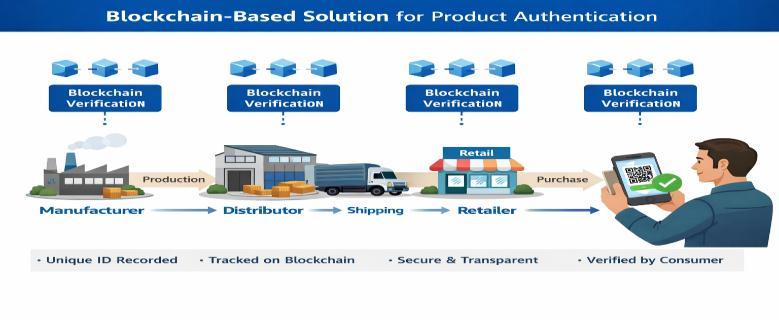
Block chain technology offers a decentralized and secure approach to product authentication. By assigning each productauniquedigitalidentityrecordedontheblockchain, everytransaction frommanufacturingtosale islogged transparently.Smartcontractscanautomateverificationof authenticityateverystage,allowingconsumerstoinstantly scanaproductandconfirmitslegitimacy.Manufacturerscan tracetheoriginandsupplychainhistoryofeachitem,while tamperingwithblockchainrecordsisvirtuallyimpossible. Real-time monitoring allows for early detection of counterfeitactivity,andintegrationwithIoTdevicesensures automated updatesonproductstatus.Blockchainreduces reliance on intermediaries, increasing trust and transparencyacrossthesupplychain.Operationalefficiency improves, and businesses can quickly recall defective or counterfeit items. Customers gain confidence in the authenticityoftheproductstheypurchase,andcompanies savecostsontraditionalanti-counterfeitingmeasures.The following diagram illustrates how blockchain tracks a product from manufacturer to customer, ensuring its authenticityateachstep.Platform
Theproposedsystem,verifiesChain,leveragesblockchain technology,QRcodeverification,andAI-driveninteraction to ensure transparent and tamper-proof product authentication throughout the supply chain. Each product registered by the manufacturer is assigned a unique SHA256hashandaQRcode,whichactsasadigitalfingerprint. This code encapsulates essential product data, making duplicationnearlyimpossible.
When products move from manufacturers to distributors andretailers,eachtransactionisstoredasablockwithinthe blockchain,containing detailssuchasownership transfer, location, timestamp, and status. These immutable records allow consumers to verify the authenticity of products by simplyscanningtheQRcode.
Additionally, an integrated Generative AI chatbot (Gemini 2.5 Flash with Lang Chain) assists users by answering product-related queries and summarizing supply chain history. The system features multiple access levels includingmanufacturer,distributor,retailer,andcustomer modules ensuringsecureandrole-specificfunctionalities. This architecture enhances trust, traceability, and accountability while minimizing counterfeit risks. The decentralizedledgerstructureensuresthatalldataremains secure,auditable,andtransparent,providinganend-to-end verificationmechanismforproductauthenticityinrealtime.
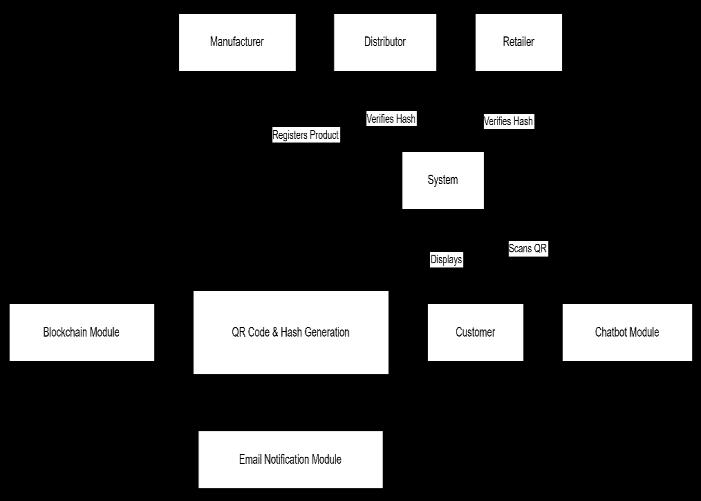
This architecture shows ablockchain-based product verification system. The process starts with
theManufacturer, who registers a product in the system. When the product is registered, the system generates auniquehashandQRcodeforthatproductandstoresthe detailssecurelyusingtheBlockchainModule,whichensures data cannot be changed or tampered with. TheDistributorandRetailerlaterinteractwiththesystem toverify the product hash, confirming that the product is genuineasitmovesthroughthesupplychain.
On the user side, theCustomerscans the QR code on the product. The system checks the hash on the blockchain anddisplays the product authenticity detailsto the customer.Ifneeded,theChatbotModulehelpscustomersby answeringquestionsrelatedtotheproductorverification process. Additionally, anEmail Notification Modulesends alerts or confirmations during important actions like productregistrationorverification.Overall,thisarchitecture ensurestransparency,security,andtrustacrosstheentire productlifecycle frommanufacturertoendcustomer.
The product registration module is the first and most importantpartoftheproposedsystem.Inthismodule,the manufacturer registers every product by entering details suchasproductname,batchnumber,manufacturingdate, expiry date, and manufacturer information. After registration, the system generates a unique cryptographic hash value that acts as a digital identity for the product. Along with the hash, a QR code is also generated and attached to the product packaging. These details are then stored in the blockchain network, ensuring that the information cannot be modified or deleted. This module prevents duplication of product identities and blocks fake product entries. By assigning a unique identity to every product,thesystemensuresauthenticityfromthepointof origin.Thismoduleformsthefoundationofthecounterfeit detectionprocess.
Volume: 13 Issue: 02 | Feb 2026 www.irjet.net p-ISSN: 2395-0072
Theblockchainstoragemoduleisresponsibleforsecurely storingallproduct-relatedinformation.Eachproductrecord is stored in the form of a block that contains the product hash,timestamp,andtransactiondetails.Theseblocksare linkedtoeachotherusingcryptographictechniques,making thedataimmutableandtamper-proof.Oncedataisaddedto the blockchain, it cannot be altered by any unauthorized entity. This ensures transparency and trust among manufacturers, distributors, retailers, and customers. Decentralizationremovestheriskofasinglepointoffailure in the system. The blockchain module also maintains a complete history of product transactions. This makes it easiertotracetheproduct’sjourneyacrossthesupplychain.
3.TheQRcodeandhashverificationmoduleallowsusersto verify the authenticity of products easily. Each product contains a QR code that is linked to its blockchain record. WhentheQRcodeisscanned,thesystemextractsthehash valueandcomparesitwiththehashstoredintheblockchain. Ifbothvaluesmatch,theproductisverifiedasgenuine.Ifthe valuesdonotmatch,theproductismarkedascounterfeitor suspicious. This module helps in quick and accurate verificationwithouttheneedforcomplexprocesses.Itcan be used by distributors, retailers, and customers. The verificationprocessisfast,reliable,anduser-friendly.This moduleplaysakeyroleindetectingfakeproducts.
TheimplementationoftheCounterfeitProductIdentification SystemUsingBlockchainiscarried outusinga web-based approachtoensureeaseofaccessandusability.Thesystem is developed with a frontend interface that allows manufacturers, distributors, retailers, and customers to interactwiththeapplication.Thebackendhandlesproduct registration, QR code generation, and verification logic. Blockchaintechnologyisintegratedtostoreproductdetails securelyinanimmutablemanner.Eachregisteredproductis assignedauniquehashandQRcodeduringimplementation. VerificationlogiccomparesscannedQRdatawithblockchain recordsinrealtime.Securitymechanismsensurethatonly authorizeduserscanregisterproducts.Thesystemsupports verificationateverysupplychainstage.Testingisperformed to validate accuracy and performance. Overall, the implementation ensures reliable detection of counterfeit products
Thesystemisimplementedusingaweb-basedarchitecture to ensure accessibility and ease of use. The frontend is developed using HTML, CSS, and JavaScript to provide a simpleandinteractiveuserinterface.Thebackendlogicis implementedusingPythonwiththeFlaskframework,which
handlesuserrequestsandsystemoperations.Arelational database is used to manage user credentials and system roles.Blockchainintegrationishandledusingcryptographic hashingtechniquestoensuredatasecurity.Thesystemruns onalocalorcloud-basedserver.Thisenvironmentsupports scalability and efficient performance. The modular design allowseasyfutureenhancements.
During implementation, the manufacturer registers products through a secure web interface. Product details such as name, batch number, manufacturing date, and unique identifiers are collected. A cryptographic hash is generated using these details to create a unique digital identity for the product. The system then generates a QR codecontainingtheproducthashorID.Boththehashand product data are stored in the blockchain. This process ensuresthat eachproducthasa uniqueand tamper-proof identity.Duplicateregistrationsareautomaticallyprevented. Thisstepinitializestheproductlifecyclesecurely.
Theblockchainisimplementedtostoreproducttransactions inanimmutablemanner.Eachproductrecordisstoredasa blockcontainingtheproducthash,timestamp,andprevious blockhash.Blocksarelinkedsequentiallytomaintaindata integrity.Anyattempttomodifystoreddatabreaksthechain and is immediately detected. The decentralized nature of blockchainensuresthatno singleentitycontrolsthedata. Thesystemusesblockchainvalidationbeforeapprovingany verificationrequest.Thisimplementationguaranteestrust and transparency. It also enables complete traceability of products.
TheQRcodegenerationisimplementedusingstandardQR librariesduringproductregistration.TheQRcodeisprinted orattachedtotheproductpackaging.WhentheQRcodeis scanned,thesystemextractstheencodedproducthash.This hashiscomparedwiththeblockchain-storedhashtoverify authenticity.Theverificationresultisreturnedinstantlyto theuser.Thisprocessissimple,fast,andefficient.Itcanbe performed using mobile devices or web scanners. This implementationallowsreal-timeproductauthentication.
TheresultsoftheCounterfeitProductIdentificationSystem Using Blockchaindemonstrate that the system effectively identifiesgenuineandcounterfeitproducts.Duringtesting, allregisteredproductsweresuccessfullyverifiedusingQR codescanningandblockchainhashcomparison.Thesystem accuratelydetectedduplicateorinvalidQRcodes,provingits reliability in counterfeit identification. Verification responsesweregeneratedwithinashorttime,showinggood
Volume: 13 Issue: 02 | Feb 2026 www.irjet.net p-ISSN: 2395-0072
system performance. Blockchain storage ensured that productdataremainedsecureandtamper-proofthroughout thetestingprocess.Thesystemhandledmultipleverification requests without performance degradation. Email notifications and chatbot responses functioned correctly during verification events. The supply chain verification process maintained complete product traceability. User interactionsweresimpleanderror-free.Overall,thesystem achievedhighaccuracy,security,andefficientperformance
The system produced accurate results during the product verification process. All registered products were successfullyverifiedusingQRcodescanningandblockchain hashcomparison.WheninvalidorduplicateQRcodeswere scanned,thesystemcorrectlyidentifiedthemascounterfeit. Nofalseverificationresultswereobservedduringtesting. The blockchain-based storage ensured that product data remained unchanged, improving accuracy. Verification results were consistent across manufacturer, distributor, retailer,andcustomermodules.Thisconfirmsthereliability of the authentication mechanism. The system effectively preventsfakeproductsfromenteringthesupplychain.High verification accuracy proves the effectiveness of the proposedapproach.
The performance of the system was evaluated based on response time and system efficiency. Product verification responsesweregeneratedquicklyafterQRcodescanning. The backend processed multiple verification requests withoutdelay.Blockchainoperationssuchasdataretrieval and validation were performed efficiently. The system showed stable performance even with repeated scans. No systemcrashesordelayswereobservedduringtesting.The lightweight frontend ensured smooth user interaction. Performanceremainedconsistentacrossdifferentuserroles. Thisdemonstratesthatthesystemissuitableforreal-time productverification.
Thesecurityanalysisshowsthatthesystemprovidesstrong protection against data tampering. Blockchain technology ensures immutability, making unauthorized data modificationimpossible.Role-basedaccesscontrolprevents unauthorized users from registering products. All verification transactions are securely recorded in the blockchain. Repeated invalid scans triggered alerts, improving system reliability. The system maintained continuousavailabilityduringtesting.Securedatahandling increasedtrustamongusers.Thecombinationofblockchain and QR code technology ensures a reliable and secure solution. Overall, the system proved to be robust and dependable.
TheCounterfeit Product Identification System Using Blockchainprovides an effective and secure solution to identifycounterfeitproductsinthemarket.Thesystemuses blockchain technology to store product information in an immutable and tamper-proof manner. Each product is assigned a unique hash value and QR code during registration.Thisensuresthateveryproducthasaunique digitalidentity.Thesystemallowsverificationateverystage of the supply chain, including manufacturer, distributor, retailer,andcustomer.Customerscaneasilyverifyproduct authenticity using a QR code scan. Blockchain ensures transparencyandpreventsunauthorizeddatamodification. The integration of supply chain verification improves traceability. The system reduces the circulation of fake products.Italsoincreasesconsumertrustingenuinebrands. Security mechanisms prevent unauthorized access. The systemperformsefficientlyduringverification.Overall,the project successfully achieves its objective of counterfeit detection.
The future enhancement of the Counterfeit Product Identification System Using Blockchain can focus on improving scalability and usability. The system can be extendedtosupportlarge-scaleindustrieswithmillionsof products. Integration with mobile applications can make verification more convenient for customers. Advanced blockchain platforms can be used to improve transaction speedandreducecost.IoTdevicessuchassmartscanners can be added for automated verification in warehouses. ArtificialIntelligencecanbeintegratedtodetectsuspicious verification patterns. Multi-language support can be introducedforglobalusers.Clouddeploymentcanimprove availabilityandperformance.Integrationwithgovernment or regulatory databases can increase trust. Enhanced analytics dashboards can help manufacturers monitor productmovement.OfflineQRverificationcanbeexplored. Strongerencryptionmethodscanimprovesecurity.Overall, future work can make the system more intelligent and widelyadaptable.
Wewouldliketoexpressoursinceregratitudetoallthose who contributed directly or indirectly to the successful completion of our project. We are extremely thankful and indebted to our supervisor, Mrs. M. Sushma, Assistant Professor, Department of Information Technology, TKR College of Engineering and Technology, for her constant guidance,encouragement,valuablesuggestions,andmoral supportthroughoutthedevelopmentofthisproject.
Wealsoextend oursincerethankstoDr N Satyanarayana (I/C),HeadoftheDepartment,DepartmentofInformation Technology,TKRCollegeofEngineeringandTechnology, for
International Research Journal of Engineering and Technology (IRJET) e-ISSN: 2395-0056
Volume: 13 Issue: 02 | Feb 2026 www.irjet.net p-ISSN: 2395-0072
his continuous encouragement and support during the courseofthiswork.WearegratefultoDr.D.V.RaviShankar, Principal,TKR College of Engineering and Technology, for providingthenecessaryfacilitiesandforhistimelysupport andvaluablesuggestionsthroughouttheprojectduration.
Finally,wewouldliketothankallthefacultymembersand staffoftheDepartmentofInformationTechnology,aswellas ourparentsandfriends,fortheircooperation,motivation, andsupport,whichplayedasignificantroleinthesuccessful completionofthisproject.
[1] S. Nakamoto, “Bitcoin: A Peer-to-Peer Electronic Cash System,”WhitePaper,2008.
[2]M. Swan, “Blockchain: Blueprint for a New Economy,”O’ReillyMedia,2015.
[3]A.Reynaetal.,“OnBlockchainandItsIntegrationwith IoT: Challenges and Opportunities,”Future Generation ComputerSystems,2018.
[4]K.Toyoda,P.T.Mathiopoulos,I.Sasase,andT.Ohtsuki,“A Novel Blockchain-Based Product Ownership Management System,”IEEEAccess,2017.
[5]Y.Lu,“BlockchainandtheRelatedIssues:AReview of CurrentResearchTopics,”JournalofManagementAnalytics, 2018.
[6]R.Kumaretal.,“QRCodeBasedProductAuthentication System,”International Journal of Computer Applications, 2020.
[7] P. K. Sharma and J. H. Park, “Blockchain-Based Secure FrameworkforSupplyChainManagement,”IEEEInternetof ThingsJournal,2019.
[8]S. Saberi et al., “Blockchain Technology and Its Relationships to Sustainable Supply Chain Management,”InternationalJournalofProductionResearch, 2019.
[9] A. Dorri, S. S. Kanhere, and R. Jurdak, “Blockchain in Internet of Things: Challenges and Solutions,”IEEE CommunicationsSurveys&Tutorials,2017.
[10]T.A.Fahimetal.,“BrainTumorDetection,Classification andSegmentationbyDLModels,”ScienceDirect,2025.