
International Research Journal of Engineering and Technology (IRJET) e-ISSN:2395-0056
Volume: 13 Issue: 03 | Mar 2026 www.irjet.net p-ISSN:2395-0072
International Research Journal of Engineering and Technology (IRJET) e-ISSN:2395-0056
Volume: 13 Issue: 03 | Mar 2026 www.irjet.net p-ISSN:2395-0072
Dhrupesh Savadia (Mentor)1, Saachi Dhumal2, Devansh Vadgama3, Daksh Jain4, Rudraa Hate5
1Mentor, Department of Computer Engineering, Thakur Polytechnic, Kandivali East-400101
2Diploma Student, Department of Computer Engineering, Thakur Polytechnic, Kandivali East-400101
3Diploma Student, Department of Computer Engineering, Thakur Polytechnic, Kandivali East-400101
4Diploma Student, Department of Computer Engineering, Thakur Polytechnic, Kandivali East-400101
5Diploma Student, Department of Computer Engineering, Thakur Polytechnic, Kandivali East-400101
Abstract - For note-taking, coding practice, document viewing, and online discussion, modern students often use several digital tools. This leads to fragmented learning processes and scattered information. Constantly switching between different platforms makes it hard for students to organize, review, and reuse information effectively, which decreases their productivity. ConnectEd is proposed as an integratedcollaborative learning space that brings together various academic and development tools into one environment to address this issue. To promote interactive and collaborative learning, the platform includes visual knowledge boards, embedded code execution, structured note creation, and a community knowledge-sharing system. Users can create block-based notes, run programming code directly in the notes, visually organize concepts using boards, and share resources through a community platform designed for questions, code sharing, and note sharing. A document ingestion system is an additional feature that allows users to upload educational materials such as PDFs, presentations, and documents. These materials can be processed automatically and converted into structured notes for easier study and reuse. ConnectEd aims to simplify digital learning processes, improve knowledge organization, and create a more cohesive and effective educational environment for today’s learners by integrating knowledge creation, experimentation, visualization, and collaboration intoasinglespace.
Key Words: Collaborative learning, Structured notetaking, Embedded code execution, Visual knowledge boards, Community knowledge sharing, Document ingestion system, Digital learning platforms, Knowledgeorganization.
Modern students today use a variety of digital tools for activities ranging from note taking to coding, document viewing and discussion forums. While these tools offer great functionality, they tend to work in isolation, which means that there is no integration of the applications or tools, and as such, students have to manage a plethora of tools,whichleadstodisjointedworkflowsandknowledge fragmentation.Thisfragmentationandswitchingbetween apps,greatlyreducestheproductivityofstudents.
Today, many students spend a large amount of time in digital environments creating content for their classes, communicating with instructors, and collaborating with their peers. Managing the multiple platforms, tools, and sources of information that make up their learning environments,however,canbefrustratingandbarriersto engagement. To help address this problem, this paper introduces ConnectEd, an integrated collaborative learning workspace that provides a single source for a core set of learning activities such as note taking, programming, idea organization, and community sharing. ConnectEd allows users to create hierarchical, outlinded notesthatincludeexecutablecode,ideamapsandconcept shelves organized on digital boards, and a social learning community for sharing knowledge. The ConnectEd workspace is intended to streamline digital learning environments,reducethetimerequiredtofindandswitch between different applications, and aid in student knowledgemanagementandunderstanding.
Students today spend a lot of time using separate applications to manage the various activities involved in learning.Theseincludetoolsfornotetaking,programming environments, viewers for PDF documents, discussion forums,andmanyotherapplications.Astheseapplications are all separate, students struggle to get all the resources they need in one place. Relevant information is spread across many apps, so students struggle to revisit concepts they have learned some time ago and re-use content they havealreadycreated.Becauseappsarefrequentlydifferent andhavedifferentinterfaces,switchingbetweenthemisa common source of distraction that breaks up learning flows.
ConnectEd solves this problem by bringing all collaborative learning activities and academic tools under oneumbrella, aunifiedcollaborativelearningworkspace. InConnectEd,userscanwritenoteswithstructures,write code inside their notes, and do mind mapping and sketching with knowledge boards. Users can also post questionsinacommunityknowledge-sharingforumtoask for help, to share knowledge, to discuss topics with other
International Research Journal of Engineering and Technology (IRJET) e-ISSN:2395-0056
Volume: 13 Issue: 03 | Mar 2026 www.irjet.net p-ISSN:2395-0072
peers and experts. ConnectEd unifies all these features into one single platform, streamlining learning workflow, and helping learners to better organize their learning activities and assets, and thus facilitating more efficient learningandcollaborativelearningexperiences.
ConnectEd is designed as an integrated digital learning platform that combines multiple academic and development tools within a single workspace. The system architecturefocusesonimprovingproductivity,knowledge organization, and collaboration for students by reducing the need to switch between multiple applications. Instead ofrelyingonseparatetoolsfornote-taking,codingpractice, document viewing, and discussions, ConnectEd integrates thesecapabilitiesintoaunifiedlearningenvironment.
Table-1: ConnectEdSystemModules
ConnectEd System Modules Module Description Purpose
Structured Notes System Block-basednotes supportingtextand code Organizesstudy materials
Code Execution Engine Runsprogramming codewithinnotes Enablesinteractive learning
Knowledge Boards Visualboardsfor connectingideas Helpsconceptual understanding
Document Ingestion System ProcessesPDFsand documents Convertsmaterials intonotes
AI Processing Pipeline Analyzesnotesand codeusingAImodels Provides explanations, summaries,and debugging
Community Platform Discussion,note sharing,codesharing Supports collaborative learning
Thecorecomponentofthesystemisthe structurednotes module, which allows users to create block-based notes containing text, code snippets, and references. This structure enables students to organize their learning materials efficiently while keeping related content together.Thenotesmoduleactsastheprimaryworkspace whereuserswrite,study,andinteractwithdifferenttypes of information. In addition, the system includes an embedded code execution environment that allows users to run programming code directly within the notes
interface. This integration enables students to experiment with programming concepts while studying theoretical material,creatingamoreinteractivelearningexperience.
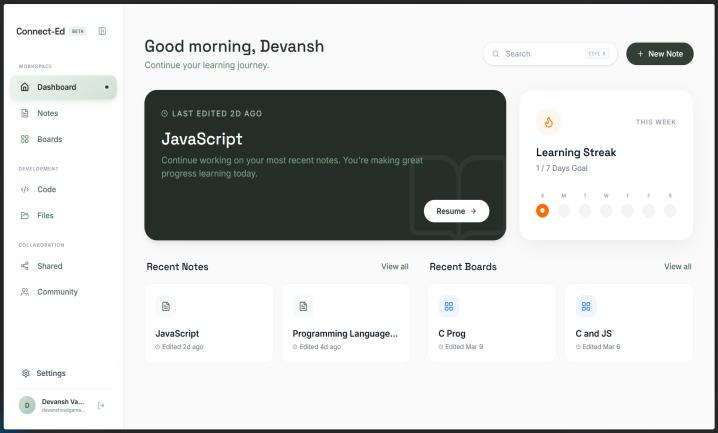
Another key component of the architecture is the visual knowledge board module, which provides a workspace where users can connect ideas and organize concepts visually. These boards help learners understand relationships between topics and build structured knowledge maps. ConnectEd also includes a document ingestion system that allows users to upload learning resources such as PDFs, presentations, and documents. These files are processed and converted into structured notessothatthecontentcanbeeasilyreviewed,organized, andreusedduringstudysessions.
The system architecture also incorporates an AI processing pipeline that enhances the learning experience through intelligent content analysis. The pipeline is designed as a modular, multi-stage system that connects the user’s workspace with AI-powered language models, enabling a wide range of on-demand academic assistance features. The pipeline operates across four distinct stages: context collection, prompt construction, modelinference,andresponsedelivery.
Inthe contextcollectionstage,whenausertriggersanAI action (such as “Summarize”, “Explain”, or “Debug”), the platform automatically gathers relevant contextual data fromtheactiveworkspace.Thisincludesthecontentofthe current note block, surrounding blocks within the same note, any code snippets present in the selection, metadata such as the programming language or subject tag, and document content if a file has been ingested into the session. By assembling rich, workspace-aware context rather than relying on isolated text, the pipeline ensures that AI responses are grounded in the student’s actual learningmaterial.
The second stage, prompt construction, involves assembling the collected context into a structured prompt thatissenttotheunderlyinglanguagemodel.Theprompt template varies depending on the requested action. For a
Volume: 13 Issue: 03 | Mar 2026 www.irjet.net
summarization request, theprompt instructs the model to condense the provided note content into concise key points.Foraconceptexplanationrequest,itasksthemodel to describe the highlighted term or passage in simple languagesuitableforastudentlearner.Foracodeanalysis request, it directs the model to review the code, identify any logical or syntactic issues, and suggest improvements. Thistemplate-drivenapproachensuresthateachtypeofAI action consistently produces relevant, task-appropriate output.
During the model inference stage, the constructed prompt is transmitted to a large language model via a secureAPI.Theplatformisdesignedtosupportintegration with multiple AI model providers, allowing the system to be configured with different models depending on performance requirements and cost considerations. Responses are streamed back to the client as they are generated, minimizing perceived latency and enabling users to begin reading the output before the full response is complete. Error handling at this stage includes timeout detection, fallback messaging, and graceful degradation in theeventthattheAIserviceistemporarilyunavailable.
Inthefinal responsedeliverystage,themodel’soutputis parsedandrenderedwithintheConnectEdinterface.Plain text explanations and summaries are displayed as inline note blocks that can be edited, saved, or discarded by the user. Code suggestions are presented in a diff-style view, highlightingproposedchangessothatlearnerscanreview and selectively apply them. This non-destructive delivery approach ensures that AI-generated content supplements thestudent’sownworkratherthanoverwritingit,keeping thelearnerincontroloftheirnotesatalltimes.
The AI pipeline supports three primary use cases within ConnectEd. The first is note summarization, where students can select a note or a section of content and request a condensed summary. This is particularly useful when reviewing large sets of study notes before an examination.Thesecondusecaseis conceptexplanation, wherestudentscanhighlightanunfamiliartermorpassage and request a plain-language explanation, reducing the need to switch to an external search engine or reference tool. The third use case is code analysis and debugging, wherestudentscansubmitacodeblocktothepipelineand receive feedback on correctness, efficiency, and style. This featuresupportsbothbeginnerslearningsyntaxandmore experienced learners refining their programming skills. Together, these capabilities make the AI pipeline a central component of the ConnectEd learning experience, transforming passive note content into an interactive and intelligentstudyresource.
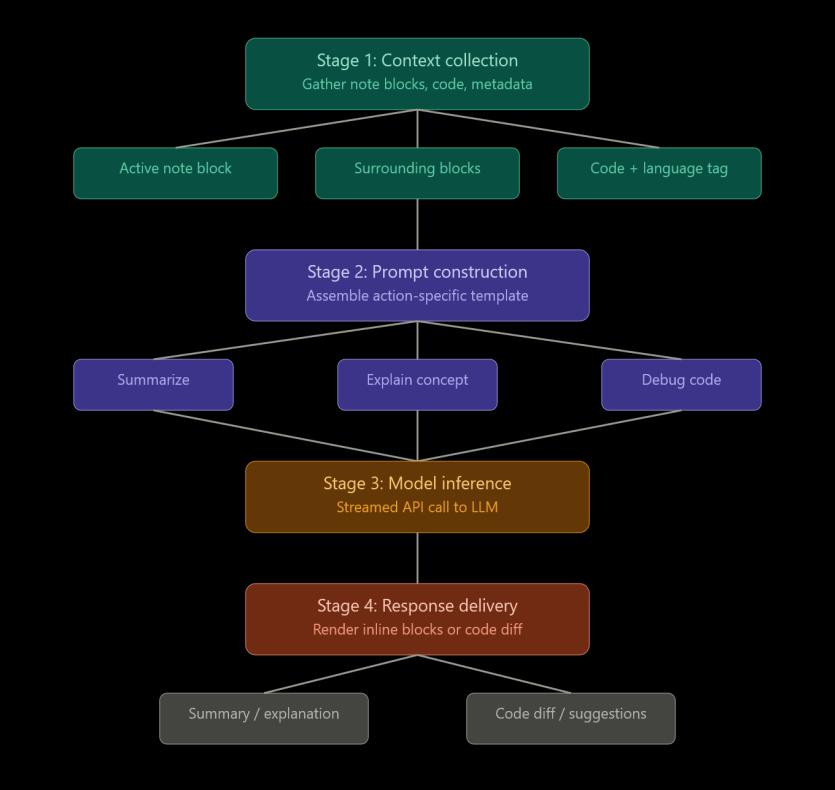
Fig. 2: AIProcessingPipeline-four-stageflowfrom contextcollectiontoresponsedelivery
Finally, ConnectEd integrates a community knowledgesharingmodule thatenablesuserstoaskquestions,share notes,publishcodesnippets,andparticipateindiscussions with other learners. This collaborative environment encourages knowledge exchange and allows students to learnfromsharedexperiencesandresources.
By integrating structured note-taking, code experimentation, AI-assisted learning, document processing, visual knowledge organization, and collaborative interaction, the overall architecture of ConnectEdcreatesaunifieddigitallearningecosystemthat supportsefficientandinteractiveeducation
This paper presented ConnectEd, an integrated collaborativelearningplatformdesignedtosimplifydigital learning workflows for students. Modern learners often relyonmultipleindependenttoolsfornote-taking,coding practice, document viewing, and online discussion, which can lead to fragmented workflows and scattered knowledge. ConnectEd addresses this issue by combining these essential academic tools into a single unified workspace.
The platform provides features such as structured notetaking, embedded code execution, visual knowledge boards, document ingestion, and community-based knowledge sharing. These components allow users to
International Research Journal of Engineering and Technology (IRJET) e-ISSN:2395-0056
Volume: 13 Issue: 03 | Mar 2026 www.irjet.net p-ISSN:2395-0072
create organized study materials, experiment with programming concepts, visually connect ideas, and collaborate with other learners within the same environment. In addition, the integration of an AI processingpipeline enhancesthelearningexperienceby enabling intelligent features such as content summarization,conceptexplanation,andcodeanalysis.
By integrating knowledge creation, experimentation, visualization, and collaboration into one platform, ConnectEd provides a more efficient and connected learning ecosystem. The system helps students manage learning resources more effectively while encouraging interactiveandcollaborativestudypractices.
Future improvements to the platform may include advanced AI-based study assistance, improved collaboration features, and enhanced document processing capabilities to further support digital learning environments.
The authors would like to express their gratitude to the facultymembersandmentorswhoprovidedguidanceand support during the development of this project. Their valuable suggestions and encouragement helped in completingthisresearchworksuccessfully.
[1] P. Brusilovsky and C. Peylo, “Adaptive and Intelligent Web-based Educational Systems,” International Journal of Artificial Intelligence in Education, vol. 13, no. 2, pp. 159–172,2003.
[2] R. E. Mayer, Multimedia Learning, 2nd ed., Cambridge UniversityPress,2009.
[3] T. Anderson, “Towards a Theory of Online Learning,” inTheoryandPracticeofOnlineLearning,AUPress,2008.
[4] M. Alavi and D. E. Leidner, “Review: Knowledge Management and Knowledge Management Systems,” MIS Quarterly,vol.25,no.1,pp.107–136,2001.