
International Research Journal of Engineering and Technology (IRJET) e-ISSN: 2395-0056
Volume: 13 Issue: 04 | Apr 2026 www.irjet.net p-ISSN: 2395-0072
International Research Journal of Engineering and Technology (IRJET) e-ISSN: 2395-0056
Volume: 13 Issue: 04 | Apr 2026 www.irjet.net p-ISSN: 2395-0072
Mahima Chandrawat1 , Dr. Umesh Pendharkar2
1M.Tech Student, Department of Civil Engineering, Ujjain Engineering College, Ujjain (M.P.)
2Principal, Ujjain Engineering College, Ujjain (M.P.)
Abstract - The structural design and stabilityassessmentof cantilever retaining walls represent a critical intersection of geo-technical and structural engineering, heavily influenced by regional regulatory frameworks. This research provides a comprehensive comparative investigation betweenthe Indian Standard (IS 456:2000) and the European Standard (Eurocode 2/EN 1992) for a wall height of 3.0 meters. Utilizing an analytical spreadsheet-based methodology, the performance is bench marked against key stability indicators, including factor of safety (FOS) against lateral sliding and overturning moments.
The analysis reveals that the IS 456 framework yields a highly conservative safety margin for overturning (FOS 5.75), whereas sliding stability emerges as the governing design constraint (FOS 1.38), necessitating the integration of a shear key for compliance. In contrast, the limit state philosophy of Eurocode 2, characterized by its nuancedapplicationofpartial safety factors for actions and materials, demonstrates a more optimized structural response. The findings suggest that the European approach offers significant potential for material economy and structural optimizationinsmall-to-mediumscale infrastructure projects.
Key Words: Cantilever Retaining Wall, IS 456:2000, Eurocode 2, Stability Analysis, Partial Safety Factors, StructuralOptimisation
The structural integrity of earth-retaining systems is a cornerstoneofcivilinfrastructure,necessitatingadherenceto stringent design codes. Among the various configurations, cantilever retaining walls are preferred for moderate heights typically up to 6 meters due to their balanced materialefficiencyandconstructionfeasibility.Historically, thedesignofthesestructuresreliedondeterministicworking stress methods; however, contemporary engineering has transitionedtowardalimitstatephilosophytobetteraccount foruncertaintiesinloadingandmaterialbehavior.
In the Indian context, the design framework is primarily regulatedbyIS456:2000,whichutilizesglobalsafetyfactors to ensure stability against lateral forces. Conversely, the European standard, Eurocode 2 (EN 1992), introduces a
moresegmentedapproachbyapplyingpartialsafetyfactors todistinctpermanentandvariableactions.Thisfundamental methodologicalshiftcreatesnoticeablediscrepanciesinboth the geometric dimensions and the reinforcement density requiredforastandard3.0mwallheight.
Thestructuraldesignandstabilityassessmentofcantilever retaining walls have been subjects of extensive global research, with a significant focus on the comparative efficiencyofinternationalbuildingcodes.Aprominentstudy by Kumar and Yadav (2022) performed a comparative evaluation between ACI 318 and IS 456, establishing that Indianstandardsmaintainahigherdegreeofconservatism regardingthe reinforcementdensityofstemandbaseslab components.Thissafetyphilosophywasfurtheranalyzedby Basheer(2017),whoobservedthatwhiletheevolutionfrom workingstresstolimitstatedesignhasoptimizedmaterial utilization,theinherentsafetymarginsinIndianstandards remain broader than those prescribed by European frameworks.
Theinfluenceofsoil-structureinteractionandgeo-technical parameters, such as the angle of internal friction and surcharge loading, was investigated by Tiwari and Gupta (2021) and Reddy and Rao (2018). Their research identifies lateral sliding as the primary governing stability constraint for walls under 6 meters a conclusion that is consistentwiththeanalyticalresultsobtainedinthisstudy. Furthermore, Patel and Solanki (2019) conductedadirect comparative analysis between IS 456 and Eurocodes, concluding that the integration of partial safety factors in Eurocode 2 (EN 1992) facilitates a more tailored and resource-efficientdesigncomparedtotheglobalsafetyfactor methodologyofIS456.
The theoretical foundation for the earth pressure calculations in this analysis is anchored in the established worksof Punmia et al. (2015) and Bansal (2017),which provide the requisite framework for determining active pressure coefficients and stability ratios. Additionally, to navigatethemethodologicalcomplexitiesofEurocode2,the decodingframeworkproposedby Bond and Harris (2008) was utilized to accurately apply partial safety factors for permanentandvariableactions.
2026, IRJET | Impact Factor value: 8.315 | ISO 9001:2008 Certified Journal | Page 3842
International Research Journal of Engineering and Technology (IRJET) e-ISSN: 2395-0056
Volume: 13 Issue: 04 | Apr 2026 www.irjet.net p-ISSN: 2395-0072
The research methodology employs a rigorous analytical framework centered on spreadsheet-basedcomputational modeling. The structural evaluation adheres to the Limit StatePhilosophy,facilitatingadirectcomparisonbetween the deterministic safety factors of IS 456:2000 and the probabilisticpartialsafetyfactorsof Eurocode2(EN1992) Thestudyissystematicallybifurcatedintothreeoperational phases: Parameter Initialization, geo-technical Stability Assessment,andStructuralComponentDesign.
Tomaintainanalyticalparity,astandardisedbaselineof input parameters was established, reflecting typical geotechnicalsiteconditions:
• Soil Characteristics: A bulk density (��) of 18 kN/m³andaninternalfrictionangle(��)of30°were utilised. These constants form the basis for determining the active earth pressure coefficient (Ka)usingRankine’sTheory.
• Geometric and LoadingConstraints: Theanalysis considersaretainingheight(H)of3.0m,augmented byauniformsurchargeload(рs)of2kN/m².
• Material Properties: Structural elements are modeledusingM20gradeconcrete(ƒck =20N/mm²) and Fe415 reinforcement steel (ƒy = 415 N/mm²)
The structural equilibrium of the cantilever wall is rigorously tested against two fundamental geotechnical failuremodes:
1. Overturning Stability: Under the IS 456 framework, stability is verified by calculating the ratio of resisting moments to destabilising overturning moments. The resisting forces (W) comprisetheself-weightofthebaseslab,thevertical stem,andthesoilmasspositionedovertheheelslab.
2. Sliding Resistance: Lateral stability is assessed based on the frictional interface at the base-soilcontact.Acoefficientoffriction(��=0.45) isappliedtothetotalverticalloadtodeterminethe sliding resistance.
3.3 Stability Evaluation
Thedesignofindividualstructuralcomponents thestem, toe,andheelslabs followscantileverbeammechanics:
• Flexural Analysis: The stem is analysed as a cantilevermemberfixedatthebase.Themaximum bendingmoment(Mw)isderivedatthejunctionby integrating the triangular soil pressure and the rectangularsurchargepressureprofiles.
• Reinforcement Optimisation: The tension reinforcement(Ast)isdeterminedthroughthelimit state of collapse in flexure, ensuring that the provided steel area satisfies both strength and serviceabilitycriteria.
• SafetyFactorDivergence:Acriticalmethodological distinctionliesinthesafetyapplication;whileIS456 utilizes a global factor of safety, Eurocode 2 implements partial safety factors (��G = 1.35 for permanentactions;��Q=1.5forvariableactions)as perDesignApproach1(DA1).
4.1 Analysis As Per IS 456:2000 FrameworkThe structuralevaluationbeginswiththedeterminationof lateral earth pressure and the subsequent stability checksundertheIndianStandardcode.
Table 1.0: CalculationsasperIS456:2000

4.2 Analysis as Per Eurocode 2 (EN 1992)
Unliketheglobalsafetyfactor,Eurocode2utilises Design Approach 1 (Combination 2) with factored actions.
International Research Journal of Engineering and Technology (IRJET) e-ISSN: 2395-0056
Volume: 13 Issue: 04 | Apr 2026 www.irjet.net p-ISSN: 2395-0072

Table 2.0: CalculationsasperEN1992
5. RESULT AND DISCUSSION
The structural and stability analysis of the cantilever retaining wall was performed using two distinct design philosophies: the Indian Standard (IS 456:2000) and the European Code (Eurocode 2/EN 1992). The comparative results for a wall height of 3.0 m are systematically summarized in Table 3 and evaluated in the subsequent sections.
Table 3.0: Comparative Design Summary and Stability indicators
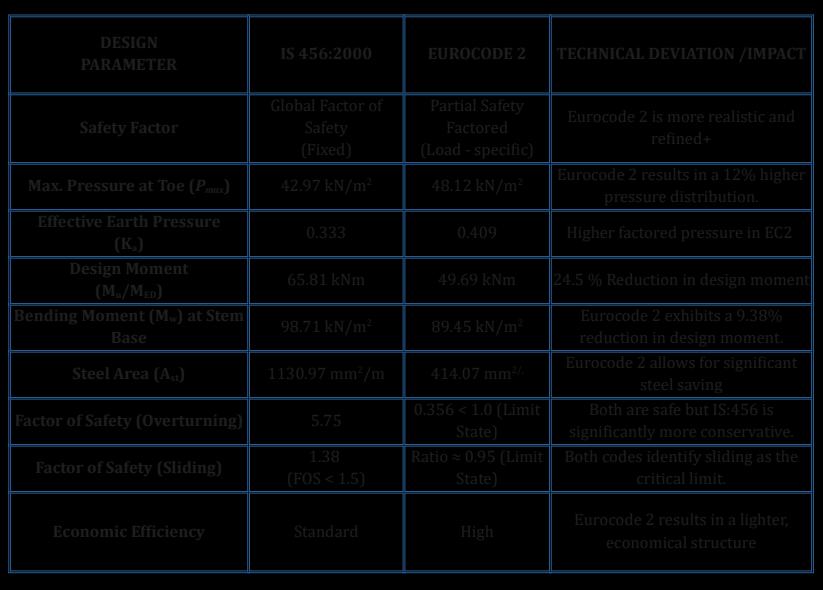
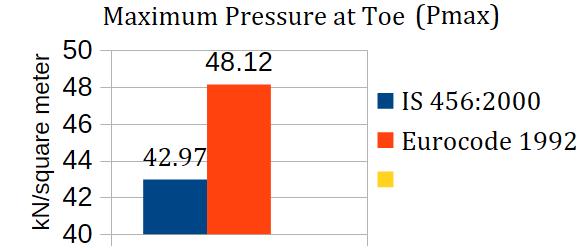
Fig-1: Eurocode2resultsina12%higherpressure distribution
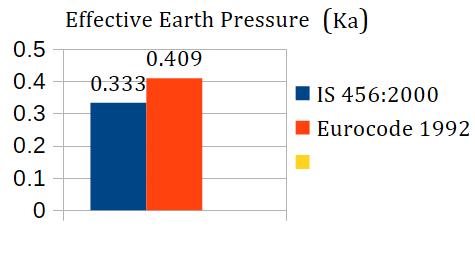
Fig-2: IndicatesHigherFactoredPressureinEC2
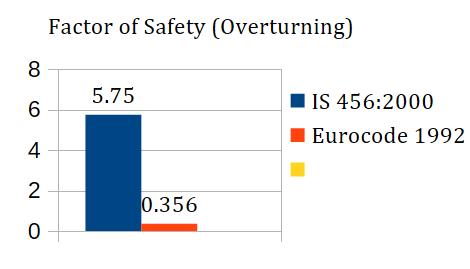
Fig-3: IndicatesFOS-overturning(Bothreplicatessafer design)
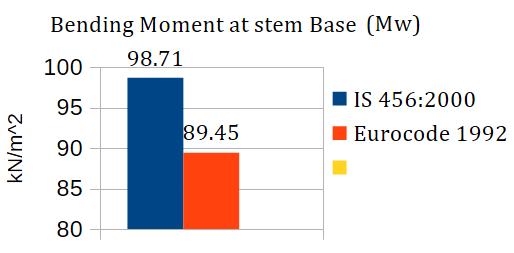
Fig-4: 9.38%reductioninbendingmomentasper Eurocode
International Research Journal of Engineering and Technology (IRJET) e-ISSN: 2395-0056
Volume: 13 Issue: 04 | Apr 2026 www.irjet.net p-ISSN: 2395-0072
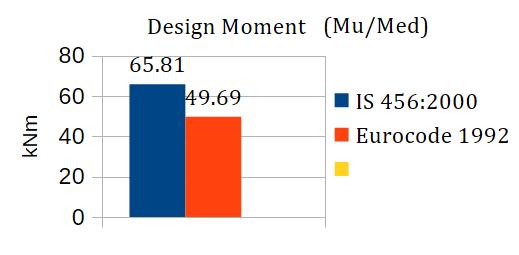
Eurocodeindicatesreductionindesignmoment
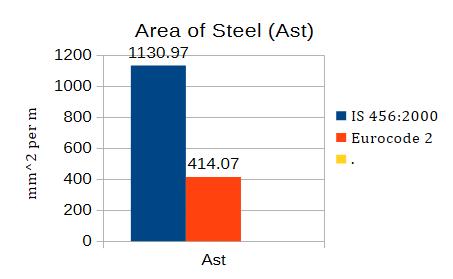
ReducedAreaofSteelasperEC2
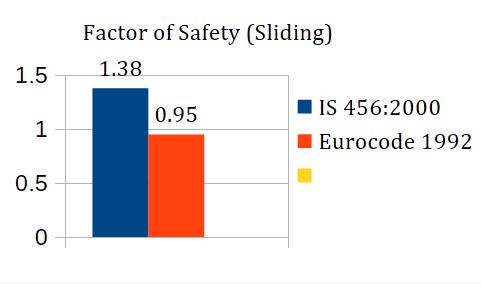
Fig-7: IndicatesFOS-Sliding(Bothreplicatessafer design)
v/s Sliding
AcriticalobservationintheIS456designisthesubstantial safety margin against overturning (FOS 5.75), which far exceeds the minimum requirement of 1.5. However, the slidingstabilityremainsacriticalconstraintwithanFOSof 1.38. This necessitates the integration of a Shear Key, as recommended by Reddy and Rao (2018). In contrast, Eurocode2’sEQUlimitstatecheckprovidesamorebalanced assessment of equilibrium, though sliding remains the primaryconcernforwallsofthisheight.
Themostsignificantdiscrepancybetweenthetwostandards lies in the flexural reinforcement calculation. The design bendingmomentunderEurocode2is24.5%lowerthanthe IS456value.Thisisprimarilyduetothenuancedapplication ofpartialsafetyfactorstopermanentandvariableactionsin the European code, as opposed to the rigid global safety factorintheIndiancode.Consequently,therequiredareaof steel (Ast) is drastically reduced in the Eurocode design, supporting the findings of Patel and Solanki (2019) regarding the economic superiority of limit state optimisationinEN1992.
Thiscomparativeinvestigationevaluatedthestructural design and stability performance of a 3.0 m cantilever retaining wall under the regulatory frameworks of IS 456:2000andEurocode2(EN1992).Basedontheanalytical results and parametric assessments, the following conclusionsareestablished:
1. Safety Philosophy vs. Structural Efficiency: The Indian Standard (IS 456:2000) maintains an excessively conservative stance regarding overturning stability, yielding a Factor of Safety (FOS)of5.75.Incontrast,Eurocode2utilisesalimit state philosophy with partial safety factors that provideamorebalancedandrefinedsafetymargin.
2. Economic Material Utilisation: Eurocode 2 demonstratessuperiormaterialeconomy,resulting ina 24.5% reduction inflexuralreinforcementfor the stem wall. This significant decrease in steel consumption highlights Eurocode 2 as a more sustainable and cost-effective framework for contemporaryinfrastructuredevelopment.
3. Stability Constraints: In both standards, sliding resistance emerges as the governing failure mode for medium-height structures. The inadequate sliding FOS (1.38) under IS 456 mandates the integration of a 290 mm depth shear key, emphasising that lateral stability is more critical thanoverturningforwallsofthisheight.
4. StrategicRecommendations: WhileIS456ensures an uncompromising level of safety, Eurocode 2 provides an optimised pathway for structural engineering. For large-scale projects in India, adopting refined safety factors analogous to European standards could facilitate substantial savingsinconcreteandreinforcementsteelwithout jeopardising the structural integrity of the system
International Research Journal of Engineering and Technology (IRJET) e-ISSN: 2395-0056
Volume: 13 Issue: 04 | Apr 2026 www.irjet.net p-ISSN: 2395-0072
Thecompletionofthisresearchworkwouldnothavebeen possible without the collective support and guidance of severalindividuals.
First and foremost, I would like to express my deepest gratitude to my supervisor, Dr. Umesh Pendharkar, for theirinvaluablementorship,constantencouragement,and for providing the academic rigor necessary to bring this study to fruition. Their expertise in the field of Civil Engineering and insightful critiques were instrumental in shapingthispaper.
I am also profoundly thankful to my friend, Er. Hitesh Pathak (M.Tech – Civil Engineering, Specialization in Environmental Engineering).Hisprofessionalinsightsas an environmental/civil engineering specialist and his extensiveexperienceconsultancy,specificallyinthedesign, drawing,andimplementationofEffluent/SewageTreatment Plants (ETP/STP), added a practical dimension to my understanding during our discussions. His constant motivationandtechnicalperspectivewereasignificantpillar ofsupportthroughoutthisjourney.
Finally,Iwouldliketothankmyfamilyandcolleaguesfor theirpatienceandbeliefinmywork,whichkeptmegoing throughthevariousstagesofthisresearch.
[1] Basheer, A. (2017). Evaluation of safety factors in structural design: A comparison between Indian standards and Eurocodes. Journal of Structural Engineering,44(2),112-120.
[2] Bond,A.J.,&Harris,A.J.(2008).DecodingEurocode7. London:Taylor&Francis.
[3] Bureau of Indian Standards. (2000). IS 456: Indian standard plain and reinforced concrete - Code of practice.NewDelhi,India.
[4] Bureau of Indian Standards. (2016). IS 1893 (Part 1): Criteria for earthquake resistant design of structures. NewDelhi,India.
[5] Dhayaratnam,P.(2018).Designofreinforcedconcrete structures(3rded.).Oxford&IBHPublishingCompany.
[6] European Committee for Standardization. (2004). EN 1992-1-1(Eurocode2):Designofconcretestructures. Brussels,Belgium.
[7] Hossain,M.A.,&Ahmed,S.(2020).Economicfeasibility of retaining walls: A comparative study of ACI and Eurocodestandards.InternationalJournalofCiviland StructuralEngineering,11(4),45-56.
[8] Kumar, P., & Yadav, B. (2022). Comparative study of designofcantileverretainingwallasperACI318&IS 456.ResearchSquarePreprints.
[9] Patel,S.,&Solanki,H.(2019).Comparativeanalysisof cantilever retaining wall design using IS code and Eurocode.InternationalJournalofEngineeringResearch &Technology(IJERT),8(06),1024-1030.
[10] Punmia,B.C.,Jain,A.K.,&Jain,A.K.(2015).Reinforced concretestructures(Vol.1&2).LaxmiPublications.
[11] Reddy, V., & Rao, G. V. (2018). Parametric study of cantileverretainingwallsunderdifferentsoilconditions as per IS 456. Journal of Emerging Technologies and InnovativeResearch(JETIR),5(8),211-218.
[12] Reynolds, C. E., & Steedman, J. C. (2007). Reinforced concretedesigner'shandbook.CRCPress.
[13] Tiwari, R., & Gupta, M. (2021). Optimization of cantilever retaining wall using genetic algorithm. StructuralEngineeringReview,15(2),88-95.
[14] Vazirani, V. N., & Ratwani, M. M. (2016). Analysis of structures(Vol.1).KhannaPublishers.
[15] Wight, J. K., & MacGregor, J. G. (2012). Reinforced concrete:Mechanicsanddesign.PearsonEducation.

The author (Mahima Chandrawat1) isan engineering professional and researcher. Their work focuses Engineering and Technical works studies, and projects. By bridging industry experience with academic research, they aim to drive efficiently in modern constructionpractices.