
International Research Journal of Engineering and Technology (IRJET) e-ISSN: 2395-0056
International Research Journal of Engineering and Technology (IRJET) e-ISSN: 2395-0056
R.Mabubasha
1,
Navuluri Sindhu
2
, MuppalaVenkata Pujitha 3, Jonnalagadda Abhishek Vardhan
1 Assistant Professor, Department of CSE, RVR & JC College of Engineering, Chowdavaram, Guntur, A.P,India. 234B. Tech Students, Department of CSE, RVR & JC College of Engineering, Chowdavaram, Guntur, A.P, India. ***
Abstract - Multi-stagererankinghasbeenappliedinRAG models across a number of studies, but what's missing is any serious accounting of how much each component actually contributes. The question of weight assignment methodsissimilarlyunderexplored.Thisstudytakesacloser look at retrieval across multiple stages, evaluating performance on three BEIR benchmark datasets FiQA, SciFact, and NFCorpus. It examines what tri-modal hybrid search does to performance scores and compares the effect of cross-encoder and LLM reranking modules directly.The ablation experiments tell a clear story: cross-encoder reranking consistently beats the baseline before it. LLM reranking is a different matter it's genuinely useful for financial question answering but loses its edge on biomedical data. The domain dependency is hard to ignore. On top of that, LLM reranking adds latency without matching the performance of well-tuned static weights. Perhaps most surprisingly, simpler retrieval pipelines outperform tri-modal retrieval outright more complexity, worseresults.
KeyWords:Hybrid Retrieval, Cross-Encoder Reranking, Reciprocal Rank Fusion (RRF), Large Language Model Reranking,RetrievalAugmented Generation (RAG) Dynamic Weight Assignment, Agentic AI, BEIR Benchmarks
Retrieval-Augmented Generation (RAG) has become the standard approach for building AI systems that need to stay factually grounded. Rather than relying on what the model memorized during training, RAG systems retrieve relevant documents at query time and use them to generate answers which cuts hallucination rates substantially.Thatmattersespeciallyinfinance,medicine, andlaw,whereaconfidentlywrongoutputcancausereal harm [16, 19, 27, 32]. The catch is that answer quality is nowhostagetoretrieval quality.Abroken retrieval stage poisons everything downstream, and as RAG systems move from research into production, a question the literature has been surprisingly slow to answer is: which partsofthepipelineactuallypulltheirweight?
A standard RAG pipeline runs in three stages. The retrieveridentifiescandidatedocumentsusingsimilaritybased signals. A reranker then reorders those candidates using a more precise model. Finally, the language model
4
reads the selected documents and generates a response. For retrieval, three main approaches are used in practice dense retrieval with neural embeddings for semantic matching [4], sparse retrieval with lexical methods like BM25forexacttermmatching[1,3,31],andgraph-based retrievalthatexploitsentityrelationshipsforstructurally complex queries [15, 23, 26, 30]. These are combined through fusion methods, with Reciprocal Rank Fusion (RRF)beingthemost widelyused[1,3,31].Reranking is handled predominantly by cross-encoders [4, 5], with growing interest in prompting large language models directlyaszero-shotrankers[7,21,22].
Several questions in this area remain genuinely open. Most published work evaluates systems end-to-end, which tells you almost nothing about what individual components are doing. Whether tri-modal retrieval actually beats bi-modal is unclear, and whether an LLM reranking step adds anything meaningful over a crossencoder remains equally unresolved [11, 12, 13, 17, 32]. Agentic RAG gets a lot of credit for letting models weigh informationsourcesdynamicallybasedonthequery[2,8, 9] appealing in theory, rarely verified in practice. And the latency cost of calling an LLM mid-pipeline tends to geteitherunderstatedorignoredentirely[18,24,27].
We ran a controlled study across three benchmarks covering genuinely different domains: FiQA, SciFact, and NFCorpus [17]. The pipeline uses tri-modal hybrid retrieval, cascaded cross-encoder and LLM reranking, Reciprocal Rank Fusion [31] for combining scores, and Claude Sonnet 4.6 via AWS Bedrock [14] for dynamic weight assignment. What we found, bluntly, is that complexity doesn't pay off. A simpler pipeline good retrieval,effectivereranking beatsmoreelaboratefusion approaches.Andstaticretrieval weights,tuned onceon a validation set, outperform LLM-based dynamic assignmentoneverydatasetwetested,withconsiderably lesslatency.
Four things fall out of this. Cross-encoder reranking accountsformostofthe performanceimprovement;LLM rerankingonlyhelpsinsomedomains.Staticweightsbeat dynamic LLM assignment consistently, and the latency gapisreal.ThecostofLLMrerankingisdisproportionate to what it actually returns in precision. And a domainlevel error analysis shows where each retrieval modality tendstofallapart.
Volume: 13 Issue: 04 | Apr 2026 www.irjet.net p-ISSN: 2395-0072 © 2026, IRJET | Impact Factor value: 8.315 | ISO 9001:2008 Certified Journal | Page 1958
International Research Journal of Engineering and Technology (IRJET) e-ISSN: 2395-0056
Volume: 13 Issue: 04 | Apr 2026 www.irjet.net p-ISSN: 2395-0072
In terms of advancements in RAG research, there have been three main directions that the field has followed in recentyears:thecreationofhybridretrievalmechanisms based on multimodal information; the usage of cascaded reranking for progressive improvements; and finally, the capability of LLMs to govern the entire retrieval process. Eachdirectionhasgivenbirthtonotionsthatcarryweight but pose open-ended questions at the same time, issues thatwillbediscussedinthefollowingsections.
An approach of fusion of modalities in information retrieval which means the strengths of a dense retrieval and a sparse retrieval are combined which are complementary to each other and have their own weakness. Retrievals that are dense fail to work on queries that contain rare words and/or very specific numbers. Retrievals that are sparse fail to capture the semanticsbehindanyquery.Thisisespeciallytrueinthe case of paraphrases, which often just asks for different terms for similar concepts. In Blended RAG [1], it was presented that mixing neural representations with BM25 leads to a considerable gain in overall performance for mixed query types, and this is the same idea we utilize. However,wecametoknowthatitwasmorecomplicated than we thought. A recent paper on hybrid search balancing showed that naive fusion may result in degraded performance due to not setting the modal weights incorrectly. There are unequivocally benefits of using one or both methods in tandem, and their efficacy no doubt lies in their proper tuning. However, the specifics of tuning your methods depend on the domain andquery-typesitisdeployedfor.Asignificantportionof the related papers simply state that hybrid search works better than its unimodal counterparts without discussing or specifying either the reason or the necessary conditions.
Knowledgegraphaugmentation.Anareatoexplorethatis somewhat unrelated to the previous topic is knowledge graph augmentation. This type of research aims to compensate for the weaknesses of text retrieval systems by introducing a knowledge graph of the information system that exists within the same document collection. Forexample,customerservicedocuments[15],legislative documents [23], and archival documents [30] all utilize knowledgegraphstoenhanceretrievalcapabilities.
Architecturedecisions.Thearchitecturesusedtoaugment knowledge graphs with text retrieval systems are also a topic of research. One study [26] examines various methods for integrating knowledge graphs into information retrieval systems. These methods include expanding and filtering search results using the knowledgegraph,aswellasusingtheknowledgegraphto
reranksearchresults.Additionally,someresearchstudies have used neural networks to learn relationships within knowledge graphs [25]. These neural networks allow for the creation of even more accurate search results but comeatacostoftrainingcomplexityandinferencetime.
Specific domain results. There are three papers in this domain-basedresearchareathatareofparticularinterest to our investigation into the weaknesses of text retrieval systems.Onestudyofanenterpriseretrieval system[11] shows that different types of documents can only be retrieved using separate information retrieval systems. Another study of a clinical decision support system [12] shows that text retrieval models struggle to process the abbreviations and specific terminologies used in those documents. Finally, a study of a financial questionanswering system [13] shows that text retrieval models that use sparse retrieval methods still achieve high accuracy by focusing on the exact matching of specific keywords and financial terms.The common weakness across all three papers can be identified by noting that although complex systems were tested against baseline methods, the individual components were not separated intheiranalysis.
Cross-encoder reranking. Theidea ofseparating retrieval from reranking letting a cheap model generate candidates, then running a more accurate model over a short list is settled enough that it barely needs defending. ColBERT [4] showed that late interaction mechanisms could close much of the accuracy gap between bi-encoders and cross-encoders without giving upallthespeed,whilecascaderankingwork[5]madethe efficiency case explicit: most of the accuracy gain from expensive models comes from applying them to the top hundredresults,notthefullcorpus.
One of the few papers that actually ablates retrieval and reranking separately [10] found that cross-encoder reranking adds roughly 10–30% relative MRR improvement over retrieval alone, with the biggest gains at moderate initial retrieval quality. That makes sense reranking can't rescue a retrieval stage that's fundamentally broken, but it does meaningfully fix the ordering when the right documents are mostly already there. The caveat is that this study predates LLM-based reranking, so its conclusions on the ceiling of reranking qualityarenowsomewhatstale.
LLM-based reranking. Using a general-purpose LLM to reorder a short candidate list rather than training a dedicatedcross-encoder hasattractedalotofattention. Listwise reranking [21] prompts the model to sort all candidatesatonceandgetscompetitiveresultsonseveral benchmarks without the quadratic cost of comparing every pair. Pairwise prompting [7] goes the other
International Research Journal of Engineering and Technology (IRJET) e-ISSN: 2395-0056
Volume: 13 Issue: 04 | Apr 2026 www.irjet.net p-ISSN: 2395-0072
direction:theLLMjudgeswhichoftwodocumentsbetter answers the query, then pairwise preferences get aggregated into a final ranking. Accuracy on TREC benchmarks is strong, though it scales poorly to large candidate sets. A recent survey [22] catalogues these methods by prompt design and flags recurring problems positional bias (LLMs tend to favour whatever's listed first), sensitivity to prompt wording, andtheper-querycostofafullforwardpass.
Rank1 [20] adds an iterative self-reflection step where the model revisits previously rejected documents before producing a final ranking. Quality improves; latency compounds with each pass. The authors raise the costbenefit question directly, then largely leave it open a pattern common enough in this subfield to be almost a convention.
Optimising rerankers. Two papers are worth flagging for what they suggest about system design. Work on LLM feedback for reranker training [6] shows that relevance judgementsfromastrongermodelcanfine-tuneaweaker cross-encoder, which creates a path to improvement without human annotations. The risk that the teacher's blindspotsget bakedintothestudent isacknowledged, thoughnotaddressed.Separately,apapercriticaloflarge embedding models [24] argues for combining smaller, faster dense retrievers with LLM reranking to match the performance of much larger end-to-end models. If that holds broadly, it suggests retrieval compute is better spent on reranking than on scaling embeddings. That's a claimwetestdirectlyacrossthreedatasets.
The core argument for agentic RAG is that a static retrievalpipelinetreatseveryquerythesameway,which isobviously wrong a simplefactual lookupanda multistep reasoning task have very different information needs. Rather than passively consuming whatever retrieval hands it, the LLM should have some say in how retrieval actually runs. A positioning paper [2] lays this out clearly: the model selects retrieval strategies, adjusts fusion parameters, rewrites queries, and decides when it hasseenenoughevidencetostop.
DynamicRAG [8] puts a version of this into practice through iterative retrieval. The system drafts an initial response, identifies what it doesn't yet know, fetches documents to fill those gaps, then produces a revised output. On multihop questions, this beats single-round retrieval not surprisingly, since those questions almost by definition require chaining across multiple sources. Theresultsarehardertointerpretthantheyfirstappear, though. Every comparison is against a baseline with no reranking, and the latency costs of running multiple retrieval rounds go unexamined. That makes the tradeoff genuinelydifficulttoevaluate.
RA-GentA [9] pushes further with a multi-agent setup where separate agents handle retrieval, verification, and attribution. The transparency benefits are real you can actuallyseewhatthesystemisdoingand why buteach additional agent means another LLM call, and the costs addupfastenoughtobecomeapracticalbarrierformost deployments.
This points to a structural problem in agentic RAG research:baselinestendtobeweak,andlatencynumbers rarelyappear.Whetherdynamicretrievalcontrolactually beatsawell-tunedstaticpipelinewithproperrerankingis thequestionthatmattersmostforanyonethinkingabout deployment, and it's the one the literature consistently sidesteps. That's the comparison we focus on in the experimentsthatfollow.
Evaluation is harder than it looks. A survey of evaluation practices [17] draws a useful distinction between retrieval metrics recall, nDCG, MAP which measure whether relevant documents were fetched, and generation metrics faithfulness, citation accuracy, factual consistency which measure what the LLM actually did with them. The two don't move together reliably. A model can retrieve the right documents and still produce a wrong answer, either by ignoring what it retrieved or by inventing details that weren't there. A broader review of RAG architectures and datasets [16] adds another wrinkle: most public benchmarks are built around simple factoid questions, which means they underrepresent the multi-document synthesis tasks that showupconstantlyinrealapplications.
The question of whether retrieval is even necessary for long-context models was put directly to the test in a comparativestudy[27].RAGstillwins,largelybecauseof the "lost in the middle" problem LLMs reliably struggle to attend to information buried deep in very long inputs. For small document sets the gap narrows, but at corpus scale retrieval remains essential. Dual-source retrieval [19] takes a stricter approach, requiring that generated answersbesupportedbytwoindependentsourcesbefore output is produced. Hallucination rates drop; recall takes a hit. The tradeoff is worth noting: retrieval quality doesn't just affect what gets found, it shapes how much you can trust what gets said.A comparative evaluation of LLMs on scientific reasoning tasks [14] found substantial performance differences across models on structured problems. That finding informs our choice of Claude Sonnet 4.6 as both the reranker and the weight assignment agent and it's also a reminder that results tiedtoonemodeldon'tnecessarilytraveltoanother.
International Research Journal of Engineering and Technology (IRJET) e-ISSN: 2395-0056
Volume: 13 Issue: 04 | Apr 2026 www.irjet.net p-ISSN: 2395-0072
Reciprocal Rank Fusion [31] combines ranked lists by summingscoresderivedfromeachitem'spositionacross lists. It is, bluntly, very hard to beat. The original paper found it outperformed both learned fusion weights and Condorcet-based methods on standard IR benchmarks, andthatfindinghasheldup.Whatmakesitsopersistent in practice is the combination of simplicity and robustness: no parameters to tune, no training data required, and it handles scores on incompatible scales without complaint. That's a genuinely uncomfortable baseline for anyone trying to replace it with something more sophisticated. LLM-based weight assignment has to clear a high bar precisely because the thing it's trying to replace already works well and costs almost nothing. We test LLM-based weight assignment against optimised static weights within a full reranking pipeline to find out whethertheaddedcomplexityactuallyearnsitskeep.
The picture that comes out of this literature is real progress alongside consistent gaps. Hybrid retrieval works, but ablations are scarce. Reranking helps, but system-level cost-benefit analysis is mostly absent. Agentic approaches are appealing in principle but keep getting benchmarked against weak baselines. Individual components get evaluated carefully; cross-domain, crossconfigurationcomparisonsdon't.Ourstudyisbuiltaround those gaps. Across FiQA, SciFact, and NFCorpus financial, biomedical, and medical domains we run systematic ablations that isolate the contributions of dense, sparse, and graph retrieval separately before adding cross-encoder and LLM reranking. We compare LLM-based dynamic weight assignment directly against optimised static weights inside a full reranking pipeline, notagainstastripped-downbaseline.Andwereportperquery latency at every stage, so the cost of each componentisvisibleratherthanassumed.
We propose a cascaded retrieval-augmented generation pipeline that combines tri-modal hybrid retrieval with progressive reranking. The architecture runs in five stages: a dynamic weight assignment agent that uses an LLM to decide how much each retrieval modality should contribute given the query; tri-modal retrieval across dense embeddings, sparse lexical matching, and graphbased entity relationships; fusion via Reciprocal Rank Fusion; cross-encoder reranking; and a final LLM-based listwise reranking pass. Each stage is described below with full mathematical formulations and algorithmic details.
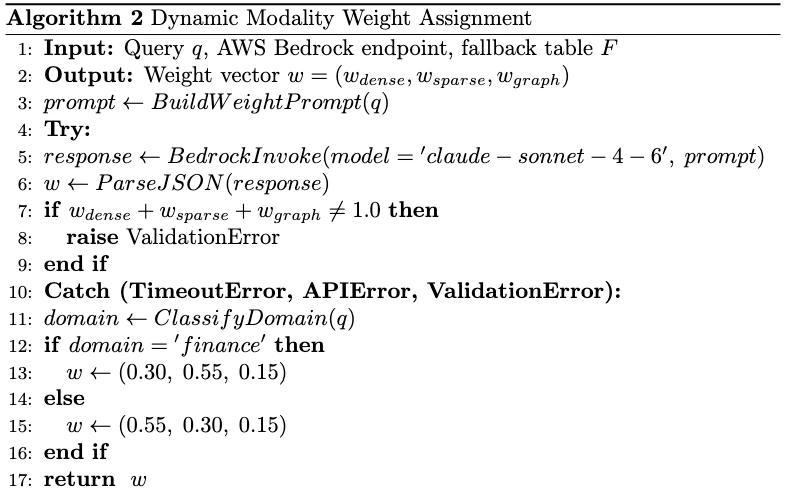
Given query q, we retrieve the top-K most relevant documents from corpus * + through
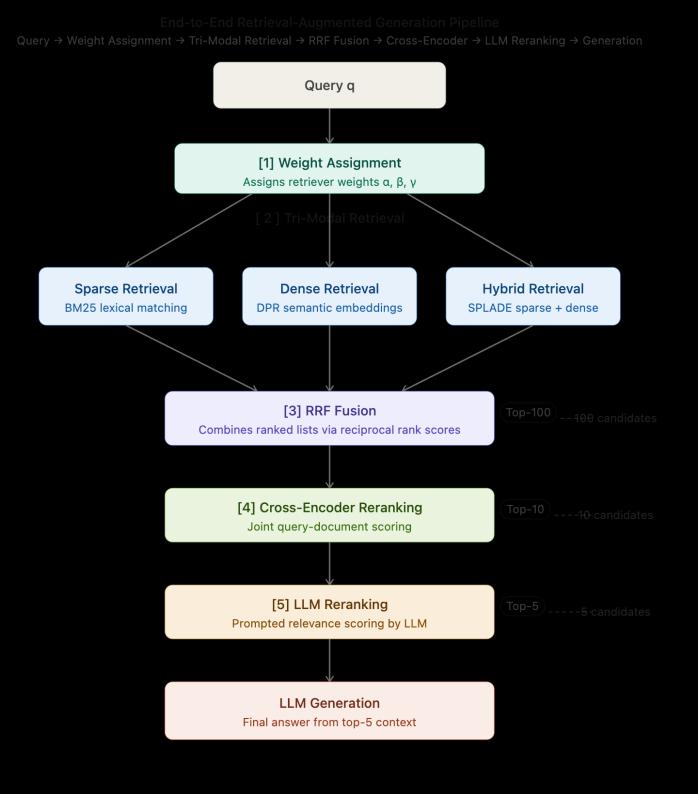
progressiverefinement.Let C_t denotethecandidateset
Fig:Pipeline
at stage t, where each stage applies a scoring function f_t andretainsthetop- results: ( ) . ( ( ) )/
This cascade reduces expensive LLM scoring calls from ( ) to ( ), cutting reranking cost by roughly 20× whilepreservingretrievalquality.
International Research Journal of Engineering and Technology (IRJET) e-ISSN: 2395-0056
Volume: 13 Issue: 04 | Apr 2026 www.irjet.net p-ISSN: 2395-0072
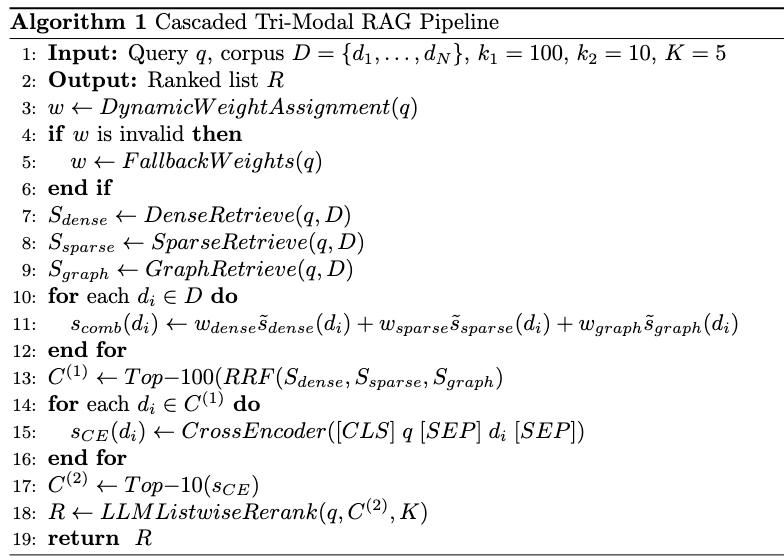
Different queries have different retrieval needs. A financial query containing specific numeric values tends torespondwell tolexical matching,sincethe exactterms matter; a conceptual question requires semantic understanding that sparse retrieval handles poorly. Rather than applying fixed global weights across all queries, we use an LLM agent to assign modality weights onaper-querybasis.
For query , the agent produces a weight vector w = subjectto:
, -
We prompt Claude Sonnet 4.6 via AWS Bedrock with a structured system message that specifies what each modality is good at and requires the output as JSON. The model is instructed to favour sparse weights for finance and numeric queries, dense weights for conceptual queries, and higher graph weights when the query is entity-rich.
When the LLM returns malformed JSON or produces weights that violate the sum constraint, a rule-based fallbackisapplied:
w = (0.30, 0.55, 0.15), if q matches finance/numeric pattern
w=(0.55,0.30,0.15), otherwise
Fortheablationbaseline,staticweights
( )ned viagridsearchontheFiQAvalidationsetareused.
Queries and documents are encoded using SentenceBERT (all-MiniLM-L6-v2) into 384-dimensional vectors. Document embeddings are formed by concatenating title andbodytextbeforeencoding:
( )
Relevanceismeasuredviacosinesimilarity:
( ) ( )
Raw cosine scores are min-max normalised to [0, 1] beforefusion:
( ) ( ) ( ) ( ) ( )
D. Stage 2b: Sparse Retrieval
SparseretrievalcombinesBM25andTF-IDF.BM25scores a document by summing term-weighted contributions acrossqueryterms:
( ) ( ) ( )( ) ( ) . /where
( ) is the term frequency of t in document , = 1.5, b = 0.75, and is the mean document length acrossthecorpus.
TF-IDF operates on bigram features (1–2 grams, maximum 50,000 features) and scores documents via cosinesimilaritybetweenTF-IDFvectors:
( ) ( )
Bothscoresarenormalisedto[0,1]separately,then averagedintoasinglesparsescore:
( ) ( ) ( )
International Research Journal of Engineering and Technology (IRJET) e-ISSN: 2395-0056
We construct an entity co-occurrence graph G = (V, E) where each node is a document and edges connect pairs thatsharenamedentities.
Entity extraction.Namedentitiesandnumericvaluesare identified using two regex patterns: capitalised phrases andnumerictokens.Formally:
( ) * +
This is deliberately lightweight the goal is fast entity signal,notNLP-qualityextraction.
Edge Construction.For each document pair ( ) where j in , ( )-, an edge is added when thetwodocumentsshareatleasttwoentities:
( ) ( ) ( )
The sliding window of 50 limits graph construction cost forlargecorpora.
PageRank Scoring.PageRankrunsontheresultinggraph withdampingfactorα=0.85,estimatingeachdocument's structuralimportance:
( ) ( ) ( )
Query scoring The final graph score for a querydocument pair combines entity overlap with the document'sPageRank:
( ) ( ) ( ) ( ( ))
AdocumentthatrankshighlyonPageRankisstructurally centraltothecorpus connectedtomanyothersthrough sharedentities.ThePageRanktermgivessuchdocuments amildrelevanceboostbeyondrawentityoverlap,onthe assumptionthatcentralitycorrelateslooselywith informativeness.
With three ranked lists in hand, we combine them using Reciprocal Rank Fusion (RRF). RRF operates on ranks rather than raw scores, which sidesteps the scale and distribution mismatches that make direct score combination unreliable across modalities. For each document d_i,theRRFscoresumsreciprocalranksacross all three modalities: ( )
* + ( )
where ( )is the position of document in modality 's ranked list, and = 60 follows standard practice.The constant k dampens the influence of top-
ranked documents and prevents a single modality from dominatingthefusedscore.
Forcomparison,theweightedlinearcombinationbaseline bypasses rank information entirely and sums normalised scoresdirectly:
( )
The top-100 documents from RRF are passed to a crossencoder(ms-marco-MiniLM-L-6-v2)fine-tunedontheMS MARCO passage ranking dataset. Unlike the bi-encoder used for dense retrieval which encodes query and document independently a cross-encoder processes them together in a single forward pass, allowing full attentionacrossboth:
The [CLS] token representation feeds into a binary classification head that outputs a relevance score. Running one forward pass per candidate makes crossencoders impractical at corpus scale, but over 100 documents the cost is manageable which is precisely whythecascadeexists.Thetop-10documentsadvanceto thefinalrerankingstage.
Thefinalstagepassesthetop-10cross-encoderoutputsto Claude Sonnet 4.6 via AWS Bedrock. Where the crossencoder scores documents independently, the LLM sees all candidates simultaneously and produces a listwise ranking. The prompt asks the model to briefly reason about which document best answers the query, then returnsaJSONarrayofindicesorderedfrommosttoleast relevant. If the response fails to parse or produces an invalid ordering, the cross-encoder ranking is kept as a fallback.This stage adds between 4 and 32 seconds per query depending on the dataset a wide range that reflects differences in document length and candidate overlap across domains. In practice we limit input to the top-5 candidates rather than all 10; this keeps latency manageablewhilestillgivingthemodelenoughcontextto makemeaningfulreorderingdecisions.
We report five standard BEIR retrieval metrics at k ∈ {1, 5, 10}, covering complementary aspects of ranking quality.
nDCG@k (Normalised Discounted Cumulative Gain) measures ranking quality while accounting for graded relevance. Documents retrieved earlier contribute more
Volume: 13 Issue: 04 | Apr 2026 www.irjet.net p-ISSN: 2395-0072 © 2026, IRJET | Impact Factor value: 8.315 | ISO 9001:2008 Certified Journal | Page 1963
International Research Journal of Engineering and Technology (IRJET) e-ISSN: 2395-0056
Volume: 13 Issue: 04 | Apr 2026 www.irjet.net p-ISSN: 2395-0072
to the score, with gains discounted logarithmically by position: ( )
where is the ideal DCG achieved by a perfect ranking.
MRR@k (Mean Reciprocal Rank)
Captures how quickly the first relevant document appears:
MAP@k (Mean Average Precision)
averagesprecisionateachpositionwherearelevant documentisretrieved: ( ) ( )
Recall@k and Precision@k measurecoverageandexactnessrespectively:
We evaluate on three BEIR benchmarks chosen to cover meaningfullydifferentdomainsandquerytypes.
TABLE B DatasetSummary
NFCorpus 3,633docs 100 Medicalnutrition
TABLE C ImplementationSummary
(384-dim) Cross-encoder ms-marco-MiniLM-L-6-v2
LLMreranker ClaudeSonnet4.6,AWSBedrock (us-east-1)
J. Ablation Study Design
Toisolatewhateachcomponentcontributes,weevaluate five pipeline configurations that build on each other progressively. Every configuration runs on the same 100 queriesperdatasetwiththesamerandomseed.
TABLE A AblationConfigurations
w_dense=0.50,w_sparse=0.35, w_graph=0.15
BM25parameters k1=1.5,b=0.75 PageRankalpha 0.85
LLM reranking takes between 4 and 32 seconds per query, which made running the full pipeline over entire test sets impractical. We evaluate on 100 queries per dataset with ground-truth relevance labels, consistent withpriorLLMreranking work.Atthatsample size,95% confidence intervals for nDCG@10 sit around ±0.098 narrowenough todetect meaningful differencesbetween ablationconfigurations.
International Research Journal of Engineering and Technology (IRJET) e-ISSN: 2395-0056
Volume: 13 Issue: 04 | Apr 2026 www.irjet.net p-ISSN: 2395-0072
A. Datasets
Experiments run on three publicly available BEIR benchmarkcorpora,chosentorepresentdistinctretrieval challengesacrossdifferentdomains.
FiQA (Financial Question Answering) contains 6,648 documents and 100 test queries drawn from financial opinionpostsandforumthreads.Thedomain'sdensityof numeric expressions, technical jargon, and domainspecific abbreviations makes it a difficult setting for purelysemanticretrieval thekindofquerywhereexact termmatchingmattersasmuchasmeaning.
SciFact is a biomedical claim verification dataset containing 5,183 scientific abstracts evaluated against 100 queries. NFCorpus comprises 3,633 documents from medicalandnutritionalsciencesources,alsoevaluatedon 100 queries. All three datasets use binary relevance judgmentsprovidedbytheBEIRbenchmark.
B. Computational Environment
All experiments run on CPU no GPU is required for MiniLM inference. The stack is Sentence-Transformers v2.2.0 with a PyTorch backend, AWS Bedrock for Claude Sonnet4.6inference,andPython3.10withNumPy,SciPy, scikit-learn.
C. Caching Strategy
Dense embeddings and graph structures are cached to diskusingpickleserializationwithMD5hashingforcache invalidation. Embeddings are computed once per dataset andreusedacrossallablationconfigurations,whichkeeps repeatedcomputationtoaminimumacrossruns.
A. Overall Pipeline Performance
Table I shows nDCG@10 at each stage of the cascaded pipeline across all three datasets. Every reranking stage improvedretrievalqualityoneverydataset.
TABLE I nDCG@10atEachPipelineStage
The cross-encoder produced the largest single-stage gains: +36.8% on FiQA, +35.9% on NFCorpus, and +4.6% on SciFact. The FiQA and NFCorpus jumps are large enough to suggest the cross-encoder wasn't just refining analready-reasonableordering itwasdoingsubstantial semantic reordering of the initial retrieval output, consistent with findings by Nogueira and Cho on BERTbased rerankers. SciFact's smaller gain likely reflects the fact that biomedical abstracts are more consistently structured, giving the initial retrieval stage less room to gowrong.
LLM reranking added smaller and more variable improvements.OnFiQAitpushednDCG@10upa further 7.7% over the cross-encoder; on SciFact, 4.8%. On NFCorpus it contributed almost nothing (+0.1%). That pattern is telling. LLM reranking appears most useful when queries require reasoning over document semantics financialandscientificqueriestendtoinvolve inference, comparison, or interpretation. Short, keywordlikebiomedical queries, by contrast,are the kind of thing the cross-encoder already handles well, leaving little for theLLMtocorrect.
Five configurations were tested to isolate each component's contribution. Table II reports nDCG@10acrossallthreedatasets.
TABLE II — AblationStudy nDCG@10
International Research Journal of Engineering and Technology (IRJET) e-ISSN: 2395-0056
Volume: 13 Issue: 04 | Apr 2026 www.irjet.net p-ISSN: 2395-0072
The dense-only result on FiQA (0.3850) outperforming bothbi-modal(0.2648)andtri-modalfusion(0.2628)was unexpected, and NFCorpus told the same story: denseonly (0.3537) beat tri-modal (0.2925) by a meaningful margin. The culprit was dynamic weight assignment. When the LLM allocated too much weight to weaker modalities, it diluted the dense signal rather than complementing it. Switching to static weights reversed the pattern tri-modal fusion outperformed dense-only on both datasets which confirms the fusion mechanism itselfwassound.Theproblemwasupstream.
SciFact behaved differently. Bi-modal fusion (0.7449) outperformed both dense-only (0.6996) and tri-modal (0.6896), suggesting that sparse retrieval genuinely helped with scientific claim queries that contain specific terminology,whilethegraphmodalityaddednoiserather than signal. Across all three datasets, the cross-encoder consistently recovered whatever performance the fusion stagehadlost.
Table III compares nDCG@10 under static weights (0.50 dense, 0.35 sparse, 0.15 graph) against LLM-assigned dynamicweights.
providedintheprompt,suggestingthemodelanchoredto those examples rather than reasoning about each query independently. Zero-shot weight assignment from query textalone,itturnsout,isnotareliablestrategy.Makingit work would likely require fine-tuning on retrieval performance signals, few-shot prompting with domainspecific examples, or a learned meta-model that operates on retrieval score distributions rather than raw query text.
Swap metrics measure how much each reranking stage disturbed the document ordering. Table IV reports average position swaps and the share of queries where thetop-rankeddocumentchanged.
TABLE IV SwapRateMetrics
Dynamicweightsunderperformedstaticweightsonevery dataset. The gap was smallest on FiQA (−0.0102) and largest on SciFact (−0.0708). This was the study's most notable negative result, and it deserves a direct explanationratherthanadiplomaticone.
TheLLMreceivedonlythe querytext.Ithadnoaccessto retrievalscores,corpusstatistics,oranysignalabouthow eachmodalitywasactuallyperforming.Thepromptasked it to classify queries into broad categories conceptual, keyword-heavy, entity-rich which oversimplifies the relationship between query type and modality effectiveness considerably. Worse, the assigned weights clustered suspiciously close to the example values
The cross-encoder was aggressive. Roughly 9 position swaps per query on average, with the top-ranked document replaced in half to four-fifths of queries depending on the dataset. That scale of reordering confirms it was doing genuine semantic correction of the initial ranking, not marginal adjustment. The LLM reranker, by contrast, was conservative fewer than 2 swaps per query on average, and top-1 changes in only 30%to61%ofqueries.Thetwostagesaredoingdifferent things. The cross-encoder fixes coarse errors from firststageretrieval;theLLMarbitratesfinedistinctionsamong documents that are already mostly right. The declining swap rate across stages is the pipeline working as intended.
QuerieswhereLLMrerankingreducednDCG@10relative to the cross-encoder output were classified as degraded. TableVsummarisesthepattern.
International Research Journal of Engineering and Technology (IRJET) e-ISSN: 2395-0056
Dataset Degraded Queries Numeric in Degraded Avg Query Length (Degraded vs. Overall)
FiQA 10/100 1/10 (10%) 11.1 vs 10.8 tokens
SciFact 5/100 1/5 (20%) 15.8 vs 11.7 tokens
NFCorpus 10/100 0/10 (0%) 4.7 vs 3.5 tokens
Dataset Delta nDCG@10 Query
FiQA -0.3691
FiQA -0.2263
SciFact -0.3691
OpeningaRothIRAaccount, whatisthefeestructurefor Vanguard,Scottrade...
Shouldaretailtraderbother aboutreadingSECfilings
1,000genomesprojectenables mappingofgeneticsequence variation...
SciFact -0.3691 ActiveH.pyloriureasehasa polymericstructure...
NFCorpus -0.1931
WhatdoyouthinkofDr. Jenkins'takeonpaleolithic diets?
NFCorpus -0.1551 blackraspberries
The failure mode is consistent across datasets: the LLM favoured documents with broad topical coverage over those with precise factual matches. On FiQA, the worst degradation came on a query about specific Roth IRA fee structures the LLM ranked a general investment document above one that actually contained the fee details. On NFCorpus, the degraded queries were short and ambiguous ("black raspberries," "breast pain"), where the LLM's attempt to reason about relevance introducedunnecessaryreorderingofrankingsthecrossencoder had already got roughly right. On SciFact, the
failures clustered around highly specific biomedical claimswheretheLLMsimplylackedthedomainprecision toimproveonthecross-encoder'soutput.
Numeric content was not a reliable predictor of degradation only0–20%ofdegradedqueriescontained numbers,whichisnotmeaningfullyabovethebaserate.
Table VII reports the average per-query latency for each pipelinestage.
TABLE VII AverageLatencyPerQuery(milliseconds)
Total per-query latency ranged from 13.2 seconds on SciFact to 43.8 seconds on FiQA. The FiQA figure is the one that warrants attention: LLM reranking alone consumed 32 seconds per query roughly 73% of total latency for an accuracy gain of 7.7% over the crossencoder.Thatisapoortradeformostproductionsettings.
The cross-encoder and LLM stages dominate latency acrossallthreedatasets.Forapplicationswhereresponse time matters, Tri-Modal + CE is the more practical configuration: it captures the majority of the accuracy gain at a fraction of the total cost, and the remaining gap closed by LLM reranking rarely justifies the added seconds.
A. Conclusion
This study evaluated a cascaded agentic RAG pipeline combining tri-modal hybrid retrieval (dense, sparse, graph), cross-encoder reranking, and LLM-based listwise reranking across three BEIR benchmark datasets.The clearestfindingisthatcross-encoderrerankingdoesmost of the work. It delivered consistent, substantial improvements across all three domains, and the swap rate analysis confirmed it was performing genuine
Volume: 13 Issue: 04 | Apr 2026 www.irjet.net p-ISSN: 2395-0072 © 2026, IRJET | Impact Factor value: 8.315 | ISO 9001:2008 Certified Journal | Page 1967
International Research Journal of Engineering and Technology (IRJET) e-ISSN: 2395-0056
Volume: 13 Issue: 04 | Apr 2026 www.irjet.net p-ISSN: 2395-0072
semantic correction rather than marginal adjustment. LLM reranking added smaller, domain-dependent gains on top most useful for reasoning-intensive financial queries on FiQA, nearly irrelevant for the short biomedicalqueriesinNFCorpus.
The dynamic weight assignment result was the study's sharpest negative finding. LLM-assigned weights underperformed static weights on every dataset, with gaps as large as −0.0708 on SciFact. Zero-shot query classification without any retrieval feedback, it turns out, is not a reliable basis for modality balancing the model anchored to example values in the prompt rather than adapting meaningfully to each query. A well-tuned static configurationbeatiteverytime.ErroranalysisfoundLLM degradation in 5–10% of queries per dataset, concentrated on queries requiring narrow factual precision. The LLM's tendency to favour broad topical coverageoverexactmatchesisapredictablefailuremode, andoneworthdesigningaround.
Two directions follow directly from these findings.The dynamic weight assignment failure points toward feedback-awareweightlearning.Thecurrentdesigngives the LLM only query text no retrieval scores, no corpus statistics, no signal about how each modality is actually performing on this query. Providing modality-level retrieval score distributions as input, or using few-shot prompting with domain-specific examples, would at minimum reduce the anchoring problem. A lightweight meta-model trained on retrieval performance signals could go further, enabling genuine query-adaptive fusion ratherthansurface-levelqueryclassification.
The LLM reranking latency problem points toward distillation.OnFiQA,theLLMstageconsumed32seconds per query and returned a 7.7% relative improvement over the cross-encoder a poor exchange rate for any latency-sensitive application. The reasoning-based refinements the LLM provides on financial and scientific queries are real, but they don't need to come from a full LLM forward pass at inference time. Distilling the LLM's rankingpreferencesintoafine-tunedT5orcross-encoder variant could preserve most of the quality gain while cutting inference time by an order of magnitude, making the full pipeline practical outside of offline or batch settings.
[1] K. Sawarkar, A. Mangal, and S. R. Solanki, "Blended RAG: Improving RAG accuracy with semantic search and hybrid query-based retrievers," in Proc. IEEE 7th Int. Conf. Multimedia Inf. Process. Retrieval (MIPR), San Jose,
CA, USA, 2024, pp. 155–161, doi: 10.1109/mipr62202.2024.00031.
[2]R. Muthusami and K. Saritha, "Hybrid retrieval generation for structured reasoning with large language models," Discover Artif. Intell., 2026, doi: 10.1007/s44163-026-01059-9.
[3] S. E. Robertson and H. Zaragoza, "The probabilistic relevance framework: BM25 and beyond," Found. Trends Inf. Retr., vol. 3, no. 4, pp. 333–389, 2009, doi: 10.1561/1500000019.
[4] O. Khattab and M. Zaharia, "ColBERT: Efficient and effective passage search via contextualized late interactionoverBERT,"arXiv,preprintarXiv:2004.12832, 2020,doi:10.48550/arxiv.2004.12832.
[5] L. Wang, J. Lin, and D. Metzler, "A cascade ranking model for efficient ranked retrieval," in Proc. 34th Int. ACM SIGIR Conf. Research and Development in Information Retrieval, Beijing, China, 2011, pp. 105–114, doi:10.1145/2009916.2009934.
[6] Y. Wu, X. Shen, F. Wang et al., "Optimizing RAG rerankerswithLLMfeedbackviareinforcementlearning," arXiv, preprint arXiv:2604.02091, 2026, doi: 10.48550/arxiv.2604.02091.
[7] Z. Qin, R. Jagerman, K. Hui et al., "Large language models are effective text rankers with pairwise ranking prompting,"inFindingsoftheAssoc.Comput.Linguistics: NAACL 2024, Mexico City, Mexico, 2024, pp. 1504–1518, doi:10.18653/v1/2024.findings-naacl.97.
[8] J. Sun, X. Zhong, S. Zhou, and J. Han, "DynamicRAG: Leveraging outputs of large language model as feedback for dynamic reranking in retrieval-augmented generation," arXiv, preprint arXiv:2505.07233, 2025, doi: 10.48550/arxiv.2505.07233.
[9] I. Besrour, J. He, T. Schreieder, and M. Färber, "RAGentA: Multi-agent retrieval-augmented generation for attributed question answering," arXiv, preprint arXiv:2506.16988,2025,doi:10.48550/arXiv.2506.16988.
[10]O.Weller,K.Ricci,E.Yang,A.Yates,D.Lawrie,andB. Van Durme, "Rank1: Test-time compute for reranking in information retrieval," arXiv, preprint arXiv:2502.18418, 2025,doi:10.48550/arxiv.2502.18418.
[11] X. Ma, X. Zhang, R. Pradeep, and J. Lin, "Zero-shot listwise document reranking with a large language model," arXiv, preprint arXiv:2305.02156, 2023, doi: 10.48550/arxiv.2305.02156.
International Research Journal of Engineering and Technology (IRJET) e-ISSN: 2395-0056
Volume: 13 Issue: 04 | Apr 2026 www.irjet.net p-ISSN: 2395-0072
[12] Y. Zhou, Q. Luo, B. Feng, and B. Wang, "Large language models for reranking: A survey," TechRxiv, 2025,doi:10.36227/techrxiv.176300630.01740917/v1.
[13]A.Colombo,A.Bernasconi,L.Bellomarini,L.Guiso,C. Michelacci, and S. Ceri, "LegisSearch: Navigating legislation with graphs and large language models," Artif. Intell.Law,2025,doi:10.1007/s10506-025-09482-6.
[14] A. L. N. Rao, H. Alipour, and N. Pendar, "Rethinking hybrid retrieval: When small embeddings and LLM reranking beat bigger models," arXiv, preprint arXiv:2506.00049,2025,doi:10.48550/arxiv.2506.00049.
[15] M. Yuan, H. Zhang, D. Liu, L. Wang, and L. Liu, "Semantic-embedding guided graph network for crossmodal retrieval," J. Vis. Commun. Image Represent., vol. 93,p.103807,2023,doi:10.1016/j.jvcir.2023.103807.
[16] A. Kau, X. He, A. Nambissan, A. Astudillo, H. Yin, and A. Aryani, "Combining knowledge graphs and large language models," arXiv, preprint arXiv:2407.06564, 2024,doi:10.48550/arxiv.2407.06564.
[17]N.Thakur,N.Reimers,A.Rücklé,A.Srivastava,andI. Gurevych, "BEIR: A heterogeneous benchmark for zeroshot evaluation of information retrieval models," in Proc. 35th Conf. Neural Inf. Process. Syst. Datasets and BenchmarksTrack,2021.
[18] Z. Li, C. Li, M. Zhang, Q. Mei, and M. Bendersky, "Retrievalaugmentedgenerationorlong-contextLLMs?A comprehensivestudyandhybridapproach,"inProc.2024 Conf. Empirical Methods Natural Language Processing: Industry Track, Miami, FL, USA, 2024, pp. 881–893, doi: 10.18653/v1/2024.emnlp-industry.66.
[19] Q. Huang, J. Yu, C. Gao et al., "A survey on large language models for critical societal domains: Finance, healthcare, and law," arXiv, preprint arXiv:2405.01769, 2024,doi:10.48550/arXiv.2405.01769.
[20] E. Lumer, M. Melich, O. Zino et al., "Rethinking retrieval: From traditional retrieval augmented generation to agentic and non-vector reasoning systems inthefinancial domain forlargelanguagemodels,"arXiv, preprintarXiv:2511.18177,2025,doi: 10.48550/arxiv.2511.18177.
[21]Y.Wan,Z.Chen,Y.Liu,C.Chen,andM.Packianather, "Empowering LLMs by hybrid retrieval-augmented generation for domain-centric Q&A in smart manufacturing," Adv. Eng. Inform., vol. 65, p. 103212, 2025,doi:10.1016/j.aei.2025.103212.
[22] Y. Momtaz, G. Russo, M. Brescia, and L. D. Landa, "Graph-based RAG for manuscript collections: A LangGraph approach," Research Square, 2026, doi: 10.21203/rs.3.rs-9293015/v1.
[23] Q. Jiang, Z. Gao, and G. E. Karniadakis, "DeepSeek vs. ChatGPT vs. Claude: A comparative study for scientific computing and scientific machine learning tasks," Theor. Appl. Mech. Lett., vol. 15, no. 3, p. 100583, 2025, doi: 10.1016/j.taml.2025.100583.
[24] Z. Xu, M. M. C. D. Cruz, M. Guevara et al., "Retrievalaugmented generation with knowledge graphs for customer service question answering," in Proc. 47th Int. ACM SIGIR Conf. Research and Development in Information Retrieval, Washington, DC, USA, 2024, pp. 2905–2909,doi:10.1145/3626772.3661370.
[25] P. Jiang, S. Ouyang, Y. Jiao, M. Zhong, R. Tian, and J. Han, "A survey on retrieval and structuring augmented generation with large language models," arXiv, preprint arXiv:2509.10697, 2025, doi: 10.48550/arxiv.2509.10697.
[26] A. Gan, H. Yu, K. Zhang, Q. Liu, W. Yan, Z. Huang, S. Tong, and G. Hu, "Retrieval augmented generation evaluation in the era of large language models: A comprehensivesurvey,"arXiv,preprintarXiv:2504.14891, 2025,doi:10.48550/arXiv.2504.14891.
[27] M. Wang, B. Tan, Y. Gao et al., "Balancing the blend: An experimental analysis of trade-offs in hybrid search," arXiv, preprint arXiv:2508.01405, 2025, doi: 10.48550/arxiv.2508.01405.
[28]J.Lee,H.Cha,Y.Hwangbo,andW.Cheon,"Enhancing large language model reliability: Minimizing hallucinations with dual retrieval-augmented generation basedonthelatestdiabetesguidelines,"J.Pers.Med.,vol. 14,no.12,p.1131,2024,doi:10.3390/jpm14121131.
[29] D. Edge, H. Trinh, N. Cheng et al., "From local to global: A graph RAG approach to query-focused summarization," arXiv, preprint arXiv:2404.16130, 2024, doi:10.48550/arxiv.2404.16130.
[30]H.ElkiranandJ.Rasheed,"Anempiricalevaluationof retrieval, reranking, and similarity for a Q&A-based retrievalaugmentedgenerationsystem,"IEEEAccess,vol. 14,pp.2605326066,2026,doi:10.1109/access.2026.36648 52.
[31] G. V. Cormack, C. L. A. Clarke, and S. Buettcher, "Reciprocal rank fusion outperforms Condorcet and individualranklearningmethods,"inProc.32ndInt.ACM SIGIR Conf. Research and Development in Information Retrieval, Boston, MA, USA, 2009, pp. 758–759, doi: 10.1145/1571941.1572114.
[32]K.Wołk,"Evaluatingretrieval-augmentedgeneration variants for clinical decision support: Hallucination mitigation and secure on-premises deployment," Electronics, vol. 14, no. 21, p. 4227, 2025, doi: 10.3390/electronics14214227.
2026, IRJET | Impact Factor value: 8.315 | ISO 9001:2008 Certified Journal | Page 1969
International Research Journal of Engineering and Technology (IRJET) e-ISSN: 2395-0056
Volume: 13 Issue: 04 | Apr 2026 www.irjet.net p-ISSN: 2395-0072
[33] I. Iaroshev, R. Pillai, L. Vaglietti, and T. Hanne, "Evaluating retrieval-augmented generation models for financial report question and answering," Appl. Sci., vol. 14,no.20,p.9318,2024,doi:10.3390/app14209318.
© 2026, IRJET | Impact Factor value: 8.315 | ISO 9001:2008 Certified Journal | Page 1970