
International Research Journal of Engineering and Technology (IRJET) e-ISSN: 2395-0056
Volume: 12 Issue: 11 | Nov 2025 www.irjet.net p-ISSN: 2395-0072
International Research Journal of Engineering and Technology (IRJET) e-ISSN: 2395-0056
Volume: 12 Issue: 11 | Nov 2025 www.irjet.net p-ISSN: 2395-0072
N.M. Lakshmi Prasad1 , Dr D.V. Prasada Rao2
1P.G. Student, Department of Civil Engineering, Sri Venkateswara University College of Engineering, Tirupati, Andhra Pradesh, India.
2Professor, Department of Civil Engineering, Sri Venkateswara University College of Engineering, Tirupati, Andhra Pradesh, India. ***
Abstract - The construction of multi-storey buildings has increased worldwide. With an increase in structure height, the importance of lateral load-resisting elements becomes more significant. Widely used lateral load resisting systems are moment resisting frames, shear walls, braced systems, outrigger systems, and diagrid systems. Diagrid is an exterior structural system that consists of inclined columns along the periphery. The main aim of this study is to compare the performance of the diagrid structural system with a framed structural system. Comparisons are made for both R.C and steel structures. Structural models are analysed and comparisons are made to find the optimum angle of diagrid, roof displacement, storey drift, and effectiveness of the diagrid structure with the framed structure in resisting lateral loads. Based on the results of the analyses, it is found that the diagrid structure with 65° diagrid angle is more effective in resisting lateral loads and reduced roof displacements, storey drift compared to a framed structure. Diagrid R.C structure saves approximately 8% of concrete and 15% reinforcement, whereas the diagrid steel structure saves approximately 18% of structural steel.
Key Words: Diagrid structure, Lateral Stability, R.C Structure, Steel Structure, Optimum angle, Lateral loads, Displacement
Duetorapidurbanisationconstructionoftallbuildingshasrapidlyincreased.Astheheightofbuildingsincreases,thelateral loadresistingsystembecomesmoreimportantthanthestructuralsystemthatresiststhegravitationalloads.Thelateralload resistingsystemsthatarewidelyusedaremainlymomentresistingelements,shearwalls,bracedsystems,outriggersystems, anddiagridsystems.Thediagridstructuralsystemisbecomingpopularinthedesignoftallstructuresduetoitsstructuraland architecturaladvantages.Diagridisanexteriorstructuralsysteminwhichperimetercolumnsarereplacedwithdiagrids.Shear andoverturningmomentdevelopedareresistedbytheaxialactionofthesediagonals,comparedtothebendingofvertical columnsinaframedstructure.[1] Optimumanglesfordiagridsarebetween35and90degrees.Diagridmemberstransfer bothlateralandgravityloadthroughaxialaction,enhancinglateralloadresistanceandrequiringlessstructuralmaterial. Triangulargridpatternofdiagridsaddsaestheticvaluetothestructure.
Thepresentstudyfocusesontheeffectivenessofthediagridsysteminresistinglateralloadswhencomparedtoaframed structure.ConcreteandSteelstructureswereanalysedwithbothframedanddiagridsystems.Astheoptimumangleof the diagrid depends on the geometry of the structure, analyses were made to determine the optimum angle of the diagrid. Performanceofthediagridstructureisanalysedbasedonthemaximumdisplacement,storeydrift,axialforce,shearforce, bendingmomentandsavingofstructuralmaterial.AnalysesareperformedbasedonIScodalprovisions.
Manyresearchershavedoneworkinthefieldofdiagridstructures.Afewstudiesarementionedalongwiththeirkeyfindings. Diagridsimprovetheaestheticappearanceofthestructurewithoutcompromisingstructuralintegrity.Thediagonalmembersin diagridstructuralsystemscarrygravityloadsaswellaslateralforcesduetotheirtriangulatedconfiguration.Itsavesupto20% ofstructuralmaterialcomparedtoaframedstructure.[2] DiagridStructureperformsbetterasalateralloadresistingsystem thanshearwallandbracingsystems.DiagridStructurehastheleastMaximumLateralDisplacementandMaximumStoreyDrift. [3] JaniKhushbu,PatelPareshV.[4]hasdoneanalysisanddesignon3636-storeydiagridsteelbuilding.Afloorplanof36mx 36misadopted.WindloadsandEarthquakeloadsareconsideredforanalysis.Loaddistributionforperipheraldiagridsand interiorcolumnsisstudiedfora36-storeybuilding.Fromtheresults,itcanbeobservedthatdiagridsresistmostofthelateral loads,whilegravityloadisresistedbyboththeinternalcolumnsandperipheraldiagrids.
International Research Journal of Engineering and Technology (IRJET) e-ISSN: 2395-0056
Volume: 12 Issue: 11 | Nov 2025 www.irjet.net p-ISSN: 2395-0072
J.Kim,Y.JunandY.HoLee[2]presentedapaperonseismicperformanceevaluationofdiagridbuilding.Designandanalysisofa 36-storeybuildingiscarriedoutfordifferentangles.Theanalysismodelstructuresare36-storeydiagridstructureswithvarious slopes(50.2°,61.0°,67.4°,71.6°,74.5°,and79.5°).Theresultshowsthatastheangleofthediagridincreased,theshearlageffect increasedandthelateral strength decreased.The diagrid structures withanangle between 60° to70°seemed to be most efficientinresistinglateralaswellasgravityloads.
DivyaC.Bhuta,UmangPareekh[5]hasdoneastudyonthelateralloadresistingsystemintallbuildings.Analysiswascarriedout ona40-storeyR.CstructurewithdifferentlateralresistingsystemslikeShearwalls,outriggersanddiagrids.Analysiswas carriedoutforearthquakeandwindloads.Comparisonoftopstoreydisplacement,storeydriftandtimeperiodisdonefor differentstructuralsystems.Itisconcludedthatthediagridsystemshowsaminimumdisplacementthanothersystems.
ManishS.Ramteke,KirtiR.Padmawar,[6]havestudiedtheComparativestudyofConventionalFramedandDiagridwithplan irregularity.Thestructuresareanalysedbythelinearstaticmethod.Thebuildingisconsideredtobeirregularinplan.Irregular plans,C-shapeplans,andL-shapeplansareconsidered.Theresultsobtainedarecomparedbyvariousparameterslikestorey displacement,baseshear,bendingmoment,frequency,andstoreydrift.Theresultshowedthatthediagridsystemresistslateral loadsmoreefficientlythantheconventionalsystem.
Fromtheliteraturestudy,itisunderstoodthatthediagridsystemperformsbetterthanframed,shearwallsandoutrigger systems.Thediagridangledependsonthestructure'sgeometry.
Inthepresentstudyofthediagridsystemwiththeconventionalframedsystem,themainobjectiveistofindtheoptimumangle oftheDiagrid.Structuralperformanceintermsofroofdisplacementsandstoreydrift,forconcreteandsteelstructures,is evaluatedforbothtypesofstructuralsystems.
Afloorplanfora12StoreyBuildingmeasuring30.8mx24.8mwithastoreyheightof3.2misadopted.ForR.Cstructures, M30 grade of concrete and Fe 550D grade steel is considered. For Steel structures, E350 Structural steel is adopted. The thicknessoftheslabis150mm,andthethicknessofexteriorandinteriorwallsis230and115mm.
WindloadsarecalculatedbasedonIS875(Part–3).Basicwindspeedisconsideredas39m/sforterraincategory3.Seismic analysisisperformedbasedonIS1893:2016,earthquakeZone-3withazonefactorof0.16,anImportancefactor(I)of1anda Responsereductionfactorof5foraspecialmomentresistingframe.EquivalentStaticmethodanalysisisperformedtoevaluate maximumdisplacementsandstoreydriftforwindandseismicloads.Basedontheresultsofstructuralanalysis,designsare carriedoutaspertheIScodesofpractice.
ConsideringGravityloadssuchasdeadloadsandliveloadsasperIS875Part1&2.Self-weightofthestructure,1.5kN/m2for floorfinishesand2.5kN/m2forrooffinishesandWallloadsof12.65kN/m2forexteriorwalls,6.5kN/m2forinteriorwalls,and 2.3kN/m2forparapetwallswereconsideredasdeadloads.Liveloadsof2kN/m2forfloorsand1.5kN/m2 forroofswere incorporated.LoadcombinationsarepreparedbasedonIS875(part-5):1987.ForR.Candsteelstructures,IS456:2000andIS 875:2007codesareconsideredforgeneraldesigninconcreteandsteelstructures.
LateralperformanceofthestructureisevaluatedbasedontheroofdisplacementandStoreydrift. AsperIndianstandard codesofpractice,thelateralswayatthetopofthebuildingshallnotexceedH/500fortransientwindloads,whereHisthetotal heightofthebuildingandunderseismicloading,thelateralswayatthetopshouldnotexceedH/250,andstoreydriftshallnot exceed0.004timesofstoreyheight.
Initially,diagridmodelswiththreediagridangles,58o,65o,and73o areanalysed.Diagridangledependsontheheightand widthofthediagridmodule.Comparisonsaremadeforroofdisplacementsandstoreydrift,basedonstructuralperformanceto lateralloads.BycomparingroofdisplacementsandStoreydrift,theoptimumangleofthediagridisdetermined. A comparative study was then carried out for framed structures with the diagrid model using the optimum angle. Roof displacementsandstoreydriftsarecomparedtoanalysethestructure'sabilitytowithstandlateralloads;reducedstoreydrift indicatesimprovedlateralstabilityandoccupants'comfort.Basedontheresultsoftheanalysis,itcanbeobservedthatthe diagridstructurereducestheroofdisplacementandthestoreydrift.Further,theeffectivenessofperipherydiagridsinresisting lateralloadsisanalysed,andtheaxialloadduetolateralloadreceivedbythediagridsandinteriorcolumnsarecompared.Itis
International Research Journal of Engineering and Technology (IRJET) e-ISSN: 2395-0056
foundthat86%oflateralloadsareresistedbytheperipherydiagrids.InteriorcolumnsareselectedtocomparetheBending momentandShearforceduetolateralloadsfortheframedanddiagridstructures.Fromthecomparisonoftheresultsofthe analysis,itisproventhatthediagridstructuresareeffectiveinresistinglateralloads.
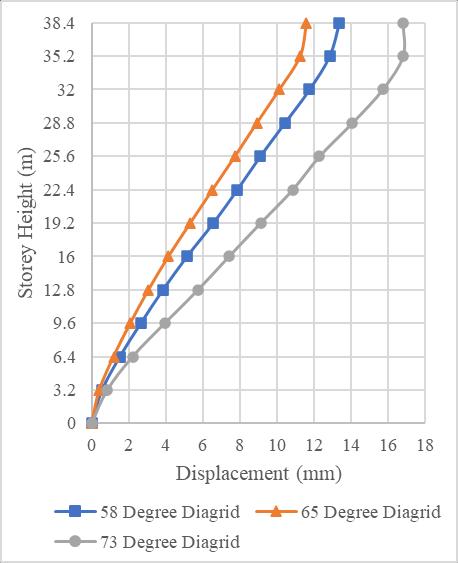
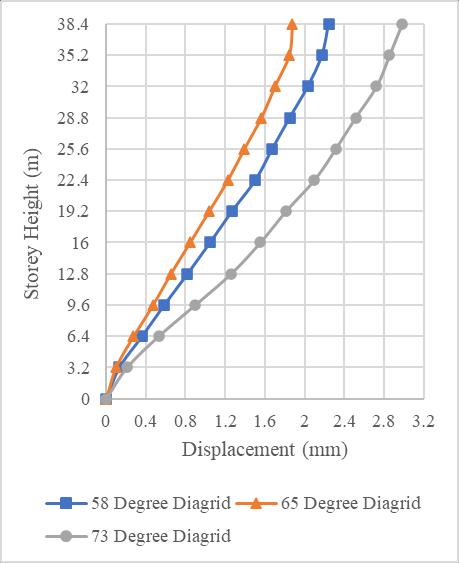
Basedontheanalysisresults,thefollowingobservationsaremadeforframedanddiagridstructures.Thevariationofstorey displacementsalongthestructureheightforthethreediagridstructuresundertheactionoflateralloadsisshowninFigure1, androofdisplacementsareshowninTable1.
Itcanbeobservedthatthe65o diagridmodelshowedtheleastresponsetolateralloadsamongthethreemodels.
(i) (ii)
Figure -1: VariationofStoreydisplacementsalongtheHeightoftheStructuredueto(i)EQ&(ii)WLforThreeTypesof DiagridStructures
Table -1: RoofdisplacementsduetoEQ&WLforDiagridStructures
Displacement
Diagrid Angle
StoreydriftvariationalongthestructureheightunderearthquakeandwindloadsisshowninFigure2,andmaximumstorey driftsareshowninTable2.
Itcanbeobservedthatthe65o diagridmodelshowstheleastvariationtolateralloadsamongthethreemodels.Hence,the optimumdiagridangleforthegivenstructureis65o,furthercomparativestudywillbecarriedoutwiththediagridmodel usingtheoptimumangle.
Volume: 12 Issue: 11 | Nov 2025 www.irjet.net p-ISSN: 2395-0072 © 2025, IRJET | Impact Factor value: 8.315 | ISO 9001:2008 Certified Journal | Page321
International Research Journal of Engineering and Technology (IRJET) e-ISSN: 2395-0056
Volume: 12 Issue: 11 | Nov 2025 www.irjet.net p-ISSN: 2395-0072
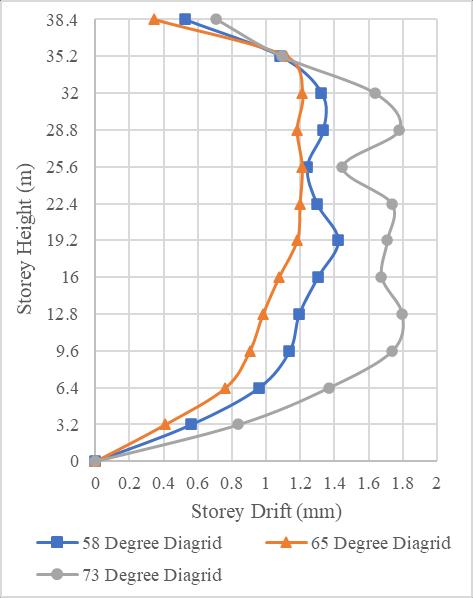
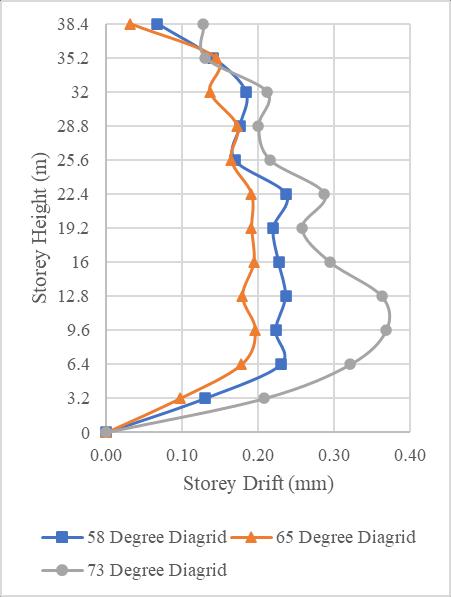
Figure -2: VariationofStoreyDriftalongtheHeightoftheStructuredueto(i)EQ&(ii)WLforThreeTypesofDiagrid Structures
Table -2: MaximumStoreyDriftduetoEQ&WLforThreeTypesofDiagridStructures
Diagrid Angle
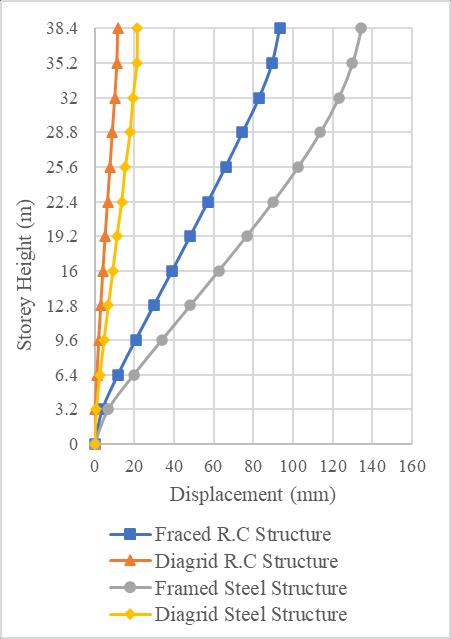
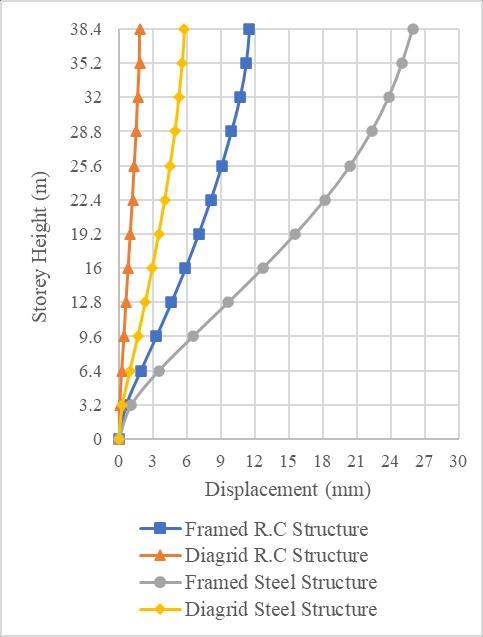
The variation of storey displacements for R.C and steel structures with framed and diagrid systems under the action of earthquakeandwindloadsisshowninFigure3.TheRoofdisplacementsforR.Candsteelstructuresunderearthquakeandwind loadsareshowninTable3.
ItcanbeobservedthattheR.Cdiagridstructureresultsin87%and84%reductionofroofdisplacements.Similarly,itcanbe observedthatthesteeldiagridstructureshowsreducedresponsetolateralloadswhencomparedtotheframedstructure.
International Research Journal of Engineering and Technology (IRJET) e-ISSN: 2395-0056
Volume: 12 Issue: 11 | Nov 2025 www.irjet.net p-ISSN: 2395-0072
(i)
(ii)
Figure -3: VariationofStoreyDisplacementalongtheHeightoftheStructure(i)EQand(ii)WLforConcrete&Steel structures
Table -3: RoofDisplacementsduetoEQ&WLforStructuralSystems
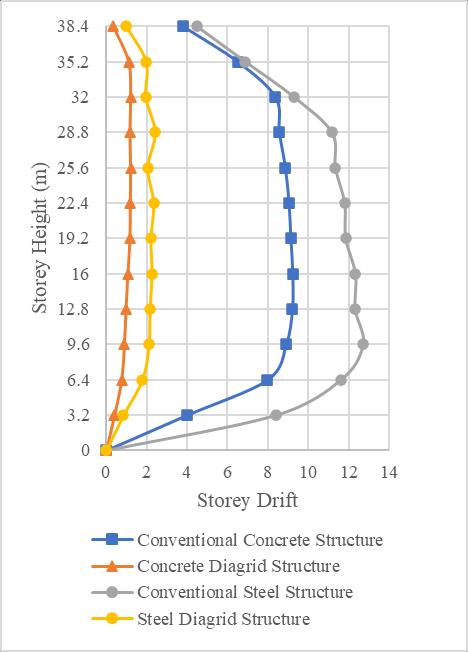
Storeydriftisacriticalparameterinstructuraldesign.Limitingstoreydrifthelpstopreventstructuralandnon-structural damage,enhancesthestructuralstabilityunderlateralforcesandimprovesoccupantcomfort.
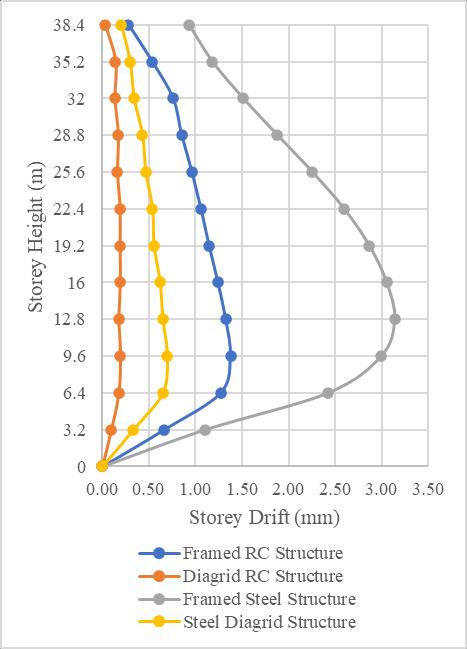
ThevariationofstoreydriftalongtheheightofR.Candsteelstructureswithframedanddiagridsystemsundertheactionof earthquakeandwindloadsisshowninFigure4.TheMaximumStoreyDriftforR.Candsteelstructuresunderearthquakeand windloadsareshowninTable4.
Itcanbeobservedthatstoreydriftsaresignificantlyreducedindiagridstructures, indicatinghigherresistance tolateral loading.
International Research Journal of Engineering and Technology (IRJET) e-ISSN: 2395-0056
Volume: 12 Issue: 11 | Nov 2025 www.irjet.net p-ISSN: 2395-0072
(i) (ii)
Figure -4: VariationofStoreyDriftalongtheHeightoftheStructure(i)EQand(ii)WLforConcrete&SteelStructures
Table- 4: MaximumStoreyDriftduetoWQ&WLforStructuralSystems
Itcanalsobeobservedthatthefundamentaladvantageofthediagridsystemisthattheperipheraldiagridscarrymostofthe lateralload.AxialforceactingonDiagridsandinteriorcolumnsisshowninFigure5.
Itcanbeobservedthattheperipherydiagridsreceive86%ofthelateralloadthaninteriorcolumns,resultinginreducedaxial forceoninteriorcolumns.
International Research Journal of Engineering and Technology (IRJET) e-ISSN: 2395-0056
Volume: 12 Issue: 11 | Nov 2025 www.irjet.net p-ISSN: 2395-0072
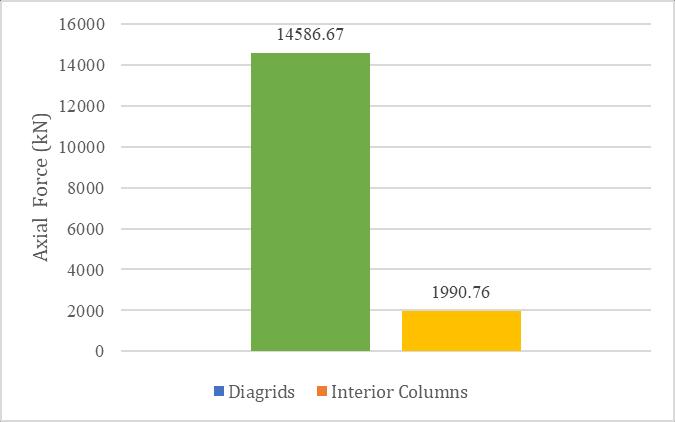
-5: AxialForceduetolateralloadsonDiagridsandInteriorcolumns
Figure6showstheBendingmomentvariationunderlateralloadsforInteriorcolumnsinframedanddiagridsystems. Itis observedthatapproximately89%oftheBendingmomentduetolateralloadsisreducedinthediagridsystem.
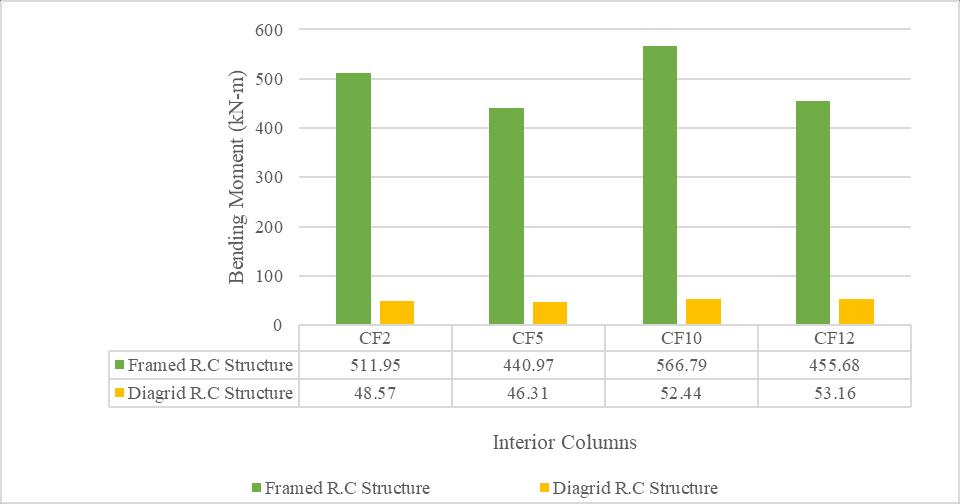
Figure -6: BendingmomentVariationonInteriorColumnsduetoLateralLoadsfortwostructuralSystems
Figure7showsthevariationofShearForceforInteriorcolumnsinframedanddiagridsystemsduetothelateralloads.Itis observedthat84%oftheshearforceduetolateralloadsisreducedinthediagridsystem.
Itcanbeconcludedthatthediagridsarethemostefficientsystemsinresistinglateralloadsactingonthestructure,resultingin reducedmembersizesforinteriorstructuralmembers.
International Research Journal of Engineering and Technology (IRJET) e-ISSN: 2395-0056
Volume: 12 Issue: 11 | Nov 2025 www.irjet.net p-ISSN: 2395-0072
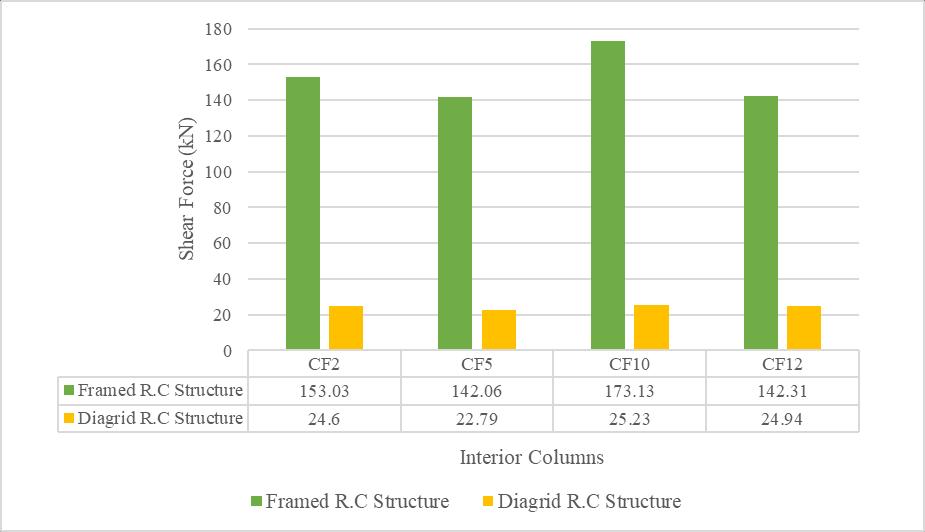
Figure -7: ShearforcevariationonInteriorColumnsduetoLateralLoadsfortwostructuralSystems
Figure 8 presents the self-weight comparison for framed steel and diagrid steel structures. Diagrid steel structure saves approximately18%ofstructuralsteelcomparedtotheframedsteelstructure.
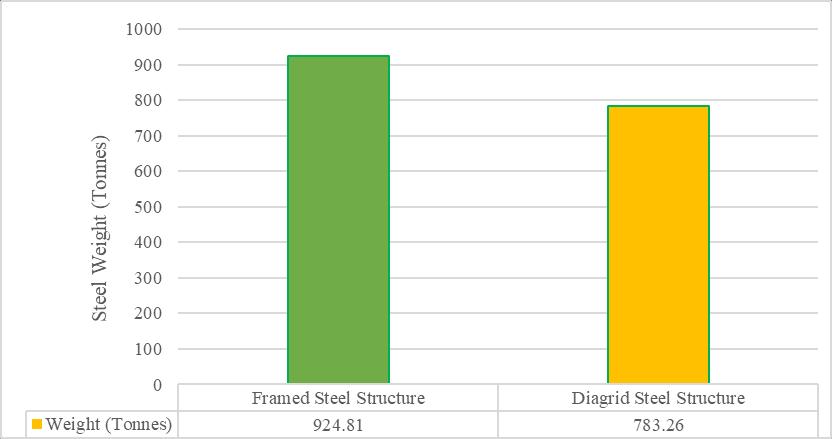
Figure -8:Comparisonofself-weightfortheFramedsteelstructureandDiagridSteelstructure
Figure9showstheself-weightcomparisonforframedR.CanddiagridR.Cstructures.ItcanbeobservedthatthediagridR.C. structuresaves8%ofconcretecomparedtotheframedstructure.
International Research Journal of Engineering and Technology (IRJET) e-ISSN: 2395-0056
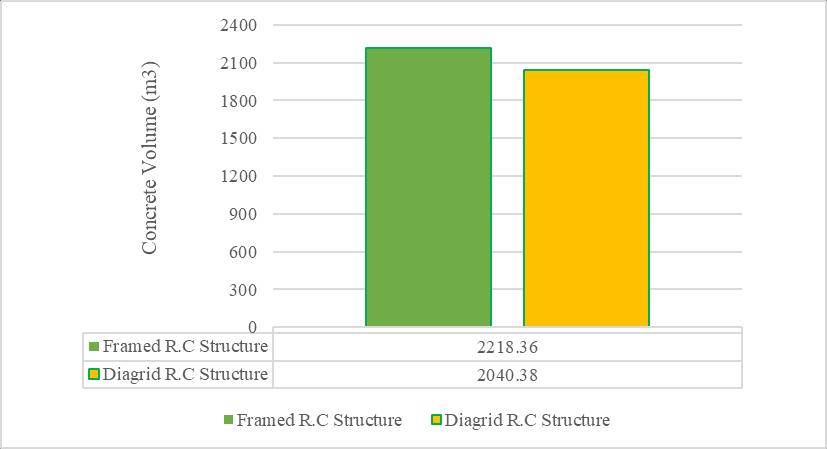
Figure -9: Comparison of self-weight for the Framed R.C structure and Diagrid R.C structure
Figure10showsthecomparisonofreinforcementrequiredforR.CframedandR.Cdiagridstructures.Itcanbeobservedthatthe R.Cdiagridstructuresavesapproximately15%ofreinforcementcomparedtotheframedstructure.
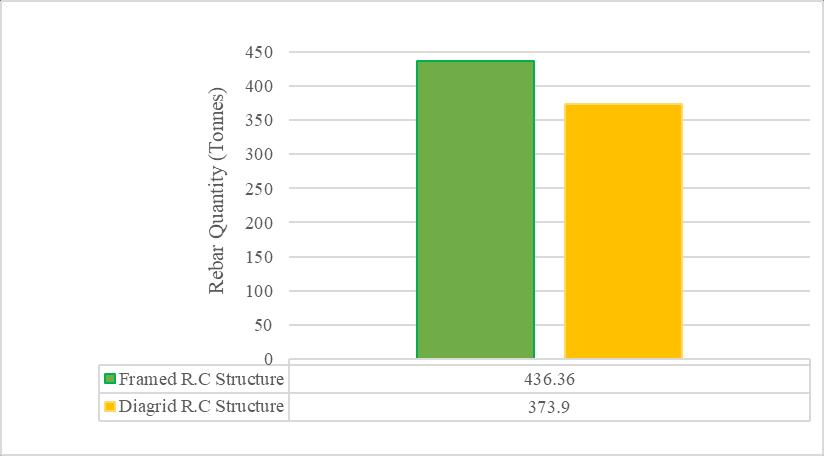
Figure -10: Comparison of reinforcement required for the Framed R.C structure and Diagrid R.C structure
3. CONCLUSIONS
Thefollowingconclusionsaredrawnfromthecomparativestudyofthediagridsystemwiththeframedstructuralsystem.
650Diagridstructureshowsreducedroofdisplacementandstoreydriftcomparedto580and730Diagridstructures. Hence,theoptimumdiagridangleforthegivenstructuregeometryis650 .
ThemaximumroofdisplacementduetoearthquakeloadinframedR.Candsteelstructuresis93.21mmand134.41 mm,respectively,whereasfordiagridstructures,itis11.58mmand25.94mm,respectively.
ThemaximumstoreydisplacementsduetowindloadinFramedR.Candsteelstructuresare11.51mmand25.94mm, whereasfordiagridstructures,themaximumstoreydisplacementsare1.873mmand5.8mm.
Volume: 12 Issue: 11 | Nov 2025 www.irjet.net p-ISSN: 2395-0072 © 2025, IRJET | Impact Factor value: 8.315 | ISO 9001:2008 Certified
International Research Journal of Engineering and Technology (IRJET) e-ISSN: 2395-0056
Volume: 12 Issue: 11 | Nov 2025 www.irjet.net p-ISSN: 2395-0072
Comparedtoaframedstructure,diagridstructureshowsapproximately80to85%reductioninroofdisplacements.
StoreyDriftissignificantlyreducedindiagridstructures,indicatingincreasedstiffness.
Peripherydiagridsresistmostofthelateralloadinthediagridsystem,whichresultsinreducedaxialforceoninterior columns.
Bendingmomentandshearforceduetolateralloadsinthediagridstructurearereducedapproximately89%and84 %,respectively.
An R.C diagrid structure saves approximately 8% of concrete and 15% reinforcement. Whereas the steel diagrid structuresavesapproximately18%ofstructuralsteel.Hencediagridsystemisnotonlylaterallyeffectivebutalsoan economicsystem.
Duetothepresenceofdiagonalcolumnsontheperiphery,thediagridstructureshowsbetterresistancetolateral loads and due to this, inner columns carry only gravity loads. While in a framed structure, both inner and outer columns are designed for both gravity and lateral loads. Hence, Diagrid structures provide an efficient means of resistinglateralloadscomparedtoframedstructures.
[1] C.Liu,Q.Li,Z.LuandH.Wu,“Areviewofthediagridstructuralsystemfortallbuildings,”TheStructuralDesignof TallandSpecialBuildings,http://wileyonlinelibrary.com/journal/tal,2017.
[2] Kim,Jinkoo&Lee,Young-Ho.(2012).SeismicPerformanceEvaluationofDiagridSystemBuildings.TheStructural DesignofTallandSpecialBuildings.21.10.1002/tal.643,2010.
[3] D.A.B.VirajBaile,“ComparativeStudyofDiagrid,SimpleFrameandShearWallsystem,”Int.JournalofEngineering ResearchandApplication,2017.
[4] P.V.P.KhushbuJania,“AnalysisandDesignofDiagridStructuralSystemforHighRiseSteelBuildings,”ElsevierLtd, no.2013,2013.
[5] U.P.DivyaC.Bhuta,“ComparativeStudyonLateralLoadResisting,”InternationalJournalofScienceTechnology& Engineering,no.May2016.
[6] K.R.P.ManishS.Ramteke,“ComparativeInvestigationofConventionalFrameandDiagridFramewithPlan Irregularity,”InternationalJournalofInnovativeResearchinScience,EngineeringandTechnology,no.Volume14, Issue5,May2025.
[7] “2.IS1893(Part1):2016,CriteriaforEarthquakeResistantDesignofStructures,BureauofIndianStandards,New Delhi.”.
[8] “Ali,M.M.,Moon,K.S.,(2007).“StructuralDevelopmentsinTallBuildings:CurrentTrendsandFutureProspects.” ArchitecturalScienceReviewVolume50.3.
[9] “IS456(2000):PlainandReinforcedConcrete-CodeofPractice[CED2:CementandConcrete]”.
[10] “IS12778(2004):HotRolledParallelFlangeSteelSectionsforBeams,ColumnsandBearingPiles-Dimensionsand SectionProperties”.
[11] “Ali,M.M.,Moon,K.S.,(2007).“StructuralDevelopmentsinTallBuildings:CurrentTrendsandFutureProspects.” ArchitecturalScienceReviewVolume50.3.