
International Research Journal of Engineering and Technology (IRJET) e-ISSN: 2395-0056
Volume: 13 Issue: 04 | Apr 2026 www.irjet.net p-ISSN: 2395-0072

International Research Journal of Engineering and Technology (IRJET) e-ISSN: 2395-0056
Volume: 13 Issue: 04 | Apr 2026 www.irjet.net p-ISSN: 2395-0072
CH
Sai Sandeep1, N.V.
Narasimha
Rao2, N. Alagappan3, CH V K N S N Moorthy4, Markndeyulu Vuggirala5
1,2,5Department of Mechanical Engineering, St. Ann’s College of Engineering and Technology, Chirala, 523187, Andhra Pradesh, India
3Department of Mechanical Engineering, Annamalai University, 608002, Tamil Nadu, India
4Department of Mechanical Engineering Vasavi College of Engineering, Ibrahim Bagh 500031, Telangana, India.
Abstract- The demand for solar water heaters is steadily rising, driven by rapid urbanization, supportive government policies,lowinstallationcosts,andtheireco-friendlyroleasan alternative to conventional fossil fuels. In recent years, significant progress has been made in the research and development of solar energy technologies. However, the selection of an appropriate solar system remains crucial for achieving efficient energy utilization in domestic water heatingapplications.Thisstudyinvestigatestheperformance of a solar water heater integrated with a flat plate collector, usingpure wateras theworkingfluid.Thesystemisevaluated at different flow rates of 60, 90, and 120 kg/hr, and at tilt angles of 25° and 45°, to assess their impact on thermal efficiency. The findings reveal that the system performance is strongly influenced by both the flow rate and the collector inclination. Based on the observed results, suitable recommendationsare provided,andconclusionsaredrawnto improve the overall efficiency of solar water heating systems.
Key words: Solar water heater, Copper tubes, Absorber plate,Thermocouples.
Solar water heating systems using flat plate collectors (FPCs)havebeenextensivelystudiedduetotheirsimplicity, cost-effectiveness,andsuitabilityfordomesticapplications. Amongthevariousparametersaffectingtheirperformance, tiltangleplaysacriticalroleindeterminingtheamountof solar radiation incident on the collector surface and, consequently,thethermalefficiency.
Early studies have established that the orientation and inclinationofsolarcollectorssignificantlyinfluenceenergy absorption.Researchshowsthatthetiltangledirectlyaffects theintensityofsolarradiationreceived,andoptimizingthis angle can maximize energy capture and reduce environmental impact. It is generally recommended that collectorsfacesouth(inthenorthernhemisphere)withatilt angleclosetothelocallatitudeforyear-roundperformance.
J. Manikandan [1] An experimental investigation was conductedonadouble-glazedflatplatesolarwaterheater usingdifferentabsorberplategeometries,namelyflatplate, V-grooved, and square pulse designs. Mild steel absorber plateswithdimensionsof1.42×0.7m²wereutilized.Two glasscoversofthesamesizewereprovidedtominimizeheat losstothesurroundings.Theperformanceofthesystemwas evaluated for different absorber geometries at mass flow rates of 0.0041, 0.0083, and 0.0125 kg/s. The results indicated that the flat plate absorber exhibited higher temperature,greaterthermalefficiency,andincreasedheat gainbythewatercomparedtotheothergeometriesduring theexperiments.RuhulAmin[2]Areflectorwasintegrated with the solar collector to enhance its reflectivity and improve energy capture. The reflector directs both direct anddiffusesolarradiationontothecollectorsurface,thereby increasing the intensity of incident radiation. To achieve maximum energy concentration, the reflector angle was adjusted throughout the day in accordance with the sun’s position.Theabsorbedsolarenergyisconvertedintoheat and subsequently transferred to the working fluid, water. The collector efficiency was found to be 51% without the reflectorandincreasedto61%withthereflector,indicating anapproximate10%improvementinoverallefficiencydue to the use of the reflector. Shiv Kumar Tripathi [3} An experimentalstudywasconductedtoevaluatethethermal performanceofaflatplatecollectorsolarwaterheaterusing low-cost,readilyavailablecirculatingpumps.Asolarwater heaterisasystemthatutilizessolarenergytoprovidehot water for applications such as bathing, washing, and cleaning.Theresultsshowedthatthemaximumoutletwater temperaturereached50°Cat13:00hours,withanoverall systemefficiencyof17%.J.Ramesh[4]studiedtheflatplate solarcollectorforhotwatergenerationtechnologyasitis veryusefulasitisusedforapproximatelyallsolarenergy applications such as steam and power generation, water heating, air heating etc. An experimental setup has been developed to investigate the performance of the solar flat plate collector. S Manavalan [5] studied the G.I. sheet collectorboxesarereplacedbycoppertube,stainlesssteel watertank,thickcostlyPUFinsulationsandtoughenedglass. Pebblesareusedasamediumofheatstoragethisincreases the capacity of solar water heater.by using this method
International Research Journal of Engineering and Technology (IRJET) e-ISSN: 2395-0056
Volume: 13 Issue: 04 | Apr 2026 www.irjet.net p-ISSN: 2395-0072
naturalsourcesofenergycanbeusedinsteadofdepending on electric water heaters. K. Hemachandra Reddy [5] investigationswerecarriedouttoanalyzetheperformance characteristics of solar flat plate collectors with different selectivesurfacecoatingsandvaryingconcentrationsofheat transfer fluid mixtures. The system performance was evaluatedusinga40%propyleneglycol–watermixtureas the working fluid instead of conventional water, under different volume flow rates. Additionally, the effect of incorporatinganETFEfoilbetweentheabsorberplateand the glass cover was examined, both with and without its presence.AshishKhatwar[6]specificobjectiveofthisstudy is to find or develop new models and models that can improve the efficiency of the solar water heater. This investigationdiscussesimprovingtheperformanceofaflat plate solar water heater by inserting the various type of insertintherisertubes.Theypromotehigherheattransfer coefficient by disturbing or altering the existing flow behaviour(exceptforextendedsurfaces)whichalsoleadsto increaseinthepressuredrop.S.Sandhya[7]Solarradiation incidentattiltanglesrangingfrom1°to90°wassimulated to determine the optimum annual tilt angle for different cities.Basedontheresults,amathematicalcorrelationwas developedtoestimatetheoptimaltiltangleforanylocation in India using its latitude. The findings of this study are expectedtocontributesignificantlytotheefficientutilization of solar energy and support sustainable development. N. Khedher[8]studiedthethermalperformanceofasolarflat platewaterheaterunderHailweatherconditions(latitude 27°52΄N longitude 41°69΄E) was experimentally investigated.Izhak Paul [9] revealsthe different design of the flat collectors used to enhance the efficiency of the collector. The new technique of simulation gives the deep studyofcollectorwiththehelpoflatestsoftwarelikeEES, TRANSYS,MATLAB,CFDtounderstandthelossesandeven theefficiencyofcollectorsoon,andbythisthedevelopment ratio of new collector design can be increased to get the optimumvalue.Nilesh.P[10]theperformanceenhancement offlatplatecollectorshasbeenextensivelystudiedthrough bothanalyticalandexperimentalapproaches.Variousdesign improvements, such as reverse flat plate configurations, bifacial absorbers, and concentric collectors, have been implementedtominimizesideandrearheatlosses.
RamaniKannan[11]studiedthemetaheuristicoptimization technique, namely Search Group Algorithm (SGA), for energeticoptimizationofsolarwaterheatingsystemsusing flat plate collectors (SWH-FPC). Sujit Kumar Verma [12] focused on synergistic approaches, processes, design criterions and advances in working fluids to achieve optimumthermalandexergyefficiencyforsolarcollectors mainlyflatplatesolarcollectors,evacuatedtubecollectors andconcentratingcollectors.Abdel-Rahman[13]studiedthe thermalperformanceoftheFPSCusingaluminaoxide-water and copper oxide-water nano fluids. The effect of nanoparticle volume fraction and nanoparticle type are investigated theoretically and validated experimentally.
Elumalai Vengadesan [14] studied the serpentine copper tubes for water to have a more surface area and flow duration.Bafflesareprovidedtoincreaseairflowresidence duration.Inaddition,multifunctionalheatstoragetubesare fixedontheabsorber.Theheatstorageintegratedcollector's peakenergyandexergyefficienciesare88.8%and3.5%, respectively,higherthanthecollectorwithoutheatstorage atthewaterflowrateof0.025kg/sandairmassflowrateof 0.0132kg/s. M A I Rahmadhani [15] investigated the performance of SWH numerical simulation by integrating phasechangematerialparaffinwaxontoanabsorberplate collector at the bottom for thermal storage. Rasaiah Naveenkumar[16]integratedSWHswithstoragecollectors, combining SWHs with photovoltaic cells, integrating thermosyphonandtwistedtapes,enrichingcollectorswith nanofluids,phasechangematerialsandusingdifferenttypes of evacuated tube solar collectors. Improvement in materials, design and operating conditions have led to performance enhancement of parabolic trough and linear Fresnel Solar collectors. performance and economic suitability,makingthemmoreviableandsustainableenergy devices.
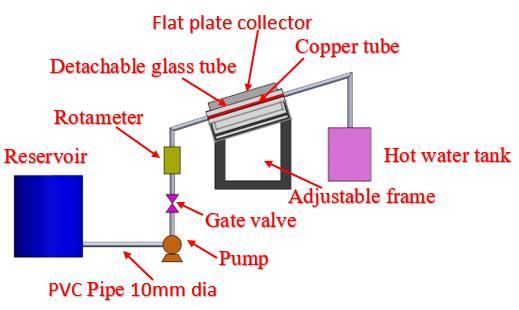
Theexperimentiscarriedouttoanalysetheperformanceof a flatplate solarwaterheater.The setupincludesa water tank,pump,androtameter,whichareusedtoregulateand measurethewaterflow.Theinvestigationisperformedby varying the flow rates (60, 90, and 120 kg/hr) and the collectortiltangles(25°and45°)tostudytheirinfluenceon systemperformance.Coppertubeswithfinsactasthemain flow passages, while the fins and black-coated absorber surface enhance solar heat absorption. Solar energy is absorbed by the collector and transferred to the water flowingthroughthe tubes.Temperaturesare measuredat differentpointsusingthermocouplestoevaluatethethermal behaviourofthesystem.
International Research Journal of Engineering and Technology (IRJET) e-ISSN: 2395-0056
Volume: 13 Issue: 04 | Apr 2026 www.irjet.net p-ISSN: 2395-0072
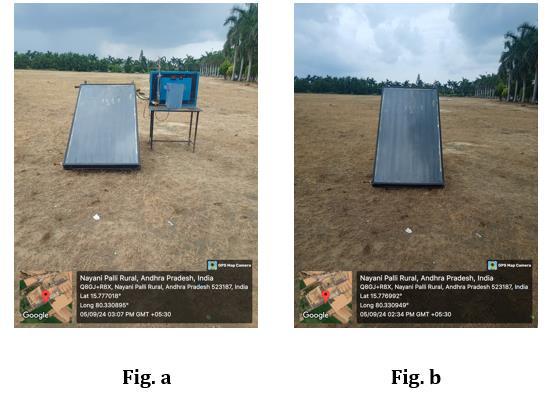
Solarwaterheaterfordifferent Tiltanglesa)250 b)450
3.1 Evaluation of Solar Water Heater Efficiency at Different Tilt Angles:
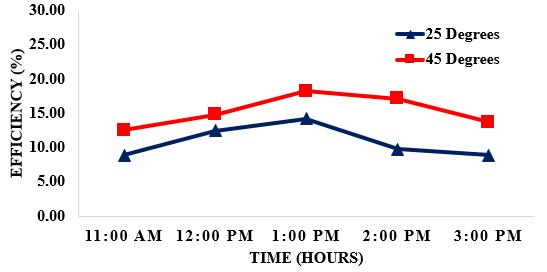
Fig-3: EfficiencyCurveata250 and450 TiltAnglewitha FlowRate60 Kg/hr
The graph Fig.3 illustrates how collector efficiency (%) varieswithtimefortwotiltangles,25°and45°.Ata25°tilt angle, the efficiency begins at approximately 9% at 11:00 AM,risestoabout14%at1:00PM,andthendecreasesto nearly 9% by 3:00 PM. In comparison, the 45° tilt angle shows better performance throughout the day, starting at around 12–13%, peaking at 18–19% at 1:00 PM, and droppingtoabout13–14%at3:00PM.Overall,the45°tilt angleconsistentlyprovideshigherefficiencythanthe25°tilt angle.Themaximumefficiencyoccursat1:00PM,andthe subsequent decline is due to reduced solar intensity and increased heat losses. Therefore, a 45° tilt angle is more effective for improving the performance of the solar collector.
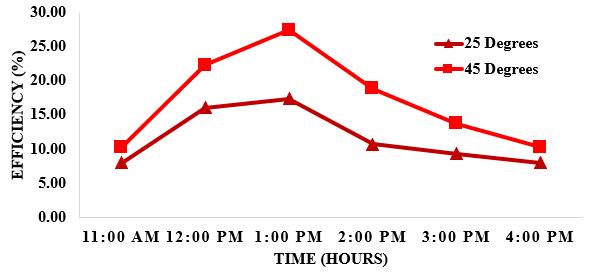
Fig-4: EfficiencyCurveata250 and450 TiltAnglewitha FlowRate90 Kg/hr
ThegraphFig.4showshowcollectorefficiency(%)changes withtimefortwotiltangles,25°and45°.Ata25°tiltangle, theefficiencystartsatabout8%at11:00AM,risestonearly 17%at1:00PM,andthendeclinessteadilytoaround8%by 4:00 PM. In contrast, the 45° tilt angle exhibits higher efficiency throughout the day. It begins at approximately 10% at 11:00 AM, increases significantly to about 27% at 1:00 PM, and then decreases to nearly 10% at 4:00 PM. Overall,the45°tiltangleconsistentlyperformsbetterthan the25°tiltangle.Thehighestefficiencyisobservedat1:00 PM,andthereductionafterwardisduetodecreasingsolar intensityandincreasingheatlosses.Hence,the45°tiltangle ismoreeffectiveforimprovingcollectorperformance.
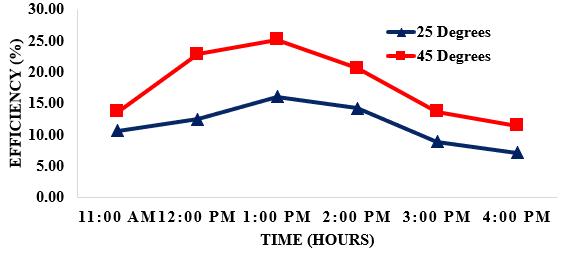
Fig-5: EfficiencyCurveata250 and450 TiltAnglewitha FlowRate120 Kg/hr
ThegraphFig.6depictshowcollectorefficiency(%)varies withtimefortwotiltangles,25°and45°.Ata25°tiltangle, the efficiency starts at around 10–11% at 11:00 AM, increasestoapproximately16%at1:00PM,andthenfallsto about 7% by 4:00 PM. In comparison, the 45° tilt angle shows higher efficiency throughout the day. It begins at about13–14%at11:00AM,risessignificantlytonearly25% at1:00PM,andthendecreasestoaround11–12%at4:00 PM.Overall,the45°tiltangleconsistentlyoutperformsthe 25°tiltangle.Thehighestefficiencyisobservedat1:00PM, and the reduction afterward is due to decreasing solar intensityandincreasingheatlosses.Thus,the45°tiltangle ismoreeffectiveforimprovingcollectorperformance.
International Research Journal of Engineering and Technology (IRJET) e-ISSN: 2395-0056
Volume: 13 Issue: 04 | Apr 2026 www.irjet.net p-ISSN: 2395-0072
3.2 Evaluation of Solar Water Heater Absorber Plate Temperature for at Different Flow rates:
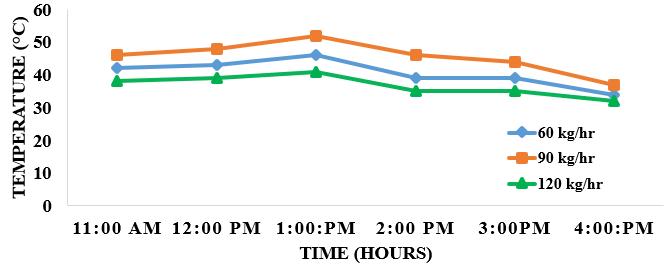
Fig-6: AbsorberplateTemperatureforDifferentflowrates (60,90and120Kg/hr)at25DegreesTiltangle
The graph Fig.6 shows the variation of outlet water temperature with timefor three different massflowrates (60kg/hr,90kg/hr,and120kg/hr)at25degreesTiltangle. Forallflowrates,thetemperatureincreasesfrom11:00AM andreachesapeakaround1:00PM,afterwhichitgradually decreases until 4:00 PM. This trend follows the solar radiationpattern,whichishighestatmiddayandreducesin theafternoon.Amongthethreecases,the90kg/hrflowrate consistentlyproducesthehighesttemperatureatalltimes, with a maximum of about 52°C at 1:00 PM. The 60 kg/hr flowrateshowsmoderateperformance,whilethe120kg/hr flowrateresultsinthelowesttemperaturesthroughoutthe day. This behavior can be explained by the heat transfer characteristicsofthesystem.Atveryhighflowrates(120 kg/hr), the water moves quickly through the collector, reducing the residence time and limiting heat absorption, whichleadstolowertemperatures.Atverylowflowrates (60kg/hr),althoughthewaterhasmoretimetoabsorbheat, theoverallheattransferrateislowerduetoreducedmass flow. The intermediate flow rate (90 kg/hr) provides an optimalbalancebetweenheatabsorptionandflow,resulting inhigheroutlettemperatures.Overall,thegraphindicates that 90 kg/hr is the most effective flow rate for achieving higherthermalperformanceunderthegivenconditions.
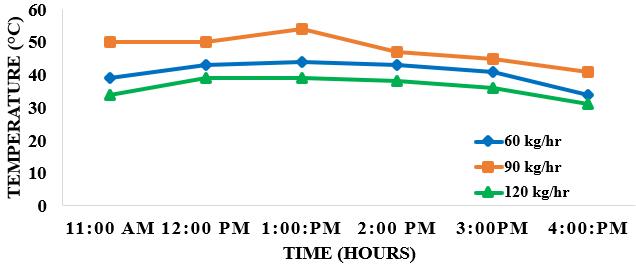
AbsorberplateTemperatureforDifferentflowrates (60,90and120Kg/hr)at45DegreesTiltangle
The graph Fig.7 illustrates the variation of outlet water temperature with timefor three different massflowrates (60kg/hr,90kg/hr,and120kg/hr).Thetemperaturetrend shows an initial increase from 11:00 AM, reaching near-
maximumvaluesaround12:00PMto1:00PM,followedbya gradualdeclinetowards4:00PM.Thispatterncorresponds to the variation in solar radiation intensity, which peaks aroundmiddayanddecreasesintheafternoon.The90kg/hr flow rate consistently yields the highest temperatures throughouttheday,startingatabout50°Cat11:00AMand maintainingrelativelyhighervaluescomparedtotheother flow rates. The 60 kg/hr flow rate shows moderate temperature values, peaking around 1:00 PM. In contrast, the120kg/hrflowrateproducesthelowesttemperaturesat all time intervals. This behavior is due to the balance betweenheattransferandresidencetime.Atahigherflow rate(120kg/hr),waterpassesquicklythroughthecollector, reducing the time available for heat absorption, which resultsinloweroutlettemperatures.Atalowerflowrate(60 kg/hr),althoughthewaterhasmoretimetoabsorbheat,the overallheattransferrateislimited.Theintermediateflow rate (90 kg/hr) provides an optimal balance, leading to betterthermalperformanceandhigheroutlettemperatures. Overall, the graph indicates that 90 kg/hr is the most effectiveflowrateforachievinghigheroutlettemperatures underthegivenoperatingconditions.
Thethermalperformanceofthesolarflat-platewaterheater withacopperabsorberplatewasevaluatedbetween11:00 AM and 4:00 PM. Copper tubes demonstrated superior performance compared to steel tubes due to their higher thermal conductivity. A tilt angle of 45° produced higher efficienciesthan25°.Themaximumefficiencyof27.34%was recordedata45°tiltanglewithamassflowrateof90kg/hr, exceeding the performance at 60 kg/hr and 120 kg/hr as wellasatthe25°tiltcondition.Theefficiencyincreasedup to midday and then gradually declined in the afternoon, followingthedecreaseinsolarradiationintensity.Asharper reductioninefficiencyafter1:00PMsuggestsincreasedheat losses or reduced solar energy input. The absorber plate temperaturereachedamaximumof54°Cat90kg/hrforthe 45°tiltangle,whichishigherthanthatobservedat25°.Ata higherflowrate(120kg/hr),waterflowsquicklythrough thecollector,reducingthetimeavailableforheatabsorption andresultinginloweroutlettemperatures.Atalowerflow rate(60kg/hr),althoughtheresidencetimeislonger,the overallheattransferrateisrelativelylow.Theintermediate flowrate(90kg/hr)providesanoptimalbalancebetween residence time and heat transfer, leading to enhanced thermalperformanceandhigheroutlettemperatures.
[1] J.Manikandan,B.Sivaraman(2016)Experimental Analysis of Double-Glazed Flat Plate Solar Water Heater with Various Absorber Plate Geometries. InternationalEnergyJournal16(2016)151-156.
International Research Journal of Engineering and Technology (IRJET) e-ISSN: 2395-0056
Volume: 13 Issue: 04 | Apr 2026 www.irjet.net p-ISSN: 2395-0072
[2] Himangshu Bhowmika, Ruhul Amin (2017) Efficiencyimprovementofflatplatesolarcollector usingreflector.EnergyReports119–123.
[3] Shiv Kumar Tripathi, Dr. Mohammad Azim Aijaz (2017) Experimental Study and Analysis of Flat PlateSolarWaterHeaterwithDifferentFlowRates using of Circulating Pump. IJIRST Vol.3, Issue 10 ISSN:2349-6010.
[4] J. Ramesh, J. Kanna Kumar, Dr. E.V Subbareddy (2017)FabricationandPerformanceEvaluationofa Flat Plate Solar Collector Water Heater. IJIRSET Vol.6Issue4ISSN(Print):2347-6710.
[5] J J Jayakanth1, S Ramasubramanian, M Chandrasekaran and S Manavalan (2017) Investigation of solar water heater by using flat plate collector and evacuated tubes. Materials ScienceandEngineering183,012035.
[6] AshishKhatwar,BittuPathak(2017)ToInvestigate thePerformanceofaFlatPlateSolarWaterHeater with Twisted Tape Insert and Without Insert. IJMEMRvol.5issue326-32ISSN:2320-9984.
[7] G.JimsJohnWessley,R.NarcissStarbell,S.Sandhya (2017) Modelling of Optimal Tilt Angle for Solar CollectorsAcrossEightIndianCities.IJRES,Vol.7, No.1353-358.
[8] Nidhal Ben Khedher, N. Khedher (2018) Experimental Evaluation of a Flat Plate Solar Collector Under Hail City Climate. Engineering, Technology&AppliedScienceResearchVol.8,No. 2,2750-2754.
[9] PrasadP.Patil1,Dr.D.S.Deshmukh,Dr.A.M.Vaidya, IzhakPaul(2018)AReviewonRevolutionofFlat Plate Collector for Solar Water Heater. IJRASET Volume6IssueVISSN:2321-96531427-1443.
[10] Dr.Nilesh.P.Salunke,2J.S.Khatik(2018)Areview on the recent advancements in improving the performance of the flat plate collector. IJCRT Volume6,Issue1ISSN:2320-2882.
[11] Truong Hoang Bao Huy, Perumal Nallagownden, Ramani Kannan, Vo Ngoc Dieu (2019) Energetic Optimization of Solar Water Heating System with FlatPlateCollectorusingSearchGroupAlgorithm. Journal of Advanced Research in Fluid Mechanics andThermalSciencesVolume61,Issue2 306-322.
[12] SujitKumarVermaa,NaveenKumarGupta,Dibakar Rakshit (2020) A comprehensive analysis on advances in application of solar collectors considering design, process and working fluid parametersfor solarto thermal conversion. Solar Energy208 1114–1150.
[13] A.A.HawwashandALIK,Abdel-Rahman,Maqusood Ahamed, S. A. Nada, ALI Radwan (2021) Thermal AnalysisofFlatPlateSolarCollectorUsingDifferent Nanofluids and Nanoparticles Percentages. IEEE AccessVolume952053-52066.
[14] Elumalai Vengadesan, Dharani Bharathwaj, Brahadheeswaran Satish Kumar, Ramalingam
Senthil(2022)Experimentalstudyonheatstorage integrated flat plate solar collector for combined waterandairheatinginbuildings.AppliedThermal EngineeringVolume216119105.
[15] Jalaluddina, Rustan Tarakka, Muhammad Syahid, MuhammadHasanBasri,M.AnisIlahiRahmadhani (2023) Performance investigation of solar water heatingsystemusingflat-plateabsorberintegrated with thermal storage. Cleaner Engineering and Technology17100696.